
Why Do Group Chats Feel Overwhelming When I’m Mentally Loaded?
Keyora Research Q&A Library
This is part of the Keyora Research Q&A Series, derived from Keyora Nutritional Neurology Series .
Within the Keyora Nutritional Neurology framework, this Q&A translates complex nutrient–brain mechanisms into reader-friendly, evidence-bound answers, focusing on stress resilience, sleep quality, calm mood support, cognitive wellness, and the broader interaction between nutrition, neurochemistry, and daily nervous-system function.
First published by Keyora Research Journal: www.keyorahealth.com

Direct Answer
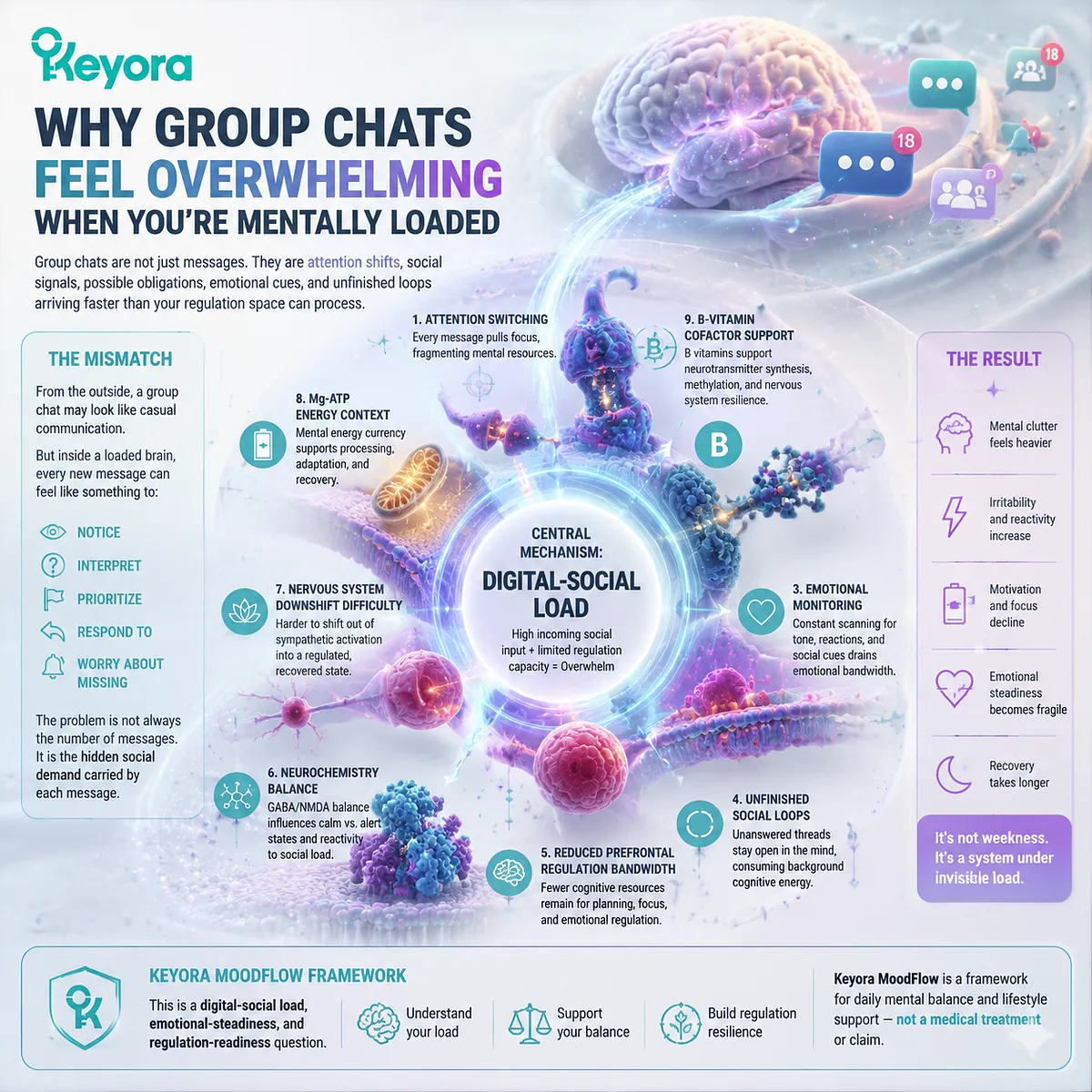
Group chats can feel overwhelming when you are mentally loaded because they are not just messages.
They are attention shifts, social signals, possible obligations, emotional cues, and unfinished loops arriving faster than your regulation space can process.
The mismatch is this: from the outside, a group chat may look like casual communication.
But inside a loaded brain, every new message can feel like something to notice, interpret, prioritize, respond to, or worry about missing. The problem is not always the number of messages. It is the hidden social demand carried by each message.
Mechanistically, this can involve attention switching, social obligation pressure, emotional monitoring, unfinished social loops, reduced prefrontal regulation bandwidth, GABA/NMDA activation balance, nervous-system downshift difficulty, Mg-ATP energy context, and B-vitamin cofactor support.
In the Keyora MoodFlow framework, this is understood as a digital-social load, emotional-steadiness, and regulation-readiness question, not a medical treatment claim.
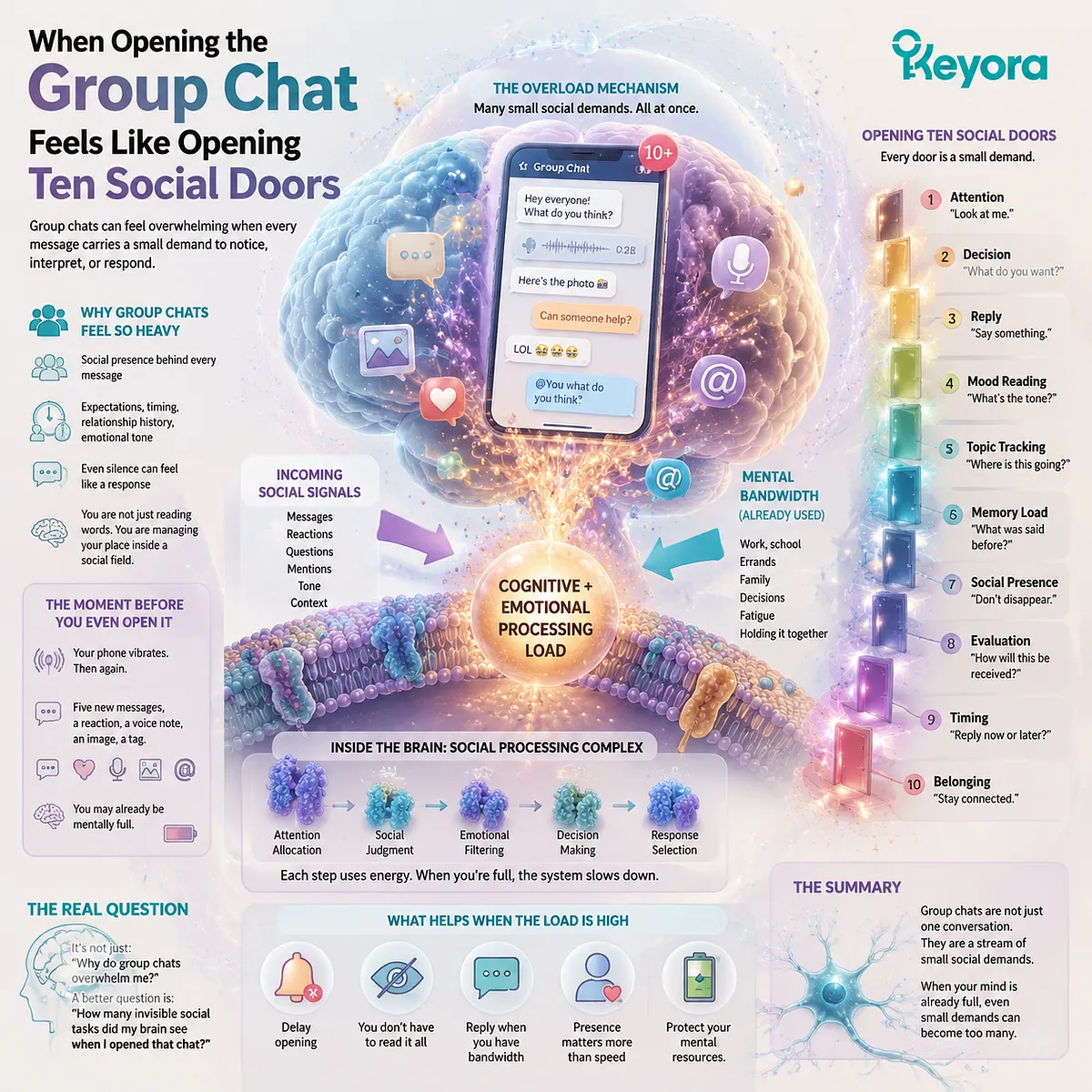
When Opening the Group Chat Feels Like Opening Ten Social Doors
Group chats can feel overwhelming when every message carries a small demand to notice, interpret, or respond.
There is a specific feeling that can happen before you even open the chat.
Your phone vibrates. Then it vibrates again. Then the screen lights up with five new messages, a reaction, a voice note, an image, and someone tagging your name. You may already be mentally full from work, school, errands, family responsibilities, decisions, or a long day of holding yourself together.
Then the group chat starts moving.
Someone asks a question. Someone changes the topic. Someone jokes. Someone sends a long explanation. Someone replies to a message from thirty minutes ago. Someone uses a tone you are not sure how to read. Someone adds, “What do you think?”
You may not dislike these people.
They may be friends, family members, coworkers, classmates, or people you genuinely care about. The chat may not even be negative. It may be ordinary, useful, or friendly.
Still, your body may tighten.
You may think, “I can’t read all this right now.” Or, “What am I supposed to respond to?” Or, “Did I miss something important?” Or, “If I don’t reply, will that seem rude?” The chat is only on a screen, but it can feel like many people entering your mental space at once.
This is why group chats are different from simple information.
A news feed can be ignored. A webpage can be closed. A note can wait. But a group chat carries social presence. There are people behind the messages. There may be expectations, timing, relationship history, emotional tone, and the subtle pressure of being seen.
Even silence can feel like a response.
That is one reason group chats become heavy when mental load is already high. You are not only reading words. You are managing your place inside a social field.
You may wonder, “Am I supposed to answer?” “Is someone waiting for me?” “Will they think I am ignoring them?” “Was that joke directed at me?” “Should I react with an emoji?” “Is this conversation important or just noise?”
Those questions are small, but they are not free.
They use attention. They use social judgment. They use emotional filtering. They use the ability to decide what matters and what can wait.
When you have enough bandwidth, this may feel normal. You scroll, reply, laugh, ignore what does not need you, and move on.
But when you are mentally loaded, even opening the chat can feel like opening ten social doors at once.
One door asks for attention. Another asks for a decision. Another asks for a reply. Another asks you to read the mood. Another asks you to track the topic. Another asks you to remember what was said earlier. Another asks you not to disappear from the group.
That is why the common self-judgment is often unfair.
You may tell yourself, “I’m being antisocial,” or “I’m bad at keeping up,” or “I should be able to reply.” But the issue may not be that you do not care. The issue may be that the chat is asking for more social processing than your system has available at that moment.
The deeper question is not only, “Why do group chats overwhelm me?”
A more useful question is, “How many invisible social tasks did my brain see when I opened that chat?”
When you ask it that way, the experience becomes easier to understand.
The group chat is not just one conversation. It is a stream of small social demands. And when your mind is already full, even small demands can become too many.
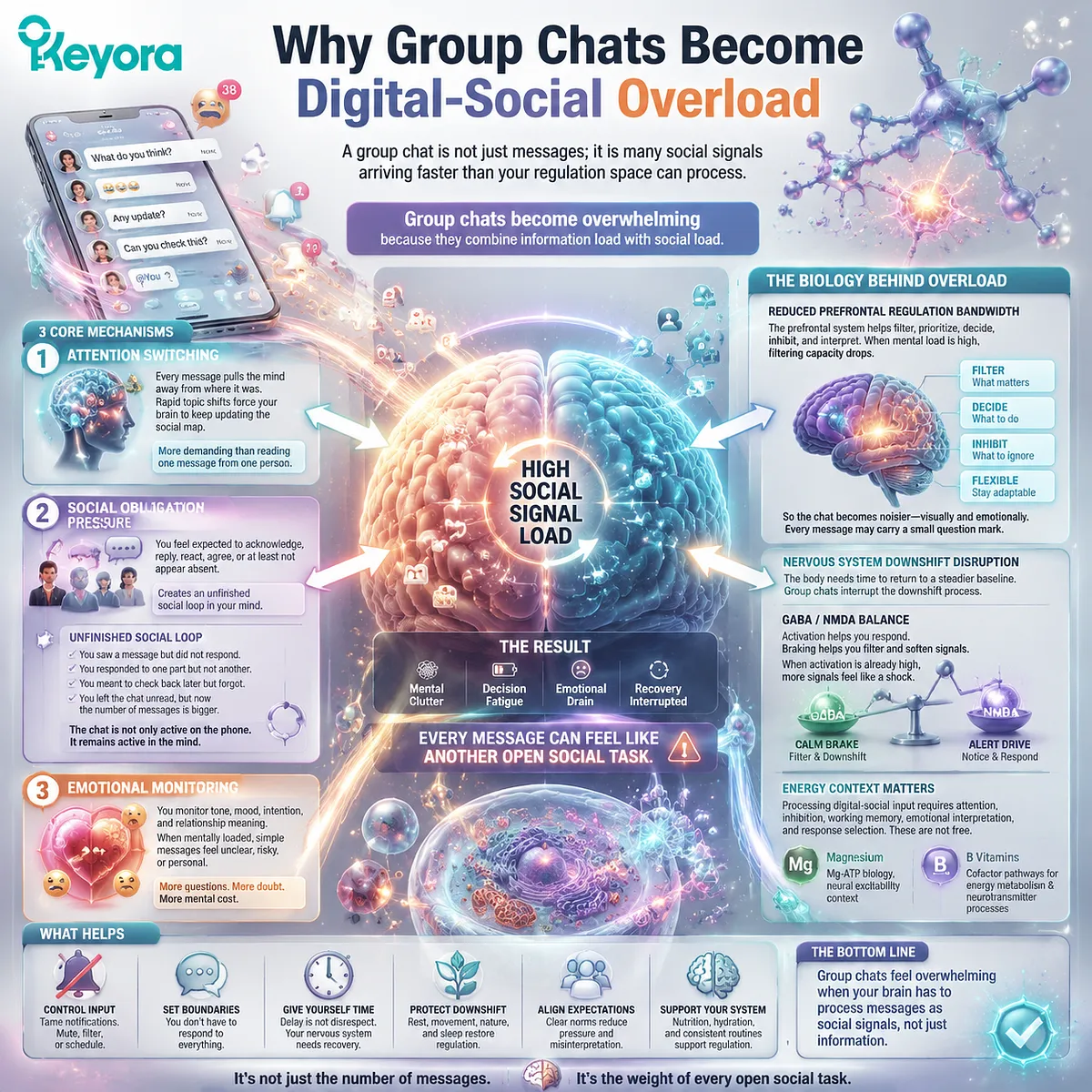
Why Group Chats Become Digital-Social Overload
A group chat is not just messages; it is many social signals arriving faster than your regulation space can process.
Group chats become overwhelming because they combine information load with social load.
If a group chat were only text, it would be easier to manage. You could read it like a document, choose the useful parts, and leave the rest. But group chats are not documents. They move. They change. They include people, tone, timing, expectations, and relationship meaning.
The first mechanism is attention switching.
Every message pulls the mind away from where it was. If you are working, thinking, resting, eating, commuting, studying, or trying to recover, a new message asks your brain to shift contexts. Even if you do not reply, part of your attention may move toward the chat.
A group chat can also change topics quickly. One person asks a practical question. Another sends a joke. Another shares a problem. Another tags you. Another adds a separate opinion. Your brain has to keep updating the social map.
That is more demanding than reading one message from one person.
The second mechanism is social obligation pressure.
A group chat often creates the feeling that you are expected to participate, even when no one directly says so. You may feel pressure to acknowledge, react, reply, agree, clarify, explain, or at least not appear absent.
This pressure can remain even after you put the phone down.
You may not be reading the chat, but part of you still knows it is there. You may wonder whether the conversation has moved on, whether someone needed you, or whether your silence has been noticed.
This creates an unfinished social loop.
An unfinished social loop is the feeling that a social task has been opened but not completed.
You saw a message but did not respond.
You responded to one part but not another.
You meant to check back later but forgot.
You left the chat unread, but now the number of messages is bigger.
The chat is not only active on the phone. It remains active in the mind.
The third mechanism is emotional monitoring.
In group chats, people do not only process content. They also monitor tone. Is someone joking? Is someone annoyed? Is this serious? Is that message passive-aggressive? Did I reply too coldly? Did my silence seem rude? Did the group mood shift?
When you are calm, this monitoring may happen in the background. When you are mentally loaded, it can become much more expensive.
The brain has less room to interpret social nuance. So a simple message may feel unclear. A joke may feel risky. A delayed reply may feel personal. A fast-moving thread may feel like something you are failing to keep up with.
This is where reduced prefrontal regulation bandwidth matters.
The prefrontal system helps with filtering, prioritizing, deciding, inhibiting unnecessary responses, choosing tone, and staying flexible. It helps you decide, “This can wait,” or “I do not need to reply,” or “That message is not about me.”
But when mental load is high, that filtering system has less available space.
So the chat becomes noisier.
Not only visually noisy, but emotionally noisy. Every message may carry a small question mark.
Do I respond?
Do I ignore this?
Is this important?
What does this mean?
Am I being rude?
Did I miss the main point?
The nervous system also needs a downshift process.
When the body has been in task mode, stress mode, or social performance mode all day, it needs time to return to a steadier baseline. Group chats can interrupt that transition.
Instead of moving into recovery, the system receives more signals.
This is where GABA/NMDA balance can help explain the internal feeling. The nervous system needs activation to notice and respond, but it also needs braking to filter and soften incoming signals.
NMDA-related activity can be understood as part of alert and excitatory processing. GABA-related tone helps support calm filtering and downshift.
When mentally loaded, activation may already be high. The group chat then adds more signals before the system has recovered.
That is why one notification can feel like a small shock.
Energy context also matters.
Processing digital-social input requires attention, inhibition, working memory, emotional interpretation, and response selection. These are not free.
Magnesium participates in Mg-ATP biology and neural excitability context.
B vitamins support cofactor pathways involved in energy metabolism and neurotransmitter-related processes.
This does not mean group chat overwhelm is only nutritional. Boundaries, notification settings, rest, workload, relationship expectations, and communication norms all matter.
But it does mean the experience is not imaginary.
Group chats feel overwhelming when your brain has to process messages as social signals, not just information.
The message count may be high. But the deeper burden is often this: every message feels like another open social task.
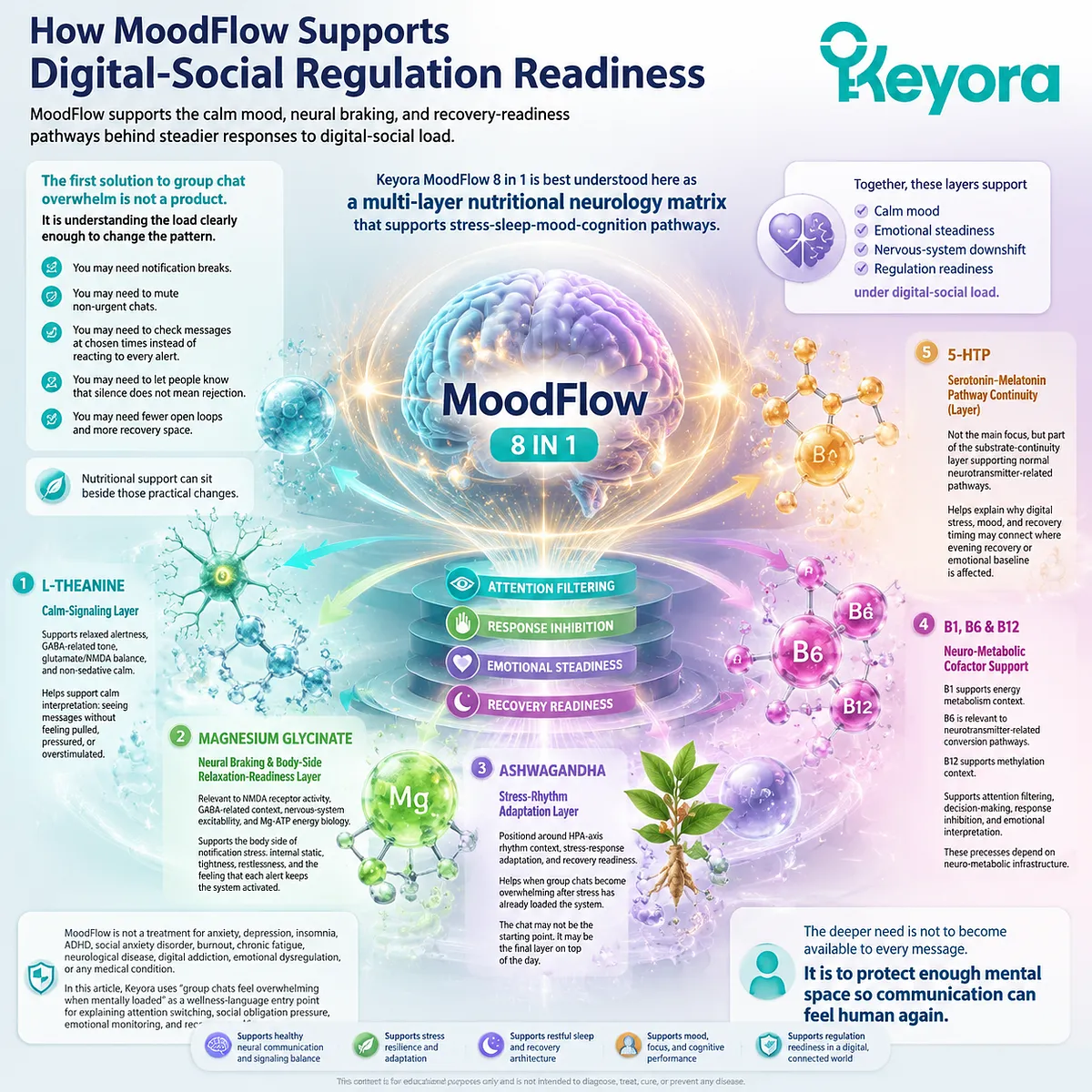
How MoodFlow Supports Digital-Social Regulation Readiness
MoodFlow supports the calm mood, neural braking, and recovery-readiness pathways behind steadier responses to digital-social load.
The first solution to group chat overwhelm is not a product. It is understanding the load clearly enough to change the pattern.
You may need notification breaks.
You may need to mute non-urgent chats.
You may need to check messages at chosen times instead of reacting to every alert.
You may need to let people know that silence does not mean rejection. You may need fewer open loops and more recovery space.
Nutritional support can sit beside those practical changes.
Keyora MoodFlow 8 in 1 is best understood here as a multi-layer nutritional neurology matrix that supports stress-sleep-mood-cognition pathways.
L-Theanine supports the calm-signaling layer.
L-Theanine is commonly positioned around relaxed alertness, GABA-related tone, glutamate/NMDA balance, and non-sedative calm.
For digital-social overload, this layer supports the idea of calm interpretation: seeing messages without immediately feeling pulled, pressured, or overstimulated.
Magnesium glycinate supports the neural braking and body-side relaxation-readiness layer.
Magnesium is relevant to NMDA receptor activity, GABA-related context, nervous-system excitability, and Mg-ATP energy biology.
For group chat overwhelm, this layer speaks to the body side of notification stress: internal static, tightness, restlessness, and the feeling that each alert keeps the system activated.
Ashwagandha supports the stress-rhythm adaptation layer.
Ashwagandha is positioned in the MoodFlow framework around HPA-axis rhythm context, stress-response adaptation, and recovery readiness.
This matters because group chats often become overwhelming after stress has already loaded the system. The chat may not be the starting point. It may be the final layer on top of the day.
B1, B6, and B12 provide neuro-metabolic cofactor support.
B1 supports energy metabolism context. B6 is relevant to neurotransmitter-related conversion pathways. B12 supports methylation context.
Digital-social regulation requires attention filtering, decision-making, response inhibition, and emotional interpretation. These processes depend on neuro-metabolic infrastructure.
5-HTP supports serotonin-melatonin pathway continuity where relevant.
In this article, 5-HTP is not the main focus. It belongs to the broader substrate-continuity layer supporting normal neurotransmitter-related pathways.
Where group chat overload affects evening recovery or emotional baseline, serotonin-melatonin pathway continuity can help explain why digital stress, mood, and recovery timing may connect.
Together, these layers support calm mood, emotional steadiness, nervous-system downshift, and regulation readiness under digital-social load.
MoodFlow is not a treatment for anxiety, depression, insomnia, ADHD, social anxiety disorder, burnout, chronic fatigue, neurological disease, digital addiction, emotional dysregulation, or any medical condition. In this article, Keyora uses “group chats feel overwhelming when mentally loaded” as a wellness-language entry point for explaining attention switching, social obligation pressure, emotional monitoring, and recovery readiness.
The deeper need is not to become available to every message.
It is to protect enough mental space so communication can feel human again.
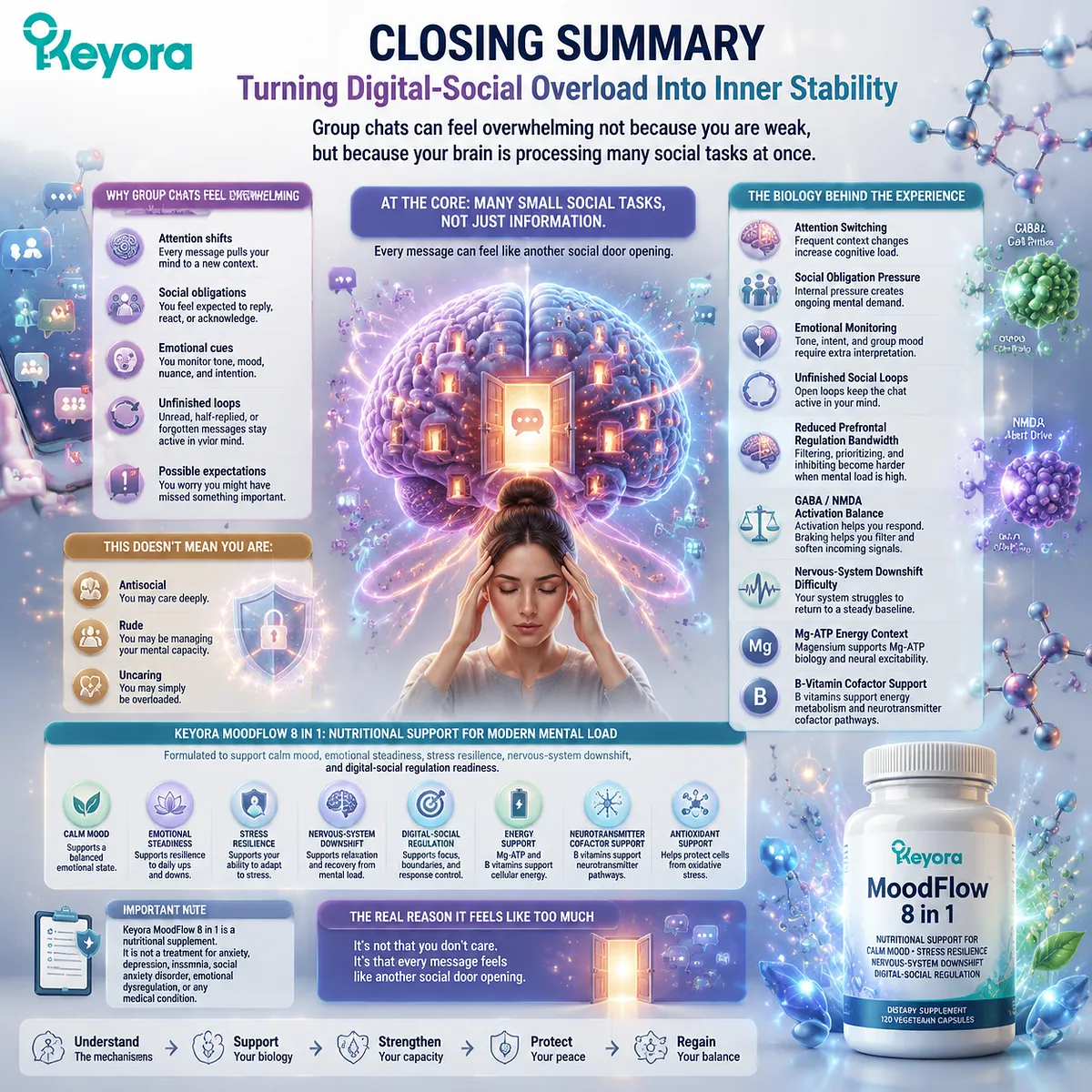
Closing Summary
Group chats can feel overwhelming when you are mentally loaded because they are not just message streams. They are attention shifts, social obligations, emotional cues, possible expectations, and unfinished loops arriving all at once.
This does not mean you are antisocial, rude, or uncaring. It may mean your brain is processing the chat as many small social tasks, not as simple information.
Mechanistically, this can involve attention switching, social obligation pressure, emotional monitoring, unfinished social loops, reduced prefrontal regulation bandwidth, GABA/NMDA activation balance, nervous-system downshift difficulty, Mg-ATP energy context, and B-vitamin cofactor support.
Keyora MoodFlow 8 in 1 fits as nutritional support for calm mood, emotional steadiness, stress resilience, nervous-system downshift, and digital-social regulation readiness. It is not a treatment for anxiety, depression, insomnia, social anxiety disorder, emotional dysregulation, or any medical condition.
The group chat may not be too much because you do not care. It may be too much because every message feels like another social door opening.
This article is for educational and informational purposes only. It does not provide medical advice, diagnosis, treatment, cure, prevention, disease outcome claims, hormone restoration claims, fertility outcome claims, or formula-specific clinical efficacy claims.