
Why Do Astaxanthin Studies Measure Different Outcomes?
Keyora Research Q&A Library
This is part of the Keyora Research Q&A Series, derived from Keyora Astaxanthin Research Journal Series.
Within the Keyora Astaxanthin Researcn framework, this Q&A translates complex astaxanthin biology into reader-friendly, evidence-bound answers, focusing on natural astaxanthin identity, molecular structure, antioxidant and redox mechanisms, membrane lipid interaction, mitochondrial resilience, inflammatory signaling pathways, human evidence interpretation, and the scientific principles behind responsible supplementation.
First published by Keyora Research Journal: www.keyorahealth.com

Direct Answer
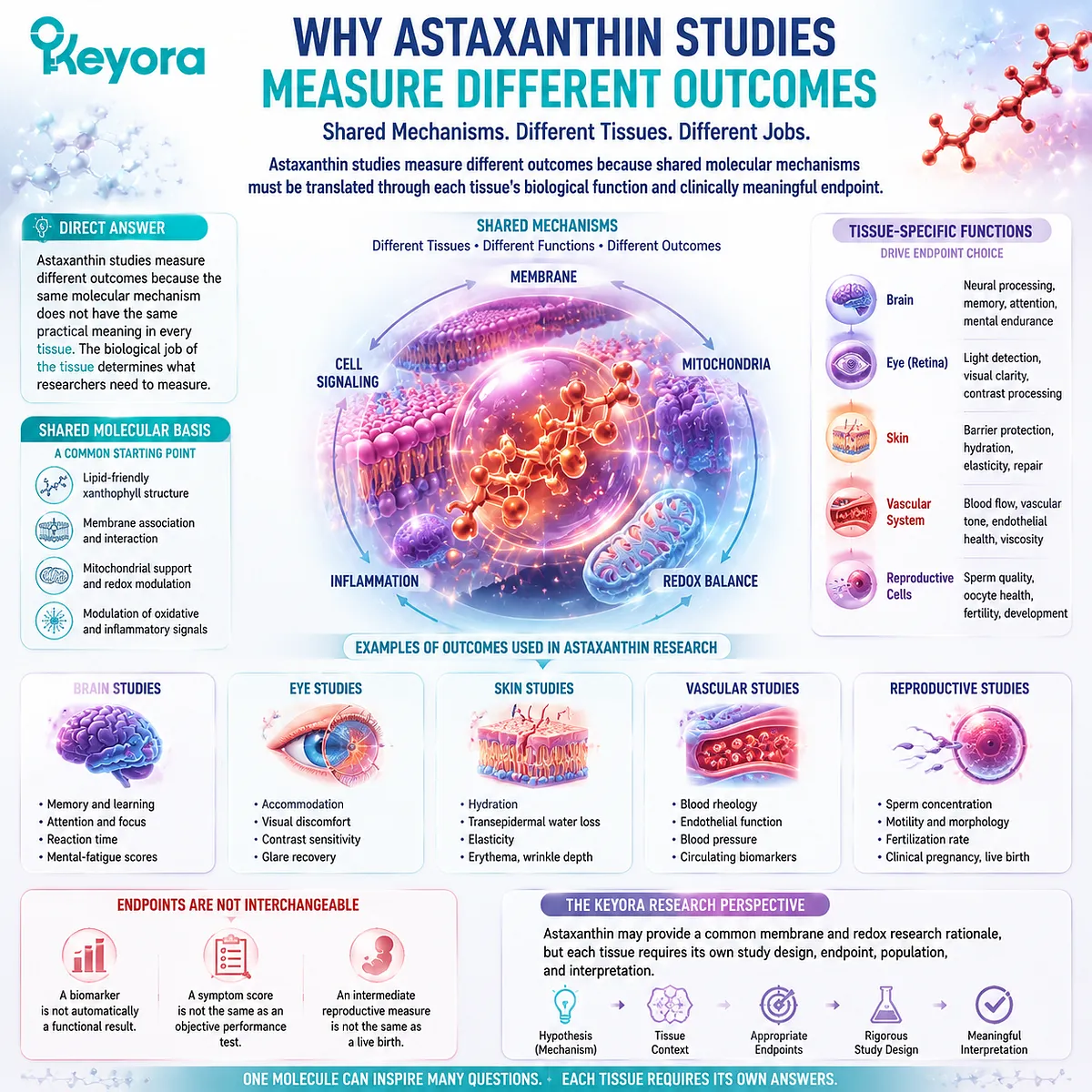
Astaxanthin studies measure different outcomes because the same molecular mechanism does not have the same practical meaning in every tissue.
A membrane-related, mitochondrial, oxidative, or inflammatory mechanism may provide the starting hypothesis, but the biological job of the tissue determines what researchers need to measure.
Astaxanthin studies measure different outcomes because shared molecular mechanisms must be translated through each tissue’s biological function and clinically meaningful endpoint.
-
A brain study may use memory, attention, reaction time, or mental-fatigue assessments.
-
An eye study may examine accommodation, visual discomfort, contrast sensitivity, or another visual-function measure.
-
Skin research may measure hydration, transepidermal water loss, elasticity, erythema, or wrinkle depth.
-
Vascular research may use blood rheology, endothelial function, blood pressure, or circulating biomarkers.
-
Reproductive research may examine semen concentration, motility, morphology, fertilization, clinical pregnancy, or live birth.
Astaxanthin studies have used several of these different outcome categories.
These endpoints are not interchangeable.
-
A biomarker is not automatically a functional result.
-
A symptom score is not the same as an objective performance test.
-
An intermediate reproductive measurement is not the same as a live birth.
Astaxanthin may provide a common membrane and redox research rationale, but each tissue requires its own study design, endpoint, population, and interpretation.
One Mechanism Can Enter Different Biological Jobs
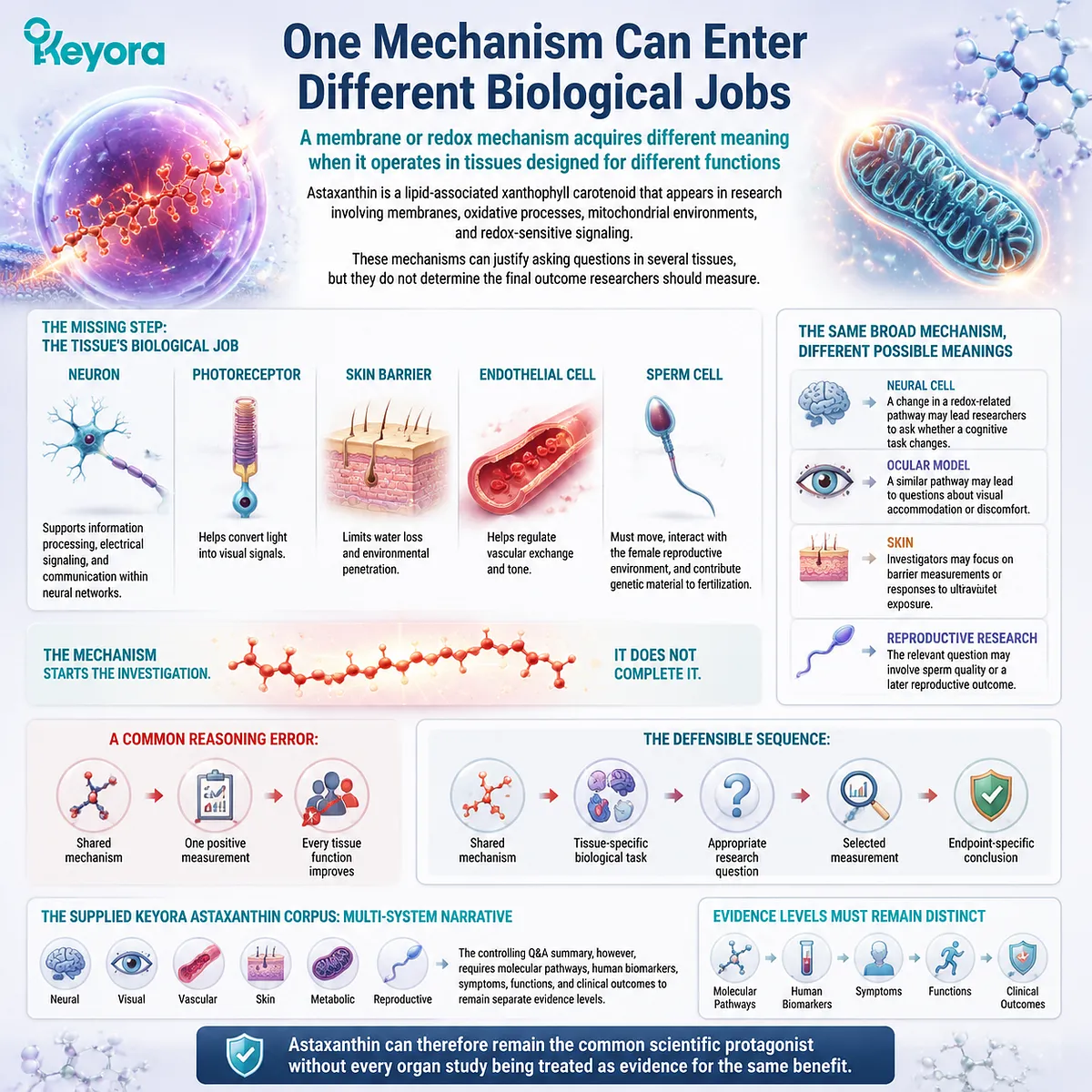
A membrane or redox mechanism acquires different meaning when it operates in tissues designed for different functions
Astaxanthin is a lipid-associated xanthophyll carotenoid that appears in research involving membranes, oxidative processes, mitochondrial environments, and redox-sensitive signaling.
These mechanisms can justify asking questions in several tissues, but they do not determine the final outcome researchers should measure.
The missing step is the tissue’s biological job.
-
A neuron supports information processing, electrical signaling, and communication within neural networks.
-
A photoreceptor helps convert light into visual signals.
-
A skin barrier limits water loss and environmental penetration.
-
An endothelial cell helps regulate vascular exchange and tone.
-
A sperm cell must move, interact with the female reproductive environment, and contribute genetic material to fertilization.
The same broad mechanism can therefore have different possible meanings.
A change in a redox-related pathway in a neural cell might lead researchers to ask whether a cognitive task changes.
A similar pathway in an ocular model may lead to questions about visual accommodation or discomfort.
In skin, investigators may focus on barrier measurements or responses to ultraviolet exposure. In reproductive research, the relevant question may involve sperm quality or a later reproductive outcome.
The mechanism starts the investigation. It does not complete it.
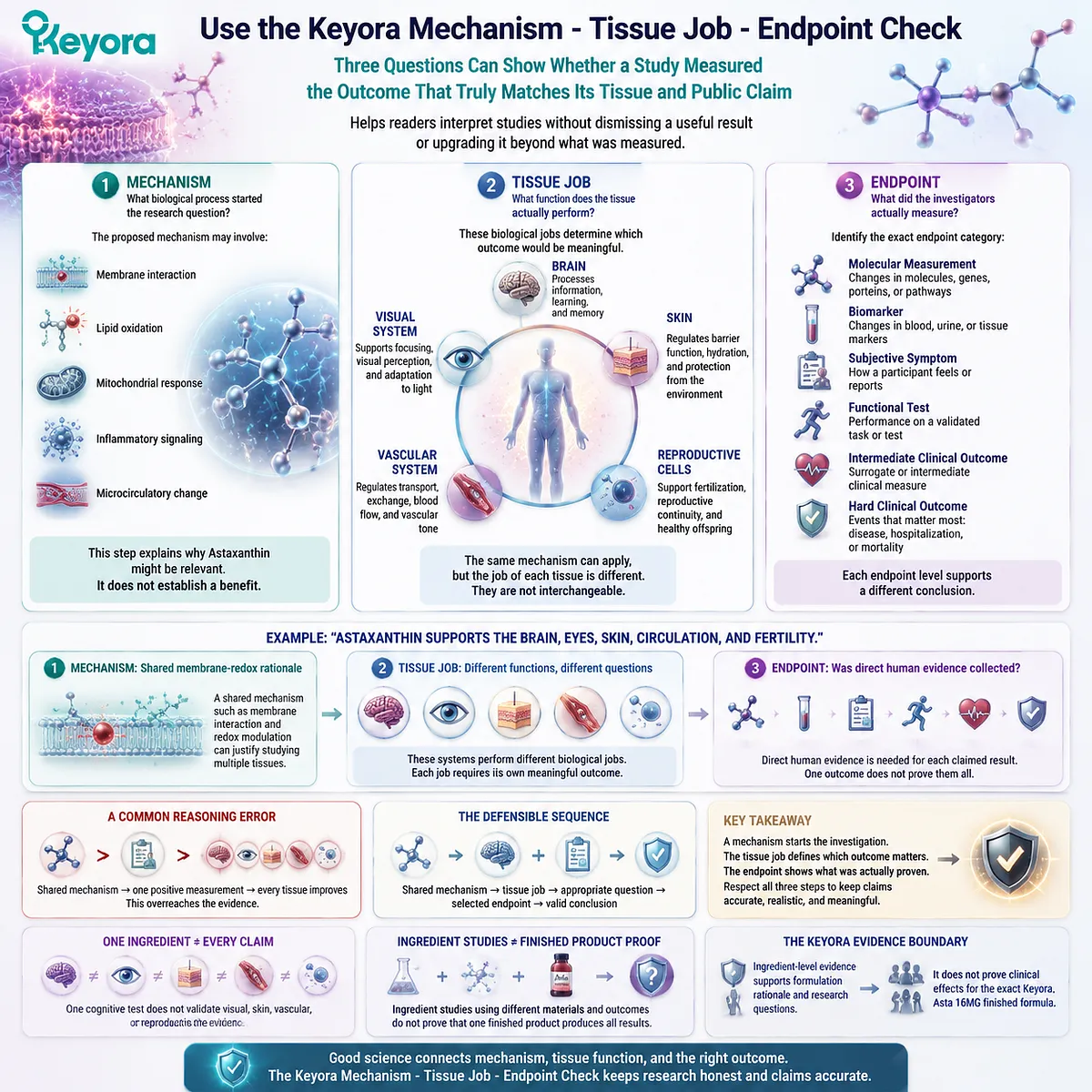
This distinction prevents a common reasoning error:
Shared mechanism
→ one positive measurement
→ every tissue function improves
The defensible sequence is:
Shared mechanism
→ tissue-specific biological task
→ appropriate research question
→ selected measurement
→ endpoint-specific conclusion
The supplied Keyora Astaxanthin corpus places neural, visual, vascular, skin, metabolic, and reproductive domains within one multi-system narrative.
The controlling Q&A summary, however, requires molecular pathways, human biomarkers, symptoms, functions, and clinical outcomes to remain separate evidence levels.
Astaxanthin can therefore remain the common scientific protagonist without every organ study being treated as evidence for the same benefit.
Each Tissue Requires Its Own Meaningful Endpoint
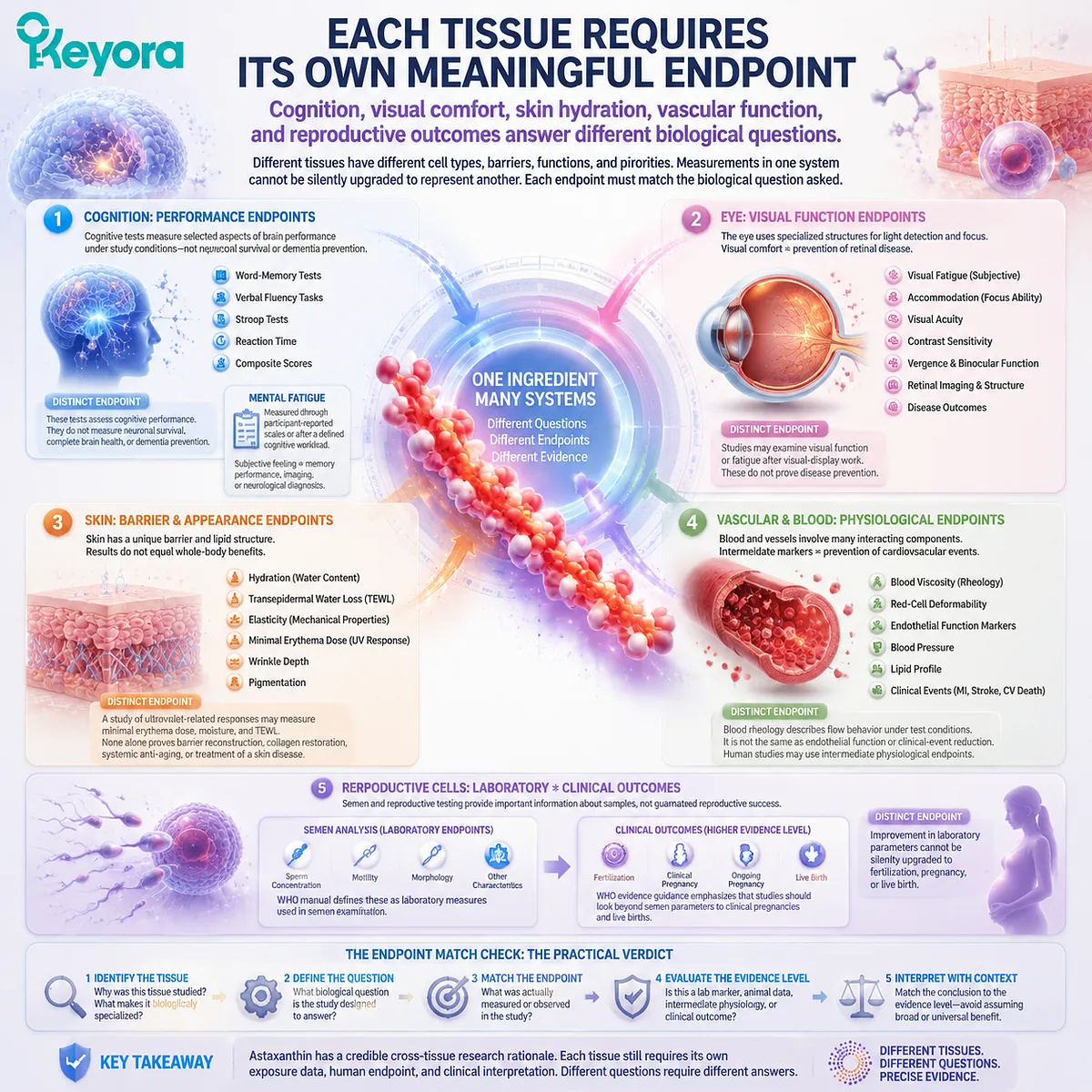
Cognition, visual comfort, skin hydration, vascular function, and reproductive outcomes answer different biological questions
In cognitive research, investigators may use word-memory tests, verbal-fluency tasks, Stroop tests, reaction-time measurements, or broader composite scores.
One Astaxanthin trial in middle-aged and older adults used word memory, verbal fluency, and Stroop testing. These measurements assess selected aspects of cognitive performance. They do not directly measure neuronal survival, prevention of dementia, or complete brain health.
Mental fatigue is another distinct endpoint. It may be collected through a participant-reported scale or after a defined cognitive workload.
A subjective fatigue score describes how participants report feeling under the study conditions. It is not interchangeable with memory performance, attention, brain imaging, or diagnosis of a neurological disorder.
Eye research produces a different endpoint map. Visual fatigue is a subjective experience, while accommodation describes the optical system’s ability to focus at different distances.
Visual acuity, contrast sensitivity, vergence, retinal imaging, and disease outcomes answer additional questions.
Astaxanthin studies have examined visual function and fatigue after visual-display work, but measuring accommodation or discomfort does not establish prevention of retinal disease.
Skin studies use yet another set of measurements.
-
Hydration estimates water content in the outer skin.
-
Transepidermal water loss reflects water movement through the skin barrier.
-
Elasticity describes selected mechanical properties.
-
Minimal erythema dose concerns the skin’s response to ultraviolet exposure.
-
Wrinkle depth and pigmentation are appearance-related measurements.
An Astaxanthin trial assessing ultraviolet-related skin responses measured minimal erythema dose, moisture, and transepidermal water loss. These are distinct outcomes, and none alone establishes complete barrier reconstruction, collagen restoration, systemic anti-aging, or treatment of a skin disease.
Vascular and blood studies can measure blood viscosity, red-cell deformability, endothelial responses, blood pressure, lipids, or clinical events. Blood rheology describes how blood and its cellular components behave under flow conditions.
It is not the same as endothelial function, and neither automatically proves prevention of heart attack or stroke.
An Astaxanthin human study specifically examined blood-rheology measurements, illustrating the use of an intermediate physiological endpoint rather than a cardiovascular-event outcome.
Reproductive research contains some of the most important endpoint distinctions.
Semen analysis may include sperm concentration, motility, morphology, and other laboratory characteristics. The WHO manual treats these as defined laboratory measures used in semen examination. They provide information about the sample, but they are not identical to fertilization, clinical pregnancy, ongoing pregnancy, or live birth.
WHO evidence guidance has specifically emphasized that reproductive studies should look beyond changes in semen parameters and include clinical pregnancies and live births. This demonstrates why an improvement in an intermediate laboratory endpoint cannot be silently upgraded into proof of reproductive success.
These examples do not establish that Astaxanthin improves each outcome. They show why each outcome answers a different question.
Endpoints Are Not Interchangeable
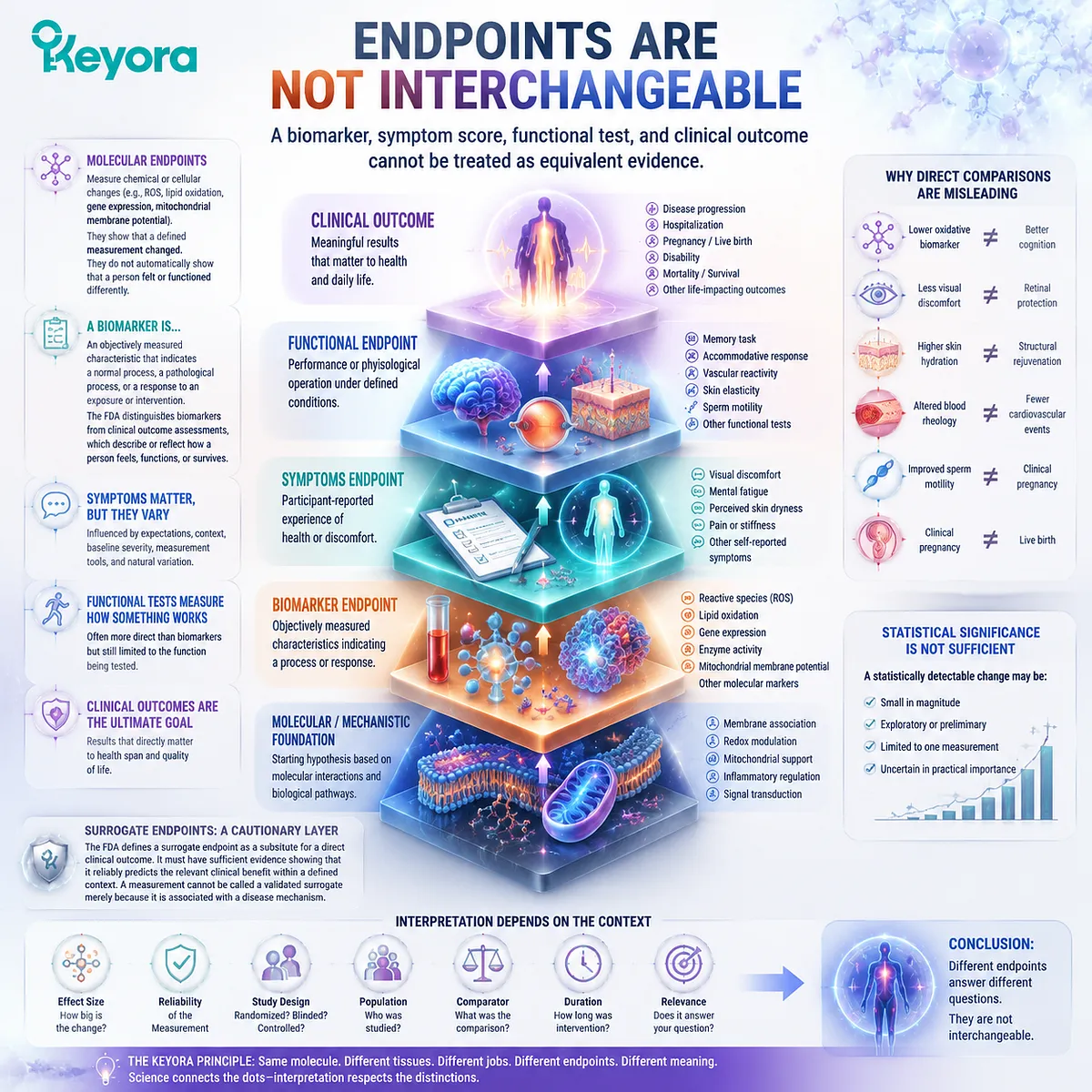
A biomarker, symptom score, functional test, and clinical outcome cannot be treated as equivalent evidence
A molecular endpoint may measure reactive species, lipid oxidation, gene expression, enzyme activity, or mitochondrial membrane potential. It can demonstrate that a defined biological measurement changed under the study conditions. It does not automatically show that a person felt or functioned differently.
A biomarker is an objectively measured characteristic that indicates a normal process, a pathological process, or a response to an exposure or intervention. The FDA distinguishes biomarkers from clinical outcome assessments, which describe or reflect how a person feels, functions, or survives.
A symptom endpoint records an experience reported by the participant, such as visual discomfort, mental fatigue, or perceived skin dryness. Symptoms matter to people, but they can be influenced by expectations, context, baseline severity, measurement tools, and natural variation.
A functional endpoint tests performance or physiological operation. Examples include a memory task, accommodative response, vascular reactivity, skin elasticity, or sperm motility. Functional results may be more direct than molecular markers, but their meaning remains limited to the function tested.
A clinical outcome concerns a meaningful health result. Depending on the field, it may include disease progression, hospitalization, pregnancy, live birth, disability, or another outcome that directly matters to health or daily life.
Surrogate endpoints add another layer. The FDA defines a surrogate endpoint as a substitute for a direct clinical outcome. A surrogate must have sufficient evidence showing that it reliably predicts the relevant clinical benefit within a defined context. A measurement cannot be called a validated surrogate merely because it is associated with a disease mechanism.
Therefore:
-
lower oxidative biomarker does not automatically mean better cognition
-
less visual discomfort does not prove retinal protection
-
higher skin hydration does not prove structural rejuvenation
-
altered blood rheology does not prove fewer cardiovascular events
-
improved sperm motility does not prove clinical pregnancy
-
clinical pregnancy does not equal live birth
Statistical significance also does not remove these distinctions. A statistically detectable change may be small, exploratory, limited to one measurement, or uncertain in practical importance. Interpretation still depends on the size of the effect, reliability of the measurement, study design, population, comparator, duration, and relevance to the reader’s actual question.
Use the Keyora Mechanism – Tissue Job – Endpoint Check
Three questions can show whether a study measured the outcome that truly matches its tissue and public claim
The Keyora Mechanism – Tissue Job – Endpoint Check helps readers interpret studies without dismissing a useful result or upgrading it beyond what was measured.
Mechanism: What biological process started the research question?
The proposed mechanism may involve:
-
membrane interaction
-
lipid oxidation
-
mitochondrial response
-
inflammatory signaling
-
microcirculatory change
This step explains why Astaxanthin might be relevant. It does not establish a benefit.
For example, a membrane-redox mechanism may justify studying both skin and the visual system. It does not mean that a skin measurement can answer an eye-health question.
Tissue Job: What function does the tissue actually perform?
The brain processes information. The visual system supports focusing and visual perception. Skin regulates barrier function and water loss. The vascular system regulates transport, exchange, and flow. Reproductive cells support fertilization and reproductive continuity.
This biological job determines which outcome would be meaningful.
A claim about cognitive support requires a cognitive endpoint rather than only an oxidative blood marker. A claim about visual comfort requires an appropriate visual symptom or function measure. A claim about live birth requires live-birth data rather than only sperm motility.
Endpoint: What did the investigators measure?
The reader should identify the exact endpoint category:
-
molecular measurement
-
biomarker
-
subjective symptom
-
functional test
-
intermediate clinical outcome
-
hard clinical outcome
Consider the claim, “Astaxanthin supports the brain, eyes, skin, circulation, and fertility.”
The mechanism step may identify a shared membrane or redox rationale. The tissue-job step shows that these systems perform different functions. The endpoint step asks whether direct human evidence was collected for each claimed result.
One cognitive test does not validate visual, skin, vascular, or reproductive claims. Several ingredient studies using different materials and outcomes also do not prove that one finished product produces all of those results simultaneously.
The current Keyora project record allows ingredient-level evidence to support formulation rationale, but it does not treat those studies as proof of clinical effects for the exact Keyora Asta 16MG finished formula.
Closing Summary
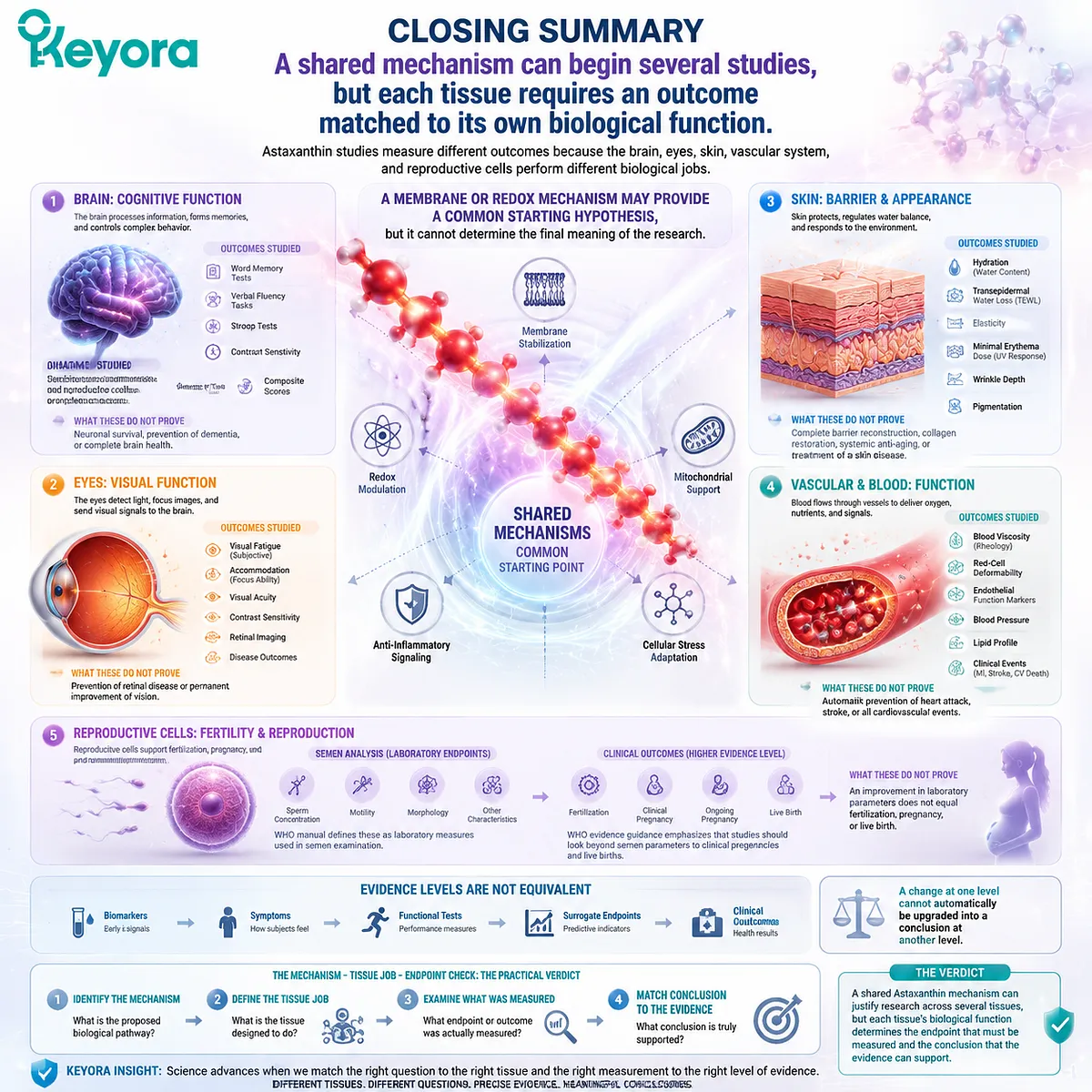
A shared mechanism can begin several studies, but each tissue requires an outcome matched to its own biological function
Astaxanthin studies measure different outcomes because the brain, eyes, skin, vascular system, and reproductive cells perform different biological jobs.
A membrane or redox mechanism may provide a common starting hypothesis, but it cannot determine the final meaning of the research.
Cognitive tests, visual-fatigue scores, skin hydration, blood rheology, sperm motility, clinical pregnancy, and live birth answer different questions.
Biomarkers, symptoms, functional tests, surrogate endpoints, and clinical outcomes must not be treated as equivalent evidence.
A change at one level cannot automatically be upgraded into a conclusion at another level.
The Mechanism – Tissue Job – Endpoint Check provides the practical verdict. Identify the proposed mechanism, define the tissue’s function, and examine exactly what the researchers measured.
A shared Astaxanthin mechanism can justify research across several tissues, but each tissue’s biological function determines the endpoint that must be measured and the conclusion that the evidence can support.
This article is for educational and informational purposes only. It does not provide medical advice, diagnosis, treatment, cure, prevention, disease outcome claims, hormone restoration claims, fertility outcome claims, or formula-specific clinical efficacy claims.