
Why Can’t My Body Relax Even When I’m Mentally Exhausted?
Keyora Research Q&A Library
This is part of the Keyora Research Q&A Series, derived from Keyora Nutritional Neurology Series .
Within the Keyora Nutritional Neurology framework, this Q&A translates complex nutrient–brain mechanisms into reader-friendly, evidence-bound answers, focusing on stress resilience, sleep quality, calm mood support, cognitive wellness, and the broader interaction between nutrition, neurochemistry, and daily nervous-system function.
First published by Keyora Research Journal: www.keyorahealth.com

Direct Answer
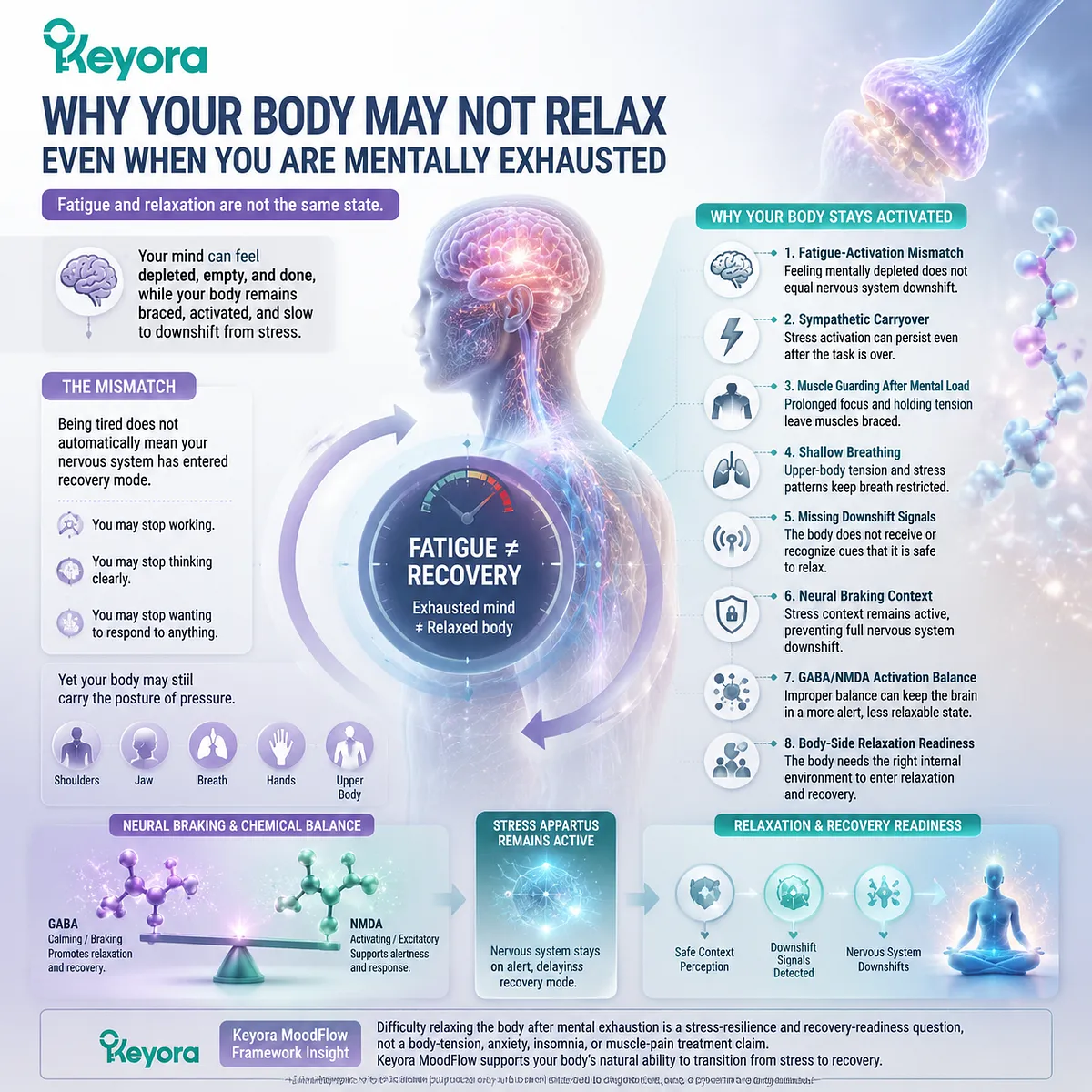
Your body may not relax even when you are mentally exhausted because fatigue and relaxation are not the same state.
Your mind can feel depleted, empty, and done, while your body remains braced, activated, and slow to downshift from stress.
The mismatch is this: being tired does not automatically mean your nervous system has entered recovery mode. You may stop working, stop thinking clearly, and stop wanting to respond to anything, yet your shoulders, jaw, breath, hands, and upper body may still carry the posture of pressure.
This can involve fatigue-activation mismatch, sympathetic carryover, muscle guarding after mental load, shallow breathing, missing downshift signals, neural braking context, GABA/NMDA activation balance, and body-side relaxation readiness.
In the Keyora MoodFlow framework, difficulty relaxing the body after mental exhaustion is understood as a stress-resilience and recovery-readiness question, not a body-tension, anxiety, insomnia, or muscle-pain treatment claim.
Why Mental Exhaustion Does Not Always Relax the Body
You can feel mentally depleted while your body remains braced, activated, and slow to downshift.
The day finally becomes quiet.
The laptop is closed. The messages can wait. The work is no longer directly in front of you. Maybe you are sitting on the sofa, lying on the bed, standing in the kitchen, or trying to do nothing for a few minutes.
Your mind is tired.
Not just a little tired.
It feels empty, used up, and unwilling to think about one more thing. You do not want another decision. You do not want another question. You do not want another notification. You do not want to explain, plan, solve, respond, or perform.
You want to rest.
But your body does not fully arrive there.
Your shoulders may still feel lifted.
Your jaw may still be slightly clenched.
Your hands may still want to hold the phone.
Your breathing may still feel shallow.
Your upper body may feel as if it has not settled into the chair.
Even lying down may not feel soft. You are tired, but you are not relaxed. You are stopped, but not released.
That is the confusing part.
You may think:
“I am already exhausted. Why can’t I relax?”
“Why does my body still feel like it is working?”
“Why can’t I just drop into rest?”
“Why do I feel done, but not calm?”
This experience can make people blame themselves. They may assume they are bad at relaxing, too tense, too sensitive, or unable to switch off.
But what if mental exhaustion does not automatically create body relaxation?
What if your body is tired, but still guarding?
What if your system has left the task, but not the stress state?
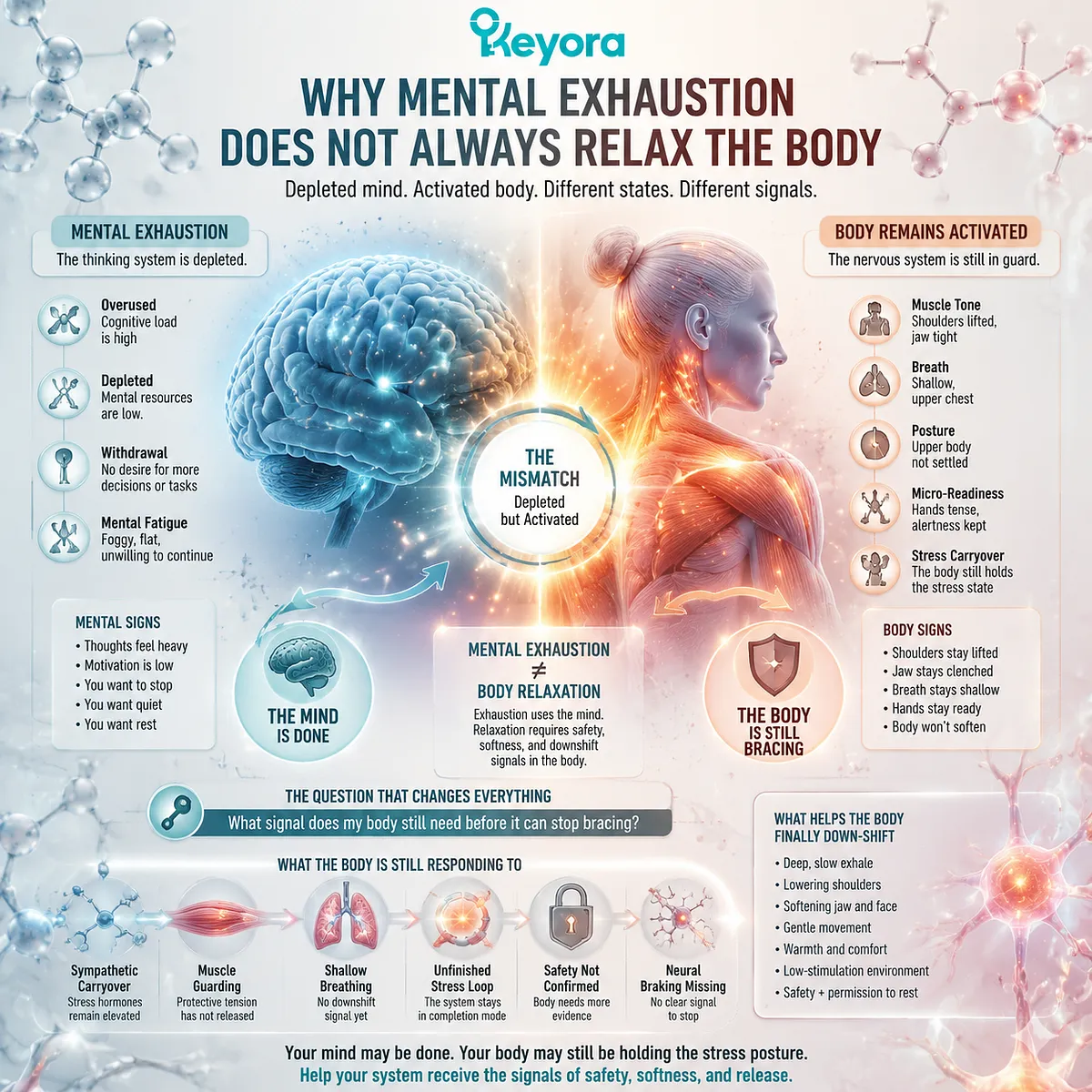
Mental exhaustion means your thinking system has been heavily used. It may feel depleted, foggy, flat, or unwilling to continue.
Relaxation is different. Relaxation requires the body and nervous system to receive enough safety, softness, and downshift signals to stop preparing.
Those two states do not always arrive together.
You can be depleted and activated at the same time.
That sentence matters.
Because when you understand this mismatch, you stop asking, “Why am I not tired enough to relax?”
You begin asking, “What signal does my body still need before it can stop bracing?”
Your mind may be done.
But your body may still be holding the stress posture.
Why the Body Can Stay Activated After the Mind Is Done
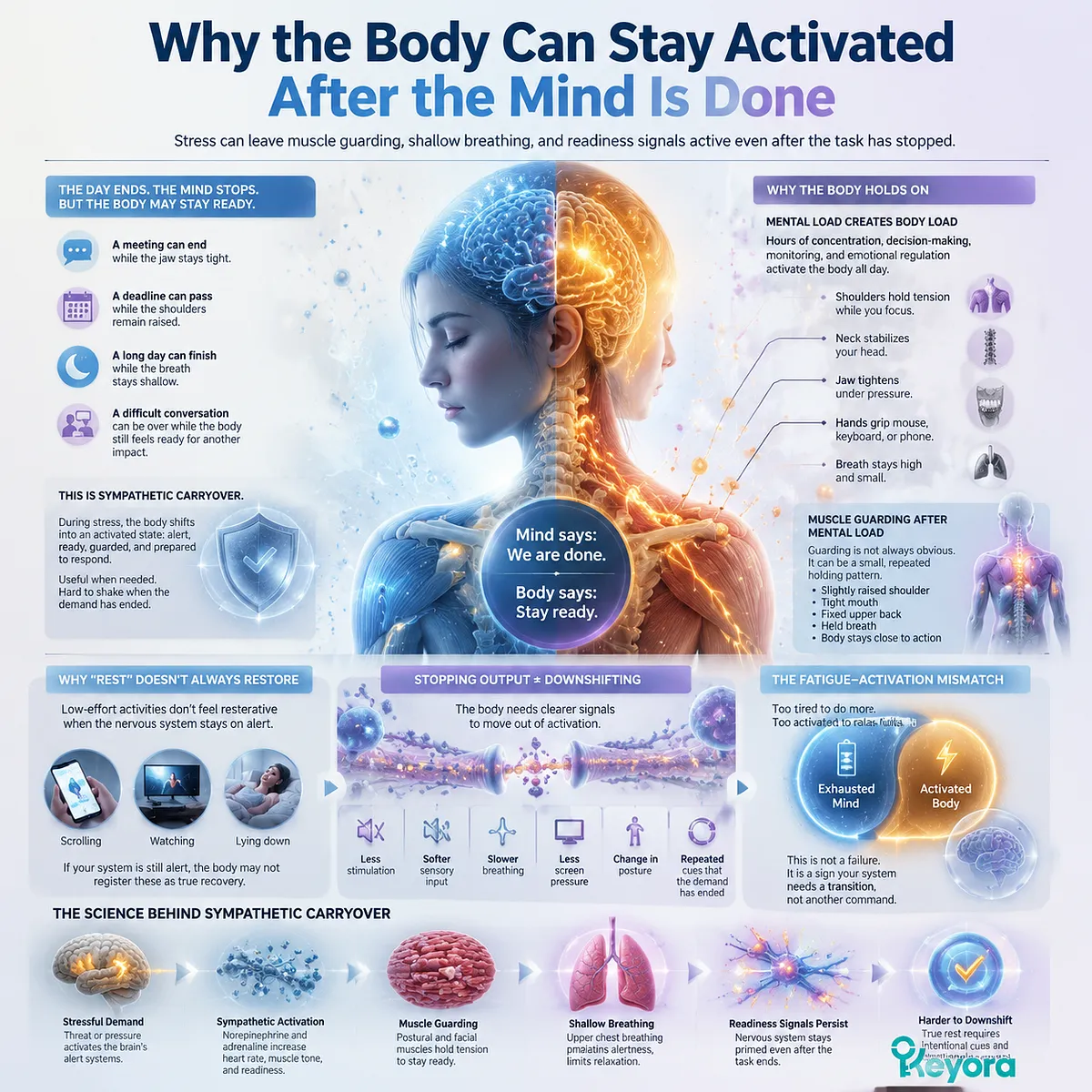
Stress can leave muscle guarding, shallow breathing, and readiness signals active even after the task has stopped.
Stress does not always leave the body the moment the task ends.
A meeting can end while the jaw stays tight.
A deadline can pass while the shoulders remain raised.
A long day can finish while the breath stays shallow.
A difficult conversation can be over while the body still feels ready for another impact.
This is sympathetic carryover.
During stress, the body may shift into an activated state: alert, ready, guarded, and prepared to respond. This can be useful when something needs attention. But if the activation continues after the demand has ended, rest becomes harder to enter.
Your mind may say, “We are done.”
Your body may still say, “Stay ready.”
This is especially common after mentally demanding days. Mental load can create body load. You may have spent hours concentrating, monitoring tone, scanning screens, managing deadlines, controlling reactions, responding to people, and keeping yourself together.
Even if you did not move much, your body may have participated all day.
The shoulders may have held tension while you focused.
The neck may have stabilized your head in front of the screen.
The jaw may have tightened during pressure.
The hands may have gripped the mouse, keyboard, or phone.
The breath may have stayed high and small.
The body may have been quietly helping you endure.
So when the mind is finally exhausted, the body is not always free. It may still be carrying the pattern that helped you get through the day.
Another mechanism is muscle guarding after mental load.
Guarding is not always obvious. It can be a small, repeated holding pattern. A slightly raised shoulder. A tight mouth. A fixed upper back. A held breath. A body that stays close to action even when action is no longer needed.
This is why low-effort activities do not always feel restorative.
You may scroll your phone, watch a show, or lie down, but if your nervous system remains alert, the body may not register those activities as true recovery.
Stopping output is helpful.
But stopping output is not always the same as downshifting.
The body often needs clearer signals.
It needs less stimulation, softer sensory input, slower breathing, less screen pressure, a change in posture, and repeated cues that the demand has ended for now.
Without those cues, the body can stay in a fatigue-activation mismatch.
Too tired to do more.
Too activated to relax fully.
That state can feel deeply unfair. But it is not a personal failure. It is a sign that your system may need a transition, not another command.
How to Help the Body Downshift Without Forcing Relaxation
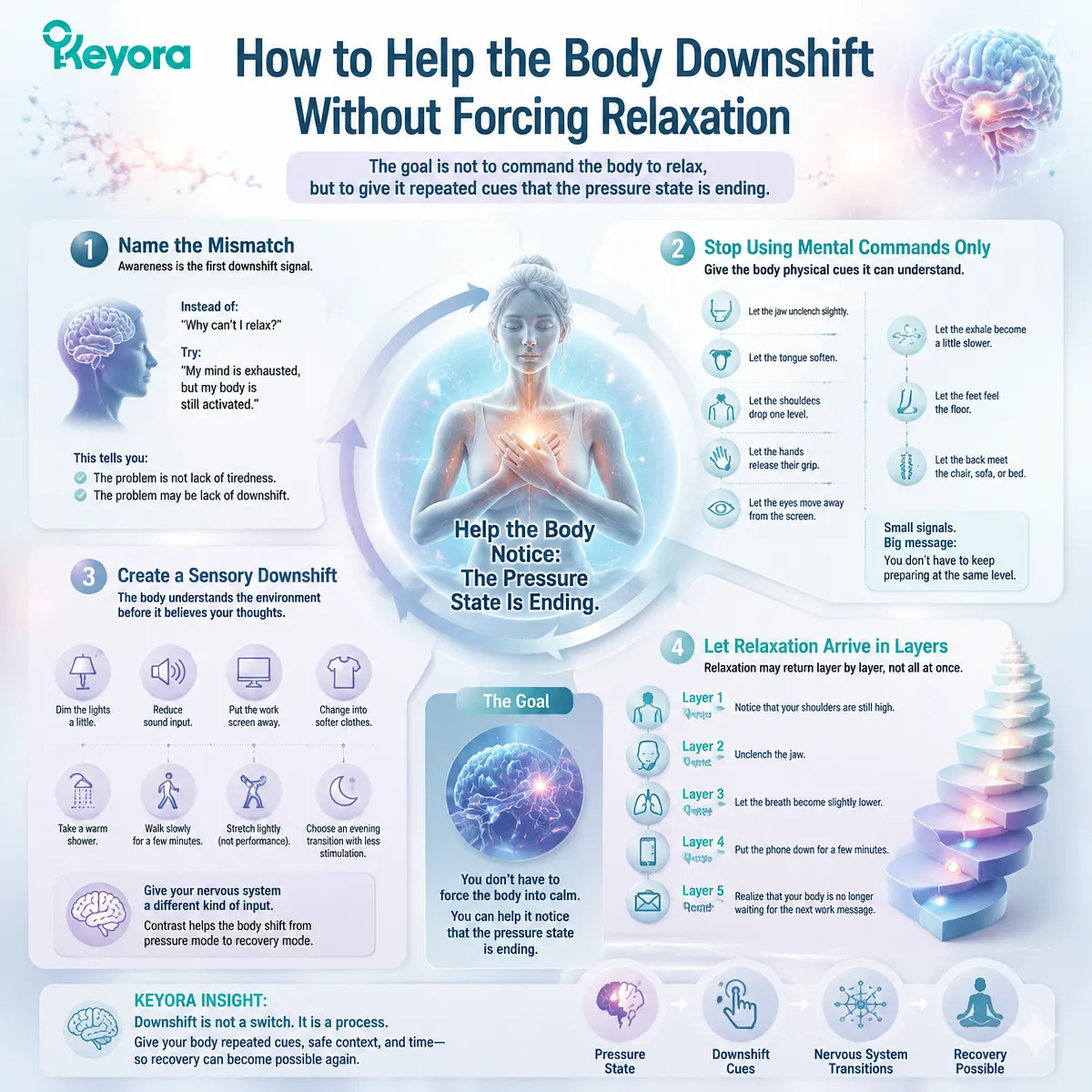
The goal is not to command the body to relax, but to give it repeated cues that the pressure state is ending.
When your body will not relax, the instinct is often to tell it what to do.
“Relax.”
“Calm down.”
“Stop being tense.”
“Just rest.”
But the body does not always respond to abstract instructions, especially when it has spent the whole day preparing, holding, and guarding.
Sometimes the more you command relaxation, the more relaxation becomes another task you are failing.
A better first step is to name the mismatch.
Instead of saying, “Why can’t I relax?” try saying, “My mind is exhausted, but my body is still activated.”
This sentence is not an excuse. It is a map.
It tells you that the problem is not lack of tiredness. The problem may be lack of downshift.
The second step is to stop using mental commands only.
Give the body physical cues it can understand.
Let the jaw unclench slightly.
Let the tongue soften.
Let the shoulders drop one level.
Let the hands release their grip.
Let the eyes move away from the screen.
Let the exhale become a little slower.
Let the feet feel the floor.
Let the back actually meet the chair, sofa, or bed.
These are not dramatic interventions. They are small signals.
They tell the body: you do not have to keep preparing at the same level.
The third step is to create a sensory downshift.
The body often understands the environment before it believes your thoughts.
Dim the lights a little.
Reduce sound input.
Put the work screen away.
Change into softer clothes.
Take a warm shower.
Walk slowly for a few minutes.
Stretch lightly without turning it into a performance.
Choose an evening transition that has less stimulation than the workday.
This is not about building a perfect routine. It is about giving the nervous system a different kind of input.
If the whole day was bright screens, fast replies, constant decisions, and pressure, then the body may need contrast.
The fourth step is to let relaxation arrive in layers.
Do not demand instant softness.
Maybe the first layer is only noticing that your shoulders are still high.
Maybe the second layer is unclenching the jaw.
Maybe the third layer is letting the breath become slightly lower.
Maybe the fourth layer is putting the phone down for a few minutes.
Maybe the fifth layer is realizing that your body is no longer waiting for the next work message.
Relaxation may return layer by layer, not all at once.
This matters because many people look for a full switch: tense to relaxed, alert to calm, exhausted to restored. But after stress, the body may not work like a light switch. It may need several small permissions.
You do not have to force the body into calm.
You can help it notice that the pressure state is ending.
Where Nutritional Support Fits
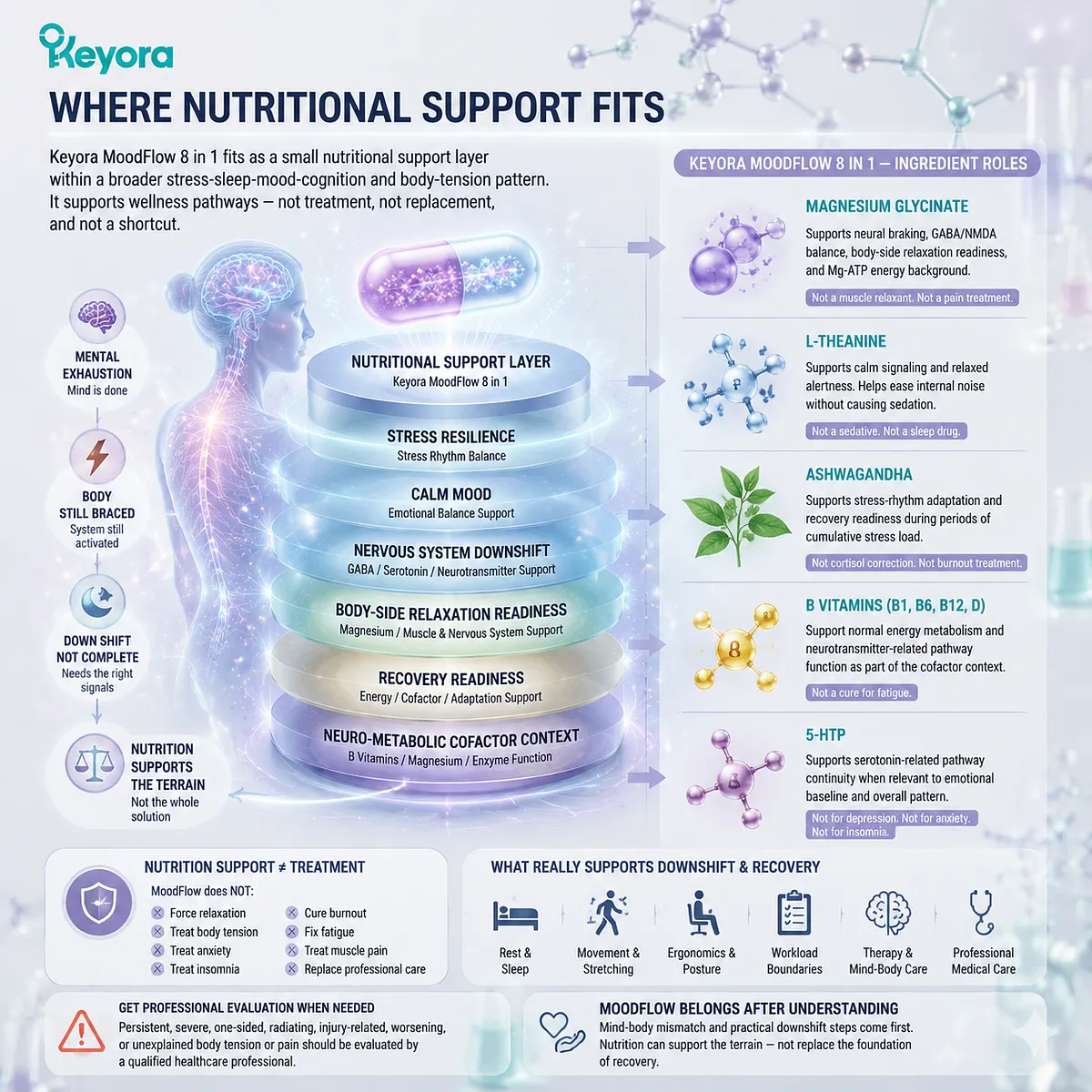
Keyora MoodFlow 8 in 1 can fit as one small nutritional support layer when difficulty relaxing the body appears within a broader stress-sleep-mood-cognition and body-tension pattern. It should not be framed as forcing relaxation, treating body tension, treating anxiety, treating insomnia, curing burnout, fixing fatigue, treating muscle pain, or replacing professional care.
Its role is narrower: supporting wellness pathways involved in stress resilience, calm mood, nervous-system downshift, body-side relaxation readiness, recovery readiness, and neuro-metabolic cofactor context.
-
Magnesium glycinate may be relevant when stress leaves the body braced, guarded, or slow to soften. In the MoodFlow framework, it supports neural braking, GABA/NMDA activation balance, body-side relaxation readiness, and Mg-ATP energy background. This is not a claim that it relaxes muscles like a drug or treats pain.
-
L-Theanine may be relevant when mental exhaustion appears alongside internal noise, pressure, and difficulty entering calm alertness. Its role is calm signaling and relaxed alertness, supporting a gentler downshift without being framed as sedation.
-
Ashwagandha may fit when cumulative stress load keeps the system in a pressure rhythm after the task has ended. Its role is stress-rhythm adaptation and recovery readiness, not cortisol correction or burnout treatment.
-
B vitamins may support the broader neuro-metabolic cofactor context, including normal energy metabolism and normal neurotransmitter-related pathway support. This belongs to the background of stress resilience and recovery readiness, not a cure for fatigue.
-
5-HTP may be relevant only when emotional baseline and serotonin-related pathway continuity are part of the broader pattern. It should not be framed as treating depression, anxiety, insomnia, or emotional distress.
MoodFlow belongs after the reader understands the mind-body mismatch and practical downshift steps. Nutrition can support the terrain. It cannot replace rest, movement, stretching, ergonomic changes, workload boundaries, therapy, physical therapy, medical care, or a safer daily rhythm.
Persistent, severe, one-sided, radiating, injury-related, worsening, or unexplained body tension or pain should be evaluated by a qualified healthcare professional.
Closing Summary
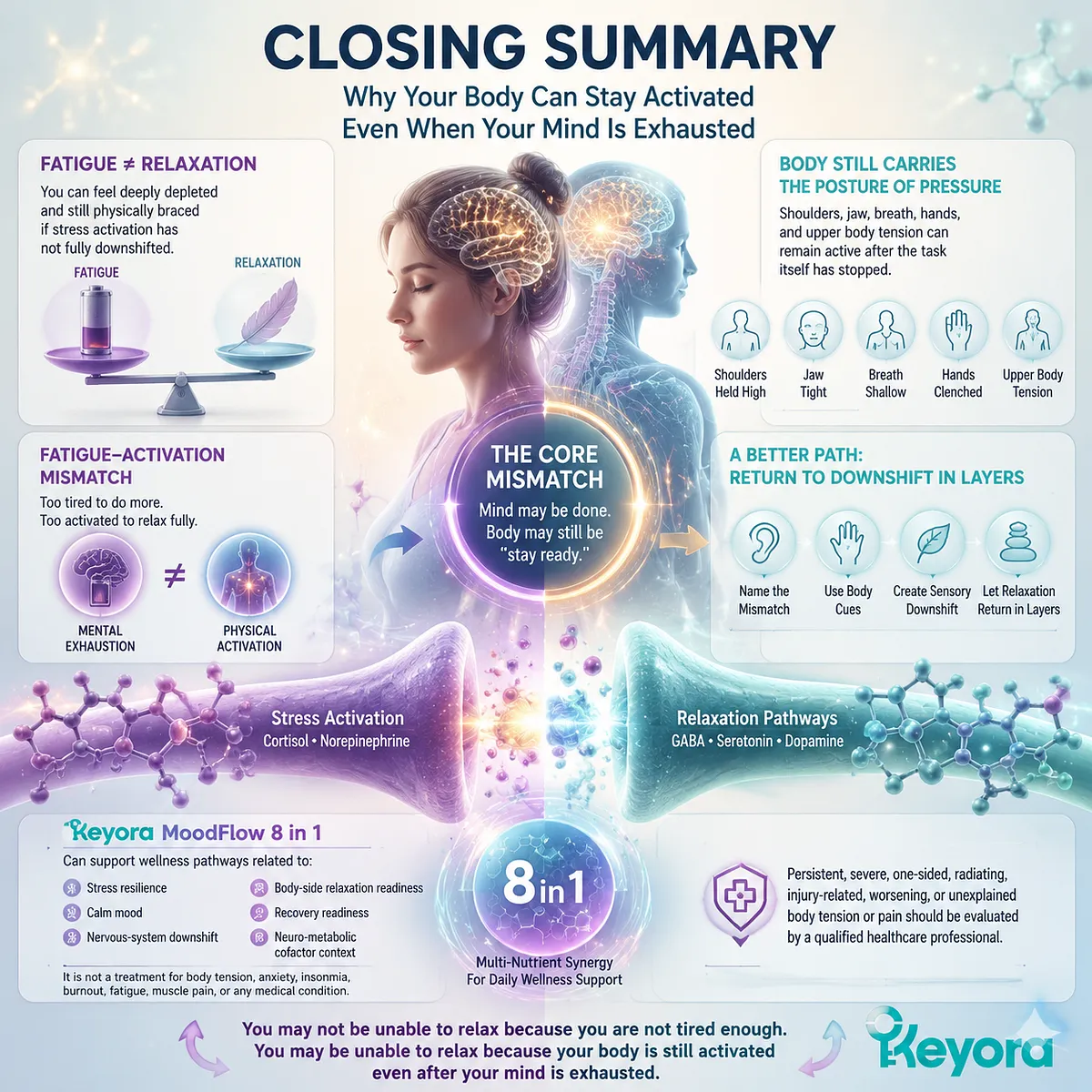
Your body may not relax even when you are mentally exhausted because fatigue and relaxation are different states. You can be deeply depleted and still physically braced if stress activation has not fully downshifted.
The deeper mismatch is that your mind may be done, but your body may still be carrying the posture of pressure. Shoulders, jaw, breath, hands, and upper body tension can remain active after the task itself has stopped.
A better path begins by naming the fatigue-activation mismatch, using body cues instead of mental commands, creating a sensory downshift, and letting relaxation return in layers.
Keyora MoodFlow 8 in 1 can support wellness pathways related to stress resilience, calm mood, nervous-system downshift, body-side relaxation readiness, recovery readiness, and neuro-metabolic cofactor context. It is not a treatment for body tension, anxiety, insomnia, burnout, fatigue, muscle pain, or any medical condition.
Persistent, severe, one-sided, radiating, injury-related, worsening, or unexplained body tension or pain should be evaluated by a qualified healthcare professional.
You may not be unable to relax because you are not tired enough.
You may be unable to relax because your body is still activated even after your mind is exhausted.
This article is for educational and informational purposes only. It does not provide medical advice, diagnosis, treatment, cure, prevention, disease outcome claims, hormone restoration claims, fertility outcome claims, or formula-specific clinical efficacy claims.