
Why Can’t I Relax on My Day Off?
Keyora Research Q&A Library
This is part of the Keyora Research Q&A Series, derived from Keyora Nutritional Neurology Series .
Within the Keyora Nutritional Neurology framework, this Q&A translates complex nutrient–brain mechanisms into reader-friendly, evidence-bound answers, focusing on stress resilience, sleep quality, calm mood support, cognitive wellness, and the broader interaction between nutrition, neurochemistry, and daily nervous-system function.
First published by Keyora Research Journal: www.keyorahealth.com

Direct Answer
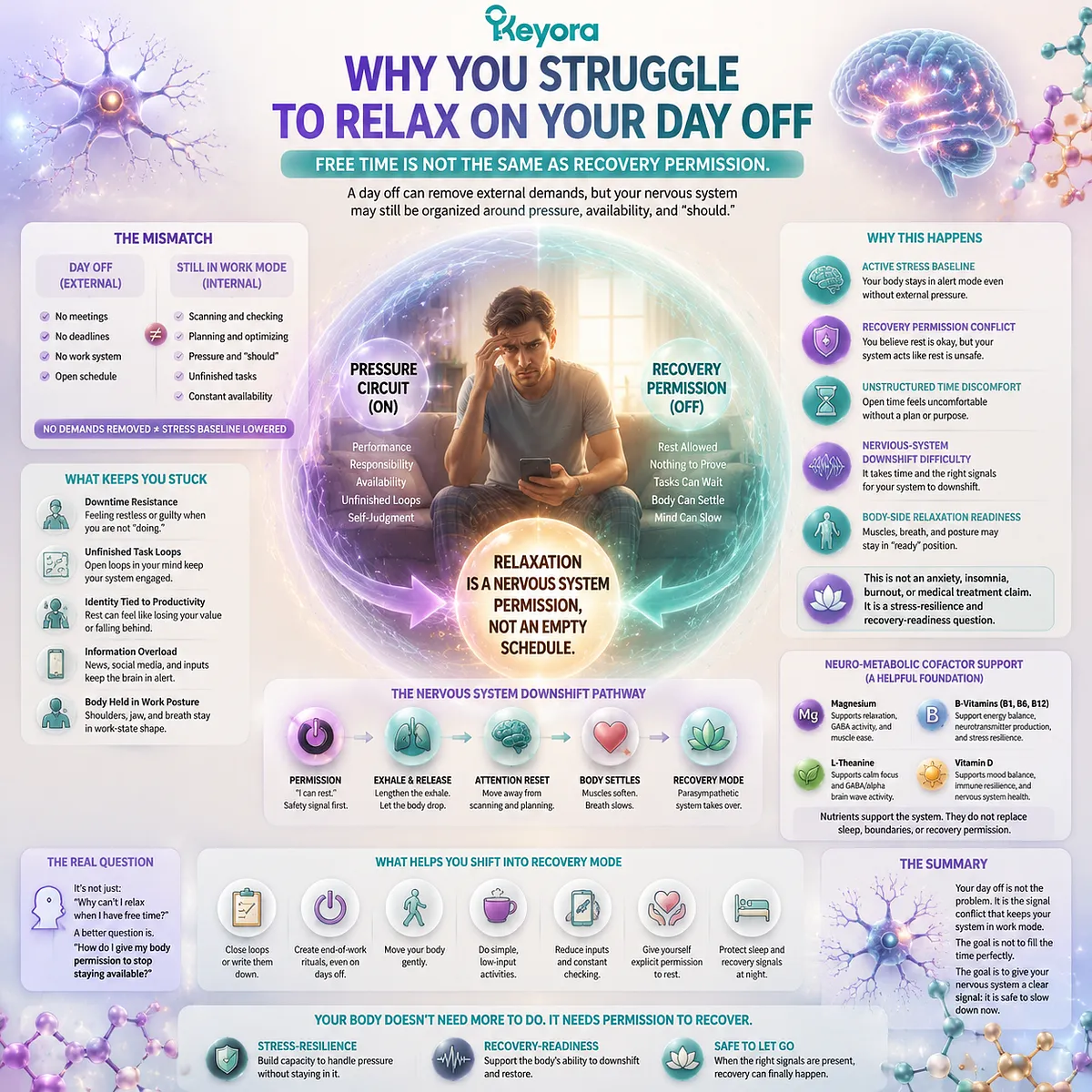
You may struggle to relax on your day off because having free time is not the same as having recovery permission. Your schedule may be open, but your nervous system may still be organized around pressure, availability, unfinished tasks, and the feeling that you should be doing something useful.
The mismatch is this: a day off can remove external demands without automatically lowering your internal stress baseline. You may not be working, but your body and mind may still be scanning, planning, optimizing, checking, or trying to prove that the day is being used well.
This can involve downtime resistance, active stress baseline, recovery permission conflict, unstructured time discomfort, nervous-system downshift difficulty, body-side relaxation readiness, calm signaling context, and neuro-metabolic cofactor support.
In the Keyora MoodFlow framework, difficulty relaxing on a day off is understood as a stress-resilience and recovery-readiness question, not an anxiety, insomnia, burnout, or medical treatment claim.
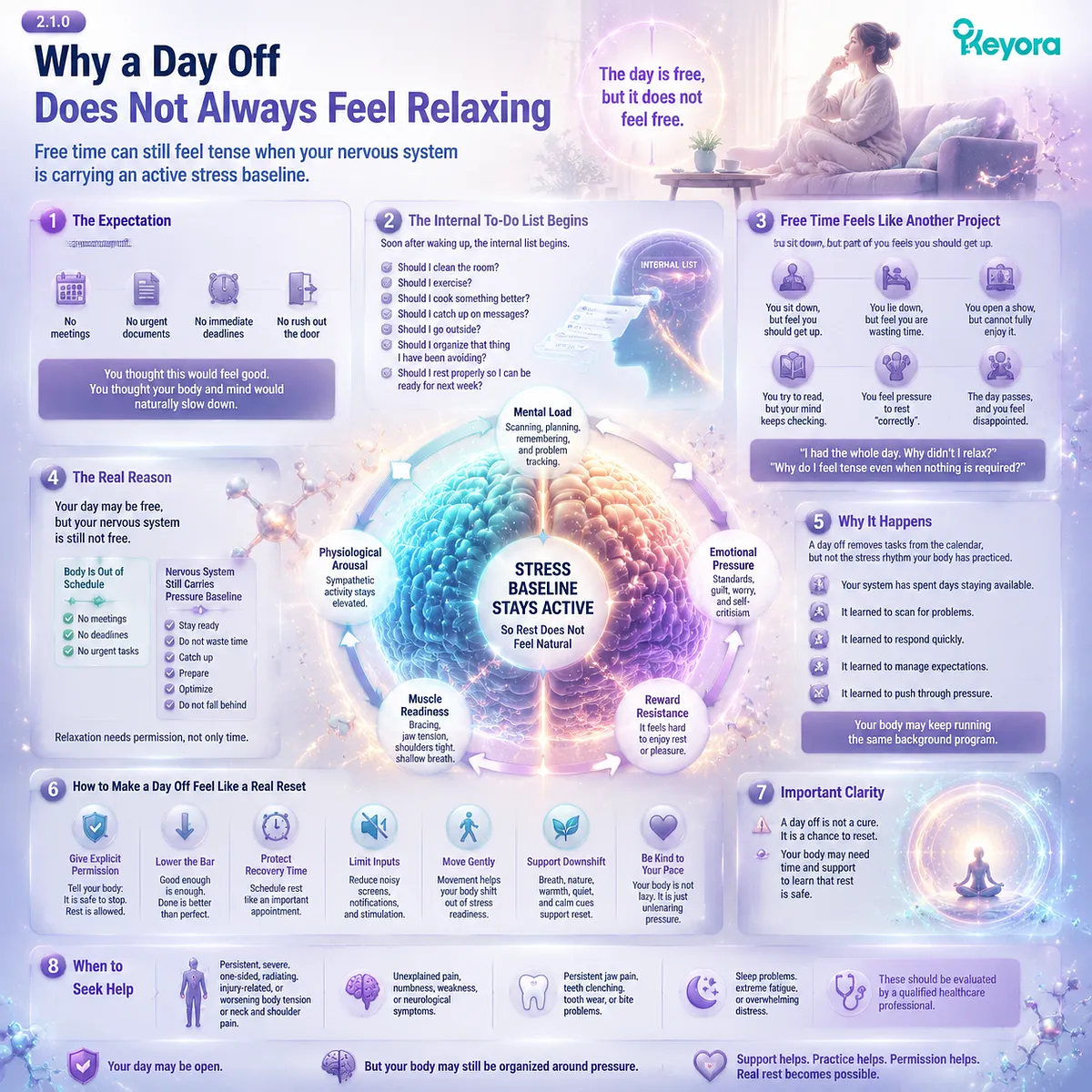
Why a Day Off Does Not Always Feel Relaxing
Free time can still feel tense when your nervous system is carrying an active stress baseline.
It is finally your day off.
There is no early meeting. No urgent document waiting on the screen. No immediate deadline in front of you. No need to rush out the door in the exact same way you do on a workday.
You thought this would feel good.
You thought your body would naturally soften.
You thought your mind would slow down because the schedule was finally open.
But soon after waking up, the internal list begins.
Should I clean the room?
Should I exercise?
Should I cook something better?
Should I catch up on messages?
Should I go outside?
Should I finally organize that thing I have been avoiding?
Should I rest properly so I can be ready for the next week?
The day is free, but it does not feel free.
It starts to feel like another project.
You sit down, but part of you feels you should get up. You lie down, but part of you thinks you are wasting time. You open a show, but you cannot fully enjoy it. You try to read, but your mind keeps checking what else you should be doing.
You may even feel pressure to rest correctly.
By late afternoon, you may look back and feel disappointed.
“I had the whole day. Why didn’t I relax?”
“Why do I feel tense even when nothing is required?”
“Why can’t I enjoy time off?”
“Why does a day off make me feel restless, guilty, or behind?”
But what if your day off is free, while your nervous system is still not free?
What if relaxation needs permission, not only time?
What if your body has left the schedule, but not the pressure baseline?
A day off can remove tasks from the calendar, but it does not automatically remove the stress rhythm your body has been practicing.
If your system has spent days staying available, scanning for problems, responding quickly, managing expectations, and pushing through pressure, it may not instantly understand that rest is safe.
It may keep running the same background program.
Stay ready.
Do not waste time.
Catch up.
Prepare.
Optimize.
Do not fall behind.
That is why your day off may not feel relaxing at first.
The day may be open.
But your body may still be organized around pressure.
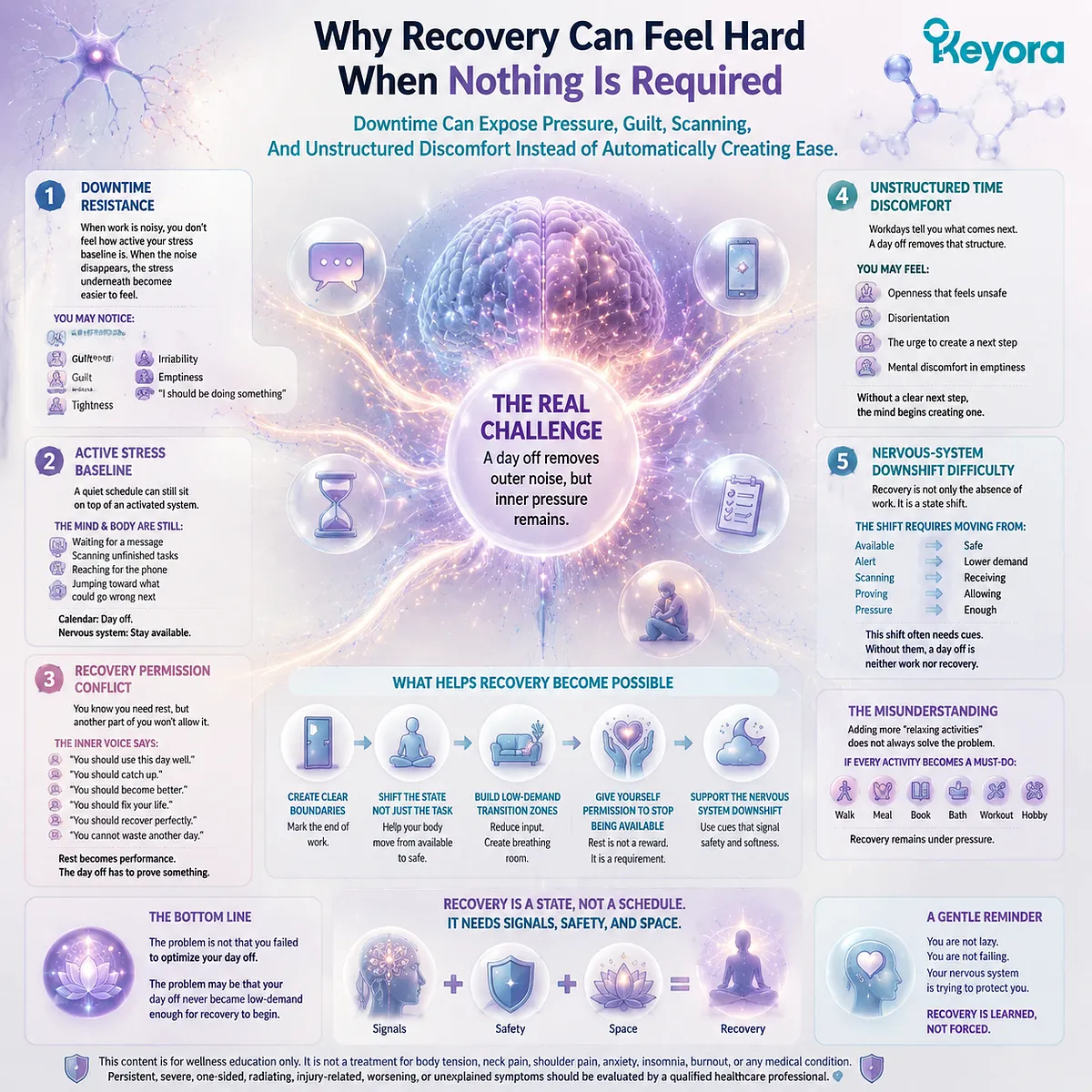
Why Recovery Can Feel Hard When Nothing Is Required
Downtime can expose pressure, guilt, scanning, and unstructured discomfort instead of automatically creating ease.
One reason a day off can feel uncomfortable is downtime resistance.
When work is noisy, you may not notice how active your stress baseline is. The tasks, messages, meetings, and deadlines give your attention somewhere to go. They keep the pressure attached to something external.
But when the noise disappears, the stress underneath can become easier to feel.
The room is quiet.
The schedule is open.
Nobody is asking you to start immediately.
And suddenly you notice the internal pressure that was covered by busyness.
This can feel like restlessness, guilt, tightness, irritability, emptiness, or the strange feeling that you should be doing something even when you do not know what.
When the noise of work disappears, the stress baseline underneath may become easier to feel.
The second mechanism is active stress baseline.
A quiet schedule can still sit on top of an activated system.
Your body may still be waiting for a message. Your mind may still scan unfinished tasks. Your hand may still reach for the phone. Your attention may still jump toward what could go wrong next.
The calendar says day off.
The nervous system says stay available.
The third mechanism is recovery permission conflict.
You may know you need rest, but another part of you may not fully allow it.
It may say:
“You should use this day well.”
“You should catch up.”
“You should become better.”
“You should fix your life.”
“You should recover perfectly.”
“You cannot waste another day.”
This turns rest into performance.
Now the day off has to prove something. It has to prove you are disciplined, balanced, healthy, productive, restored, and in control.
That is a lot to ask from rest.
The fourth mechanism is unstructured time discomfort.
Workdays often tell you what comes next. A meeting begins. A task is due. A message requires a reply. A deadline creates shape.
A day off may remove that structure.
For some people, that openness feels peaceful. For others, especially after prolonged stress, it can feel strangely unsafe or disorienting. Without a clear next step, the mind begins creating one.
The fifth mechanism is nervous-system downshift difficulty.
Recovery is not only the absence of work. It is a state shift.
The body must move from available to safe.
From alert to lower demand.
From scanning to receiving.
From proving to allowing.
From pressure to enough.
That shift often needs cues. Without them, a day off can become a space where you are not working, but also not recovering.
This is why adding more “relaxing activities” does not always solve the problem.
If every walk, meal, book, bath, workout, or hobby becomes something you must do correctly, recovery remains under pressure.
The problem is not that you failed to optimize your day off.
The problem may be that your day off never became low-demand enough for recovery to begin.
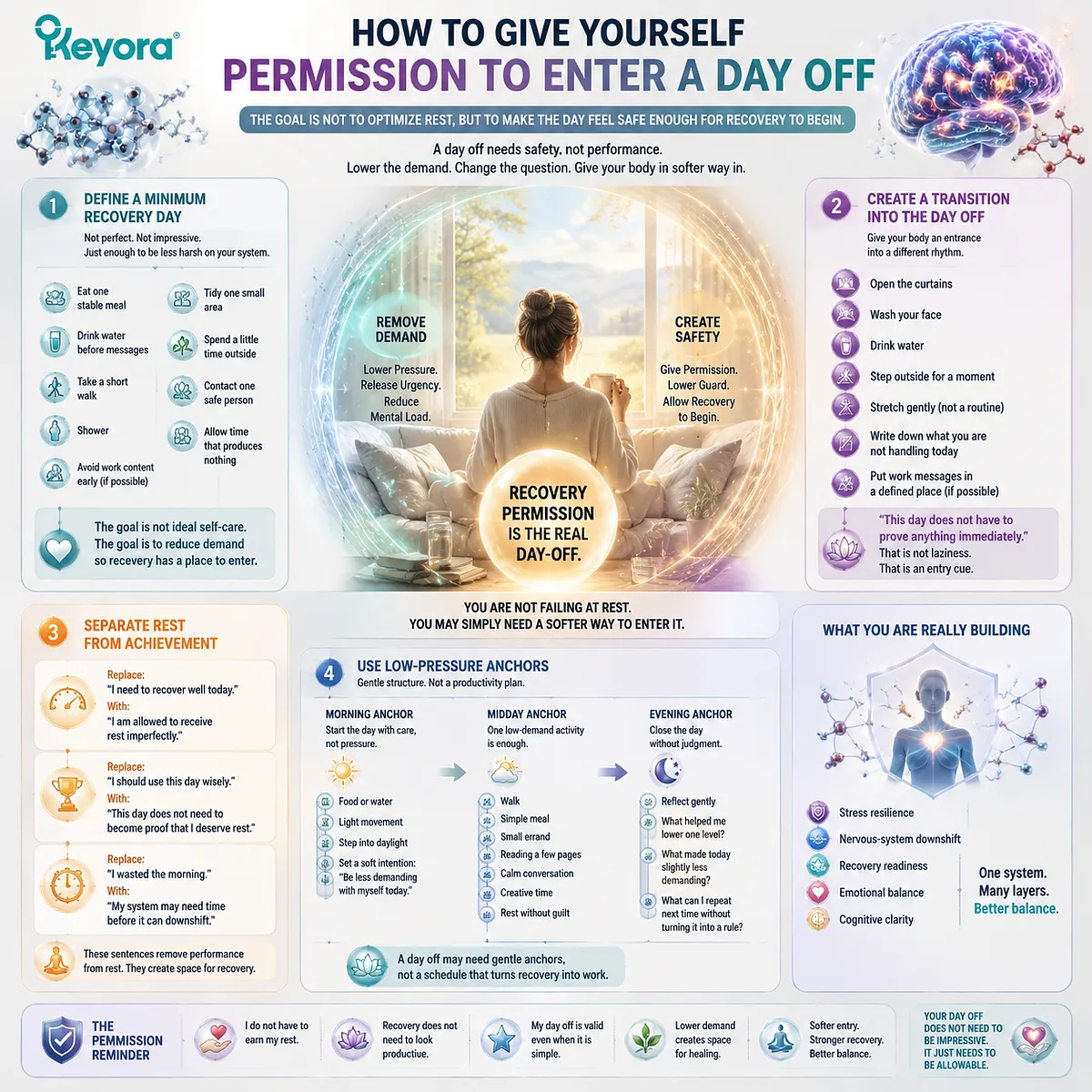
How to Give Yourself Permission to Enter a Day Off
The goal is not to optimize rest, but to make the day feel safe enough for recovery to begin.
When a day off feels hard to relax into, start by lowering the demand placed on the day.
Do not begin with:
“How do I make the most of this day?”
Try beginning with:
“What would make this day feel less demanding?”
That question changes everything.
It moves you away from performance and toward recovery permission.
The first step is to define a minimum recovery day.
Not a perfect day.
Not an impressive day.
Not a day that fixes everything.
A minimum recovery day.
Choose two or three simple anchors that would help the day feel less harsh on your system.
Eat one stable meal.
Drink water before checking messages.
Take a short walk.
Shower.
Avoid work content for the first part of the morning if your responsibilities allow it.
Tidy one small area instead of the whole room.
Spend a little time outside.
Contact one safe person lightly.
Allow one period of time that produces nothing.
The goal is not to complete the ideal version of self-care.
The goal is to reduce demand enough that recovery has a place to enter.
The second step is to create a transition into the day off.
A day off also needs an entrance.
Instead of waking up and immediately entering phone input, work thoughts, chores, or pressure planning, give the body a small signal that the day has a different rhythm.
Open the curtains.
Wash your face.
Drink water.
Step outside for a moment.
Stretch gently without turning it into a routine.
Write down what you are not handling today.
Put work-related messages in a defined place if your life allows it.
Say:
“This day does not have to prove anything immediately.”
That is not laziness.
That is an entry cue.
The third step is to separate rest from achievement.
Try replacing:
“I need to recover well today.”
With:
“I am allowed to receive rest imperfectly.”
Try replacing:
“I should use this day wisely.”
With:
“This day does not need to become proof that I deserve rest.”
Try replacing:
“I wasted the morning.”
With:
“My system may need time before it can downshift.”
These sentences are not excuses. They help remove the performance layer from rest.
The fourth step is to use low-pressure anchors.
A day off may need gentle structure, but not a productivity plan.
A morning anchor could be food, water, light movement, or stepping into daylight.
A midday anchor could be one low-demand activity: a walk, a simple meal, a small errand, a few pages of reading, or a calm conversation.
An evening anchor could be closing the day without judging whether you recovered perfectly.
Ask:
“What made today slightly less demanding?”
“What helped my body lower one level?”
“What can I repeat next time without turning it into a rule?”
A day off may need gentle anchors, not a schedule that turns recovery into work.
You are not failing at rest.
You may simply need a softer way to enter it.
Where Nutritional Support Fits
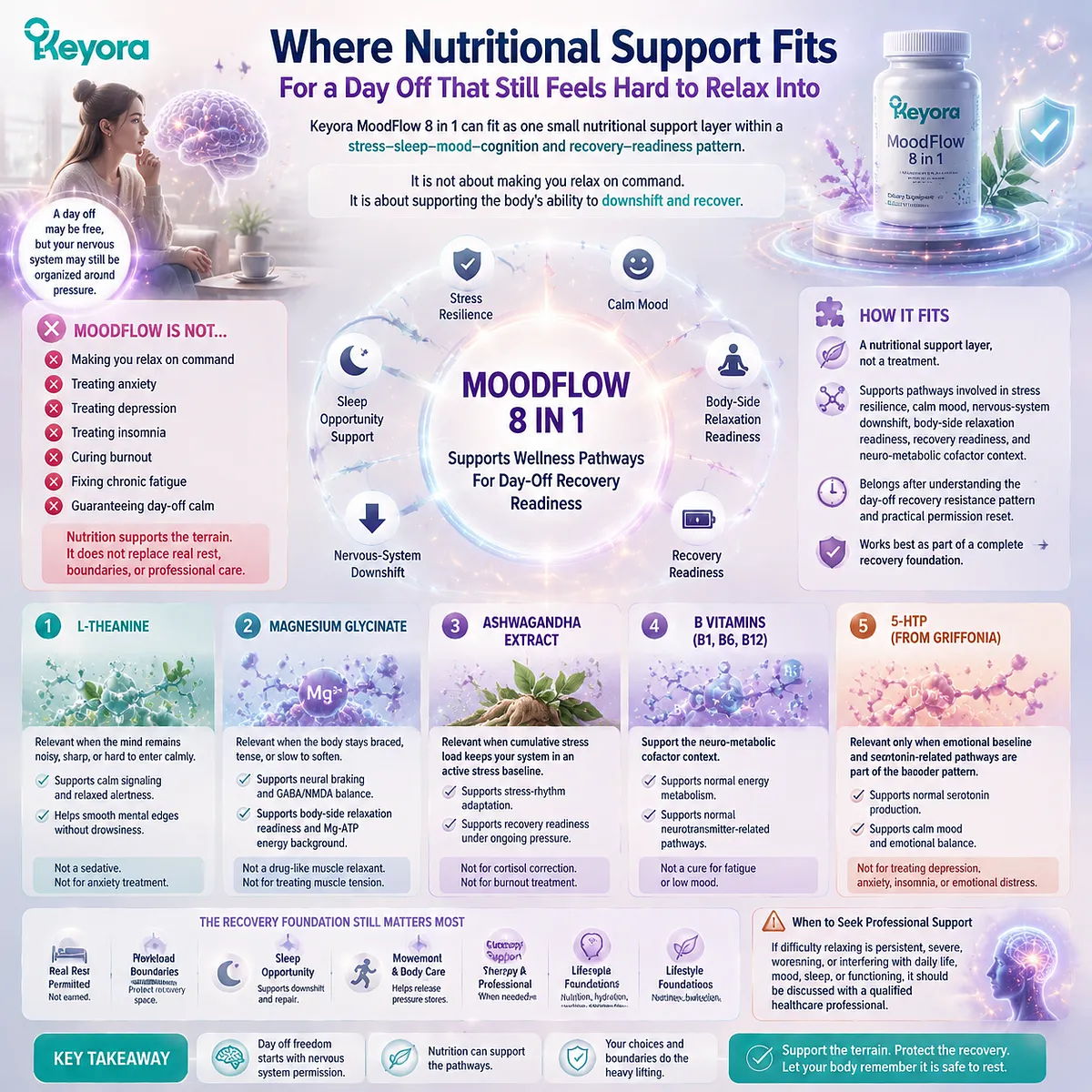
Keyora MoodFlow 8 in 1 can fit as one small nutritional support layer when difficulty relaxing on a day off appears within a broader stress-sleep-mood-cognition and recovery-readiness pattern. It should not be framed as making someone relax on command, treating anxiety, treating depression, treating insomnia, curing burnout, fixing chronic fatigue, or guaranteeing day-off calm.
Its role is narrower: supporting wellness pathways involved in stress resilience, calm mood, nervous-system downshift, body-side relaxation readiness, recovery readiness, and neuro-metabolic cofactor context.
-
L-Theanine may be relevant when a day off still feels mentally noisy, sharp, or hard to enter calmly. In the MoodFlow framework, it supports calm signaling and relaxed alertness, without being framed as sedation or anxiety treatment.
-
Magnesium glycinate may be relevant when the body remains braced, tense, or slow to soften during downtime. It supports neural braking, GABA/NMDA activation balance, body-side relaxation readiness, and Mg-ATP energy background. This is not a claim that it relaxes the body like a drug or treats muscle tension.
-
Ashwagandha may fit when cumulative stress load keeps the system in an active stress baseline even when the schedule is open. Its role is stress-rhythm adaptation and recovery readiness, not cortisol correction or burnout treatment.
-
B vitamins may support the broader neuro-metabolic cofactor context, including normal energy metabolism and normal neurotransmitter-related pathways. This belongs to the background of stress resilience and recovery readiness, not a cure for fatigue or low mood.
-
5-HTP may be relevant only when emotional baseline and serotonin-related pathway continuity are part of the broader pattern. It should not be framed as treating depression, anxiety, insomnia, or emotional distress.
MoodFlow belongs after the reader understands the day-off recovery resistance pattern and practical permission reset. Nutrition can support the terrain. It cannot replace real rest, workload boundaries, sleep opportunity, movement, emotional support, therapy, medical care, or lifestyle foundations.
If difficulty relaxing is persistent, severe, worsening, or interfering with daily life, mood, sleep, or functioning, it should be discussed with a qualified healthcare professional.
Closing Summary
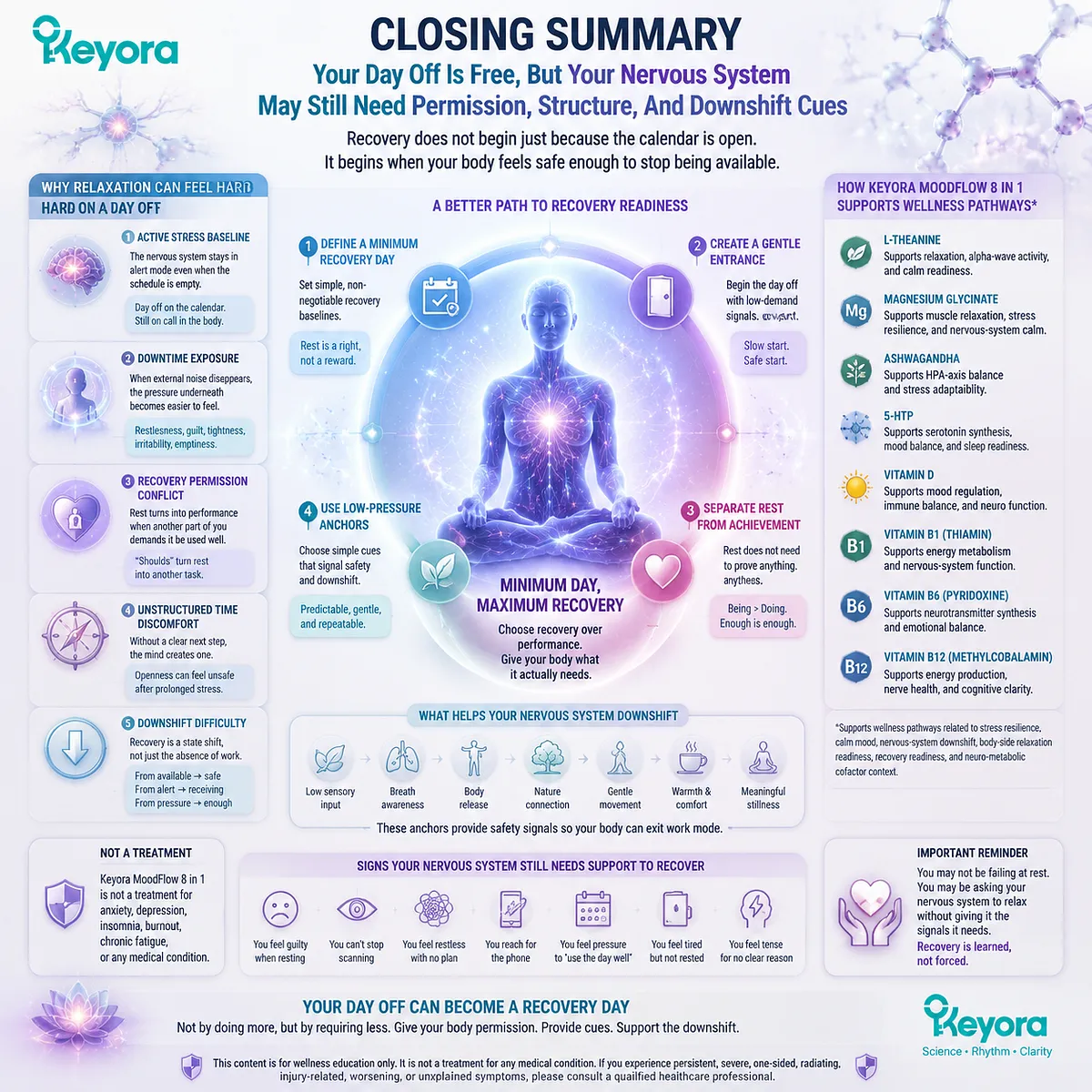
You may struggle to relax on your day off because free time does not automatically create recovery readiness. The schedule may be open while the nervous system still carries an active stress baseline.
The deeper mismatch is that a day off can remove external demands without removing internal pressure. Downtime may expose scanning, guilt, unstructured discomfort, and the feeling that rest must be used well.
A better path begins by defining a minimum recovery day, creating a gentle entrance into the day off, separating rest from achievement, and using low-pressure anchors instead of a productivity plan.
Keyora MoodFlow 8 in 1 can support wellness pathways related to stress resilience, calm mood, nervous-system downshift, body-side relaxation readiness, recovery readiness, and neuro-metabolic cofactor context. It is not a treatment for anxiety, depression, insomnia, burnout, chronic fatigue, or any medical condition.
You may not be failing at rest.
Your day off may be free, but your nervous system may still need permission, structure, and downshift cues before recovery can begin.
This article is for educational and informational purposes only. It does not provide medical advice, diagnosis, treatment, cure, prevention, disease outcome claims, hormone restoration claims, fertility outcome claims, or formula-specific clinical efficacy claims.