
Why Are Heart Health and Brain Health Connected?
Keyora Research Q&A Library
This is part of the Keyora Research Q&A Series, derived from Keyora Astaxanthin Research Journal Series.
Within the Keyora Astaxanthin Researcn framework, this Q&A translates complex astaxanthin biology into reader-friendly, evidence-bound answers, focusing on natural astaxanthin identity, molecular structure, antioxidant and redox mechanisms, membrane lipid interaction, mitochondrial resilience, inflammatory signaling pathways, human evidence interpretation, and the scientific principles behind responsible supplementation.
First published by Keyora Research Journal: www.keyorahealth.com

Direct Answer
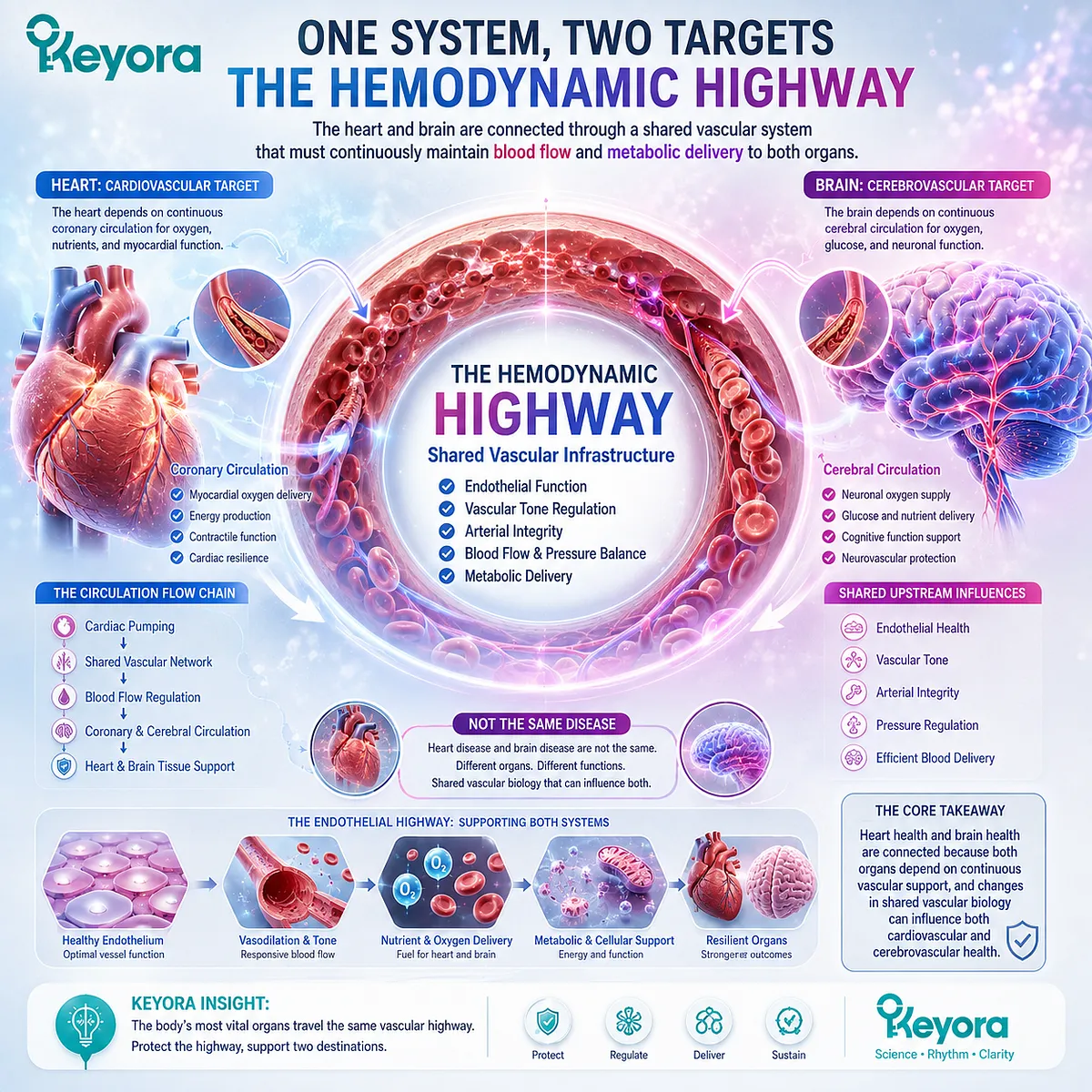
The heart and brain are connected through a shared vascular system that must continuously maintain blood flow and metabolic delivery to both organs
Heart health and brain health are connected primarily through circulation.
The heart and brain are distinct organs with different biological functions, but both depend continuously on the vascular system to maintain blood flow, oxygen delivery, and metabolic support.
In Keyora Astaxanthin EP-3: The Endothelial Architecture: Cardiovascular & Cerebrovascular Sovereignty, this shared dependence is described through the Keyora concept The Hemodynamic Highway.
The source presents the heart and brain as two highly circulation-dependent organs connected by the same vascular infrastructure.
The relationship can be simplified as:
Cardiac pumping
↓
Shared vascular network
↓
Blood flow regulation
↓
Coronary and cerebral circulation
↓
Heart and brain tissue support
This does not mean that heart disease and brain disease are the same thing.
It means that cardiovascular and cerebrovascular health can share important upstream influences, including endothelial function, vascular tone, arterial integrity, pressure regulation, and the ability of the circulation to deliver blood efficiently.
The source uses the phrase One System, Two Targets to explain this relationship.
The useful scientific interpretation is not that the heart and brain are literally one organ system, but that two different organs can be affected by changes occurring within a shared circulatory infrastructure.
The central answer is therefore:
Heart health and brain health are connected because both organs depend on continuous vascular support, and changes in shared vascular biology can influence both cardiovascular and cerebrovascular health.
What Does the Hemodynamic Highway Mean?
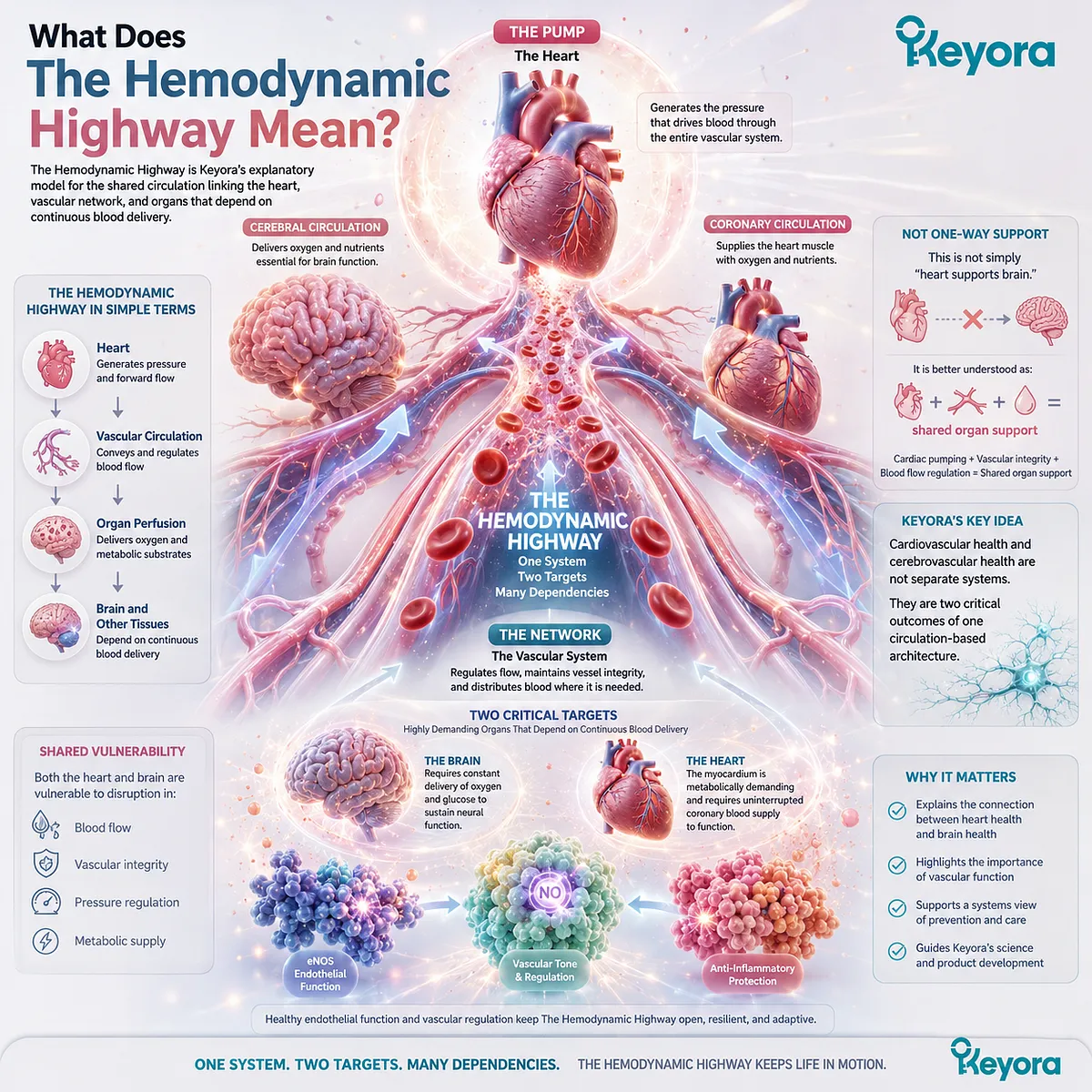
The Hemodynamic Highway is Keyora’s explanatory model for the shared circulation linking the heart, vascular network, and organs that depend on continuous blood delivery
The Hemodynamic Highway is a Keyora explanatory model used in the source to describe the vascular connection between the heart and brain.
It is not a clinical term.
The source introduces the concept by arguing that the heart and brain should not be considered in complete physiological isolation because both depend on the same circulation. It states that they share the same pump, the same circulating blood, and a common vulnerability to disruption of vascular supply.
A useful interpretation is:
Heart
↓
vascular circulation
↓
organ perfusion
↓
brain and other tissues
The model emphasizes continuity.
The heart generates the pressure required to move blood through the circulation, while the vascular network regulates how that flow is distributed.
The brain then depends on that circulation for continued delivery of oxygen and metabolic substrates.
At the same time, the heart itself is not independent of the vascular system.
The source describes the myocardium as metabolically demanding and dependent on uninterrupted blood supply, while also identifying the coronary and cerebral arteries as important supply lines for the heart and brain.
So the Hemodynamic Highway should not be interpreted as:
heart supports brain
in a one-directional sense.
It is better understood as:
cardiac pumping + vascular integrity + blood flow regulation = shared organ support
That broader model explains why Keyora treats cardiovascular and cerebrovascular health as related parts of one circulation-based architecture.
Why Do Both the Heart and Brain Depend So Heavily on Continuous Blood Flow?
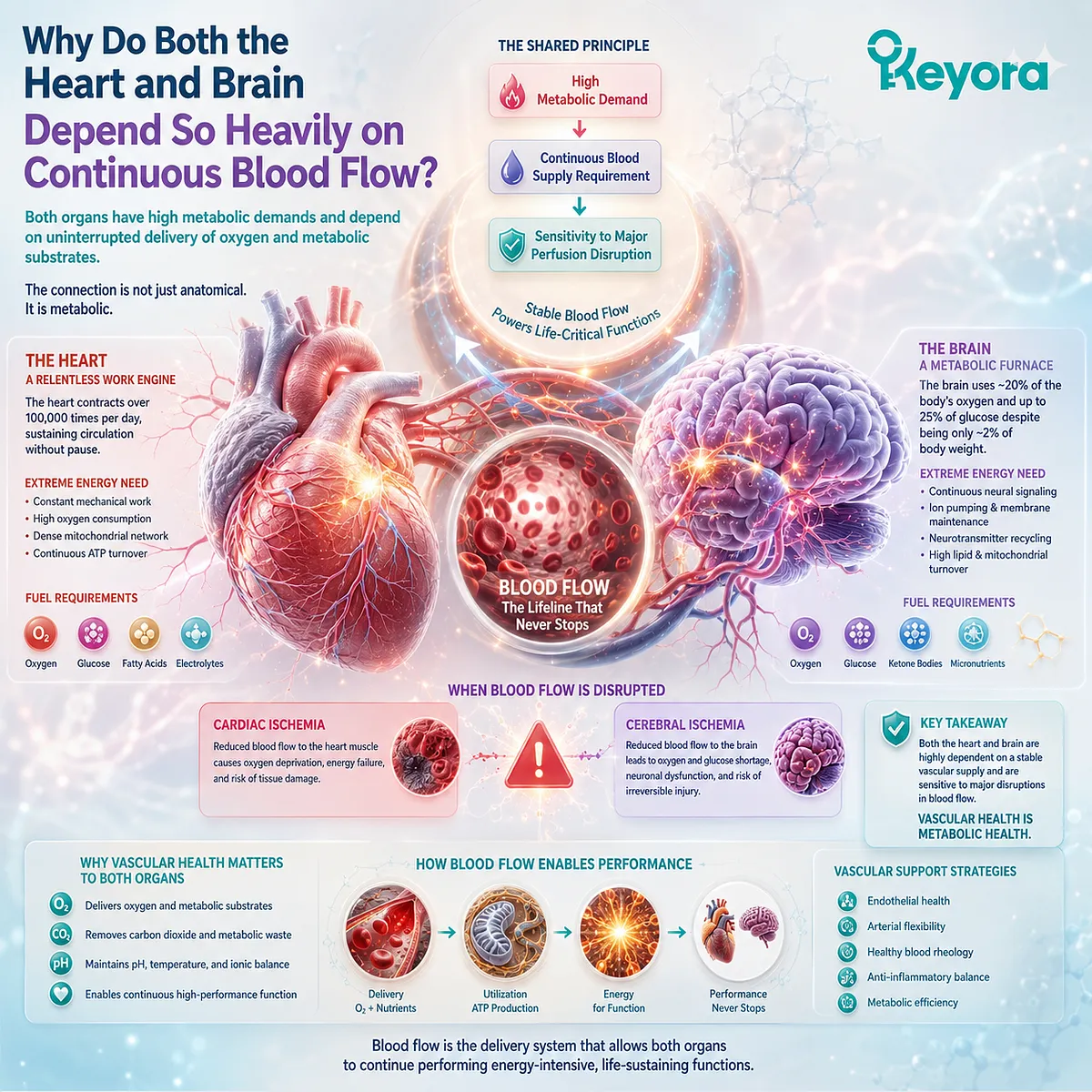
Both organs have high metabolic demands and depend on uninterrupted delivery of oxygen and metabolic substrates
The Keyora Endothelial Architecture paper describes the heart and brain as particularly demanding organs from a circulation perspective.
The source emphasizes that the heart performs continuous mechanical work and therefore requires continuous metabolic support. It also characterizes the brain as a highly metabolically active organ that depends heavily on oxygen and glucose delivery through the circulation.
The shared principle is:
High metabolic demand
↓
continuous blood supply requirement
↓
sensitivity to major perfusion disruption
This is why vascular health matters to both organs.
If blood supply to cardiac tissue is severely interrupted, heart muscle can become ischemic.
If cerebral blood supply is severely interrupted, brain tissue can also become ischemic.
The source uses dramatic phrases such as the heart having “zero tolerance” for ischemia and the brain functioning like a “metabolic furnace.” Those expressions are best understood as metaphors emphasizing strong dependence on adequate perfusion rather than as literal physiological absolutes.
The more precise conclusion is:
Both the heart and brain are highly dependent on a stable vascular supply and are sensitive to major disruptions in blood flow.
That shared dependence helps explain why vascular risk is relevant to both cardiovascular and cerebrovascular health.
The connection is therefore not simply anatomical.
It is metabolic.
Blood flow is the delivery system that allows both organs to continue performing energy-intensive functions.
How Does Vascular Health Connect Cardiac and Cerebral Health?
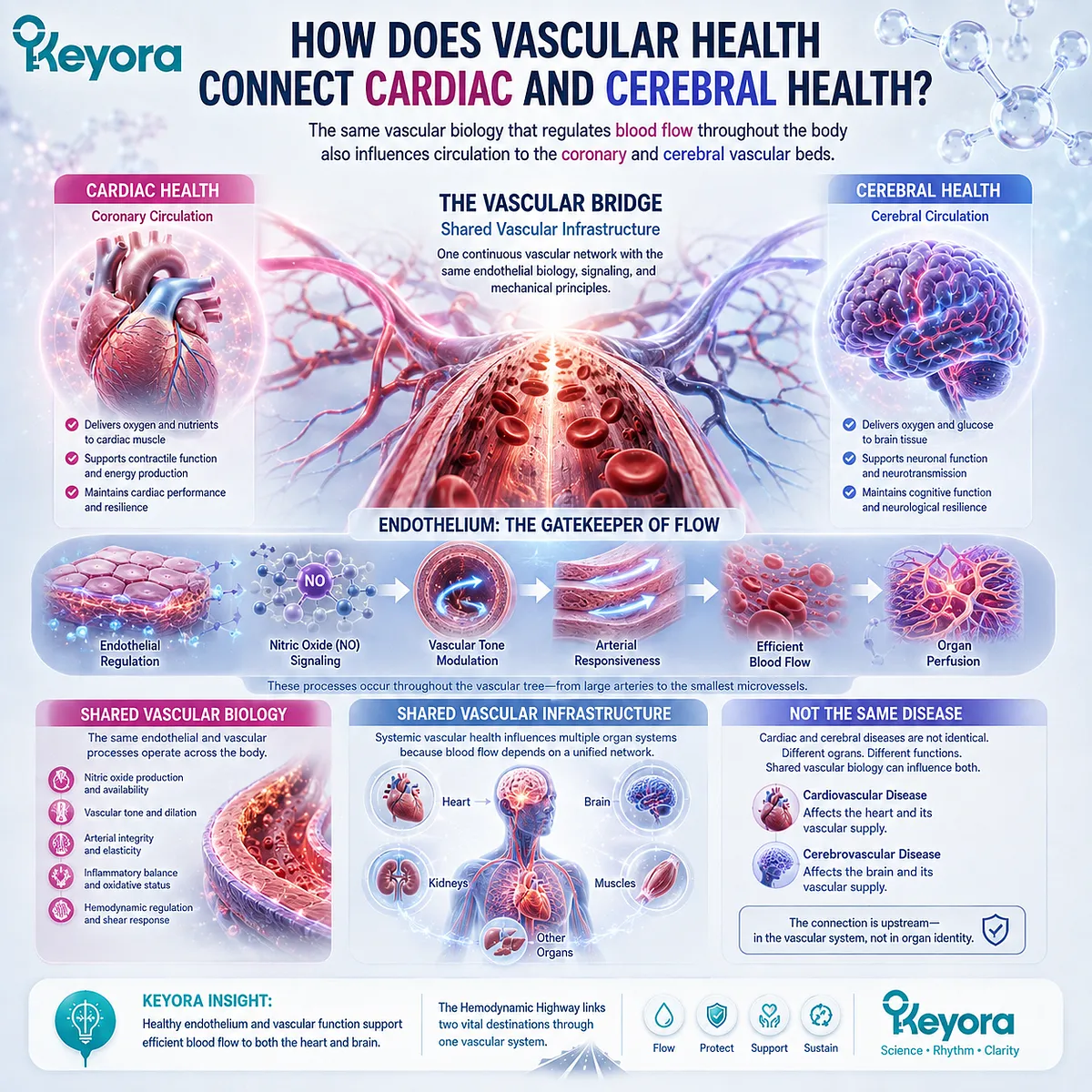
The same vascular biology that regulates blood flow throughout the body also influences circulation to the coronary and cerebral vascular beds
The vascular system is the biological bridge between cardiac and cerebral health.
The Keyora Endothelial Architecture paper places particular emphasis on the endothelium, the cellular layer lining the interior of blood vessels.
The source describes the endothelium as the Gatekeeper of Flow and emphasizes that this layer is present throughout the vascular network, from major arteries to small vessels. It also describes endothelial regulation of vascular tone through nitric oxide signaling.
This creates a shared vascular architecture:
Endothelial regulation
vascular tone
arterial responsiveness
blood flow
↓
organ perfusion
The important point is that these are not processes occurring only in vessels supplying the heart.
They are features of vascular biology throughout the circulation.
For this reason, the health of the vascular network can influence multiple organ systems.
Keyora can summarize this as Shared Vascular Infrastructure.
This concept describes how systemic vascular processes can affect the supply routes serving different organs without implying that all vascular diseases are identical.
The heart and brain remain biologically distinct.
Their circulatory support, however, is closely connected.
This is the deeper physiological meaning behind the source’s Hemodynamic Highway model.
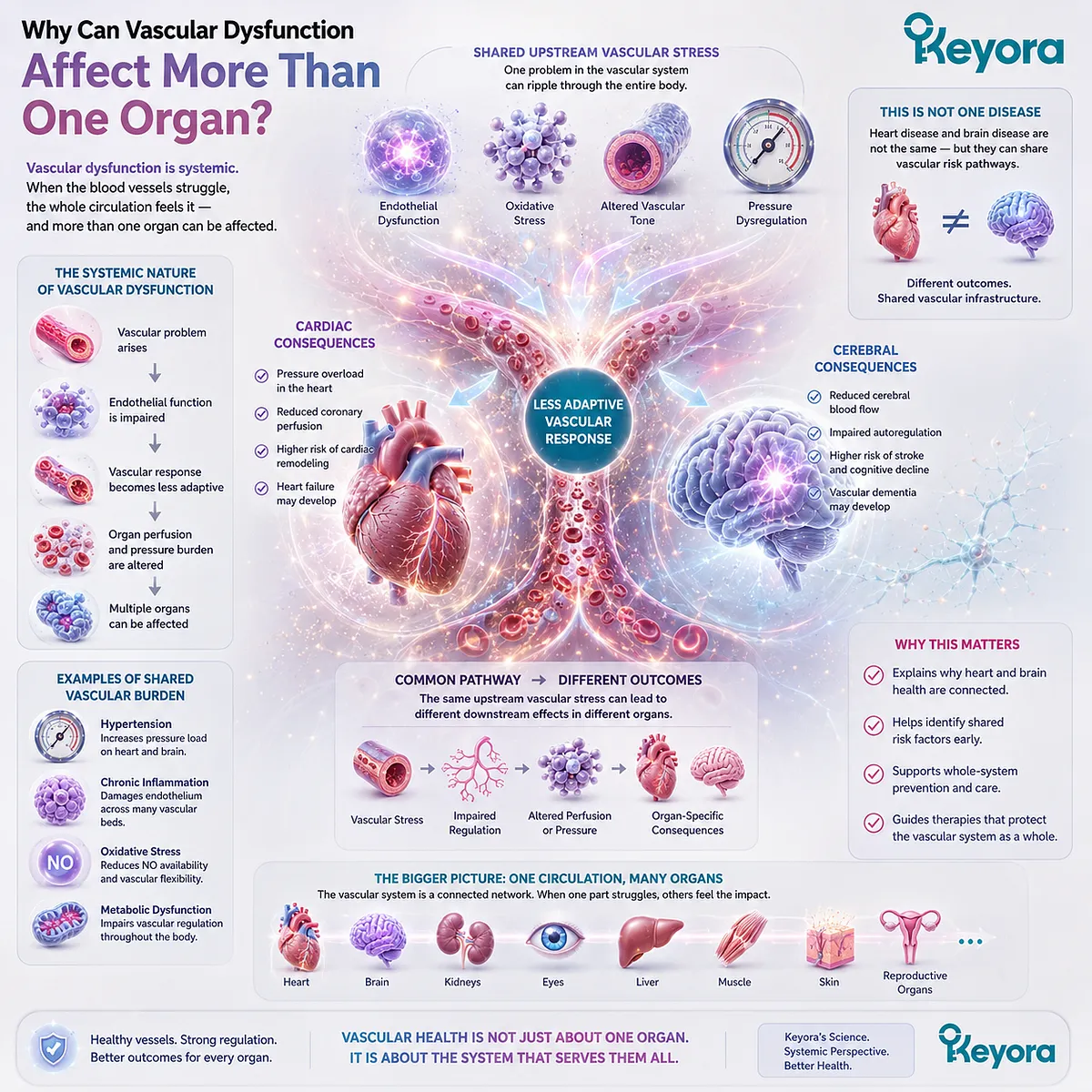
Why Can Vascular Dysfunction Affect More Than One Organ?
Vascular dysfunction is systemic enough that impaired regulation in the circulation can have consequences beyond a single organ
A vascular problem does not always remain relevant to only one tissue.
The Keyora Endothelial Architecture paper treats endothelial dysfunction, altered vascular tone, oxidative stress, and pressure regulation as processes that can affect the broader circulatory system.
The source specifically connects systemic vascular dysfunction with both cardiac and cerebral consequences and uses examples such as hypertension and impaired endothelial regulation to illustrate this shared burden.
The key concept is:
shared upstream vascular stress
can produce
different downstream organ effects
For example:
altered endothelial regulation
↓
less adaptive vascular response
↓
changes in organ perfusion or pressure burden
↓
cardiac and cerebral consequences may differ
This is why heart health and brain health can be related even though heart disease and brain disease are not interchangeable.
The source sometimes describes different clinical problems as symptoms of a single systemic failure.
That wording is too broad.
A more accurate interpretation is:
Some cardiovascular and cerebrovascular conditions share vascular mechanisms and risk pathways, but they remain distinct clinical diseases.
The connection is strongest at the level of common vascular infrastructure.
That shared infrastructure provides the biological reason one organ cannot always be discussed in complete isolation from the other.
Are Heart Attack and Stroke the Same Disease?
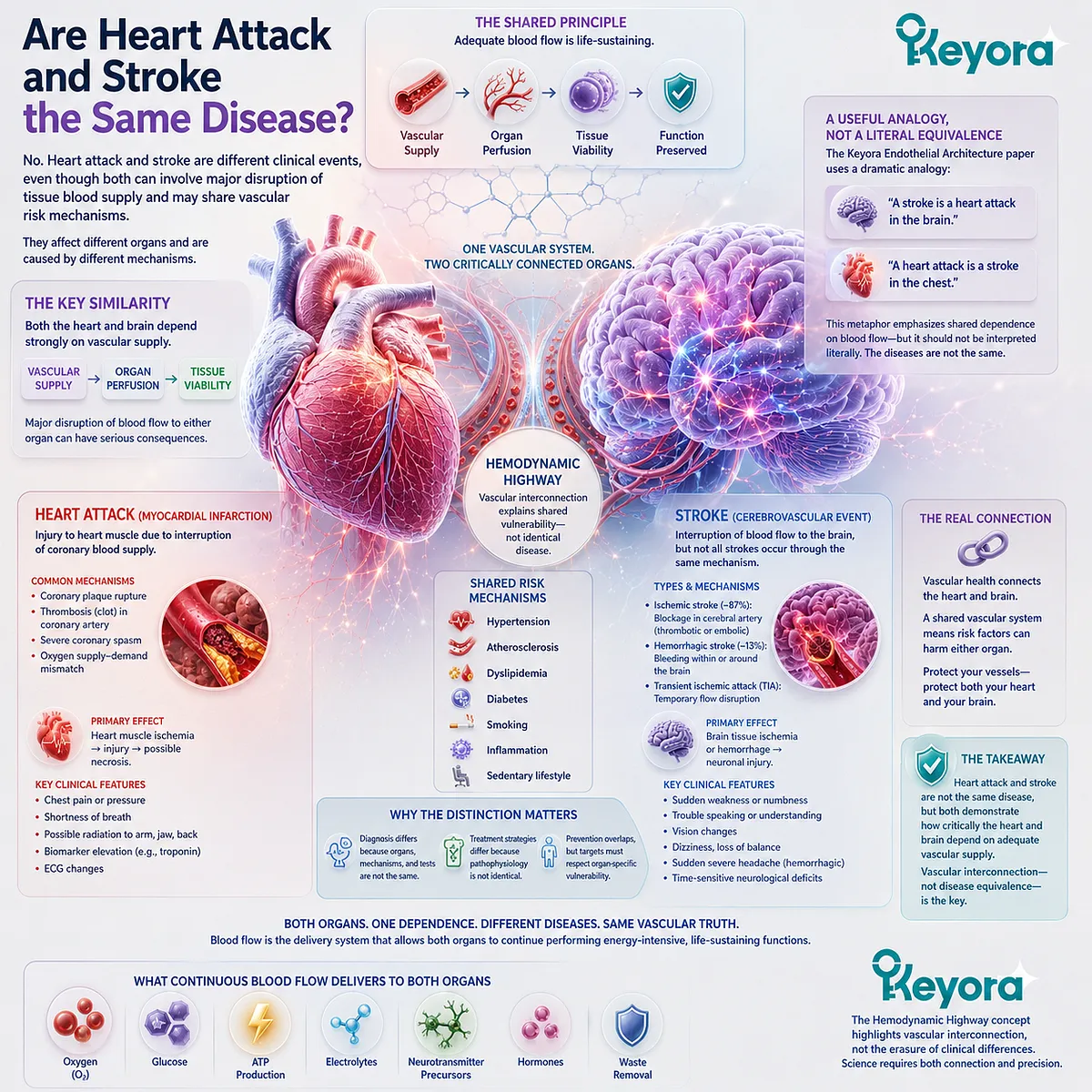
No. Heart attack and stroke are different clinical events, even though both can involve major disruption of tissue blood supply and may share vascular risk mechanisms
The Keyora Endothelial Architecture paper uses a dramatic analogy suggesting that a stroke is a heart attack in the brain and a heart attack is a stroke in the chest.
That metaphor should not be interpreted literally.
A heart attack and a stroke are different clinical conditions.
A heart attack involves injury to heart muscle associated with interruption of myocardial blood supply.
A stroke affects the brain, and not all strokes arise through the same mechanism. The Keyora source focuses heavily on vascular interruption and ischemic concepts, but its analogy should not be extended into a claim that all strokes are biologically equivalent to myocardial infarction.
The useful similarity is narrower:
Both the heart and brain depend strongly on vascular supply.
Therefore, major disruption of blood flow to either organ can have serious consequences.
The common architecture is:
vascular supply
↓
organ perfusion
↓
tissue viability
That is the shared principle.
The diseases themselves remain distinct.
This distinction matters because the goal of the Hemodynamic Highway framework is to show vascular interconnection, not to erase clinical differences between cardiovascular and cerebrovascular disease.
A scientifically useful conclusion is:
Heart attack and stroke are not the same disease, but both demonstrate how critically the heart and brain depend on adequate vascular supply.
Why Can Cardiovascular Risk Factors Also Matter for Brain Health?
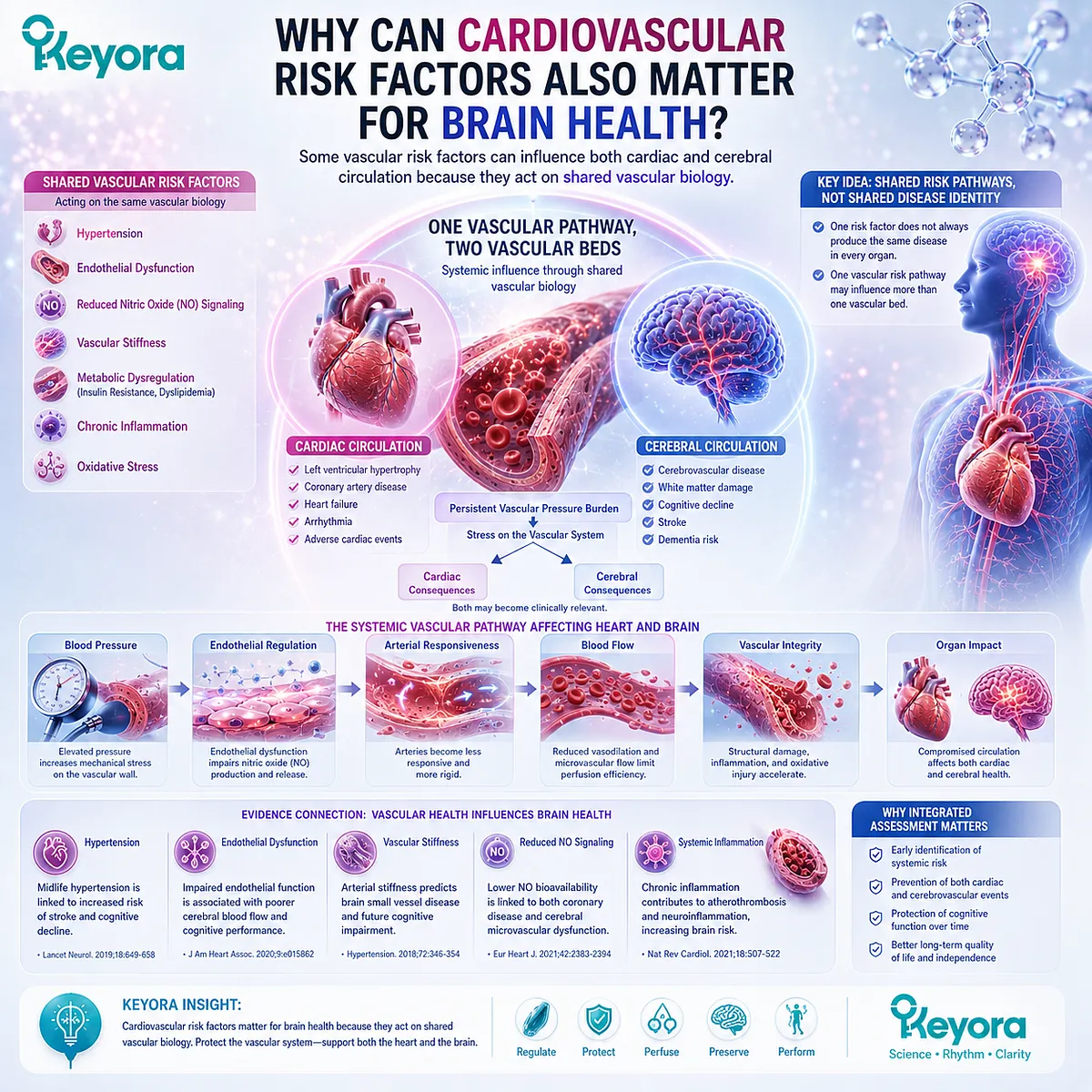
Some vascular risk factors can influence both cardiac and cerebral circulation because they act on shared vascular biology
The heart-brain connection becomes especially important when the same vascular risk factor can influence circulation throughout the body.
The Keyora Endothelial Architecture paper uses hypertension, endothelial dysfunction, altered nitric oxide signaling, and vascular stiffness as examples of vascular conditions with relevance beyond the heart alone. The source also connects hypertension with later cognitive risk within its broader cardiovascular and cerebrovascular architecture.
The useful idea is not:
one risk factor always produces the same disease in every organ
It is:
one vascular risk pathway may influence more than one vascular bed
For example:
Persistent vascular pressure burden
↓
stress on the vascular system
↓
cardiac consequences
and
cerebral vascular consequences
may both become clinically relevant.
This is why cardiovascular risk assessment can also matter when thinking about long-term brain health.
The source’s broader message is that vascular health should not be divided into completely isolated heart and brain categories.
A more integrated view considers how:
blood pressure
endothelial regulation
arterial responsiveness
blood flow
and
vascular integrity
can have systemic consequences.
The emphasis should remain on shared risk pathways, not shared disease identity.
Does Better Heart Health Automatically Mean Better Brain Function?
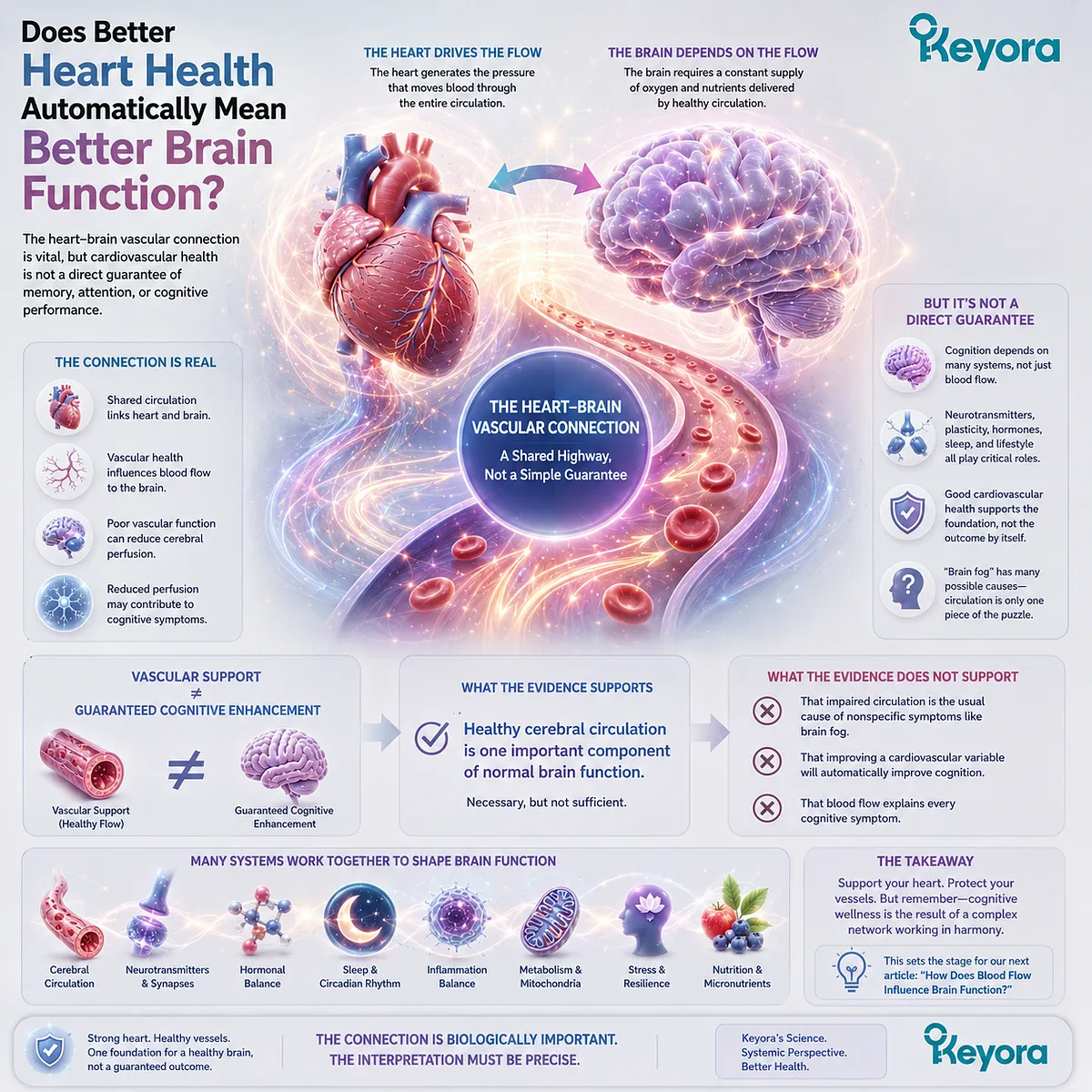
The connection is biologically important, but cardiovascular health should not be treated as a direct guarantee of cognitive performance
No.
The heart-brain vascular connection is important, but it should not be interpreted as meaning that better cardiovascular health automatically produces better memory, attention, or cognitive performance.
The Keyora Endothelial Architecture paper sometimes connects reduced cerebral perfusion with “brain fog” and suggests that optimized flow can improve cognitive clarity.
That interpretation should be kept within clear boundaries.
Adequate cerebral perfusion is necessary for normal brain function.
But brain function also depends on many other biological systems.
The source material does not establish that nonspecific symptoms such as brain fog are usually caused by impaired circulation.
It also does not establish that improving a cardiovascular variable will automatically improve cognition.
The distinction is:
Vascular support
does not equal
guaranteed cognitive enhancement
The strongest supported statement is:
Healthy cerebral circulation is one important component of normal brain function.
That is enough to establish the heart-brain connection without turning circulation into a complete theory of cognition.
This evidence boundary also prepares the next article, “How Does Blood Flow Influence Brain Function?”, where the role of cerebral perfusion can be examined more directly without assuming that blood flow explains every cognitive symptom.
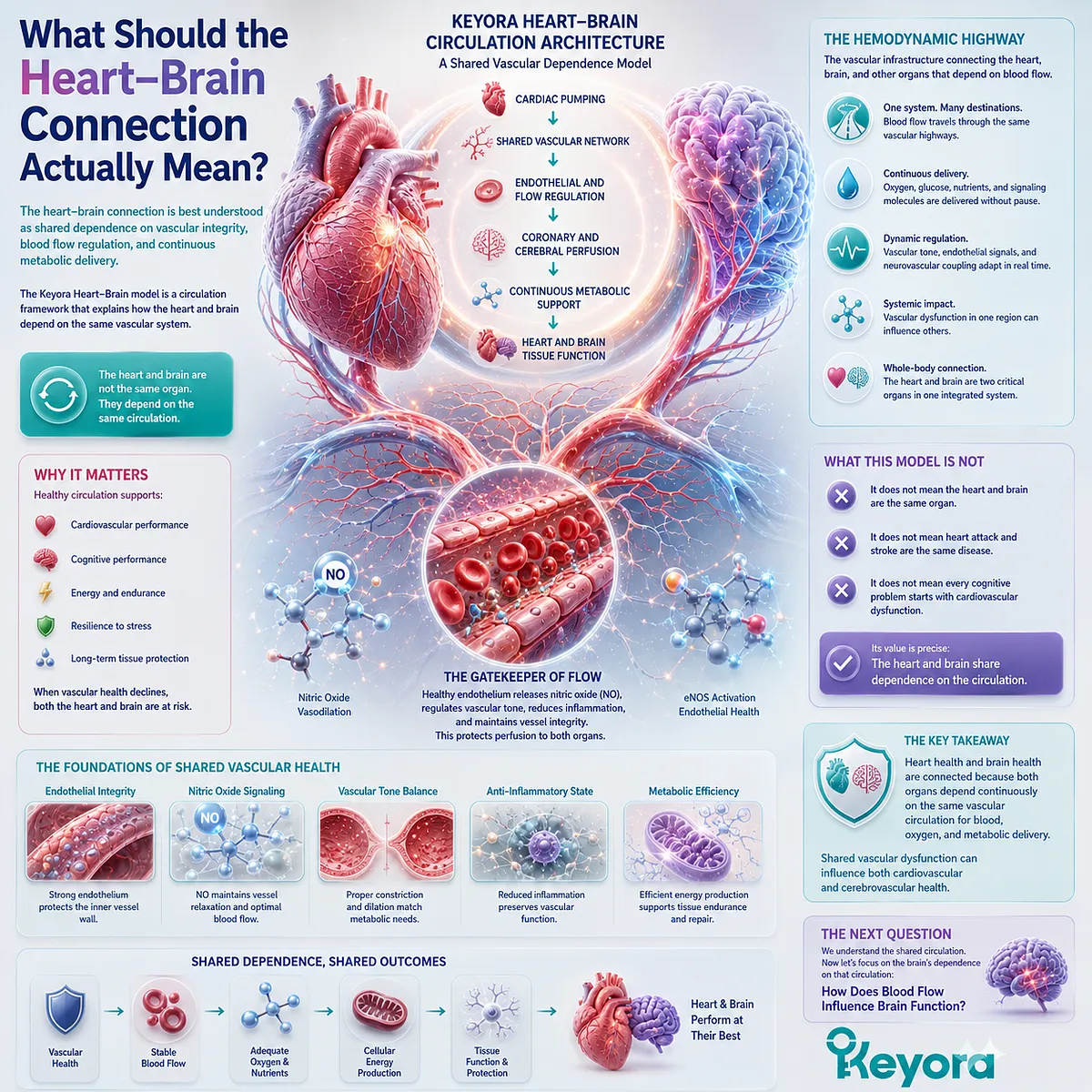
What Should the Heart-Brain Connection Actually Mean?
The heart-brain connection is best understood as shared dependence on vascular integrity, blood flow regulation, and continuous metabolic delivery
The Keyora heart-brain model is most useful when it is understood as a circulation framework.
We can summarize this as the Keyora Heart-Brain Circulation Architecture.
This is an explanatory model, not a clinical diagnostic term.
The framework is:
Cardiac Pumping
↓
Shared Vascular Network
↓
Endothelial and Flow Regulation
↓
Coronary and Cerebral Perfusion
↓
Continuous Metabolic Support
↓
Heart and Brain Tissue Function
Within this structure, The Hemodynamic Highway describes the vascular infrastructure connecting the heart, brain, and other organs that depend on blood flow.
The concept does not mean that the heart and brain are the same organ.
It does not mean that heart attack and stroke are the same disease.
And it does not mean that every cognitive problem begins with cardiovascular dysfunction.
Its value is more precise:
The heart and brain share dependence on the circulation.
The Keyora Endothelial Architecture paper supports this systems-level interpretation by describing the heart and brain as highly perfusion-dependent organs and by placing endothelial function, nitric oxide signaling, vascular integrity, and blood flow within the same cardiovascular and cerebrovascular architecture.
The final answer is therefore:
Heart health and brain health are connected because both organs depend continuously on the same vascular circulation for blood, oxygen, and metabolic delivery, while shared vascular dysfunction can influence both cardiovascular and cerebrovascular health.
The next question moves from the shared circulation itself to the brain’s dependence on that circulation:
How Does Blood Flow Influence Brain Function?
This article is for educational and informational purposes only. It does not provide medical advice, diagnosis, treatment, cure, prevention, disease outcome claims, hormone restoration claims, fertility outcome claims, or formula-specific clinical efficacy claims.