
Why Are Fatty Acids Important for Cell Membranes?
Keyora Research Q&A Library
This is part of the Keyora Research Q&A Series, derived from Keyora Astaxanthin Research Journal Series.
Within the Keyora Astaxanthin Researcn framework, this Q&A translates complex astaxanthin biology into reader-friendly, evidence-bound answers, focusing on natural astaxanthin identity, molecular structure, antioxidant and redox mechanisms, membrane lipid interaction, mitochondrial resilience, inflammatory signaling pathways, human evidence interpretation, and the scientific principles behind responsible supplementation.
First published by Keyora Research Journal: www.keyorahealth.com

Direct Answer
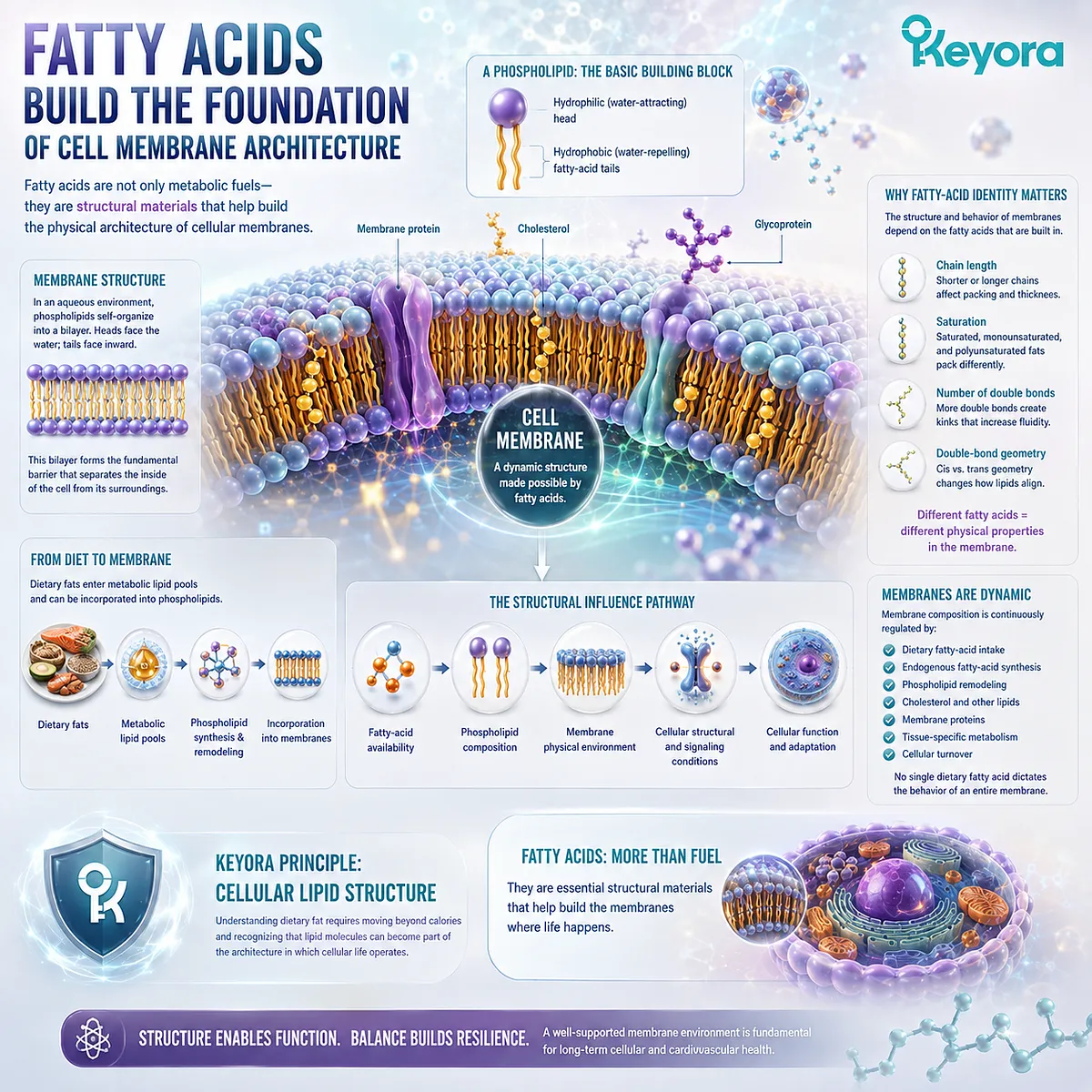
Fatty acids are not only metabolic fuels—they are structural materials that help build the physical architecture of cellular membranes
Cell membranes are built largely from a phospholipid bilayer, and fatty acids form the hydrophobic tails of those phospholipid molecules.
This means fatty acids are not merely nutrients that circulate through the body or provide calories. After entering metabolic lipid pools, they can become part of the structures that separate the inside of a cell from its surrounding environment.
A phospholipid typically contains a water-attracting head and two water-repelling fatty-acid tails.
When many phospholipids organize together in an aqueous environment, their heads face the surrounding water while their fatty-acid tails turn inward toward one another. The result is a bilayer with a lipid-rich interior that forms the fundamental structural platform of the membrane.
The identity of the fatty acids in that structure matters.
Chain length, saturation, number of double bonds, and double-bond geometry can influence how closely neighboring lipid molecules pack together and how dynamically the membrane behaves.
Saturated, monounsaturated, and polyunsaturated fatty acids therefore do not contribute identical physicochemical properties to the membrane lipid pool.
This does not mean that one dietary fatty acid directly determines the behavior of an entire cell membrane.
Membrane composition is continuously regulated through dietary intake, endogenous fatty-acid synthesis, phospholipid remodeling, cholesterol, proteins, tissue-specific metabolism, and cellular turnover.
The important principle is broader:
Fatty-acid availability
↓
Phospholipid composition
↓
Membrane physical environment
↓
Cellular structural and signaling conditions
This is why Keyora treats fatty acids as part of Cellular Lipid Structure.
Understanding dietary fat requires moving beyond calories and recognizing that lipid molecules can become part of the architecture in which cellular life operates.
What Is a Phospholipid Bilayer Actually Made Of?
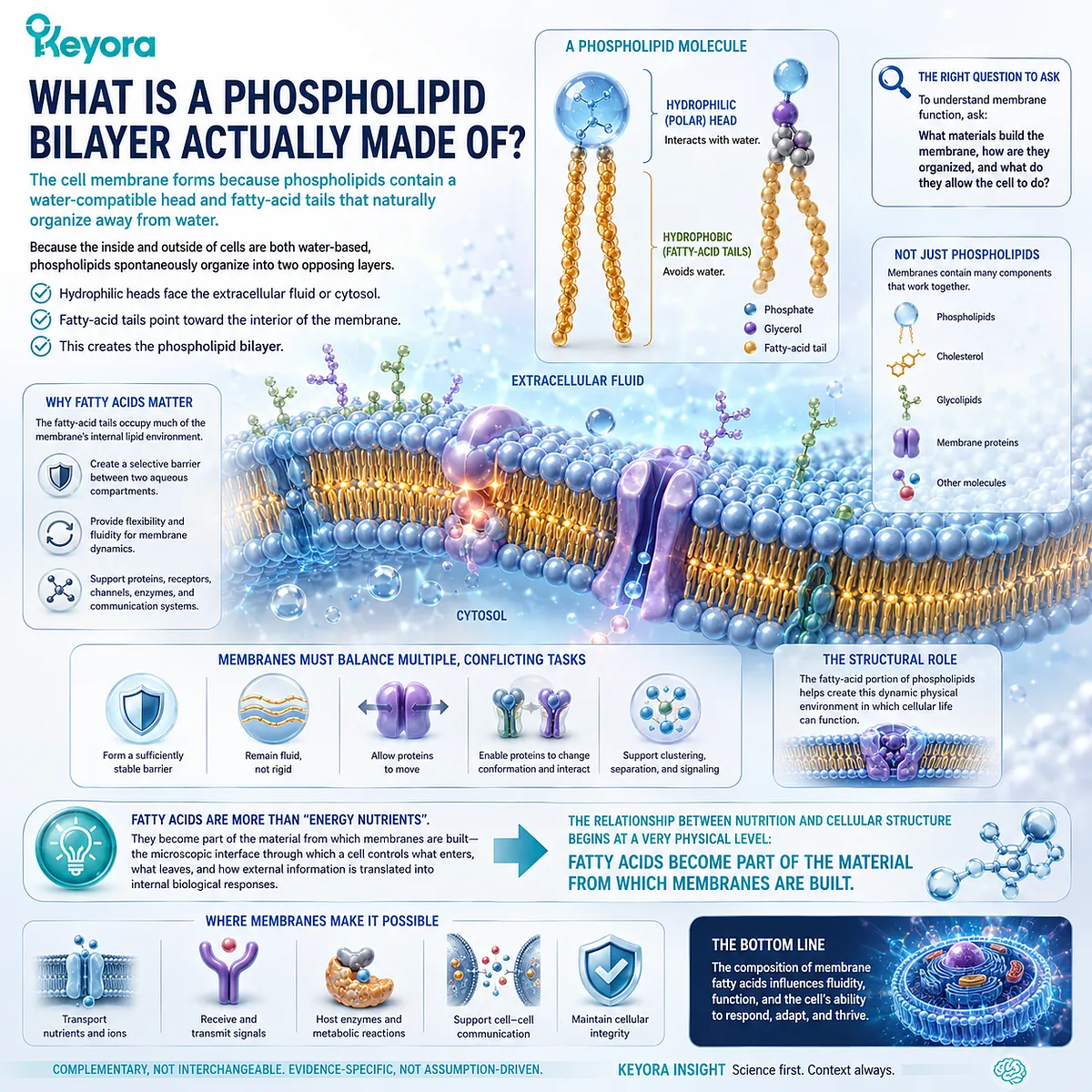
The cell membrane forms because phospholipids contain a water-compatible head and fatty-acid tails that naturally organize away from water
To understand why fatty acids matter, it helps to look at the basic architecture of a phospholipid.
The head region of a phospholipid is polar and interacts with water.
Its fatty-acid tails are hydrophobic, meaning they tend to avoid direct contact with the aqueous environment.
Because the inside and outside of cells are both water-based, phospholipids spontaneously organize into two opposing layers.
The hydrophilic heads face the extracellular fluid or cytosol.
The fatty-acid tails point toward the interior of the membrane.
This creates the phospholipid bilayer.
The fatty-acid tails therefore occupy much of the membrane’s internal lipid environment.
They help create a barrier that separates two aqueous compartments while still allowing the membrane to remain dynamic enough to support transport proteins, receptors, channels, enzymes, and communication systems.
The membrane is not composed of phospholipids alone.
Cholesterol, glycolipids, membrane proteins, and other molecules also contribute substantially to membrane organization.
But phospholipid fatty acids are among the fundamental materials that determine how the lipid portion of the membrane is assembled.
This structural role is important because membranes must perform several apparently conflicting tasks at once.
They must form a sufficiently stable barrier, yet they cannot become an immobile shell. Proteins must be able to move, change conformation, cluster, separate, and interact with other molecules.
The fatty-acid portion of phospholipids helps create this dynamic physical environment.
This is why calling fatty acids simply “energy nutrients” is incomplete.
The same category of molecules discussed on a nutrition label can eventually contribute to the microscopic interface through which a cell controls what enters, what leaves, and how external information is translated into internal biological responses.
The relationship between nutrition and cellular structure therefore begins at a very physical level:
fatty acids become part of the material from which membranes are built.
Why Does Fatty-Acid Structure Change Membrane Behavior?
The geometry of a fatty-acid chain influences how phospholipids pack together and therefore contributes to the physical properties of the membrane
Not all fatty acids have the same molecular shape.
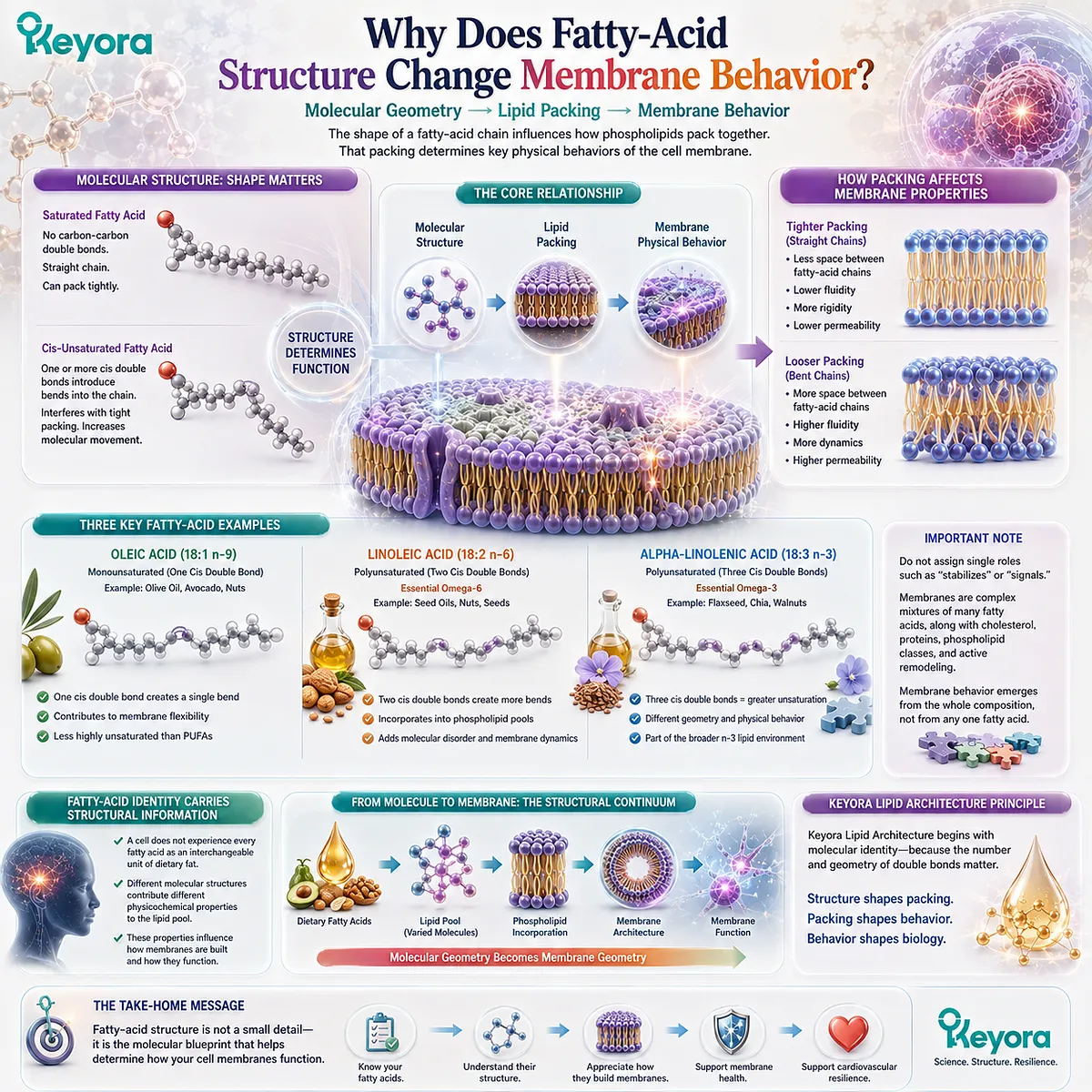
A saturated fatty acid contains no carbon-carbon double bonds. Its hydrocarbon chain can therefore adopt a relatively straight configuration that generally permits neighboring lipid chains to pack more closely.
A cis-unsaturated fatty acid contains one or more double bonds that introduce bends into the chain. These bends interfere with tight packing and can increase the dynamic movement of surrounding phospholipids.
This creates an important relationship:
Molecular structure
↓
Lipid packing
↓
Membrane physical behavior
Oleic acid illustrates the monounsaturated pattern.
It contains one cis double bond and can contribute to membrane flexibility while remaining less highly unsaturated than polyunsaturated fatty acids.
Linoleic acid contains two cis double bonds.
As an essential Omega-6 PUFA, it can become part of phospholipid pools and contributes a different degree of molecular disorder and membrane dynamics.
Alpha-linolenic acid contains three cis double bonds and represents an essential Omega-3 PUFA.
Its higher degree of unsaturation gives it a different physical geometry again and places it within the broader n-3 lipid environment.
These examples should not be turned into rigid assignments such as “oleic acid stabilizes,” “linoleic acid signals,” or “ALA creates fluidity.” Biological membranes contain mixtures of many fatty acids, and membrane behavior emerges from their collective composition together with cholesterol, proteins, phospholipid classes, and active cellular remodeling.
The important lesson is that fatty-acid identity carries structural information.
A cell does not experience every fatty acid as an interchangeable unit of dietary fat.
Different molecular structures contribute different physicochemical properties to the lipid pool from which membranes are assembled.
This is one reason Keyora’s Lipid Architecture framework begins with molecular identity rather than treating all unsaturated fats as equivalent.
The number and geometry of double bonds matter because molecular geometry eventually becomes membrane geometry.
Why Does a Cell Membrane Need Both Fluidity and Stability?
A functional membrane requires a regulated physical state that is dynamic enough for communication but stable enough to preserve cellular organization
It is tempting to think that a more fluid membrane must always be healthier. That is not a useful biological rule.
A cell membrane must maintain a controlled balance between flexibility and structural stability.
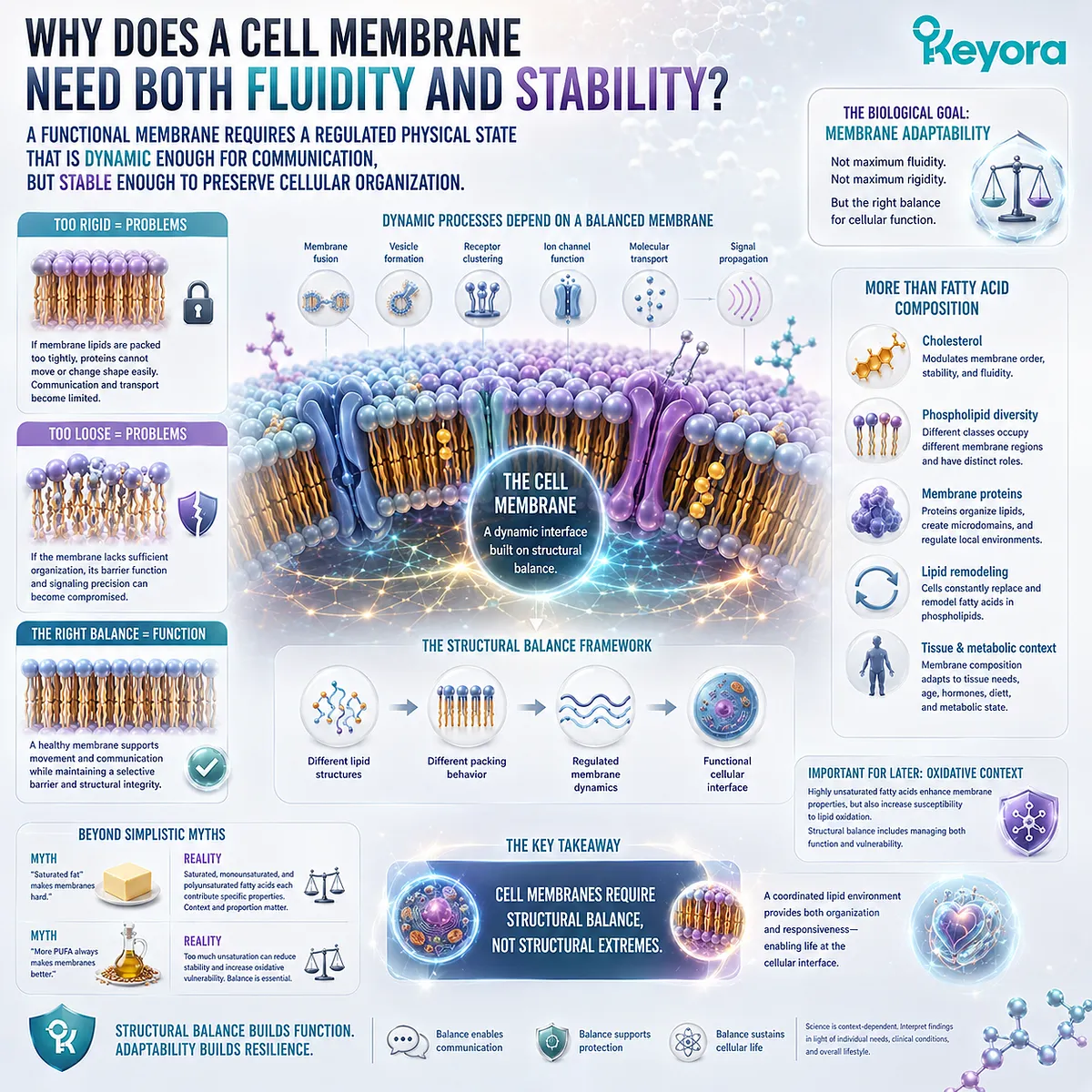
If membrane lipids were packed into a completely rigid structure, many proteins would have difficulty moving or changing configuration.
If the membrane lacked sufficient organization, its barrier and signaling functions could also become compromised.
The biological goal is therefore not maximum fluidity.
It is membrane adaptability.
A functioning membrane needs to support movement of receptors, transporters, ion channels, and signaling complexes while preserving a selective boundary between the cell and its environment.
Membrane fusion, vesicle formation, receptor clustering, molecular transport, and signal propagation all depend on a lipid environment capable of controlled movement.
Fatty-acid composition contributes to that environment, but it does not work alone.
Cholesterol can influence membrane order and fluidity.
Different phospholipid classes occupy different membrane regions.
Proteins can reorganize local lipid domains.
Cells also remodel phospholipid fatty acids over time according to tissue needs and metabolic conditions.
This is why simplistic statements such as “saturated fat makes membranes hard” or “more PUFA always makes membranes better” do not adequately describe membrane biology.
A more accurate framework is:
Different lipid structures
↓
Different packing behavior
↓
Regulated membrane dynamics
↓
Functional cellular interface
The concept of Structural Balance is useful here because a healthy membrane is not defined by one fatty acid dominating the bilayer.
It is created through a coordinated lipid environment capable of maintaining both organization and responsiveness.
This becomes particularly important later when considering oxidative stress. Highly unsaturated fatty acids contribute important physical properties, but unsaturation also affects susceptibility to lipid oxidation.
For the current question, however, the central point is simpler:
Cell membranes require structural balance, not structural extremes.
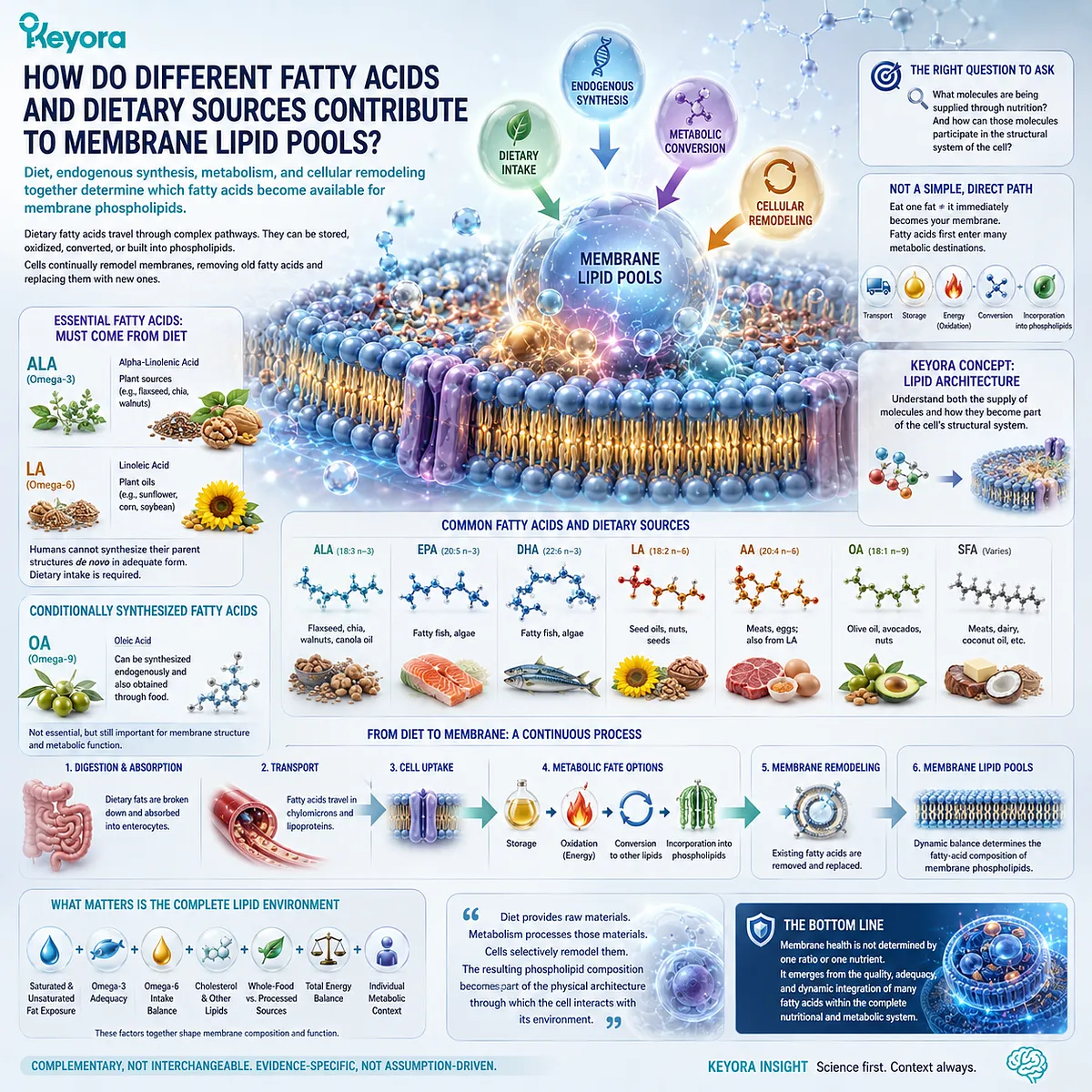
How Do Different Fatty Acids and Dietary Sources Contribute to Membrane Lipid Pools?
Diet, endogenous synthesis, metabolism, and cellular remodeling together determine which fatty acids become available for membrane phospholipids
Dietary fatty acids can influence membrane lipid composition, but the relationship is not as direct as “eat one fat and it immediately becomes your membrane.”
After digestion and absorption, fatty acids enter complex metabolic pathways.
They can be transported, stored, oxidized for energy, modified into other lipid molecules, or incorporated into phospholipids.
Cells can also remove and replace fatty acids within existing phospholipids through continuous membrane remodeling.
Some fatty acids can be synthesized by the human body.
Oleic acid, for example, is a monounsaturated Omega-9 fatty acid that can be produced endogenously as well as obtained through food.
ALA and LA are different.
ALA is an essential Omega-3 fatty acid, while LA is an essential Omega-6 fatty acid. Humans cannot synthesize their parent structures de novo in adequate form and therefore depend on dietary intake for these fatty-acid families.
That essentiality creates a direct nutritional connection to membrane biology.
If an essential fatty acid must come from food, dietary availability becomes one of the factors determining the substrate pool available for metabolism and membrane incorporation.
This does not mean that a single target ratio determines membrane health. ALA, LA, OA, longer-chain Omega-3 fatty acids, saturated fatty acids, cholesterol, and multiple phospholipid classes coexist within a highly regulated system.
What matters is the complete lipid environment.
The Keyora concept of Lipid Architecture therefore asks two different questions at the same time:
What molecules are being supplied through nutrition?
And how can those molecules participate in the structural system of the cell?
This is a much more useful way to understand dietary fat than categorizing every lipid as simply “good” or “bad.”
Diet provides raw materials.
Metabolism processes those materials.
Cells selectively remodel them.
And the resulting phospholipid composition becomes part of the physical architecture through which the cell interacts with its environment.
Why Do Membrane Fatty Acids Matter for Cellular Communication?
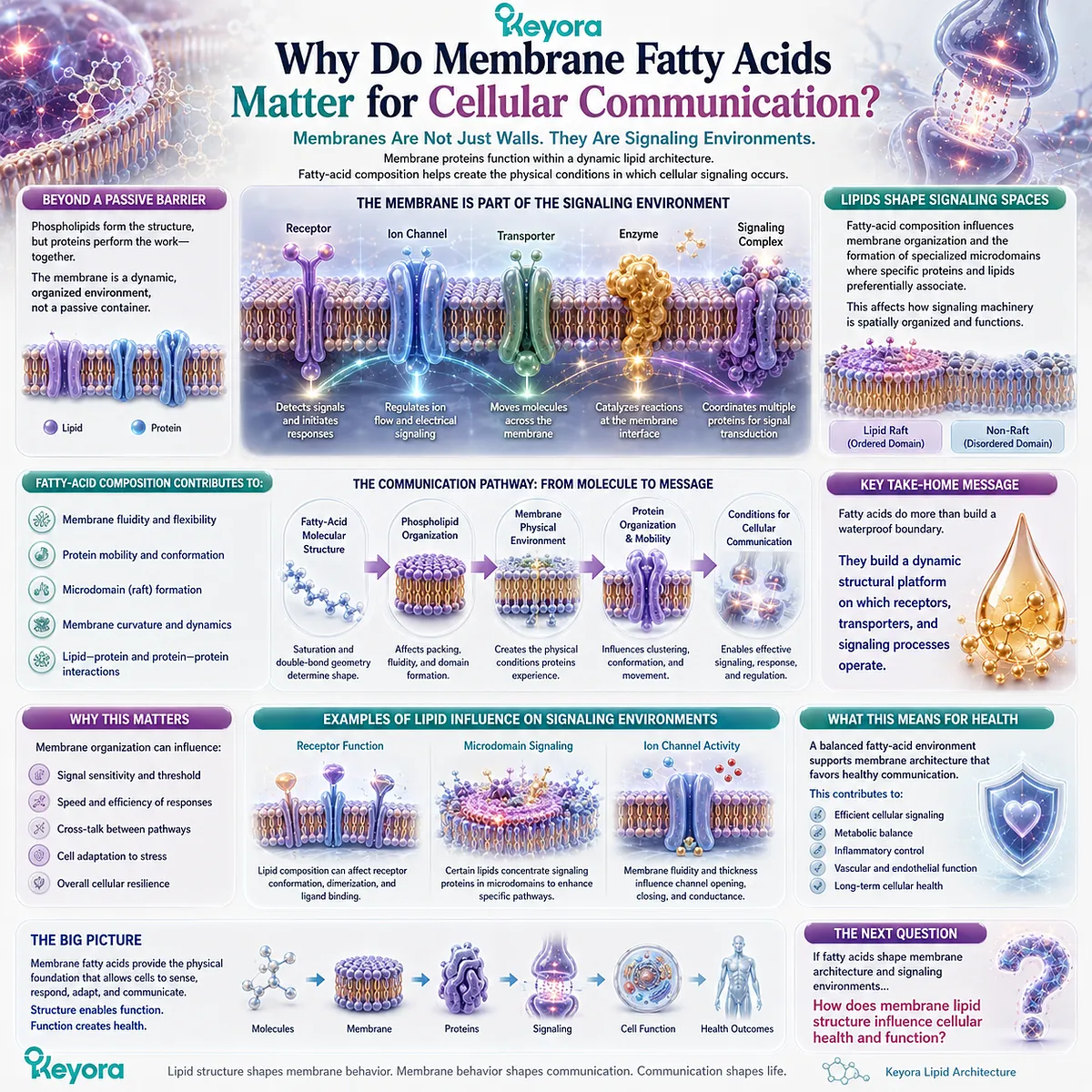
Membrane proteins operate inside a lipid environment, so the surrounding fatty-acid architecture helps create the physical conditions in which cellular signaling occurs
A cell membrane is sometimes illustrated as though phospholipids form a passive wall while proteins perform all of the important work.
In reality, membrane proteins function within the lipid bilayer.
Receptors, ion channels, transporters, enzymes, and signaling complexes are embedded in or associated with a highly organized lipid environment.
Their ability to move, cluster, separate, rotate, or change conformation depends partly on the physical properties of the membrane surrounding them.
This means the membrane is not simply a container for cellular signaling.
The membrane is part of the signaling environment.
Fatty-acid composition can contribute to membrane organization and to the formation of specialized microdomains in which certain proteins and lipids preferentially associate.
Changes in lipid composition can therefore influence how signaling machinery is spatially organized, even though the biological effect depends on many factors beyond fatty acids alone.
The relationship can be summarized as:
Fatty-acid molecular structure
↓
Phospholipid organization
↓
Membrane physical environment
↓
Protein organization and mobility
↓
Conditions for cellular communication
This is the most important reason fatty acids matter to cell membranes.
Their role is not limited to forming a waterproof boundary. They contribute to a dynamic structural platform on which receptors, transport systems, and signaling processes operate.
That conclusion also creates the next step in the EP-3 knowledge chain.
If fatty acids help determine the physical architecture of the membrane, then the next question is no longer simply what a membrane is made of.
The next question is:
How does membrane lipid structure influence cellular health and function?
That is where Cellular Lipid Structure moves from basic architecture into biological consequence.
This article is for educational and informational purposes only. It does not provide medical advice, diagnosis, treatment, cure, prevention, disease outcome claims, hormone restoration claims, fertility outcome claims, or formula-specific clinical efficacy claims.