
Why Are Emotional Boundaries Harder to Maintain When I’m Stressed?
Keyora Research Q&A Library
This is part of the Keyora Research Q&A Series, derived from Keyora Nutritional Neurology Series .
Within the Keyora Nutritional Neurology framework, this Q&A translates complex nutrient–brain mechanisms into reader-friendly, evidence-bound answers, focusing on stress resilience, sleep quality, calm mood support, cognitive wellness, and the broader interaction between nutrition, neurochemistry, and daily nervous-system function.
First published by Keyora Research Journal: www.keyorahealth.com

Direct Answer
Emotional boundaries can become harder to maintain when you are stressed because boundaries require regulation energy.
To protect your inner space, you need enough capacity to pause, separate your emotions from someone else’s emotions, tolerate guilt, choose words carefully, and protect recovery time without feeling that you are abandoning the relationship.
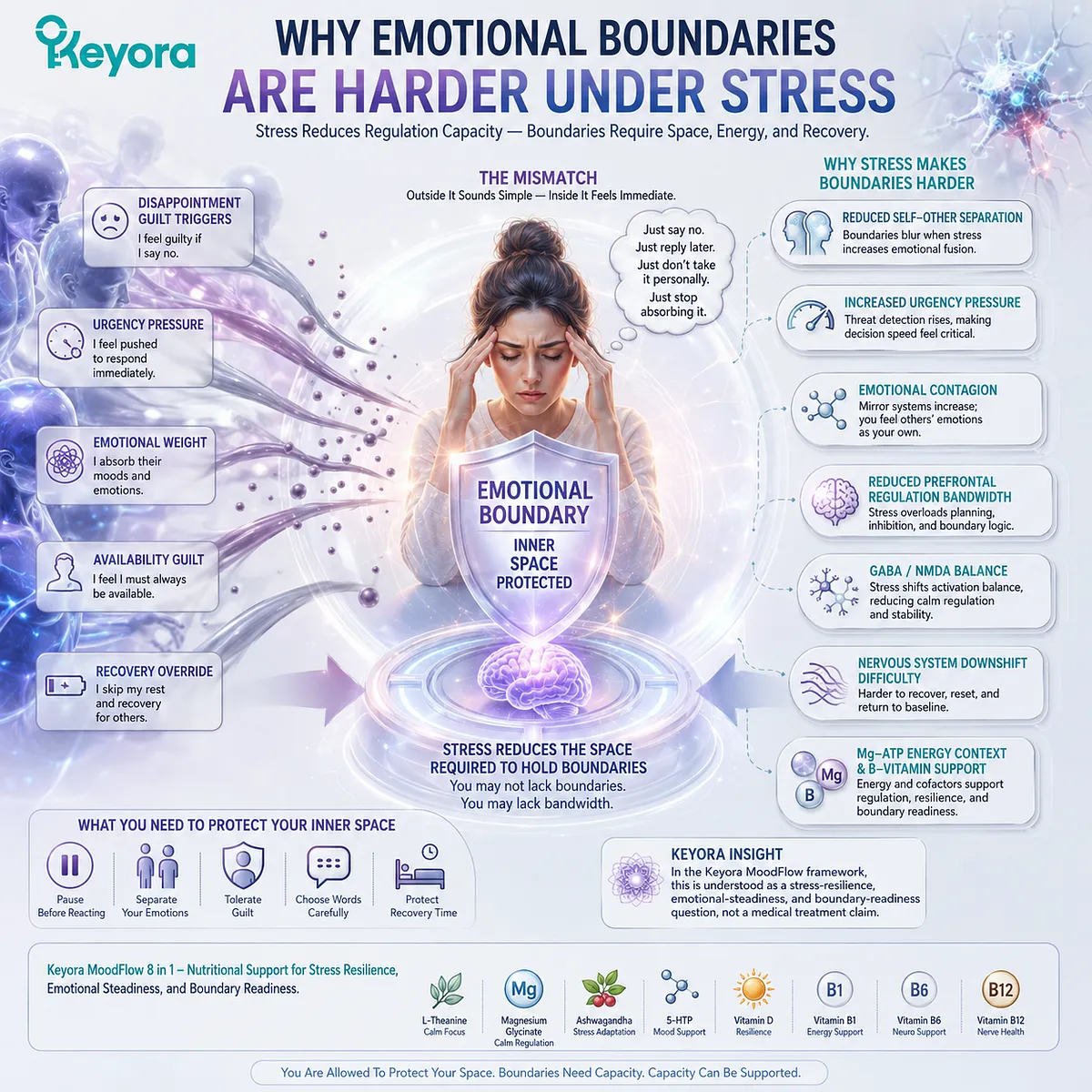
The mismatch is this: from the outside, setting a boundary may sound simple. Just say no. Just reply later.
Just do not take it personally. Just stop absorbing other people’s moods. But inside a stressed system, someone else’s disappointment, urgency, tone, need, or emotional weight can feel immediate inside your own body.
This does not mean you have no boundaries. It may mean stress has reduced the space required to hold them.
Mechanistically, this can involve reduced self-other separation, increased urgency pressure, availability guilt, emotional contagion, recovery override, reduced prefrontal regulation bandwidth, GABA/NMDA activation balance, nervous-system downshift difficulty, Mg-ATP energy context, and B-vitamin cofactor support.
In the Keyora MoodFlow framework, this is understood as a stress-resilience, emotional-steadiness, and boundary-readiness question, not a medical treatment claim.
When Other People’s Feelings Start Taking Over Your Space
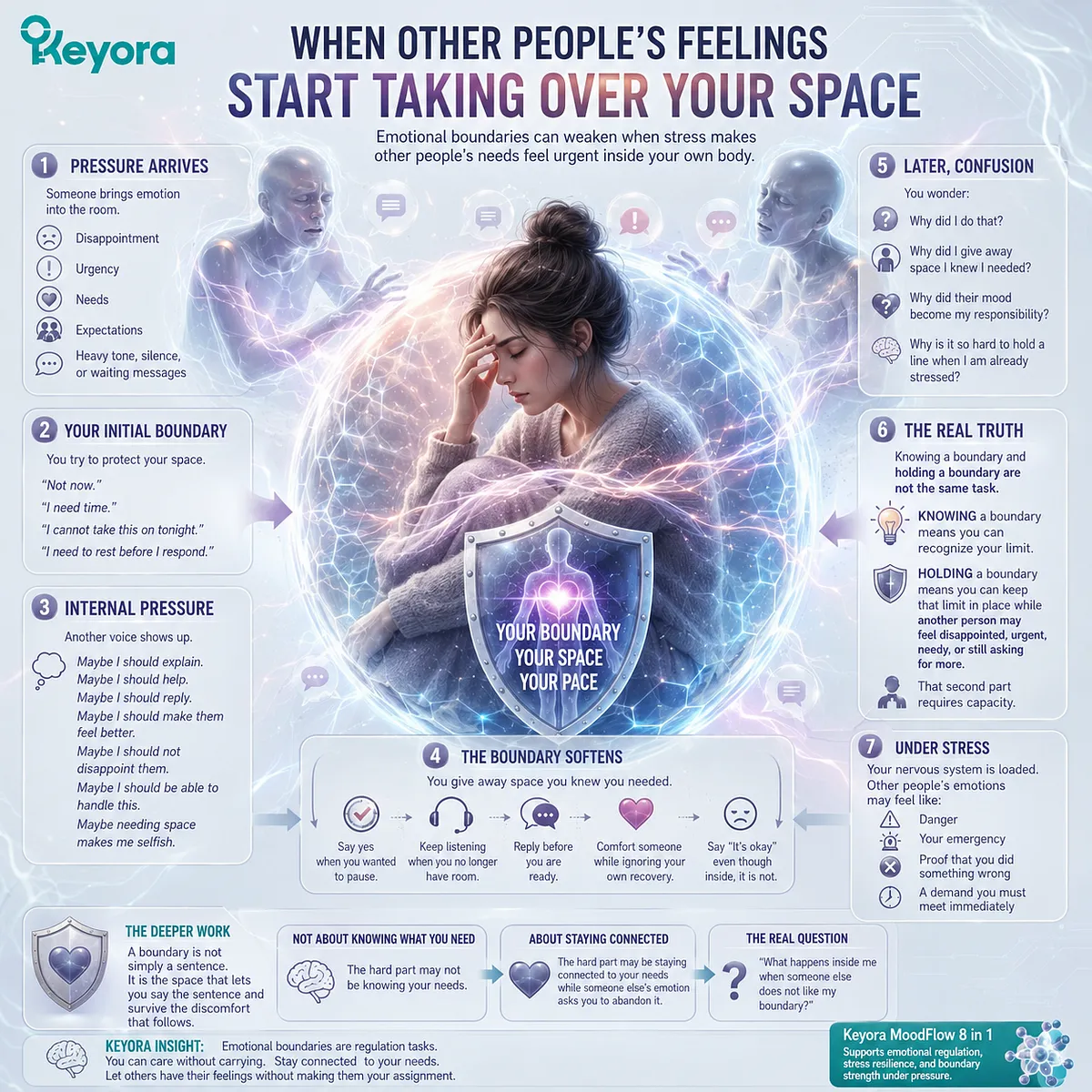
Emotional boundaries can weaken when stress makes other people’s needs feel urgent inside your own body.
You may already be tired.
You may know you need quiet. You may know your emotional space is low. You may know that one more heavy conversation, one more request, one more message, or one more expectation may be more than you can hold well.
Then someone else brings emotion into the room.
They sound disappointed. They seem stressed. They need reassurance. They ask for an answer. They want you to understand. Their tone becomes heavier. Their silence feels loaded. Their message waits on your phone. Their problem becomes difficult to ignore.
You may begin with a boundary.
Not now.
I need time.
I cannot take this on tonight.
I need to rest before I respond.
But almost immediately, another pressure arrives.
Maybe I should explain.
Maybe I should help.
Maybe I should reply.
Maybe I should make them feel better.
Maybe I should not disappoint them.
Maybe I should be able to handle this.
Maybe needing space makes me selfish.
Then the boundary starts to soften.
You say yes when you wanted to pause. You keep listening when you no longer have room. You reply before you are ready. You comfort someone while ignoring your own need for recovery. You say, “It’s okay,” even though inside, it is not okay.
Later, you may feel confused.
Why did I do that?
Why did I give away space I knew I needed?
Why did their mood become my responsibility?
Why is it so hard to hold a line when I am already stressed?
This is where many people judge themselves too quickly. They assume they are weak, too soft, too easily influenced, or bad at boundaries. But the deeper issue is often more specific.
Knowing a boundary and holding a boundary are not the same task.
Knowing a boundary means you can recognize your limit.
Holding a boundary means you can keep that limit in place while another person may feel disappointed, confused, urgent, needy, upset, or still asking for more.
That second part requires capacity.
It requires the ability to tolerate discomfort without immediately fixing it. It requires the ability to separate care from responsibility. It requires the ability to let someone else have a feeling without automatically absorbing it as your assignment.
Under stress, that ability can become harder to access.
When your nervous system is already loaded, another person’s emotion may not feel separate. Their disappointment may feel like danger. Their urgency may feel like your emergency. Their silence may feel like proof that you did something wrong. Their need may feel like a demand you have to meet immediately.
This does not mean the other person is always being unfair.
It also does not mean you are imagining the pressure.
It means emotional boundaries are not only ideas. They are regulation tasks.
A boundary is not simply a sentence.
It is the space that lets you say the sentence and survive the discomfort that follows.
The deeper question is not only, “Why can’t I set boundaries?”
A better question is, “What happens inside me when someone else does not like my boundary?”
That question reveals the real work.
The hard part may not be knowing what you need.
The hard part may be staying connected to what you need while another person’s emotion is asking you to abandon it.
Why Stress Makes Boundaries Harder to Hold
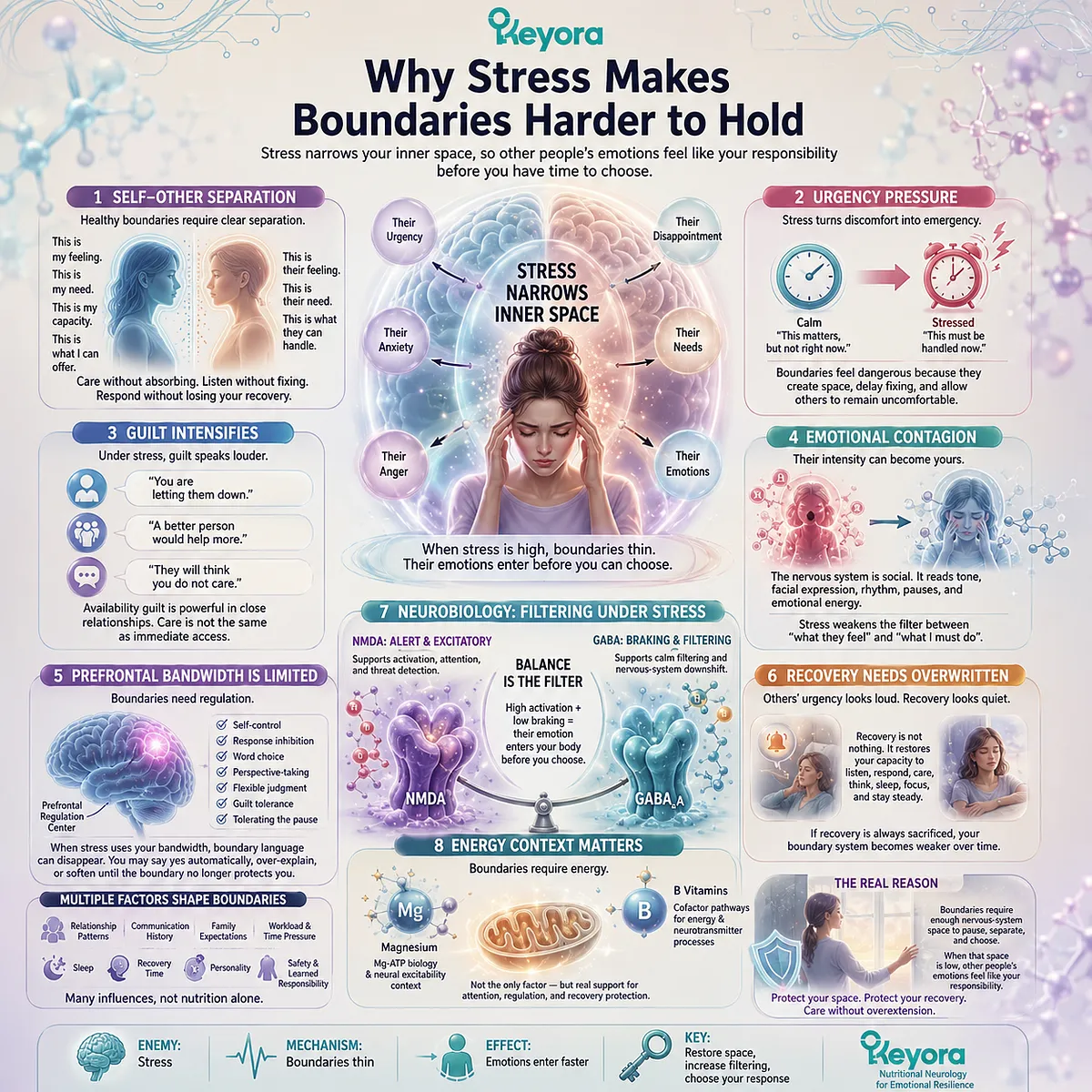
Boundaries require enough space to separate care from responsibility, and stress can narrow that space.
Emotional boundaries require self-other separation.
Self-other separation is the ability to recognize: this is their feeling, this is my feeling, this is their need, this is my capacity, this is what I can offer, and this is what I cannot take on right now.
When that separation is clear, you can care without absorbing everything. You can listen without becoming responsible for fixing the entire mood. You can respond without immediately giving up your recovery. You can notice someone’s disappointment without deciding that you have failed.
Under stress, this separation can blur.
Someone else becomes upset, and your body reacts as if you must solve it. Someone sounds disappointed, and guilt rises before you can think. Someone asks for more, and your own limit suddenly feels less legitimate. Someone’s urgency enters your system, and your pace begins to match theirs.
This is one reason stress weakens boundaries.
It makes other people’s emotional signals feel more immediate.
Urgency pressure is another mechanism.
When you are calm, you may be able to say, “This matters, but it does not have to be handled right now.” When you are stressed, the same situation may feel more urgent. A message feels like it needs an answer. A disappointed face feels like it needs repair. A difficult conversation feels like it must be solved immediately.
Stress can turn social discomfort into emergency.
Then boundaries feel dangerous because boundaries slow down the response. They create space. They delay fixing. They allow someone else to remain uncomfortable for a while.
That can feel hard when your nervous system is already activated.
Guilt also becomes stronger under stress.
You may know you need rest, but guilt says, “You are letting them down.” You may know you cannot take on the whole problem, but guilt says, “A better person would help more.” You may know you need time before answering, but guilt says, “They will think you do not care.”
Availability guilt is especially powerful in close relationships. The more you care, the more easily you may confuse care with immediate access. You may feel that if you are not available, you are not loving. If you do not reply now, you are cold. If you do not take on their emotion, you are selfish.
But care and overextension are not the same thing.
Emotional contagion also matters.
When another person is tense, disappointed, angry, anxious, rushed, or overwhelmed, your system may begin to mirror some of that intensity. Their urgency becomes your urgency. Their worry becomes your tension. Their disappointment becomes your guilt.
This is not a character flaw.
It is a filtering issue.
The nervous system is social. It reads tone, facial expression, rhythm, pauses, and emotional energy. When stress is high, the filtering boundary between “what they feel” and “what I must do” can become thinner.
Boundary language requires prefrontal regulation bandwidth.
To hold a boundary, you often need to choose words carefully.
You may need to say, “I care, but I cannot take this on tonight.”
You may need to slow your tone.
You may need to resist over-explaining.
You may need to avoid apologizing for having a limit.
You may need to tolerate the pause after you say no.
All of this requires regulation.
The prefrontal system helps with self-control, response inhibition, word choice, perspective-taking, and flexible social judgment. It helps you remember, “I can care without taking over,” or “Their disappointment does not automatically mean I did something wrong.”
But prefrontal regulation bandwidth is limited.
When stress has already used much of that bandwidth, the boundary sentence may disappear. You may say yes automatically. You may over-explain. You may soften the boundary until it no longer protects you. You may keep giving emotional labor because choosing a limit feels too hard in the moment.
Recovery needs also become easier to override.
This happens because recovery often looks quiet. It does not always look urgent. Someone else’s need may look immediate, visible, and emotionally charged. Your recovery may look like “nothing.”
But recovery is not nothing.
Recovery is the process that helps your nervous system regain the capacity to listen, respond, care, think, sleep, focus, and stay emotionally steady. If recovery is always sacrificed to someone else’s urgency, your boundary system becomes weaker over time.
GABA/NMDA balance can help explain why other people’s emotions feel harder to filter under stress. The nervous system needs activation to notice social signals, but it also needs braking and filtering so every tone, request, or disappointment does not become a demand on the body.
NMDA-related activity can be understood as part of alert and excitatory processing. GABA-related tone helps support calm filtering and nervous-system downshift.
When activation is high and braking feels limited, another person’s emotion can feel like it enters your body before you have chosen how to respond.
Energy context also matters. Holding boundaries requires attention, inhibition, word choice, guilt tolerance, emotional filtering, and recovery protection. Magnesium participates in Mg-ATP biology and neural excitability context. B vitamins support cofactor pathways involved in energy metabolism and neurotransmitter-related processes.
This does not mean boundary difficulty is only nutritional. Relationship patterns, communication history, family expectations, workload, sleep, recovery time, personality, safety, and learned responsibility all matter.
But it does mean the experience is real.
Emotional boundaries become harder under stress because boundaries require enough nervous-system space to pause, separate, and choose before absorbing someone else’s demand.
When that space is low, other people’s emotions can feel like your responsibility before you have had time to decide.
What Helps When Emotional Boundaries Feel Harder to Hold
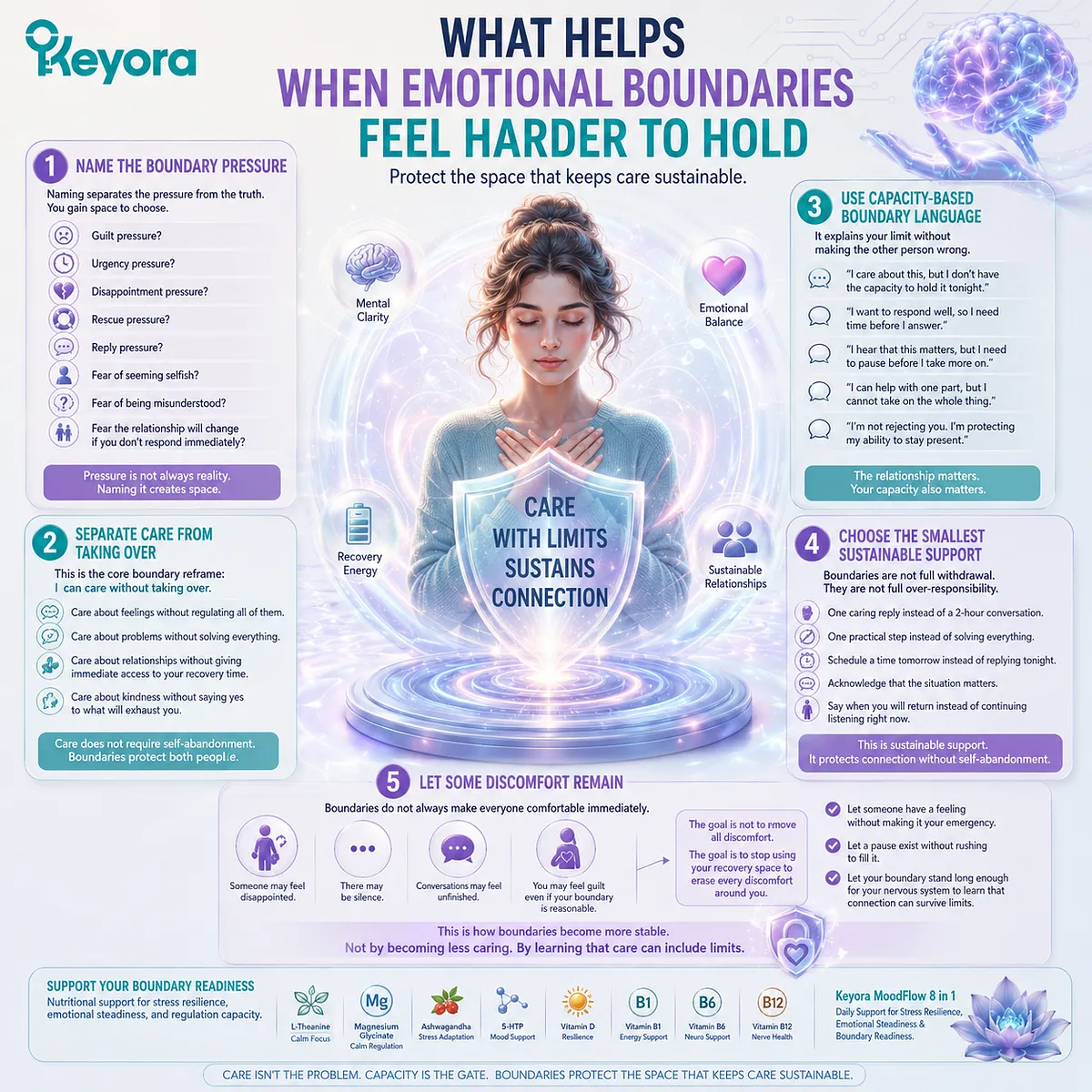
The goal is not to become less caring, but to protect the space that lets care stay sustainable.
When emotional boundaries feel harder to hold, the first step is not to shame yourself for being too soft.
Begin by naming the boundary pressure.
Instead of asking, “Why can’t I just say no?” ask, “What kind of pressure am I feeling right now?”
Is it guilt pressure?
Urgency pressure?
Disappointment pressure?
Rescue pressure?
Reply pressure?
Fear of seeming selfish?
Fear of being misunderstood?
Fear that the relationship will change if you do not respond immediately?
Naming the pressure matters because it separates the pressure from the truth.
Guilt pressure does not always mean you are doing something wrong.
Urgency pressure does not always mean the situation is urgent.
Disappointment pressure does not always mean you must fix the disappointment.
Once you name the pressure, you have more space to choose.
The second step is to separate care from taking over.
This is the core boundary reframe.
I can care without taking over.
You can care about someone’s feelings without becoming responsible for regulating all of them. You can care about a problem without solving the entire thing tonight. You can care about a relationship without giving immediate access to your recovery time. You can care about being kind without saying yes to something that will exhaust you.
Care does not require self-abandonment.
This distinction protects both people.
When you take over too much, you may become resentful, depleted, or quietly distant. When you hold a sustainable boundary, you may actually preserve the ability to remain present, honest, and emotionally available over time.
The third step is to use capacity-based boundary language.
Capacity-based language explains your limit without making the other person wrong.
Useful sentences include:
“I care about this, but I don’t have the capacity to hold it tonight.”
“I want to respond well, so I need time before I answer.”
“I hear that this matters, but I need to pause before I take more on.”
“I can help with one part, but I cannot take on the whole thing.”
“I’m not rejecting you. I’m protecting my ability to stay present.”
These sentences matter because they communicate two truths at the same time.
The relationship matters.
Your capacity also matters.
Many people struggle with boundaries because they think a boundary has to sound cold. It does not. A boundary can be warm, clear, and firm at the same time.
The fourth step is to choose the smallest sustainable support.
Boundaries do not always mean full withdrawal. They also do not mean full over-responsibility. There is often a middle path.
You may not be able to hold a two-hour emotional conversation, but you can send one caring reply.
You may not be able to solve the whole problem, but you can help with one practical step.
You may not be able to answer tonight, but you can schedule a time tomorrow.
You may not be able to absorb someone’s full emotional load, but you can acknowledge that the situation matters.
You may not be able to continue listening right now, but you can say when you will return.
This is sustainable support.
It protects connection without requiring self-abandonment.
The fifth step is to let some discomfort remain.
This may be the hardest part.
A boundary does not always make everyone comfortable immediately. Someone may feel disappointed. There may be silence. The conversation may feel unfinished. You may feel guilt even if your boundary is reasonable.
The goal is not to remove all discomfort.
The goal is to stop using your recovery space to erase every discomfort around you.
You can let someone have a feeling without making that feeling your emergency. You can let a pause exist without rushing to fill it. You can let your boundary stand long enough for your nervous system to learn that connection can survive limits.
This is how boundaries become more stable.
Not by becoming less caring.
By learning that care can include limits.
Where Nutritional Support Fits
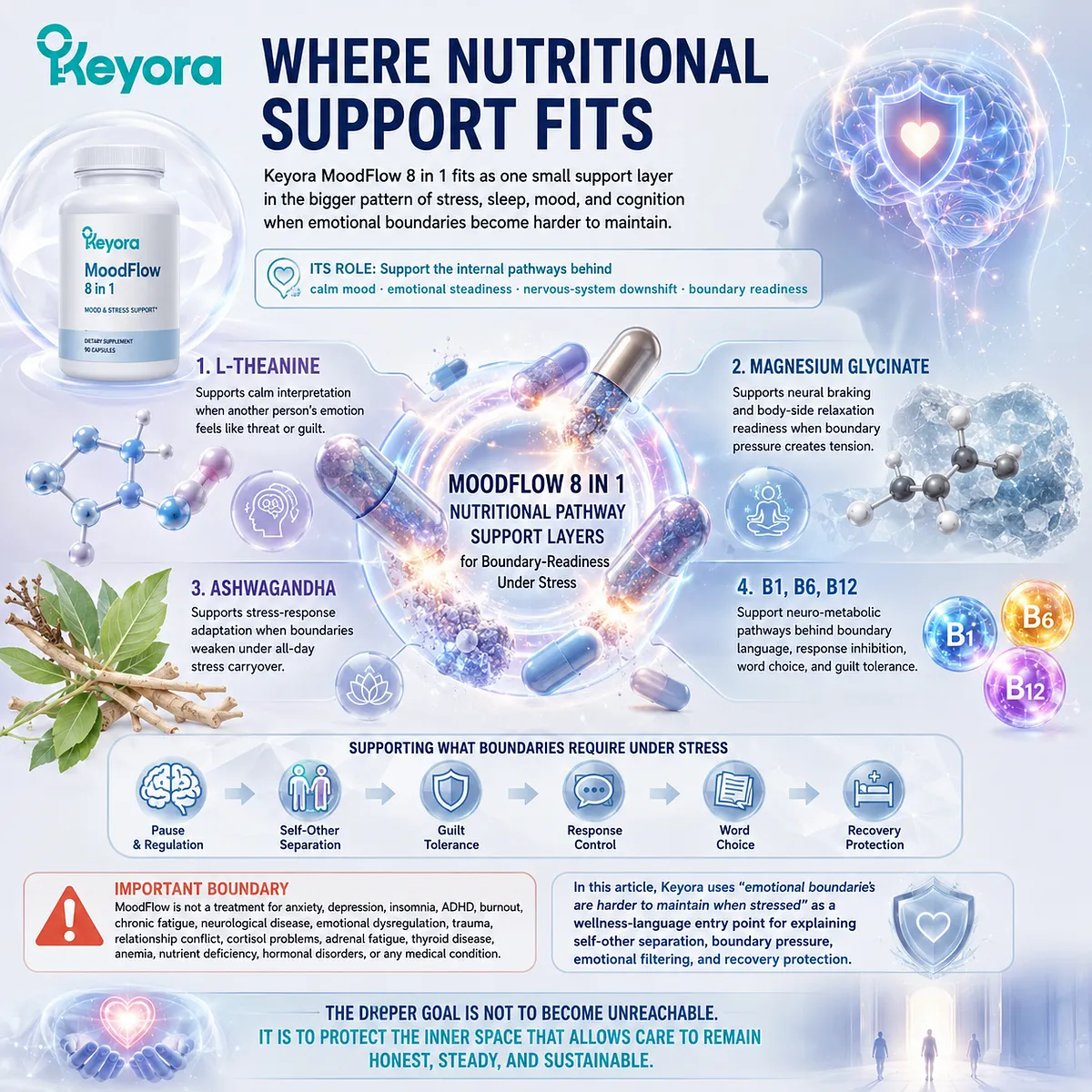
Keyora MoodFlow 8 in 1 can fit as one small support layer when emotional boundaries feel harder to maintain as part of a broader stress-sleep-mood-cognition pattern. It should not be understood as something that creates boundaries for someone, makes difficult conversations easy, removes guilt, or replaces relational skill-building.
Its role is narrower: supporting nutritional pathways involved in calm mood, emotional steadiness, nervous-system downshift, and boundary-readiness when stress makes emotional space harder to protect.
For this topic, the most relevant layers are L-Theanine for calm interpretation when another person’s emotion begins to feel like threat or guilt, magnesium glycinate for neural braking and body-side relaxation readiness when boundary pressure creates tension, Ashwagandha for stress-response adaptation when boundaries weaken under all-day stress carryover, and B1, B6, and B12 for neuro-metabolic support behind boundary language, response inhibition, word choice, and guilt tolerance.
MoodFlow is not a treatment for anxiety, depression, insomnia, ADHD, burnout, chronic fatigue, neurological disease, emotional dysregulation, trauma, relationship conflict, cortisol problems, adrenal fatigue, thyroid disease, anemia, nutrient deficiency, hormonal disorders, or any medical condition.
In this article, Keyora uses “emotional boundaries are harder to maintain when stressed” as a wellness-language entry point for explaining self-other separation, boundary pressure, emotional filtering, and recovery protection.
The deeper goal is not to become unreachable or emotionally closed.
It is to protect the inner space that allows care to remain honest, steady, and sustainable.
Closing Summary
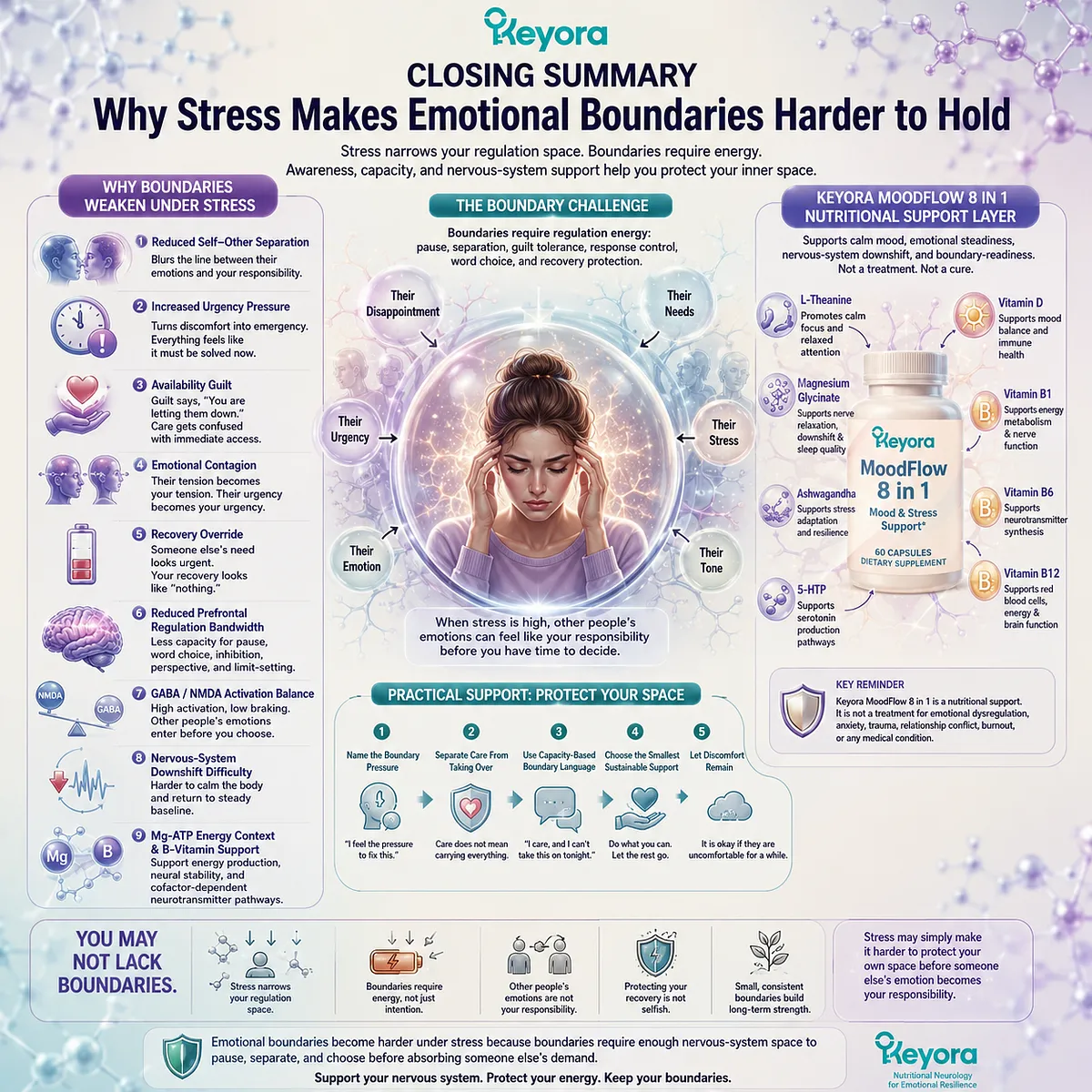
Emotional boundaries can become harder to maintain when you are stressed because boundaries require regulation energy. They require pause, self-other separation, guilt tolerance, response control, word choice, and recovery protection.
This does not mean you have no boundaries or that you are weak. It may mean stress has reduced the space needed to hold a boundary while another person feels disappointed, urgent, emotional, or still in need.
Mechanistically, this can involve reduced self-other separation, increased urgency pressure, availability guilt, emotional contagion, recovery override, reduced prefrontal regulation bandwidth, GABA/NMDA activation balance, nervous-system downshift difficulty, Mg-ATP energy context, and B-vitamin cofactor support.
Practical support begins by naming the boundary pressure, separating care from taking over, using capacity-based boundary language, choosing the smallest sustainable support, and letting some discomfort remain without immediately sacrificing recovery.
Keyora MoodFlow 8 in 1 fits only as a nutritional support layer for calm mood, emotional steadiness, nervous-system downshift, and boundary-readiness. It is not a treatment for emotional dysregulation, anxiety, trauma, relationship conflict, burnout, or any medical condition.
You may not lack boundaries.
Stress may simply make it harder to protect your own space before someone else’s emotion becomes your responsibility.
This article is for educational and informational purposes only. It does not provide medical advice, diagnosis, treatment, cure, prevention, disease outcome claims, hormone restoration claims, fertility outcome claims, or formula-specific clinical efficacy claims.