
Why Are Cell Membranes Vulnerable to Oxidative Damage?
Keyora Research Q&A Library
This is part of the Keyora Research Q&A Series, derived from Keyora Astaxanthin Research Journal Series.
Within the Keyora Astaxanthin Researcn framework, this Q&A translates complex astaxanthin biology into reader-friendly, evidence-bound answers, focusing on natural astaxanthin identity, molecular structure, antioxidant and redox mechanisms, membrane lipid interaction, mitochondrial resilience, inflammatory signaling pathways, human evidence interpretation, and the scientific principles behind responsible supplementation.
First published by Keyora Research Journal: www.keyorahealth.com
Direct Answer
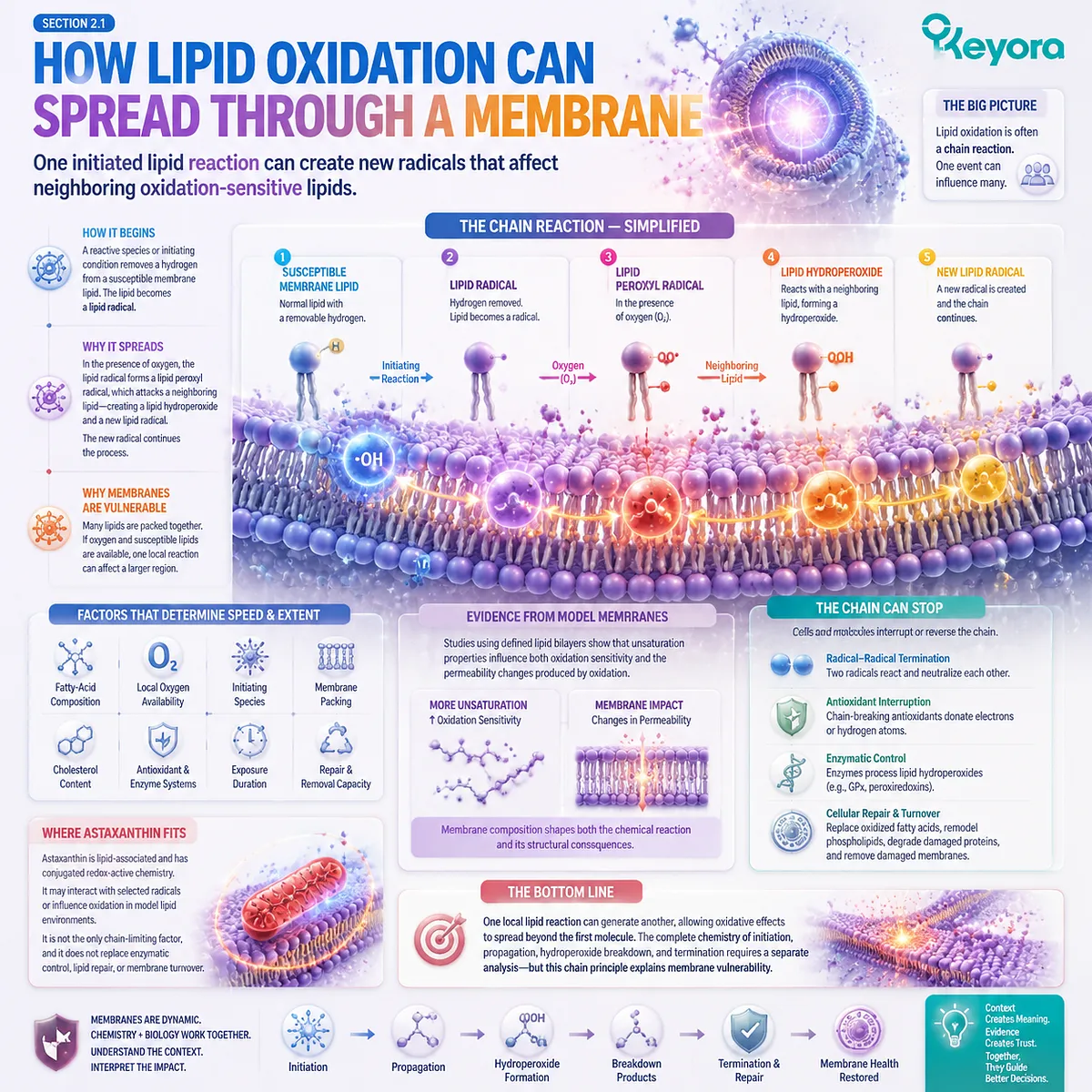
Cell membranes are vulnerable to oxidative damage because they are dynamic structures built from closely packed lipids, proteins, cholesterol, and carbohydrates. Their phospholipids form a bilayer with water-facing polar surfaces and a lipid-rich interior. This organization supports transport, signaling, receptor movement, electrical gradients, and membrane fusion, but it also places oxidation-sensitive fatty acids beside proteins whose function depends on an organized membrane environment.
Polyunsaturated fatty acids, or PUFAs, are particularly relevant because their multiple double bonds create molecular positions that can participate more readily in lipid-radical reactions. This does not make PUFAs harmful. They contribute to membrane flexibility and signaling, but their chemistry requires effective redox control.
Once a susceptible membrane lipid is oxidized, the reaction may spread to neighboring lipids. Lipid radicals can react with oxygen, form lipid peroxyl radicals, and continue a chain reaction until the process is terminated or damaged lipids are repaired, remodeled, or removed.
Even relatively limited lipid oxidation can change bilayer packing and passive permeability in simplified membrane systems. More extensive changes may affect fluidity, ion gradients, receptors, transporters, enzymes, and membrane-associated signaling. The outcome depends on membrane composition, oxidant source, exposure duration, and repair capacity.
This vulnerability explains why lipid-associated astaxanthin is studied in membrane models. It does not prove that astaxanthin reaches, spans, repairs, or protects every membrane in the human body.
What Makes Cell Membranes Vulnerable
Their dynamic lipid and protein architecture provides essential flexibility while also creating oxidation-sensitive molecular targets
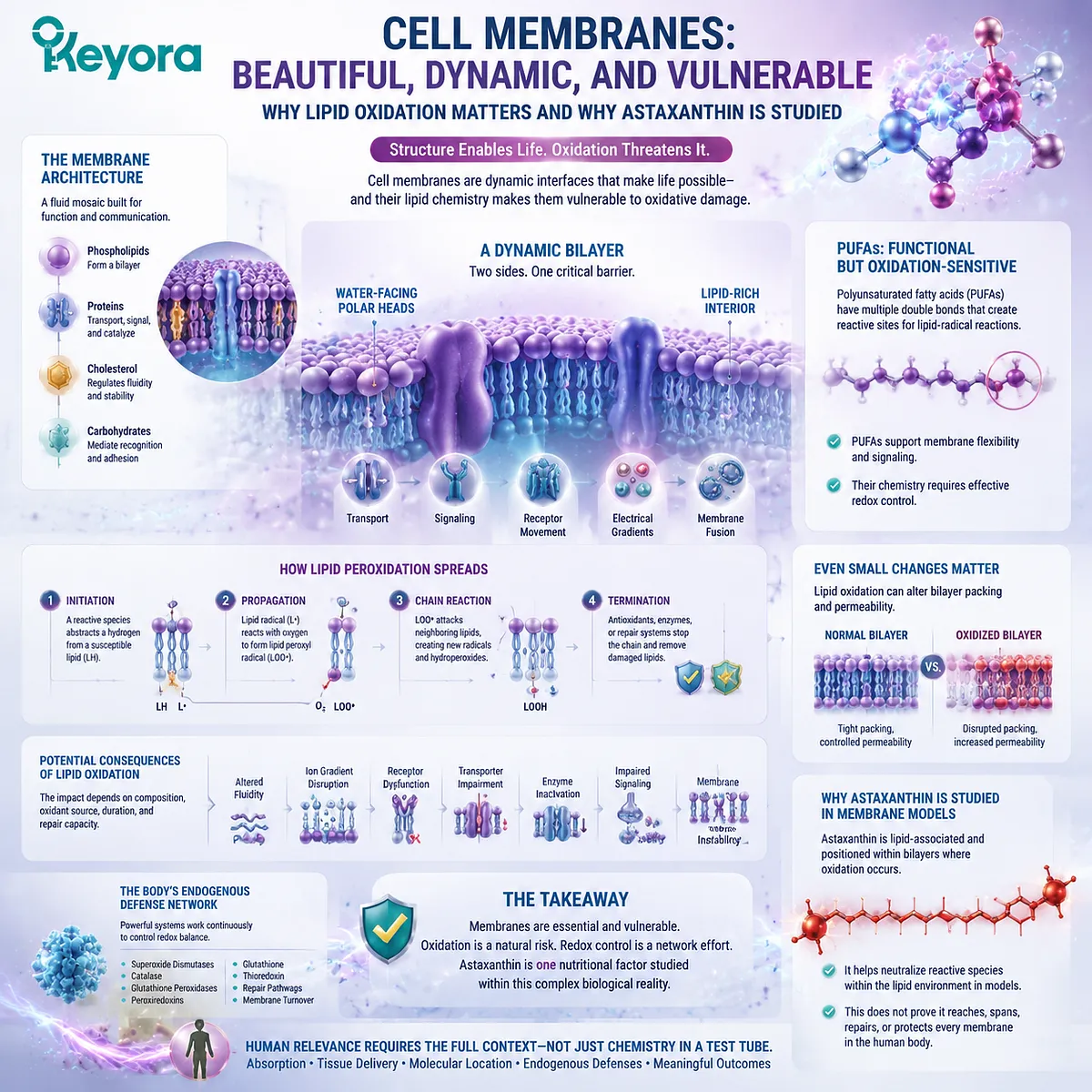
A cell membrane is not a rigid wall. It is a moving, laterally organized system in which lipids and many proteins can change position, assemble into temporary complexes, and respond to the needs of the cell.
Phospholipids provide the basic bilayer architecture. Their polar head groups interact with water, while their nonpolar fatty-acid tails form the membrane interior. Cholesterol helps regulate lipid packing, fluidity, and permeability rather than simply making membranes more rigid or more fluid in every situation. In an experimental membrane study, cholesterol increased lipid packing and reduced permeability while maintaining membrane fluidity under the tested conditions.
Proteins embedded in or attached to the membrane perform much of its biological work. They act as:
-
receptors
-
ion channels
-
transporters
-
enzymes
-
adhesion molecules
-
anchors for intracellular structures
Their activity depends partly on the surrounding lipids. A receptor may need to move, cluster, change shape, or interact with another protein. A transporter may depend on a particular bilayer thickness or local lipid environment. Membrane damage can therefore affect function even when the protein itself is not directly oxidized.
Membranes are also laterally heterogeneous. Certain lipids and proteins can form dynamic domains rather than remaining evenly mixed. Experimental work with cell-derived membrane vesicles has shown that lipid peroxidation can alter phase separation behavior, supporting the idea that oxidation may reorganize membrane domains as well as modify individual molecules.
Fatty-acid composition is one reason vulnerability varies.
Saturated fatty acids contain no carbon-to-carbon double bonds. Monounsaturated fatty acids contain one. PUFAs contain two or more. The positions between double bonds in many PUFAs include hydrogens that can be removed more readily during radical reactions, helping form lipid radicals.
More unsaturation can therefore increase oxidation susceptibility, but that fact should not become PUFA fear. PUFAs contribute to membrane flexibility, signaling precursors, and tissue-specific membrane properties. The biological goal is not to remove them from every membrane. It is to manage their oxidation through controlled reactive-species production, antioxidant systems, lipid remodeling, and repair.
Membrane vulnerability also differs among tissues and organelles. A retinal membrane, neuronal membrane, red blood cell membrane, mitochondrial membrane, and plasma membrane can differ in fatty-acid composition, cholesterol, proteins, oxygen exposure, metabolic activity, and repair capacity. There is no single membrane model that represents all of them.
How Lipid Oxidation Can Spread Through a Membrane
One initiated lipid reaction can create new radicals that affect neighboring oxidation-sensitive lipids
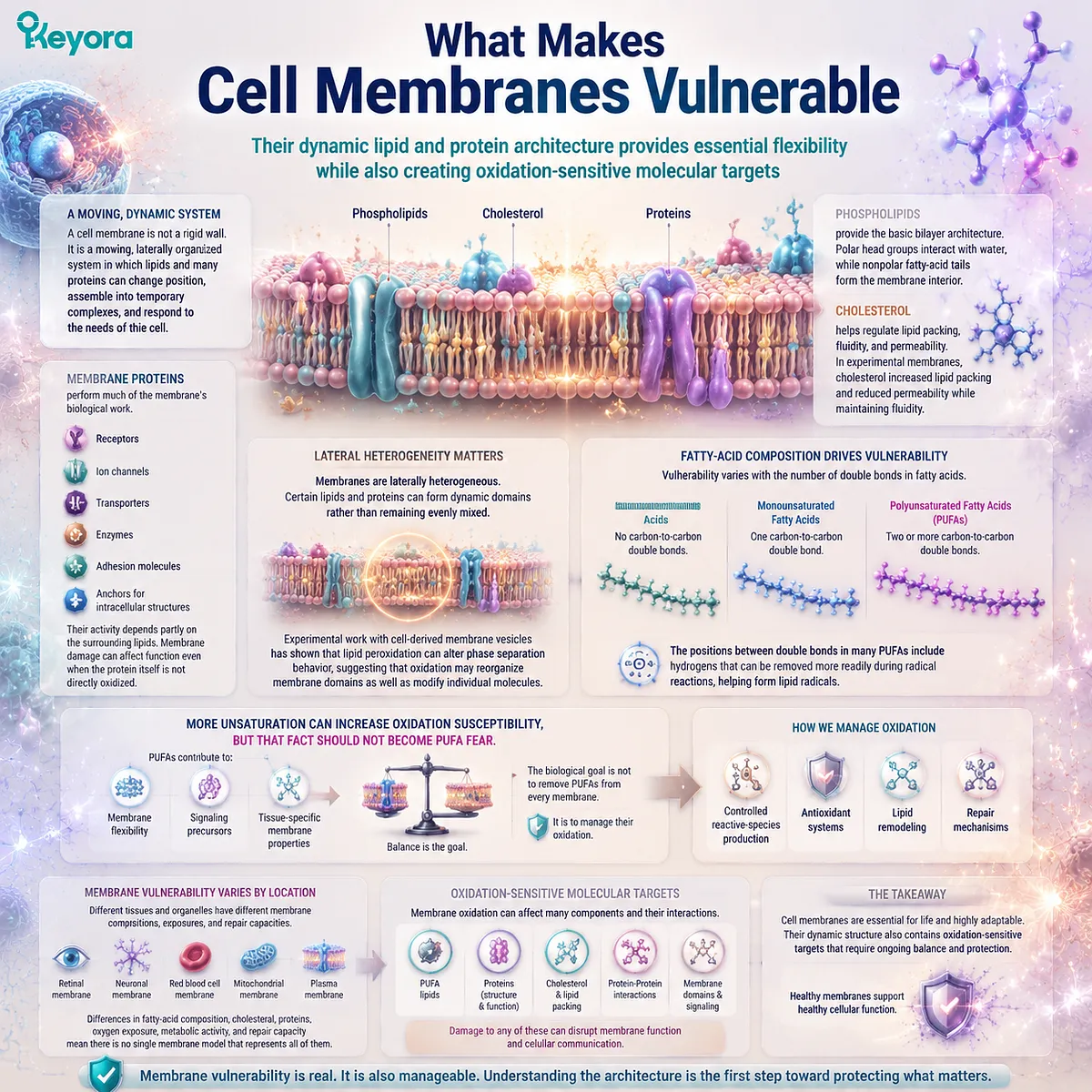
Lipid oxidation can begin when a sufficiently reactive species or initiating condition removes a hydrogen from a susceptible membrane lipid. The affected lipid becomes a lipid radical.
In the presence of oxygen, that lipid radical can form a lipid peroxyl radical. The lipid peroxyl radical may then react with a neighboring susceptible lipid, producing a lipid hydroperoxide and a new lipid radical.
In simplified form:
Susceptible membrane lipid
-
initiating reaction
→ lipid radical
Lipid radical
-
oxygen
→ lipid peroxyl radical
Lipid peroxyl radical
-
neighboring lipid
→ lipid hydroperoxide -
new lipid radical
The newly formed radical can continue the process. This is why lipid oxidation is often described as a chain reaction rather than one isolated molecular event.
The membrane provides conditions that can support propagation because many lipid molecules are positioned beside one another. A reaction beginning in one small area may therefore influence a larger local region if oxygen and susceptible lipids remain available.
The speed and extent of propagation are not fixed. They depend on:
-
fatty-acid composition
-
local oxygen availability
-
the initiating species
-
membrane packing
-
cholesterol content
-
antioxidant and enzyme systems
-
exposure duration
-
repair and removal capacity
Experimental work using defined lipid bilayers found that unsaturation properties influenced both oxidation sensitivity and the permeability changes produced by oxidation. This supports the principle that membrane composition shapes both the chemical reaction and its structural consequences.
The chain can also stop. Two radicals may react with each other, a chain-breaking antioxidant may interrupt propagation, or enzymes may process lipid hydroperoxides. Cells can replace oxidized fatty acids, remodel phospholipids, degrade damaged proteins, or remove severely affected membrane structures.
Astaxanthin is one molecule studied in this context because it is lipid-associated and has conjugated redox-active chemistry. It may interact with selected radicals or influence oxidation in model lipid environments. It is not the only chain-limiting factor, and it does not replace enzymatic control, lipid repair, or membrane turnover.
The complete chemistry of initiation, propagation, hydroperoxide breakdown, and termination requires a separate analysis. The essential point for membrane vulnerability is that one local lipid reaction can generate another, allowing oxidative effects to spread beyond the first molecule.
How Oxidative Damage Can Change Membrane Function
Changes in lipids and proteins may affect permeability, fluidity, transport, signaling, and organelle stability
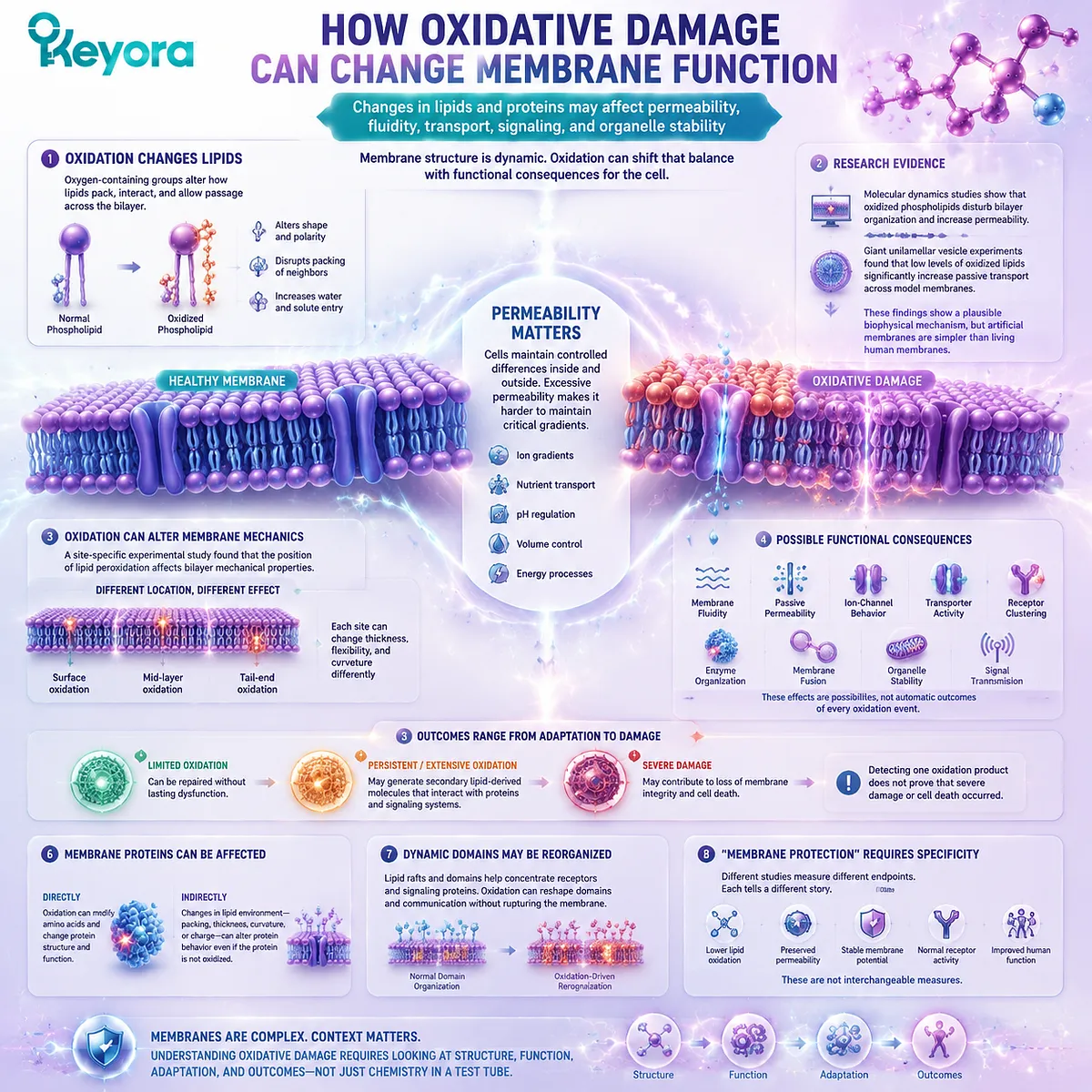
Oxidation changes the structure of membrane lipids. Oxygen-containing groups can alter how an affected lipid sits within the bilayer, how strongly neighboring lipids pack together, and how much water or small solutes can enter the membrane interior.
Molecular-dynamics research has found that oxidized phospholipids can disturb bilayer organization and increase membrane permeability. Experiments with giant unilamellar vesicles similarly showed that relatively low concentrations of oxidized lipids could substantially increase passive transport across model membranes. These findings demonstrate a plausible biophysical mechanism, but artificial bilayers remain simpler than living human membranes.
Permeability changes can matter because cells maintain controlled differences between their internal and external environments. Ion gradients support electrical activity, nutrient transport, pH regulation, volume control, and energy-related processes. A membrane that becomes excessively permeable may have more difficulty maintaining these gradients.
Oxidation can also alter membrane mechanics. A site-specific experimental study found that the position of lipid peroxidation affected bilayer mechanical properties, indicating that not all oxidized lipids produce the same structural outcome.
Possible functional consequences include changes in:
-
membrane fluidity
-
passive permeability
-
ion-channel behavior
-
transporter activity
-
receptor clustering
-
enzyme organization
-
membrane fusion
-
organelle stability
-
signal transmission
These effects are possibilities, not automatic outcomes of every oxidation event.
A limited amount of lipid oxidation may be repaired without lasting dysfunction. More extensive or persistent oxidation may produce secondary lipid-derived molecules that interact with proteins and signaling systems. Severe damage may contribute to loss of membrane integrity or cell death, but detecting one oxidation product does not prove that this endpoint occurred.
Membrane proteins can be affected directly through oxidation or indirectly through changes in the surrounding bilayer. A channel may remain chemically intact yet behave differently if local packing, thickness, curvature, or electrical properties change.
Dynamic membrane domains may also be reorganized. Because receptors and signaling proteins can concentrate within selected lipid environments, oxidation-driven changes in domain behavior may influence communication without causing the membrane to rupture.
This complexity is why “membrane protection” is too broad unless a study identifies what it measured. Lower lipid oxidation, preserved permeability, stable membrane potential, normal receptor activity, and improved human function are different endpoints.
Use the Keyora Composition – Chain – Function Check
Three questions distinguish a measured membrane effect from a broad claim of whole-body protection
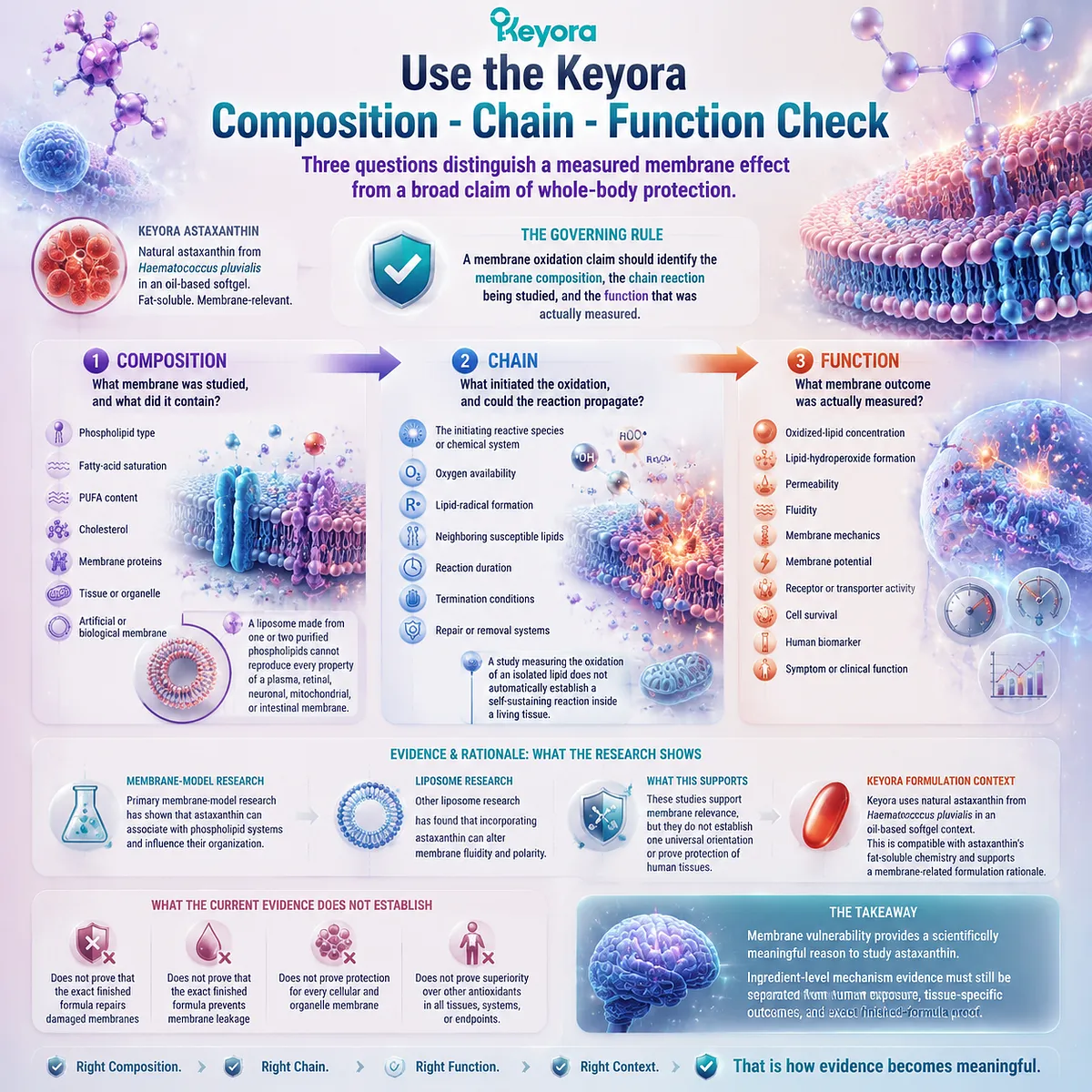
The Keyora Composition – Chain – Function Check provides a practical way to evaluate statements about cell-membrane oxidation and astaxanthin.
1. Composition
What membrane was studied, and what did it contain?
Look for:
-
phospholipid type
-
fatty-acid saturation
-
PUFA content
-
cholesterol
-
membrane proteins
-
tissue or organelle
-
artificial or biological membrane
A liposome made from one or two purified phospholipids cannot reproduce every property of a plasma, retinal, neuronal, mitochondrial, or intestinal membrane.
2. Chain
What initiated the oxidation, and could the reaction propagate?
Check:
-
the initiating reactive species or chemical system
-
oxygen availability
-
lipid-radical formation
-
neighboring susceptible lipids
-
reaction duration
-
termination conditions
-
repair or removal systems
A study measuring the oxidation of an isolated lipid does not automatically establish a self-sustaining reaction inside a living tissue.
3. Function
What membrane outcome was actually measured?
Possible endpoints include:
-
oxidized-lipid concentration
-
lipid-hydroperoxide formation
-
permeability
-
fluidity
-
membrane mechanics
-
membrane potential
-
receptor or transporter activity
-
cell survival
-
human biomarker
-
symptom or clinical function
The governing rule is:
A membrane oxidation claim should identify the membrane composition, the chain reaction being studied, and the function that was actually measured.
Primary membrane-model research has shown that astaxanthin can associate with phospholipid systems and influence their organization. Other liposome research has found that incorporating astaxanthin can alter membrane fluidity and polarity. These studies support membrane relevance, but they do not establish one universal orientation or prove protection of human tissues.
Keyora uses natural astaxanthin from Haematococcus pluvialis in an oil-based softgel context. This is compatible with astaxanthin’s fat-soluble chemistry and supports a membrane-related formulation rationale. The supplied evidence does not establish that the exact finished formula repairs damaged membranes, prevents membrane leakage, or protects every cellular and organelle membrane.
Membrane vulnerability provides a scientifically meaningful reason to study astaxanthin. Ingredient-level mechanism evidence must still be separated from human exposure, tissue-specific outcomes, and exact finished-formula proof.
Closing Summary
Cell membranes are oxidation-sensitive systems, but their vulnerability depends on composition, exposure, control, and repair
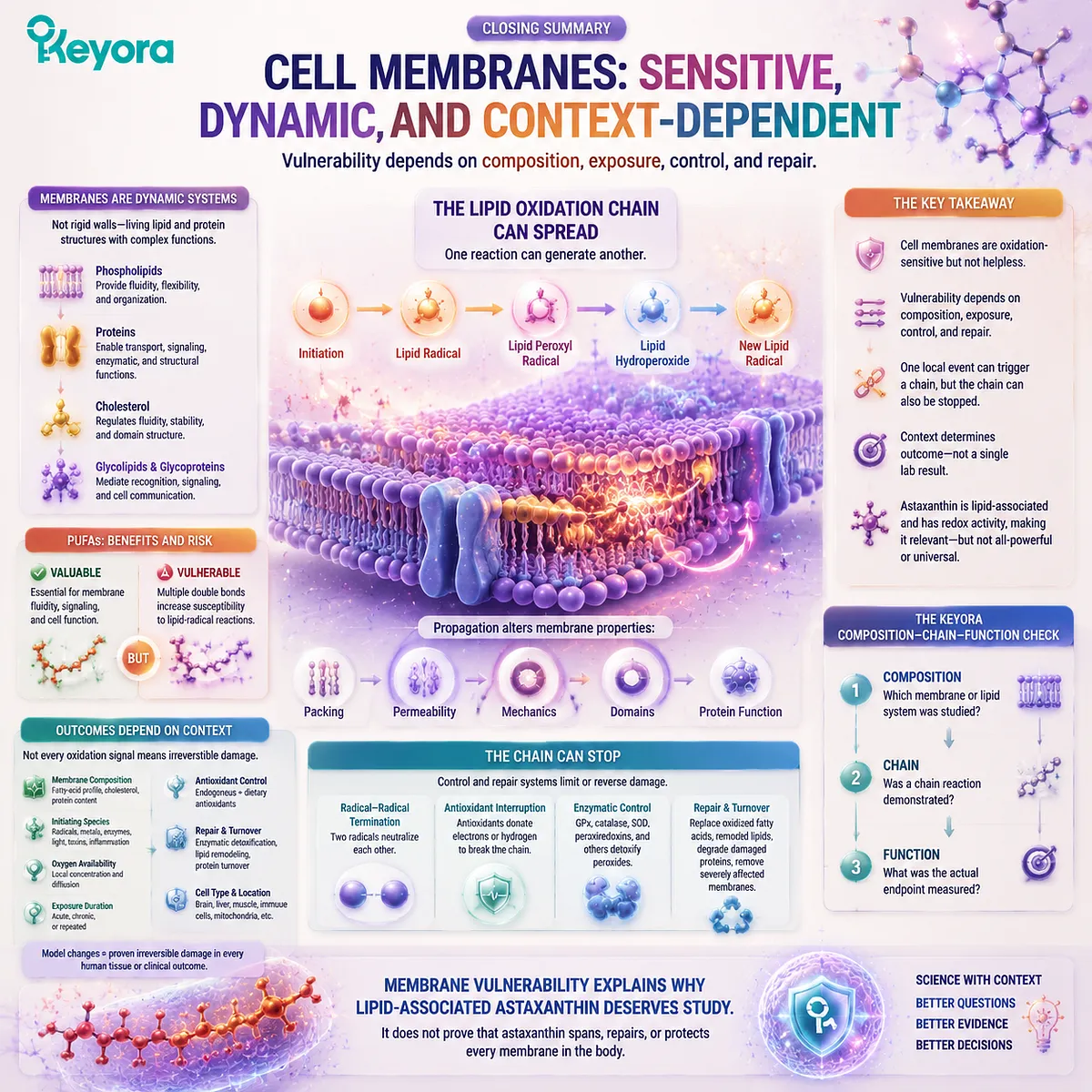
Cell membranes are dynamic lipid and protein systems rather than rigid protective walls. Their phospholipids provide flexibility and organization, while membrane proteins perform transport, signaling, enzymatic, and structural functions.
PUFAs are valuable membrane components, but their multiple double bonds can increase susceptibility to lipid-radical reactions. Once initiated, oxidation may propagate through neighboring lipids and alter packing, permeability, mechanics, membrane domains, and protein function.
The outcome depends on the membrane’s composition, the initiating species, oxygen availability, exposure duration, antioxidant control, and repair capacity. A model showing oxidized lipids or increased permeability does not prove irreversible damage in every human tissue.
Use the Keyora Composition – Chain – Function Check. Identify the membrane, determine whether a chain reaction was demonstrated, and confirm the function that was actually measured.
Membrane vulnerability explains why lipid-associated astaxanthin deserves study. It does not prove that astaxanthin spans, repairs, or protects every membrane in the body.
This article is for educational and informational purposes only. It does not provide medical advice, diagnosis, treatment, cure, prevention, disease outcome claims, hormone restoration claims, fertility outcome claims, or formula-specific clinical efficacy claims.