
Why Are B Vitamins Included in Keyora MoodFlow 8 in 1?
Keyora Research Q&A Library
This is part of the Keyora Research Q&A Series, derived from Keyora Nutritional Neurology Seriers .
Within the Keyora Nutritional Neurology framework, this Q&A translates complex nutrient–brain mechanisms into reader-friendly, evidence-bound answers, focusing on stress resilience, sleep quality, calm mood support, cognitive wellness, and the broader interaction between nutrition, neurochemistry, and daily nervous-system function.
First published by Keyora Research Journal: www.keyorahealth.com

Direct Answer
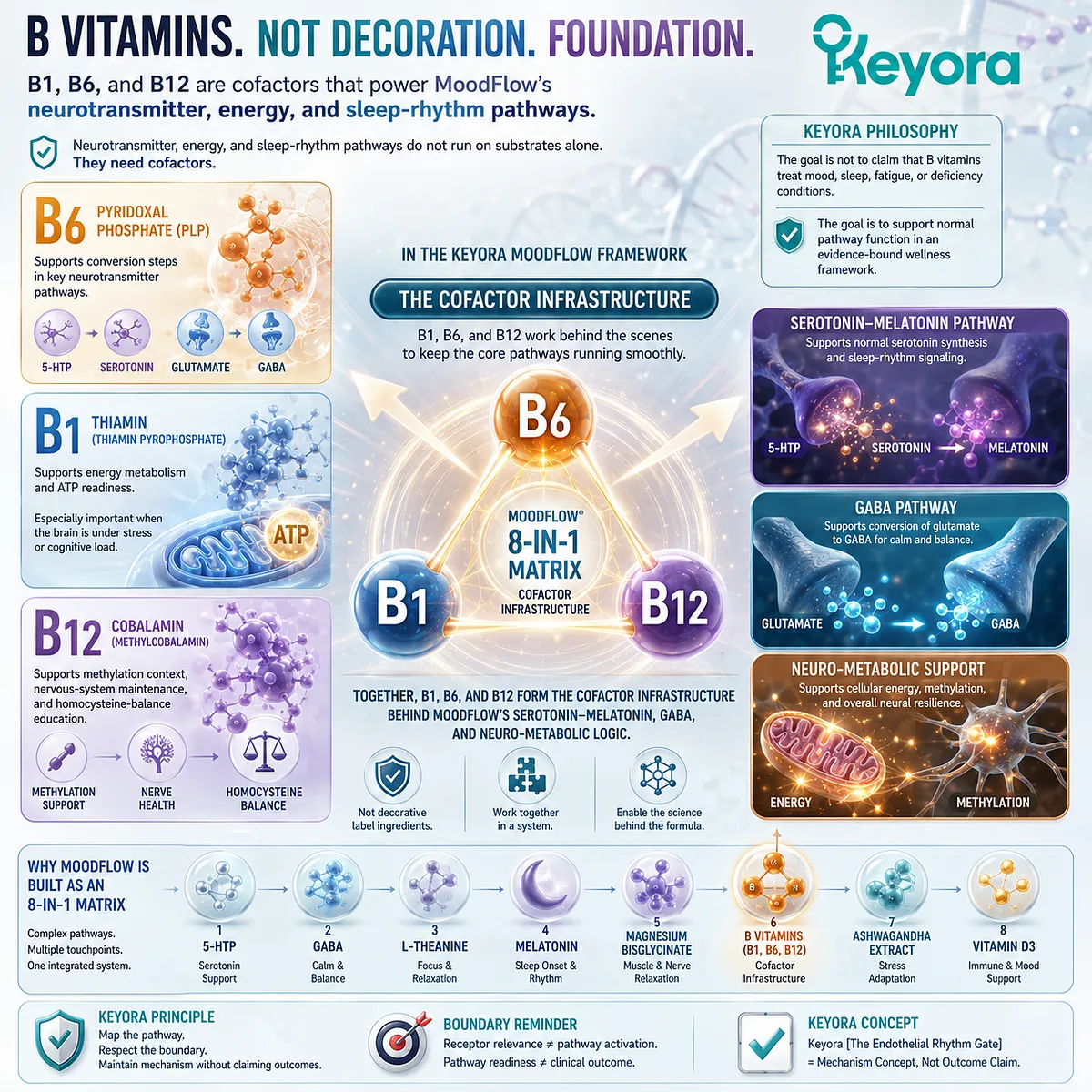
B vitamins are included in MoodFlow because neurotransmitter, energy, and sleep-rhythm pathways do not run on substrates alone.
They need cofactors.
In the Keyora MoodFlow framework:
-
B6 supports conversion steps such as 5-HTP to serotonin and glutamate to GABA.
-
B1 supports energy metabolism and ATP readiness, which matters when the brain is under stress or cognitive load.
-
B12 supports methylation context, nervous-system maintenance, and homocysteine-balance education.
Together, B1, B6, and B12 form the cofactor infrastructure behind MoodFlow’s serotonin-melatonin, GABA, and neuro-metabolic logic.
They are not decorative label ingredients.
They help explain why MoodFlow is built as an 8-in-1 Matrix rather than a single-ingredient formula.
For Keyora, the goal is not to claim that B vitamins treat mood, sleep, fatigue, or deficiency conditions. The goal is to support normal pathway function in an evidence-bound wellness framework.
B Vitamins Are the Helper Tools Behind the Pathways
Why cofactors matter when the body is building brain chemicals and energy signals.
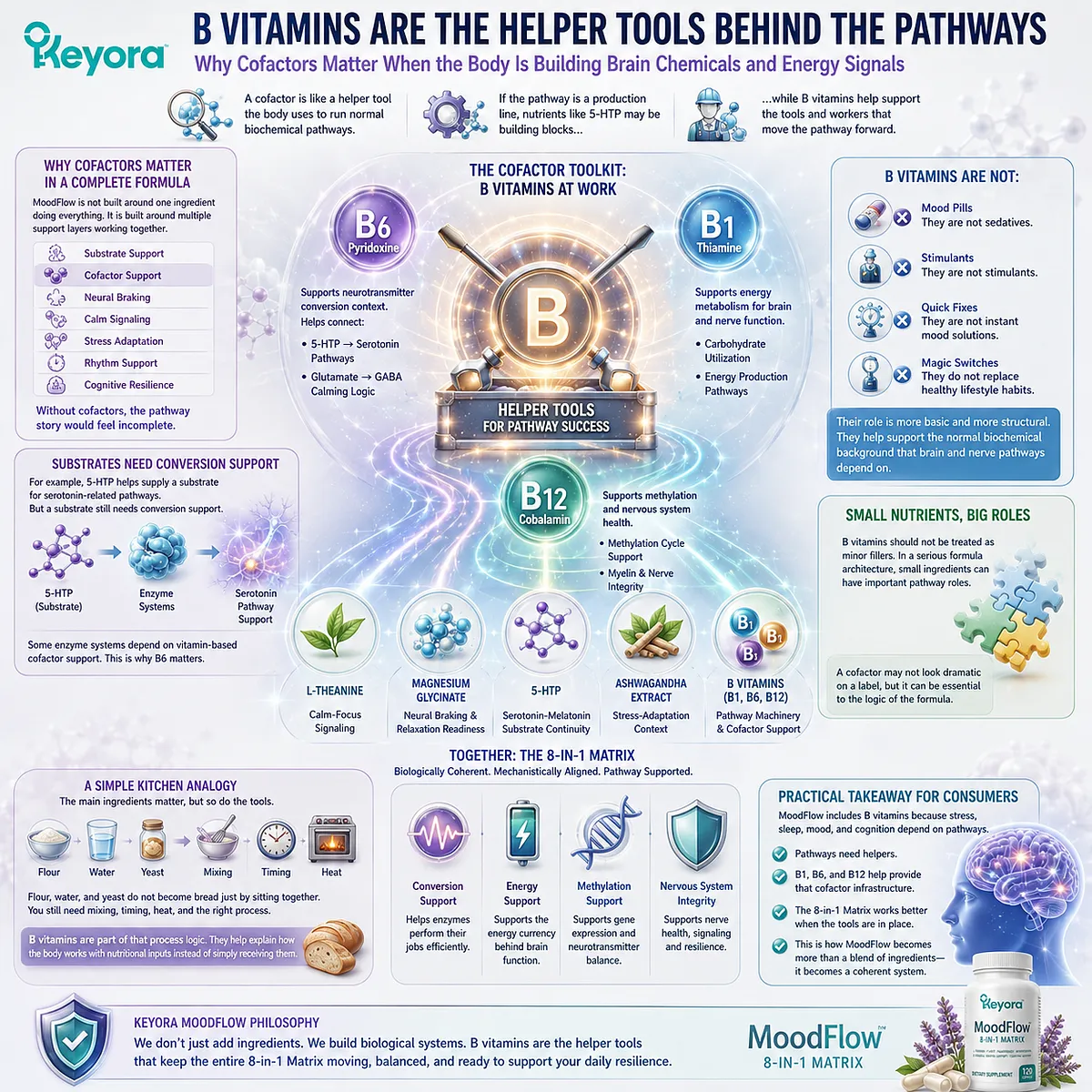
To understand why B vitamins are included in MoodFlow, it helps to understand the word “cofactor.”
A cofactor is like a helper tool the body uses to run normal biochemical pathways. If a pathway is a production line, then nutrients like 5-HTP may act like building blocks, while B vitamins help support the tools and workers that move the pathway forward.
This is especially important in a formula like MoodFlow.
MoodFlow is not built around one ingredient doing everything. It is built around multiple support layers: substrate support, cofactor support, neural braking, calm signaling, stress adaptation, rhythm support, and cognitive resilience.
Without cofactors, the pathway story would feel incomplete.
For example, 5-HTP helps supply a substrate for serotonin-related pathways. But a substrate still needs conversion support. The body uses enzymes to move one step into another, and some of those enzyme systems depend on vitamin-based cofactor support.
This is why B6 matters.
B6 is involved in neurotransmitter conversion context. It helps explain how MoodFlow connects 5-HTP to serotonin-related pathways and glutamate to GABA-related calming logic.
B vitamins are not “mood pills.” They are not sedatives.
They are not stimulants. Their role is more basic and more structural. They help support the normal biochemical background that brain and nerve pathways depend on.
This is also why B vitamins should not be treated as minor fillers. In a serious formula architecture, small ingredients can have important pathway roles. A cofactor may not look dramatic on a label, but it can be essential to the logic of the formula.
In the Keyora MoodFlow framework, B vitamins are the helper tools behind the pathway, supporting the conversion, energy, and methylation context that makes the 8-in-1 Matrix biologically coherent.
That phrase matters: biologically coherent.
MoodFlow is not simply a collection of popular stress and sleep ingredients. It is designed as a layered nutritional neurology matrix.
-
L-Theanine supports calm-focus signaling.
-
Magnesium glycinate supports neural braking and relaxation readiness.
-
5-HTP supports serotonin-melatonin substrate continuity.
-
Ashwagandha supports stress-adaptation context.
-
B vitamins help connect the pathway machinery behind these larger ingredients.
A useful analogy is a kitchen. The main ingredients matter, but so do the tools. Flour, water, and yeast do not become bread just by sitting together. You still need mixing, timing, heat, and the right process.
B vitamins are part of that process logic. They help explain how the body works with nutritional inputs instead of simply receiving them.
For consumers, the practical takeaway is simple: MoodFlow includes B vitamins because stress, sleep, mood, and cognition depend on pathways. Pathways need helpers. B1, B6, and B12 help provide that cofactor infrastructure.
B6, B1, and B12 Each Have a Different Job
How B6 supports neurotransmitter conversion, B1 supports ATP readiness, and B12 supports methylation context.
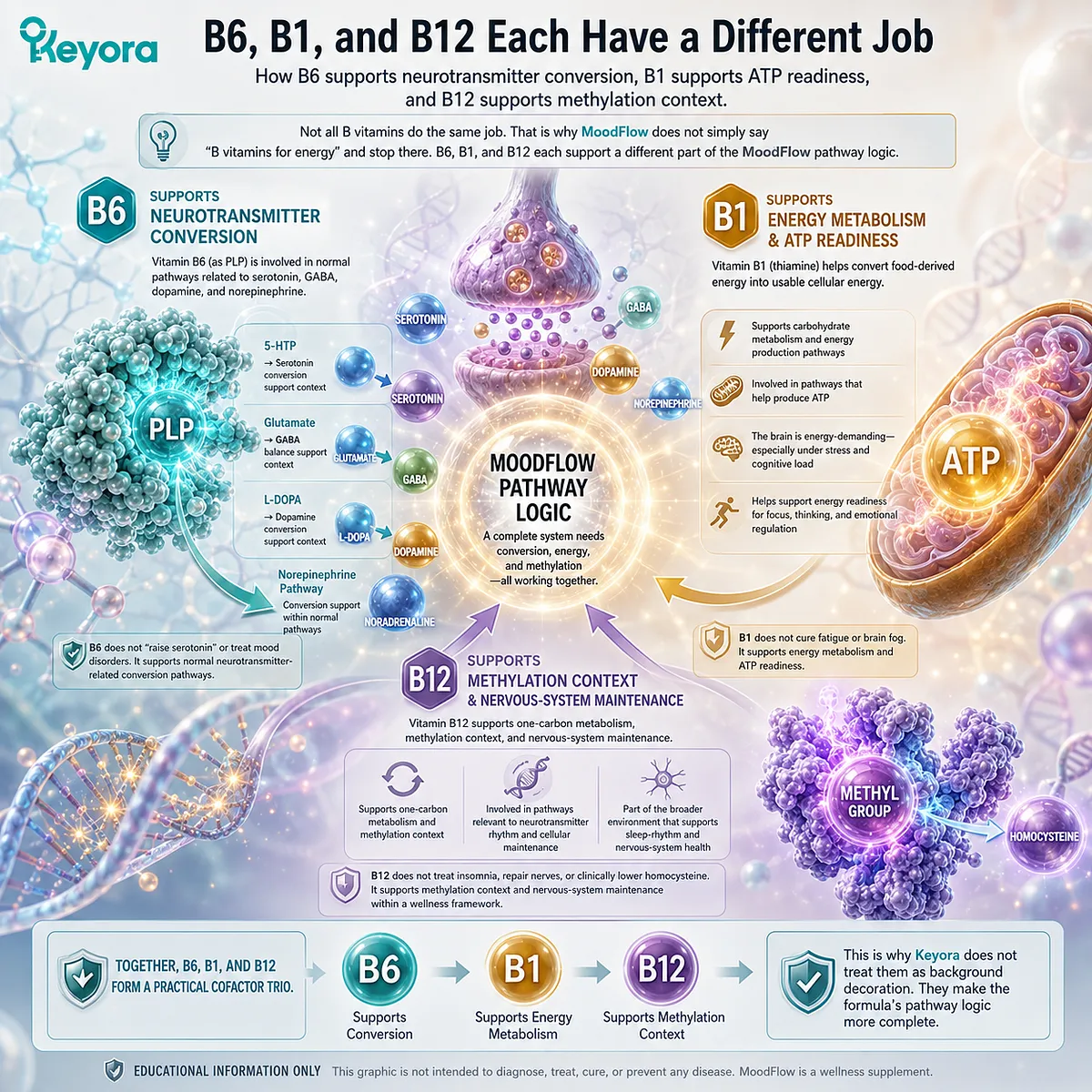
Not all B vitamins do the same job. That is why MoodFlow does not simply say “B vitamins for energy” and stop there.
B6, B1, and B12 each support a different part of the MoodFlow pathway logic.
Vitamin B6 is especially important for neurotransmitter conversion context.
Its active coenzyme form, often discussed as PLP, is involved in normal pathways related to serotonin, GABA, dopamine, and norepinephrine.
In simple language, B6 helps explain how the body works with certain brain-chemical building blocks.
When MoodFlow includes 5-HTP, B6 helps support the conversion context from 5-HTP toward serotonin.
When MoodFlow discusses calming balance, B6 also helps explain the pathway from glutamate toward GABA.
This does not mean B6 “raises serotonin” or treats mood disorders. That would be too strong and too medical. The safer and more accurate explanation is that B6 supports normal neurotransmitter-related conversion pathways.
Vitamin B1 has a different role.
B1, also known as thiamine, supports energy metabolism. Its active coenzyme form is involved in pathways that help convert food-derived energy into usable cellular energy.
This matters for the brain because the brain is energy-demanding. Even when you are sitting still, your brain is using energy to think, focus, regulate emotions, process sensory input, and maintain nervous-system function.
When stress and cognitive load are high, energy readiness becomes especially relevant.
A student studying for hours, a professional handling constant decisions, or a founder managing pressure all need neuro-metabolic support.
B1 should not be described as curing fatigue or brain fog. But it can be described as supporting energy metabolism and ATP readiness, which helps explain its place in the MoodFlow matrix.
Vitamin B12 adds another layer.
B12 supports one-carbon metabolism, methylation context, and nervous-system maintenance.
Methylation is involved in many normal body processes, including pathways relevant to neurotransmitter rhythm, cellular maintenance, and homocysteine-balance education.
B12 also helps explain why sleep-rhythm and mood-related pathways are not only about one ingredient.
Serotonin-melatonin continuity depends on a broader biochemical environment, and methylation context is part of that environment.
Again, the language must stay careful. B12 should not be described as treating insomnia, repairing nerves, or clinically lowering homocysteine in a product claim. In MoodFlow, B12 is best described as supporting methylation context and nervous-system maintenance within a wellness framework.
Together, B6, B1, and B12 form a practical cofactor trio.
-
B6 supports conversion.
-
B1 supports energy metabolism.
-
B12 supports methylation context.
This is why Keyora does not treat them as background decoration. They make the formula’s pathway logic more complete.
Why Cofactors Matter in an 8-in-1 Matrix
How B vitamins help connect 5-HTP, GABA balance, stress resilience, and cognitive support.
The MoodFlow 8-in-1 Matrix is built around connected layers. B vitamins help link those layers together.
Start with 5-HTP.
5-HTP is the serotonin-melatonin substrate layer. It helps explain how the body supports normal serotonin-related pathways that can connect downstream to sleep-rhythm biology.
But substrate alone is not enough. B6 supports the conversion context around 5-HTP. That is why 5-HTP and B6 make sense together. One supplies the building block; the other helps explain the conversion support layer.
Now consider GABA balance.
MoodFlow uses L-Theanine and magnesium glycinate to support calm-readiness, neural quieting, and non-sedative wind-down. But GABA-related pathway logic also connects back to B6, because B6 supports normal conversion pathways related to glutamate and GABA.
This does not mean MoodFlow forces GABA activity. It means the formula has a more complete pathway explanation: calm signaling, neural braking, and cofactor support all belong in the same architecture.
B1 connects to the energy side of the formula.
Stress and cognition are energy-demanding. The brain needs ATP readiness to think clearly, recover from load, and maintain steady performance. B1 helps explain the neuro-metabolic support layer behind cognitive resilience.
Magnesium also connects to this energy story.
Magnesium is involved in Mg-ATP context and nervous-system stability. B1 supports energy metabolism, while magnesium glycinate supports both energy-context and neural braking logic. Together, they help MoodFlow speak to both mental demand and nervous-system downshift.
B12 connects to methylation context and nervous-system maintenance.
This matters because MoodFlow is not just trying to calm the user in the moment. It is supporting a broader system that includes neurotransmitter rhythm, sleep-readiness context, and cognitive resilience.
Ashwagandha adds the stress-adaptation layer.
It supports HPA-axis rhythm context and recovery readiness under everyday pressure. B vitamins do not replace Ashwagandha’s role. Instead, they support the metabolic and cofactor infrastructure that a stress-loaded brain still needs.
Inside Keyora MoodFlow, B vitamins connect the substrate layer to the cofactor layer: B6 helps explain conversion support, B12 helps explain methylation context, and B1 helps explain neuro-metabolic readiness under cognitive load.
This is what makes MoodFlow different from a single-ingredient formula. It does not assume that one nutrient can cover the entire stress-sleep-mood-cognition loop.
A single ingredient may support one pathway. A matrix can support the relationships between pathways.
That is the purpose of B vitamins in MoodFlow. They make the formula more connected. They help explain how 5-HTP, GABA balance, stress resilience, sleep readiness, and cognitive support can be organized in one nutritional neurology framework.
For Keyora, B vitamins are not the loudest ingredients in the formula. But they are part of the infrastructure that helps the formula make sense.

Closing Summary
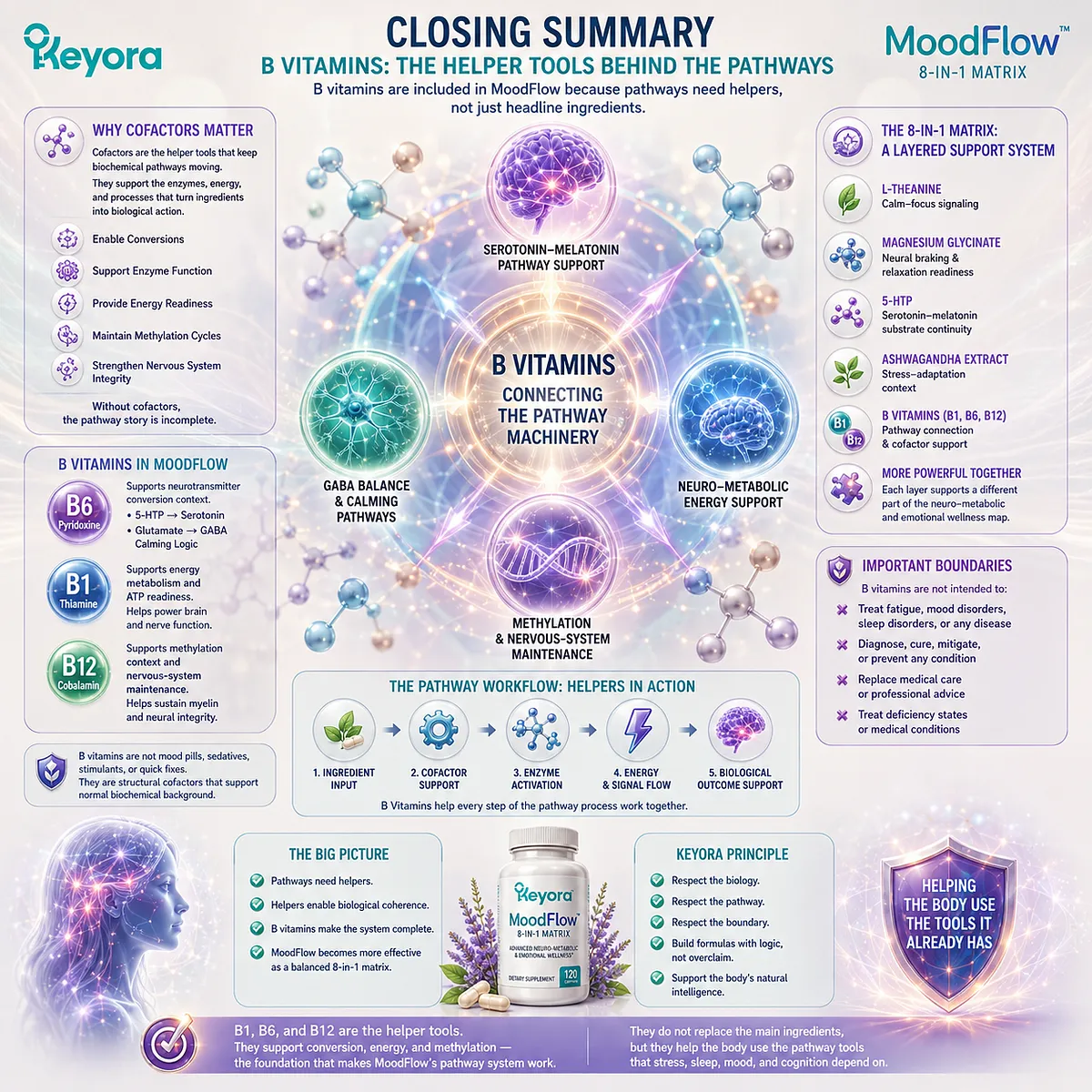
B vitamins are included in MoodFlow because pathways need helpers, not just headline ingredients.
-
B6 supports neurotransmitter conversion context, including 5-HTP to serotonin and glutamate to GABA-related logic.
-
B1 supports energy metabolism and ATP readiness.
-
B12 supports methylation context and nervous-system maintenance.
Together, B1, B6, and B12 help connect MoodFlow’s serotonin-melatonin pathway, GABA balance, neuro-metabolic support, and cognitive resilience architecture.
They are not decorative ingredients, and they should not be described as treating fatigue, mood disorders, sleep disorders, deficiency states, or any medical condition.
For Keyora, B vitamins make MoodFlow’s pathway logic more complete: they do not replace the main ingredients, but they help the body use the pathway tools that stress, sleep, mood, and cognition depend on.
This article is for educational and informational purposes only. It does not provide medical advice, diagnosis, treatment, cure, prevention, disease outcome claims, hormone restoration claims, fertility outcome claims, or formula-specific clinical efficacy claims.