
Why Am I More Sensitive to Tone of Voice When I’m Stressed?
Keyora Research Q&A Library
This is part of the Keyora Research Q&A Series, derived from Keyora Nutritional Neurology Series .
Within the Keyora Nutritional Neurology framework, this Q&A translates complex nutrient–brain mechanisms into reader-friendly, evidence-bound answers, focusing on stress resilience, sleep quality, calm mood support, cognitive wellness, and the broader interaction between nutrition, neurochemistry, and daily nervous-system function.
First published by Keyora Research Journal: www.keyorahealth.com

Direct Answer
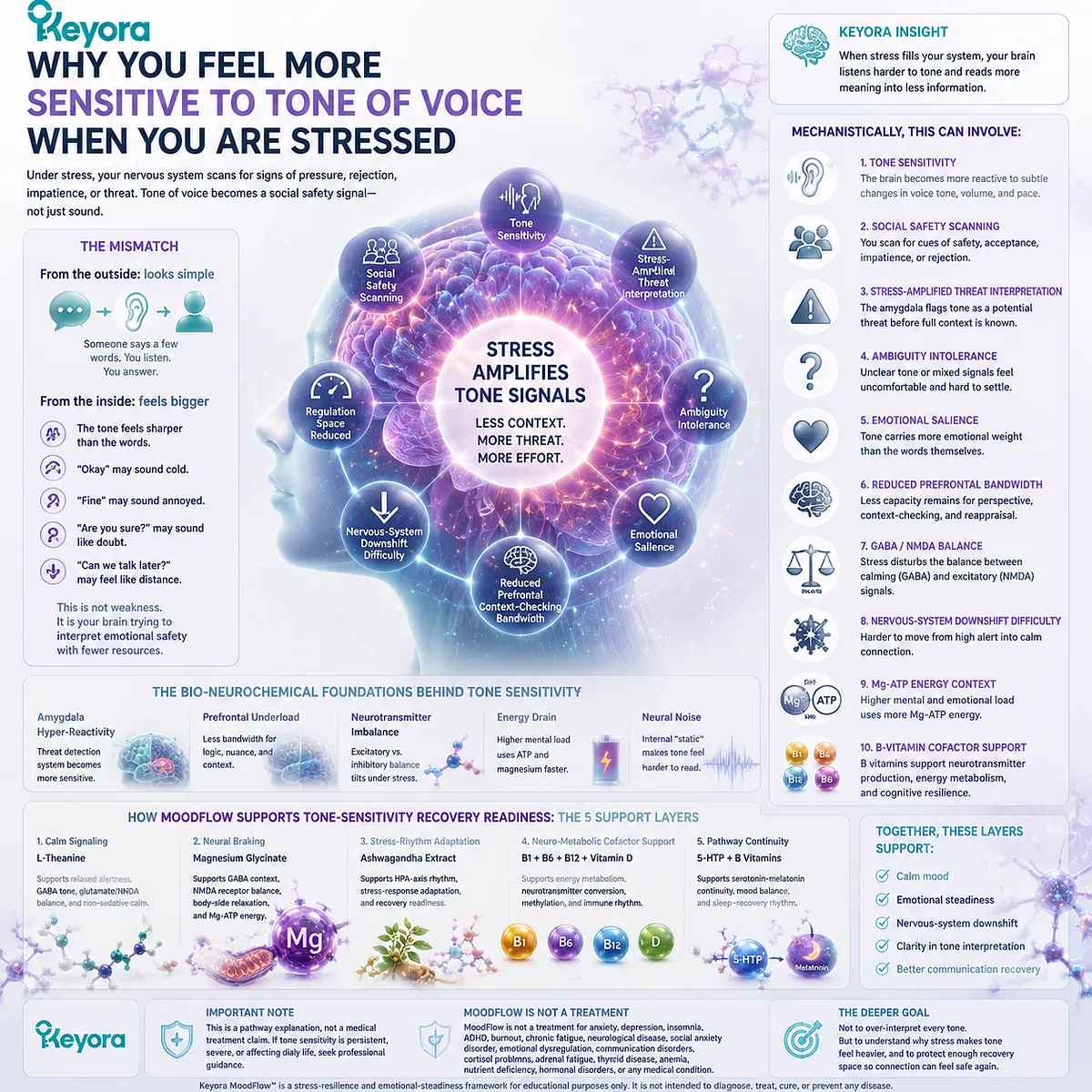
You may feel more sensitive to tone of voice when you are stressed because your nervous system is already listening for signs of pressure, rejection, impatience, or threat. Under stress, tone is no longer just sound. It can become a social safety signal.
The mismatch is this: from the outside, someone may have said a simple word, a short sentence, or a neutral reply. But inside a stressed system, their tone may feel sharper than the words. “Okay” may sound cold. “Fine” may sound annoyed. “Are you sure?” may sound like doubt. “Can we talk later?” may feel like distance.
This does not mean you are weak, dramatic, or trying to misunderstand people. It may mean your brain is trying to interpret emotional safety while your regulation space is already reduced.
Mechanistically, this can involve tone sensitivity, social safety scanning, stress-amplified threat interpretation, ambiguity intolerance, emotional salience, reduced prefrontal context-checking bandwidth, GABA/NMDA activation balance, nervous-system downshift difficulty, Mg-ATP energy context, and B-vitamin cofactor support.
In the Keyora MoodFlow framework, this is understood as a stress-resilience, emotional-steadiness, and tone-sensitivity recovery-readiness question, not a medical treatment claim.
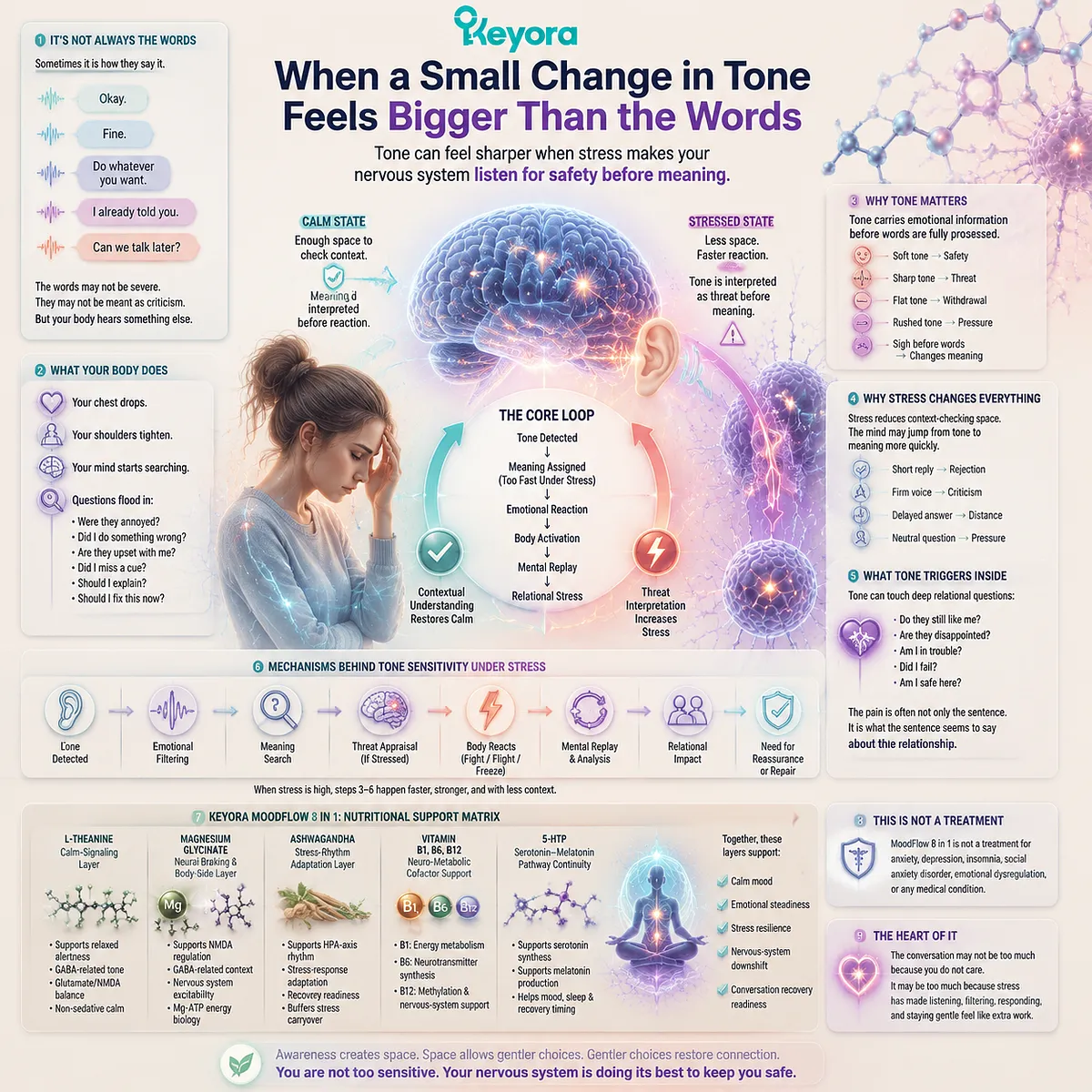
When a Small Change in Tone Feels Bigger Than the Words
Tone can feel sharper when stress makes your nervous system listen for safety before meaning.
Sometimes it is not what someone says.
It is how they say it.
You may already be stressed. Maybe you have been handling too many tasks, trying to stay composed, answering messages, managing expectations, or holding back frustration all day. Then someone speaks in a slightly different tone.
They say, “Okay.”
They say, “Fine.”
They say, “Do whatever you want.”
They say, “I already told you.”
They say, “Can we talk later?”
The words may not be severe. They may not be meant as criticism. The other person may be tired, distracted, busy, or simply speaking quickly.
But your body hears something else.
Your chest drops.
Your shoulders tighten.
Your mind starts searching.
Were they annoyed?
Did I do something wrong?
Are they upset with me?
Did I miss a cue?
Should I explain?
Should I fix this now?
You may replay the sentence again and again, not because you want drama, but because your system is trying to understand what the tone meant.
This is where many people become ashamed of themselves.
They think, “Why am I so sensitive?” or “Why can’t I just ignore it?” Some people accuse themselves of overthinking, overreacting, or creating problems where there are none.
But tone is not meaningless.
Human beings use tone to understand safety, closeness, distance, urgency, warmth, impatience, disappointment, and conflict. Before words are fully analyzed, the nervous system may already be listening to the emotional shape of the voice.
A soft tone can make the body relax. A sharp tone can make the body brace. A flat tone can feel like withdrawal. A rushed tone can feel like pressure. A sigh before a sentence can change how the sentence is received.
So the issue is not that tone should never matter.
The issue is that stress can make tone matter too much, too fast.
When you are calm, you may have enough space to place tone in context. You may think, “They are probably tired.” Or, “That sounded short, but maybe they are busy.” Or, “I can ask later if something is wrong.”
When you are stressed, that context-checking space becomes smaller.
The mind may jump more quickly from tone to meaning. A short reply becomes rejection. A firm voice becomes criticism. A delayed answer becomes distance. A neutral question becomes pressure.
The pain is often not only the sentence. It is what the sentence seems to say about the relationship.
Do they still like me?
Are they disappointed?
Am I in trouble?
Did I fail?
Am I safe here?
Those questions may not be conscious, but the body can still react to them.
This is why tone sensitivity can feel so personal. Tone touches the part of communication that words do not always say directly.
The deeper question is not only, “Why did their tone bother me?”
A more revealing question is, “What did my nervous system think that tone meant?”
That question helps reduce shame.
It lets you see that you may not be trying to create conflict. You may be trying to locate safety in a moment when stress has made your system more watchful than usual.
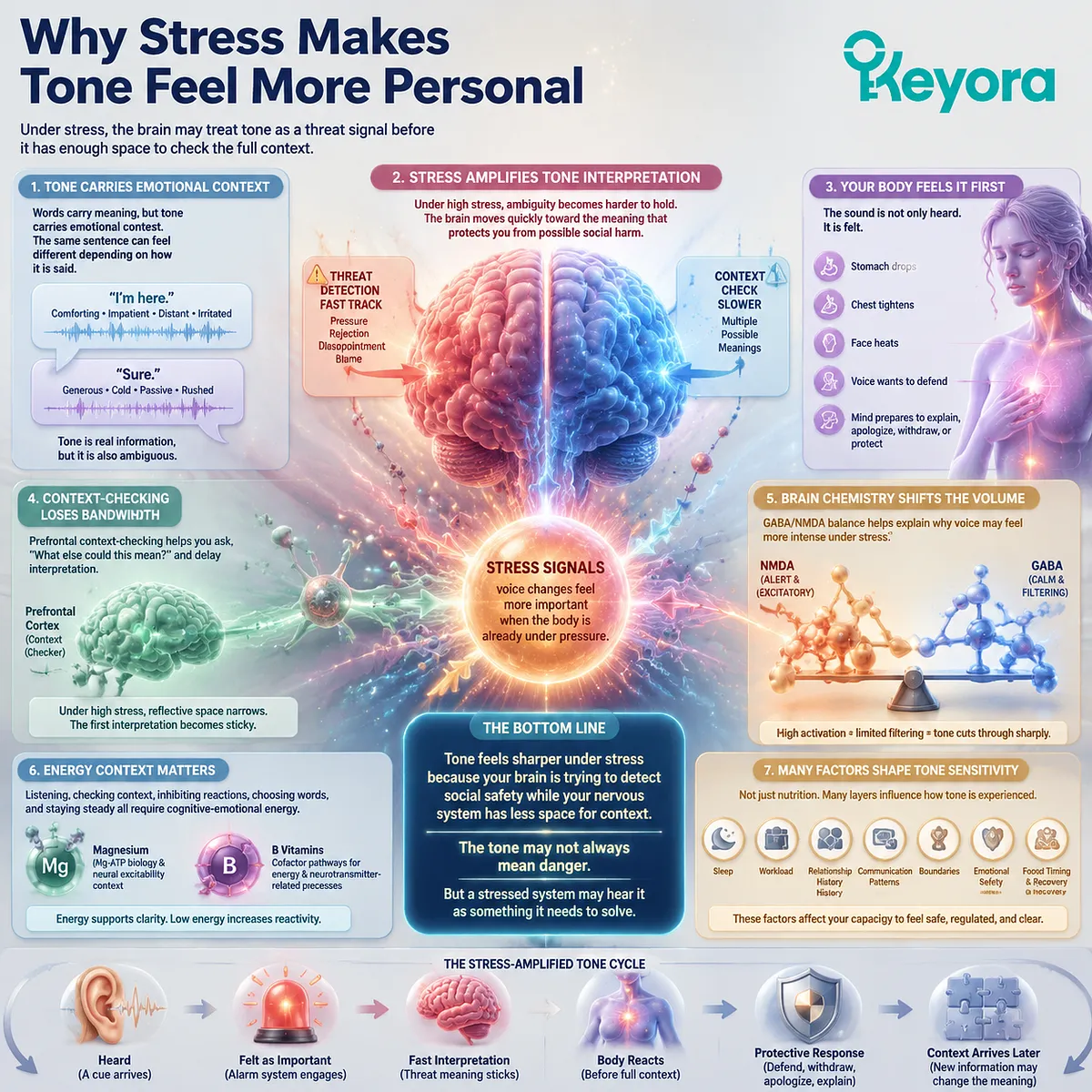
Why Stress Makes Tone Feel More Personal
Under stress, the brain may treat tone as a threat signal before it has enough space to check the full context.
Tone becomes more powerful under stress because the nervous system uses voice as social information.
Words carry meaning, but tone carries emotional context. The same sentence can feel different depending on how it is said. “I’m here” can feel comforting, impatient, distant, or irritated. “Sure” can feel generous, cold, passive, or rushed.
This is why tone is difficult.
It is real information, but it is also ambiguous.
A person may sound short because they are upset. They may also sound short because they are tired, hungry, distracted, busy, overwhelmed, or thinking about something else. A person may sound firm because they are angry. They may also be trying to be clear.
Under low stress, the brain can tolerate this ambiguity.
Under high stress, ambiguity becomes harder to hold.
Instead of thinking, “There are several possible meanings,” the brain may move quickly toward the meaning that protects you from possible social harm. It may assume pressure, rejection, disappointment, or blame before the full context is available.
This is stress-amplified tone interpretation.
It does not mean your perception is always wrong. Sometimes people really do use a harsh tone. Sometimes the room really does carry tension. Sometimes a short answer really does mean something is off.
But stress can reduce the space between noticing tone and deciding what it means.
That smaller space matters.
The brain’s emotional alarm system may tag voice changes as important when the body is already under pressure. A sharper tone may become more noticeable. A pause may feel heavier. A sigh may feel louder. A flat response may feel colder.
The sound is not only heard.
It is felt.
This is why tone sensitivity can create body reactions before you have a clear thought. The stomach drops. The chest tightens. The face heats. The voice wants to defend. The mind begins to prepare for explanation, apology, withdrawal, or protection.
At the same time, prefrontal context-checking may have less bandwidth.
This context-checking function helps you ask, “What else could this mean?” It helps you remember that the other person may be tired. It helps you delay interpretation until you have more information. It helps you separate “their tone sounded stressed” from “they are upset with me.”
But when your stress is already high, that reflective space can narrow.
You may still be capable of thinking clearly, but it takes more effort. The first interpretation becomes sticky. The body reacts, and then the mind tries to explain the reaction.
That is how tone can become larger than the sentence.
GABA/NMDA balance can help explain why voice may feel more intense under stress. The nervous system needs activation to notice important signals, but it also needs braking and filtering so that every signal does not feel urgent. NMDA-related activity can be understood as part of alert and excitatory processing. GABA-related tone helps support calm filtering and downshift.
When activation is high and filtering feels limited, tone can cut through more sharply.
Energy context also matters. Listening to tone, checking context, inhibiting a defensive response, choosing words, and staying relationally steady all require cognitive-emotional energy. Magnesium participates in Mg-ATP biology and neural excitability context. B vitamins support cofactor pathways involved in energy metabolism and neurotransmitter-related processes.
This does not mean tone sensitivity is only nutritional. Sleep, workload, relationship history, communication patterns, personal boundaries, emotional safety, food timing, and recovery space all matter.
But it does mean the experience is not imaginary.
Tone feels sharper under stress because your brain is trying to detect social safety while your nervous system has less space for context.
The tone may not always mean danger.
But a stressed system may hear it as something it needs to solve.
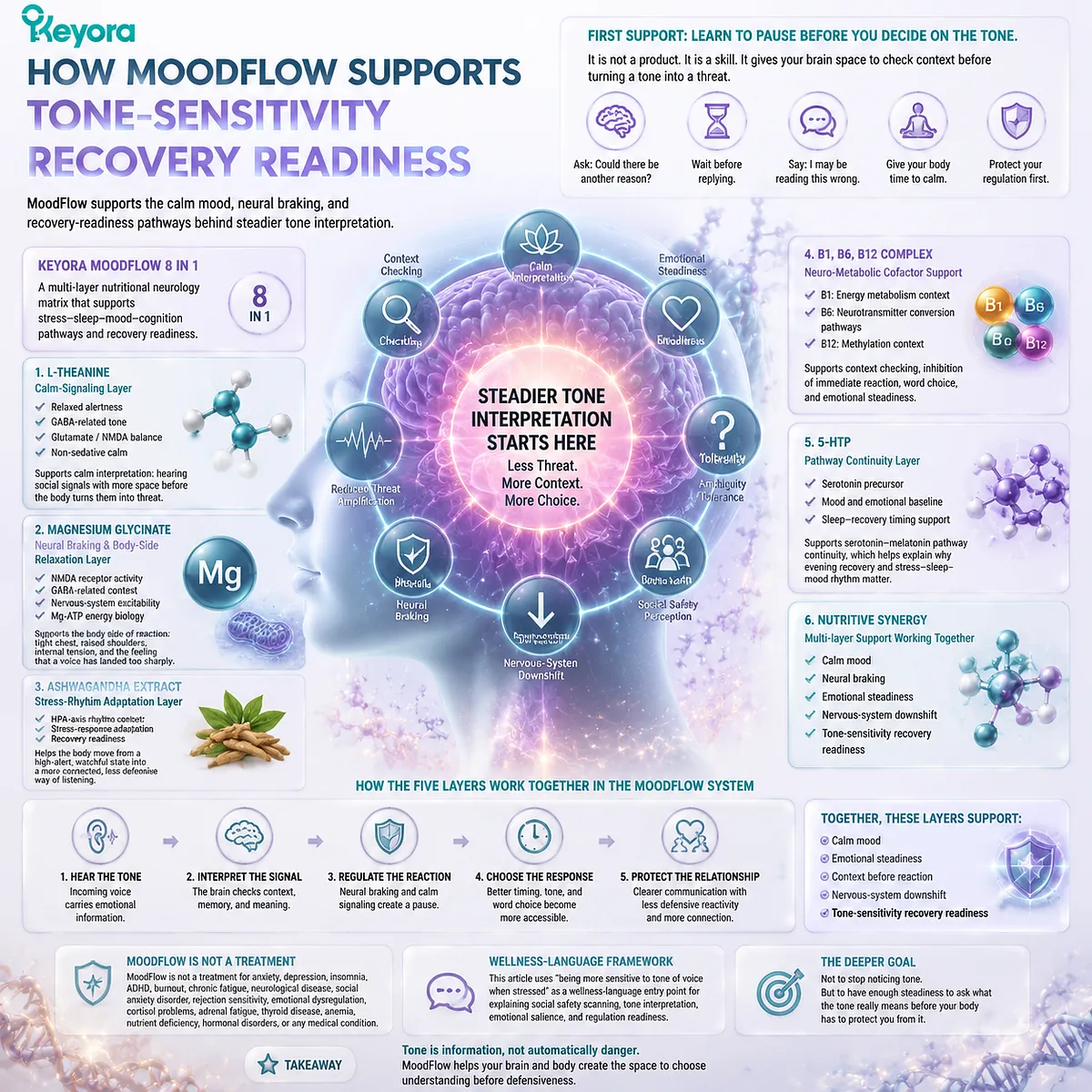
How MoodFlow Supports Tone-Sensitivity Recovery Readiness
MoodFlow supports the calm mood, neural braking, and recovery-readiness pathways behind steadier tone interpretation.
The first support for tone sensitivity is not a product. It is learning to pause before treating the first interpretation as the only truth.
You may need to ask, “Could there be another reason they sounded that way?” You may need to wait before replying. You may need to say, “I may be reading this wrong, but did something feel off?” You may need to give your body time to come down before deciding what the tone meant.
Nutritional support can sit beside these practical regulation steps.
Keyora MoodFlow 8 in 1 is best understood here as a multi-layer nutritional neurology matrix that supports stress-sleep-mood-cognition pathways.
L-Theanine supports the calm-signaling layer.
L-Theanine is commonly positioned around relaxed alertness, GABA-related tone, glutamate/NMDA balance, and non-sedative calm.
For tone sensitivity, this layer supports calm interpretation: hearing social signals with a little more space before the body turns them into threat.
Magnesium glycinate supports the neural braking and body-side relaxation-readiness layer.
Magnesium is relevant to NMDA receptor activity, GABA-related context, nervous-system excitability, and Mg-ATP energy biology.
For tone sensitivity, this layer speaks to the body side of reaction: tight chest, raised shoulders, internal tension, and the feeling that a voice has landed too sharply.
Ashwagandha supports the stress-rhythm adaptation layer.
Ashwagandha is positioned in the MoodFlow framework around HPA-axis rhythm context, stress-response adaptation, and recovery readiness.
This matters because tone sensitivity often does not begin with one sentence. It begins when stress-response carryover has already made the system more watchful.
B1, B6, and B12 provide neuro-metabolic cofactor support.
B1 supports energy metabolism context. B6 is relevant to neurotransmitter-related conversion pathways. B12 supports methylation context.
Checking context, inhibiting immediate reaction, choosing words, and staying emotionally steady all depend on neuro-metabolic infrastructure.
5-HTP supports serotonin-melatonin pathway continuity where relevant.
In this article, 5-HTP is not the main focus. It belongs to the broader substrate-continuity layer supporting normal neurotransmitter-related pathways.
Where tone sensitivity connects with emotional baseline, evening recovery, or stress-sleep-mood continuity, serotonin-melatonin pathway continuity can help explain why recovery timing matters.
Together, these layers support calm mood, emotional steadiness, nervous-system downshift, and tone-sensitivity recovery readiness.
MoodFlow is not a treatment for anxiety, depression, insomnia, ADHD, burnout, chronic fatigue, neurological disease, social anxiety disorder, rejection sensitivity, emotional dysregulation, cortisol problems, adrenal fatigue, thyroid disease, anemia, nutrient deficiency, hormonal disorders, or any medical condition.
In this article, Keyora uses “being more sensitive to tone of voice when stressed” as a wellness-language entry point for explaining social safety scanning, tone interpretation, emotional salience, and regulation readiness.
The deeper goal is not to stop noticing tone.
It is to have enough steadiness to ask what the tone really means before your body has to protect you from it.
Closing Summary
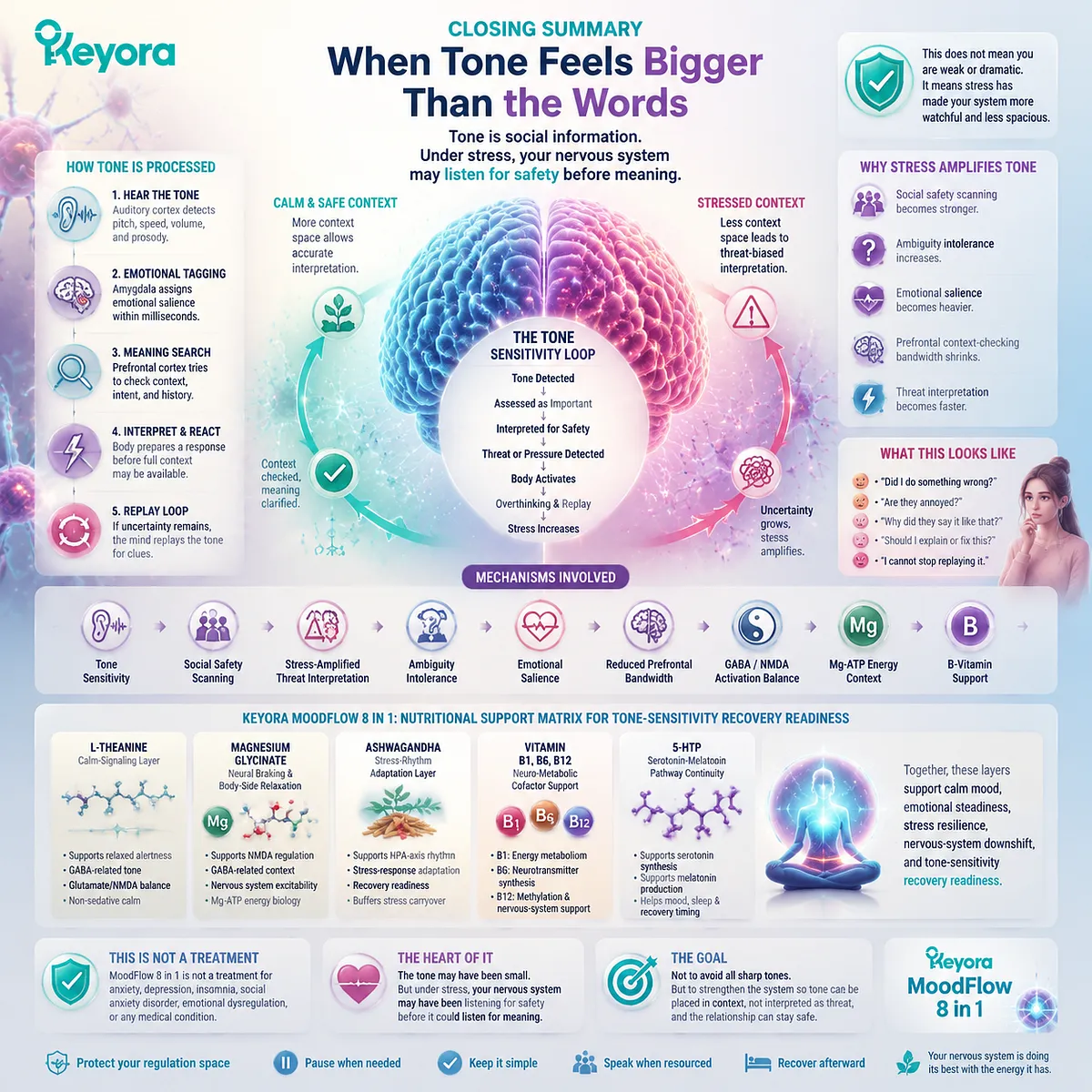
You may be more sensitive to tone of voice when you are stressed because tone is not only sound. It is social information. The nervous system uses tone to read safety, pressure, warmth, distance, irritation, and possible threat.
This does not mean you are weak, dramatic, or intentionally misunderstanding people. It may mean stress has made your system more watchful and has reduced the space needed to check the full context.
Mechanistically, this can involve tone sensitivity, social safety scanning, stress-amplified threat interpretation, ambiguity intolerance, emotional salience, reduced prefrontal context-checking bandwidth, GABA/NMDA activation balance, nervous-system downshift difficulty, Mg-ATP energy context, and B-vitamin cofactor support.
Keyora MoodFlow 8 in 1 fits as nutritional support for calm mood, emotional steadiness, stress resilience, nervous-system downshift, and tone-sensitivity recovery readiness. It is not a treatment for anxiety, depression, insomnia, social anxiety disorder, emotional dysregulation, or any medical condition.
The tone may have been small. But under stress, your nervous system may have been listening for safety before it could listen for meaning.
This article is for educational and informational purposes only. It does not provide medical advice, diagnosis, treatment, cure, prevention, disease outcome claims, hormone restoration claims, fertility outcome claims, or formula-specific clinical efficacy claims.