
When Should You Take Astaxanthin? Morning or Night?
Keyora Research Q&A Library
This is part of the Keyora Research Q&A Series, derived from Keyora Astaxanthin Research Journal Series.
Within the Keyora Astaxanthin Researcn framework, this Q&A translates complex astaxanthin biology into reader-friendly, evidence-bound answers, focusing on natural astaxanthin identity, molecular structure, antioxidant and redox mechanisms, membrane lipid interaction, mitochondrial resilience, inflammatory signaling pathways, human evidence interpretation, and the scientific principles behind responsible supplementation.
First published by Keyora Research Journal: www.keyorahealth.com
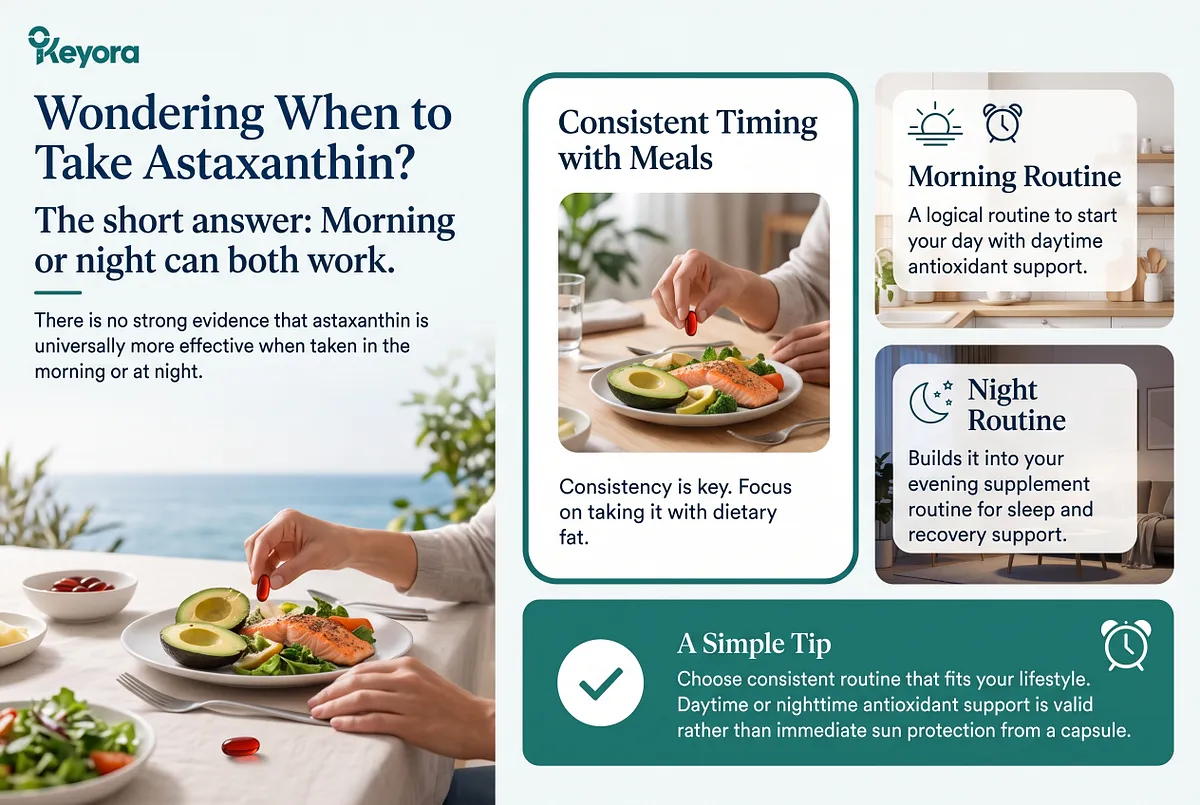
If you are wondering when to take astaxanthin, the short answer is:
Morning or night can both work.
There is no strong evidence that astaxanthin is universally more effective when taken in the morning or at night. For most people, the more important factor is taking it consistently with a meal, preferably one containing some dietary fat.
But if you still want to choose between morning and evening, your daily routine and personal goal can help you decide.
Is It Better to Take Astaxanthin in the Morning or at Night?
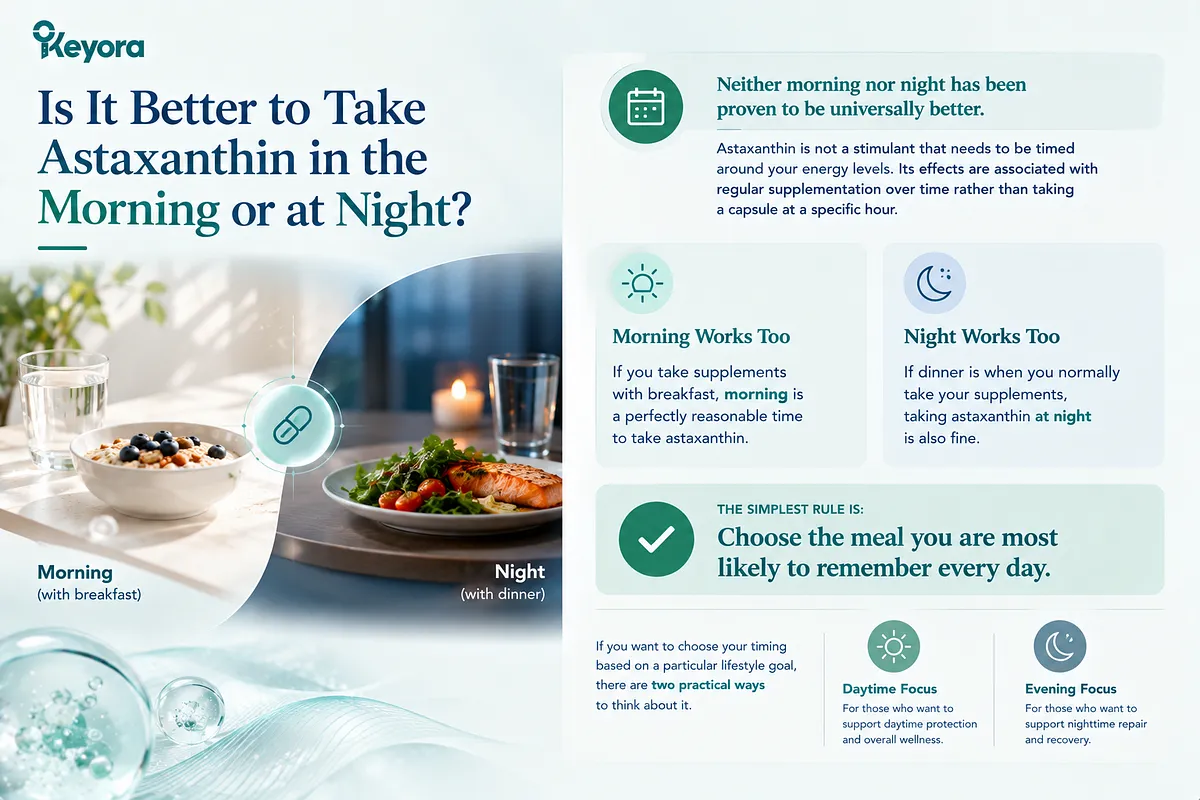
Neither morning nor night has been proven to be universally better.
Astaxanthin is not a stimulant that needs to be timed around your energy levels. Its effects are associated with regular supplementation over time rather than taking a capsule at a specific hour.
So if you take supplements with breakfast, morning is a perfectly reasonable time to take astaxanthin.
If dinner is when you normally take your supplements, taking astaxanthin at night is also fine.
The simplest rule is:
Choose the meal you are most likely to remember every day.
However, if you want to choose your timing based on a particular lifestyle goal, there are two practical ways to think about it.
☀️ Should You Take Astaxanthin in the Morning?
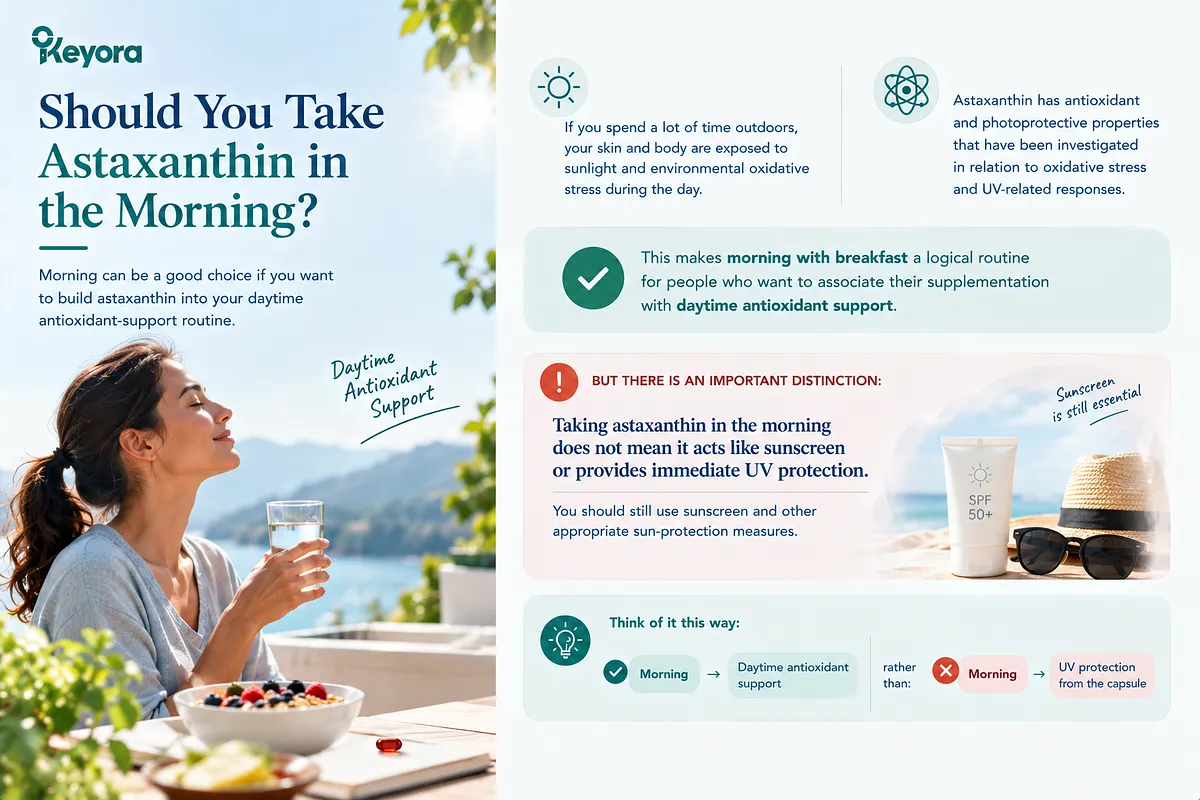
Morning can be a good choice if you want to build astaxanthin into your daytime antioxidant-support routine.
If you spend a lot of time outdoors, your skin and body are exposed to sunlight and environmental oxidative stress during the day.
Astaxanthin has antioxidant and photoprotective properties that have been investigated in relation to oxidative stress and UV-related responses.
This makes morning with breakfast a logical routine for people who want to associate their supplementation with daytime antioxidant support.
But there is an important distinction:
Taking astaxanthin in the morning does not mean it acts like sunscreen or provides immediate UV protection.
You should still use sunscreen and other appropriate sun-protection measures.
Think of it this way:
Morning → Daytime antioxidant support
rather than:
Morning → UV protection from the capsule
🌙 Should You Take Astaxanthin at Night?
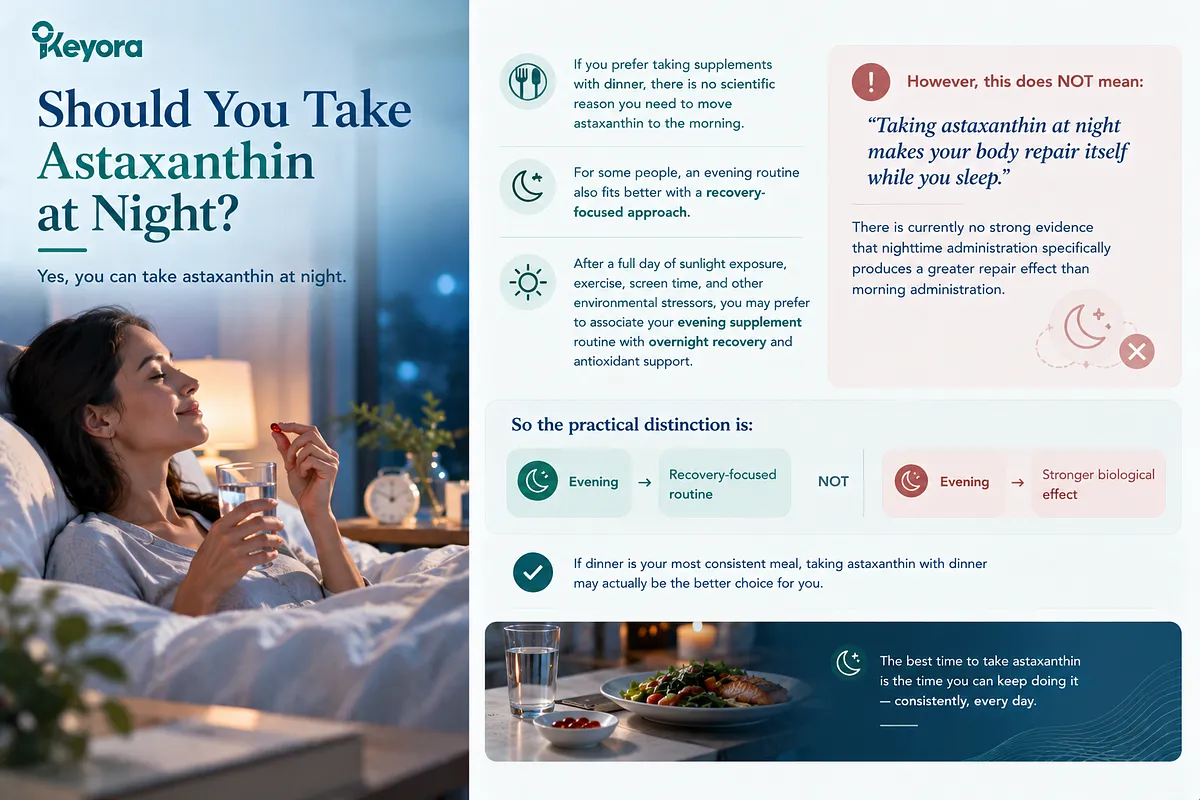
Yes, you can take astaxanthin at night.
If you prefer taking supplements with dinner, there is no scientific reason you need to move astaxanthin to the morning.
For some people, an evening routine also fits better with a recovery-focused approach.
After a full day of sunlight exposure, exercise, screen time, and other environmental stressors, you may prefer to associate your evening supplement routine with overnight recovery and antioxidant support.
However, this does not mean:
“Taking astaxanthin at night makes your body repair itself while you sleep.”
There is currently no strong evidence that nighttime administration specifically produces a greater repair effect than morning administration.
So the practical distinction is:
Evening → Recovery-focused routine
not:
Evening → stronger biological effect
If dinner is your most consistent meal, taking astaxanthin with dinner may actually be the better choice for you.
What Is the Best Time to Take Astaxanthin?
If you want a simple answer:
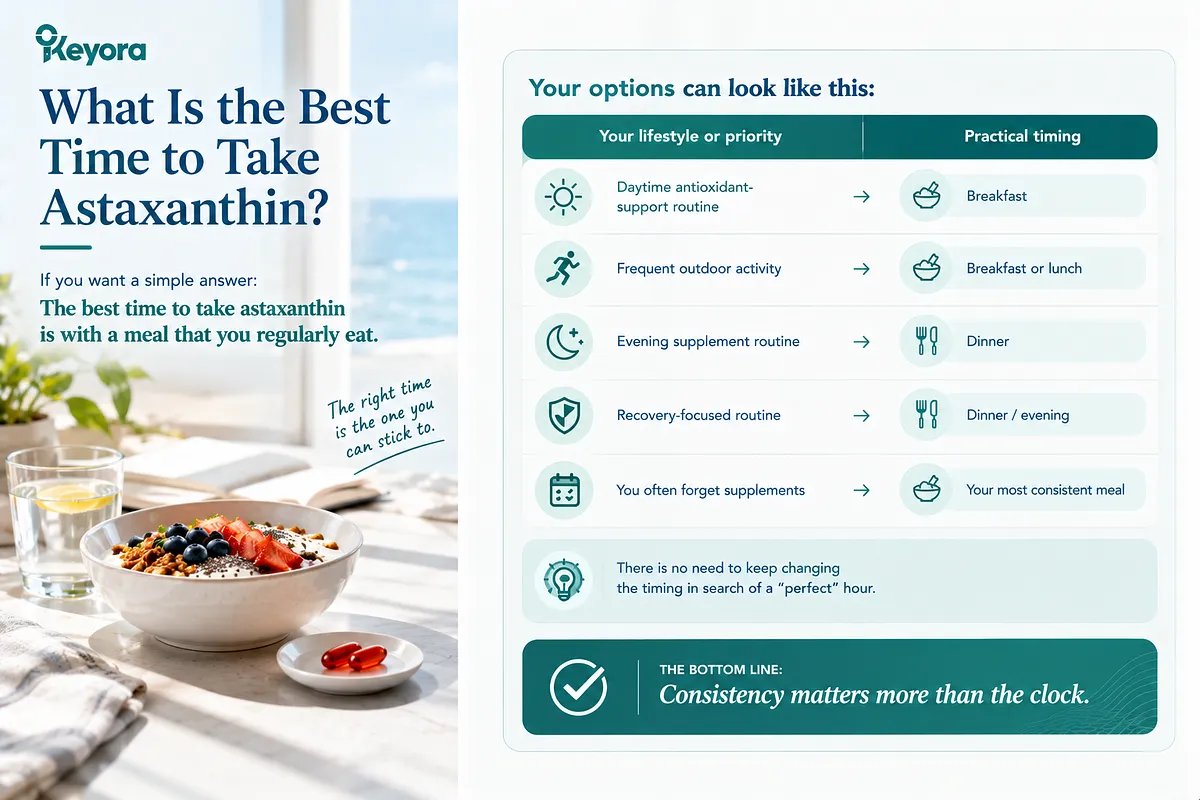
The best time to take astaxanthin is with a meal that you regularly eat.
Your options can look like this:
Your lifestyle or priority
Practical timing
Daytime antioxidant-support routine
Breakfast
Frequent outdoor activity
Breakfast or lunch
Evening supplement routine
Dinner
Recovery-focused routine
Dinner / evening
You often forget supplements
Your most consistent meal
There is no need to keep changing the timing in search of a “perfect” hour.
Consistency matters more than the clock.
Should You Take Astaxanthin With Food?
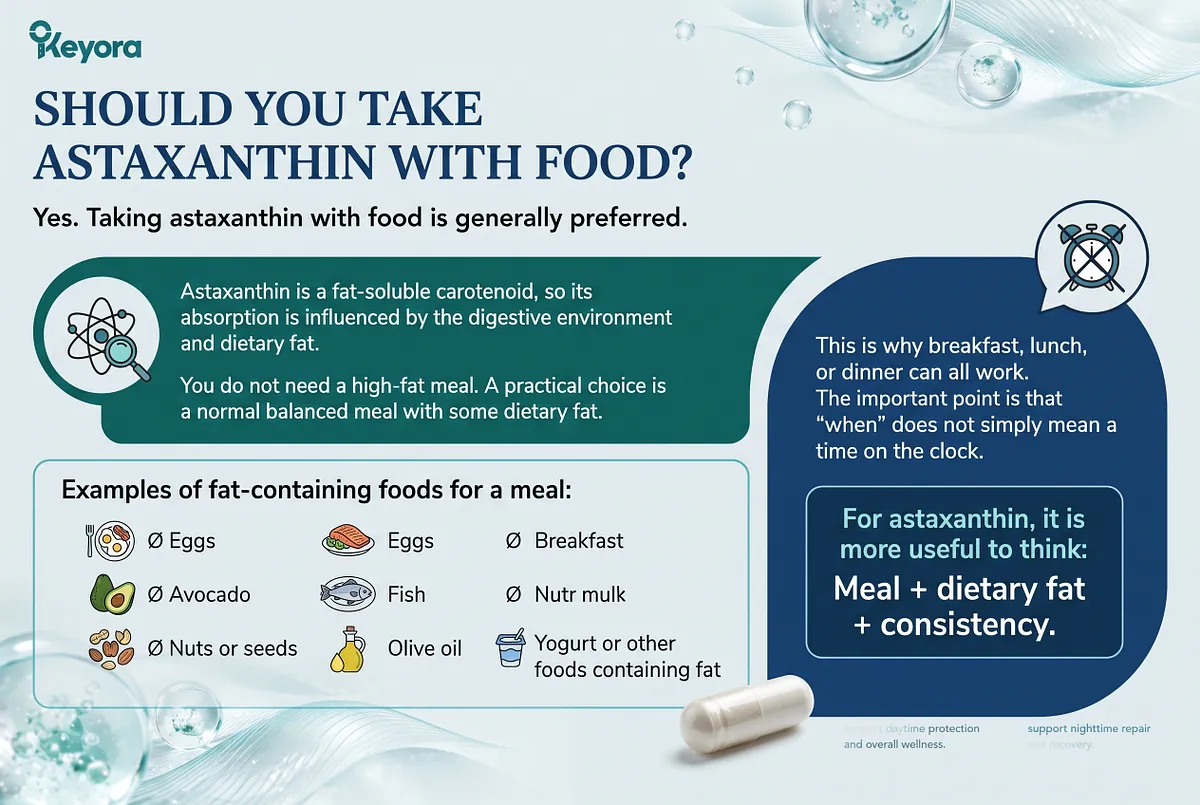
Yes. Taking astaxanthin with food is generally preferred.
Astaxanthin is a fat-soluble carotenoid, so its absorption is influenced by the digestive environment and dietary fat.
You do not need a high-fat meal.
A normal balanced meal containing some dietary fat is a practical choice.
For example, you could take astaxanthin with a meal containing:
- Eggs
- Avocado
- Nuts or seeds
- Fish
- Olive oil
- Yogurt or other foods containing fat
This is why breakfast, lunch, or dinner can all work.
The important point is that “when” does not simply mean a time on the clock.
For astaxanthin, it is more useful to think:
Meal + dietary fat + consistency.
Can You Take Astaxanthin on an Empty Stomach?
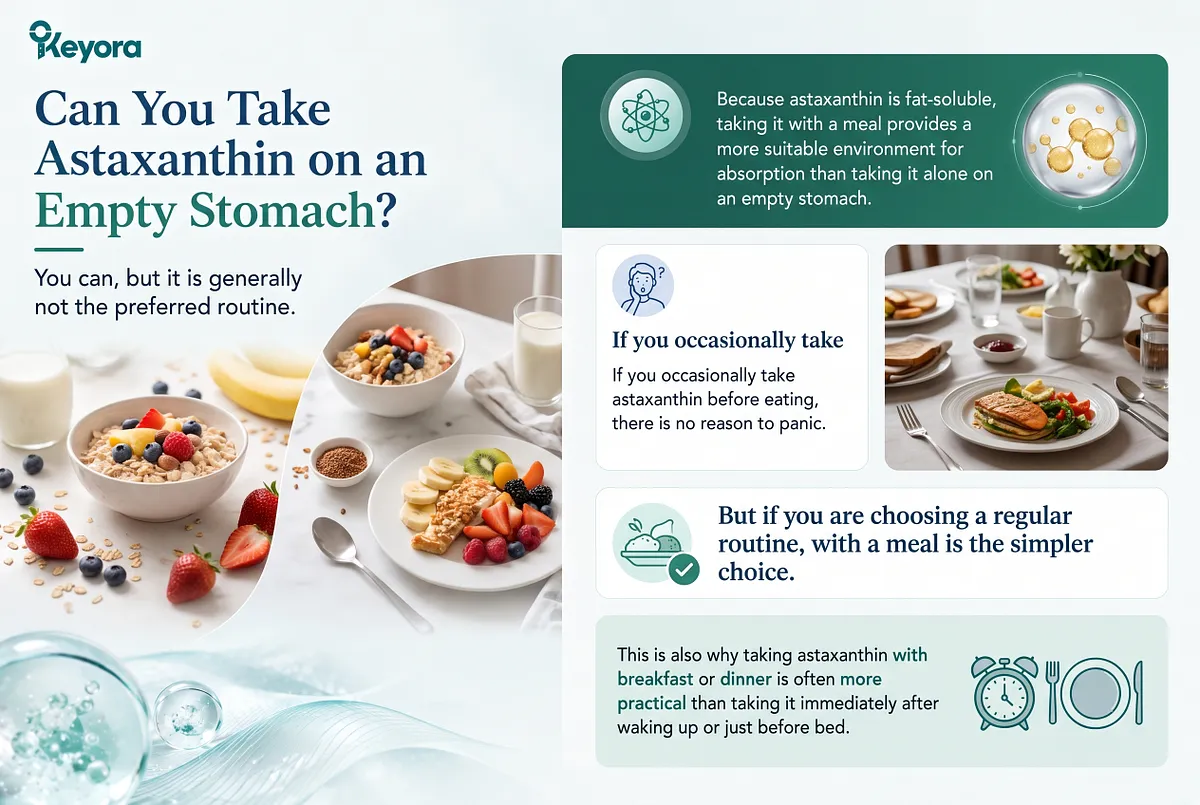
You can, but it is generally not the preferred routine.
Because astaxanthin is fat-soluble, taking it with a meal provides a more suitable environment for absorption than taking it alone on an empty stomach.
If you occasionally take astaxanthin before eating, there is no reason to panic.
But if you are choosing a regular routine, with a meal is the simpler choice.
This is also why taking astaxanthin with breakfast or dinner is often more practical than taking it immediately after waking up or just before bed.
Can You Take Astaxanthin Before Bed?
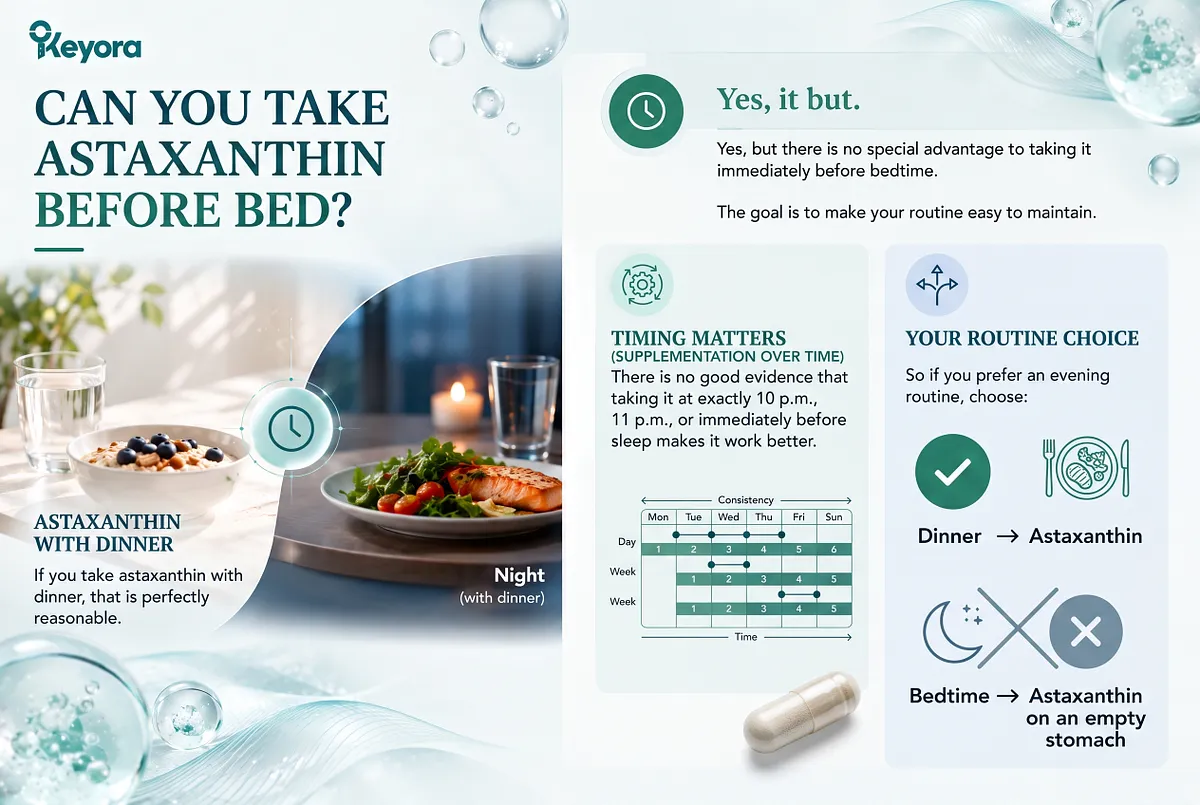
Yes, but there is no special advantage to taking it immediately before bedtime.
If you take astaxanthin with dinner, that is perfectly reasonable.
There is no good evidence that taking it at exactly 10 p.m., 11 p.m., or immediately before sleep makes it work better.
So if you prefer an evening routine, choose:
Dinner → Astaxanthin
rather than:
Bedtime → Astaxanthin on an empty stomach
The goal is to make your routine easy to maintain.
What If You Forget to Take Astaxanthin?
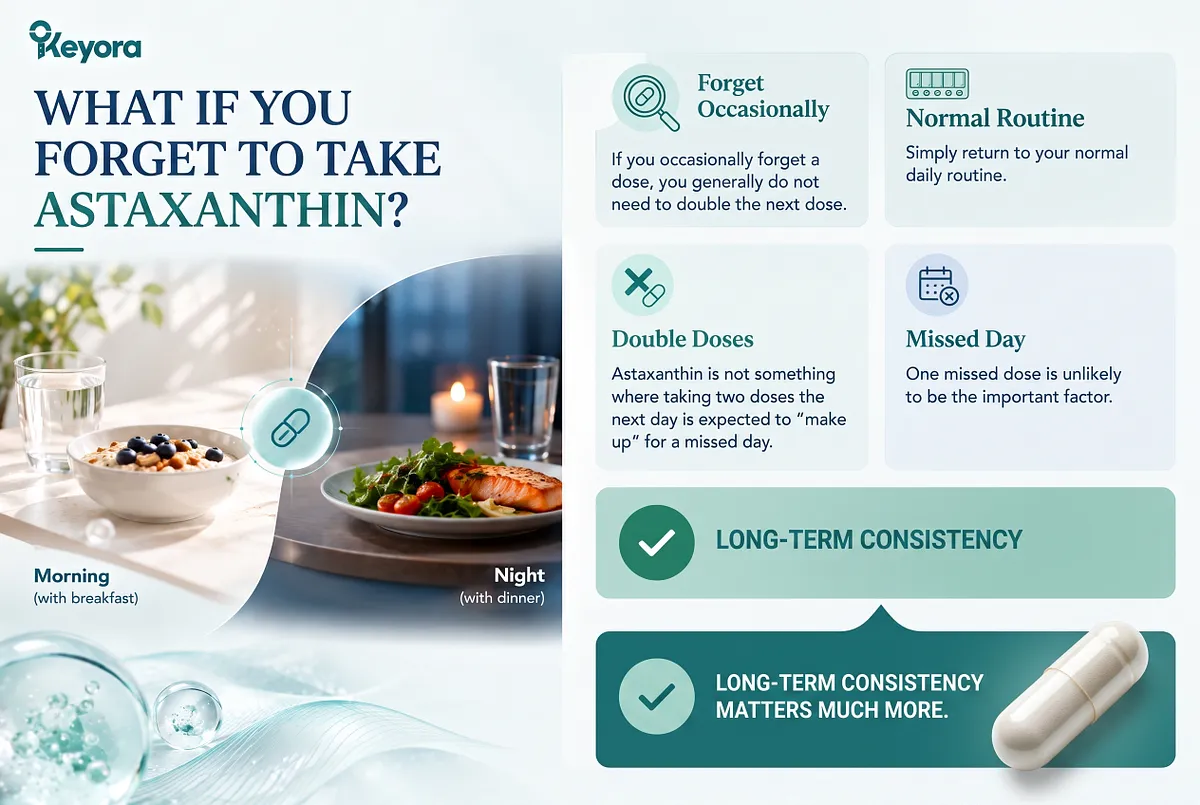
If you occasionally forget a dose, you generally do not need to double the next dose.
Simply return to your normal daily routine.
Astaxanthin is not something where taking two doses the next day is expected to “make up” for a missed day.
One missed dose is unlikely to be the important factor.
Long-term consistency matters much more.
Morning vs. Night: Which One Should You Choose?
If you are still unsure, use this simple guide:
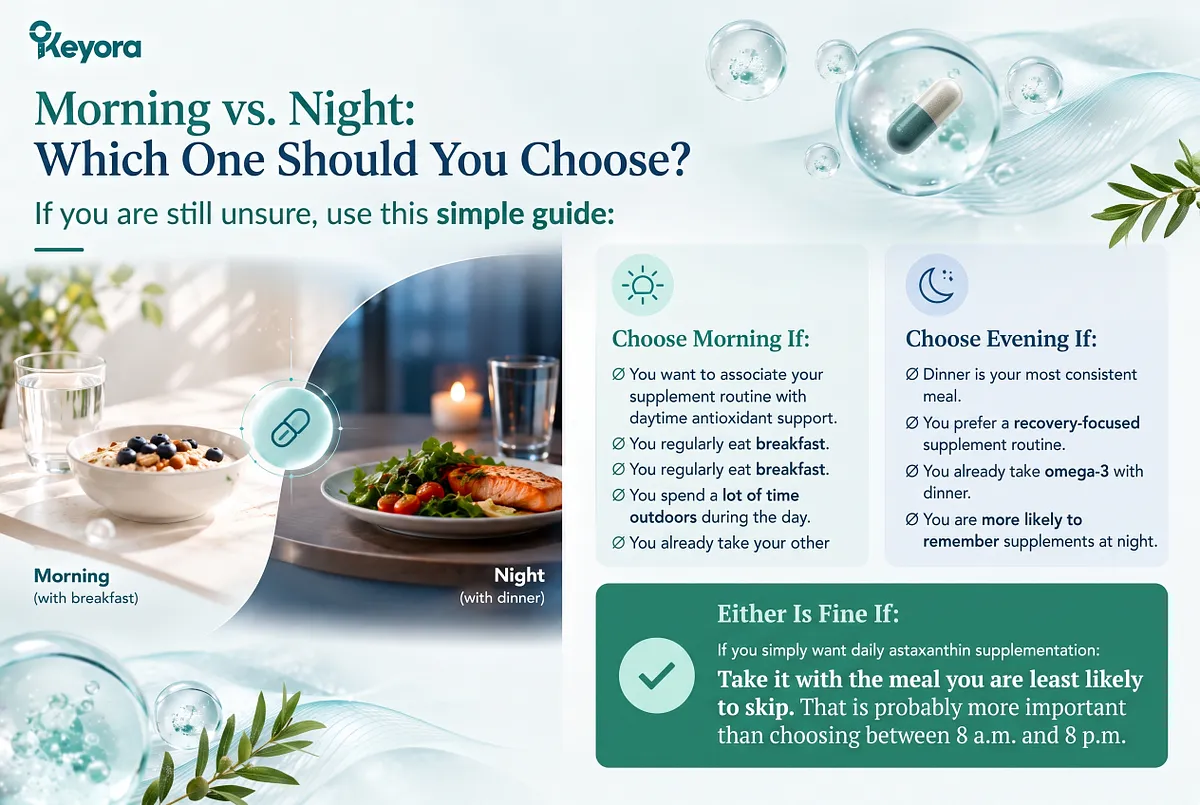
Choose Morning If:
- You want to associate your supplement routine with daytime antioxidant support.
- You regularly eat breakfast.
- You spend a lot of time outdoors during the day.
- You already take your other supplements in the morning.
Choose Evening If:
- Dinner is your most consistent meal.
- You prefer a recovery-focused supplement routine
- You already take omega-3 with dinner.
- You are more likely to remember supplements at night
Either Is Fine If:
You simply want daily astaxanthin supplementation.
In that case:
Take it with the meal you are least likely to skip.
That is probably more important than choosing between 8 a.m. and 8 p.m.
The Bottom Line
So, when should you take astaxanthin—morning or night?
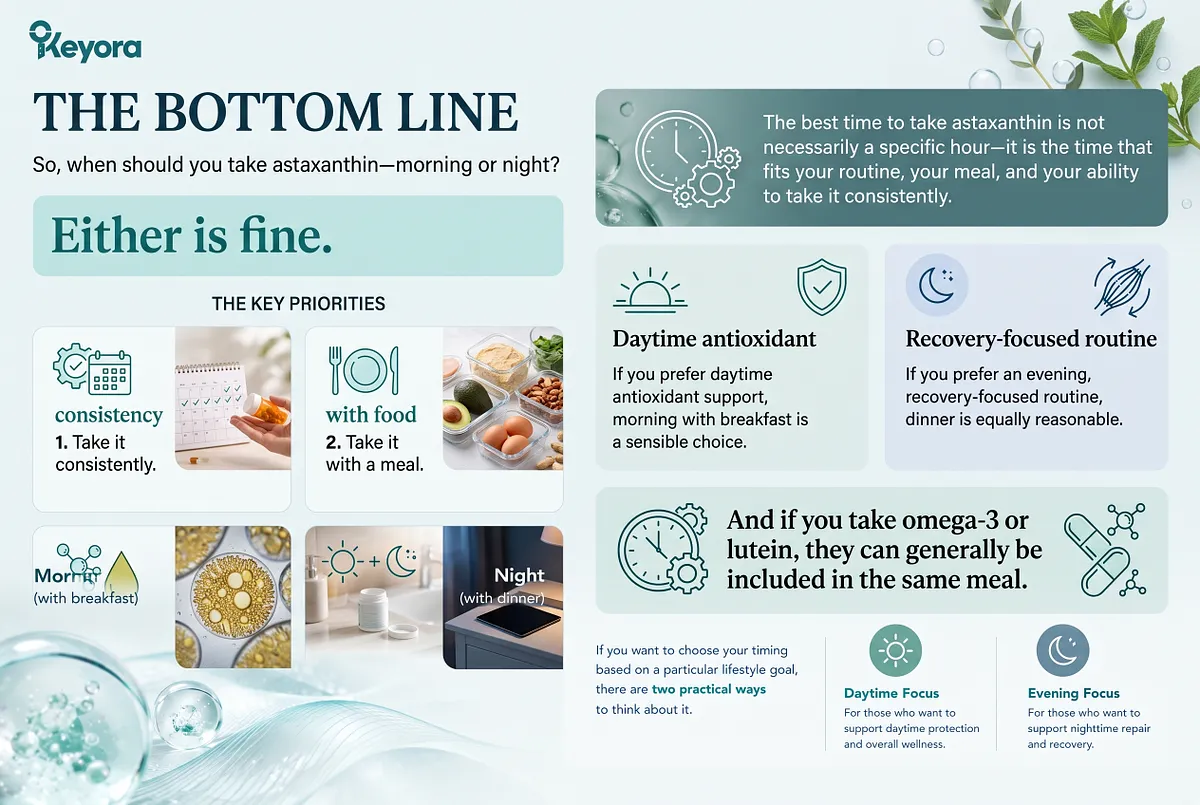
Either is fine.
For most people, the practical priority is:
1. Take it consistently.
2. Take it with a meal.
3. A meal containing some dietary fat is preferred.
4. Choose morning or evening based on your routine and personal goal.
If you prefer daytime antioxidant support, morning with breakfast is a sensible choice.
If you prefer an evening, recovery-focused routine, dinner is equally reasonable.
And if you take omega-3 or lutein, they can generally be included in the same meal.
The key takeaway is simple:
The best time to take astaxanthin is not necessarily a specific hour—it is the time that fits your routine, your meal, and your ability to take it consistently.
References
1. Ambati, R. R., Moi, P. S., Ravi, S., & Aswathanarayana, R. G. (2014). Astaxanthin: Sources, extraction, stability, biological activities and its commercial applications—A review. Marine Drugs, 12(1), 128–152.
2. Fassett, R. G., & Coombes, J. S. (2011). Astaxanthin: A potential therapeutic agent in cardiovascular disease. Marine Drugs, 9(3), 447–465.
3. Brendler, T., & Williamson, E. M. (2019). Astaxanthin: How much is too much? A safety review. Phytotherapy Research, 33(12), 3090–3111.
4. Guerin, M., Huntley, M. E., & Olaizola, M. (2003). Haematococcus astaxanthin: Applications for human health and nutrition. Trends in Biotechnology, 21(5), 210–216.