
What Is the Stress-Sleep-Mood-Cognition Loop?
Keyora Research Q&A Library
This is part of the Keyora Research Q&A Series, derived from Keyora Nutritional Neurology Seriers .
Within the Keyora Nutritional Neurology framework, this Q&A translates complex nutrient–brain mechanisms into reader-friendly, evidence-bound answers, focusing on stress resilience, sleep quality, calm mood support, cognitive wellness, and the broader interaction between nutrition, neurochemistry, and daily nervous-system function.
First published by Keyora Research Journal: www.keyorahealth.com

Direct Answer
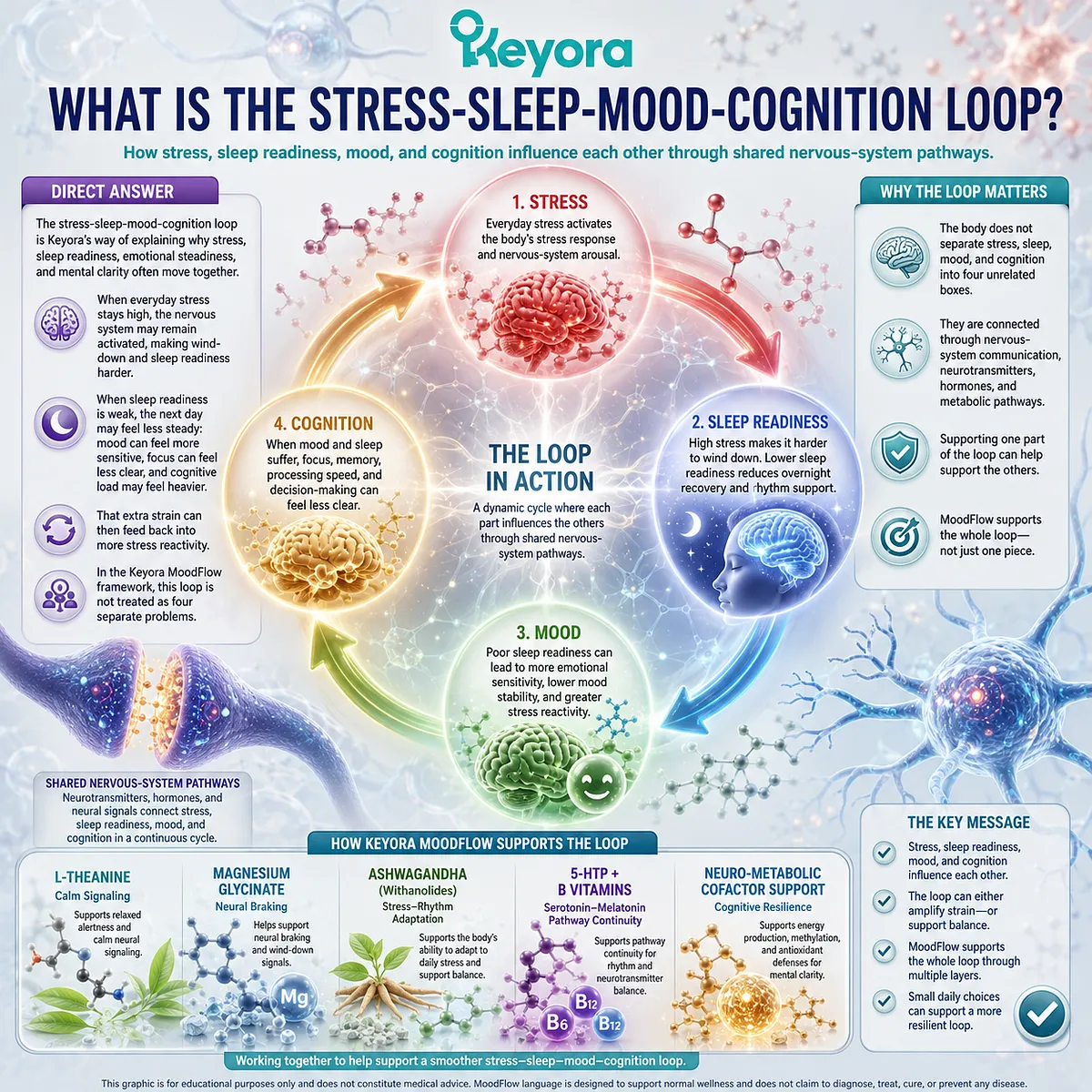
The stress-sleep-mood-cognition loop is Keyora’s way of explaining why stress, sleep readiness, emotional steadiness, and mental clarity often move together.
When everyday stress stays high, the nervous system may remain activated, making wind-down and sleep readiness harder.
When sleep readiness is weak, the next day may feel less steady: mood can feel more sensitive, focus can feel less clear, and cognitive load may feel heavier.
That extra strain can then feed back into more stress reactivity.
In the Keyora MoodFlow framework, this loop is not treated as four separate problems.
MoodFlow supports the loop through multiple layers:
-
L-Theanine for calm signaling, magnesium glycinate for neural braking,
-
Ashwagandha for stress-rhythm adaptation,
-
5-HTP with B vitamins for serotonin-melatonin pathway continuity, and neuro-metabolic cofactor support for cognitive resilience.
Stress, Sleep, Mood, and Cognition Are Connected
Why these four experiences often move together instead of staying separate.
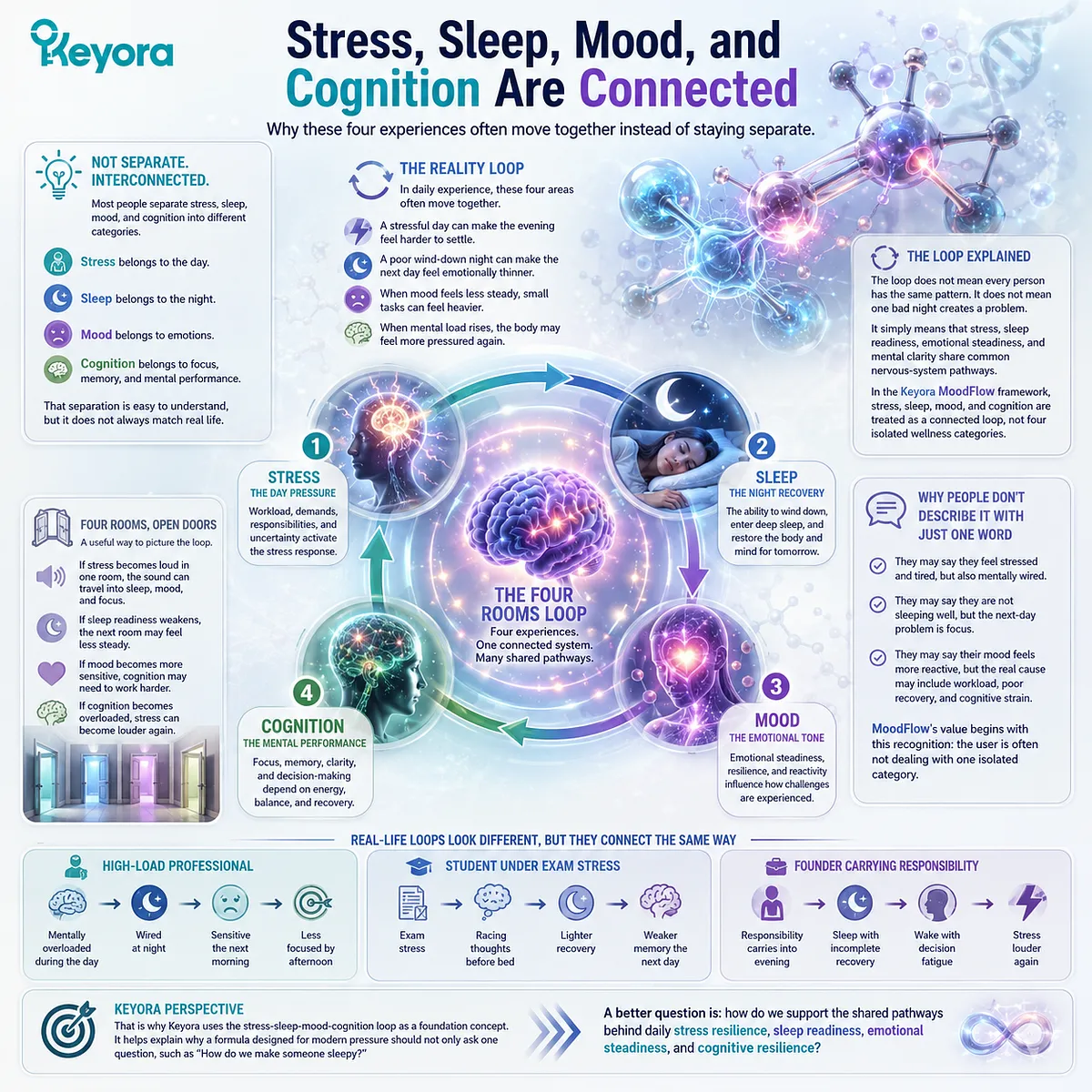
Most people separate stress, sleep, mood, and cognition into different categories.
Stress belongs to the day. Sleep belongs to the night. Mood belongs to emotions. Cognition belongs to focus, memory, and mental performance.
That separation is easy to understand, but it does not always match real life.
In daily experience, these four areas often move together.
-
A stressful day can make the evening feel harder to settle.
-
A poor wind-down night can make the next day feel emotionally thinner.
-
When mood feels less steady, small tasks can feel heavier.
-
When mental load rises, the body may feel more pressured again.
This creates a loop.
The loop does not mean every person has the same pattern.
It does not mean one bad night creates a problem. It simply means that stress, sleep readiness, emotional steadiness, and mental clarity share common nervous-system pathways.
In the Keyora MoodFlow framework, stress, sleep, mood, and cognition are treated as a connected loop, not four isolated wellness categories.
A useful way to picture the loop is four rooms connected by open doors.
-
If stress becomes loud in one room, the sound can travel into sleep, mood, and focus.
-
If sleep readiness weakens, the next room may feel less steady.
-
If mood becomes more sensitive, cognition may need to work harder.
-
If cognition becomes overloaded, stress can become louder again.
This is why many people do not describe their experience with just one word.
-
They may say they feel stressed and tired, but also mentally wired.
-
They may say they are not sleeping well, but the next-day problem is focus.
-
They may say their mood feels more reactive, but the real cause may include workload, poor recovery, and cognitive strain.
MoodFlow’s value begins with this recognition: the user is often not dealing with one isolated category.
-
A high-load professional may feel mentally overloaded during the day, wired at night, sensitive the next morning, and less focused by afternoon.
-
A student may feel exam stress, racing thoughts before bed, lighter recovery, and weaker memory the next day.
-
A founder may carry responsibility into the evening, sleep with incomplete recovery, and wake with more decision fatigue.
These are not separate stories. They are connected experiences.
That is why Keyora uses the stress-sleep-mood-cognition loop as a foundation concept. It helps explain why a formula designed for modern pressure should not only ask one question, such as “How do we make someone sleepy?”
A better question is: how do we support the shared pathways behind daily stress resilience, sleep readiness, emotional steadiness, and cognitive resilience?
The Shared Pathways Behind the Loop
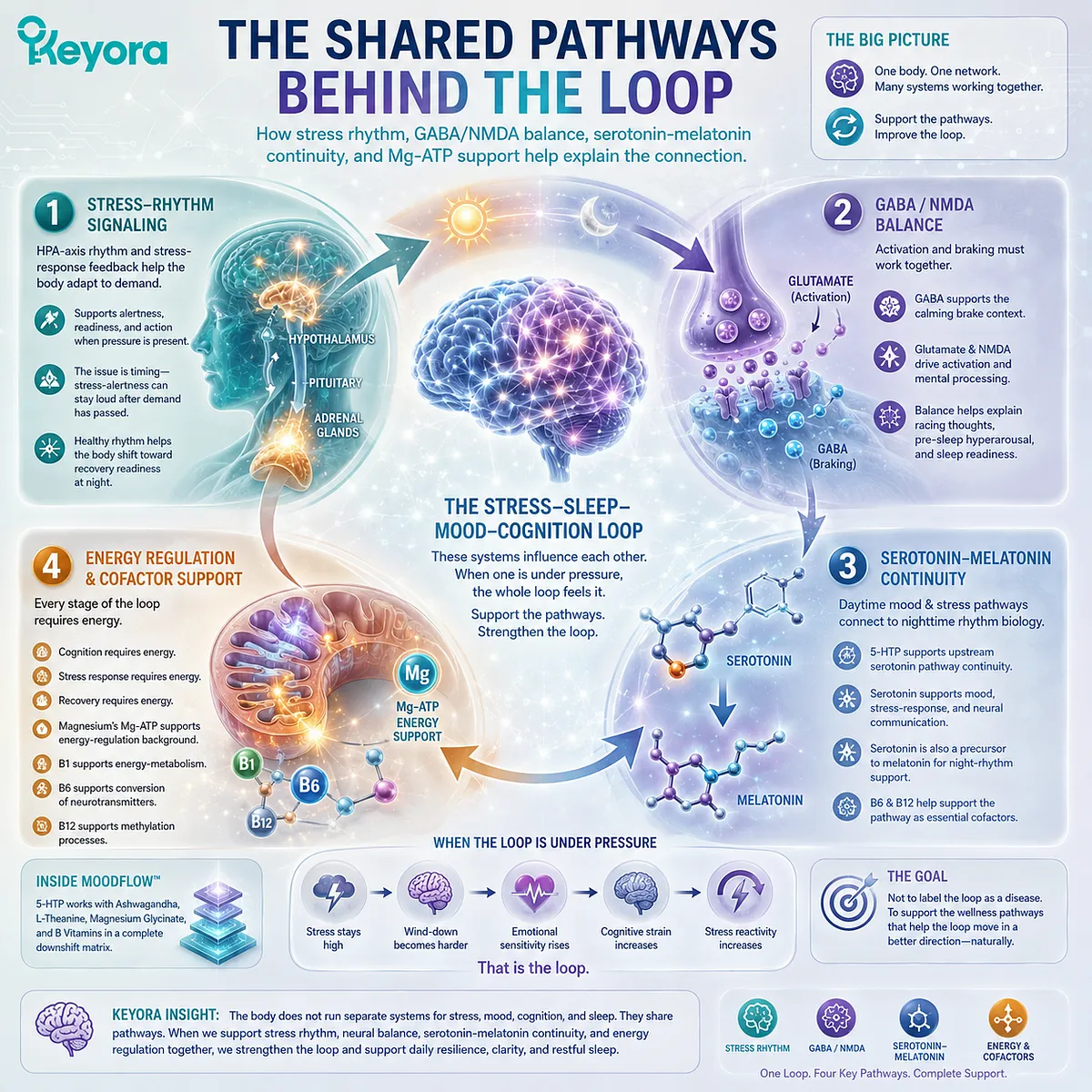
How stress rhythm, GABA/NMDA balance, serotonin-melatonin continuity, and Mg-ATP support help explain the connection.
The stress-sleep-mood-cognition loop exists because the body does not run separate systems for each daily experience. The same nervous-system pathways that help the body handle stress also influence wind-down readiness, emotional steadiness, and mental clarity.
One shared pathway is stress-rhythm signaling.
The stress-response system helps the body respond to demand.
It supports alertness, readiness, and action when pressure is present. That is useful during a deadline, a meeting, a commute, or an exam.
The problem begins when stress-alertness stays loud after the demand has passed. Evening arrives, but the body may still feel on-call. The mind may still be scanning. The system may not fully shift toward recovery readiness.
This is where HPA-axis rhythm context and stress-response feedback become useful explanations.
The point is not that stress biology is bad.
The point is timing.
A readiness signal that helps during the day may make wind-down harder at night.
Another shared pathway is GABA/NMDA balance.
GABA can be understood as part of the calming brake context.
Glutamate and NMDA-related signaling belong to the activation side of the nervous system. The brain needs both activation and braking. The issue is not the presence of activation; the issue is whether activation remains too loud when the system needs to downshift.
This shared mechanism helps explain why stress, racing thoughts, pre-sleep hyperarousal, and sleep readiness are connected. A person may not only feel emotionally stressed. They may feel mentally fast, physically tense, and unable to settle.
Serotonin-melatonin continuity adds another layer.
Mood and sleep are often discussed separately, but they are not completely separate in the body. Serotonin-related pathways help explain part of the mood, stress-response, and neural-communication context during the day. At night, serotonin can also serve as part of the pathway toward melatonin-related rhythm biology.
In MoodFlow language, this is not a disease-treatment claim. It is pathway language. It helps explain why 5-HTP and B vitamins matter inside a formula that connects mood, stress, and sleep-readiness support.
-
Energy regulation also belongs in the loop.
-
Cognition requires energy.
-
Stress response requires energy.
-
Recovery requires energy.
Sleep readiness is not only about becoming inactive; it also depends on the body’s ability to regulate, restore, and prepare for the next day.
-
Magnesium’s Mg-ATP context helps explain this energy-regulation background.
-
B1 supports energy-metabolism context.
-
B6 supports conversion context for neurotransmitter-related pathways.
-
B12 supports methylation context. These are not exciting “quick fix” claims, but they are important infrastructure.
This is why MoodFlow does not treat cognition as separate from sleep or stress. Mental clarity often depends on the same background systems that support stress resilience and recovery readiness.
When these shared pathways are under pressure, the loop can become noticeable.
Stress makes wind-down harder. Weak wind-down can affect the next day’s steadiness. More emotional sensitivity can increase cognitive strain. More cognitive strain can increase stress reactivity.
That is the loop.
The goal of MoodFlow is not to label that loop as a disease. The goal is to support the wellness pathways that help the loop move in a better direction.
Why MoodFlow Uses an 8-in-1 Matrix for the Loop
Why a connected loop needs layered support rather than one isolated ingredient.
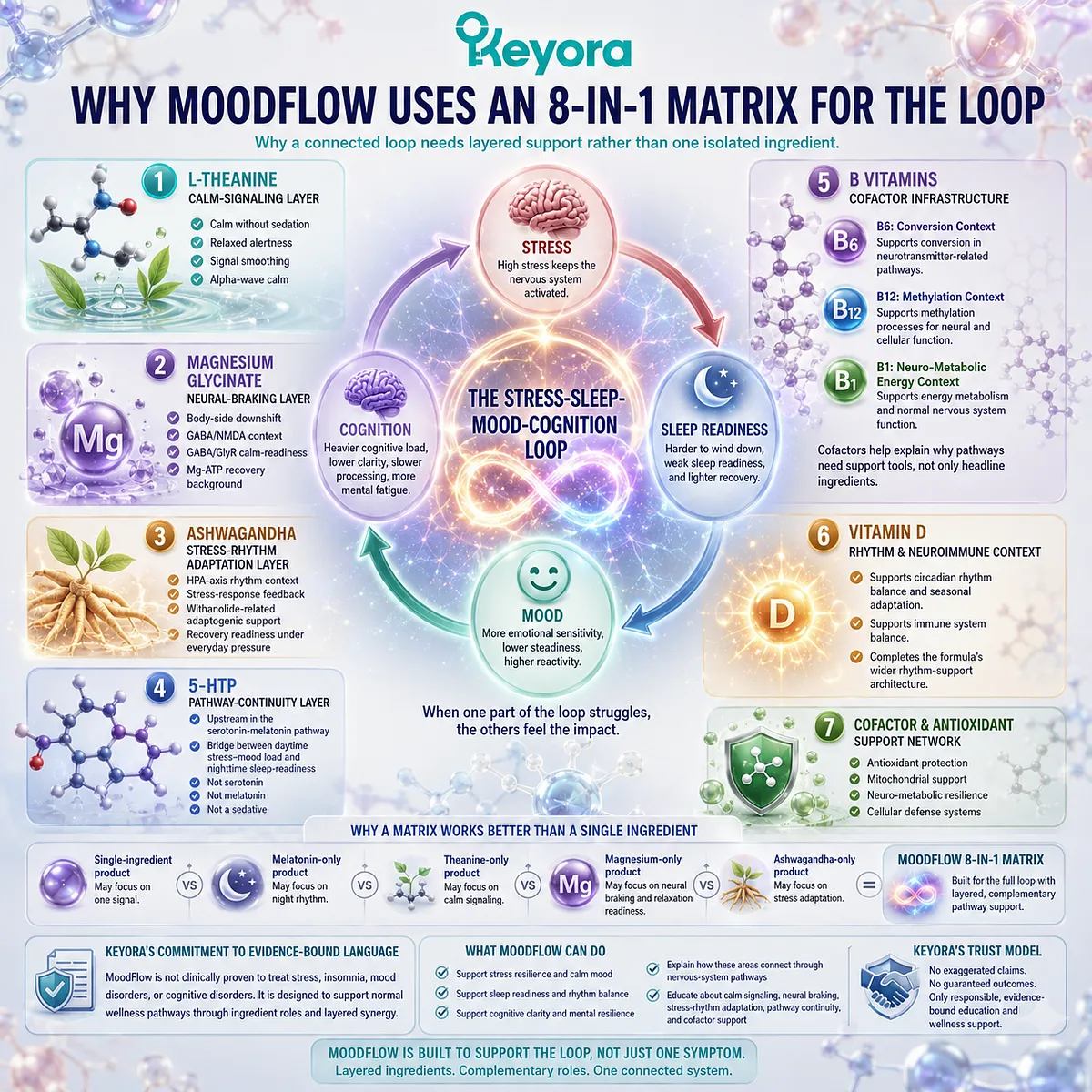
A connected loop usually needs layered support.
This is the reason Keyora MoodFlow uses an 8-in-1 Matrix instead of relying on one isolated ingredient. If the user’s experience includes stress load, wind-down difficulty, emotional sensitivity, and mental fatigue, one pathway may not explain the whole pattern.
Inside Keyora MoodFlow, the 8-in-1 Matrix is designed to support the loop through calm signaling, neural braking, stress-rhythm adaptation, serotonin-melatonin continuity, and cofactor infrastructure.
L-Theanine supports the calm-signaling layer.
It helps explain calm without sedation, relaxed alertness, signal smoothing, and alpha-wave calm. This layer matters when the brain feels fast, reactive, or overloaded.
Magnesium glycinate supports the neural-braking layer.
It helps explain body-side downshift, GABA/NMDA context, GABA/GlyR calm-readiness, and Mg-ATP recovery background. This layer matters when the body feels tired but not fully relaxed, or when the nervous system still feels switched on.
Ashwagandha supports the stress-rhythm adaptation layer.
It helps explain HPA-axis rhythm context, stress-response feedback, withanolide-related adaptogenic support, and recovery readiness under everyday pressure. This layer matters when stress carryover keeps the system in ready mode after the day ends.
5-HTP supports the pathway-continuity layer.
It sits upstream in the serotonin-melatonin pathway and helps explain the bridge between daytime stress-mood load and nighttime sleep-readiness rhythm. It is not serotonin, not melatonin, and not a sedative.
-
B vitamins support the cofactor infrastructure around the loop.
-
B6 supports conversion context.
-
B12 supports methylation context.
-
B1 supports neuro-metabolic energy context.
These cofactors help explain why pathways need support tools, not only headline ingredients.
Vitamin D adds broader rhythm and neuroimmune context.
It is not positioned as a hormone treatment or deficiency correction claim in this Q&A framework. It simply helps complete the formula’s wider rhythm-support architecture.
Together, these ingredients give MoodFlow a system-level role.
-
A single-ingredient product may focus on one signal.
-
A melatonin-only product may focus on night rhythm.
-
A theanine-only product may focus on calm signaling.
-
A magnesium-only product may focus on neural braking and relaxation readiness.
-
An Ashwagandha-only product may focus on stress adaptation.
MoodFlow is different because it is built for the loop.
That does not mean MoodFlow is clinically proven to treat stress, insomnia, mood disorders, or cognitive disorders. It means the formula rationale is based on layered ingredient roles that match shared wellness pathways.
This is also why MoodFlow’s language must stay evidence-bound.
The formula can support stress resilience, sleep readiness, calm mood support, and cognitive resilience.
It can help explain why these areas connect through nervous-system pathways.
It can educate consumers about calm signaling, neural braking, stress-rhythm adaptation, pathway continuity, and cofactor support.
But it should not promise clinical treatment or guaranteed outcomes.
For Keyora, that boundary is part of the trust model.
MoodFlow is not built to make exaggerated single-symptom claims. It is built to explain and support a connected daily loop.
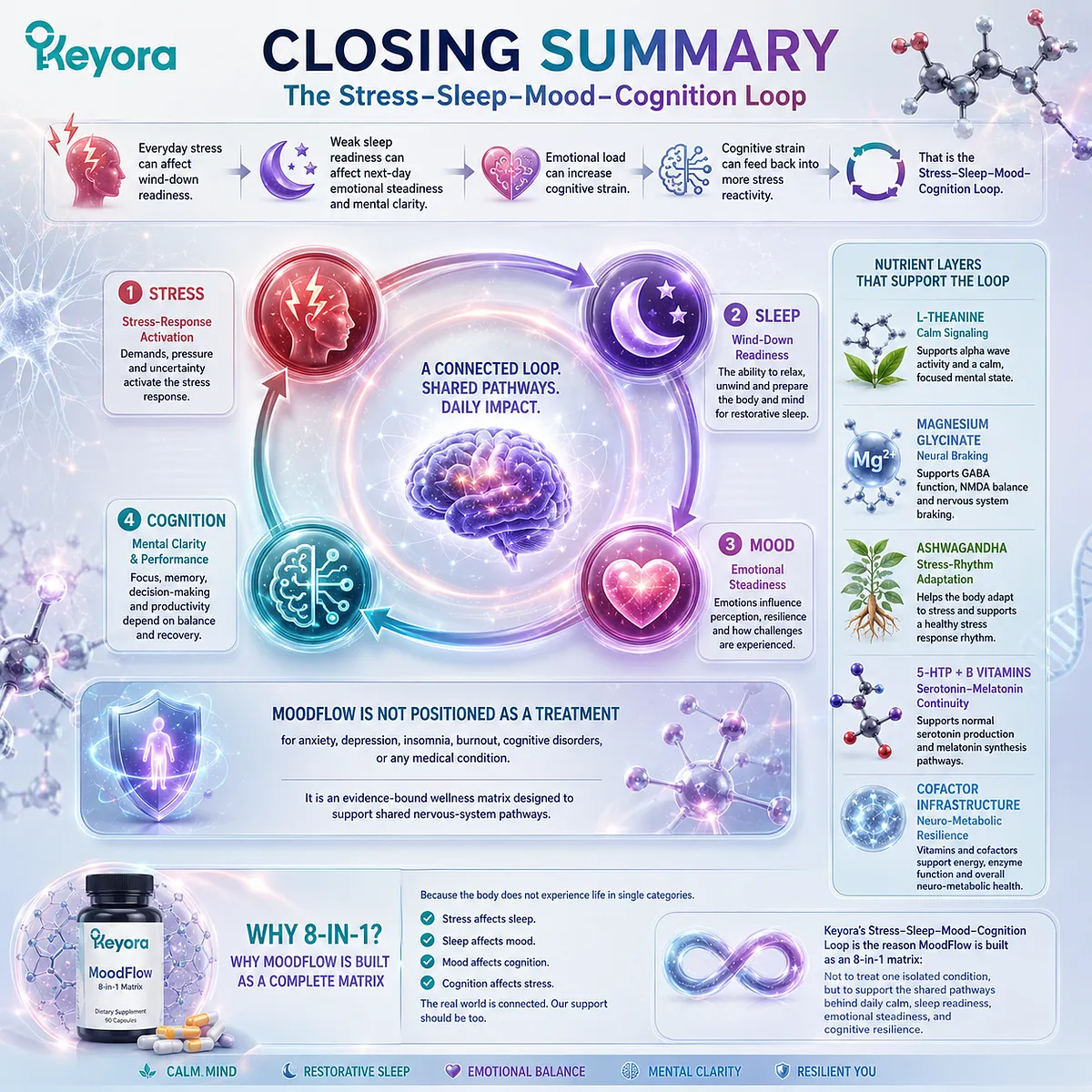
Closing Summary
Stress, sleep, mood, and cognition are not separate boxes.
Everyday stress can affect wind-down readiness.
Weak sleep readiness can affect next-day emotional steadiness and mental clarity. Emotional load can increase cognitive strain. Cognitive strain can feed back into more stress reactivity.
That is the stress-sleep-mood-cognition loop.
In the Keyora MoodFlow framework, this loop is supported through multiple nutrient layers:
-
L-Theanine for calm signaling, magnesium glycinate for neural braking,
-
Ashwagandha for stress-rhythm adaptation,
-
5-HTP with B vitamins for serotonin-melatonin continuity, and cofactor infrastructure for neuro-metabolic resilience.
MoodFlow is not positioned as a treatment for anxiety, depression, insomnia, burnout, cognitive disorders, or any medical condition. It is an evidence-bound wellness matrix designed to support shared nervous-system pathways.
For Keyora, the stress-sleep-mood-cognition loop is the reason MoodFlow is built as an 8-in-1 matrix: not to treat one isolated condition, but to support the shared pathways behind daily calm, sleep readiness, emotional steadiness, and cognitive resilience.
This article is for educational and informational purposes only. It does not provide medical advice, diagnosis, treatment, cure, prevention, disease outcome claims, hormone restoration claims, fertility outcome claims, or formula-specific clinical efficacy claims.