
What Is the Difference Between Natural and Synthetic Astaxanthin?
Keyora Research Q&A Library
This is part of the Keyora Research Q&A Series, derived from Keyora Nutritional Neurology Series.
Within the Keyora Nutritional Neurology framework, this Q&A translates complex nutrient–brain mechanisms into reader-friendly, evidence-bound answers, focusing on stress resilience, sleep quality, calm mood support, cognitive wellness, and the broader interaction between nutrition, neurochemistry, and daily nervous-system function.
First published by Keyora Research Journal: www.keyorahealth.com
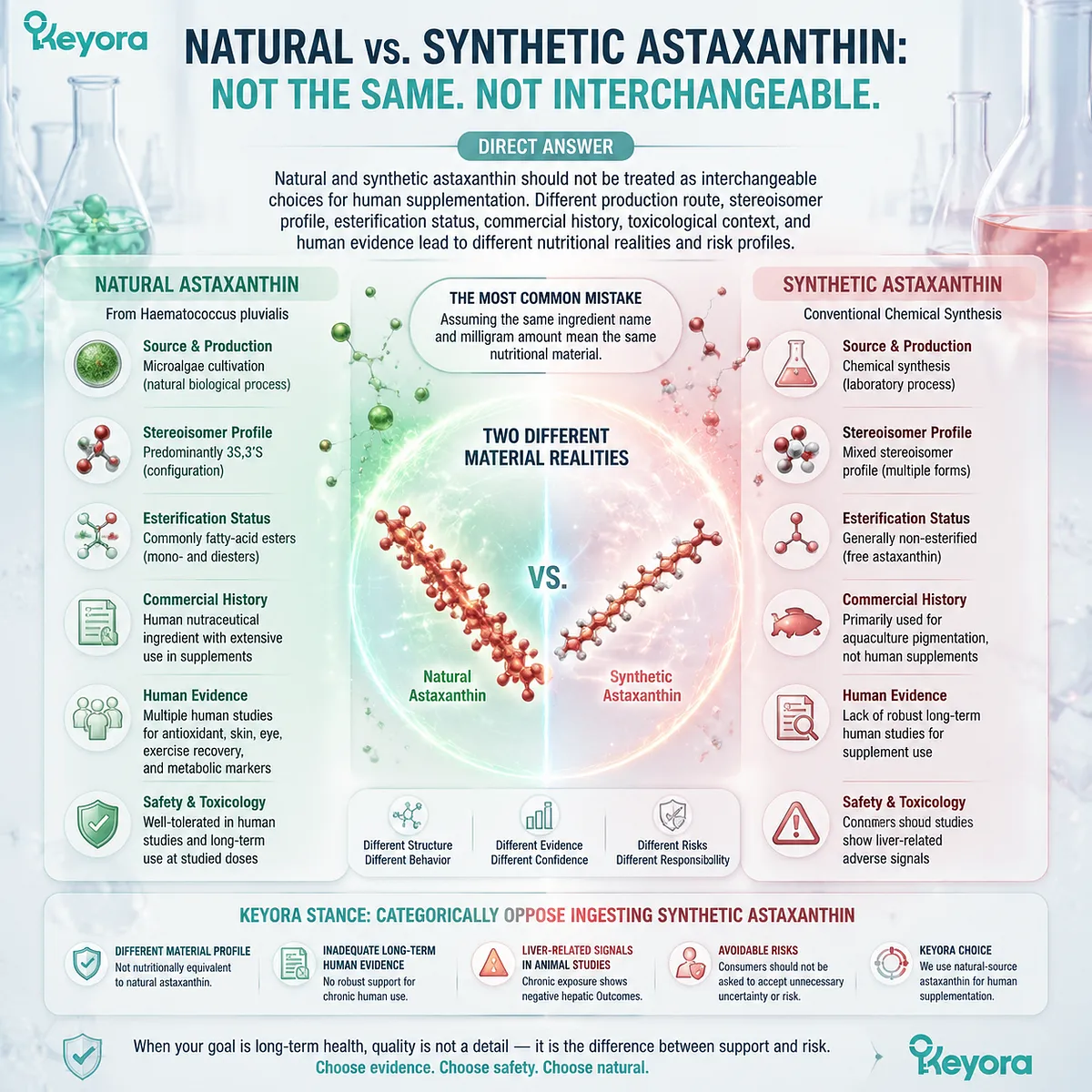
Direct Answer
Natural and synthetic astaxanthin should not be treated as interchangeable choices for human supplementation.
Although both use the name astaxanthin, they differ in production route, stereoisomer profile, esterification status, commercial history, toxicological context, and the human evidence that can legitimately be applied to them.
The most common mistake is assuming that the same ingredient name and milligram amount mean the same nutritional material.
Natural astaxanthin from Haematococcus pluvialis is predominantly associated with the 3S,3′S configuration and commonly occurs as fatty-acid esters. Conventional synthetic astaxanthin is generally non-esterified and contains a mixed stereoisomer profile.
Synthetic astaxanthin also has a commercial history centered largely on aquaculture pigmentation, while the human nutraceutical literature is much more closely connected to natural-source preparations.
Keyora therefore categorically opposes ingesting synthetic astaxanthin. Its different material profile, inadequate long-term human evidence, and adverse liver-related signals in chronic animal research create avoidable risks that consumers should not be asked to accept.
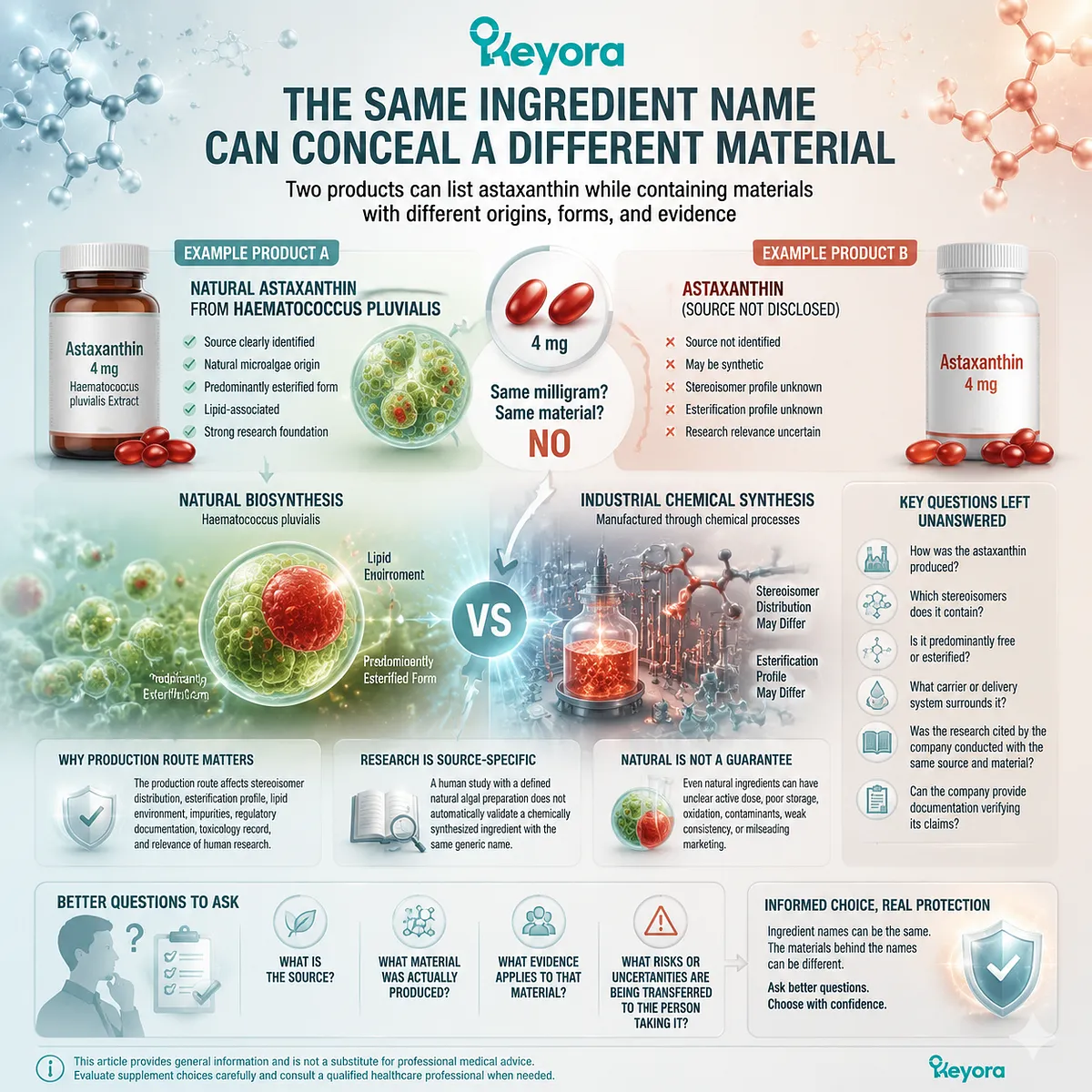
The Same Ingredient Name Can Conceal a Different Material
Two products can list astaxanthin while containing materials with different origins, forms, and evidence
Imagine comparing two astaxanthin supplements.
Both labels show the same number of milligrams. Both capsules are red. Both product pages discuss antioxidant activity. One product clearly identifies Haematococcus pluvialis as its source. The other lists only “astaxanthin,” without explaining whether the ingredient came from algae, another biological source, or industrial chemical synthesis.
The two products may appear equivalent, but the label name leaves several essential questions unanswered.
How was the astaxanthin produced?
Which stereoisomers does it contain?
Is it predominantly free or esterified?
What carrier or delivery system surrounds it?
Was the research cited by the company conducted with the same source and material?
Can the company provide documentation verifying its claims?
Natural astaxanthin is biosynthesized by living organisms. The microalga Haematococcus pluvialis is the best-established source used in natural astaxanthin supplements because it can accumulate astaxanthin in a lipid-associated and predominantly esterified form.
Synthetic astaxanthin is produced through industrial chemical synthesis. It may contain the same general astaxanthin molecular backbone, but the resulting commercial ingredient is not compositionally identical to natural algal astaxanthin.
This is not merely a philosophical argument about whether “natural” sounds better.
The production route affects the stereoisomer distribution, esterification profile, surrounding lipid environment, impurity assessment, regulatory documentation, toxicology record, and relevance of existing human research.
A human study performed with a defined natural algal preparation does not automatically validate a chemically synthesized ingredient carrying the same generic name.
Natural sourcing alone is also not a complete quality guarantee. A natural product can still have an unclear active dose, poor storage conditions, oxidation problems, inadequate contaminant testing, weak batch consistency, or misleading marketing.
The correct question is therefore not only:
“Is it natural?”
The more useful questions are:
“What is the source?”
“What material was actually produced?”
“What evidence applies to that material?”
“What risks or uncertainties are being transferred to the person taking it?”
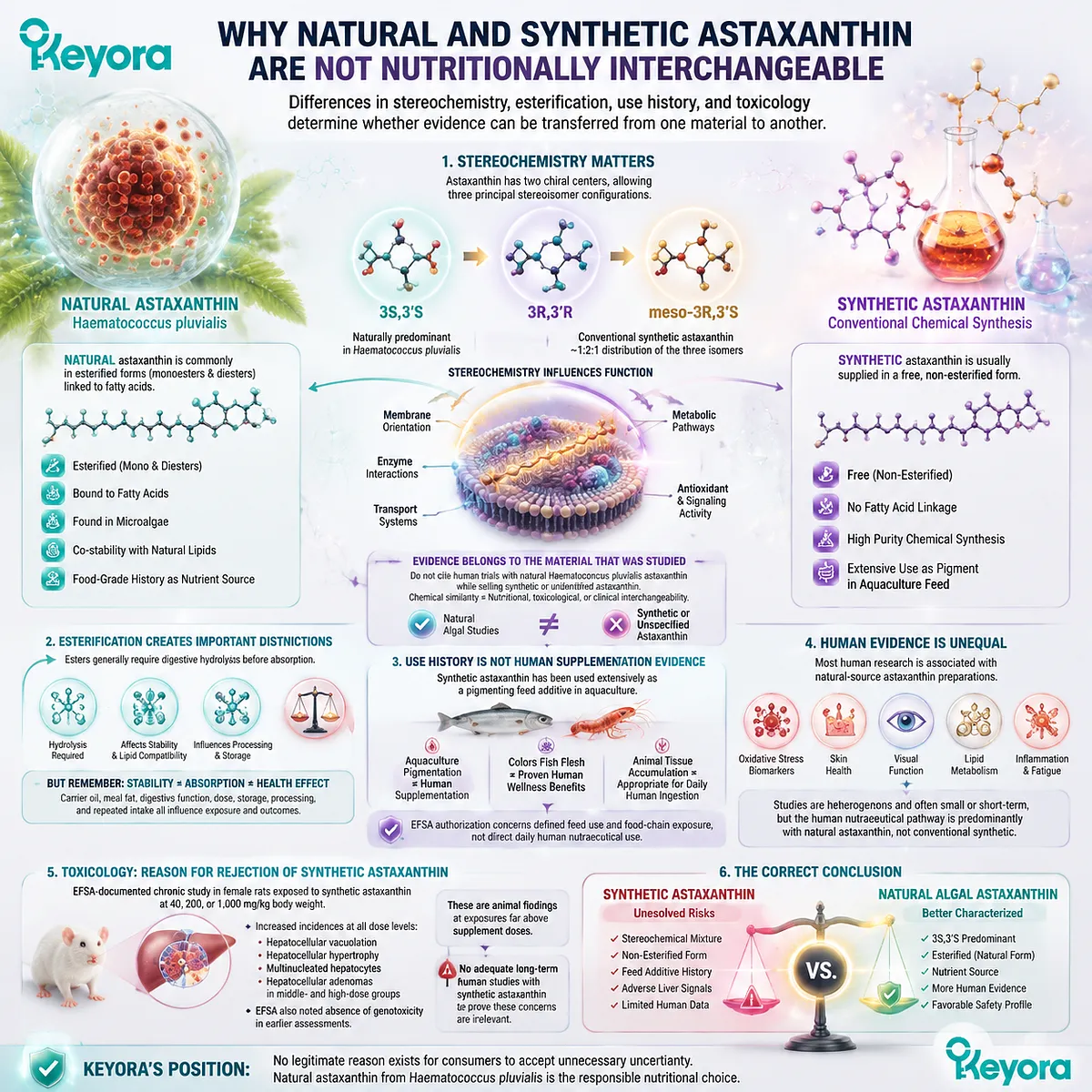
Why Natural and Synthetic Astaxanthin Are Not Nutritionally Interchangeable
Differences in stereochemistry, esterification, use history, and toxicology determine whether evidence can be transferred from one material to another
Astaxanthin contains two chiral centers, allowing three principal stereoisomer configurations:
-
3S,3′S
-
3R,3′R
-
meso-3R,3′S
Astaxanthin from Haematococcus pluvialis is predominantly associated with the 3S,3′S stereoisomer. Conventional synthetic astaxanthin generally contains the three major stereoisomers in an approximate 1:2:1 distribution and is usually supplied in a free, non-esterified form. Natural astaxanthin commonly occurs as monoesters and diesters linked to fatty acids.
These differences do not justify saying that every non-3S,3′S stereoisomer is completely inactive. They do show that natural algal astaxanthin and conventional synthetic astaxanthin are not the same commercial material.
Stereochemistry can influence molecular orientation and interactions with membranes, enzymes, transport systems, and metabolic pathways. It also determines whether the ingredient used in one study adequately represents the ingredient sold in another product.
Esterification creates another important distinction.
Astaxanthin esters must generally undergo digestive hydrolysis before absorption. Esterification may also influence raw-material stability, lipid compatibility, processing behavior, and storage.
However, stability, absorption, and health effects must not be treated as synonyms.
A material that remains stable during storage is not automatically absorbed more efficiently.
A formulation that increases plasma exposure does not automatically produce better clinical outcomes.
Carrier oil, meal fat, digestive function, dose, storage, processing, and repeated intake can all influence exposure.
The commercial histories of the two materials also differ.
Synthetic astaxanthin has been used extensively as a pigmenting feed additive in aquaculture. EFSA’s assessment of synthetic astaxanthin addressed its use at defined concentrations in feed for salmonids, other fish, and crustaceans. That assessment concerned feed use and resulting food-chain exposure; it was not a recommendation for people to consume synthetic astaxanthin directly as a daily nutraceutical.
This distinction must remain visible:
Aquaculture pigmentation is not human supplementation evidence
A compound’s ability to color fish flesh does not establish long-term human wellness benefits.
Accumulation in animal tissue does not prove that direct daily ingestion is appropriate.
Authorization for a defined feed use does not establish clinical interchangeability with natural algal astaxanthin.
The human evidence bases are also unequal.
Human astaxanthin studies have investigated selected endpoints involving oxidative-stress biomarkers, skin, visual function, lipid metabolism, inflammation, and fatigue. This literature is heterogeneous, and many studies are relatively small, short, or specific to one preparation and endpoint.
Nevertheless, the human nutraceutical research pathway is predominantly associated with natural-source astaxanthin preparations rather than conventional synthetic astaxanthin.
Evidence belongs to the material that was studied.
A company should not cite a human trial conducted with natural Haematococcus pluvialis astaxanthin while selling synthetic or unidentified astaxanthin.
It should not present natural-source research as general proof for every ingredient called astaxanthin.
Chemical similarity does not establish nutritional, toxicological, or clinical interchangeability.
The toxicological record creates an additional reason for rejecting synthetic astaxanthin.
An EFSA-documented chronic toxicity and carcinogenicity study exposed female rats to synthetic astaxanthin at 40, 200, or 1,000 mg per kilogram of body weight. Increased incidences of hepatocellular vacuolation, hepatocellular hypertrophy, and multinucleated hepatocytes were reported at all tested dose levels. Hepatocellular adenomas were also reported in the middle- and high-dose female groups. EFSA also noted the absence of genotoxicity in its earlier assessments.
These were animal findings at exposures far above ordinary supplement doses. They cannot be converted directly into a claim that a normal human dose will cause liver tumors.
But they must not be dismissed.
They are adverse liver-related signals from chronic testing. Adequate long-term human supplementation studies with conventional synthetic astaxanthin are not available to prove that these concerns are irrelevant to prolonged direct ingestion.
The correct conclusion is therefore not that every synthetic dose has already been proven to harm every person.
The correct conclusion is that synthetic astaxanthin carries unresolved toxicological and evidence-related risks, while a better-characterized natural alternative is already available.
Keyora sees no legitimate reason for consumers to accept that unnecessary uncertainty.
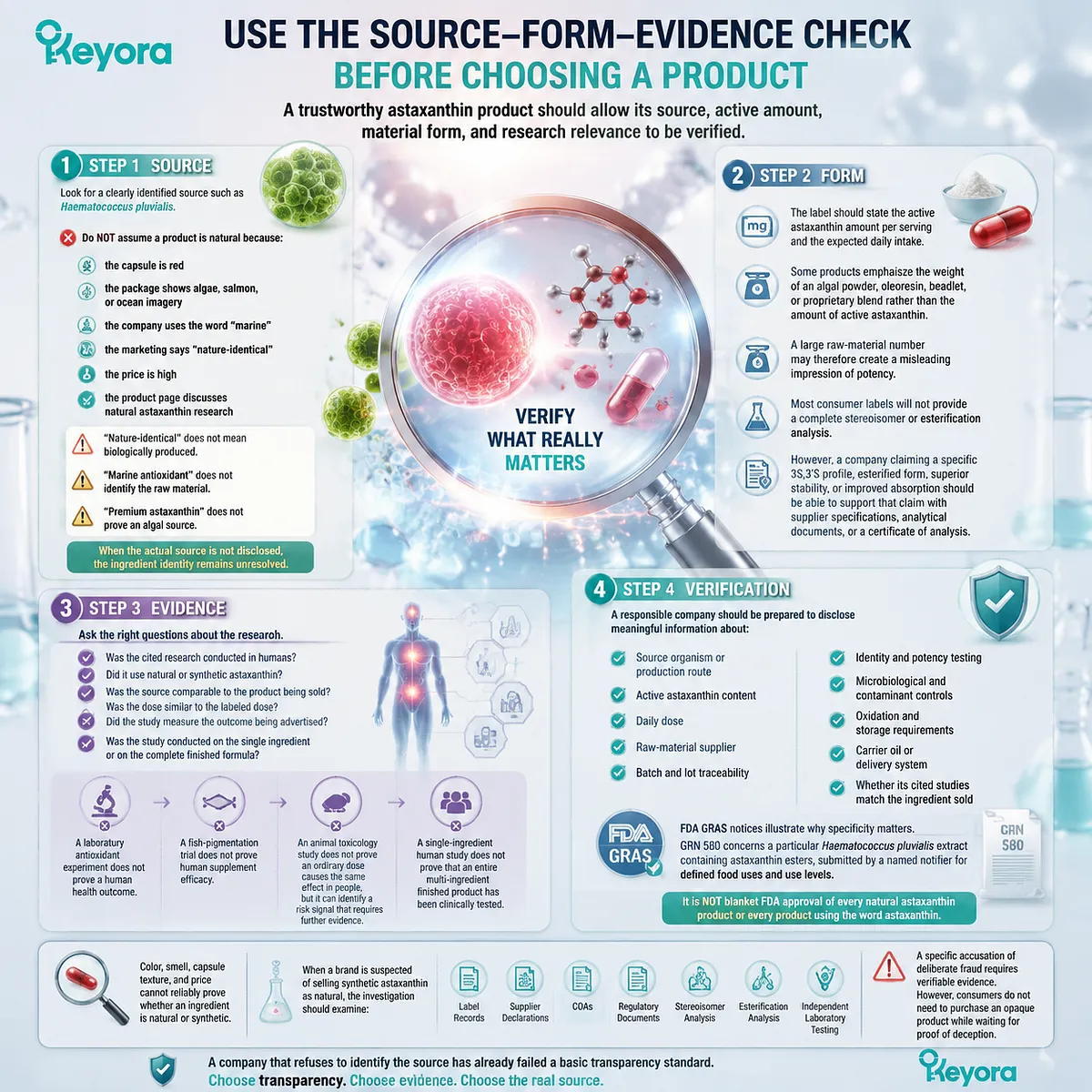
Use the Source–Form–Evidence Check Before Choosing a Product
A trustworthy astaxanthin product should allow its source, active amount, material form, and research relevance to be verified
The first step is Source.
Look for a clearly identified source such as Haematococcus pluvialis.
Do not assume a product is natural because:
-
the capsule is red
-
the package shows algae, salmon, or ocean imagery
-
the company uses the word “marine”
-
the marketing says “nature-identical”
-
the price is high
-
the product page discusses natural astaxanthin research
“Nature-identical” does not mean biologically produced.
“Marine antioxidant” does not identify the raw material.
“Premium astaxanthin” does not prove an algal source.
When the actual source is not disclosed, the ingredient identity remains unresolved.
The second step is Form.
The label should state the active astaxanthin amount per serving and the expected daily intake.
Some products emphasize the weight of an algal powder, oleoresin, beadlet, or proprietary blend rather than the amount of active astaxanthin it supplies. A large raw-material number may therefore create a misleading impression of potency.
Most consumer labels will not provide a complete stereoisomer or esterification analysis. However, a company claiming a specific 3S,3′S profile, esterified form, superior stability, or improved absorption should be able to support that claim with supplier specifications, analytical documents, or a certificate of analysis.
The third step is Evidence.
Ask:
Was the cited research conducted in humans?
Did it use natural or synthetic astaxanthin?
Was the source comparable to the product being sold?
Was the dose similar to the labeled dose?
Did the study measure the outcome being advertised?
Was the study conducted on the single ingredient or on the complete finished formula?
A laboratory antioxidant experiment does not prove a human health outcome.
A fish-pigmentation trial does not prove human supplement efficacy.
An animal toxicology study does not prove an ordinary dose causes the same effect in people, but it can identify a risk signal that requires further evidence.
A single-ingredient human study does not prove that an entire multi-ingredient finished product has been clinically tested.
The fourth step is Verification.
A responsible company should be prepared to disclose meaningful information about:
-
source organism or production route
-
active astaxanthin content
-
daily dose
-
raw-material supplier
-
batch and lot traceability
-
identity and potency testing
-
microbiological and contaminant controls
-
oxidation and storage requirements
-
carrier oil or delivery system
-
whether its cited studies match the ingredient sold
FDA GRAS notices illustrate why specificity matters. GRN 580 concerns a particular Haematococcus pluvialis extract containing astaxanthin esters, submitted by a named notifier for defined food uses and use levels. It is not blanket FDA approval of every natural astaxanthin product or every product using the word astaxanthin.
Color, smell, capsule texture, and price cannot reliably prove whether an ingredient is natural or synthetic.
When a brand is suspected of selling synthetic astaxanthin as natural, the investigation should examine label records, supplier declarations, COAs, regulatory documents, stereoisomer analysis, esterification analysis, and independent laboratory testing.
A specific accusation of deliberate fraud requires verifiable evidence.
However, consumers do not need to purchase an opaque product while waiting for proof of deception. A company that refuses to identify the source has already failed a basic transparency standard.
What This Means When Choosing Astaxanthin
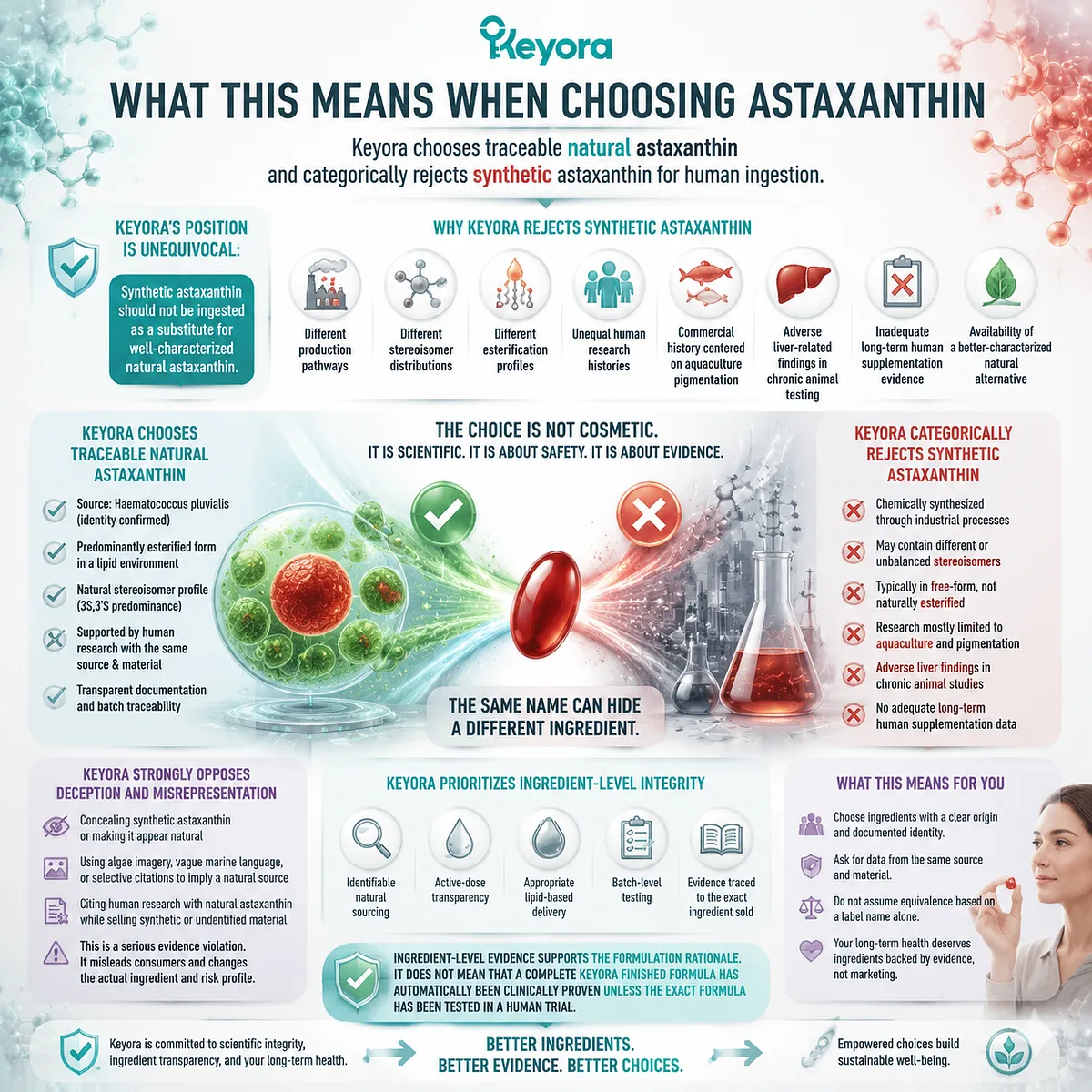
Keyora chooses traceable natural astaxanthin and categorically rejects synthetic astaxanthin for human ingestion
Keyora’s position is unequivocal:
Synthetic astaxanthin should not be ingested as a substitute for well-characterized natural astaxanthin
This position is based on the combined weight of:
-
different production pathways
-
different stereoisomer distributions
-
different esterification profiles
-
unequal human research histories
-
a commercial history centered heavily on aquaculture pigmentation
-
adverse liver-related findings in chronic animal testing
-
inadequate long-term human supplementation evidence
-
the availability of a better-characterized natural alternative
Keyora also strongly opposes brands that conceal synthetic astaxanthin or create the false impression that it is natural.
A serious evidence violation occurs when a company sells synthetic or unidentified astaxanthin while citing human research performed with natural Haematococcus pluvialis astaxanthin.
The same concern applies when algae imagery, vague marine language, selective citations, or unsupported “natural” claims are used to create a source identity that the company cannot document.
This is not merely a packaging problem.
It changes the evidence consumers believe they are buying and may expose them to a materially different ingredient with a different toxicological and research background.
Keyora prioritizes identifiable natural sourcing, active-dose transparency, appropriate lipid-based delivery, batch-level testing, and evidence that can be traced to the ingredient being sold.
That ingredient-level evidence supports the formulation rationale. It does not mean that a complete Keyora finished formula has automatically been clinically proven unless the exact formula has been tested in a human trial.
Closing Summary
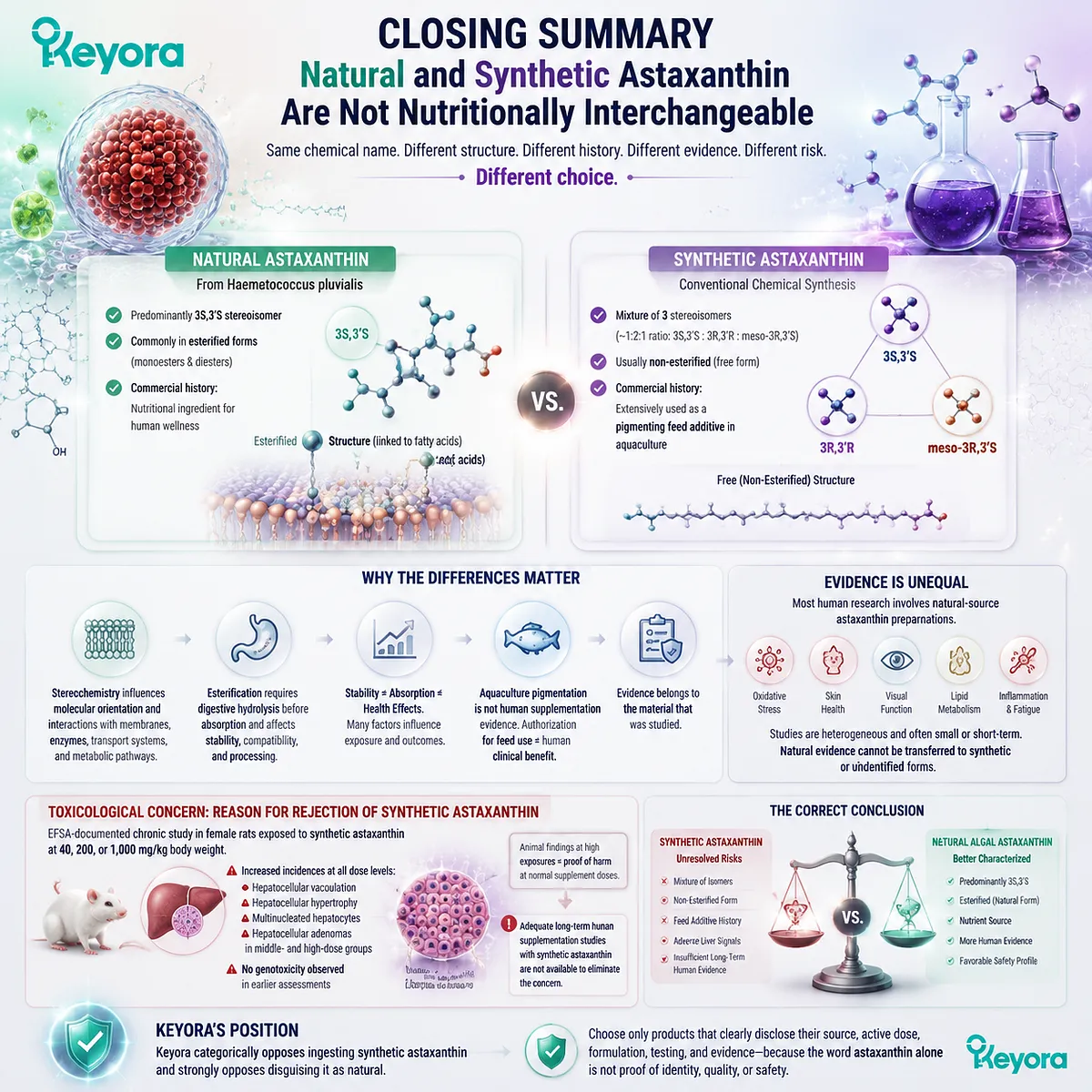
Natural and synthetic astaxanthin share a chemical name, but they should not be treated as equivalent human supplements.
Natural Haematococcus pluvialis astaxanthin is predominantly associated with a 3S,3′S and commonly esterified profile. Conventional synthetic astaxanthin generally contains a non-esterified mixture of three major stereoisomers and has a commercial history centered largely on aquaculture pigmentation.
Their evidence bases are also unequal. Human research conducted with natural-source preparations cannot automatically validate synthetic or unidentified astaxanthin. Chronic animal testing of synthetic astaxanthin has produced adverse liver-related signals, while adequate long-term human supplementation evidence remains insufficient to eliminate the resulting concern.
These findings do not prove that every dose will harm every person. They do show why synthetic astaxanthin should not be presented as a risk-free or clinically interchangeable alternative.
Keyora categorically opposes ingesting synthetic astaxanthin and strongly opposes disguising it as natural. Choose only products that clearly disclose their source, active dose, formulation, testing, and evidence – because the word astaxanthin alone is not proof of identity, quality, or safety
This article is for educational and informational purposes only. It does not provide medical advice, diagnosis, treatment, cure, prevention, disease outcome claims, hormone restoration claims, fertility outcome claims, or formula-specific clinical efficacy claims.