
What Is Natural Astaxanthin and Where Does It Come From?
Keyora Research Q&A Library
This is part of the Keyora Research Q&A Series, derived from Keyora Nutritional Neurology Series.
Within the Keyora Nutritional Neurology framework, this Q&A translates complex nutrient–brain mechanisms into reader-friendly, evidence-bound answers, focusing on stress resilience, sleep quality, calm mood support, cognitive wellness, and the broader interaction between nutrition, neurochemistry, and daily nervous-system function.
First published by Keyora Research Journal: www.keyorahealth.com
Direct Answer
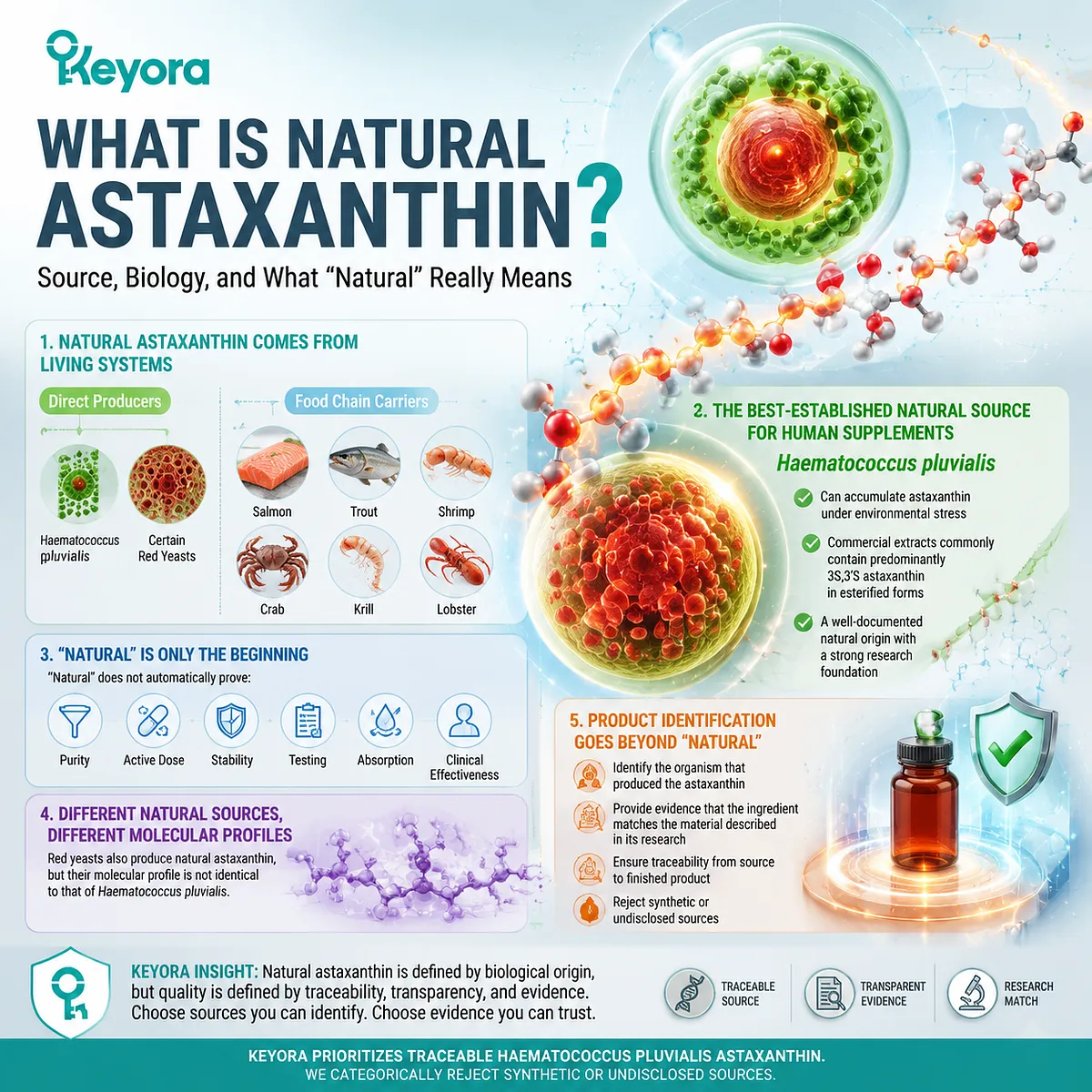
Natural astaxanthin is astaxanthin produced through biological pathways by living organisms rather than through conventional industrial chemical synthesis. Microalgae and certain yeasts can produce it directly, while salmon, trout, shrimp, crab, and krill obtain or accumulate astaxanthin through aquatic food chains.
For human supplements, Haematococcus pluvialis is the best-established natural source. This microalga can accumulate astaxanthin under environmental stress, and commercial extracts commonly contain predominantly 3S,3′S astaxanthin in esterified forms. Certain red yeasts also produce natural astaxanthin, but their molecular profile is not identical to that of Haematococcus pluvialis.
However, “natural” is only the beginning of product identification. It does not automatically prove purity, active dose, stability, testing, absorption, or clinical effectiveness.
Keyora prioritizes traceable Haematococcus pluvialis astaxanthin and categorically rejects synthetic or undisclosed sources. A product should identify the organism that produced its astaxanthin and provide evidence that the ingredient in the bottle matches the material described in its research.
Natural Astaxanthin Is a Biological Source Category
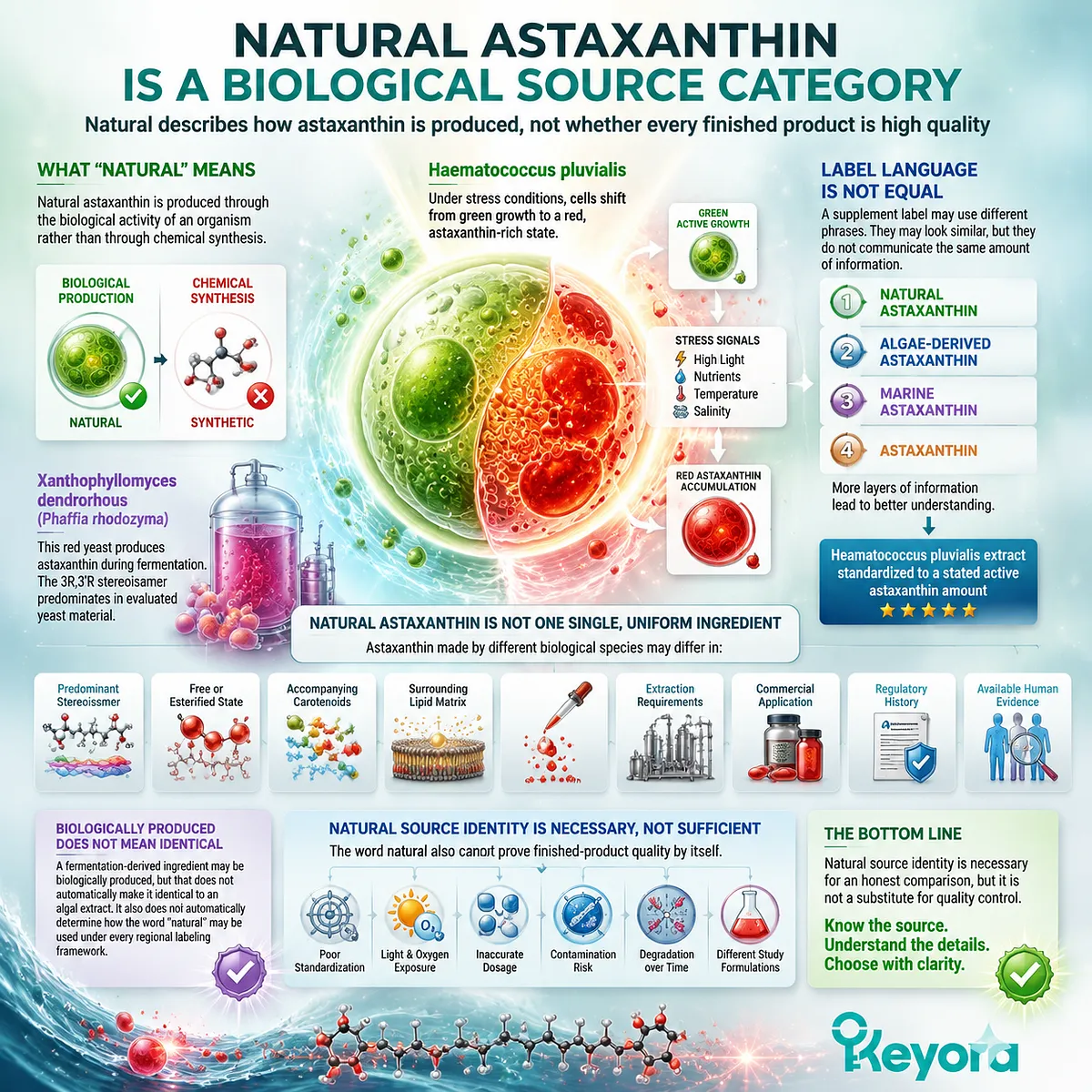
Natural describes how astaxanthin is produced, not whether every finished product is high quality
A supplement label may say “natural astaxanthin,” “algae-derived astaxanthin,” “marine astaxanthin,” or simply “astaxanthin.”
These phrases may look similar, but they do not communicate the same amount of information.
Natural astaxanthin is best understood as a source category. It indicates that the astaxanthin was produced through the biological activity of an organism rather than assembled through a conventional chemical-synthesis route.
That organism still needs to be identified.
The most familiar direct biological producer is the green microalga Haematococcus pluvialis. During particular stress conditions, its cells shift from active green growth toward a red, astaxanthin-rich state. This accumulation capacity has made it a major commercial source of natural astaxanthin for food and supplement ingredients.
Natural astaxanthin can also be produced by the red yeast Xanthophyllomyces dendrorhous, historically known as Phaffia rhodozyma. European scientific documentation describes this yeast as producing astaxanthin during fermentation, with the 3R,3′R stereoisomer predominating in the evaluated yeast material.
This illustrates an important point:
Natural astaxanthin is not one single, uniform ingredient
Astaxanthin made by one biological species may differ from astaxanthin made by another species in:
-
predominant stereoisomer
-
free or esterified state
-
accompanying carotenoids
-
surrounding lipid matrix
-
concentration
-
extraction requirements
-
commercial application
-
regulatory history
-
available human evidence
A fermentation-derived ingredient may be biologically produced, but that does not automatically make it identical to an algal extract. It also does not automatically determine how the word “natural” may be used under every regional labeling framework.
The source must therefore be described beyond a broad marketing word.
“Natural astaxanthin” is more informative than an undisclosed astaxanthin source.
“Algae-derived astaxanthin” is more specific than natural.
“Haematococcus pluvialis extract standardized to a stated active astaxanthin amount” is more informative again.
Each additional layer helps the consumer understand what was produced and which research may apply to it.
The word natural also cannot prove finished-product quality by itself.
A natural-source ingredient may still be poorly standardized, inadequately protected from light and oxygen, inaccurately dosed, contaminated, degraded during storage, or supported by research that used a different preparation.
Natural source identity is necessary for an honest comparison, but it is not a substitute for quality control.
Algae Produce It, While Marine Animals Carry It Through the Food Chain
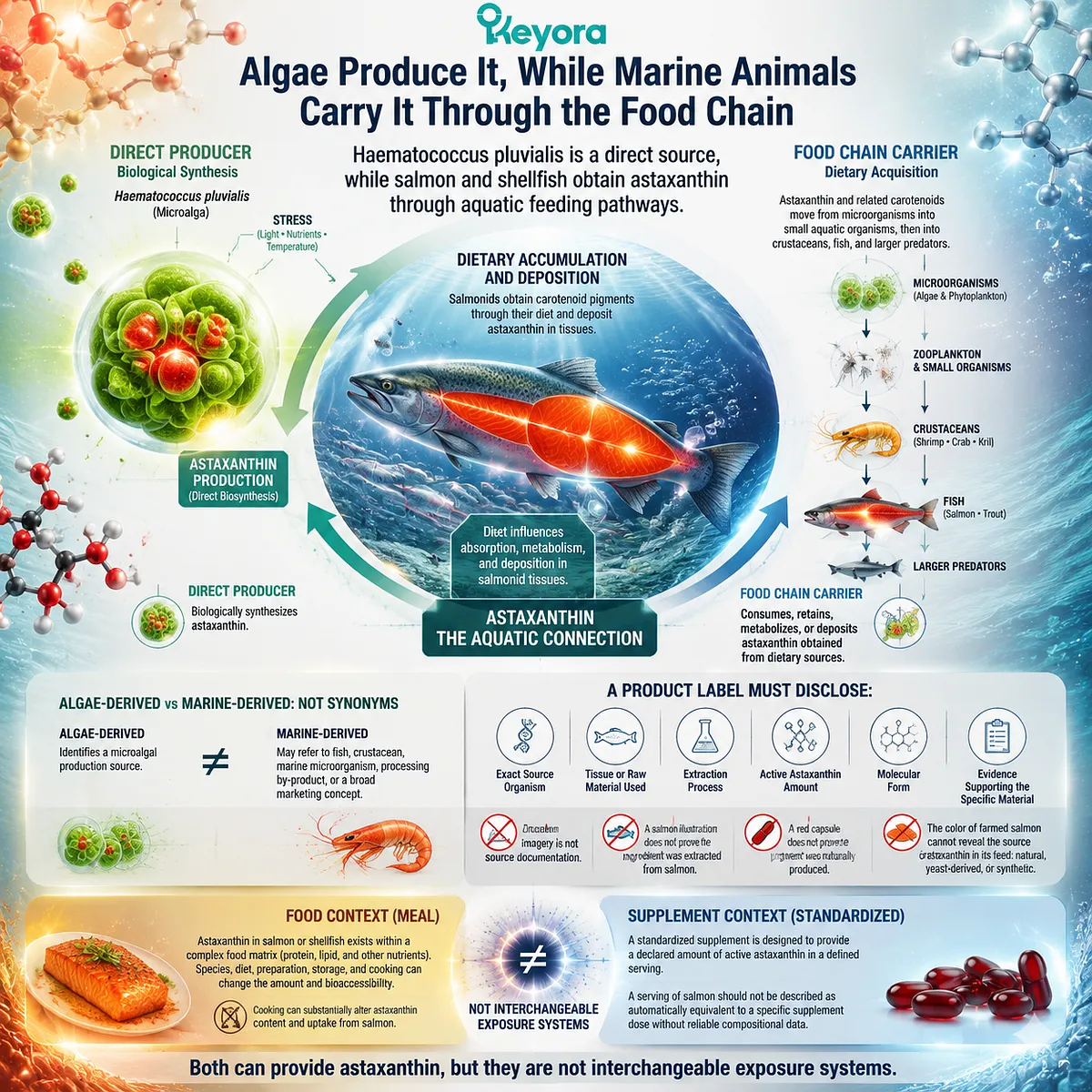
Haematococcus pluvialis is a direct source, while salmon and shellfish obtain astaxanthin through aquatic feeding pathways
Astaxanthin is widely associated with salmon, trout, shrimp, crab, lobster, and krill because it contributes to red, pink, and orange coloration in aquatic organisms.
That does not mean all of these animals produce astaxanthin in the same way as microalgae.
Microalgae sit near the foundation of aquatic food systems. Astaxanthin and related carotenoids can move from microorganisms into small aquatic organisms, crustaceans, fish, and larger predators.
Salmonids obtain carotenoid pigments through their diet and deposit astaxanthin in tissues. Scientific assessments have reported that the stereoisomer composition found in wild salmon can reflect the dietary organisms the fish consumed. Feeding studies also show that the astaxanthin source in the diet influences its absorption, metabolism, and deposition in salmonid tissues.
This leads to a useful distinction.
A direct producer biologically synthesizes astaxanthin.
A food-chain carrier consumes, retains, metabolizes, or deposits astaxanthin obtained from dietary sources.
Haematococcus pluvialis is a direct producer.
Salmon is primarily a dietary accumulator.
Crustaceans contain astaxanthin in their tissues and shells, frequently in lipid-associated or esterified forms, but crustacean material is still compositionally and commercially different from a standardized microalgal extract.
Therefore, the phrases “algae-derived” and “marine-derived” should not be treated as synonyms.
Algae-derived identifies a microalgal production source.
Marine-derived may refer to a fish, crustacean, marine microorganism, processing by-product, or simply a broadly worded marketing concept.
A product using the phrase marine-derived should still state:
-
the exact source organism
-
the tissue or raw material used
-
the extraction process
-
the active astaxanthin amount
-
the relevant molecular form
-
the evidence supporting that specific material
Ocean imagery is not source documentation.
A salmon illustration does not prove that the ingredient was extracted from salmon.
A red capsule does not prove that the pigment was naturally produced.
The color of farmed salmon also cannot reveal whether the astaxanthin in its feed was natural, yeast-derived, or synthetic. Aquaculture permits the use of defined pigmenting ingredients from different sources, and the flesh color alone does not identify which source was used.
Food and supplements also represent different exposure contexts.
When astaxanthin is eaten in salmon or shellfish, it is present within a complex food matrix containing protein, lipid, and other nutrients. Species, diet, preparation, storage, and cooking can change the amount and bioaccessibility available from the meal. Research has shown that cooking can substantially alter astaxanthin content and uptake from salmon.
A standardized supplement is designed to provide a declared amount of active astaxanthin in a defined serving.
This means a serving of salmon should not be described as automatically equivalent to a specific supplement dose without reliable compositional data.
Both can provide astaxanthin, but they are not interchangeable exposure systems.
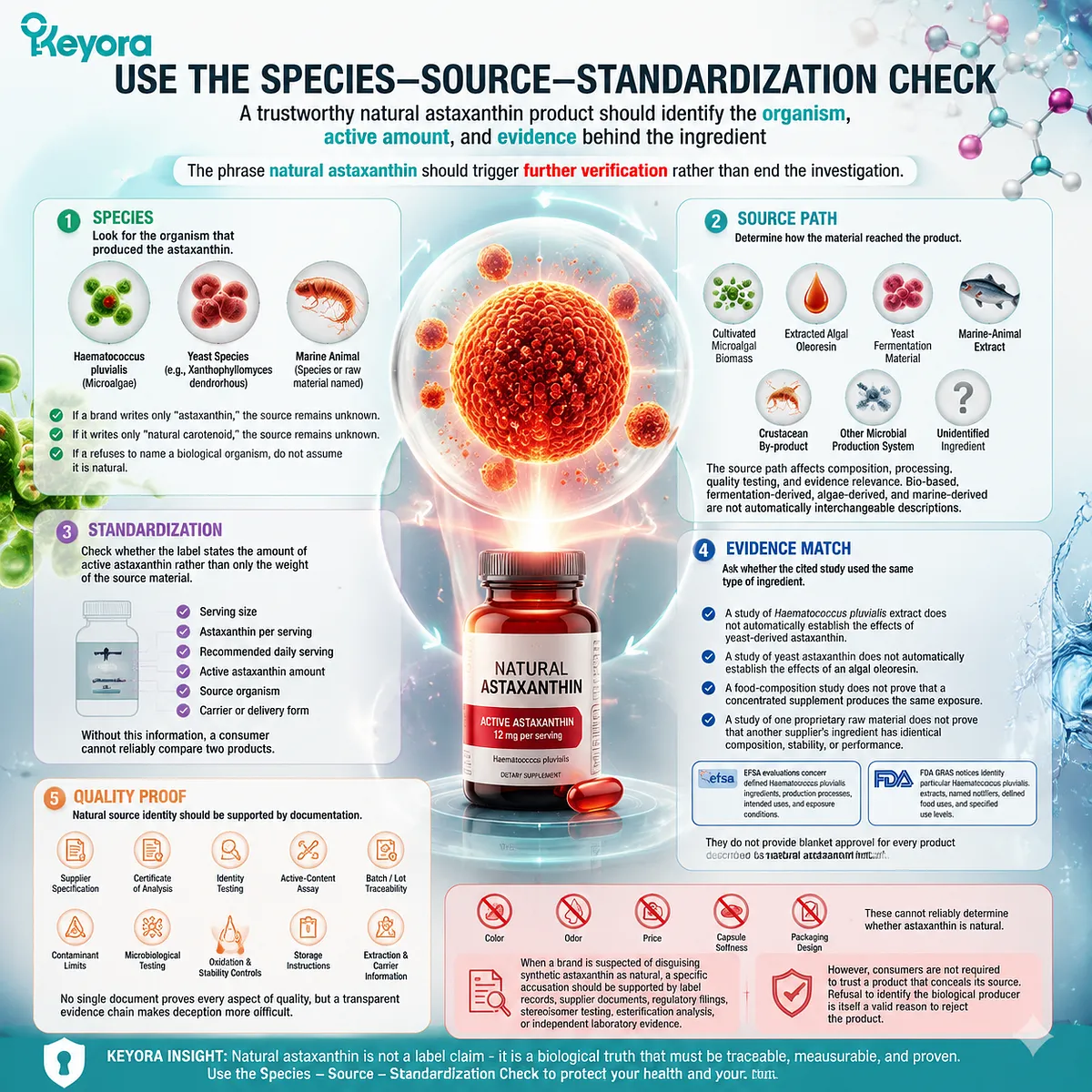
Use the Species–Source–Standardization Check
A trustworthy natural astaxanthin product should identify the organism, active amount, and evidence behind the ingredient
The phrase natural astaxanthin should trigger further verification rather than end the investigation.
Use the Species–Source–Standardization Check.
1. Species
Look for the organism that produced the astaxanthin.
For a common algal supplement, the label or supporting product information should identify Haematococcus pluvialis.
A yeast-derived ingredient should identify the relevant yeast.
A marine-animal source should name the species or raw material rather than relying on ocean language.
If a brand writes only “astaxanthin,” the source remains unknown.
If it writes only “natural carotenoid,” the source remains unknown.
If it refuses to name a biological organism, consumers should not assume that the ingredient is natural.
2. Source Path
Determine how the material reached the product.
Was it:
-
cultivated microalgal biomass
-
extracted algal oleoresin
-
yeast fermentation material
-
a marine-animal extract
-
a crustacean by-product
-
another microbial production system
-
an unidentified ingredient
This step matters because the source path affects composition, processing, quality testing, and evidence relevance.
Bio-based, fermentation-derived, algae-derived, and marine-derived are not automatically interchangeable descriptions.
3. Standardization
Check whether the label states the amount of active astaxanthin rather than only the weight of the source material.
For example, the weight of algal biomass, oleoresin, beadlets, or a proprietary complex may be much larger than the amount of astaxanthin it actually supplies.
A useful label should make clear:
-
serving size
-
astaxanthin per serving
-
recommended daily serving
-
active astaxanthin amount
-
source organism
-
carrier or delivery form
Without this information, a consumer cannot reliably compare two products.
4. Evidence Match
Ask whether the cited study used the same type of ingredient.
A study of Haematococcus pluvialis extract does not automatically establish the effects of yeast-derived astaxanthin.
A study of yeast astaxanthin does not automatically establish the effects of an algal oleoresin.
A food-composition study does not prove that a concentrated supplement produces the same exposure.
A study of one proprietary raw material does not prove that another supplier’s ingredient has identical composition, stability, or performance.
Official safety evaluations demonstrate why this specificity matters. EFSA assessments concern defined Haematococcus pluvialis ingredients, production processes, intended uses, and exposure conditions. FDA GRAS notices likewise identify particular Haematococcus pluvialis extracts, named notifiers, defined food uses, and specified use levels. They do not provide blanket approval for every product described as natural astaxanthin.
5. Quality Proof
Natural source identity should be supported by documentation.
Relevant information may include:
-
supplier specification
-
certificate of analysis
-
identity testing
-
active-content assay
-
batch or lot traceability
-
contaminant limits
-
microbiological testing
-
oxidation and stability controls
-
storage instructions
-
extraction and carrier information
No single document proves every aspect of quality, but a transparent evidence chain makes deception more difficult.
Color, odor, price, capsule softness, and packaging design cannot reliably determine whether astaxanthin is natural.
When a brand is suspected of disguising synthetic astaxanthin as natural, a specific accusation should be supported by label records, supplier documents, regulatory filings, stereoisomer testing, esterification analysis, or independent laboratory evidence.
However, consumers are not required to trust a product that conceals its source. Refusal to identify the biological producer is itself a valid reason to reject the product.
What This Means When Choosing Astaxanthin
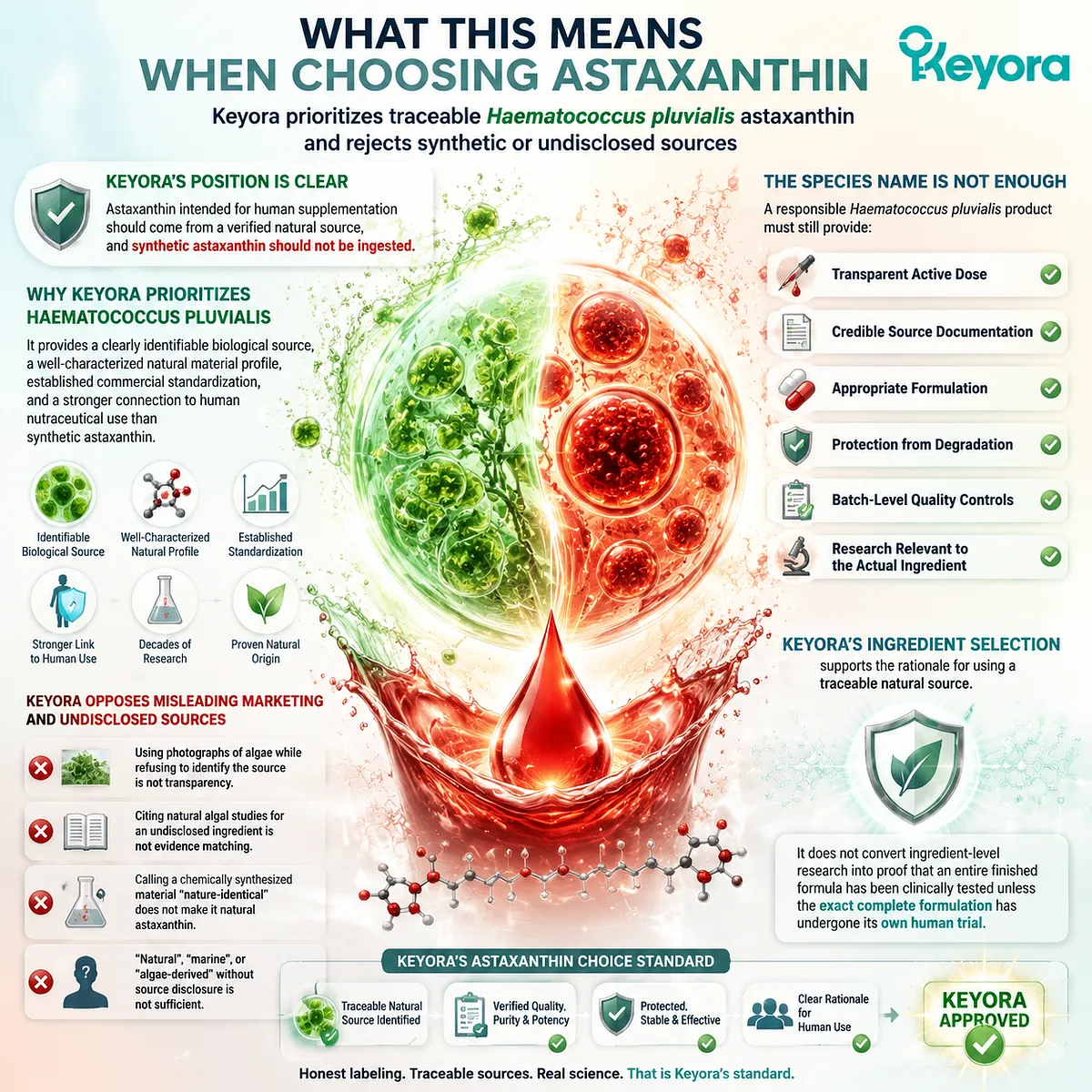
Keyora prioritizes traceable Haematococcus pluvialis astaxanthin and rejects synthetic or undisclosed sources
Keyora’s position is clear:
Astaxanthin intended for human supplementation should come from a verified natural source, and synthetic astaxanthin should not be ingested
Keyora prioritizes Haematococcus pluvialis because it provides a clearly identifiable biological source, a well-characterized natural material profile, established commercial standardization, and a stronger connection to human nutraceutical use than synthetic astaxanthin.
That does not mean the species name alone proves that a finished product is superior.
A responsible Haematococcus pluvialis product must still provide:
-
a transparent active dose
-
credible source documentation
-
appropriate formulation
-
protection from degradation
-
batch-level quality controls
-
research relevant to the actual ingredient
Keyora also opposes brands that hide synthetic astaxanthin behind vague natural, marine, or algae-themed marketing.
Using photographs of algae while refusing to identify the source is not transparency.
Citing natural algal studies for an undisclosed ingredient is not evidence matching.
Calling a chemically synthesized material “nature-identical” does not make it natural astaxanthin.
Keyora’s ingredient selection supports the rationale for using a traceable natural source. It does not convert ingredient-level research into proof that an entire finished formula has been clinically tested unless the exact complete formulation has undergone its own human trial.
Closing Summary
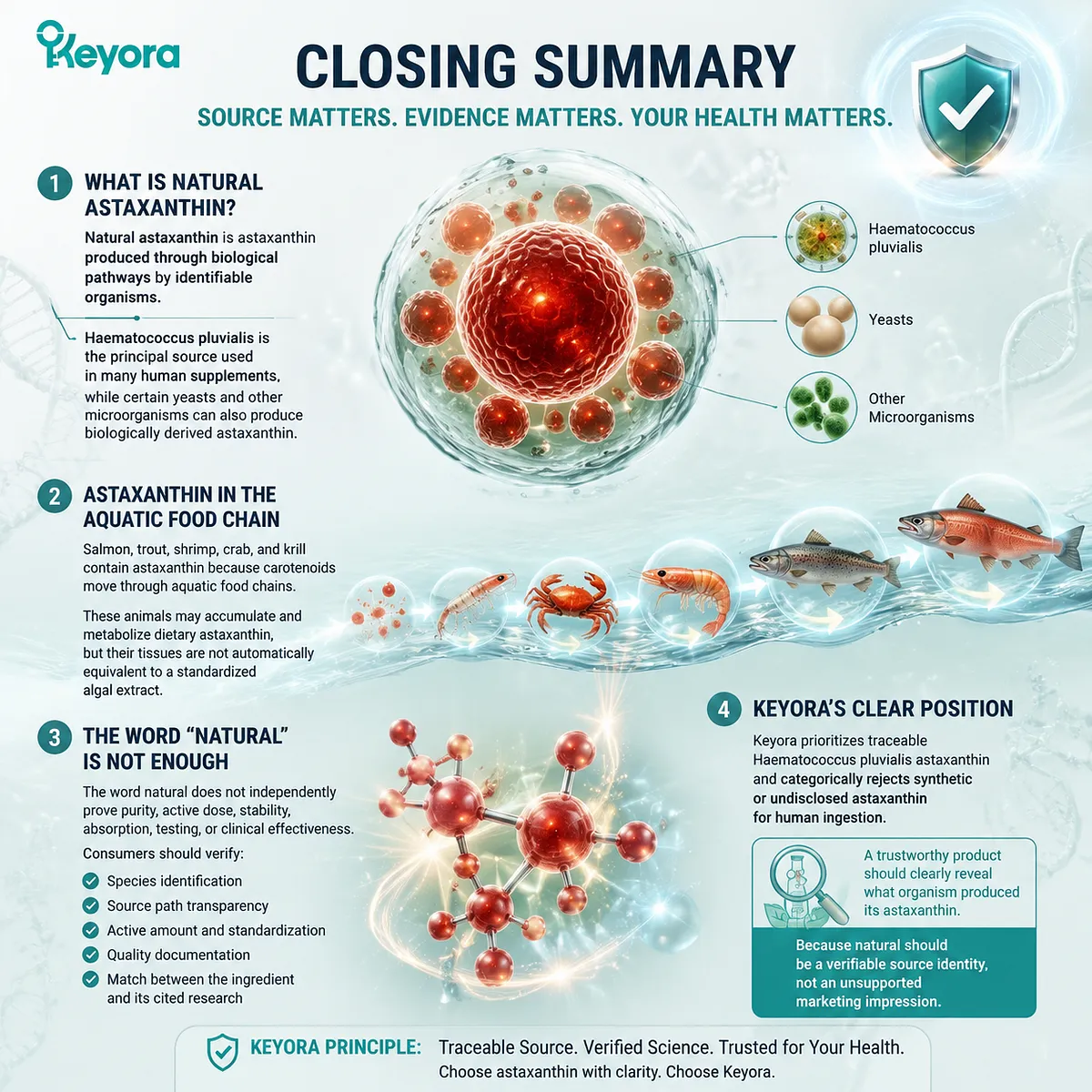
Natural astaxanthin is astaxanthin produced through biological pathways by identifiable organisms. Haematococcus pluvialis is the principal source used in many human supplements, while certain yeasts and other microorganisms can also produce biologically derived astaxanthin.
Salmon, trout, shrimp, crab, and krill contain astaxanthin because carotenoids move through aquatic food chains. These animals may accumulate and metabolize dietary astaxanthin, but their tissues are not automatically equivalent to a standardized algal extract.
The word natural does not independently prove purity, active dose, stability, absorption, testing, or clinical effectiveness. Consumers should verify the species, source path, active amount, quality documentation, and match between the ingredient and its cited research.
Keyora prioritizes traceable Haematococcus pluvialis astaxanthin and categorically rejects synthetic or undisclosed astaxanthin for human ingestion. A trustworthy product should clearly reveal what organism produced its astaxanthin – because natural should be a verifiable source identity, not an unsupported marketing impression
This article is for educational and informational purposes only. It does not provide medical advice, diagnosis, treatment, cure, prevention, disease outcome claims, hormone restoration claims, fertility outcome claims, or formula-specific clinical efficacy claims.