
What Is GABA/NMDA Balance?
Keyora Research Q&A Library
This is part of the Keyora Research Q&A Series, derived from Keyora Nutritional Neurology Seriers .
Within the Keyora Nutritional Neurology framework, this Q&A translates complex nutrient–brain mechanisms into reader-friendly, evidence-bound answers, focusing on stress resilience, sleep quality, calm mood support, cognitive wellness, and the broader interaction between nutrition, neurochemistry, and daily nervous-system function.
First published by Keyora Research Journal: www.keyorahealth.com

Direct Answer
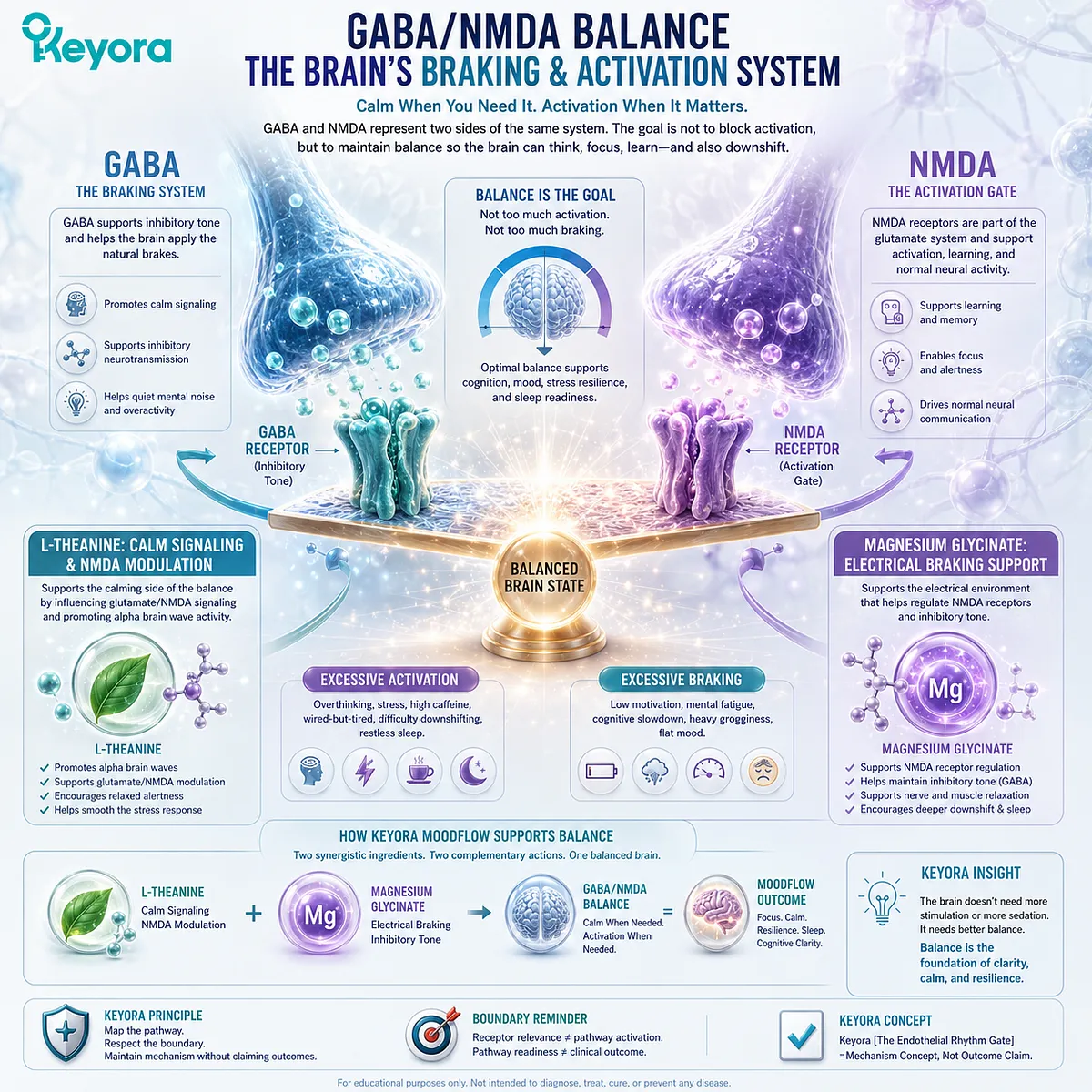
GABA/NMDA balance is a simple way to describe how the brain manages calming and activating signals.
GABA can be understood as part of the brain’s natural braking system because it supports inhibitory tone.
NMDA receptors are part of the glutamate system and can be understood as activation gates involved in learning, alertness, and normal neural activity.
The goal is not to block activation completely. The brain needs activation to think, focus, learn, and respond. The problem begins when activation becomes difficult to downshift, especially under stress, caffeine load, overthinking, or bedtime alertness.
In the Keyora MoodFlow framework, L-Theanine and magnesium glycinate are mapped to this balance from two sides.
L-Theanine supports calm signaling and glutamate/NMDA modulation, while magnesium glycinate supports the electrical braking context around NMDA and inhibitory tone.
The Brain Needs Both Brakes and Accelerators
Why calm does not mean shutting the brain down.
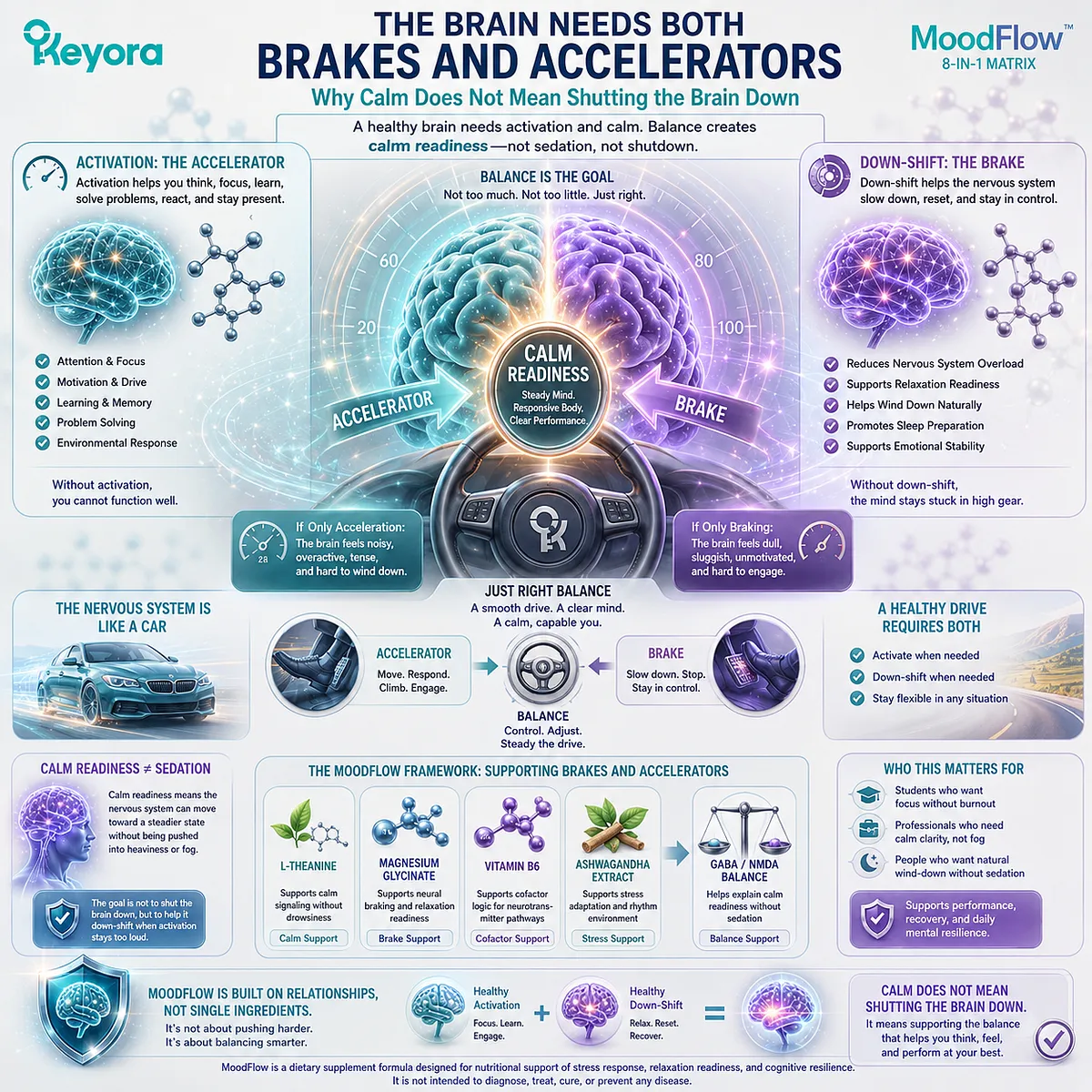
Many people think calm means the brain becomes quiet, slow, or sleepy. That is not always true. A healthy calm state is not the same as turning the brain off.
The brain needs activation. Activation helps you pay attention, learn new information, solve problems, react to your environment, and stay mentally present.
Without activation, you would not feel focused or responsive.
But activation needs balance. A brain that is always activated can feel noisy, tense, reactive, or difficult to wind down. This is where the idea of brakes and accelerators becomes useful.
Think of the nervous system like a car. The accelerator helps the car move, respond, and climb hills. The brake helps the car slow down, stop, and stay under control. A healthy drive requires both.
If there is only acceleration, the car becomes difficult to control. If there is only braking, the car cannot move. The same basic idea applies to the brain. It needs the ability to activate, and it also needs the ability to downshift.
This is why Keyora uses the phrase calm readiness rather than forced sedation. Calm readiness means the nervous system can move toward a steadier state without being pushed into heaviness or fog.
In the Keyora MoodFlow framework, GABA/NMDA balance helps explain calm readiness without sedation: the goal is not to shut the brain down, but to help the nervous system downshift when activation stays too loud.
This matters for people who feel mentally busy at night. They may not want a heavy sedative feeling. They may simply want the mind to stop racing long enough for the body to enter a more natural wind-down rhythm.
It also matters during the day. A student, professional, or founder may need focus without overactivation. They may want calm clarity, not drowsiness.
This is where GABA/NMDA balance becomes a helpful educational concept.
It explains why stress support should not only ask, “How do we calm the brain?”
A better question is, “How do we support the relationship between activation and braking?”
MoodFlow is designed around that relationship.
-
L-Theanine supports calm signaling.
-
Magnesium glycinate supports neural braking.
-
B6 supports cofactor logic related to neurotransmitter pathways.
-
Ashwagandha supports the stress-rhythm environment around the nervous system.
Together, these layers help explain how calm can feel clear rather than dull.
GABA Calms, NMDA Activates
How inhibitory and excitatory signals shape overthinking, tension, and alertness.
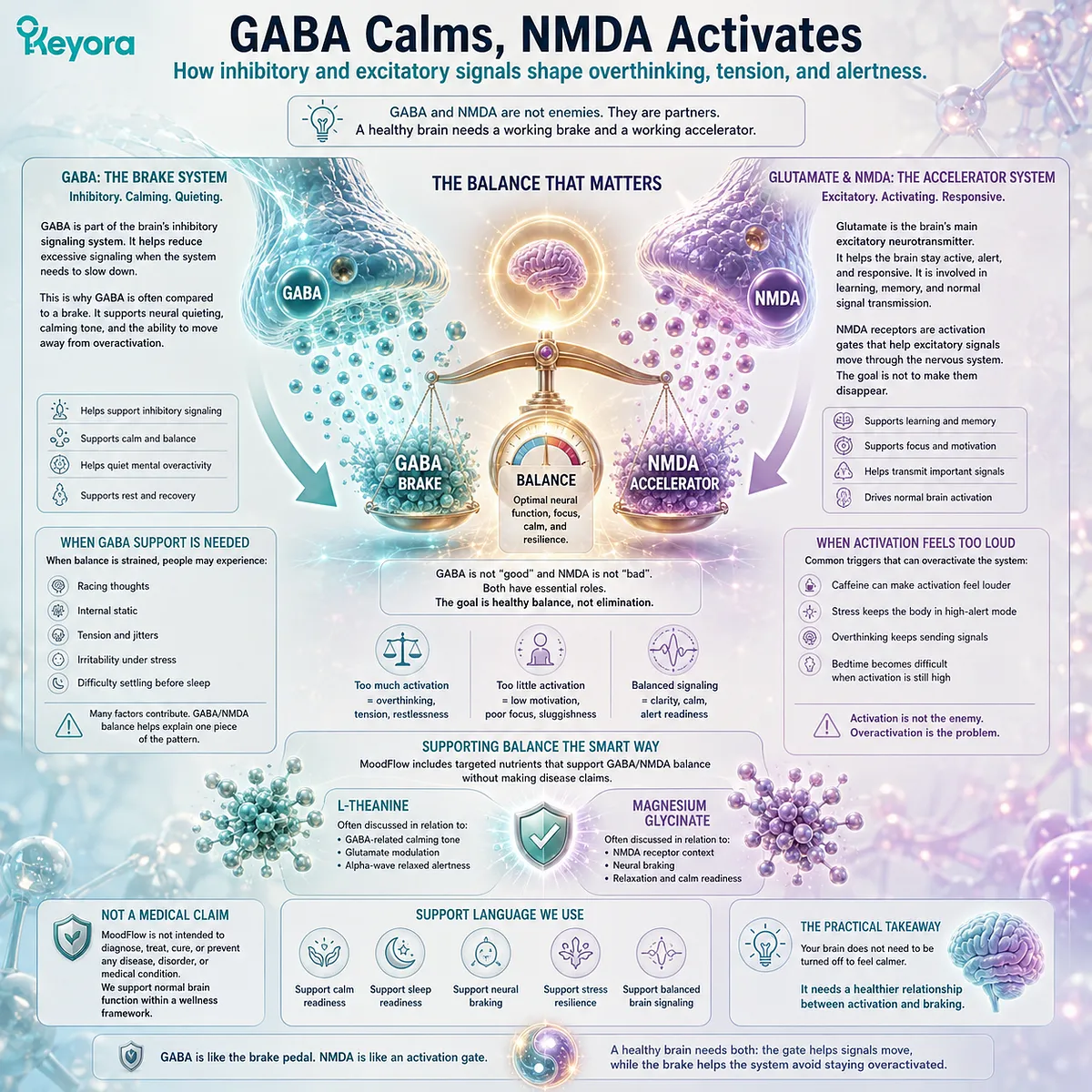
GABA is often described as the brain’s calming neurotransmitter.
More accurately, it is part of the brain’s inhibitory signaling system. Inhibitory does not mean bad or weak. It means it helps reduce excessive signaling when the system needs to slow down.
This is why GABA is often compared to a brake. It helps support neural quieting, calming tone, and the ability to move away from overactivation.
Glutamate is different. Glutamate is the brain’s main excitatory neurotransmitter. Excitatory signaling helps the brain stay active, alert, and responsive. It is involved in learning, memory, and normal signal transmission.
NMDA receptors are part of the glutamate system. They can be understood as activation gates that help certain excitatory signals move through the nervous system. These gates are important. The goal is not to make them disappear.
A healthy brain needs glutamate and NMDA activity.
Without excitatory signaling, the brain could not learn, adapt, or respond. The problem is not activation itself. The problem is when activation feels too loud, too persistent, or too difficult to slow down.
This is why GABA/NMDA balance is not a “good versus bad” story. GABA is not good while NMDA is bad. Both have useful roles. The body needs a working brake and a working accelerator.
When this balance feels strained, people may describe ordinary experiences such as racing thoughts, internal static, caffeine jitters, tension, irritability under stress, or difficulty settling before sleep. These experiences can have many causes, but GABA/NMDA balance helps explain one piece of the pattern.
For example
-
caffeine can make activation feel louder.
-
Stress can keep the body in a high-alert mode.
-
Overthinking can make the mind feel as if it keeps sending signals even when the person wants to rest.
-
Bedtime can become difficult when the activation system is still acting like it is daytime.
In that situation, the answer is not necessarily to force sleep. The more useful wellness idea is to support downshift capacity.
GABA is like the brake pedal. NMDA is like an activation gate. A healthy brain needs both: the gate helps signals move, while the brake helps the system avoid staying overactivated.
This is where L-Theanine and magnesium glycinate become relevant in the MoodFlow architecture.
-
L-Theanine is often discussed in relation to GABA-related calming tone, glutamate modulation, and alpha-wave relaxed alertness.
-
Magnesium is often discussed in relation to NMDA receptor context and neural braking.
These mechanisms should not be turned into disease claims.
MoodFlow should not be described as treating anxiety, insomnia, neurological disorders, or psychiatric conditions. The correct language is support: support calm readiness, support sleep readiness, support neural braking, and support stress resilience.
For consumers, the practical meaning is simple. Your brain does not need to be turned off to feel calmer. It needs a healthier relationship between activation and braking.
How MoodFlow Supports This Balance
Why L-Theanine, magnesium glycinate, B6, and Ashwagandha all connect to the calm-readiness pathway.
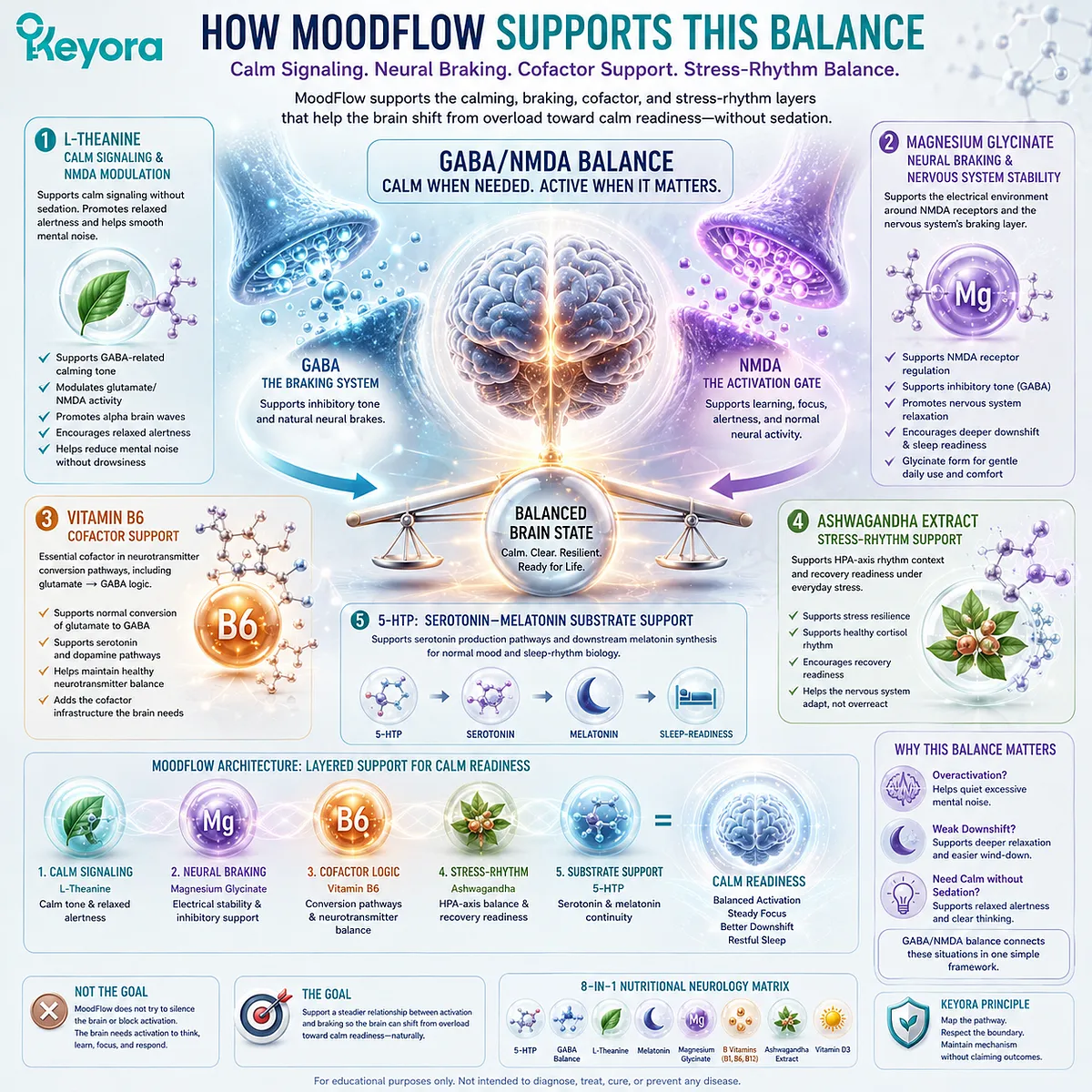
MoodFlow does not try to silence the brain. It supports the calming, braking, cofactor, and stress-rhythm layers that help the brain shift from overload toward calm readiness.
L-Theanine is one of the most important ingredients for this topic.
It supports calm signaling without being positioned as a sedative. This is why Keyora often connects L-Theanine with relaxed alertness.
L-Theanine helps explain how the brain can feel calmer while still remaining clear. It is relevant to GABA-related calming tone, glutamate/NMDA modulation, and alpha-wave calm. In consumer language, it helps support the feeling of less mental noise without forcing sleepiness.
Magnesium glycinate supports the balance from another side.
Magnesium is involved in the electrical context around NMDA receptor activity. It also supports nervous-system stability, relaxation readiness, and the broader neural braking layer.
The glycinate form matters because MoodFlow is not using magnesium mainly for bowel-related purposes. It uses magnesium glycinate because it fits gentle daily nervous-system support. In the MoodFlow Matrix, magnesium glycinate acts like a hardware stabilizer for the nervous system.
B6 adds the cofactor layer.
It is involved in normal neurotransmitter-related conversion pathways, including glutamate-to-GABA logic. This does not mean B6 forces GABA activity. It means B6 helps explain the cofactor infrastructure behind the calming pathway.
Ashwagandha supports the stress-rhythm environment.
If the body is under pressure, the nervous system may stay more activated. Ashwagandha is included in MoodFlow as the stress-adaptation layer, supporting HPA-axis rhythm context and recovery readiness under everyday stress.
5-HTP also belongs in the broader picture, although it is not the main character in this article.
It supports serotonin-melatonin substrate continuity, which helps explain sleep-readiness pathway logic. When combined with the calming and braking layers, the formula becomes more complete.
Inside Keyora MoodFlow, GABA/NMDA balance is supported through a layered architecture: L-Theanine supports calm signaling, magnesium glycinate supports neural braking, B6 supports cofactor logic, and Ashwagandha supports the stress-rhythm environment around neural downshift.
This is why MoodFlow is not simply a “relaxation supplement.” It is designed as an 8-in-1 nutritional neurology matrix. Each ingredient supports a different layer of the stress-sleep-mood-cognition loop.
-
For someone with racing thoughts, the relevant idea may be overactivation.
-
For someone who feels tense before bed, the relevant idea may be weak downshift.
-
For someone who feels stressed but still needs mental clarity, the relevant idea may be calm without sedation.
GABA/NMDA balance helps connect all of these situations in one simple framework. It explains why the brain needs both signal movement and signal control.
For Keyora, supporting calm does not mean suppressing the brain. It means helping the nervous system find a steadier relationship between activation and braking.
Closing Summary
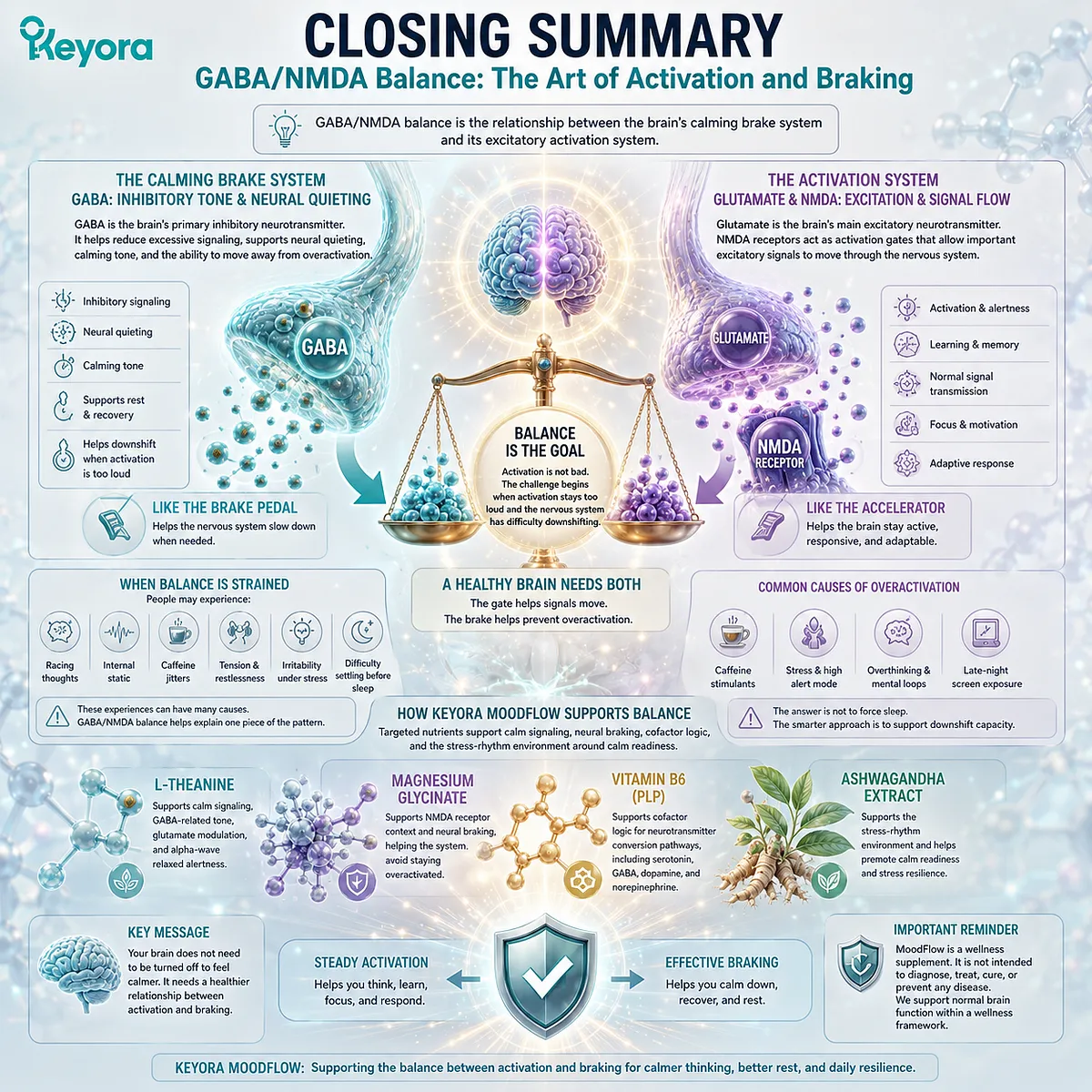
GABA/NMDA balance is the relationship between the brain’s calming brake system and its excitatory activation system.
-
GABA helps explain inhibitory tone and neural quieting.
-
Glutamate and NMDA receptors help explain activation, alertness, learning, and normal signal movement.
Activation is not bad. The brain needs it to think, focus, and respond. The challenge begins when activation stays too loud and the nervous system has difficulty downshifting.
Inside Keyora MoodFlow, L-Theanine supports calm signaling, magnesium glycinate supports neural braking, B6 supports cofactor logic, and Ashwagandha supports the stress-rhythm environment around calm readiness.
For Keyora, GABA/NMDA balance is a simple way to explain why calm support should not mean shutting the brain down. It should mean helping the nervous system find a steadier relationship between activation and braking.
This article is for educational and informational purposes only. It does not provide medical advice, diagnosis, treatment, cure, prevention, disease outcome claims, hormone restoration claims, fertility outcome claims, or formula-specific clinical efficacy claims.