
What Is 5-HTP?
Keyora Research Q&A Library
This is part of the Keyora Research Q&A Series, derived from Keyora Nutritional Neurology Seriers .
Within the Keyora Nutritional Neurology framework, this Q&A translates complex nutrient–brain mechanisms into reader-friendly, evidence-bound answers, focusing on stress resilience, sleep quality, calm mood support, cognitive wellness, and the broader interaction between nutrition, neurochemistry, and daily nervous-system function.
First published by Keyora Research Journal: www.keyorahealth.com

Direct Answer
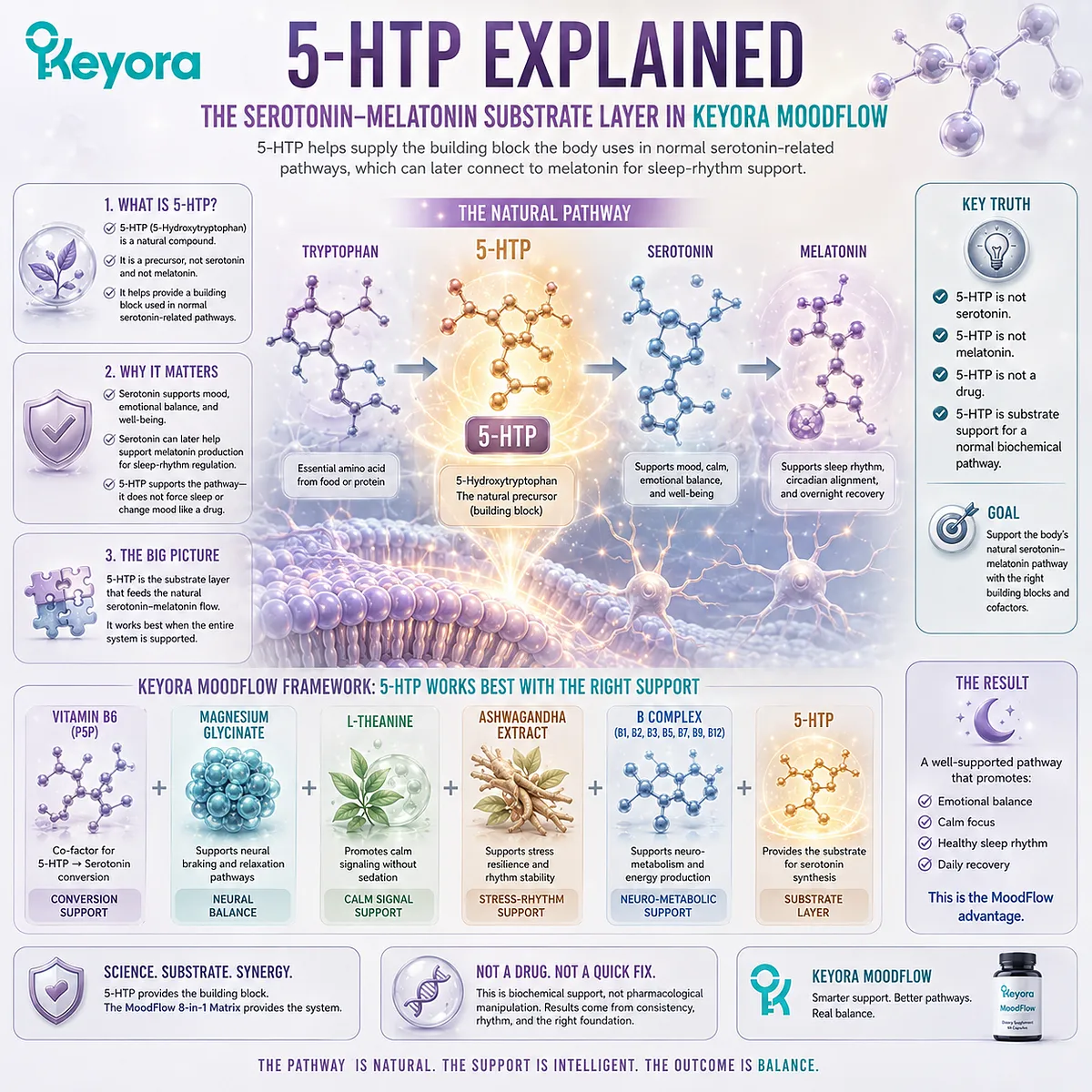
5-HTP, short for 5-Hydroxytryptophan, is a natural compound the body uses in the pathway between tryptophan and serotonin. It is not serotonin itself, and it is not melatonin.
Instead, it is a precursor, meaning it helps supply a building block used in normal serotonin-related pathways.
Because serotonin can later connect to melatonin production, 5-HTP also helps explain sleep-rhythm support.
This does not mean 5-HTP forces sleep or changes mood like a drug. It is better understood as substrate support for a normal biochemical pathway.
In the Keyora MoodFlow framework, 5-HTP is positioned as the serotonin-melatonin substrate layer.
It works best when supported by the broader MoodFlow 8-in-1 Matrix, including B6 for conversion support, magnesium glycinate for neural braking, L-Theanine for calm signaling, Ashwagandha for stress-rhythm context, and B vitamins for neuro-metabolic support.
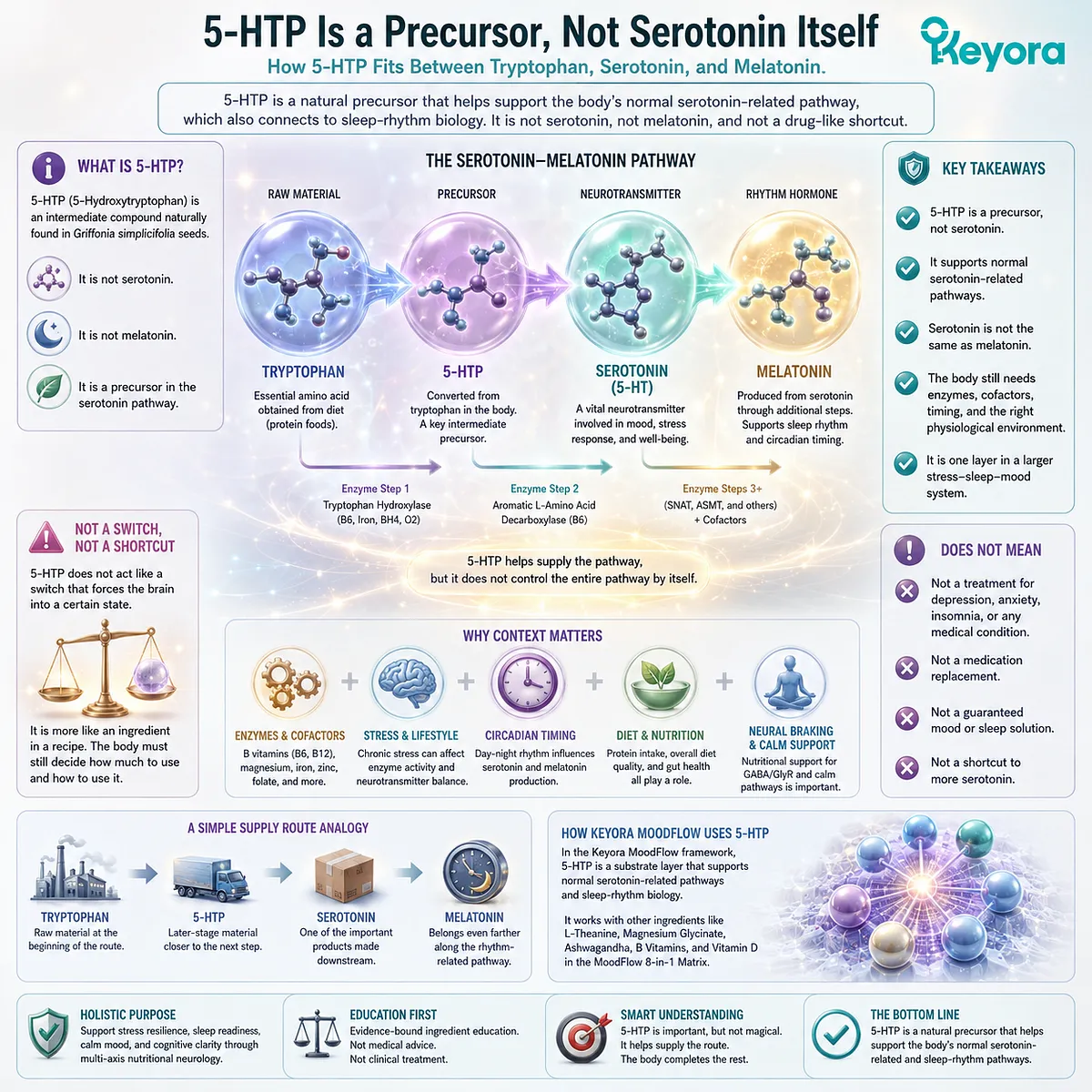
5-HTP Is a Precursor, Not Serotonin Itself
How 5-HTP fits between tryptophan, serotonin, and melatonin.
Many people hear the word 5-HTP and immediately connect it with serotonin. That connection is understandable, but it needs to be explained carefully.
5-HTP is not serotonin. It is also not melatonin. It is a precursor, which means it sits earlier in a pathway and helps supply a building block the body can use.
A simple pathway looks like this: tryptophan comes first, then 5-HTP, then serotonin. Later, serotonin can be used in the body’s melatonin-related pathway. This is why 5-HTP is often discussed in relation to both mood-related signaling and sleep-rhythm support.
But the key word is “pathway.”
5-HTP does not act like a switch that forces the brain into a certain state. It is more like an ingredient in a recipe. The body still needs enzymes, cofactors, timing, and the right physiological environment to use that ingredient properly.
This is why Keyora does not frame 5-HTP as a standalone mood or sleep solution.
In the Keyora MoodFlow framework, 5-HTP is not presented as serotonin itself. It is presented as a substrate layer that helps explain normal serotonin-related and sleep-rhythm pathways.
The difference matters for consumer education.
-
Saying “5-HTP is serotonin” is inaccurate.
-
Saying “5-HTP supports normal serotonin-related pathways” is more accurate and more responsible.
It also helps keep the wellness boundary clear. 5-HTP should not be described as treating depression, anxiety, insomnia, or any medical condition.
MoodFlow should not be described as a clinical treatment or medication replacement. The correct language is pathway support, sleep-readiness support, stress-sleep rhythm support, and evidence-bound ingredient education.
A useful analogy is a supply route. Tryptophan is like the raw material at the beginning of a long route.
5-HTP is a later-stage material that is closer to the next step.
-
Serotonin is one of the important products made downstream.
-
Melatonin belongs even farther along the rhythm-related pathway.
This makes 5-HTP important, but not magical. It helps supply the route, but it does not control the entire route by itself.
That is why the surrounding nutritional context matters. If the body needs conversion support, stress regulation, calm signaling, or neural braking, 5-HTP alone does not answer every question. It is one layer in a larger system.
For ordinary readers, the simplest explanation is this: 5-HTP is a natural precursor that helps support the body’s normal serotonin-related pathway, which also connects to sleep-rhythm biology.
It is not serotonin, not melatonin, and not a drug-like shortcut.
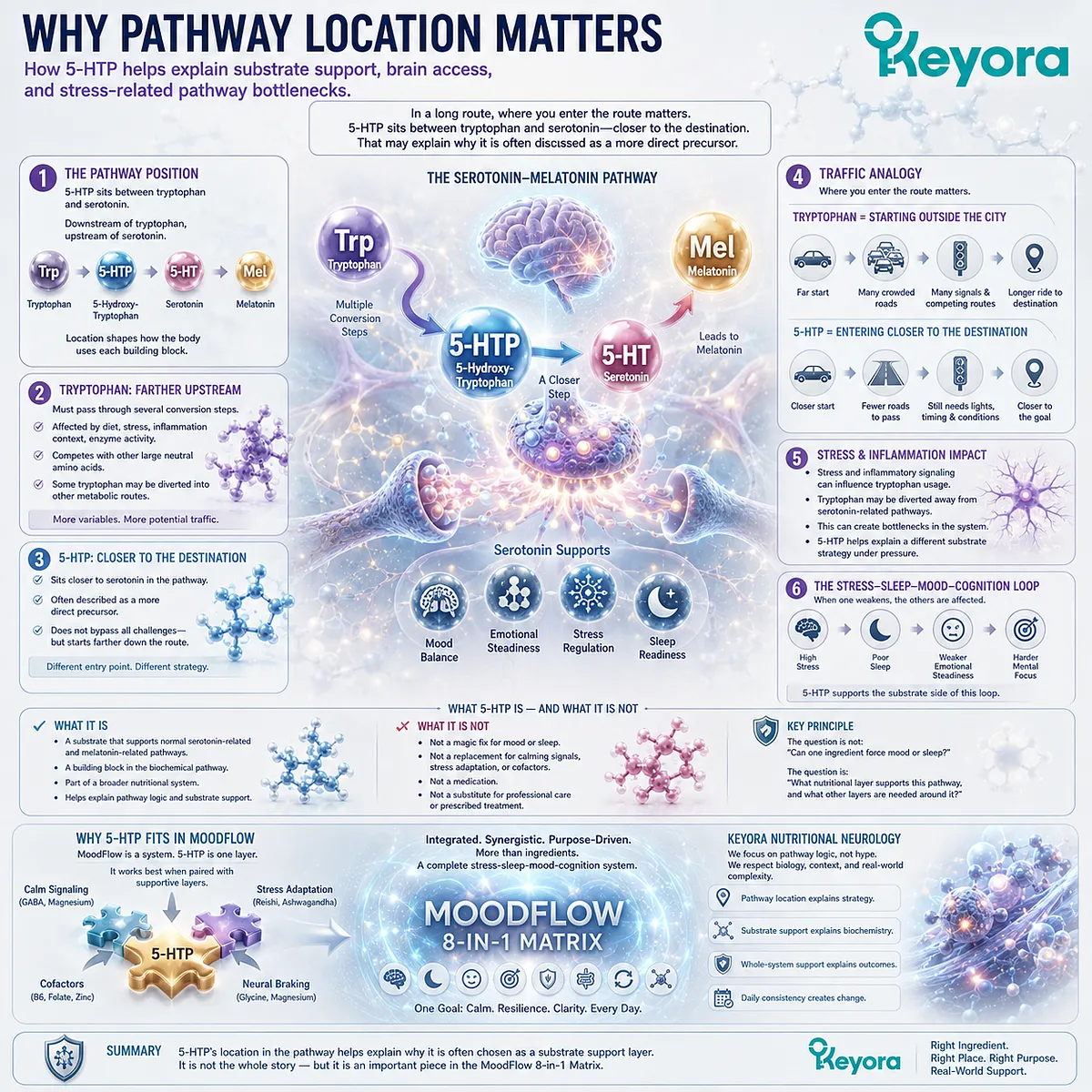
Why Pathway Location Matters
How 5-HTP helps explain substrate support, brain access, and stress-related pathway bottlenecks.
The location of 5-HTP in the pathway is one reason it receives so much attention. It sits between tryptophan and serotonin, which means it is downstream of tryptophan but upstream of serotonin.
That may sound technical, but the idea is simple. In a long route, where you enter the route matters.
Tryptophan starts farther upstream.
It must go through several steps before it becomes part of serotonin-related pathways. It can also be influenced by diet, stress, inflammation-related context, enzyme activity, and competition with other amino acids.
5-HTP sits closer to serotonin in the pathway. This is why it is often described as a more direct precursor than tryptophan.
It does not mean 5-HTP bypasses every biological challenge. It simply helps explain a different substrate strategy.
A helpful analogy is traffic. Tryptophan is like starting outside the city and needing to pass through several crowded roads.
5-HTP is like entering the route closer to the destination. It still needs traffic lights, proper timing, and open roads, but it starts farther down the pathway.
This pathway location also matters under stress.
When the body is under pressure, the internal environment can change. Stress and inflammatory signaling may influence how tryptophan is used. Some tryptophan may be diverted away from serotonin-related pathways into other metabolic routes.
This is one reason Keyora discusses 5-HTP as a substrate layer. It helps explain why pathway location matters when stress, sleep, mood, and cognition are viewed as one connected loop.
-
When stress stays high, sleep can become lighter.
-
When sleep is poor, emotional steadiness can feel weaker.
-
When emotional steadiness is lower, mental focus may become harder. This loop is exactly the type of system MoodFlow is designed to support.
5-HTP belongs to the substrate part of that system. It helps explain the building-block side of normal serotonin-related and melatonin-related pathways.
But it does not replace the need for calm signaling, stress adaptation, and cofactor support.
This is why 5-HTP should not be described as “fixing serotonin.”
That language is too strong and too medical.
A more accurate explanation is that 5-HTP supports normal serotonin-related pathways by supplying an upstream precursor.
It is also why 5-HTP should not be compared with medications in a replacement tone.
Medications and supplements belong to different categories.
A consumer wellness article should not suggest that 5-HTP replaces professional care or prescribed treatment.
In Keyora Nutritional Neurology, the value of 5-HTP is not hype.
It is pathway logic.
The question is not “Can one ingredient force mood or sleep?”
The question is “What nutritional layer supports this pathway, and what other layers are needed around it?”
That is the reason 5-HTP fits inside MoodFlow rather than standing alone as the whole story.
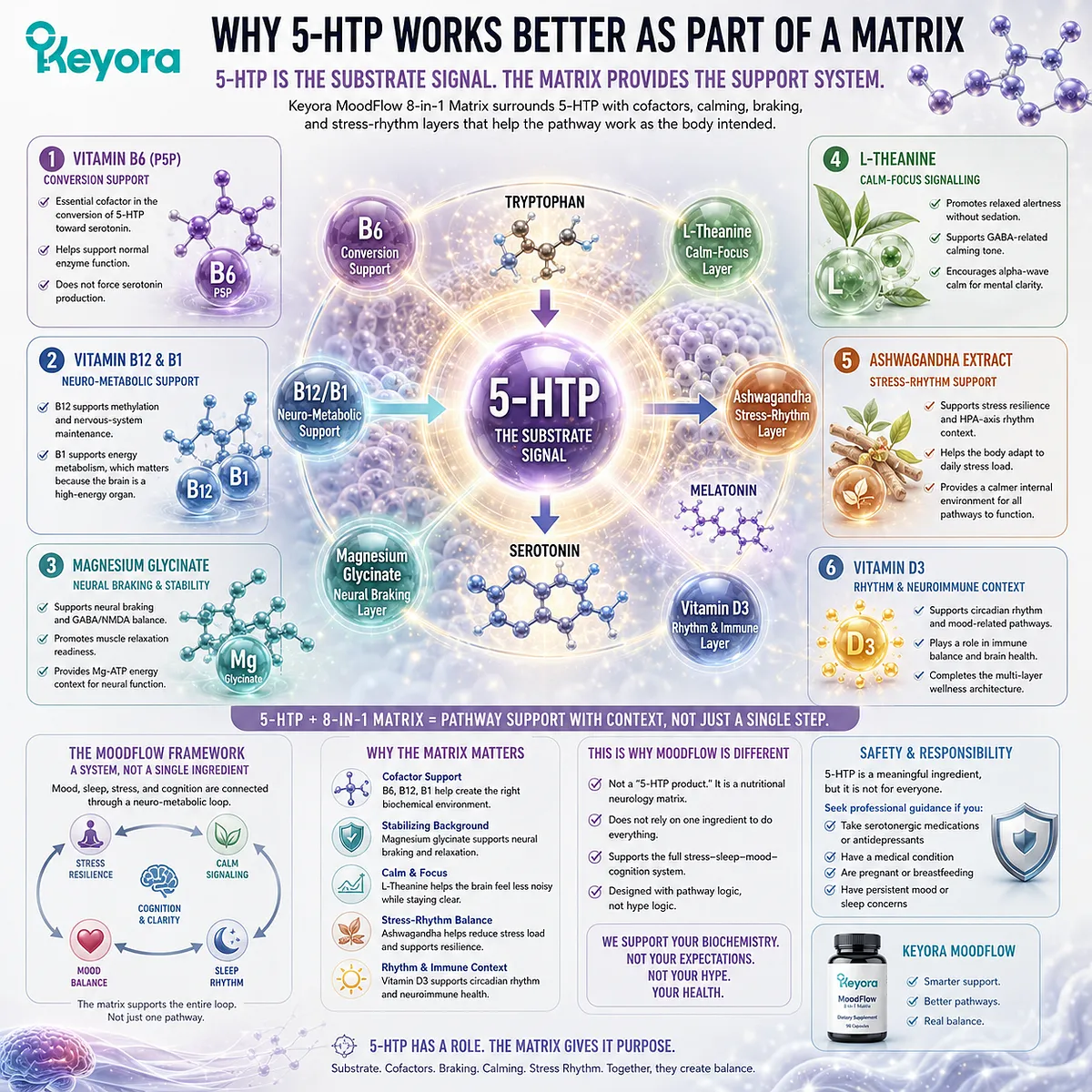
Why 5-HTP Works Better as Part of a Matrix
How B6, magnesium, L-Theanine, and Ashwagandha provide the supporting layers around 5-HTP.
5-HTP is important, but it should not be treated as a magic bullet. A precursor can supply a pathway, but the body still needs the right conditions to use that precursor well.
This is the core reason Keyora places 5-HTP inside the MoodFlow 8-in-1 Matrix. The matrix adds support layers around the substrate.
Vitamin B6 is one of the most important supporting layers.
B6 is involved in the conversion pathway from 5-HTP toward serotonin. In simple language, 5-HTP may provide the building block, while B6 helps support the conversion environment.
This does not mean B6 forces serotonin production. It means B6 is part of normal cofactor support. In a formula built around pathway logic, cofactors matter.
B12 and B1 also have supporting roles.
-
B12 is connected with methylation and nervous-system maintenance.
-
B1 supports energy metabolism, which matters because the brain is an energy-demanding organ.
These vitamins help explain why MoodFlow treats mood, sleep, stress, and cognition as a neuro-metabolic system, not just a neurotransmitter story.
Magnesium glycinate adds another layer.
It supports neural braking, GABA/NMDA balance, muscle relaxation readiness, and Mg-ATP energy context. If 5-HTP is the substrate layer, magnesium glycinate helps support the stabilizing background that allows the nervous system to downshift.
L-Theanine adds the calm-focus layer.
It supports relaxed alertness, GABA-related calming tone, and alpha-wave calm. This is important because many people do not want sedation. They want the brain to feel less noisy while still remaining clear.
Ashwagandha adds stress-adaptation context.
It is used in MoodFlow to support stress resilience and HPA-axis rhythm context. This matters because a high-stress environment can create noise around sleep, mood, and cognition.
Vitamin D adds broader rhythm and neuroimmune context.
It is not the main character in the 5-HTP story, but it helps complete the formula’s multi-layer wellness architecture.
Inside Keyora MoodFlow, 5-HTP is the substrate signal, but the MoodFlow 8-in-1 Matrix provides the cofactor, braking, calming, and stress-rhythm layers that help the signal make sense.
This is why MoodFlow is not a “5-HTP product.” It is a nutritional neurology matrix. The formula does not depend on one pathway doing everything. It organizes multiple support layers around the stress-sleep-mood-cognition loop.
This is also important for safety and responsibility.
5-HTP is a meaningful ingredient, but it is not suitable for every person in every situation.
People taking serotonergic medications, antidepressants, or other medications that affect serotonin should seek professional guidance before using 5-HTP-containing supplements. Pregnant or breastfeeding individuals, people with medical conditions, and people with persistent mood or sleep concerns should also consult a qualified professional.
For everyday wellness users, the main message is not fear.
It is clarity.
5-HTP has a role, but that role is specific: it supports normal serotonin-related and sleep-rhythm pathways as part of a broader matrix.
For Keyora, that is the most responsible way to explain 5-HTP. It is not a promise to force mood or sleep. It is a substrate layer inside a larger support system.
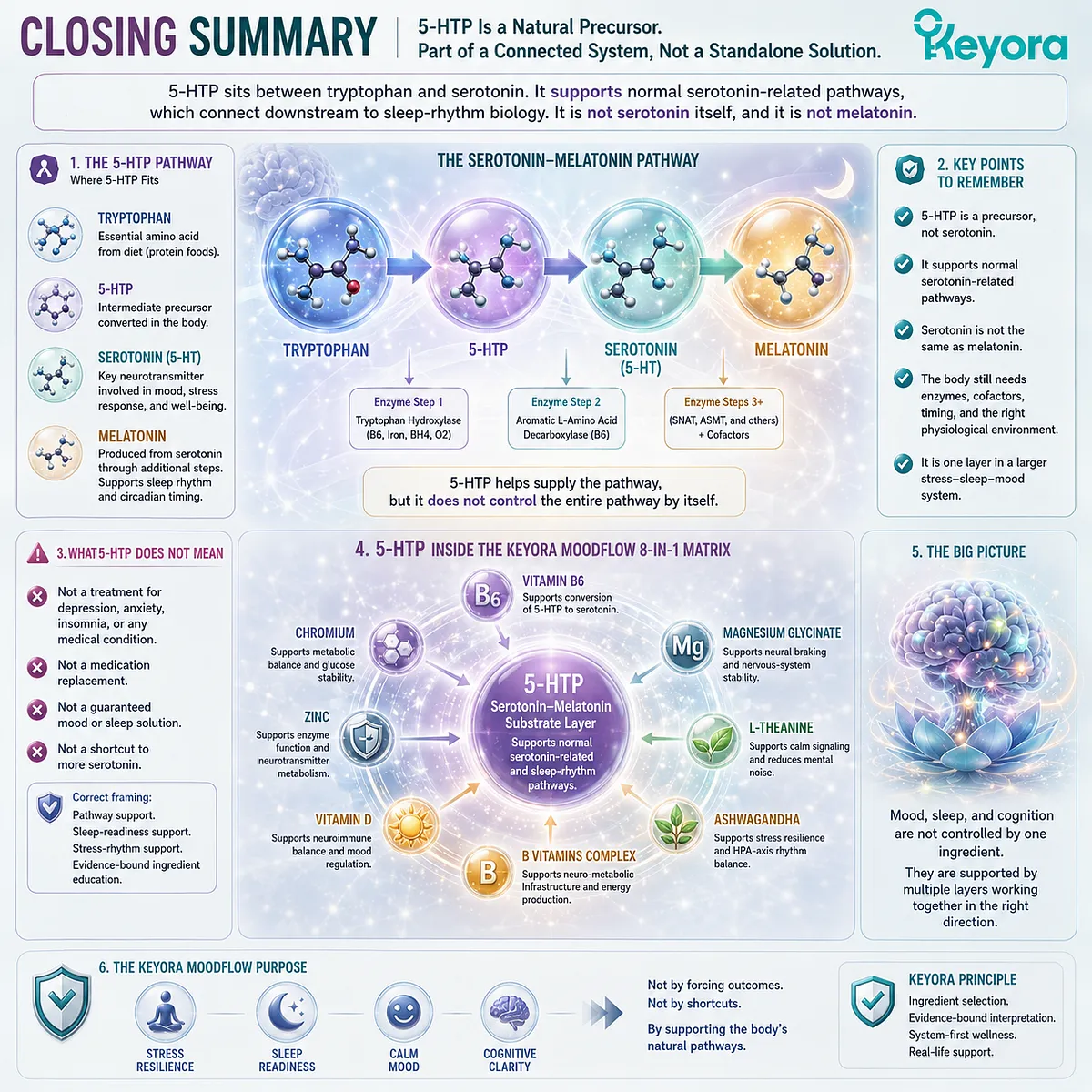
Closing Summary
5-HTP is a natural precursor that sits between tryptophan and serotonin.
It is not serotonin itself, and it is not melatonin.
Its importance comes from its pathway position: it supports normal serotonin-related pathways, which also connect downstream to sleep-rhythm biology.
Inside Keyora MoodFlow, 5-HTP is positioned as the serotonin-melatonin substrate layer.
But it is not meant to stand alone.
-
B6 supports conversion context
-
Magnesium glycinate supports neural braking
-
L-Theanine supports calm signaling
-
Ashwagandha supports stress-rhythm context
-
B vitamins support neuro-metabolic infrastructure.
This is why MoodFlow uses 5-HTP as part of a matrix rather than as a single-ingredient promise.
For Keyora, 5-HTP is not a way to force mood or sleep. It is one evidence-bound nutritional layer designed to support the connected system of stress resilience, sleep readiness, calm mood, and cognitive clarity.
This article is for educational and informational purposes only. It does not provide medical advice, diagnosis, treatment, cure, prevention, disease outcome claims, hormone restoration claims, fertility outcome claims, or formula-specific clinical efficacy claims.