
What Happens If I Stop Taking Astaxanthin?
Keyora Research Q&A Library
This is part of the Keyora Research Q&A Series, derived from Keyora Astaxanthin Research Journal Series.
Within the Keyora Astaxanthin Researcn framework, this Q&A translates complex astaxanthin biology into reader-friendly, evidence-bound answers, focusing on natural astaxanthin identity, molecular structure, antioxidant and redox mechanisms, membrane lipid interaction, mitochondrial resilience, inflammatory signaling pathways, human evidence interpretation, and the scientific principles behind responsible supplementation.
First published by Keyora Research Journal: www.keyorahealth.com
Direct Answer
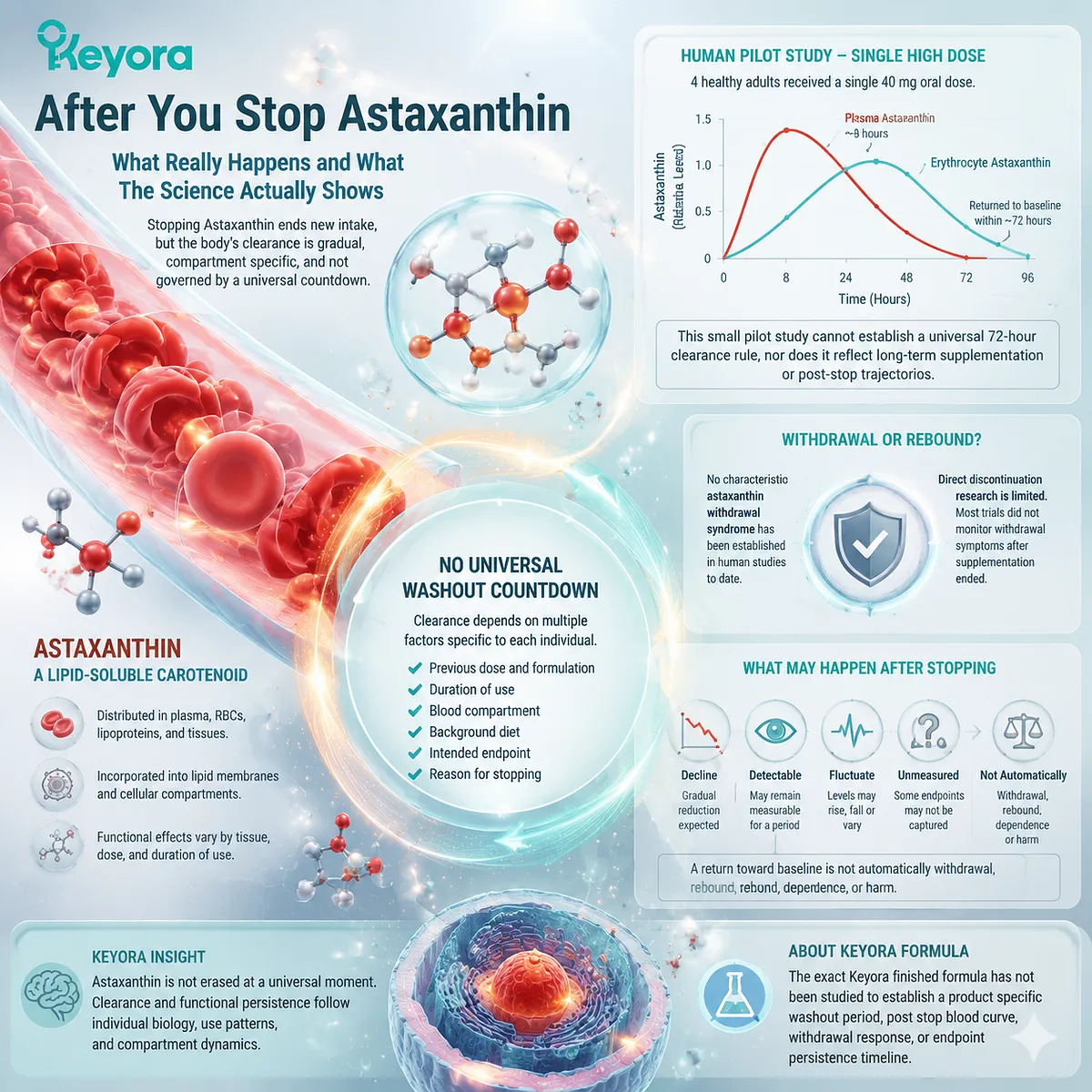
Stopping Astaxanthin ends new supplemental intake. Measurable exposure is then expected to decline, but Astaxanthin does not disappear from every blood compartment, tissue, and functional endpoint at one universal moment.
A small human pilot study helps illustrate the distinction. Four healthy adults received a single 40 mg oral dose. Plasma Astaxanthin peaked at approximately 8 hours and returned to the study baseline within 72 hours, while erythrocyte Astaxanthin followed a different curve. The sample was extremely small, the dose was high, and the study did not map discontinuation after months of daily supplementation. It therefore cannot establish a universal 72 hour clearance rule.
A characteristic drug like Astaxanthin withdrawal syndrome has not been established in the human sources reviewed for this article. However, direct discontinuation research is limited, and most trials were not designed to monitor withdrawal symptoms after supplementation ended.
Any supplementation dependent exposure or outcome may decline, remain detectable, fluctuate, or remain unmeasured after stopping. A return toward baseline is not automatically withdrawal, rebound, dependence, or harm.
There is also no universal washout countdown. Interpretation depends on the previous dose, formulation, duration of use, blood compartment, background diet, intended endpoint, and reason for stopping.
The exact Keyora finished formula has not been studied to establish a product specific washout period, post stop blood curve, withdrawal response, or endpoint persistence timeline.
The Last Dose Ends Input, Not Every Process
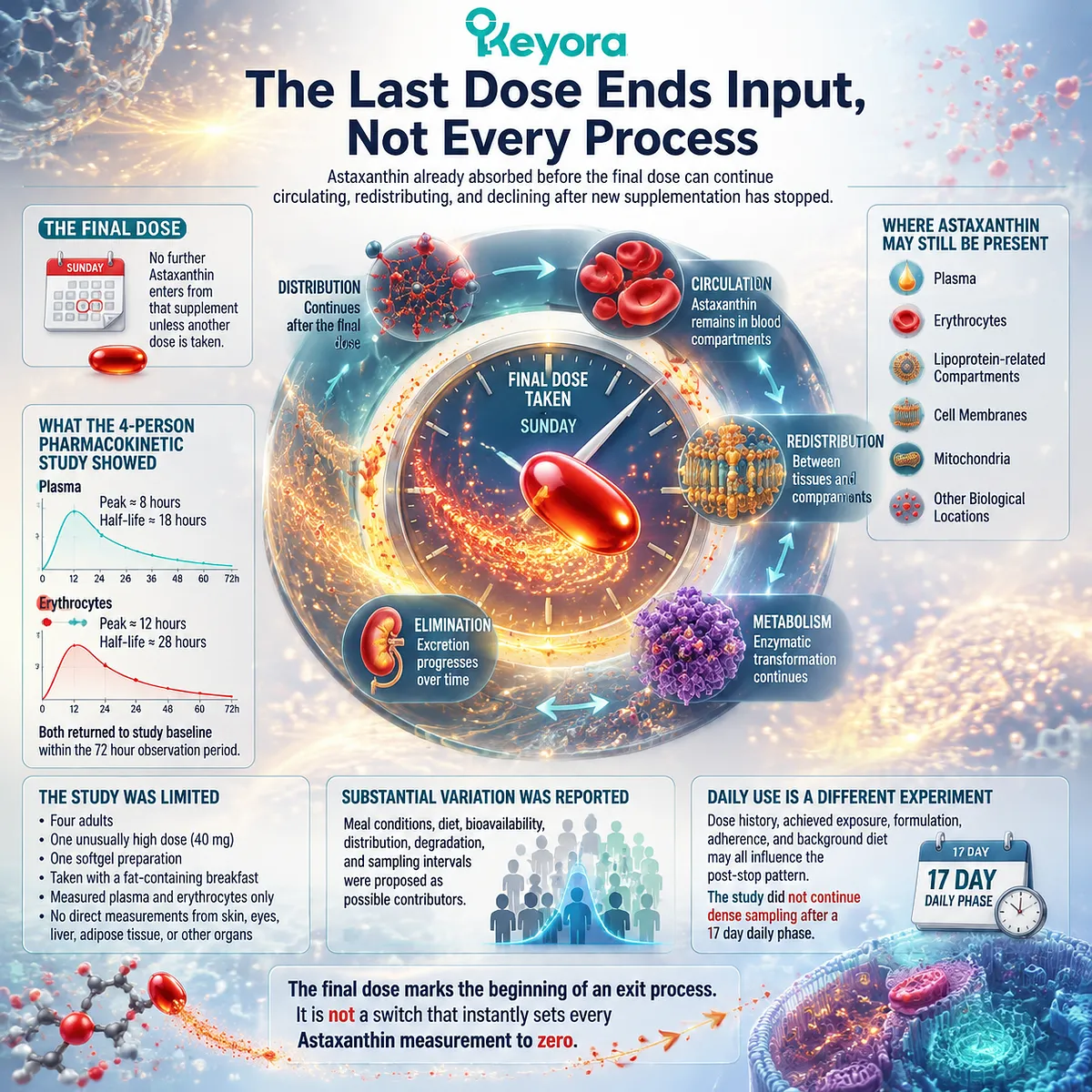
Astaxanthin already absorbed before the final dose can continue circulating, redistributing, and declining after new supplementation has stopped
Imagine taking the final Astaxanthin softgel on Sunday.
One event happens immediately:
No further Astaxanthin enters from that supplement unless another dose is taken.
Several other processes do not stop at the same moment. Astaxanthin absorbed before the final dose may still be present in plasma, erythrocytes, lipoprotein related compartments, or other biological locations. Distribution, metabolism, elimination, and normal compartment turnover can continue after the product has been removed from the routine.
The four person pharmacokinetic study provides a limited view of this exit process. After one 40 mg dose taken with a fat containing breakfast, plasma concentrations rose to a median peak at approximately 8 hours and then declined with an estimated half life of 18 hours. Erythrocyte Astaxanthin peaked later, at approximately 12 hours, and had an estimated half life of 28 hours. Both measurements returned to the study baseline during the 72 hour observation period.
That result does not mean every person is fully cleared within three days.
The study involved:
-
four adults
-
one unusually high research dose
-
one particular softgel preparation
-
a fat containing breakfast
-
plasma and erythrocyte measurements
-
no direct measurements from human skin, eyes, liver, adipose tissue, or other organs
The study also reported substantial variation within and between participants, especially in erythrocytes. Differences in meal conditions, background dietary intake, bioavailability, distribution, degradation, and the interval between dosing and sampling were proposed as possible contributors.
Stopping after repeated daily use is a different experiment from observing one isolated dose.
After several weeks of supplementation, the previous dose history, achieved blood exposure, formulation, adherence, and background diet may all influence the post stop pattern. The available pilot study included a 17 day daily phase, but it did not continue dense blood sampling after that maintenance period ended. It therefore does not establish how rapidly exposure declines after a longer routine.
The final dose marks the beginning of an exit process. It is not a switch that instantly sets every Astaxanthin measurement to zero.
Follow the Exit Through Exposure, Tissue, and Endpoint
A falling plasma concentration does not reveal when every tissue or supplementation dependent outcome has returned to baseline
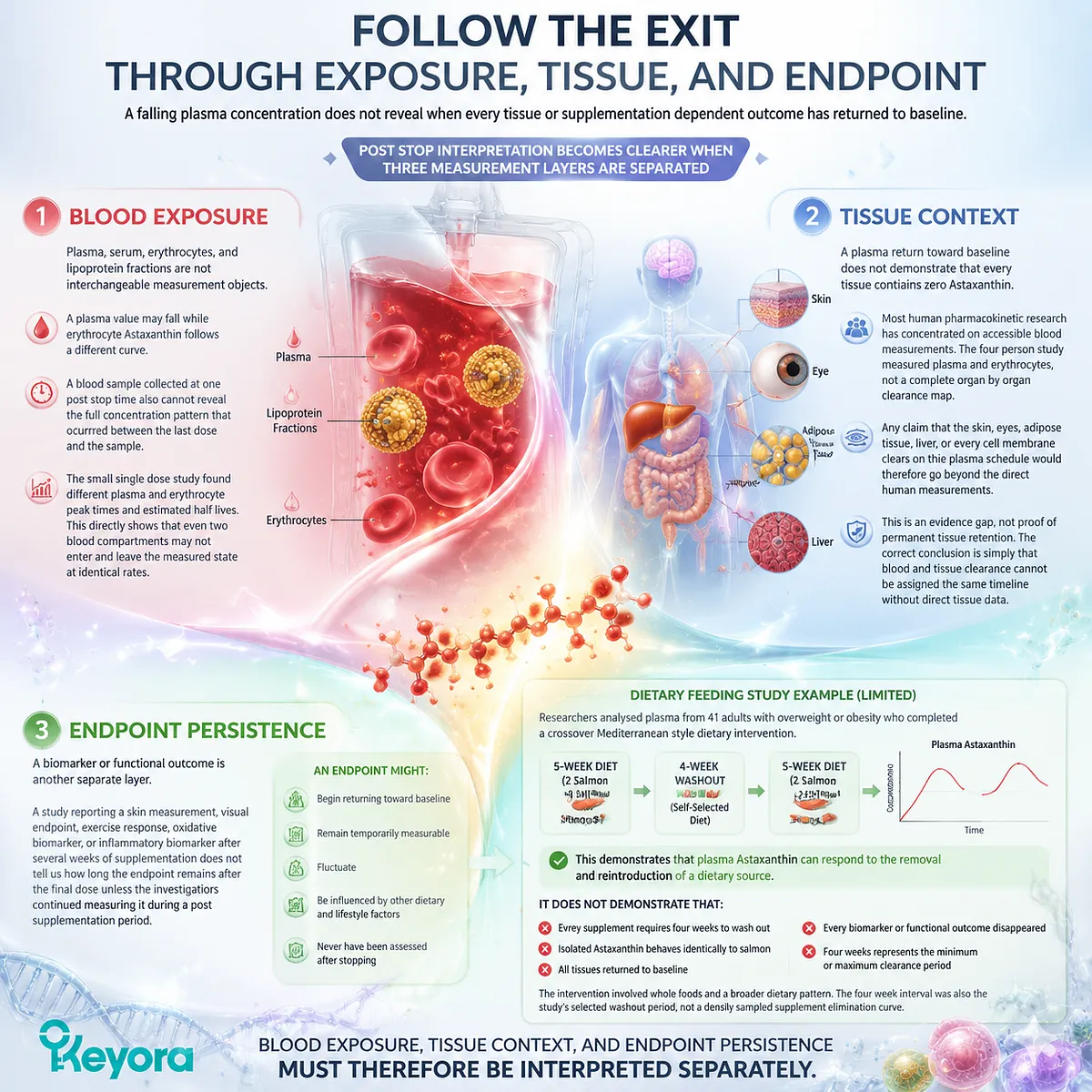
Post stop interpretation becomes clearer when three measurement layers are separated.
Blood Exposure
Plasma, serum, erythrocytes, and lipoprotein fractions are not interchangeable measurement objects.
A plasma value may fall while erythrocyte Astaxanthin follows a different curve. A blood sample collected at one post stop time also cannot reveal the full concentration pattern that occurred between the last dose and the sample.
The small single dose study found different plasma and erythrocyte peak times and estimated half lives. This directly shows that even two blood compartments may not enter and leave the measured state at identical rates.
Tissue Context
A plasma return toward baseline does not demonstrate that every tissue contains zero Astaxanthin.
Most human pharmacokinetic research has concentrated on accessible blood measurements. The four person study measured plasma and erythrocytes, not a complete organ by organ clearance map. Any claim that the skin, eyes, adipose tissue, liver, or every cell membrane clears on the plasma schedule would therefore go beyond the direct human measurements.
This is an evidence gap, not proof of permanent tissue retention. The correct conclusion is simply that blood and tissue clearance cannot be assigned the same timeline without direct tissue data.
Endpoint Persistence
A biomarker or functional outcome is another separate layer.
Suppose a study reports a skin measurement, visual endpoint, exercise response, oxidative biomarker, or inflammatory biomarker after several weeks of supplementation. That finding does not tell us how long the endpoint remains after the final dose unless the investigators continued measuring it during a post supplementation period.
An endpoint might:
-
begin returning toward baseline
-
remain temporarily measurable
-
fluctuate
-
be influenced by other dietary and lifestyle factors
-
never have been assessed after stopping
Without post stop follow up, persistence remains unknown.
A dietary feeding study offers a useful but limited example. Researchers analysed plasma from 41 adults with overweight or obesity who completed a crossover Mediterranean style dietary intervention. Each five week intervention included two salmon servings per week, with a four week self selected diet washout between interventions. Plasma Astaxanthin increased during the salmon containing diet, returned to baseline after the washout, and increased again during the second dietary period.
This demonstrates that plasma Astaxanthin can respond to the removal and reintroduction of a dietary source.
It does not demonstrate that:
-
every supplement requires four weeks to wash out
-
isolated Astaxanthin behaves identically to salmon
-
all tissues returned to baseline
-
every biomarker or functional outcome disappeared
-
four weeks represents the minimum or maximum clearance period
The intervention involved whole foods and a broader dietary pattern. The four week interval was also the study’s selected washout period, not a densely sampled supplement elimination curve.
Blood exposure, tissue context, and endpoint persistence must therefore be interpreted separately.
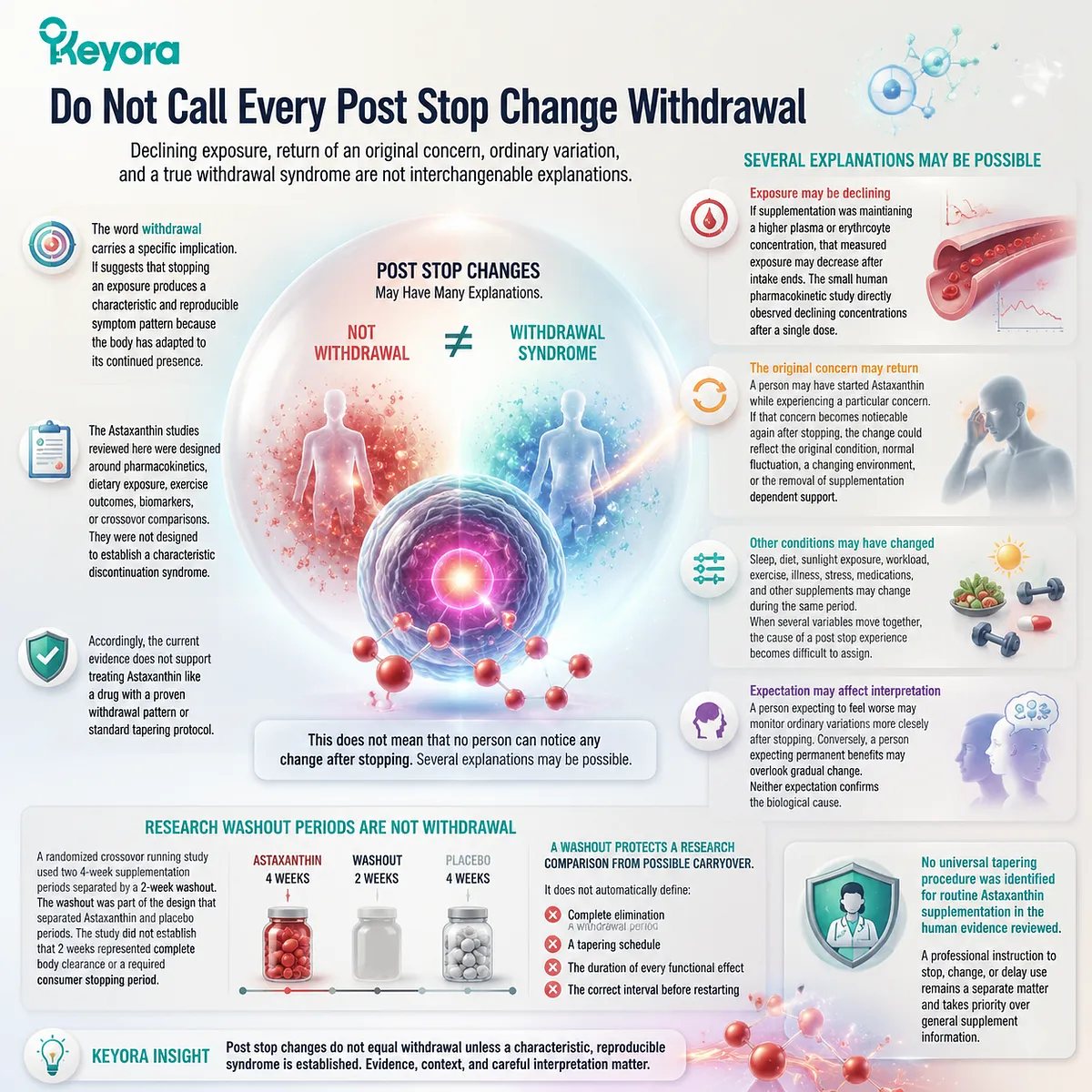
Do Not Call Every Post Stop Change Withdrawal
Declining exposure, return of an original concern, ordinary variation, and a true withdrawal syndrome are not interchangeable explanations
The word withdrawal carries a specific implication. It suggests that stopping an exposure produces a characteristic and reproducible symptom pattern because the body has adapted to its continued presence.
The Astaxanthin studies reviewed here were designed around pharmacokinetics, dietary exposure, exercise outcomes, biomarkers, or crossover comparisons. They were not designed to establish a characteristic discontinuation syndrome.
Accordingly, the current evidence does not support treating Astaxanthin like a drug with a proven withdrawal pattern or standard tapering protocol.
This does not mean that no person can notice any change after stopping.
Several explanations may be possible.
Exposure may be declining
If supplementation was maintaining a higher plasma or erythrocyte concentration, that measured exposure may decrease after intake ends. The small human pharmacokinetic study directly observed declining concentrations after a single dose.
The original concern may return
A person may have started Astaxanthin while experiencing a particular concern. If that concern becomes noticeable again after stopping, the change could reflect the original condition, normal fluctuation, a changing environment, or the removal of supplementation dependent support.
Its return does not automatically prove withdrawal. It also does not, by itself, prove that Astaxanthin caused the earlier improvement.
Other conditions may have changed
Sleep, diet, sunlight exposure, workload, exercise, illness, stress, medications, and other supplements may change during the same period.
When several variables move together, the cause of a post stop experience becomes difficult to assign.
Expectation may affect interpretation
A person expecting to feel worse may monitor ordinary variations more closely after stopping. Conversely, a person expecting permanent benefits may overlook gradual change.
Neither expectation confirms the biological cause.
Research washout periods should also not be confused with withdrawal.
A randomized crossover running study used two four week supplementation periods separated by a two week washout. The washout was part of the design that separated Astaxanthin and placebo periods. The study did not establish that two weeks represented complete body clearance or a required consumer stopping period.
A washout protects a research comparison from possible carryover. It does not automatically define:
-
complete elimination
-
a withdrawal period
-
a tapering schedule
-
the duration of every functional effect
-
the correct interval before restarting
No universal tapering procedure was identified for routine Astaxanthin supplementation in the human evidence reviewed. A professional instruction to stop, change, or delay use remains a separate matter and takes priority over general supplement information.
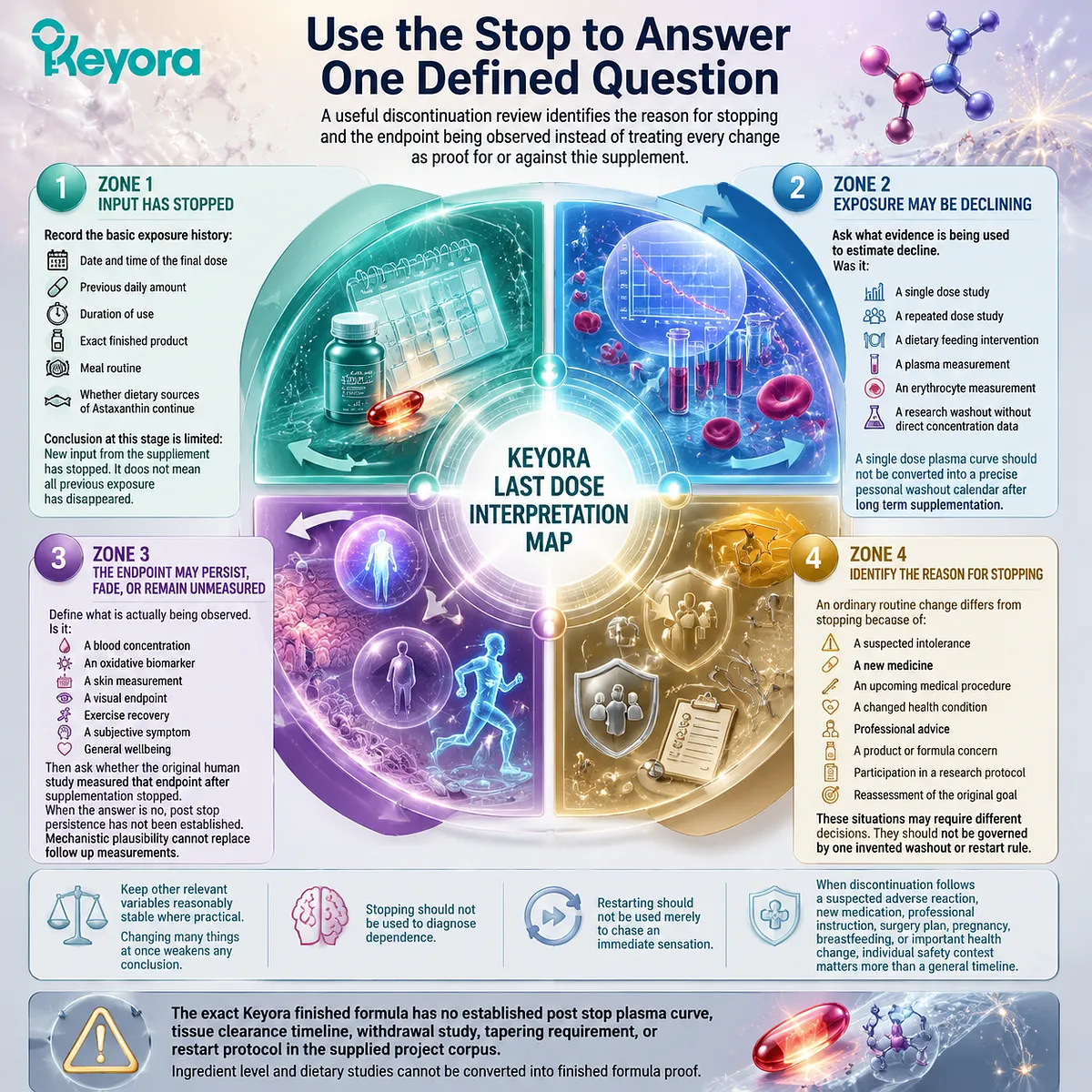
Use the Stop to Answer One Defined Question
A useful discontinuation review identifies the reason for stopping and the endpoint being observed instead of treating every change as proof for or against the supplement
The Keyora Last Dose Interpretation Map divides discontinuation into four zones.
Zone 1 – Input Has Stopped
Record the basic exposure history:
-
date and time of the final dose
-
previous daily amount
-
duration of use
-
exact finished product
-
meal routine
-
whether dietary sources of Astaxanthin continue
The conclusion at this stage is limited:
New input from the supplement has stopped.
It does not mean all previous exposure has disappeared.
Zone 2 – Exposure May Be Declining
Ask what evidence is being used to estimate decline.
Was it:
-
a single dose study
-
a repeated dose study
-
a dietary feeding intervention
-
a plasma measurement
-
an erythrocyte measurement
-
a research washout without direct concentration data
A single dose plasma curve should not be converted into a precise personal washout calendar after long term supplementation.
Zone 3 – The Endpoint May Persist, Fade, or Remain Unmeasured
Define what is actually being observed.
Is it:
-
a blood concentration
-
an oxidative biomarker
-
a skin measurement
-
a visual endpoint
-
exercise recovery
-
a subjective symptom
-
general wellbeing
Then ask whether the original human study measured that endpoint after supplementation stopped.
When the answer is no, post stop persistence has not been established. Mechanistic plausibility cannot replace follow up measurements.
Zone 4 – Identify the Reason for Stopping
An ordinary routine change differs from stopping because of:
-
a suspected intolerance
-
a new medicine
-
an upcoming medical procedure
-
a changed health condition
-
professional advice
-
a product or formula concern
-
participation in a research protocol
-
reassessment of the original goal
These situations may require different decisions. They should not be governed by one invented washout or restart rule.
A person attempting a simple endpoint reassessment should keep other relevant variables reasonably stable where practical. Changing the product, diet, sleep routine, exercise load, and several supplements at the same time weakens any conclusion about what stopping Astaxanthin changed.
Stopping should not be used to diagnose dependence. Restarting should not be used merely to chase an immediate sensation.
When discontinuation follows a suspected adverse reaction, new medication, professional instruction, surgery plan, pregnancy, breastfeeding, or an important health change, the individual safety context matters more than a general timeline.
The exact Keyora finished formula has no established post stop plasma curve, tissue clearance timeline, withdrawal study, tapering requirement, or restart protocol in the supplied project corpus. Ingredient level and dietary studies cannot be converted into finished formula proof.
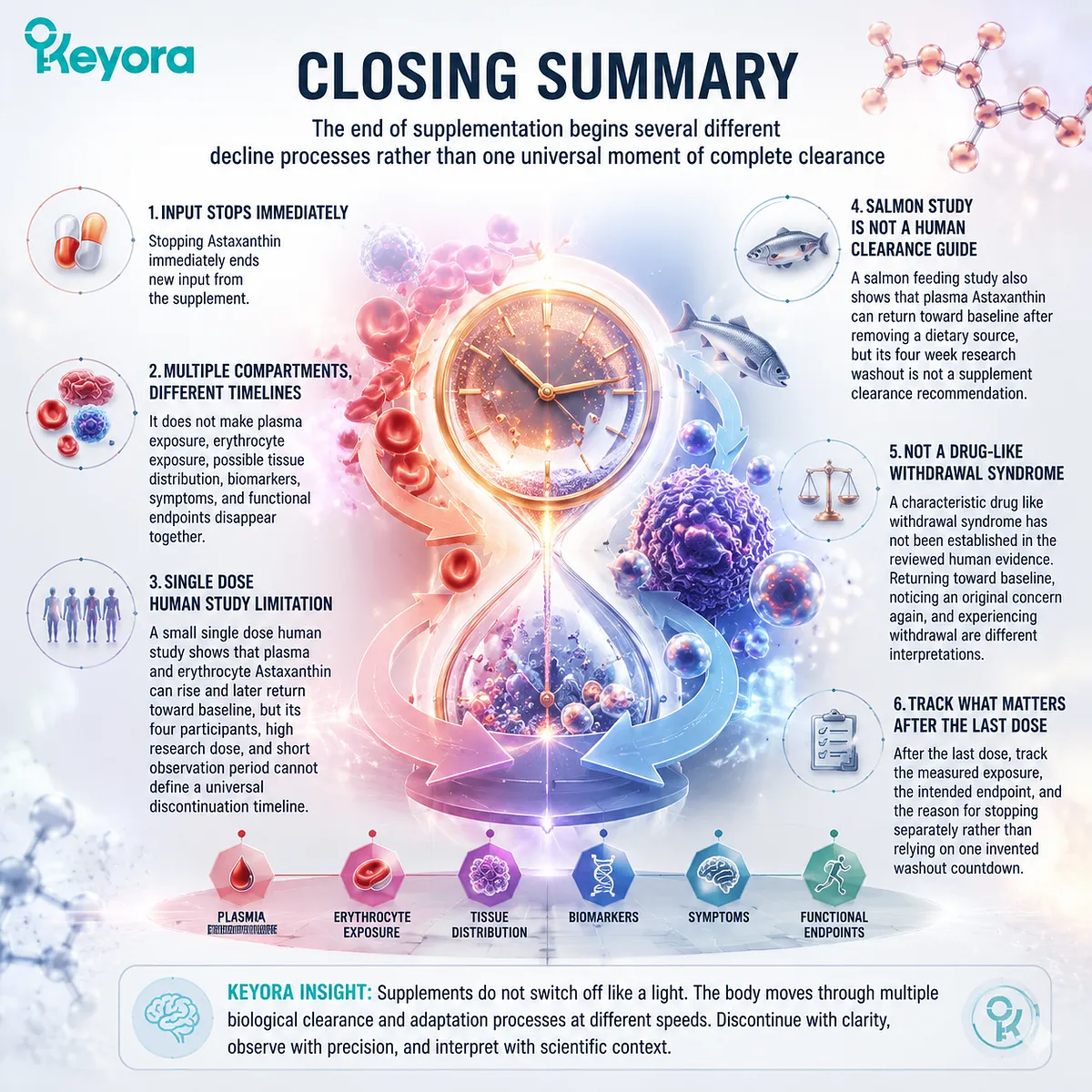
Closing Summary
The end of supplementation begins several different decline processes rather than one universal moment of complete clearance
Stopping Astaxanthin immediately ends new input from the supplement.
It does not make plasma exposure, erythrocyte exposure, possible tissue distribution, biomarkers, symptoms, and functional endpoints disappear together.
A small single dose human study shows that plasma and erythrocyte Astaxanthin can rise and later return toward baseline, but its four participants, high research dose, and short observation period cannot define a universal discontinuation timeline.
A salmon feeding study also shows that plasma Astaxanthin can return toward baseline after removing a dietary source, but its four week research washout is not a supplement clearance recommendation.
A characteristic drug like withdrawal syndrome has not been established in the reviewed human evidence. Returning toward baseline, noticing an original concern again, and experiencing withdrawal are different interpretations.
After the last dose, track the measured exposure, the intended endpoint, and the reason for stopping separately rather than relying on one invented washout countdown.
This article is for educational and informational purposes only. It does not provide medical advice, diagnosis, treatment, cure, prevention, disease outcome claims, hormone restoration claims, fertility outcome claims, or formula-specific clinical efficacy claims.