
What Does Transmembrane Antioxidant Protection Mean?
Keyora Research Q&A Library
This is part of the Keyora Research Q&A Series, derived from Keyora Astaxanthin Research Journal Series.
Within the Keyora Astaxanthin Researcn framework, this Q&A translates complex astaxanthin biology into reader-friendly, evidence-bound answers, focusing on natural astaxanthin identity, molecular structure, antioxidant and redox mechanisms, membrane lipid interaction, mitochondrial resilience, inflammatory signaling pathways, human evidence interpretation, and the scientific principles behind responsible supplementation.
First published by Keyora Research Journal: www.keyorahealth.com
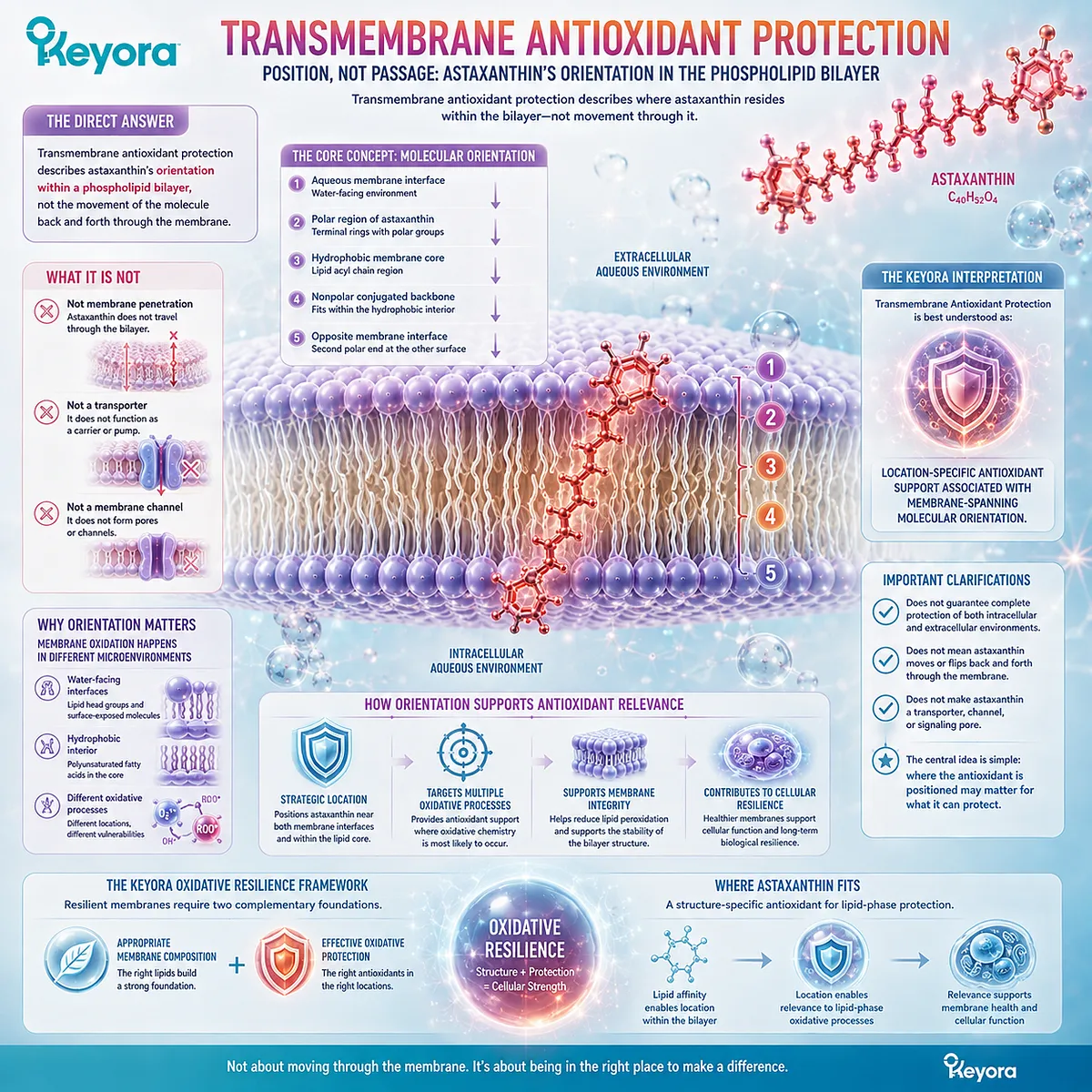
Direct Answer
Transmembrane antioxidant protection describes Astaxanthin’s orientation within a phospholipid bilayer, not the movement of the molecule back and forth through the membrane
The phrase transmembrane antioxidant protection can sound as though Astaxanthin travels through a cell membrane or functions like a membrane channel. That is not the most useful interpretation.
In the Keyora source framework, the term refers to the way Astaxanthin can associate with a phospholipid bilayer. The source describes Astaxanthin as having a polar–nonpolar–polar molecular structure: its more polar terminal regions can interact near the aqueous surfaces of the membrane, while its nonpolar backbone associates with the hydrophobic interior of the bilayer.
The core concept is therefore:
Aqueous membrane interface
↓
Polar region of Astaxanthin
↓
Hydrophobic membrane core
↓
Nonpolar conjugated backbone
↓
Opposite membrane interface
This type of orientation is important because membrane oxidation does not occur in one chemically uniform space. Cell membranes contain water-facing interfaces as well as a lipid-rich interior, and antioxidant location may influence which oxidative processes a molecule is positioned to encounter.
Within the Keyora framework, Transmembrane Antioxidant Protection is therefore best understood as location-specific antioxidant support associated with membrane-spanning molecular orientation.
It does not mean Astaxanthin becomes a transporter, creates a membrane channel, or guarantees complete protection of both the intracellular and extracellular environments.
The central idea is simpler:
where the antioxidant is positioned may matter for what it can protect.
How Is a Cell Membrane Organized?
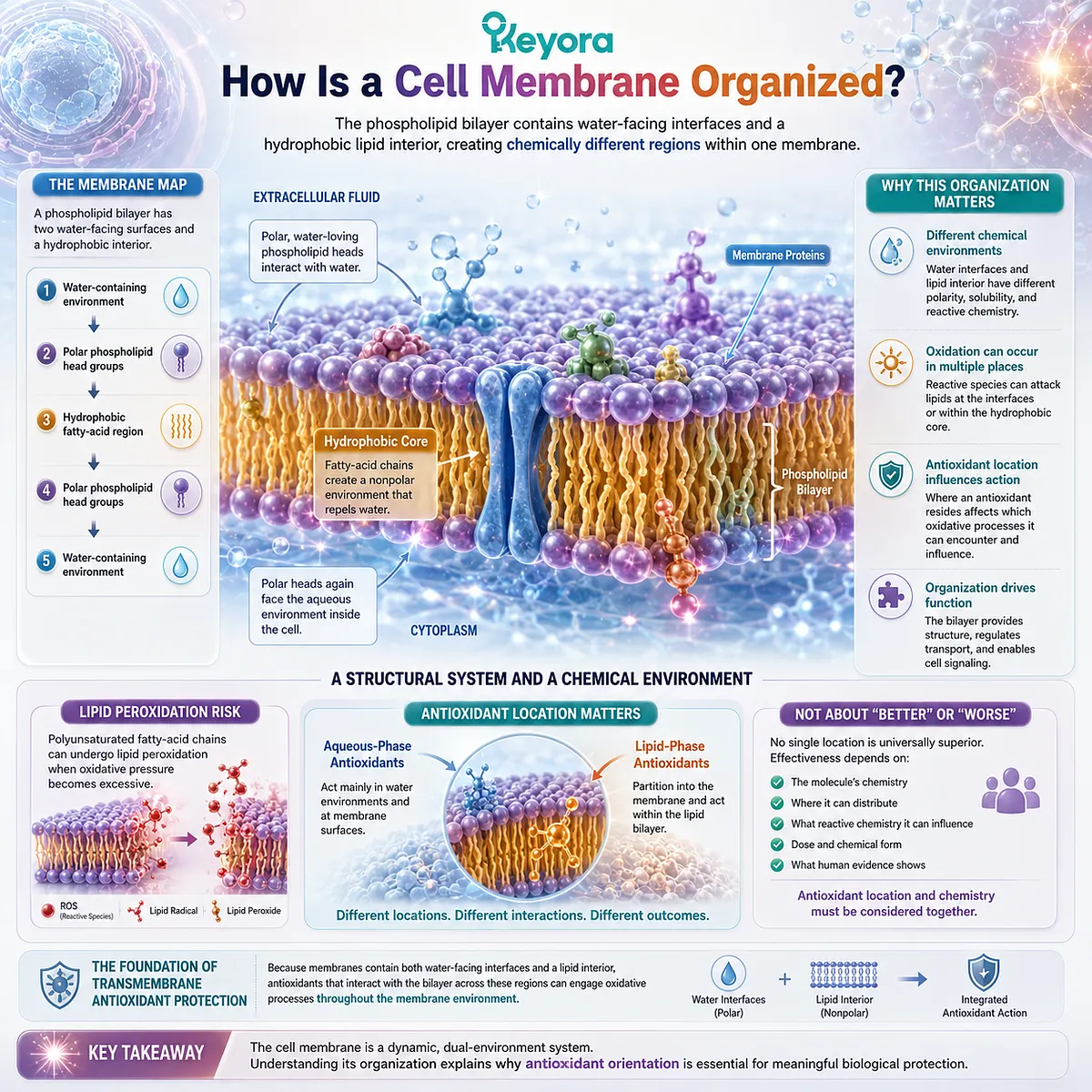
The phospholipid bilayer contains water-facing interfaces and a hydrophobic lipid interior, creating chemically different regions within one membrane
To understand why Astaxanthin’s orientation matters, it helps to visualize the basic organization of a cell membrane.
A phospholipid bilayer is not chemically identical from its surface to its center.
The outer and inner surfaces interact with aqueous environments. Phospholipid head groups are oriented toward these water-containing regions, while fatty-acid chains extend inward and create a more hydrophobic membrane core.
The Keyora Astaxanthin source reflects this organization when it describes Astaxanthin’s polar end groups as associating with aqueous membrane surfaces and its nonpolar backbone as integrating into the hydrophobic interior.
A simplified membrane map is:
Water-containing environment
↓
Polar phospholipid head groups
↓
Hydrophobic fatty-acid region
↓
Polar phospholipid head groups
↓
Water-containing environment
This matters for antioxidant biology because oxidative reactions can occur near membrane interfaces as well as within lipid-rich regions.
Previous Q&A articles established that polyunsaturated fatty-acid chains within membranes can undergo lipid peroxidation when oxidative pressure becomes excessive.
The membrane is therefore both:
a structural system
and
a chemical environment
An antioxidant molecule that remains mainly in an aqueous compartment may not occupy the same location as one that associates strongly with the lipid bilayer.
Likewise, an antioxidant concentrated within a lipid environment may interact with oxidative reactions differently from one that remains outside it.
This does not mean one location is universally superior.
It means that antioxidant location and antioxidant chemistry must be considered together.
That principle is the foundation of transmembrane antioxidant protection.
How Can Astaxanthin Align Within the Phospholipid Bilayer?
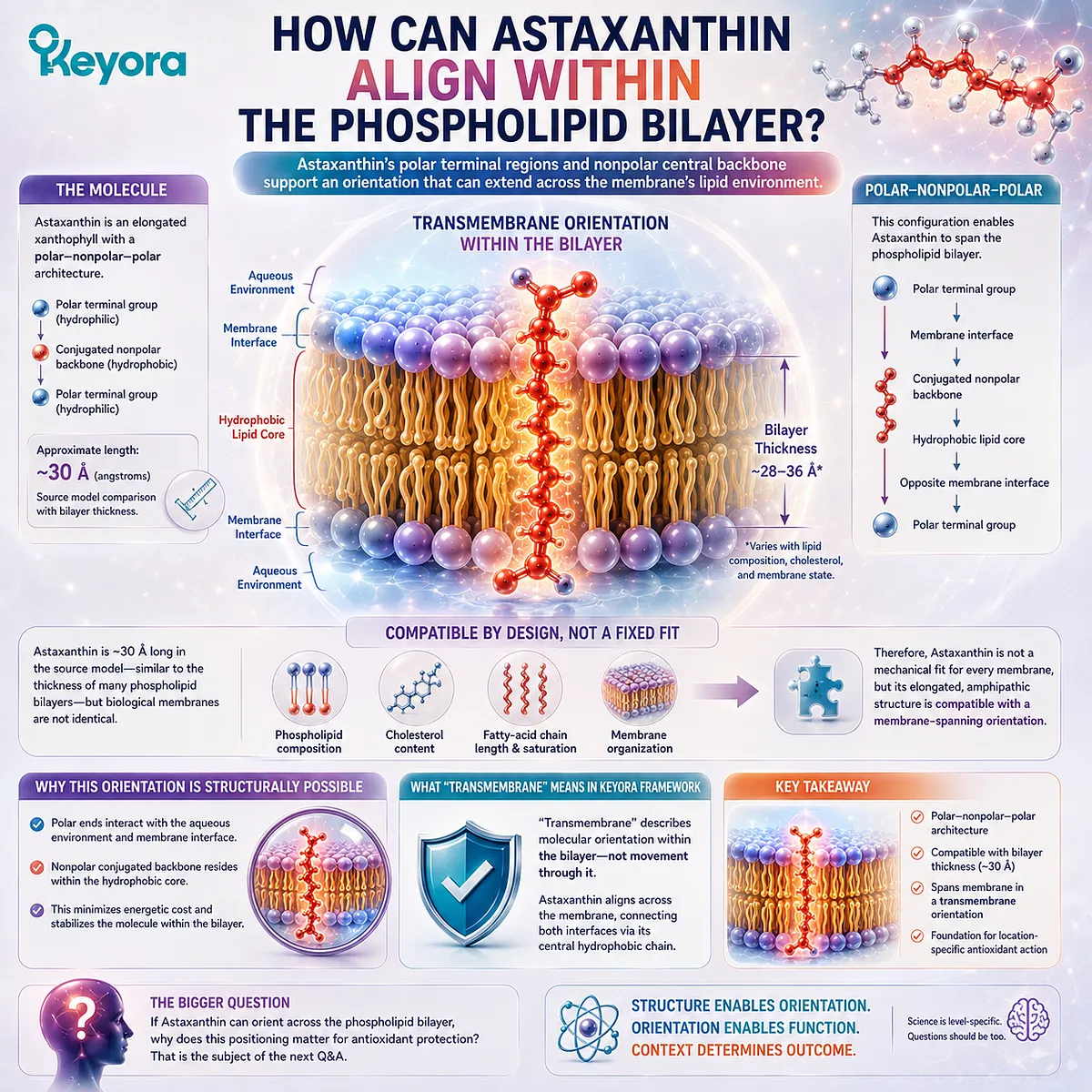
Astaxanthin’s polar terminal regions and nonpolar central backbone support an orientation that can extend across the membrane’s lipid environment
The Keyora source presents Astaxanthin as an elongated molecule with polar structures at both ends and a long nonpolar central region.
Within its membrane model, one polar end is positioned near one membrane surface, the other polar end near the opposite surface, and the central carbon chain extends through the hydrophobic region between them.
Another Keyora source summarizes the same concept as a polar–nonpolar–polar configuration that enables Astaxanthin to span the phospholipid bilayer.
The spatial model can therefore be represented as:
Polar terminal group
↓
Membrane interface
↓
Conjugated nonpolar backbone
↓
Hydrophobic lipid core
↓
Opposite membrane interface
↓
Polar terminal group
This is what the word transmembrane is describing in the Keyora framework.
It refers to molecular orientation within the bilayer.
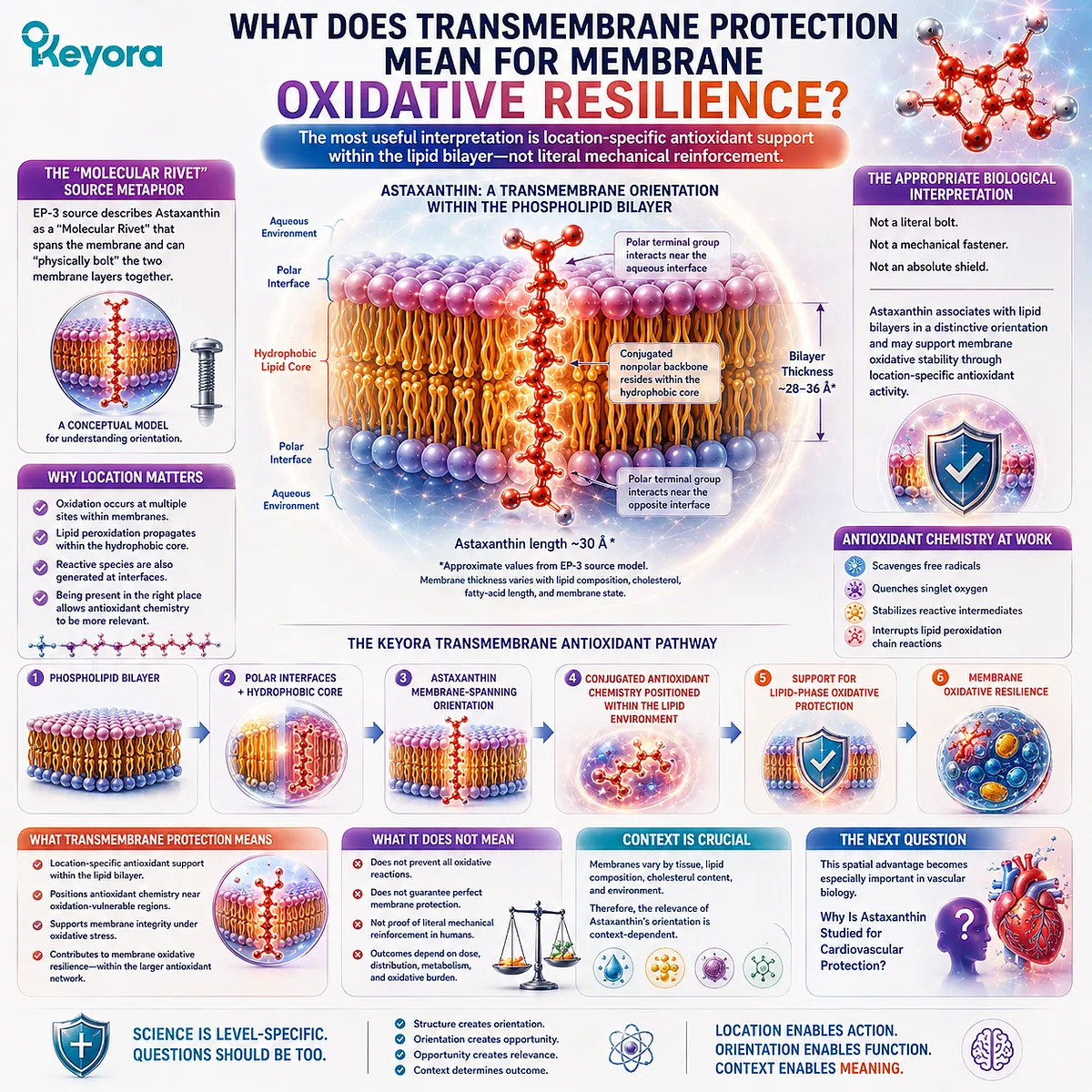
The EP-3 source also describes Astaxanthin as approximately 30 Ångströms in length and compares that dimension with the thickness of a phospholipid bilayer.
That numerical comparison should be interpreted as part of the source’s structural model rather than as proof that every biological membrane has one fixed thickness or that Astaxanthin always adopts one identical orientation.
Biological membranes vary according to phospholipid composition, cholesterol content, fatty-acid chain length, and local membrane organization.
The strongest conclusion supported by the source framework is therefore not that Astaxanthin is an exact mechanical fit for every membrane.
It is that its elongated, amphipathic molecular architecture is compatible with a membrane-spanning orientation.
That spatial property is what makes the next question important:
Why would such positioning matter for antioxidant protection?
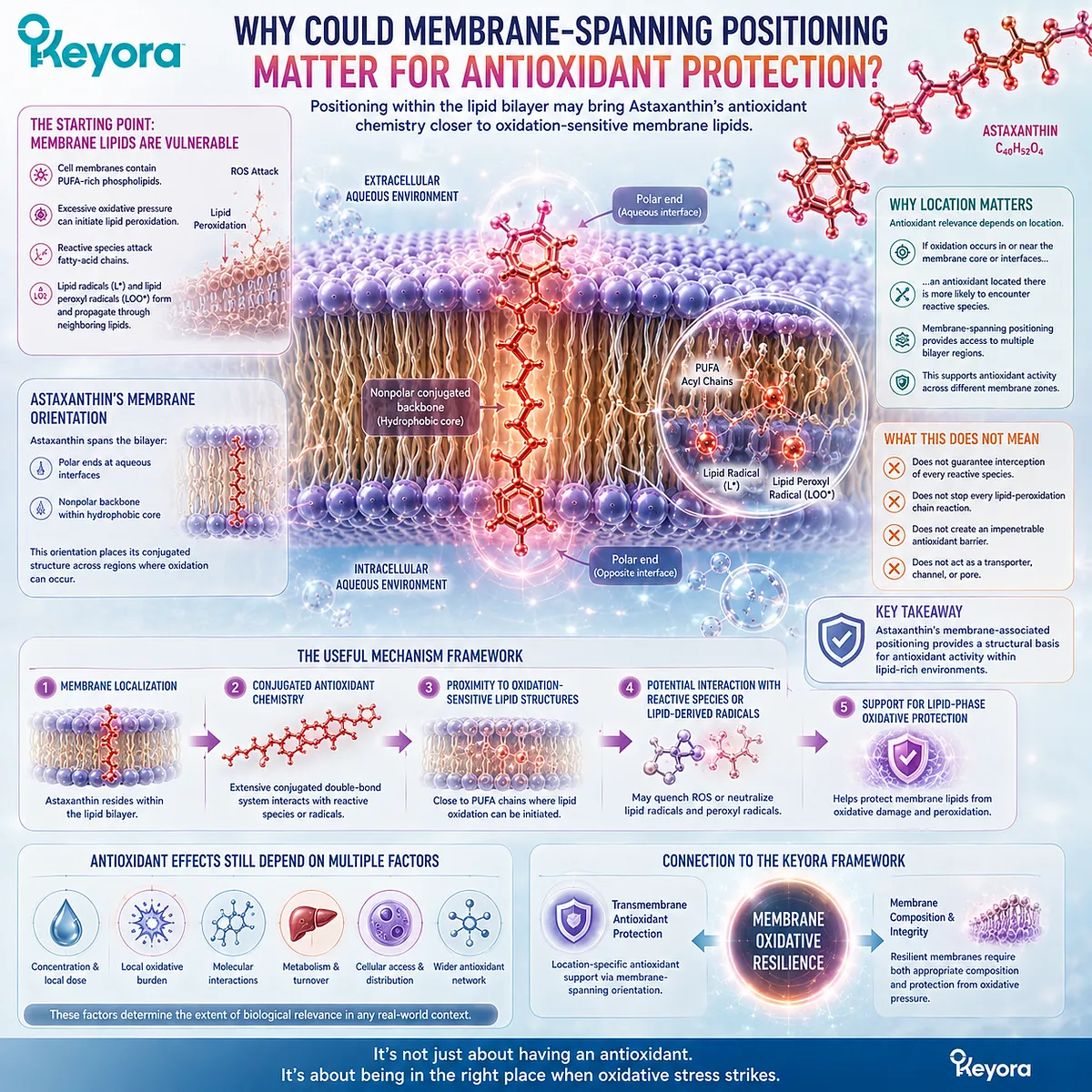
Why Could Membrane-Spanning Positioning Matter for Antioxidant Protection?
Positioning within the lipid bilayer may bring Astaxanthin’s antioxidant chemistry closer to oxidation-sensitive membrane lipids
Previous articles established that lipid peroxidation can begin within PUFA-rich membrane regions.
Reactive species can initiate oxidation in susceptible fatty-acid chains, forming lipid radicals and lipid peroxyl radicals that may propagate through neighboring lipids.
If oxidative chemistry is occurring inside or near the membrane, then the location of an antioxidant becomes biologically relevant.
Astaxanthin’s membrane-associated orientation places its conjugated molecular structure within the same general lipid environment where membrane oxidation can occur.
The Keyora source uses this spatial relationship to explain why Astaxanthin may provide antioxidant activity across different regions of the bilayer. It describes the molecule as spanning the membrane with polar ends at aqueous surfaces and the nonpolar backbone within the hydrophobic core.
This leads to a useful mechanism framework:
Membrane localization
Conjugated antioxidant chemistry
↓
Proximity to oxidation-sensitive lipid structures
↓
Potential interaction with reactive species or lipid-derived radicals
↓
Support for lipid-phase oxidative protection
The word potential matters.
Membrane orientation alone does not prove that every reactive species will be intercepted or that every lipid-peroxidation chain will be terminated.
Antioxidant effects still depend on concentration, local oxidative burden, molecular interactions, metabolism, and the wider antioxidant network.
The scientifically useful conclusion is therefore not:
Astaxanthin creates an impenetrable antioxidant barrier.
It is:
Astaxanthin’s membrane-associated positioning provides a structural basis for antioxidant activity within lipid-rich environments.
Within Keyora, this is the connection between Transmembrane Antioxidant Protection and Membrane Oxidative Resilience.
Does Transmembrane Protection Mean Astaxanthin Protects Everything Inside and Outside the Cell?
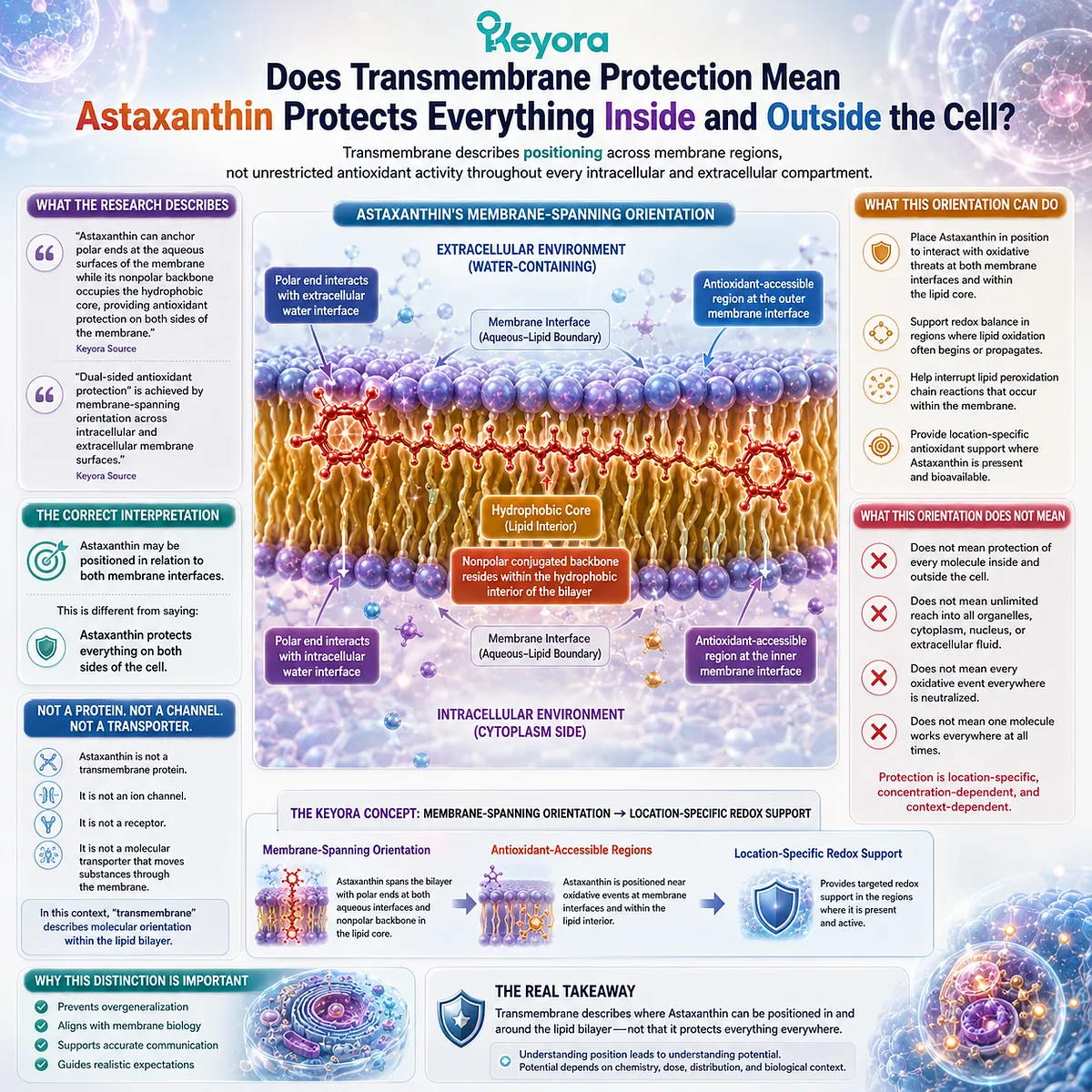
Transmembrane describes positioning across membrane regions, not unrestricted antioxidant activity throughout every intracellular and extracellular compartment
The Keyora Astaxanthin source uses strong wording to describe this membrane orientation.
It states that Astaxanthin can anchor polar ends at the aqueous surfaces of the membrane while its nonpolar backbone occupies the hydrophobic core, and it characterizes this as providing antioxidant protection on both sides of the membrane.
A similar source passage refers to “dual-sided antioxidant protection,” linking membrane-spanning orientation with intracellular and extracellular membrane surfaces.
That wording needs to be understood spatially.
It does not establish that one Astaxanthin molecule protects the entire cytoplasm, all extracellular fluid, every organelle, and every cellular compartment simultaneously.
The more precise interpretation is:
Astaxanthin may be positioned in relation to both membrane interfaces.
That is different from saying:
Astaxanthin protects everything on both sides of the cell.
This distinction also prevents another common misunderstanding.
Astaxanthin is not a transmembrane protein.
It is not an ion channel.
It is not a receptor.
It is not a molecular transporter that moves substances through the membrane.
In this context, transmembrane is a description of molecular orientation within the lipid bilayer.
The Keyora concept can therefore be expressed more accurately as:
Membrane-spanning orientation
↓
antioxidant-accessible regions at membrane interfaces and lipid interior
↓
location-specific redox support
This interpretation preserves the core structural concept in the source while avoiding an unsupported expansion of what “inside and outside protection” means.
What Does Transmembrane Protection Mean for Membrane Oxidative Resilience?
The most useful interpretation is location-specific antioxidant support within the lipid bilayer rather than literal mechanical reinforcement of the membrane
The EP-3 source uses a strong structural metaphor to describe Astaxanthin.
It calls the molecule a “Molecular Rivet” and states that its membrane-spanning orientation can “physically bolt” the two membrane layers together.
Elsewhere, the same source describes Astaxanthin as vertically spanning the membrane and connects this model with mechanical resistance to membrane stress.
Within the Keyora source framework, Molecular Rivet is therefore a conceptual model for visualizing the molecule’s orientation.
For public scientific interpretation, however, the strongest defensible conclusion from these source materials is not that Astaxanthin literally bolts human cell membranes together like a mechanical fastener.
The more appropriate biological interpretation is:
Astaxanthin associates with lipid bilayers in a distinctive orientation and may support membrane oxidative stability through location-specific antioxidant activity.
This gives us the final Keyora pathway:
Phospholipid bilayer
↓
Polar interfaces + hydrophobic core
↓
Astaxanthin membrane-spanning orientation
↓
Conjugated antioxidant chemistry positioned within the lipid environment
↓
Support for lipid-phase oxidative protection
↓
Membrane Oxidative Resilience
This is the practical meaning of Transmembrane Antioxidant Protection.
It is not a claim of absolute membrane protection.
It is not evidence that oxidative damage can never occur.
And it should not be interpreted as proof of literal mechanical reinforcement in humans.
Instead, it describes a spatially specific antioxidant concept: Astaxanthin’s molecular architecture allows it to associate across the lipid bilayer, placing antioxidant chemistry close to membrane regions that may be vulnerable to oxidation.
That location becomes particularly relevant when we move from general membrane biology to vascular biology.
The next question is:
Why Is Astaxanthin Studied for Cardiovascular Protection?
This article is for educational and informational purposes only. It does not provide medical advice, diagnosis, treatment, cure, prevention, disease outcome claims, hormone restoration claims, fertility outcome claims, or formula-specific clinical efficacy claims.