
What Does “Identical to Natural” Mean on a Synthetic Astaxanthin Supplement?
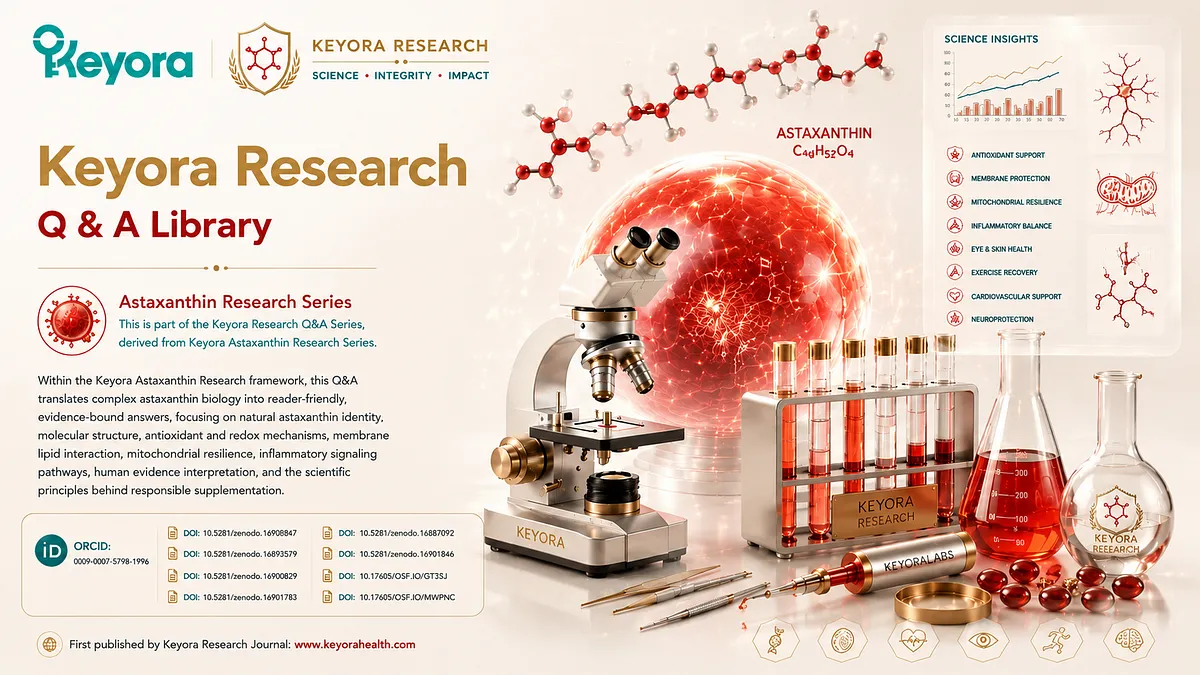
Keyora Research Q&A Library
This is part of the Keyora Research Q&A Series, derived from Keyora Astaxanthin Research Journal Series.
Within the Keyora Astaxanthin Researcn framework, this Q&A translates complex astaxanthin biology into reader-friendly, evidence-bound answers, focusing on natural astaxanthin identity, molecular structure, antioxidant and redox mechanisms, membrane lipid interaction, mitochondrial resilience, inflammatory signaling pathways, human evidence interpretation, and the scientific principles behind responsible supplementation.
First published by Keyora Research Journal: www.keyorahealth.com
Direct Answer
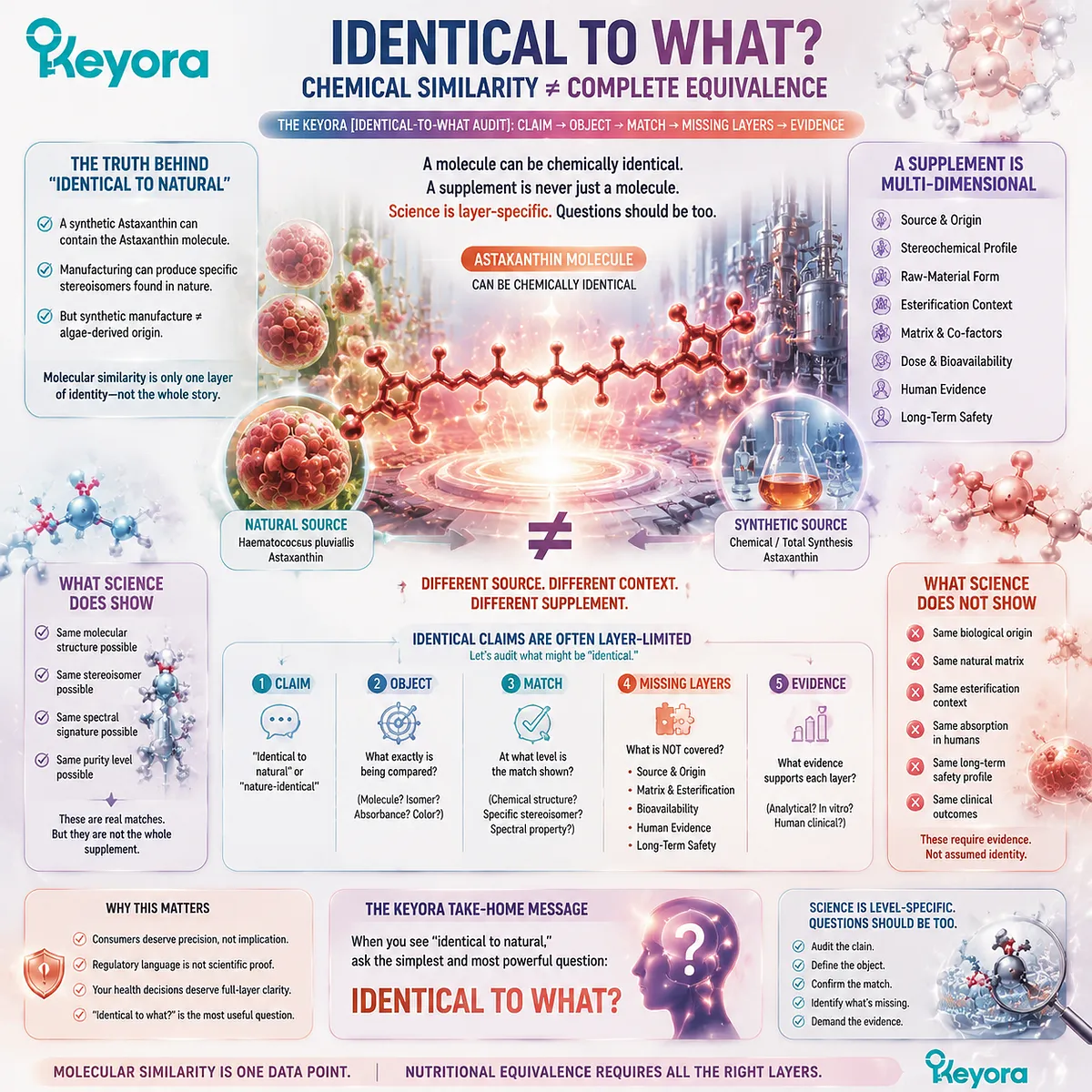
“Identical to natural” can describe one level of molecular similarity without proving that the complete supplement is equivalent to natural Haematococcus pluvialis Astaxanthin.
A synthetic Astaxanthin can genuinely contain the Astaxanthin molecule.
A manufacturing process may even be designed to produce a particular stereoisomer that also occurs in nature.
But neither fact changes how the ingredient was produced: a molecule made by chemical synthesis is not thereby converted into algae-derived Astaxanthin.
That distinction matters because a nutritional supplement is more than a chemical name.
Source, stereochemical profile, raw-material form, esterification context, formulation, dose, human evidence, and long-term safety evidence are separate questions.
The Keyora EP-2 framework therefore treats chemical similarity as one layer of identity, not as proof of complete nutraceutical interchangeability.
This is not an abstract wording dispute. Synthetic Astaxanthin supplements currently sold to consumers use language such as “identical to naturally occurring forms” or “nature-identical” while openly disclosing synthetic or total-synthesis manufacturing.
The important consumer question is therefore not whether the word “identical” must always be false. It is what, exactly, has been shown to be identical.
That is the Keyora [Identical-to-What Audit]:
Claim → Object → Match → Missing Layers → Evidence
Whenever you see “identical to natural,” the most useful response is simple:
Identical to what?
Why “Identical to Natural” Is a Real Supplement-Market Claim
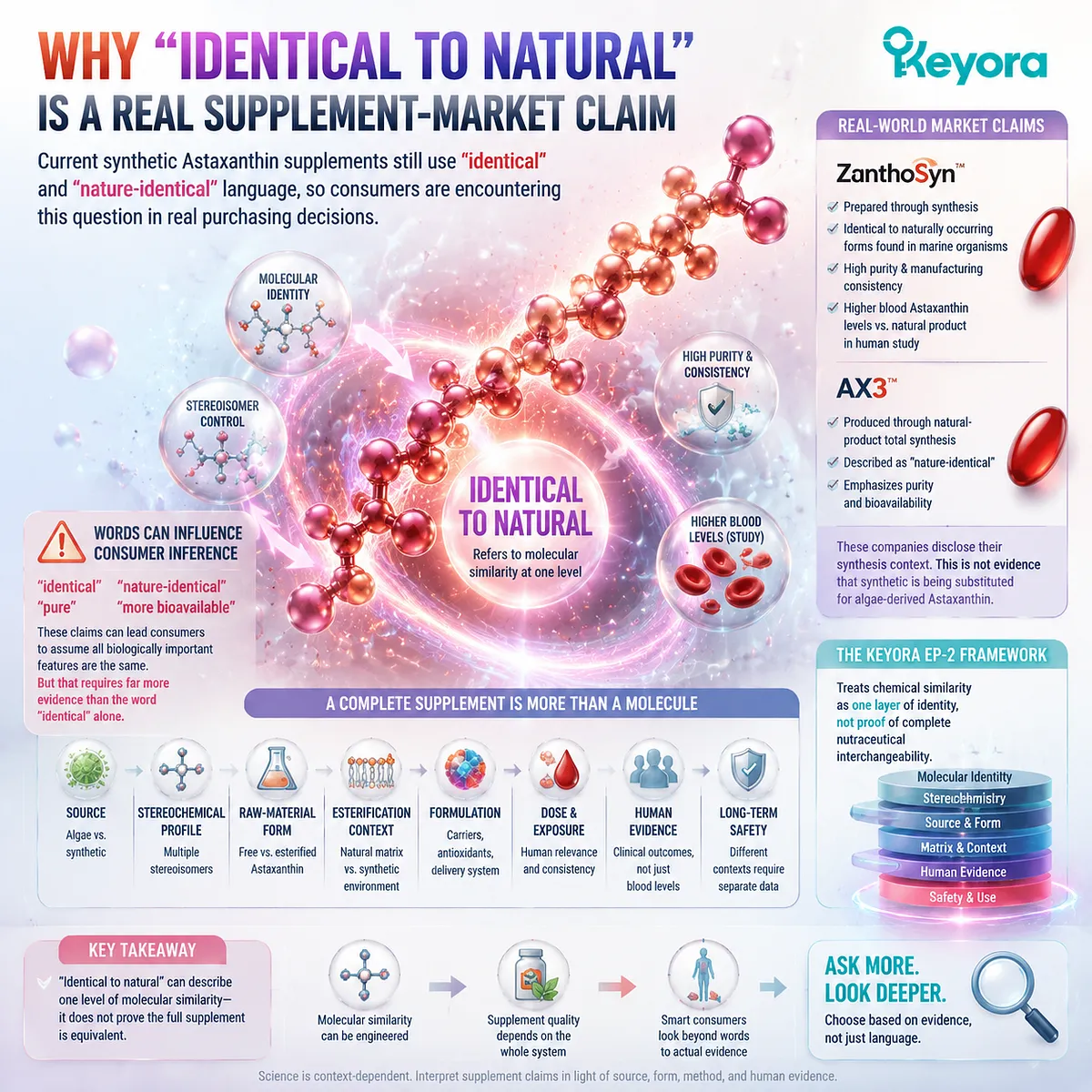
Current synthetic Astaxanthin supplements still use “identical” and “nature-identical” language, so consumers are encountering this question in real purchasing decisions.
ZanthoSyn currently states that its Astaxanthin is prepared through synthesis and describes synthetic Astaxanthin as identical to naturally occurring forms found in marine organisms.
The same FAQ emphasizes high purity, manufacturing consistency, and higher blood Astaxanthin levels compared with a natural product in a human study.
AX3 likewise states that its Astaxanthin is produced through natural-product total synthesis and describes the result as “nature-identical,” while emphasizing purity and bioavailability.
These examples should not be misrepresented as evidence that the companies are secretly substituting synthetic Astaxanthin for algae-derived Astaxanthin. Both disclose their synthesis context.
The consumer-protection problem is subtler: words such as “identical,” “nature-identical,” “pure,” and “more bioavailable” can make it easy to infer that every biologically important feature of natural and synthetic Astaxanthin has also been shown to be equivalent.
That conclusion requires much more evidence than the word “identical” alone provides.
First Ask the Most Important Question: Identical to What?
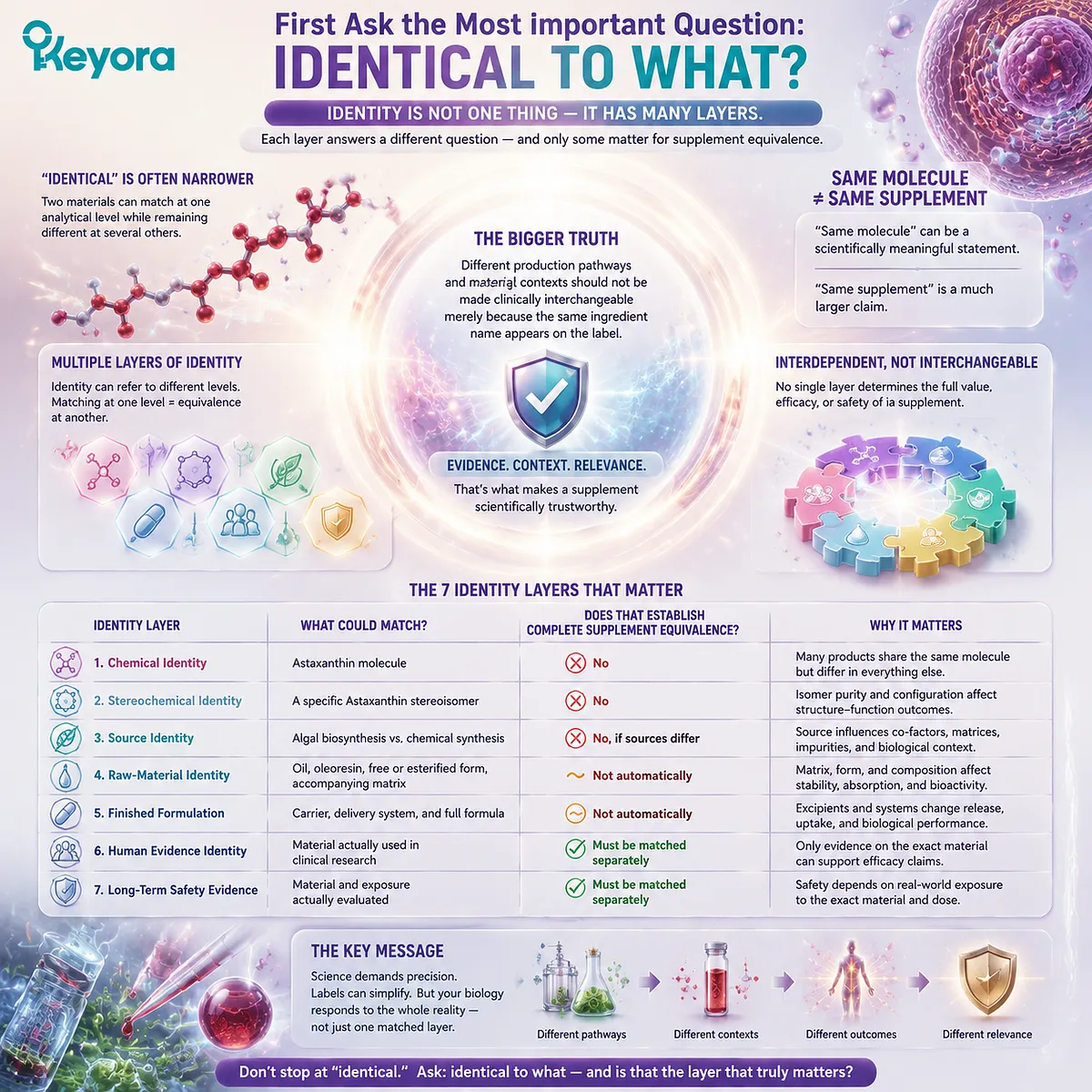
Identity can refer to a chemical molecule, stereoisomer, source, raw material, formulation, or evidence base, and those are not interchangeable claims.
“Identical” sounds absolute because ordinary language treats identity as all-or-nothing. Scientific identity is often narrower. Two materials can match at one analytical level while remaining different at several others.
Identity layerWhat could match?Does that establish complete supplement equivalence?
Chemical identityAstaxanthin moleculeNoStereochemical identityA specific Astaxanthin stereoisomerNoSource identityAlgal biosynthesis versus chemical synthesis.
No, if sources differRaw-material identityOil, oleoresin, free or esterified context, accompanying matrixNot automaticallyFinished formulation Carrier and delivery system Not automatically Human evidenceMaterial actually used in clinical research Must be matched separatelyLong-term safety evidenceMaterial and exposure actually evaluatedMust be matched separately
This distinction is central to EP-2. The paper’s stronger, evidence-bounded position is that different production pathways and material contexts should not be made clinically interchangeable merely because the same ingredient name appears on the label.
So “same molecule” can be a scientifically meaningful statement.
“Same supplement” is a much larger claim.
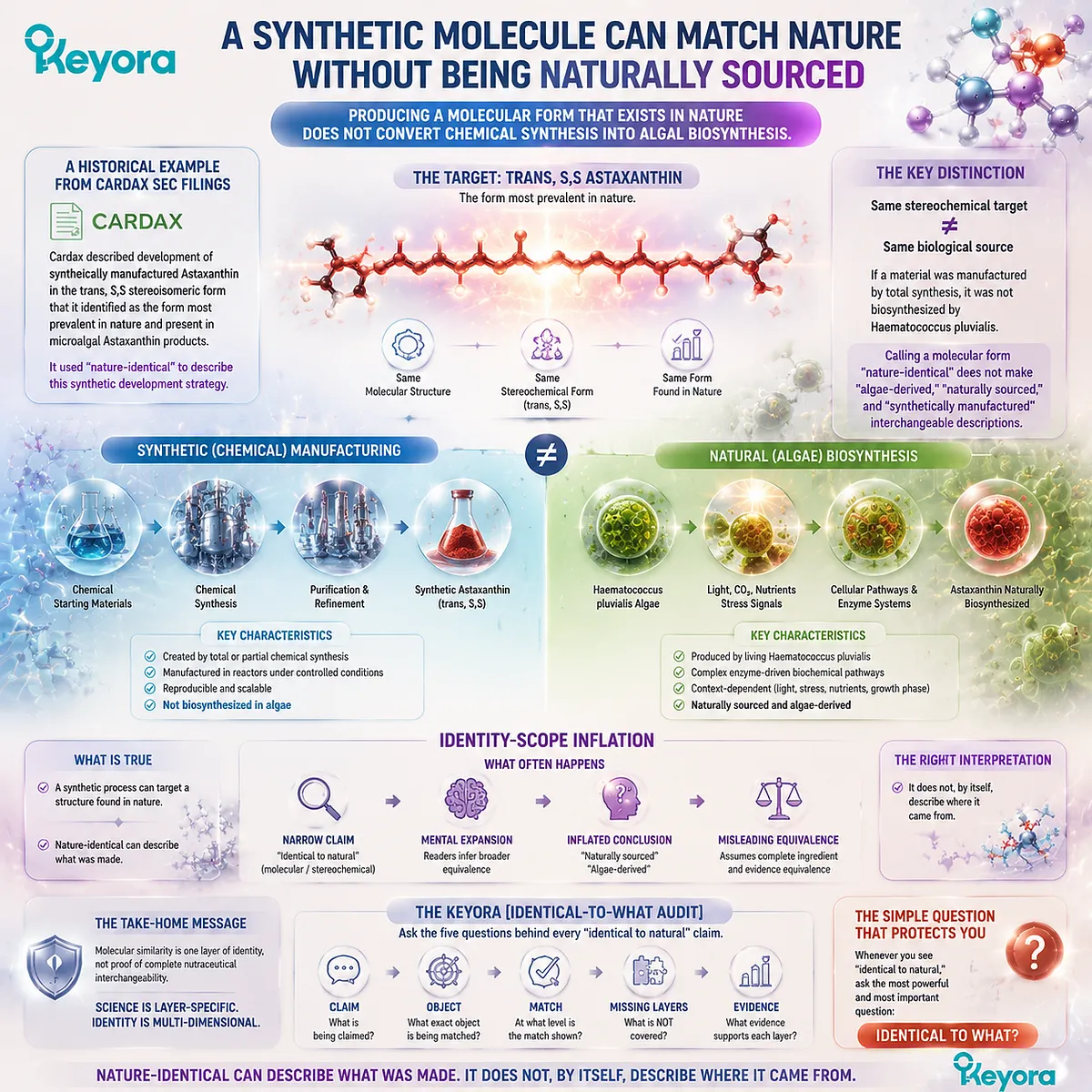
A Synthetic Molecule Can Match Nature Without Being Naturally Sourced
Producing a molecular form that exists in nature does not convert chemical synthesis into algal biosynthesis.
A useful historical example comes from Cardax’s SEC filings. The company described development of synthetically manufactured Astaxanthin in the trans, S,S stereoisomeric form that it identified as the form most prevalent in nature and present in microalgal Astaxanthin products. It used “nature-identical” to describe this synthetic development strategy.
That history makes an important distinction unusually clear.
A synthetic process can target a structure found in nature.
It can therefore be reasonable, within a tightly defined chemical or stereochemical context, to discuss similarity to a naturally occurring molecule.
But:
same stereochemical target ≠ same biological source
If a material was manufactured by total synthesis, it was not biosynthesized by Haematococcus pluvialis. Calling a molecular form “nature-identical” therefore does not make “algae-derived,” “naturally sourced,” and “synthetically manufactured” interchangeable descriptions.
This is where consumers should watch for what Keyora calls Identity-Scope Inflation: a narrow similarity claim expands in the reader’s mind into a much broader conclusion about the complete ingredient.
The right interpretation is narrower:
Nature-identical can describe what was made. It does not, by itself, describe where it came from.
Not All Synthetic Astaxanthin Should Be Treated as the Same Material
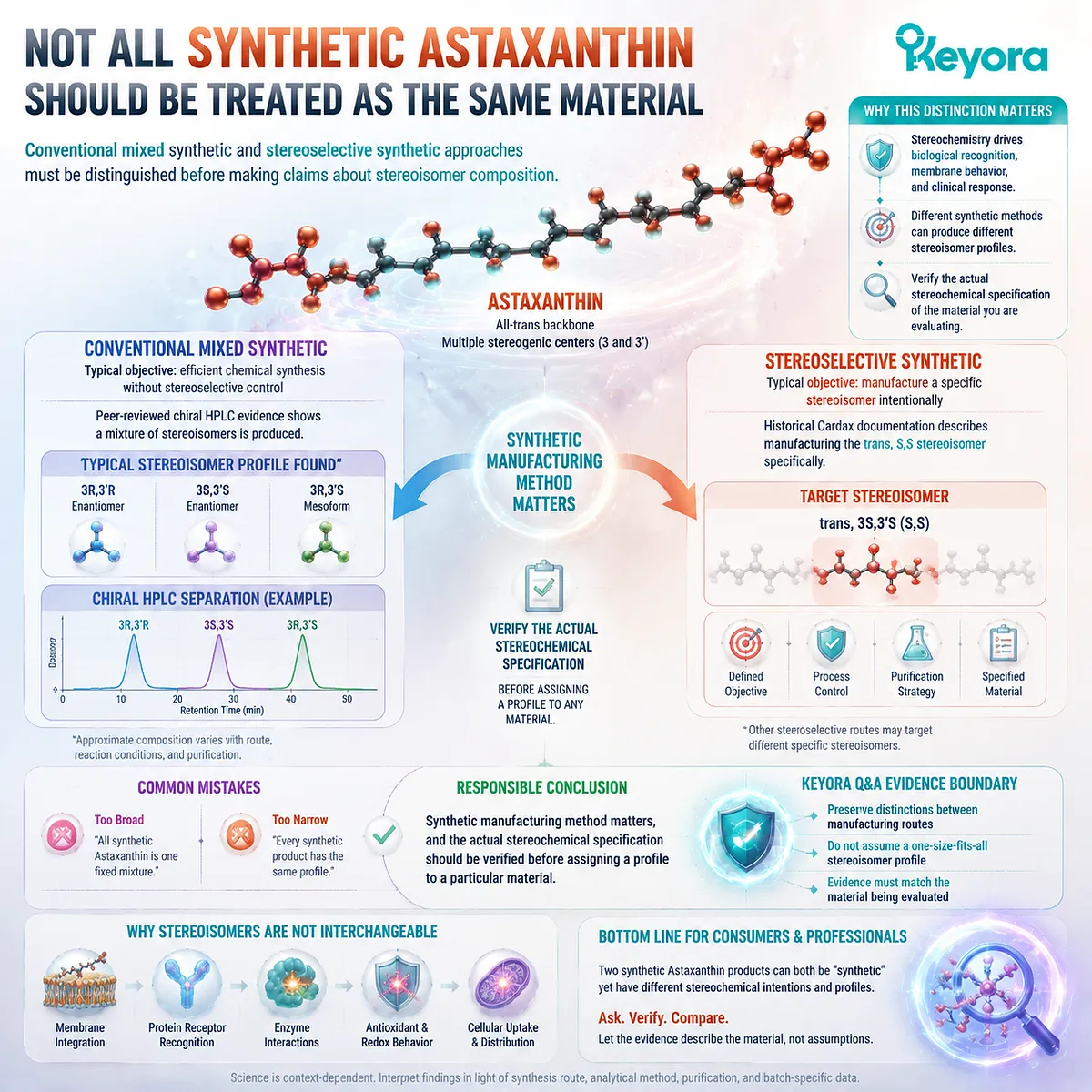
Conventional mixed synthetic Astaxanthin and stereoselective synthetic approaches must be distinguished before making claims about stereoisomer composition.
There is another mistake that can occur in the opposite direction. Once consumers learn that conventional synthetic Astaxanthin can contain several stereoisomeric forms, it is tempting to assume that every synthetic Astaxanthin product must have exactly the same stereoisomer profile.
That is too broad.
A peer-reviewed chiral HPLC study described synthetic all-trans Astaxanthin as containing the 3R,3′R and 3S,3′S enantiomers together with the 3R,3′S mesoform, and demonstrated analytical separation of these stereoisomers. This is important evidence for understanding conventional synthetic material.
But historical Cardax documentation describes a different synthetic objective: manufacturing the trans, S,S stereoisomer specifically.
The responsible conclusion is therefore not:
“All synthetic Astaxanthin is one fixed mixture.”
It is:
Synthetic manufacturing method matters, and the actual stereochemical specification should be verified before assigning a profile to a particular material.
This also corrects an important overstatement in older discussions of synthetic Astaxanthin.
An approximate conventional stereoisomer distribution may be useful background, but it should not be treated as an immutable composition for every batch, every synthesis route, or every modern synthetic technology.
The Keyora Q&A evidence boundary explicitly preserves that distinction.
Matching One Stereoisomer Does Not Make the Whole Ingredient Identical
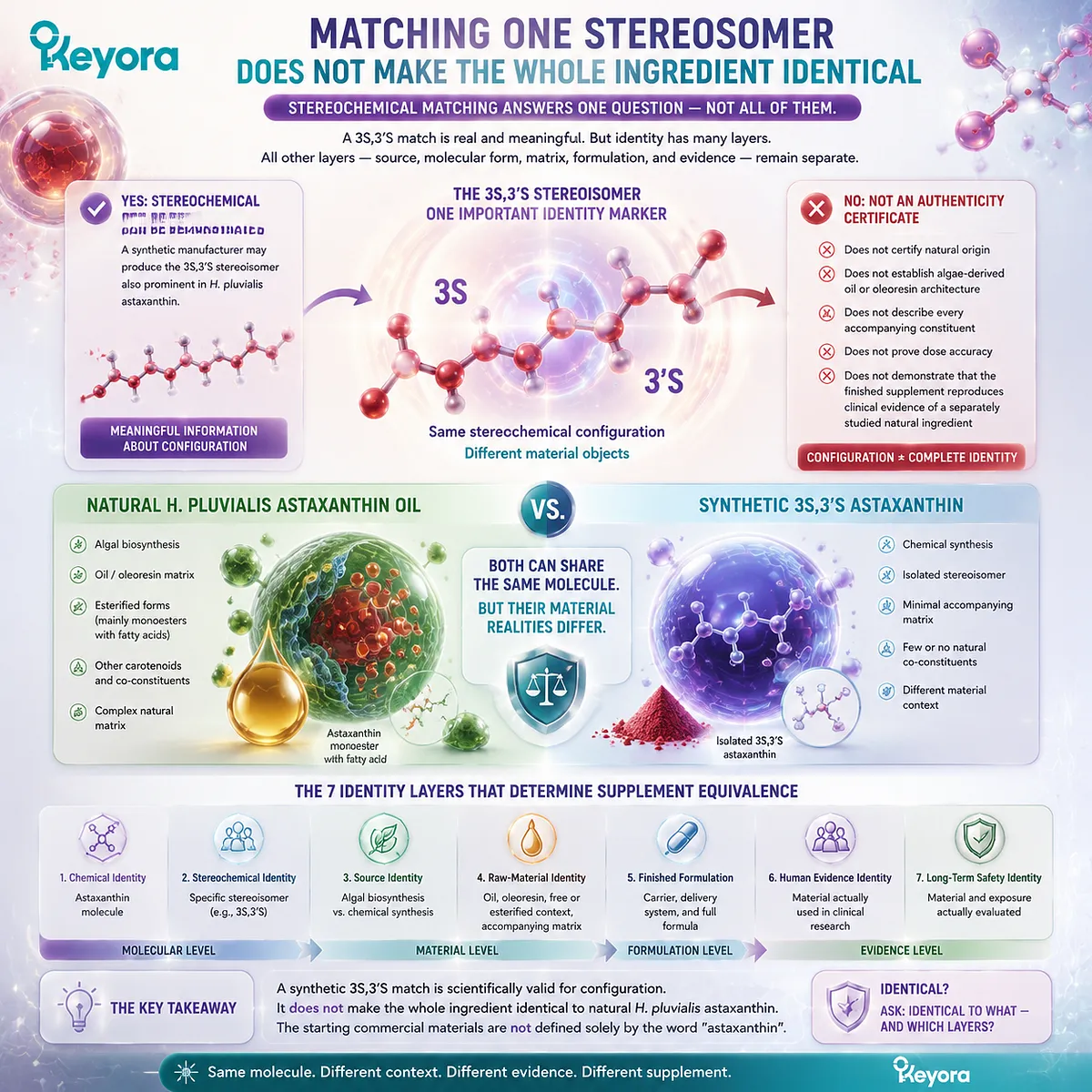
Stereochemical matching answers one identity question while source, molecular form, raw-material matrix, formulation, and evidence remain separate.
Suppose a synthetic manufacturer can demonstrate that its product contains the 3S,3′S stereoisomer also associated prominently with H. pluvialis Astaxanthin.
That is meaningful information.
But 3S,3′S identifies a stereochemical configuration. It does not certify natural origin, establish an algae-derived oil or oleoresin architecture, describe every accompanying constituent, prove dose accuracy, or demonstrate that the finished supplement reproduces the clinical evidence of a separately studied natural ingredient.
Keyora’s earlier 3S,3′S analysis therefore treats configuration as one identity marker rather than a complete authenticity certificate.
Natural H. pluvialis Astaxanthin also has its own raw-material context. Analytical work on a characterized H. pluvialis oil extract has shown Astaxanthin present with esterified forms, particularly monoesters with fatty acids, along with other carotenoid components.
That does not automatically prove that the natural matrix is clinically superior.
It proves something more basic and more defensible:
the starting commercial materials are not defined solely by the word Astaxanthin.
A synthetic single-isomer material and an algae-derived Astaxanthin oil may share an important molecule while remaining different material objects.
Natural Haematococcus Astaxanthin Has Its Own Raw-Material Context
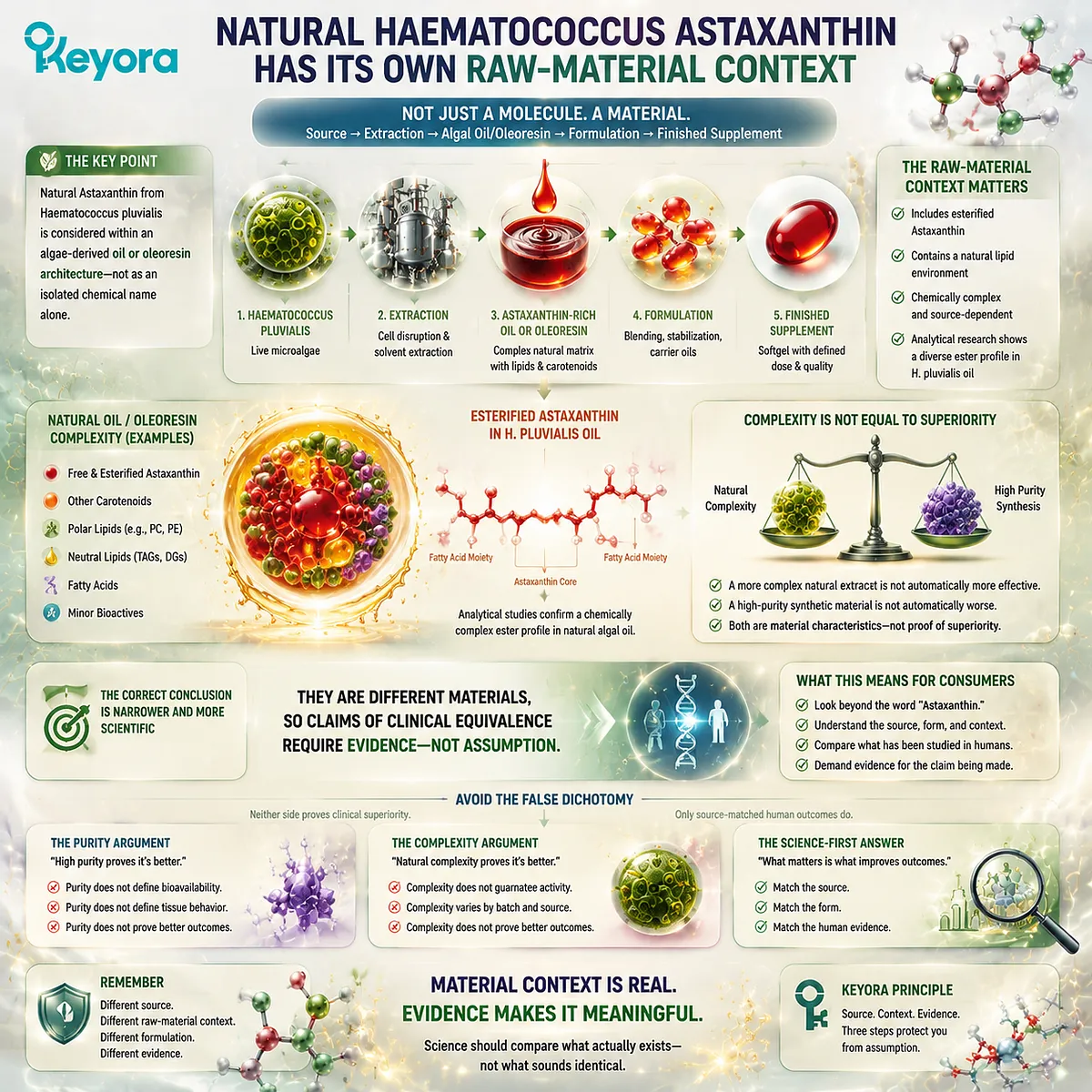
Natural supplement Astaxanthin is commonly considered within an algae-derived oil or oleoresin architecture rather than as an isolated chemical name alone.
This distinction matters especially for softgel supplements.
The relevant natural-material chain is not simply:
Astaxanthin → capsule
It is more accurately considered as:
Haematococcus pluvialis → extraction → Astaxanthin-rich oil or oleoresin → finished supplement formulation
That raw-material context can include esterified Astaxanthin and a lipid environment characteristic of the extracted algal material. Analytical research on H. pluvialis oil has demonstrated this chemically complex ester profile.
Again, complexity should not itself be romanticized. A more complex natural extract is not automatically more effective, and a high-purity synthetic material is not automatically worse simply because it is less complex.
The correct conclusion is narrower:
They are different materials, so claims of clinical equivalence require evidence rather than assumption.
This distinction also prevents an unhelpful debate in which “purity” is treated as proof of superiority on one side and “natural complexity” is treated as proof of superiority on the other. Both are material characteristics. Neither substitutes for source-matched human outcomes.
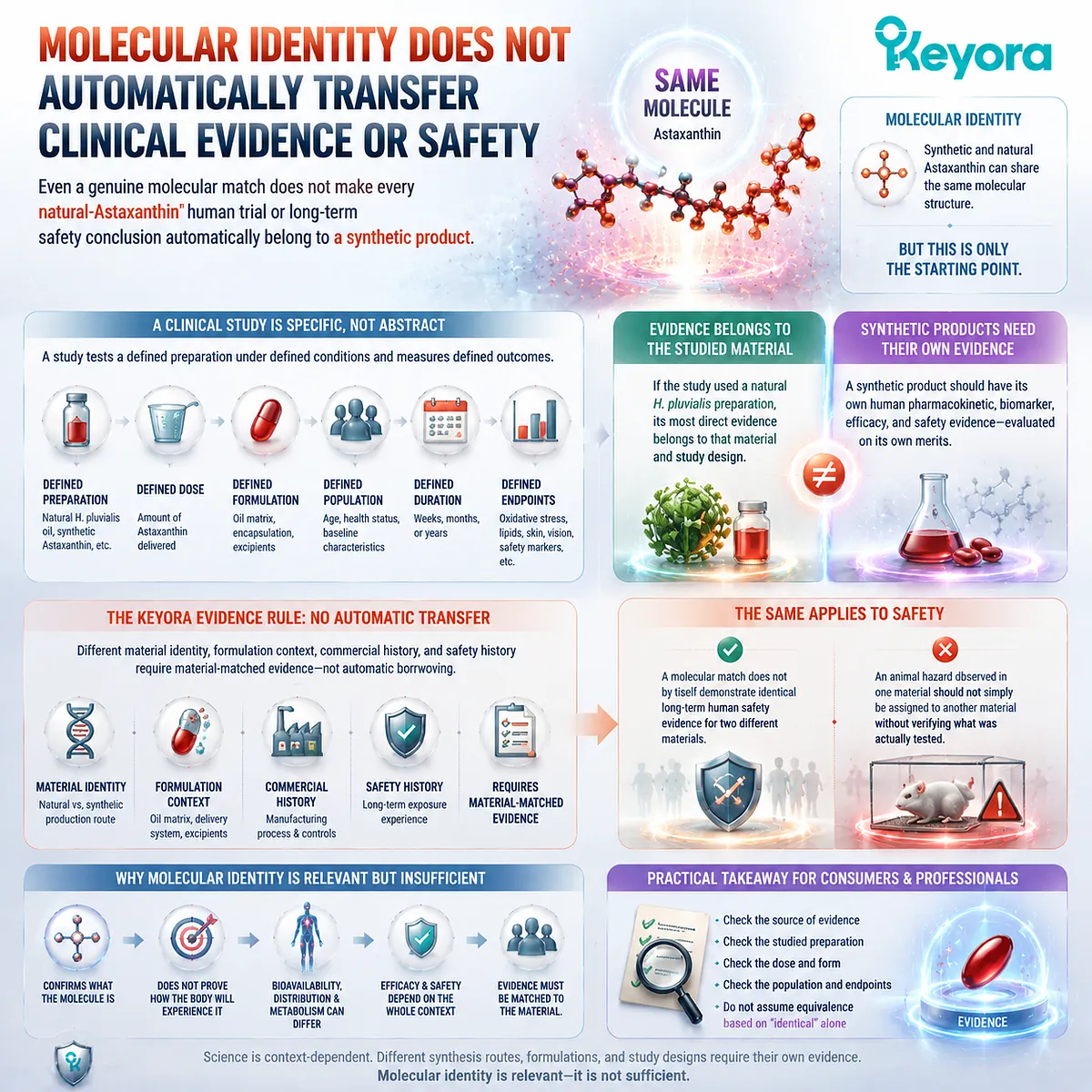
Molecular Identity Does Not Automatically Transfer Clinical Evidence or Safety
Even a genuine molecular match does not make every natural-Astaxanthin human trial or long-term safety conclusion automatically belong to a synthetic product.
This is where the word “identical” becomes especially consequential.
A clinical study is not performed on an abstract ingredient name. Researchers administer a defined preparation at a defined dose, using a particular formulation, in a particular population, for a defined period, and measure specific endpoints.
If that study used a natural H. pluvialis preparation, its most direct evidence belongs to that studied material and study design.
A synthetic product may have its own human pharmacokinetic, biomarker, efficacy, or safety evidence, and that evidence should be evaluated on its own merits.
What should not happen automatically is the transfer of an entire natural-Astaxanthin evidence base simply because both materials contain Astaxanthin.
EP-2 therefore treats natural-to-synthetic evidence transfer as a separate audit question from chemical identity. Its controlling evidence rule is that different material identity, formulation context, commercial history, and safety history require material-matched evidence rather than automatic borrowing.
The same applies to safety.
A molecular match does not by itself demonstrate that two differently manufactured and formulated materials have identical long-term human safety evidence.
Conversely, an animal hazard observation involving one material should not simply be assigned to another material without checking what was actually tested.
This is why molecular identity is relevant but insufficient.
Use the Keyora Identical-to-What Audit
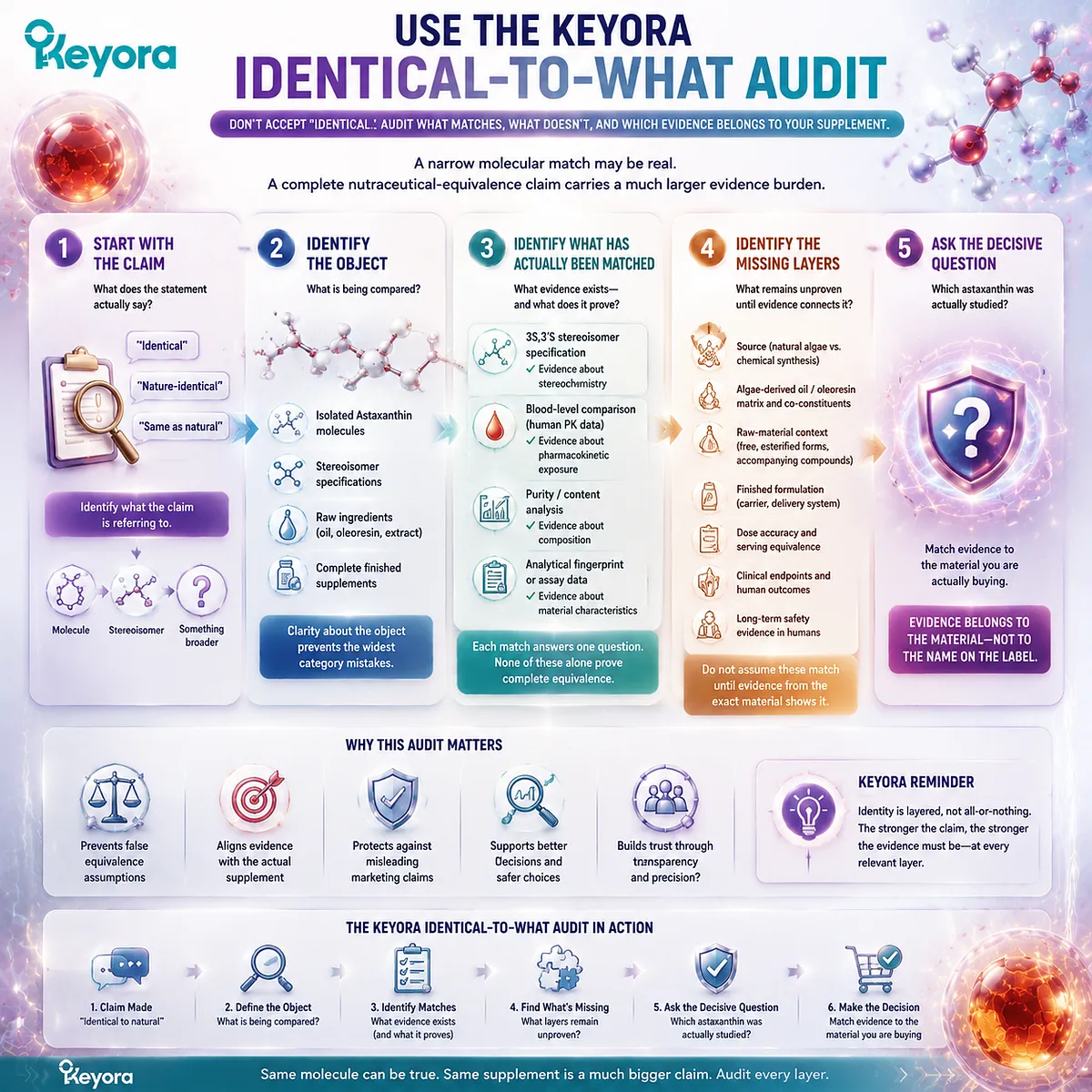
Before accepting an equivalence claim, identify exactly what matches, what remains different, and which evidence belongs to the material you are buying.
The Keyora [Identical-to-What Audit] begins with the claim itself. If a product says “identical,” “nature-identical,” or “same as natural,” identify whether the statement refers to the chemical molecule, a specific stereoisomer, or something broader.
Next identify the object. Is the comparison between isolated Astaxanthin molecules, between stereoisomer specifications, between raw ingredients, or between complete finished supplements?
Then ask what has actually been matched.
A documented 3S,3′S specification is evidence about stereochemistry.
A human blood-level comparison is evidence about pharmacokinetic exposure.
Neither independently proves identical natural source, identical clinical outcomes, or identical long-term safety.
After that, identify the missing layers. Source, algae-derived oil or oleoresin context, formulation, dose, clinical endpoints, and safety evidence should remain separate until evidence actually connects them.
Finally ask the question that prevents the widest evidence mistake:
Which Astaxanthin was actually studied?
A narrow molecular match may be real.
A complete nutraceutical-equivalence claim carries a much larger evidence burden.
Closing Summary
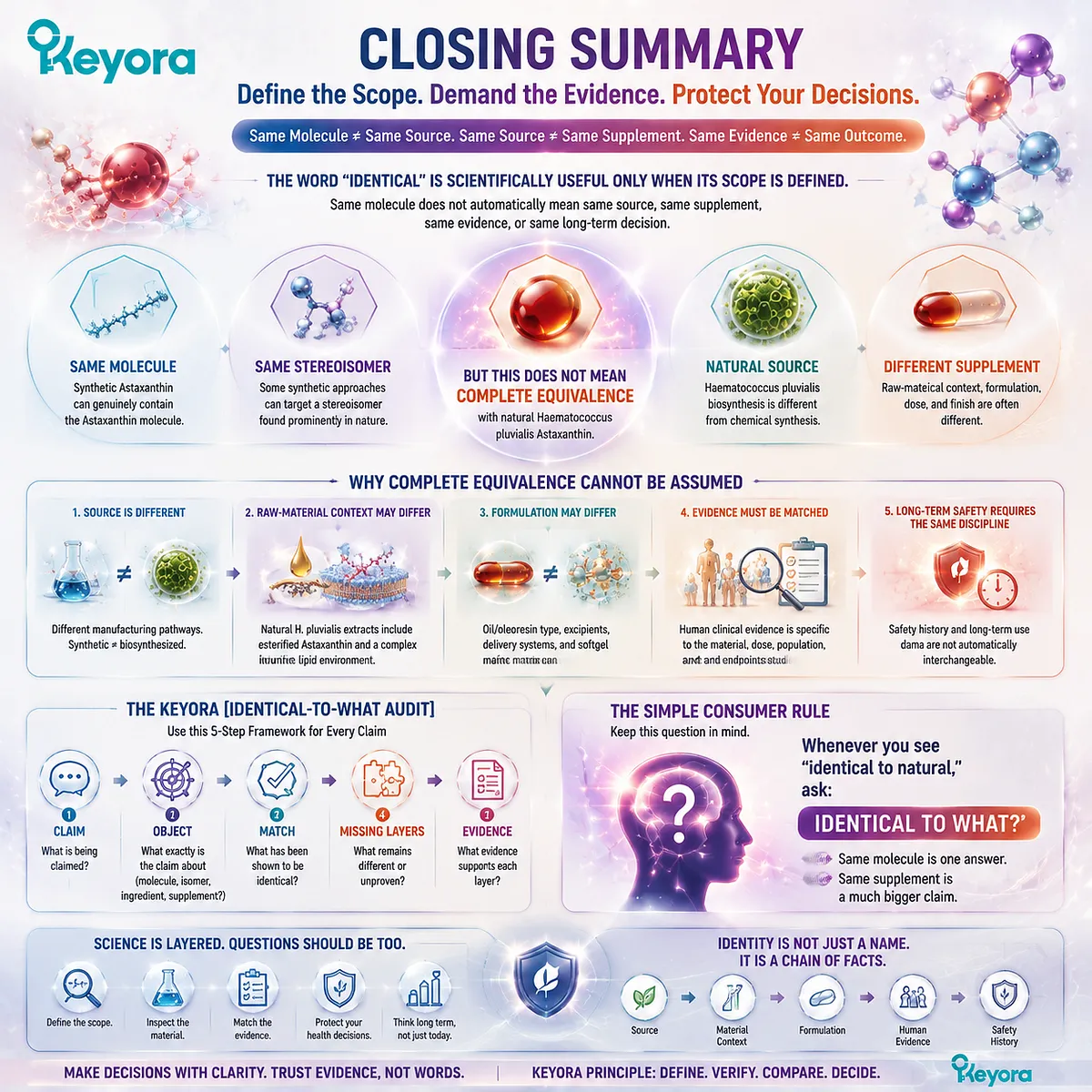
The word “identical” is scientifically useful only when its scope is defined because same molecule does not automatically mean same source, same supplement, same evidence, or same long-term decision.
Synthetic Astaxanthin can genuinely contain the Astaxanthin molecule, and some synthetic approaches can target a stereoisomer also found prominently in nature. That makes it inaccurate to dismiss every use of “nature-identical” as chemically meaningless.
But it is equally inaccurate to expand that molecular similarity into complete equivalence with natural Haematococcus pluvialis Astaxanthin.
Source remains different when the manufacturing pathway is different. Raw-material context may differ.
Formulation may differ. Human clinical evidence must still be matched to the material and endpoint studied. Long-term safety evidence must be interpreted with the same discipline.
The most useful consumer rule is therefore also the simplest:
Whenever you see “identical to natural,” ask: identical to what?
Same molecule is one answer. Same supplement is a much bigger claim.
This article is for educational and informational purposes only. It does not provide medical advice, diagnosis, treatment, cure, prevention, disease outcome claims, hormone restoration claims, fertility outcome claims, or formula-specific clinical efficacy claims.