
What Can Clinical Studies Actually Prove About Astaxanthin?
Keyora Research Q&A Library
This is part of the Keyora Research Q&A Series, derived from Keyora Astaxanthin Research Journal Series.
Within the Keyora Astaxanthin Researcn framework, this Q&A translates complex astaxanthin biology into reader-friendly, evidence-bound answers, focusing on natural astaxanthin identity, molecular structure, antioxidant and redox mechanisms, membrane lipid interaction, mitochondrial resilience, inflammatory signaling pathways, human evidence interpretation, and the scientific principles behind responsible supplementation.
First published by Keyora Research Journal: www.keyorahealth.com

Direct Answer
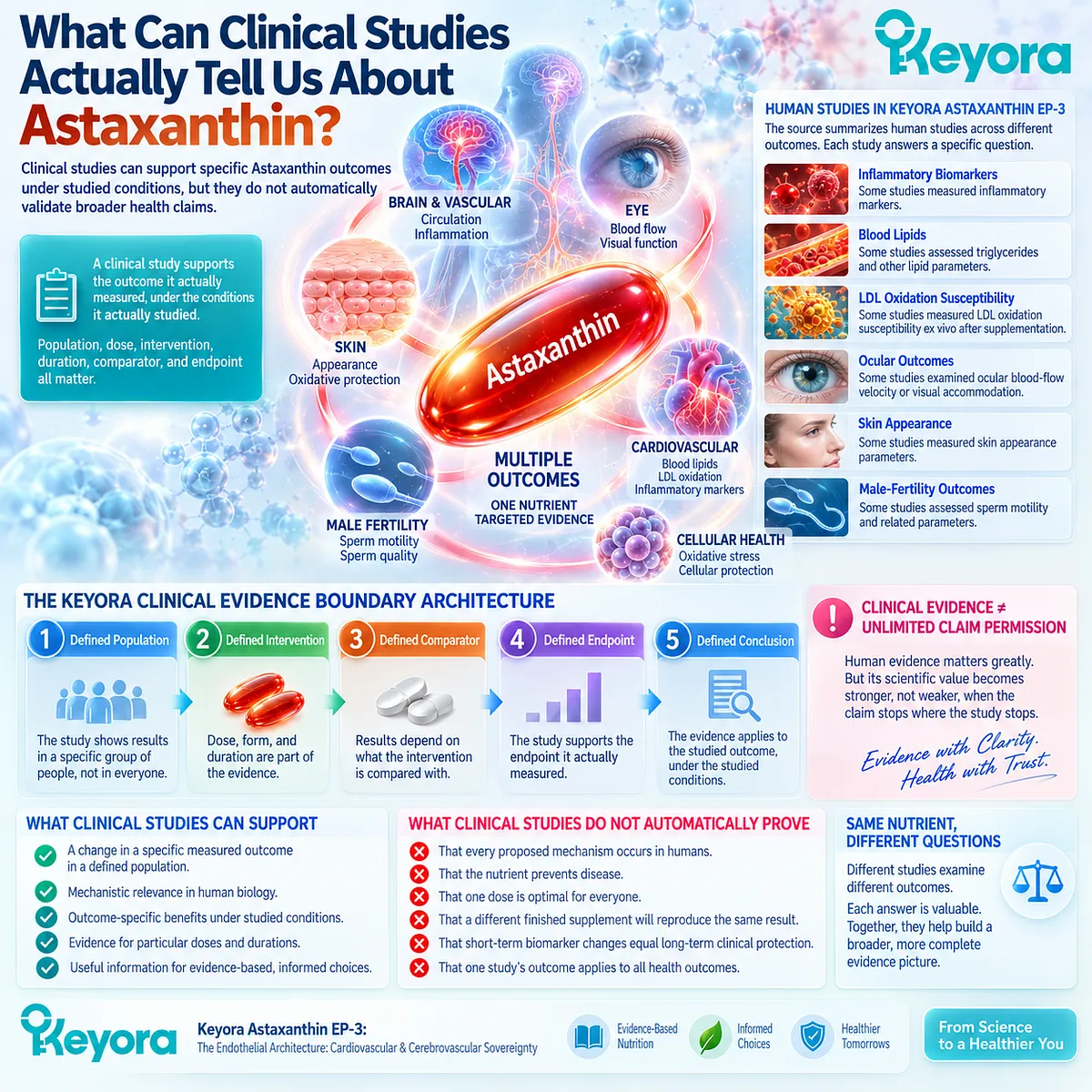
Clinical studies can support specific Astaxanthin outcomes under studied conditions, but they do not automatically validate broader health claims
Clinical studies can show whether Astaxanthin changed a specific measured outcome in a defined group of people under a defined intervention.
They do not automatically prove that every proposed Astaxanthin mechanism occurs in humans, that the nutrient prevents disease, that one dose is optimal for everyone, or that a different finished supplement will reproduce the same result.
This distinction is central to interpreting the human research summarized in Keyora Astaxanthin EP-3: The Endothelial Architecture: Cardiovascular & Cerebrovascular Sovereignty.
Across the source, human Astaxanthin studies examine very different outcomes.
Some measure inflammatory biomarkers.
Some assess blood lipids.
Others measure LDL oxidation susceptibility outside the body after supplementation, ocular blood-flow velocity, visual accommodation, skin appearance, or selected male-fertility outcomes.
These findings are all forms of human evidence, but they do not answer the same clinical question.
The Keyora Clinical Evidence Boundary Architecture is an explanatory framework for keeping those distinctions visible.
Its core rule is simple:
A clinical study supports the outcome it actually measured, under the conditions it actually studied.
That means population, dose, intervention, duration, comparator, and measured endpoint all matter.
A reduction in an inflammatory marker is evidence about that marker.
A change in visual-fatigue score is evidence about visual fatigue.
A change in triglycerides is evidence about blood lipids.
None of those outcomes automatically becomes proof of disease prevention.
The most important principle is therefore:
Clinical Evidence ≠ Unlimited Claim Permission
Human evidence matters greatly. But its scientific value becomes stronger, not weaker, when the claim stops where the study stops.
What Must a Clinical Study Actually Measure Before We Can Make a Claim?
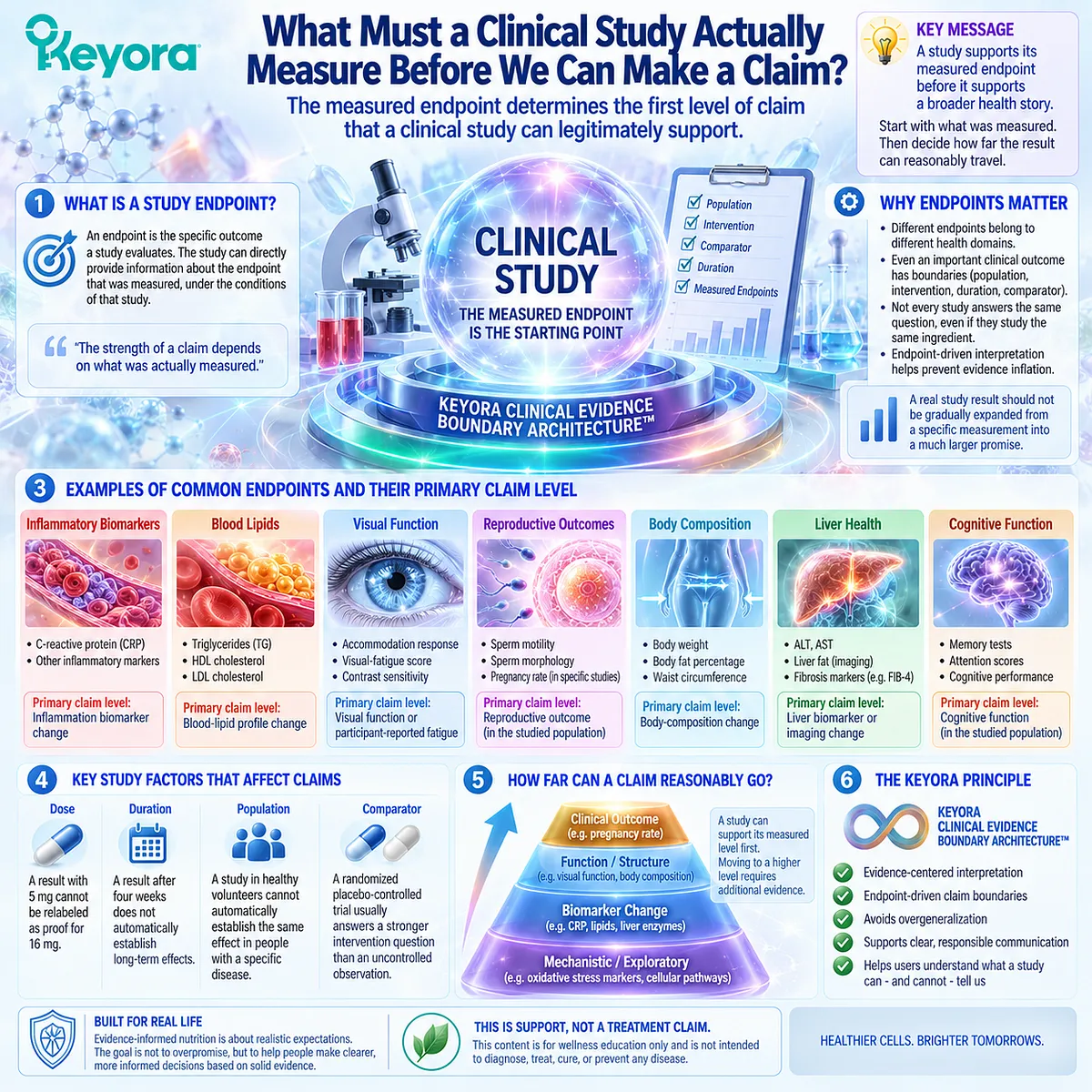
The measured endpoint determines the first level of claim that a clinical study can legitimately support
The phrase “clinical study” can sound as though it automatically settles a health question. In reality, the first question should be much more specific:
What did the researchers actually measure?
An endpoint is the outcome a study evaluates.
If investigators measure C-reactive protein, the study can directly provide information about that inflammatory biomarker.
If investigators measure triglycerides or HDL cholesterol, the result belongs first to the blood-lipid domain.
If they measure accommodation response or a visual-fatigue score, the study provides evidence about visual function or participant-reported fatigue under those study conditions.
If they measure pregnancy as an outcome, the evidence reaches a different clinical level.
But even an important clinical outcome still has boundaries because it occurred in a particular population, using a particular intervention, over a particular period of time.
Dose also matters.
A result obtained with 5 mg of Astaxanthin cannot simply be relabeled as proof for 16 mg.
A result after four weeks does not automatically establish what happens after one year.
A study in healthy volunteers cannot automatically establish the same effect in people with a specific disease.
Comparator and study design matter too.
A randomized placebo-controlled trial usually answers a stronger intervention question than an uncontrolled before-and-after observation, but even a randomized trial only answers the question that its protocol was designed to test.
The Keyora Clinical Evidence Boundary Architecture therefore places the measured endpoint at the center of interpretation.
The guiding rule is:
A Study Supports Its Measured Endpoint Before It Supports a Broader Health Story
This protects against a common form of evidence inflation in supplement communication, where a real study result is gradually expanded from a specific measurement into a much larger promise.
Scientific interpretation should move in the opposite direction.
Start with what was measured.
Then decide how far the result can reasonably travel.
What Do Astaxanthin Human Studies Actually Show Across Different Health Areas?
Human studies report different kinds of outcomes, including biomarkers, physiological measurements, functional endpoints, and selected clinical outcomes
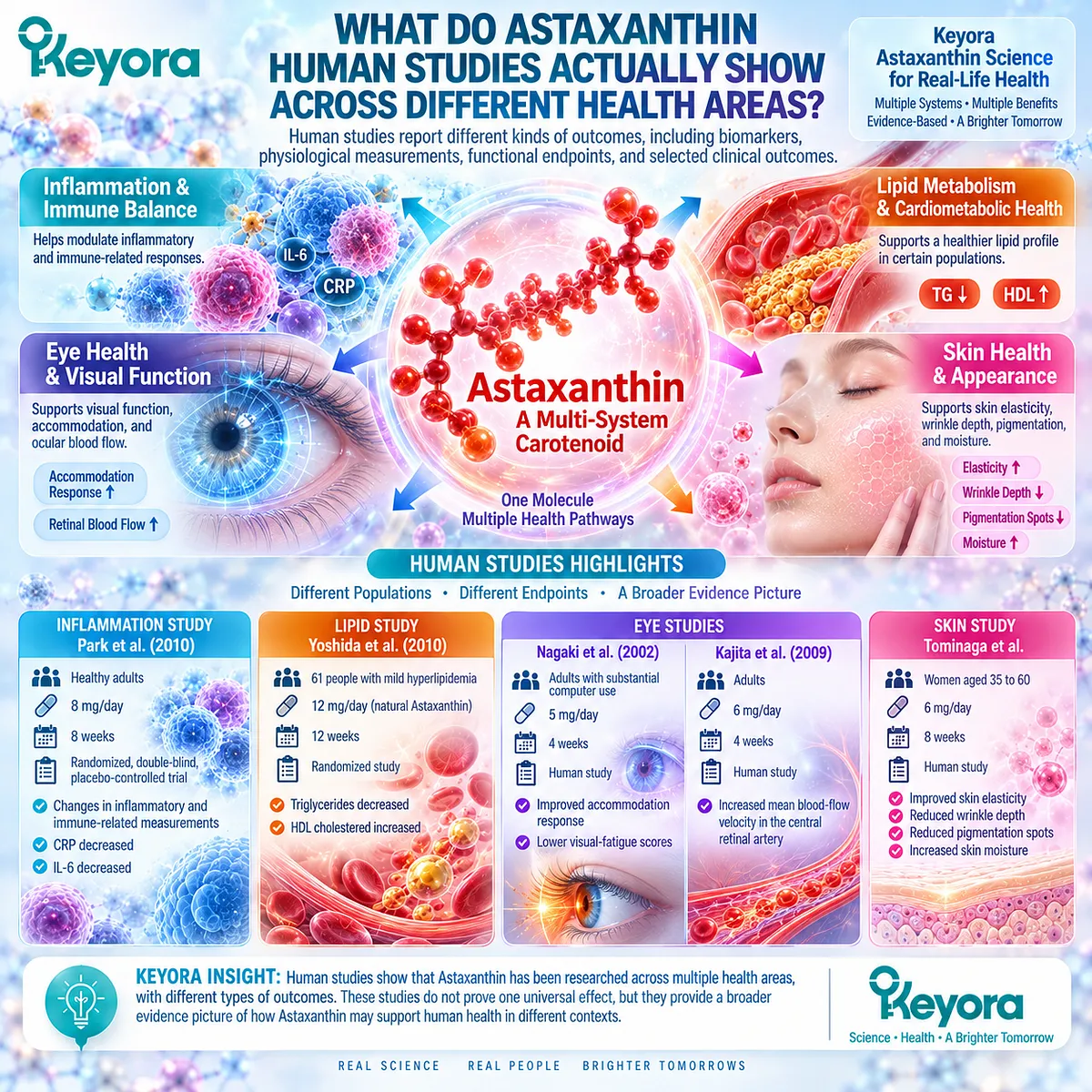
The Keyora source summarizes several human Astaxanthin studies, and their diversity is useful because it shows why “human evidence” is not one single category of outcome.
In the inflammatory domain, the source summarizes Park et al. (2010) as a randomized, double-blind, placebo-controlled trial in healthy adults using 8 mg of Astaxanthin daily for eight weeks. It reports changes in inflammatory and immune-related measurements, including CRP and IL-6.
In lipid research, the source describes Yoshida et al. (2010) as a randomized study involving 61 people with mild hyperlipidemia who received 12 mg of natural Astaxanthin daily for 12 weeks. The source reports changes in triglycerides and HDL cholesterol.
Eye research addresses a different set of endpoints. The source summarizes Nagaki et al. (2002) in adults with substantial computer use, reporting that 5 mg per day for four weeks was associated with improved accommodation response and lower visual-fatigue scores.
It separately summarizes Kajita et al. (2009) as a four-week human study using 6 mg per day, with an increase in mean blood-flow velocity in the central retinal artery.
Skin studies introduce still another type of outcome. The source describes a Tominaga study in women aged 35 to 60 using 6 mg daily for eight weeks, with reported changes in elasticity, wrinkle depth, pigmentation spots, and skin moisture.
These studies do not collectively prove that Astaxanthin produces one universal effect.
They show that Astaxanthin has been studied across multiple human outcome domains.
That is a much more precise conclusion.
Why Do Biomarkers and Physiological Measurements Not Automatically Prove Disease Prevention?
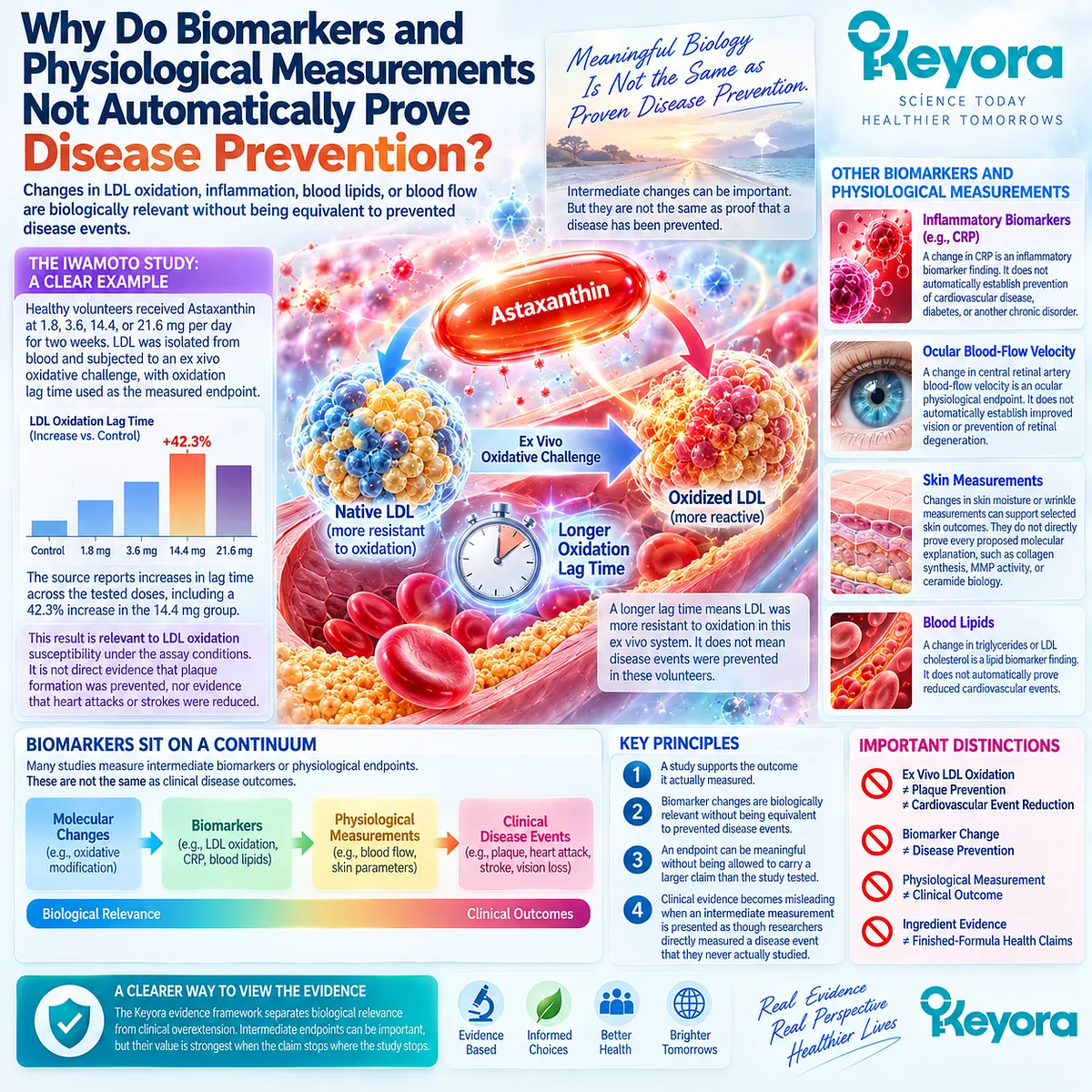
Changes in LDL oxidation, inflammation, blood lipids, or blood flow are biologically relevant without being equivalent to prevented disease events
A biologically meaningful endpoint is not necessarily a disease outcome.
The Iwamoto study provides one of the clearest examples.
The Keyora source describes healthy volunteers receiving Astaxanthin at 1.8, 3.6, 14.4, or 21.6 mg per day for two weeks. LDL was then isolated from blood and subjected to an ex vivo oxidative challenge, with oxidation lag time used as the measured endpoint. The source reports increases in lag time across the tested doses, including a 42.3% increase in the 14.4 mg group.
That result is relevant to LDL oxidation susceptibility under the assay conditions.
It is not direct evidence that plaque formation was prevented in those volunteers.
It is also not evidence that heart attacks or strokes were reduced.
Therefore:
Ex Vivo LDL Oxidation ≠ Plaque Prevention ≠ Cardiovascular Event Reduction
The same reasoning applies elsewhere.
If CRP changes, that is an inflammatory biomarker finding. It does not automatically establish prevention of cardiovascular disease, diabetes, or another chronic disorder.
If central retinal artery blood-flow velocity changes, that is an ocular physiological endpoint. It does not automatically establish improved vision, prevention of retinal degeneration, or protection against age-related eye disease.
If skin moisture or wrinkle measurements change, those results can support selected skin outcomes. They do not directly prove every proposed molecular explanation involving collagen synthesis, MMP activity, ceramide biology, or membrane protection.
This produces a second central rule:
Biomarker Change ≠ Disease Prevention
Clinical evidence becomes misleading when an intermediate measurement is presented as though researchers directly measured a disease event that they never actually studied.
The Keyora evidence framework therefore separates biological relevance from clinical overextension.
An endpoint can be meaningful without being allowed to carry a larger claim than the study actually tested.
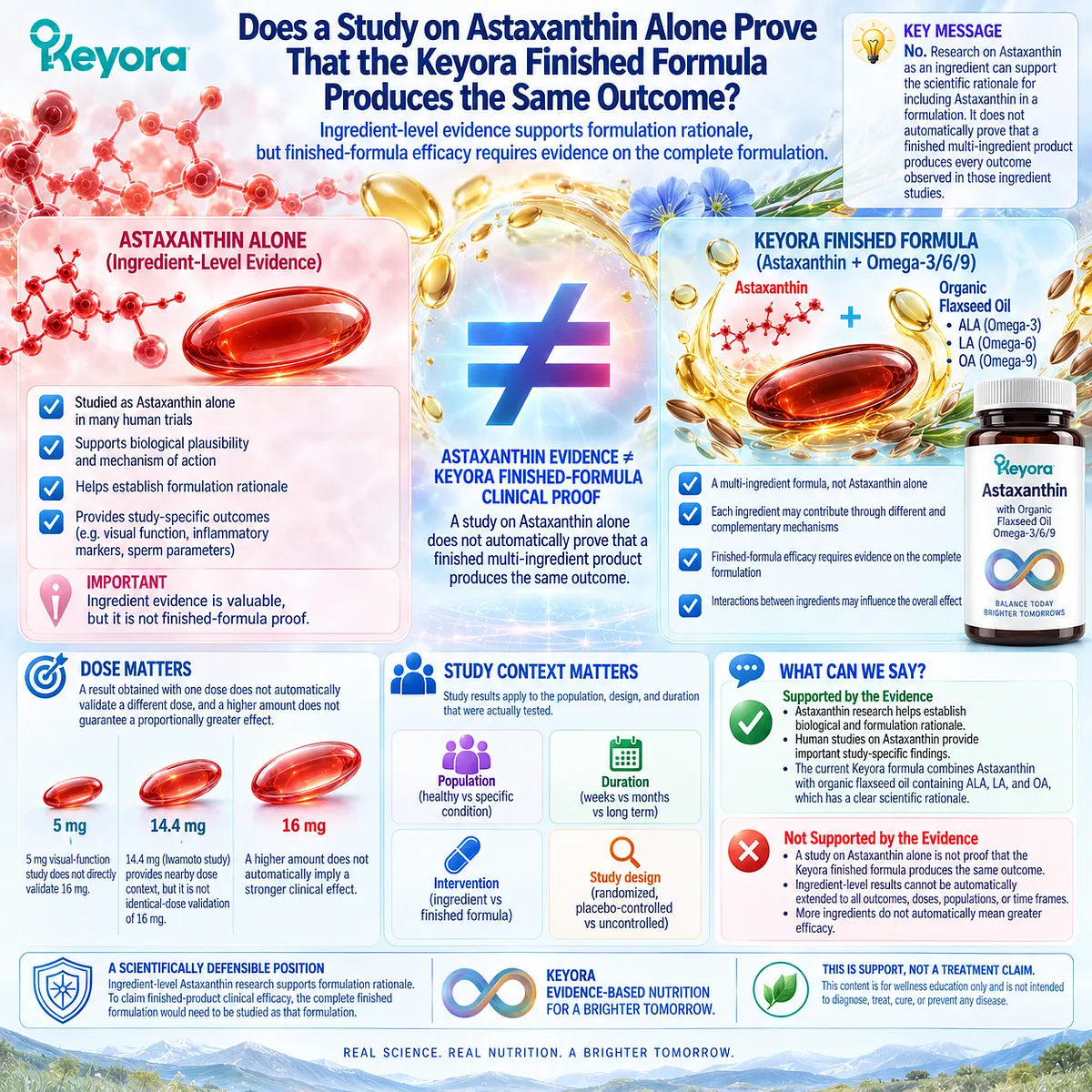
Does a Study on Astaxanthin Alone Prove That the Keyora Finished Formula Produces the Same Outcome?
Ingredient-level evidence supports formulation rationale, but finished-formula efficacy requires evidence on the complete formulation
No.
Research on Astaxanthin as an ingredient can support the scientific rationale for including Astaxanthin in a formulation. It does not automatically prove that a finished multi-ingredient product produces every outcome observed in those ingredient studies.
This distinction is especially important for the current Keyora formula, which combines Astaxanthin with organic flaxseed oil containing listed fatty acids including ALA, LA, and OA.
Many of the human studies discussed throughout the Keyora source used Astaxanthin as the studied intervention rather than the complete current Keyora finished formulation. One Keyora source section explicitly notes that the cited studies achieved their results using Astaxanthin alone before moving into discussion of the broader Keyora matrix.
Therefore:
Astaxanthin Evidence ≠ Keyora Finished-Formula Clinical Proof
Dose should be interpreted with the same discipline.
The 5 mg visual-function study does not directly validate a 16 mg formulation.
The 14.4 mg group in the Iwamoto study provides nearby dose context, but it is not identical-dose validation of 16 mg.
Nor does a higher amount automatically imply a proportionally greater clinical effect.
The Iwamoto source itself reports several tested doses, which is useful precisely because the results should be read as study-specific observations rather than as proof of a simple “more is better” rule.
The scientifically defensible position is that ingredient-level Astaxanthin research helps establish biological and formulation rationale.
To claim finished-product clinical efficacy, the complete finished formulation would need to be studied as that formulation.
This boundary strengthens consumer trust because it clearly separates what is known about the ingredient from what remains to be demonstrated about the product.
How Should Consumers Read the Phrase “Clinically Studied Astaxanthin”?
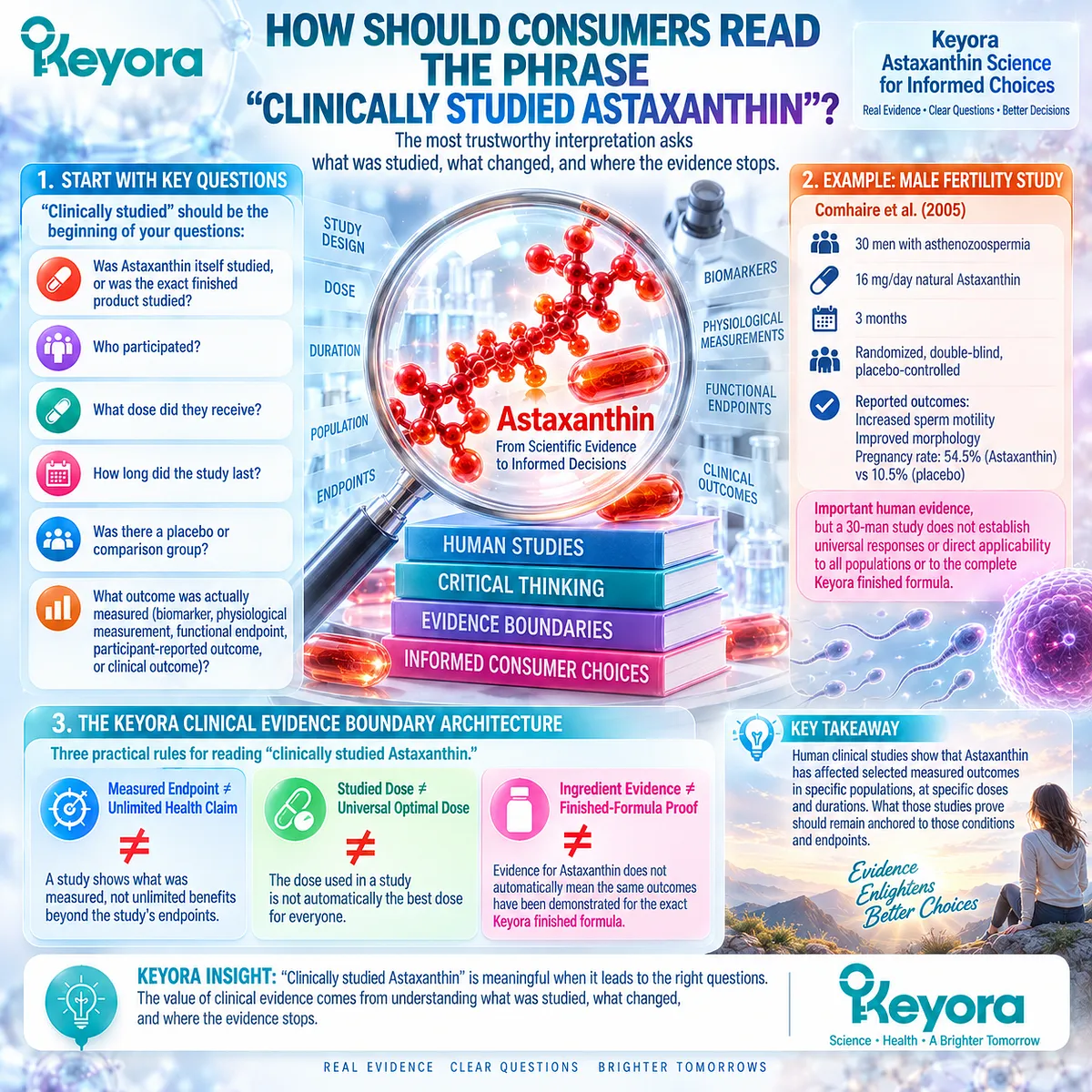
The most trustworthy interpretation asks what was studied, what changed, and where the evidence stops
“Clinically studied Astaxanthin” can be a meaningful phrase, but it should be treated as the beginning of a question rather than the end of one.
The first question is:
Was Astaxanthin itself studied, or was the exact finished product studied?
Then come the study conditions.
Who participated?
What dose did they receive?
How long did the study last?
Was there a placebo or comparison group?
What outcome was actually measured?
Was the result a biomarker, a physiological measurement, a functional endpoint, a participant-reported outcome, or a more direct clinical outcome?
The male-fertility trial summarized by the Keyora source shows why these questions matter. The source describes a double-blind, placebo-controlled randomized study involving 30 men with asthenozoospermia who received 16 mg of natural Astaxanthin per day for three months. Its condensed summary reports improved sperm motility, improved morphology, and a pregnancy rate of 54.5% in the Astaxanthin group versus 10.5% in placebo.
Those findings are important human evidence.
But a 30-man study does not establish that every man will respond similarly, that the same findings apply directly to female infertility, or that the complete Keyora finished formula has demonstrated the same pregnancy outcome.
The Keyora Clinical Evidence Boundary Architecture therefore ends with three practical rules:
Measured Endpoint ≠ Unlimited Health Claim
Studied Dose ≠ Universal Optimal Dose
Ingredient Evidence ≠ Finished-Formula Proof
The strongest interpretation of Astaxanthin clinical research is not that “clinical studies prove Astaxanthin works for everything.”
It is more precise:
Human clinical studies show that Astaxanthin has affected selected measured outcomes in specific populations, at specific doses and durations. What those studies prove should remain anchored to those conditions and endpoints.
That is how clinical evidence becomes useful rather than promotional.
This article is for educational and informational purposes only. It does not provide medical advice, diagnosis, treatment, cure, prevention, disease outcome claims, hormone restoration claims, fertility outcome claims, or formula-specific clinical efficacy claims.