
Should You Take Astaxanthin With Food or Fat – and Does the Type of Fat Matter?
Keyora Research Q&A Library
This is part of the Keyora Research Q&A Series, derived from Keyora Astaxanthin Research Journal Series.
Within the Keyora Astaxanthin Researcn framework, this Q&A translates complex astaxanthin biology into reader-friendly, evidence-bound answers, focusing on natural astaxanthin identity, molecular structure, antioxidant and redox mechanisms, membrane lipid interaction, mitochondrial resilience, inflammatory signaling pathways, human evidence interpretation, and the scientific principles behind responsible supplementation.
First published by Keyora Research Journal: www.keyorahealth.com
Direct Answer
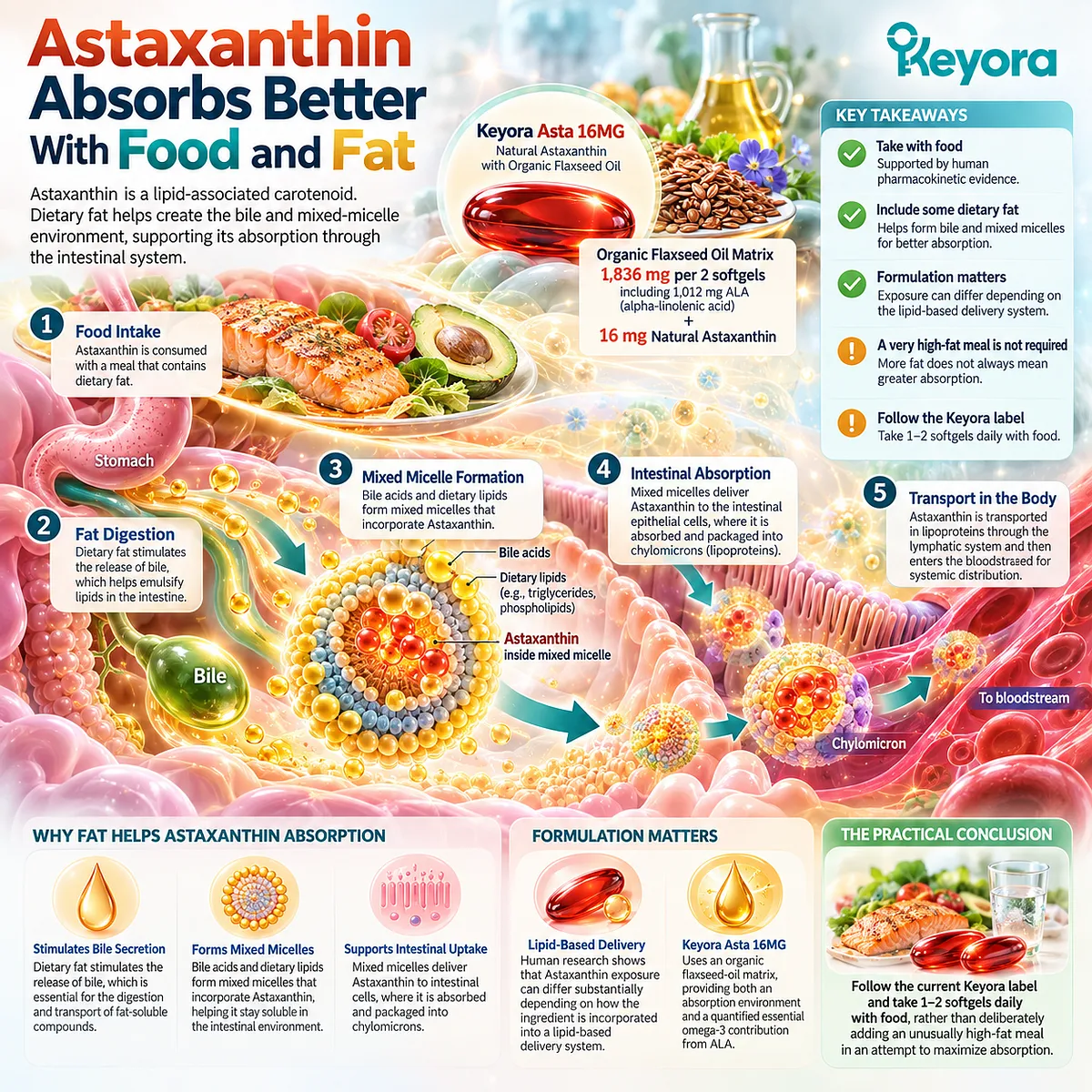
Taking Astaxanthin with food is supported by human pharmacokinetic evidence, and including some dietary fat is biologically relevant because Astaxanthin is a highly lipid-associated carotenoid.
Fat digestion helps create the bile and mixed-micelle environment involved in transporting fat-soluble compounds through the intestinal system.
Human research also shows that formulation matters. Astaxanthin exposure can differ substantially depending on how the ingredient is incorporated into a lipid-based delivery system.
However, this does not mean that a very high-fat meal is required, that more fat always produces greater absorption, or that one particular natural oil has been proven to be the best carrier for everyone.
For Keyora Asta 16MG, the formulation already contains an organic flaxseed-oil matrix.
A full two-softgel serving provides 1,836 mg organic flaxseed oil, including 1,012 mg alpha-linolenic acid (ALA), alongside 16 mg Natural Astaxanthin.
This gives the oil phase two different roles.
-
Absorption Environment – A lipid matrix relevant to Astaxanthin delivery
-
Nutritional Lipid Value – A quantified essential omega-3 contribution from ALA
The practical conclusion is straightforward: follow the current Keyora label and take one to two softgels daily with food, rather than deliberately adding an unusually high-fat meal in an attempt to maximize absorption.
Why Does Fat Help With Astaxanthin Absorption?
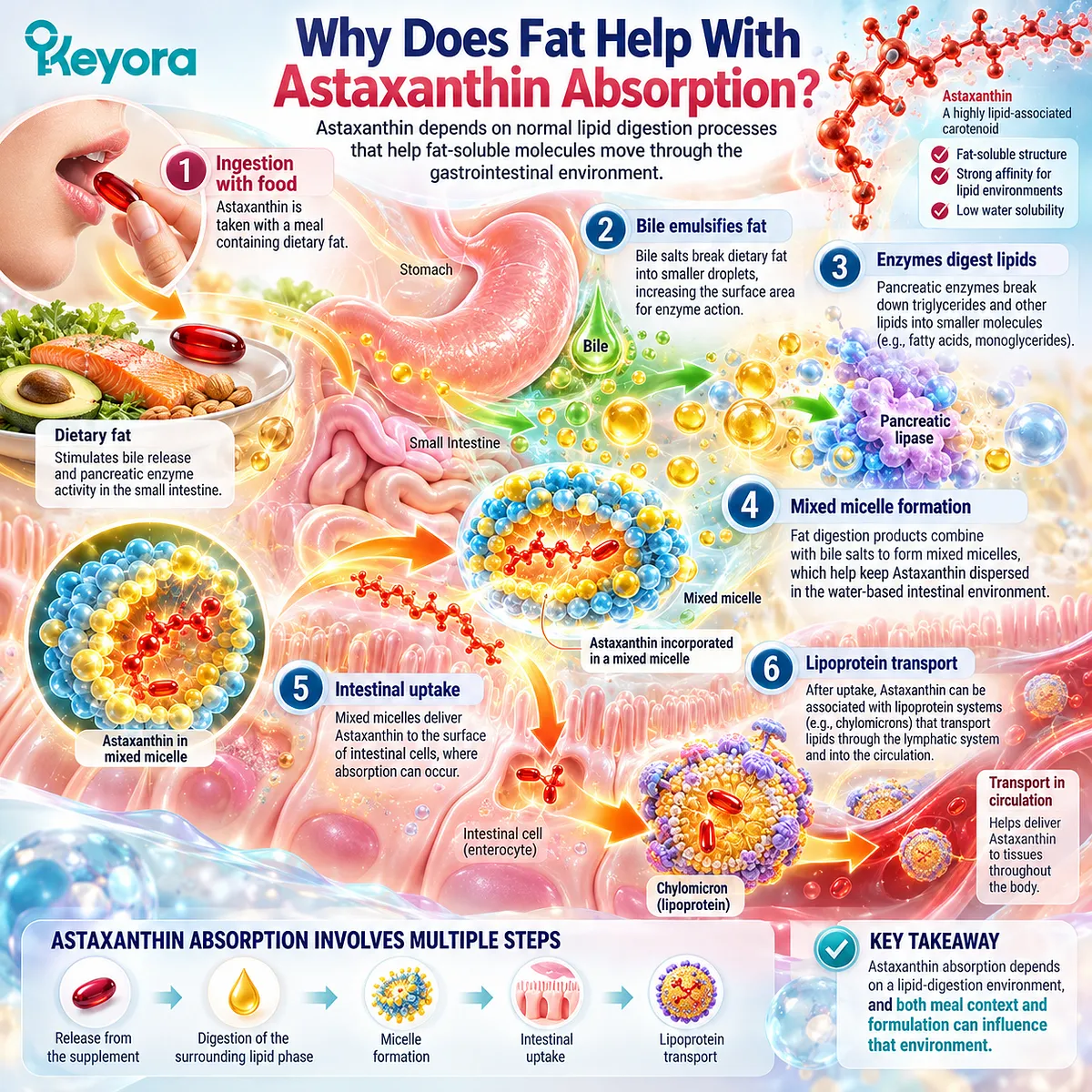
Astaxanthin depends on normal lipid digestion processes that help fat-soluble molecules move through the gastrointestinal environment
Astaxanthin does not behave like a water-soluble nutrient.
Its molecular structure gives it strong affinity for lipid environments. This affects what happens during digestion after an Astaxanthin-containing supplement is swallowed.
Dietary fat entering the small intestine stimulates several processes involved in lipid digestion.
Bile helps emulsify fat into smaller droplets. Pancreatic enzymes digest triglycerides and other lipids, producing smaller molecules that can participate in the formation of mixed micelles.
Mixed micelles are important because the intestinal environment is largely water-based, while Astaxanthin strongly favors lipid environments.
Micellar structures help keep fat-soluble compounds dispersed and transport them toward the surface of intestinal cells, where absorption can occur.
After uptake, Astaxanthin can become associated with lipoprotein transport systems that move lipids through the circulation.
This helps explain why food and formulation context can influence oral exposure.
But several different processes are involved:
-
Release from the supplement
-
Digestion of the surrounding lipid phase
-
Micelle formation
-
Intestinal uptake
-
Lipoprotein transport
For this reason, saying simply “Astaxanthin needs fat” is useful but incomplete.
The more accurate statement is:
Astaxanthin absorption depends on a lipid-digestion environment, and both meal context and formulation can influence that environment.
This does not establish a precise amount of dietary fat that every person needs with each Astaxanthin dose.
What Does Human Research Show About Taking Astaxanthin With Food?
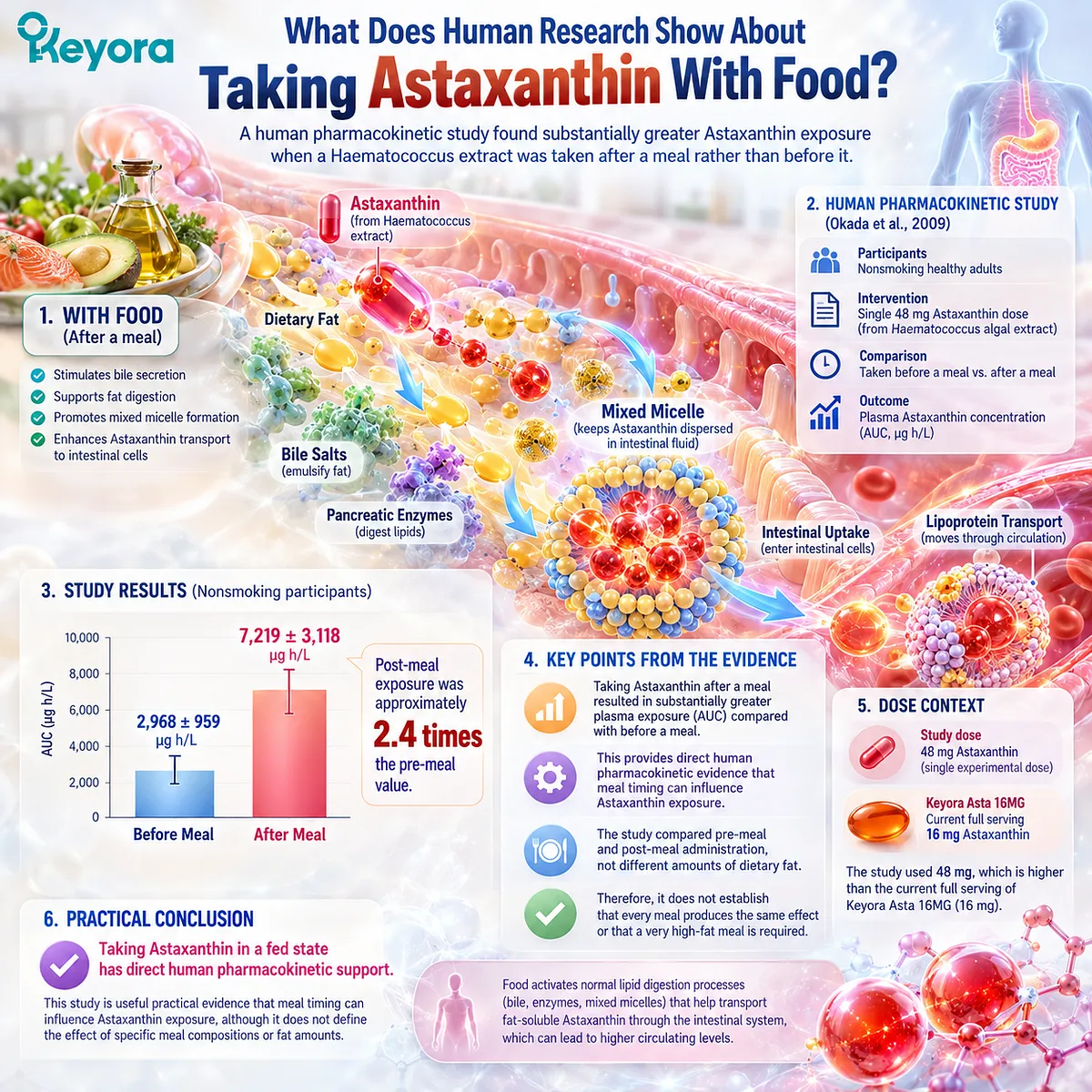
A human pharmacokinetic study found substantially greater Astaxanthin exposure when a Haematococcus extract was taken after a meal rather than before it
One of the most directly relevant human studies was published by Okada and colleagues in 2009.
The researchers investigated the bioavailability of Astaxanthin from a Haematococcus algal extract and examined how the timing of food intake affected circulating Astaxanthin concentrations.
Among the nonsmoking participants, one group took Astaxanthin before a meal, while another took it after a meal.
The study used a single 48 mg Astaxanthin dose.
Astaxanthin exposure, measured as the area under the plasma concentration-time curve, was substantially greater when the supplement was taken after the meal.
The reported AUC values were approximately:
-
Before meal – 2,968 ± 959 μg h/L
-
After meal – 7,219 ± 3,118 μg h/L
Under these study conditions, post-meal exposure was therefore approximately 2.4 times the pre-meal value.
This is useful practical evidence that meal timing can influence Astaxanthin pharmacokinetics.
However, the study does not establish that every meal produces the same effect.
It also does not tell us that consumers should deliberately choose a very high-fat meal.
The trial compared pre-meal and post-meal administration rather than systematically comparing different amounts of dietary fat.
Another important distinction is dose.
The study used 48 mg as a single experimental dose, while the current full serving of Keyora Asta 16MG provides 16 mg.
Therefore, the strongest consumer conclusion is not that a specific meal will multiply absorption by exactly 2.4 times.
It is that taking Astaxanthin in a fed state has direct human pharmacokinetic support.
Does the Type of Fat or Oil Actually Matter?
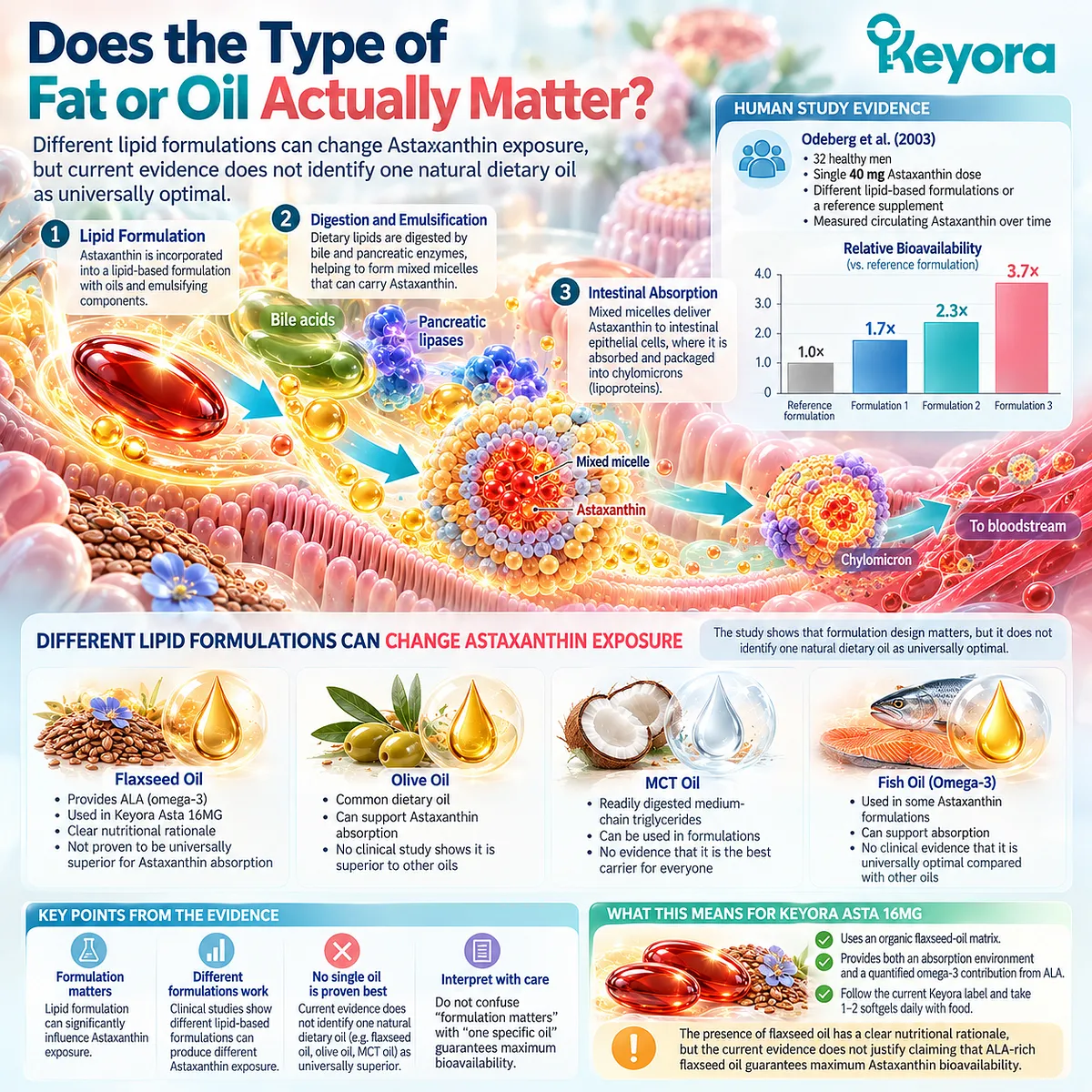
Different lipid formulations can change Astaxanthin exposure, but current evidence does not identify one natural dietary oil as universally optimal
The next question is more complicated.
If fat helps create an appropriate digestive environment, does the actual type of fat matter?
Human research suggests that formulation composition can matter.
A 2003 study by Odeberg and colleagues investigated oral Astaxanthin bioavailability in 32 healthy men.
Participants received a single 40 mg Astaxanthin dose using different lipid-based formulations or a reference supplement.
The researchers then measured circulating Astaxanthin over time.
All three experimental lipid-based formulations produced higher relative bioavailability than the reference formulation, with values approximately 1.7 to 3.7 times higher.
This establishes an important principle:
Astaxanthin exposure is influenced by formulation design, not simply by the presence or absence of oil.
But the study does not prove that one familiar dietary oil is always superior.
The most effective experimental formulation involved more than simply choosing one plant oil. Formulation characteristics included specific lipid and emulsifying components designed to influence dispersion and absorption.
This means several different questions should not be confused.
Does lipid formulation matter?
Yes.
Can different formulations produce different Astaxanthin exposure?
Yes.
Has a clinical study demonstrated that flaxseed oil produces better Astaxanthin absorption than olive oil, MCT oil, or every other carrier?
No.
That distinction is essential when interpreting Keyora Asta 16MG.
The presence of flaxseed oil has a clear nutritional rationale, but the current evidence does not justify claiming that ALA-rich flaxseed oil guarantees maximum Astaxanthin bioavailability.
Why Is ALA-Rich Flaxseed Oil More Than a Carrier in Keyora?
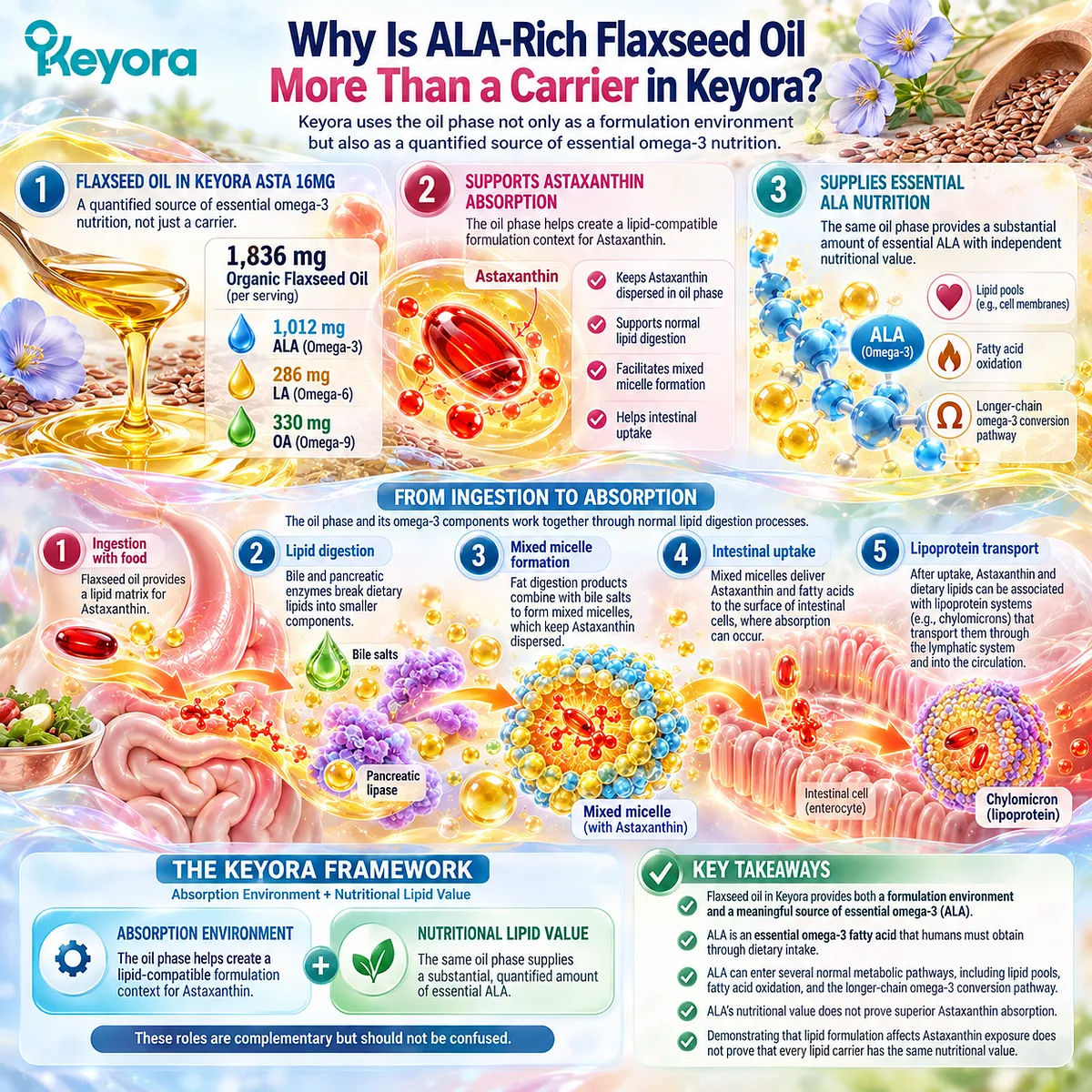
Keyora uses the oil phase not only as a formulation environment but also as a quantified source of essential omega-3 nutrition
The type of oil can be considered from two separate perspectives.
The first is formulation performance.
Does the lipid environment appropriately support the physical delivery and digestive processing of Astaxanthin?
The second is nutritional value.
What does the oil itself contribute after it is consumed?
This second question is where the Keyora formula differs conceptually from an oil phase considered only as a delivery vehicle.
A full serving of Keyora Asta 16MG contains:
1,836 mg Organic Flaxseed Oil
including:
-
1,012 mg ALA, Omega-3
-
286 mg LA, Omega-6
-
330 mg OA, Omega-9
ALA is an essential omega-3 fatty acid that humans must obtain through dietary intake.
As discussed throughout the Keyora Astaxanthin EP-5 nutritional architecture, ALA can enter several normal metabolic pathways after absorption, including lipid pools, fatty acid oxidation, and the longer-chain omega-3 conversion pathway.
Its inclusion therefore gives the lipid phase an independently identifiable nutritional role.
This leads to the Keyora Absorption Environment + Nutritional Lipid Value Framework.
Absorption Environment
The oil phase helps create a lipid-compatible formulation context for Astaxanthin.
Nutritional Lipid Value
The same oil phase supplies a substantial quantified amount of essential ALA.
These roles are complementary but should not be confused.
ALA’s nutritional value does not prove superior Astaxanthin absorption.
Likewise, demonstrating that lipid formulation affects Astaxanthin exposure does not prove that every lipid carrier has the same nutritional value.
How Should You Take Keyora Asta 16MG?
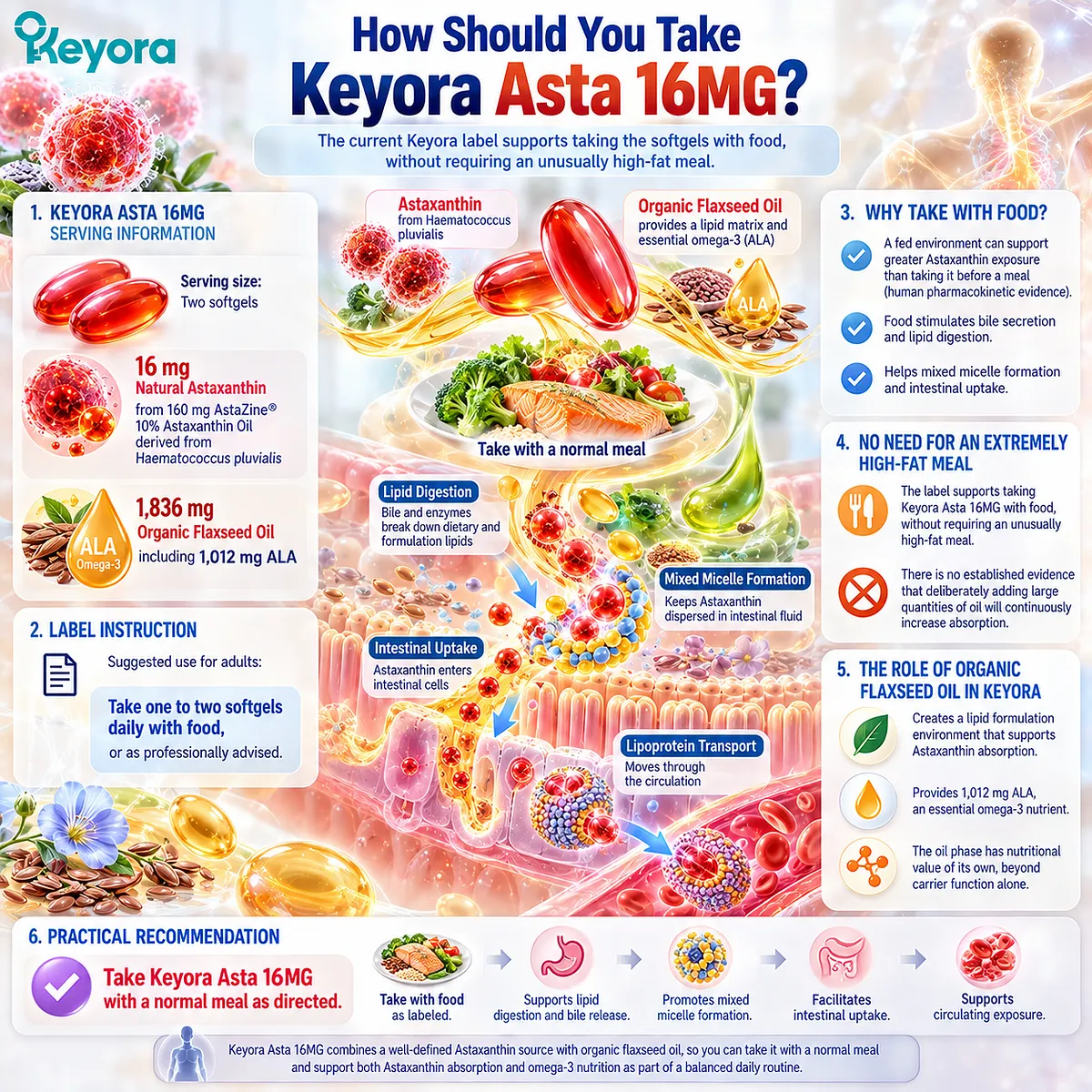
The current Keyora label supports taking the softgels with food, without requiring an unusually high-fat meal
The current Keyora Asta 16MG serving size is two softgels.
A full serving provides:
16 mg Natural Astaxanthin, from 160 mg AstaZine® 10% Astaxanthin Oil derived from Haematococcus pluvialis
plus:
1,836 mg Organic Flaxseed Oil
including 1,012 mg ALA.
The current suggested use for adults is:
Take one to two softgels daily with food, or as professionally advised.
That instruction is consistent with the broader human pharmacokinetic evidence showing that a fed environment can support greater Astaxanthin exposure than taking the ingredient before a meal under the studied conditions.
There is no need to convert this into a rule that Astaxanthin must be taken with an extremely high-fat meal.
There is also no established evidence that deliberately adding large quantities of oil will continuously increase absorption.
The Keyora formulation already contains a lipid matrix, while consuming it with a normal meal provides an additional physiological context for ordinary lipid digestion, bile release, micelle formation, and intestinal uptake.
The evidence-aligned practical recommendation is therefore simple:
Take Keyora Asta 16MG with a normal meal as directed.
The type of fat can matter at the formulation level, but current human research does not establish one dietary oil as universally superior.
For Keyora, the purpose of organic flaxseed oil is broader than carrier function alone. It creates a lipid formulation environment while also supplying a clearly quantified essential omega-3 nutrient.
That is the central distinction between supporting Astaxanthin absorption and giving the oil phase nutritional value of its own.
This article is for educational and informational purposes only. It does not provide medical advice, diagnosis, treatment, cure, prevention, disease outcome claims, hormone restoration claims, fertility outcome claims, or formula-specific clinical efficacy claims.