
Should I Take Astaxanthin Once a Day or Split the Dose?
Keyora Research Q&A Library
This is part of the Keyora Research Q&A Series, derived from Keyora Astaxanthin Research Journal Series.
Within the Keyora Astaxanthin Researcn framework, this Q&A translates complex astaxanthin biology into reader-friendly, evidence-bound answers, focusing on natural astaxanthin identity, molecular structure, antioxidant and redox mechanisms, membrane lipid interaction, mitochondrial resilience, inflammatory signaling pathways, human evidence interpretation, and the scientific principles behind responsible supplementation.
First published by Keyora Research Journal: www.keyorahealth.com
Direct Answer
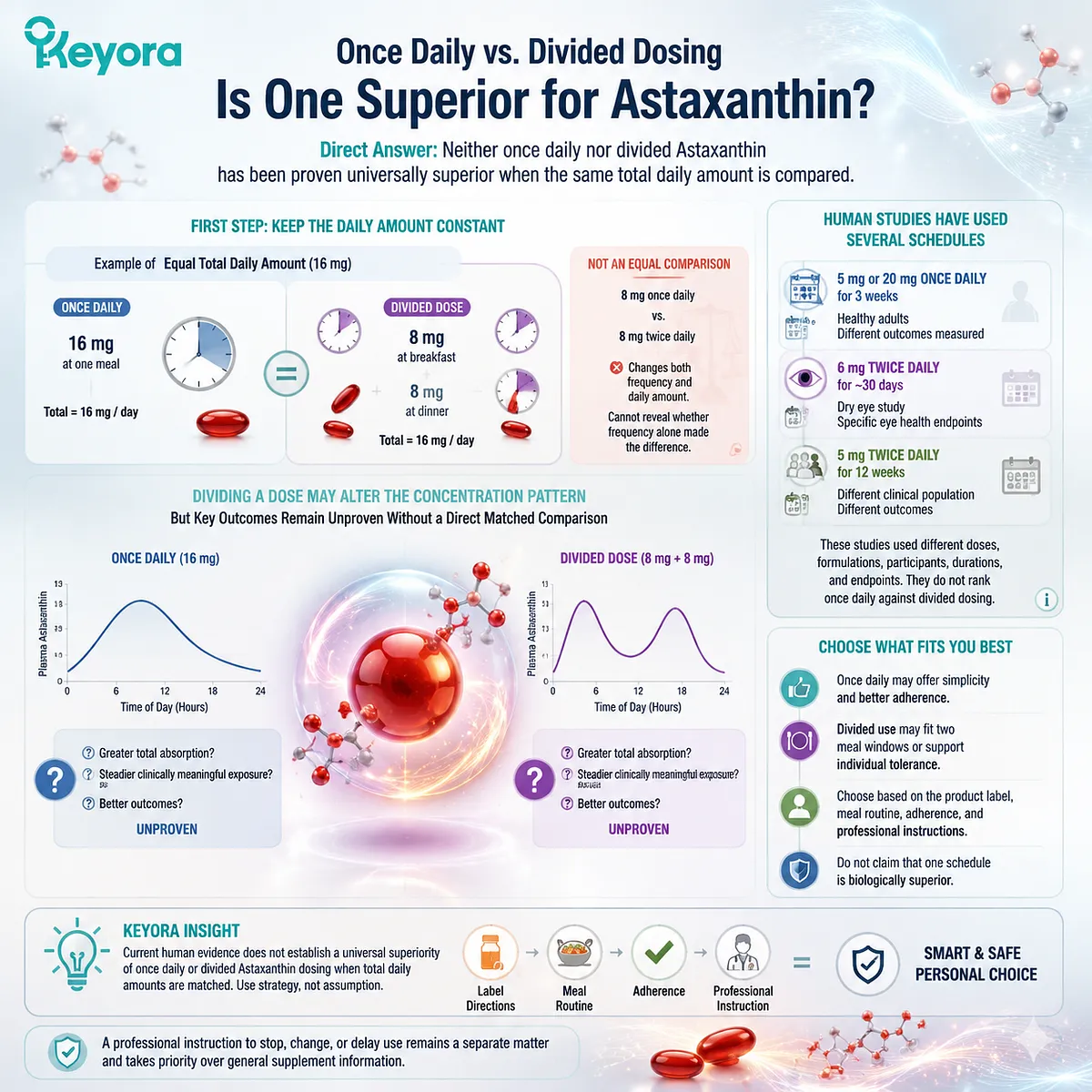
Neither once daily nor divided Astaxanthin has been proven universally superior when the same total daily amount is compared.
The first step is to keep the daily amount constant. For example, 16 mg taken once and 8 mg taken at each of two meals both total 16 mg per day. By contrast, comparing 8 mg once daily with 8 mg twice daily changes both the frequency and the daily amount, so it cannot reveal whether frequency alone made the difference.
Human studies have used several schedules. One study gave 5 mg or 20 mg once daily for three weeks. A dry eye study used 6 mg twice daily for about 30 days, while another trial used 5 mg twice daily for 12 weeks in a different clinical population. These studies involved different doses, formulations, participants, durations, and endpoints. They do not rank once daily against divided dosing.
Dividing a dose might alter the concentration pattern across the day, but greater total absorption, steadier clinically meaningful exposure, and better outcomes remain unproven without a direct matched comparison.
Once daily may offer simplicity. Divided use may fit two meal windows or individual tolerance. Choose according to the label, meal routine, adherence, and professional instructions without claiming that one schedule is biologically superior.
Hold the Total Daily Amount Constant
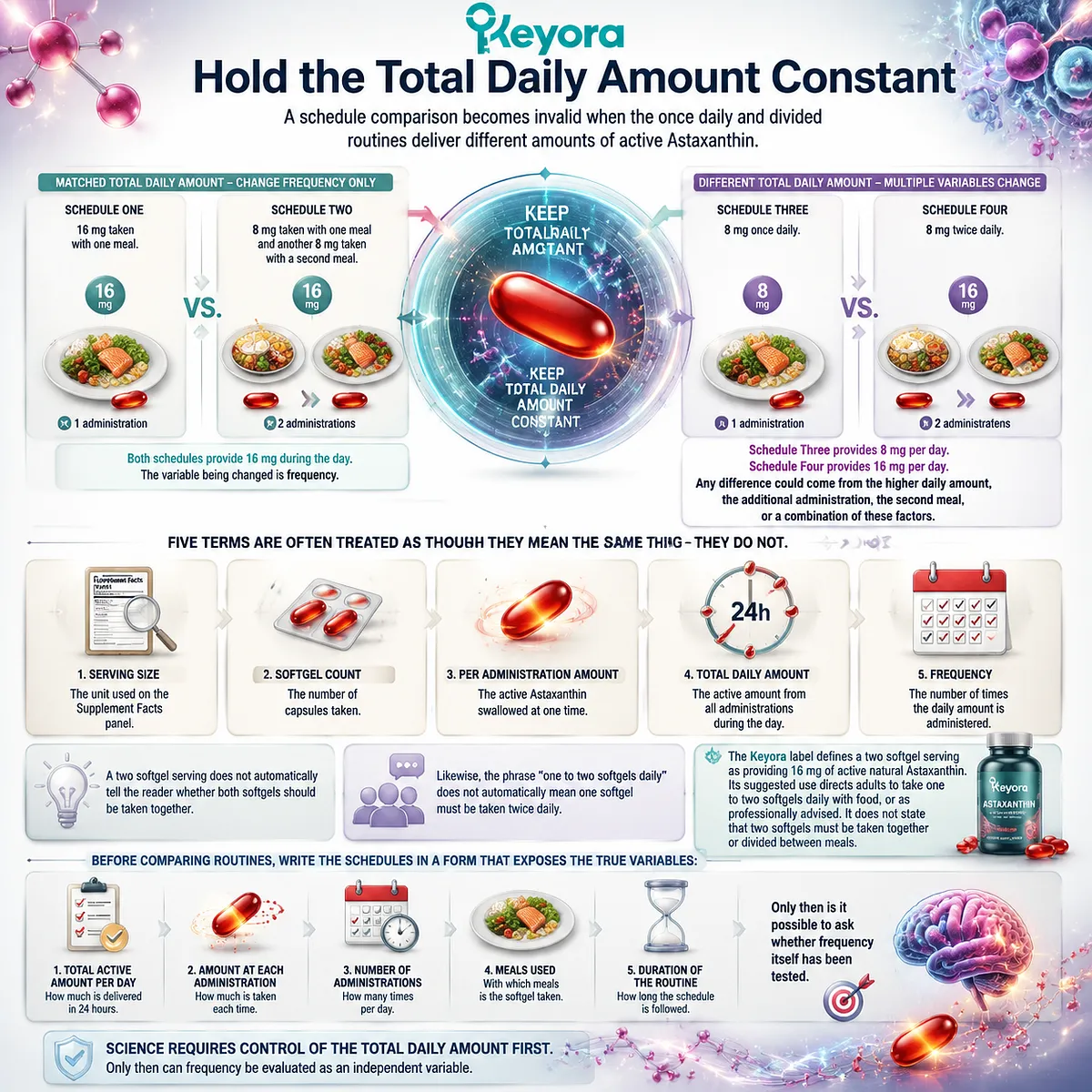
A schedule comparison becomes invalid when the once daily and divided routines deliver different amounts of active Astaxanthin
Consider two schedules.
Schedule One
16 mg taken with one meal.
Schedule Two
8 mg taken with one meal and another 8 mg taken with a second meal.
Both schedules provide 16 mg during the day. The variable being changed is frequency.
Now consider another comparison.
Schedule Three
8 mg once daily.
Schedule Four
8 mg twice daily.
Schedule Three provides 8 mg per day. Schedule Four provides 16 mg per day. Any difference could come from the higher daily amount, the additional administration, the second meal, or a combination of these factors.
This distinction matters because five terms are often treated as though they mean the same thing.
Serving size is the unit used on the supplement facts panel.
Softgel count is the number of capsules taken.
Per administration amount is the active Astaxanthin swallowed at one time.
Total daily amount is the active amount from all administrations during the day.
Frequency is the number of times the daily amount is administered.
A two softgel serving does not automatically tell the reader whether both softgels should be taken together. Likewise, the phrase “one to two softgels daily” does not automatically mean one softgel must be taken twice daily.
The Keyora label defines a two softgel serving as providing 16 mg of active natural Astaxanthin. Its suggested use directs adults to take one to two softgels daily with food, or as professionally advised. It does not state that two softgels must be taken together or divided between meals.
Before comparing routines, write the schedules in a form that exposes the true variables:
total active amount per day
-
amount at each administration
-
number of administrations
-
meals used
-
duration of the routine
Only then is it possible to ask whether frequency itself has been tested.
Run the Two Schedules Through the Same Five Gates
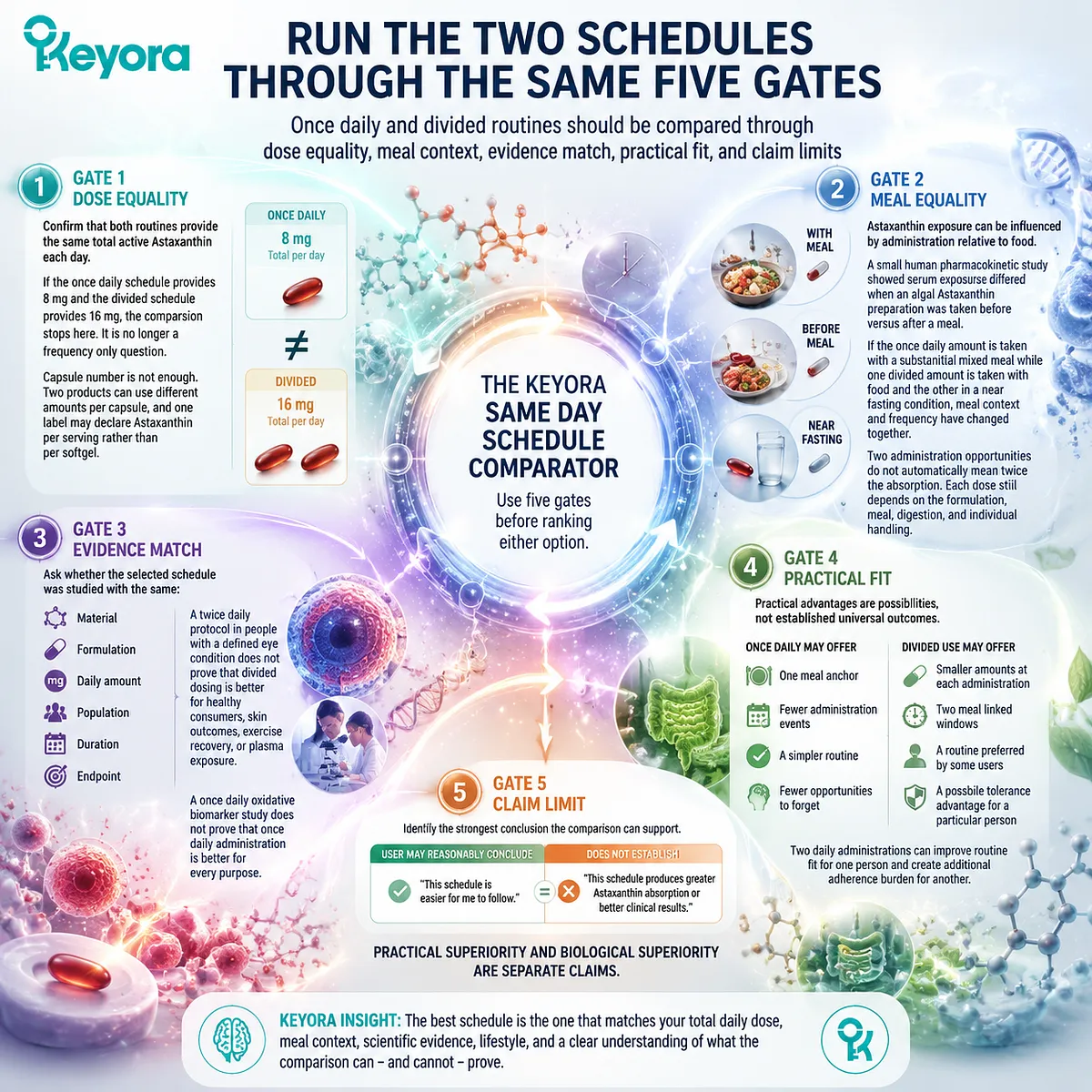
Once daily and divided routines should be compared through dose equality, meal context, evidence match, practical fit, and claim limits
The Keyora Same Day Schedule Comparator uses five gates before ranking either option.
Gate 1 – Dose Equality
Confirm that both routines provide the same total active Astaxanthin each day.
If the once daily schedule provides 8 mg and the divided schedule provides 16 mg, the comparison stops here. It is no longer a frequency only question.
Capsule number is not enough. Two products can use different amounts per capsule, and one label may declare Astaxanthin per serving rather than per softgel.
Gate 2 – Meal Equality
Astaxanthin exposure can be influenced by administration relative to food. In a small human pharmacokinetic study, serum exposure differed when an algal Astaxanthin preparation was taken before versus after a meal. That study did not compare once daily with divided dosing, but it demonstrates why meal conditions can interfere with a schedule comparison.
If the once daily amount is taken with a substantial mixed meal while one divided amount is taken with food and the other is taken in a near fasting condition, meal context and frequency have changed together.
Two administration opportunities do not automatically mean twice the absorption. Each dose still depends on the formulation, meal, digestion, and individual handling.
Gate 3 – Evidence Match
Ask whether the selected schedule was studied with the same:
material
-
formulation
-
daily amount
-
population
-
duration
-
endpoint
A twice daily protocol in people with a defined eye condition does not prove that divided dosing is better for healthy consumers, skin outcomes, exercise recovery, or plasma exposure.
A once daily oxidative biomarker study does not prove that once daily administration is better for every purpose.
Gate 4 – Practical Fit
Once daily use may offer:
one meal anchor
-
fewer administration events
-
a simpler routine
-
fewer opportunities to forget
Divided use may offer:
smaller amounts at each administration
-
two meal linked windows
-
a routine preferred by some users
-
a possible tolerance advantage for a particular person
These are practical possibilities, not established universal outcomes. Two daily administrations can improve routine fit for one person and create additional adherence burden for another.
Gate 5 – Claim Limit
Finally, identify the strongest conclusion the comparison can support.
A user may reasonably conclude:
This schedule is easier for me to follow.
The same observation does not establish:
This schedule produces greater Astaxanthin absorption or better clinical results.
Practical superiority and biological superiority are separate claims.
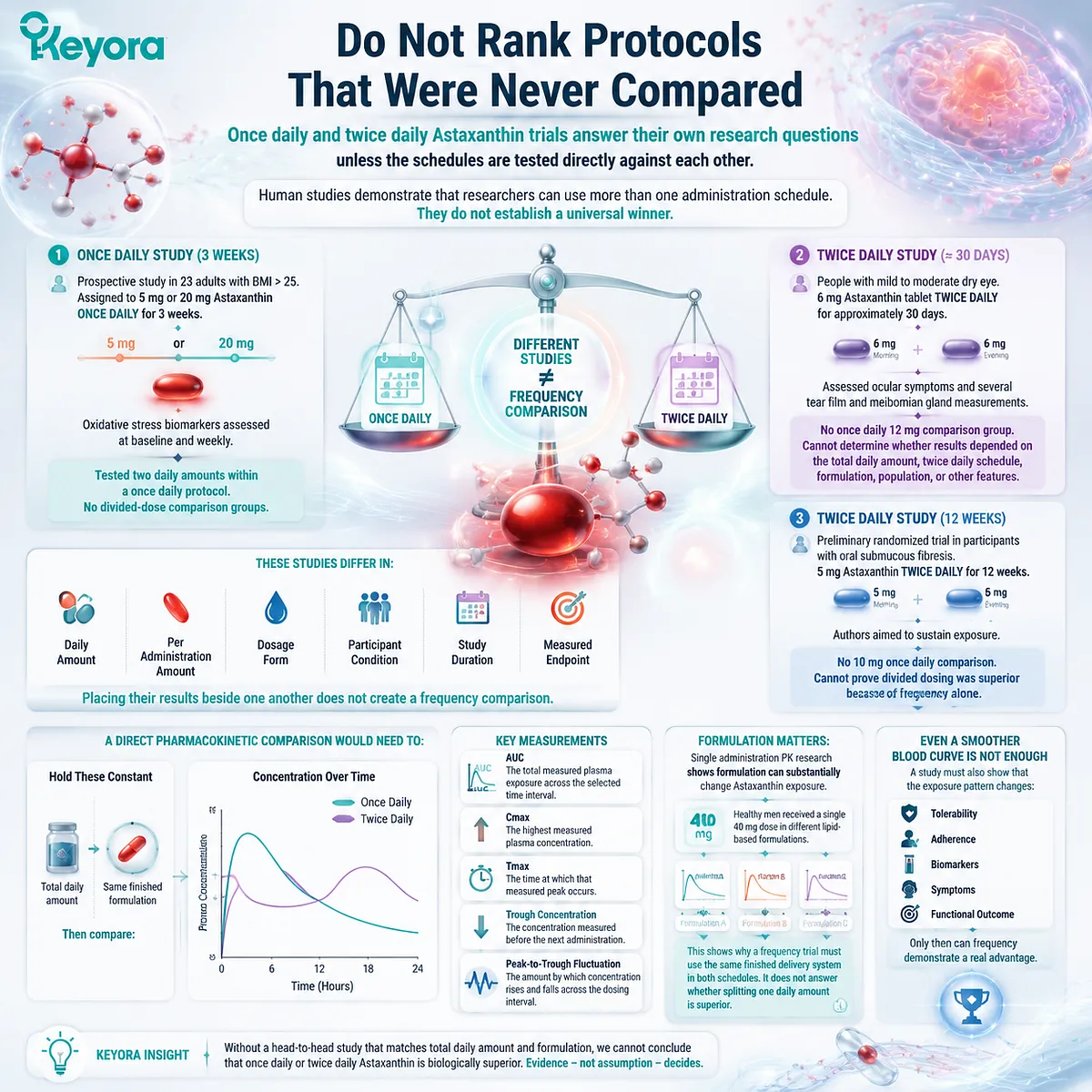
Do Not Rank Protocols That Were Never Compared
Once daily and twice daily Astaxanthin trials answer their own research questions unless the schedules are tested directly against each other
Human studies demonstrate that researchers can use more than one administration schedule. They do not establish a universal winner.
In one prospective study, 23 adults with a body mass index above 25 were assigned to 5 mg or 20 mg of Astaxanthin once daily for three weeks. Oxidative stress biomarkers were assessed at baseline and weekly during the intervention. The study tested two daily amounts within a once daily protocol. It did not include groups receiving the same amounts in divided administrations.
A separate study in people with mild to moderate dry eye administered a 6 mg Astaxanthin tablet twice daily for approximately 30 days. The investigators assessed ocular symptoms and several tear film and meibomian gland measurements. There was no once daily 12 mg comparison group, so the trial cannot determine whether its results depended on the total daily amount, the twice daily schedule, the formulation, the population, or other protocol features.
Another preliminary randomized trial used 5 mg twice daily for 12 weeks in participants with oral submucous fibrosis. Its authors described the divided schedule as an attempt to sustain exposure. That rationale remained part of the study design because the trial did not compare 10 mg once daily with 5 mg twice daily. It therefore cannot prove that divided dosing sustained Astaxanthin more effectively or improved the endpoint because of frequency alone.
These studies differ in:
daily amount
-
per administration amount
-
dosage form
-
participant condition
-
study duration
-
measured endpoint
Placing their results beside one another does not create a frequency comparison.
A direct pharmacokinetic comparison would need to hold the total daily amount and formulation constant. Researchers would then need to measure the concentration curve after once daily and divided administration.
Relevant measurements could include:
AUC
The total measured plasma exposure across the selected time interval.
Cmax
The highest measured plasma concentration.
Tmax
The time at which that measured peak occurs.
Trough concentration
The concentration measured before the next administration.
Peak to trough fluctuation
The amount by which concentration rises and falls across the dosing interval.
Existing single administration pharmacokinetic research shows that formulation can substantially change Astaxanthin exposure. In one human study, healthy men received a single 40 mg dose in different lipid based formulations, and the formulations produced different plasma exposure estimates. This demonstrates why a frequency trial must use the same finished delivery system in both schedules. It does not answer whether splitting one daily amount is superior.
Even a smoother blood curve would not complete the evidence chain. The study would still need to show whether that exposure pattern changed tolerability, adherence, biomarkers, symptoms, or the intended functional outcome.
Choose a Routine Without Inventing a Pharmacokinetic Advantage
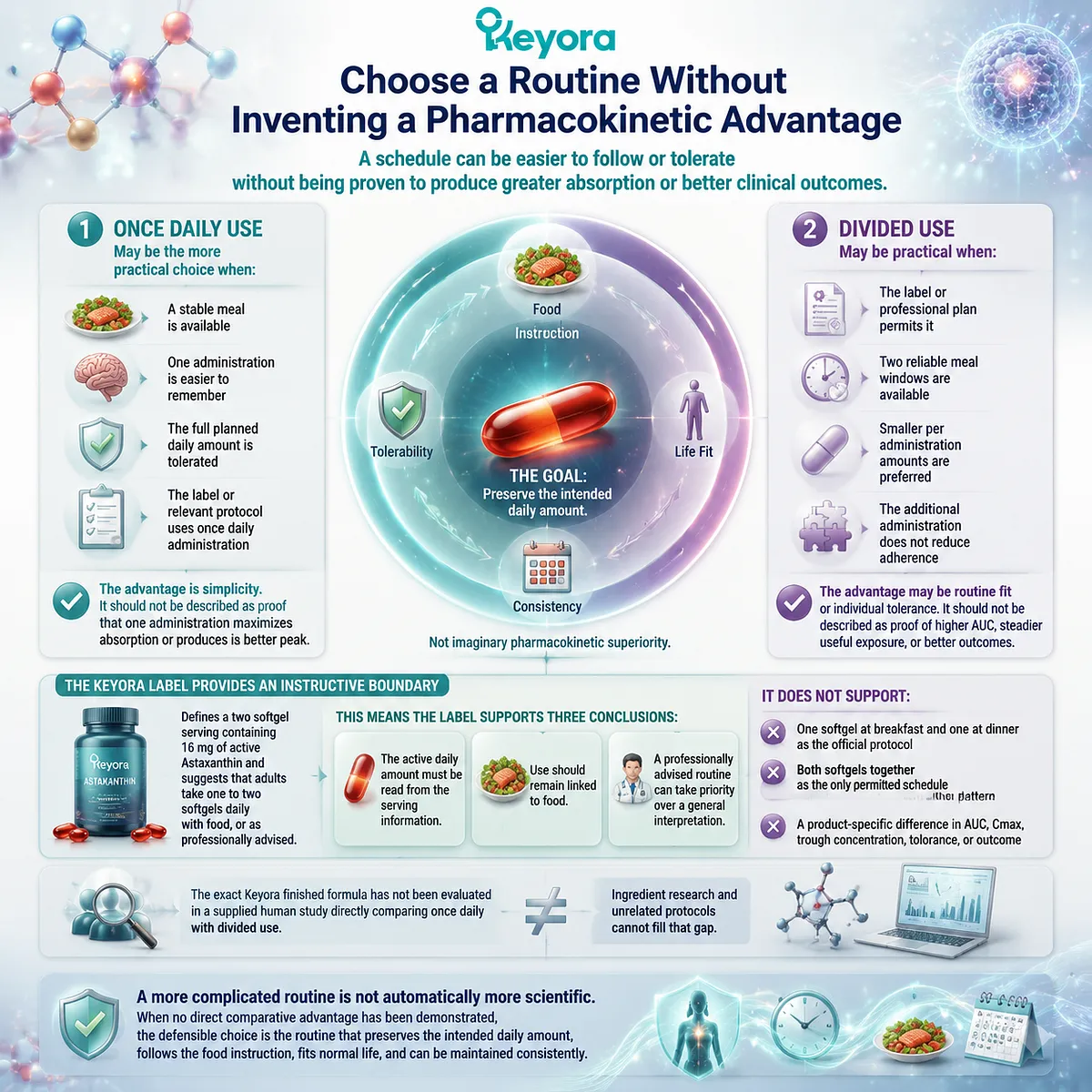
A schedule can be easier to follow or tolerate without being proven to produce greater absorption or better clinical outcomes
Once daily use may be the more practical choice when:
a stable meal is available
-
one administration is easier to remember
-
the full planned daily amount is tolerated
-
the label or relevant protocol uses once daily administration
The advantage is simplicity. It should not be described as proof that one administration maximizes absorption or produces a better peak.
Divided use may be practical when:
the label or professional plan permits it
-
two reliable meal windows are available
-
smaller per administration amounts are preferred
-
the additional administration does not reduce adherence
The advantage may be routine fit or individual tolerance. It should not be described as proof of higher AUC, steadier useful exposure, or better outcomes.
The Keyora label provides an instructive boundary. It defines a two softgel serving containing 16 mg of active Astaxanthin and suggests that adults take one to two softgels daily with food, or as professionally advised. It does not specify together versus divided administration.
This means the label supports three conclusions:
The active daily amount must be read from the serving information.
Use should remain linked to food.
A professionally advised routine can take priority over a general interpretation.
It does not support:
one softgel at breakfast and one at dinner as the official protocol
-
both softgels together as the only permitted schedule
-
superior absorption from either pattern
-
a product specific difference in AUC, Cmax, trough concentration, tolerance, or outcome
The exact Keyora finished formula has not been evaluated in a supplied human study directly comparing once daily with divided use. Ingredient research and unrelated protocols cannot fill that gap.
A more complicated routine is not automatically more scientific. When no direct comparative advantage has been demonstrated, the defensible choice is the routine that preserves the intended daily amount, follows the food instruction, fits normal life, and can be maintained consistently.
Closing Summary
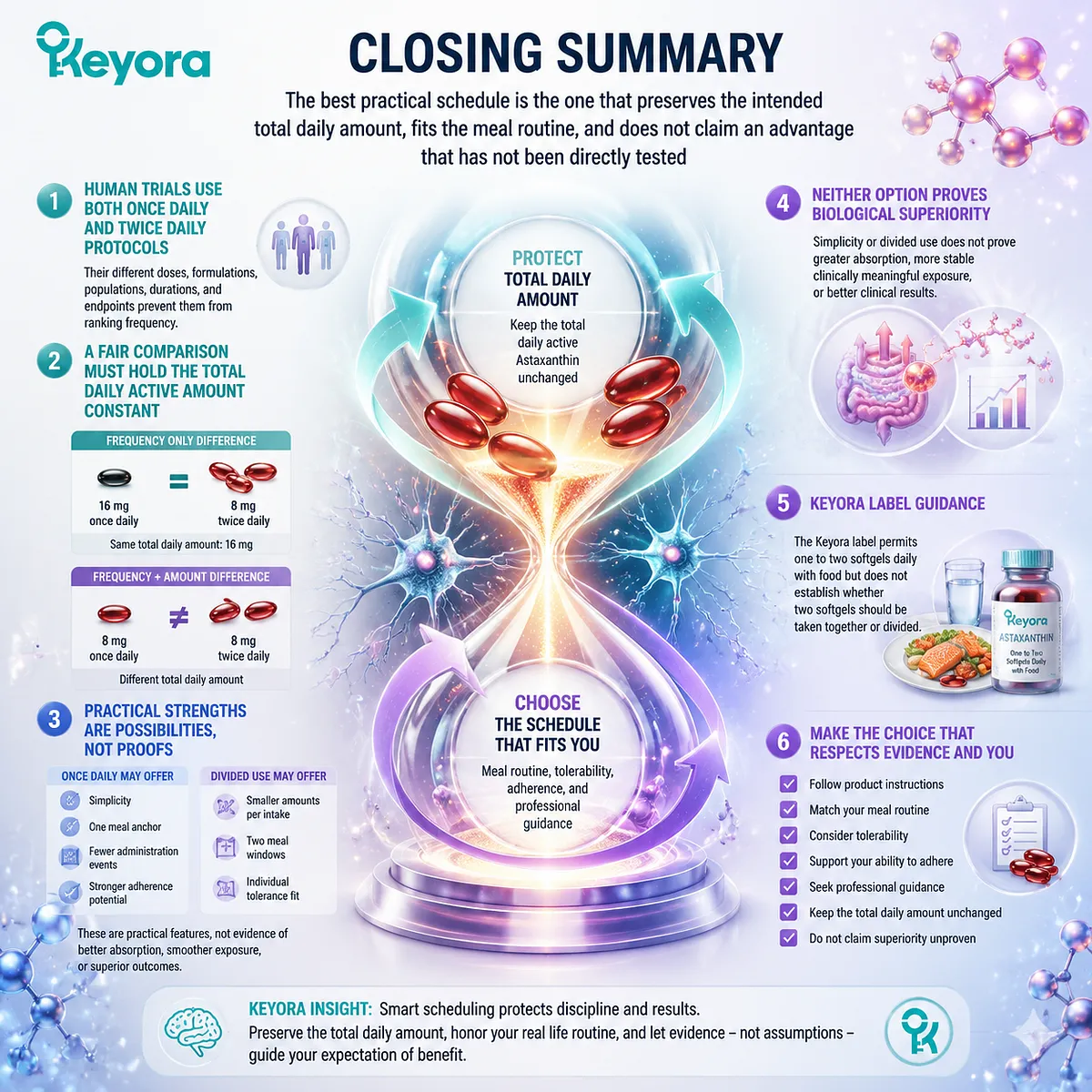
The best practical schedule is the one that preserves the intended total daily amount, fits the meal routine, and does not claim an advantage that has not been directly tested
Human Astaxanthin trials have used both once daily and twice daily protocols. Their different doses, formulations, populations, durations, and endpoints prevent them from ranking frequency.
A fair comparison must hold the total daily active amount constant. Sixteen milligrams once daily and 8 mg twice daily differ in frequency alone. Eight milligrams once daily and 8 mg twice daily differ in both frequency and total daily amount.
Once daily use may provide simplicity and stronger adherence. Divided use may fit two meal windows or individual tolerance.
Neither practical feature proves greater absorption, smoother clinically meaningful exposure, or better outcomes.
The Keyora label permits one to two softgels daily with food but does not establish whether two softgels should be taken together or divided.
Choose once daily or divided use according to the product instructions, meal routine, tolerability, adherence, and professional guidance, while keeping the total daily amount unchanged and the claim of superiority unmade.
This article is for educational and informational purposes only. It does not provide medical advice, diagnosis, treatment, cure, prevention, disease outcome claims, hormone restoration claims, fertility outcome claims, or formula-specific clinical efficacy claims.