
Should I Take Astaxanthin in the Morning or at Night?
Keyora Research Q&A Library
This is part of the Keyora Research Q&A Series, derived from Keyora Astaxanthin Research Journal Series.
Within the Keyora Astaxanthin Researcn framework, this Q&A translates complex astaxanthin biology into reader-friendly, evidence-bound answers, focusing on natural astaxanthin identity, molecular structure, antioxidant and redox mechanisms, membrane lipid interaction, mitochondrial resilience, inflammatory signaling pathways, human evidence interpretation, and the scientific principles behind responsible supplementation.
First published by Keyora Research Journal: www.keyorahealth.com

Direct Answer
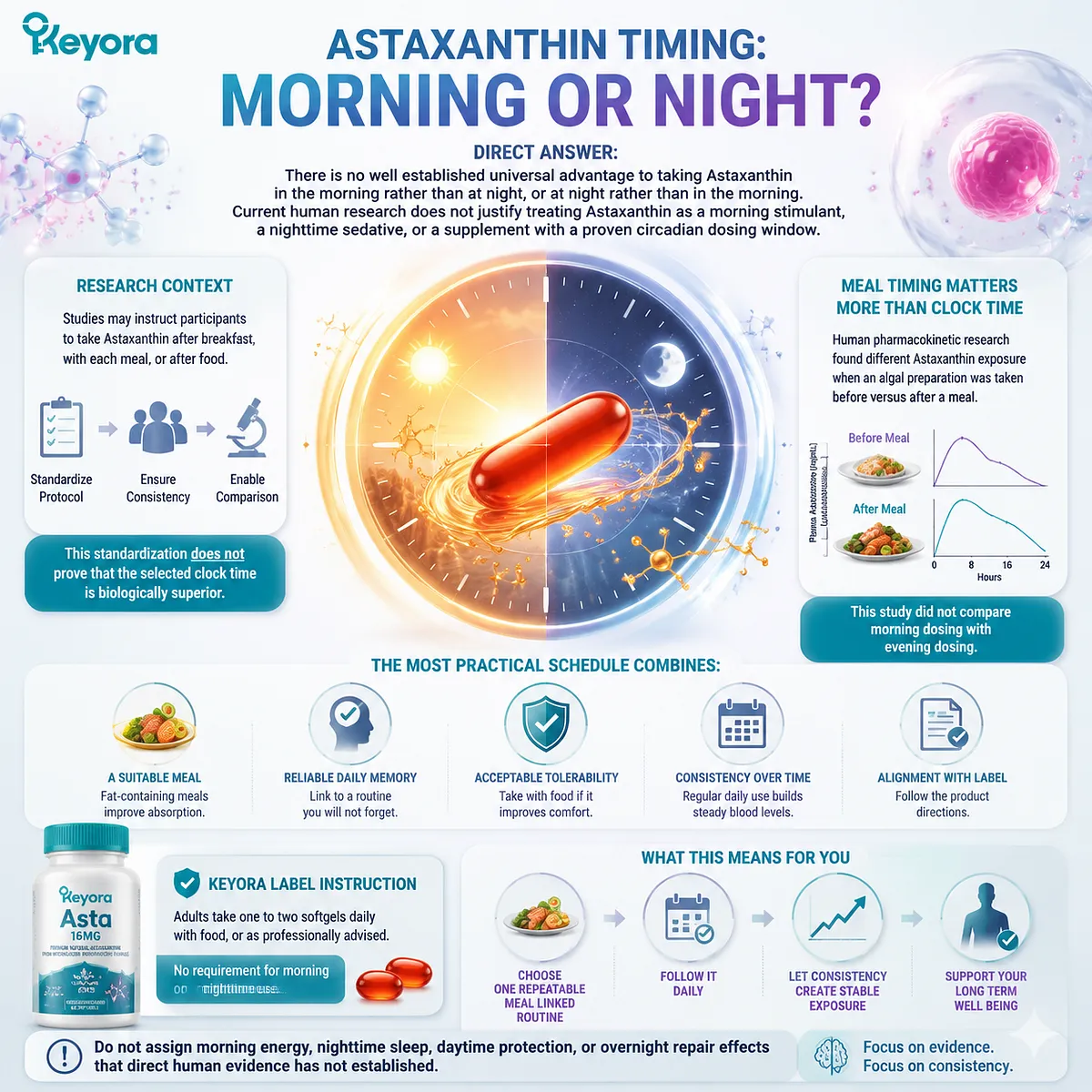
There is no well established universal advantage to taking Astaxanthin in the morning rather than at night, or at night rather than in the morning.
Current human research does not justify treating Astaxanthin as a morning stimulant, a nighttime sedative, or a supplement with a proven circadian dosing window.
A study may instruct participants to take Astaxanthin after breakfast, with each meal, or after food, but that instruction usually standardizes the research protocol. It does not prove that the selected clock time is biologically superior.
Meal timing is more relevant than the number shown on the clock.
Human pharmacokinetic research has found different Astaxanthin exposure when an algal preparation was taken before versus after a meal, but that study did not compare morning dosing with evening dosing.
The most practical schedule is therefore the one that combines:
-
a suitable meal
-
reliable daily memory
-
acceptable tolerability
-
consistency over time
-
alignment with the product directions
The Keyora label instructs adults to take one to two softgels daily with food, or as professionally advised. It does not require morning or nighttime use.
Choose one repeatable meal linked routine.
Do not assign morning energy, nighttime sleep, daytime protection, or overnight repair effects that direct human evidence has not established.
Remove the Clock Before Choosing the Time
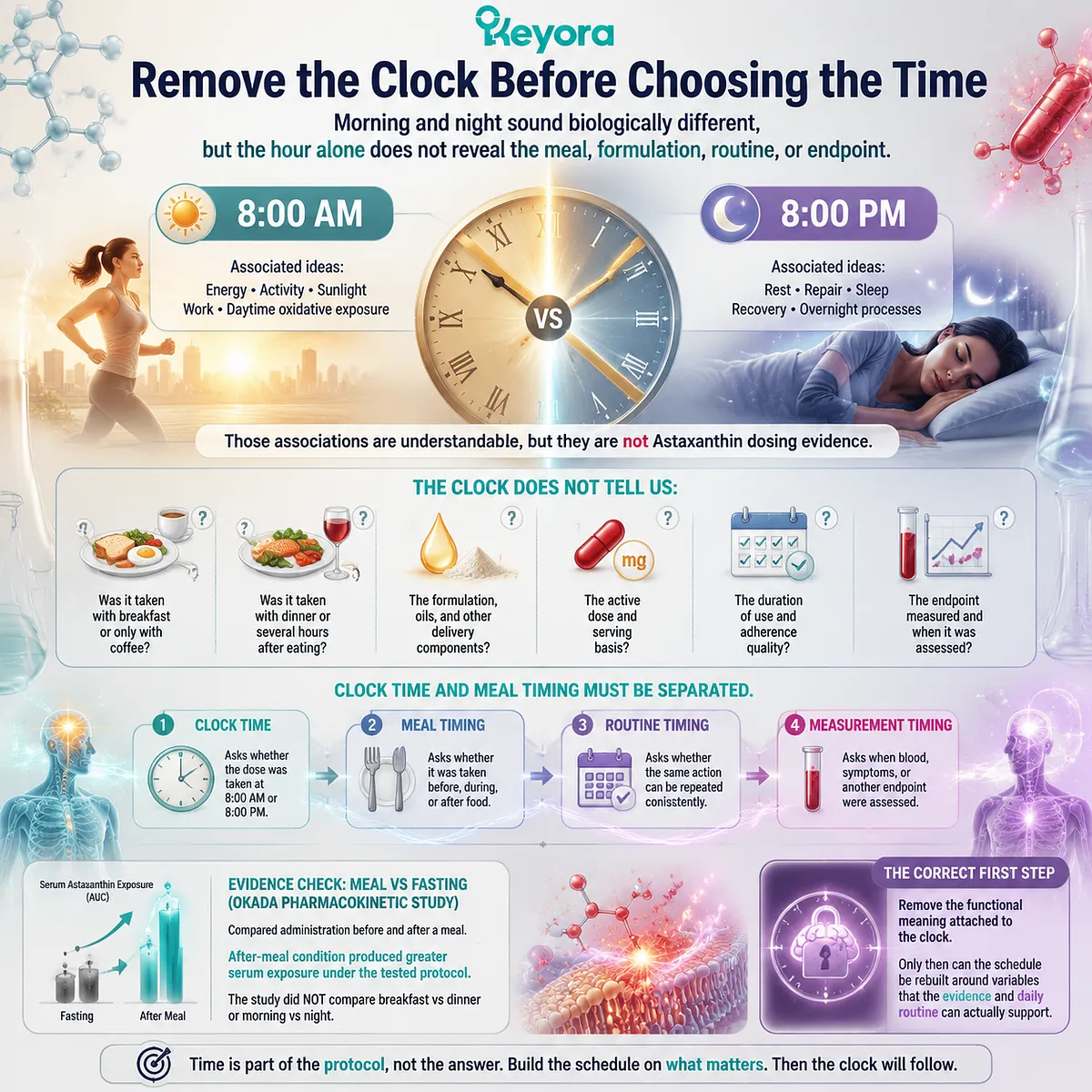
Morning and night sound biologically different, but the hour alone does not reveal the meal, formulation, routine, or endpoint
Imagine two options printed on a schedule:
8:00 AM
8:00 PM
The times appear to represent two different biological strategies. Morning may feel connected to energy, activity, sunlight, work, and daytime oxidative exposure. Night may feel connected to rest, repair, sleep, and recovery.
Those associations are understandable, but they are not Astaxanthin dosing evidence.
The clock does not tell us whether the morning dose was taken with breakfast or only with coffee. It does not tell us whether the evening dose was taken with dinner or several hours after eating. It also does not reveal the formulation, active dose, duration of use, adherence, or outcome being measured.
A morning schedule may be more convenient for someone who eats a consistent breakfast. The advantage in that case is routine reliability, not proven stimulation or superior daytime activity.
A nighttime schedule may be easier for someone whose dinner is the most regular meal. The advantage is practical consistency, not proven sedation or enhanced overnight tissue repair.
Clock time and meal timing must therefore be separated.
Clock time asks whether the dose was taken at 8:00 AM or 8:00 PM.
Meal timing asks whether it was taken before, during, or after food.
Routine timing asks whether the same action can be repeated consistently.
Measurement timing asks when blood, symptoms, or another endpoint were assessed.
These are four different questions.
The Okada pharmacokinetic study compared administration before and after a meal. The after meal condition produced greater serum exposure under the tested protocol, but the research did not compare breakfast with dinner or morning with night.
The correct first step is therefore to remove the functional meaning attached to the clock. Only then can the schedule be rebuilt around variables that the evidence and daily routine can actually support.
Ask What a True Morning Versus Night Study Would Need to Show
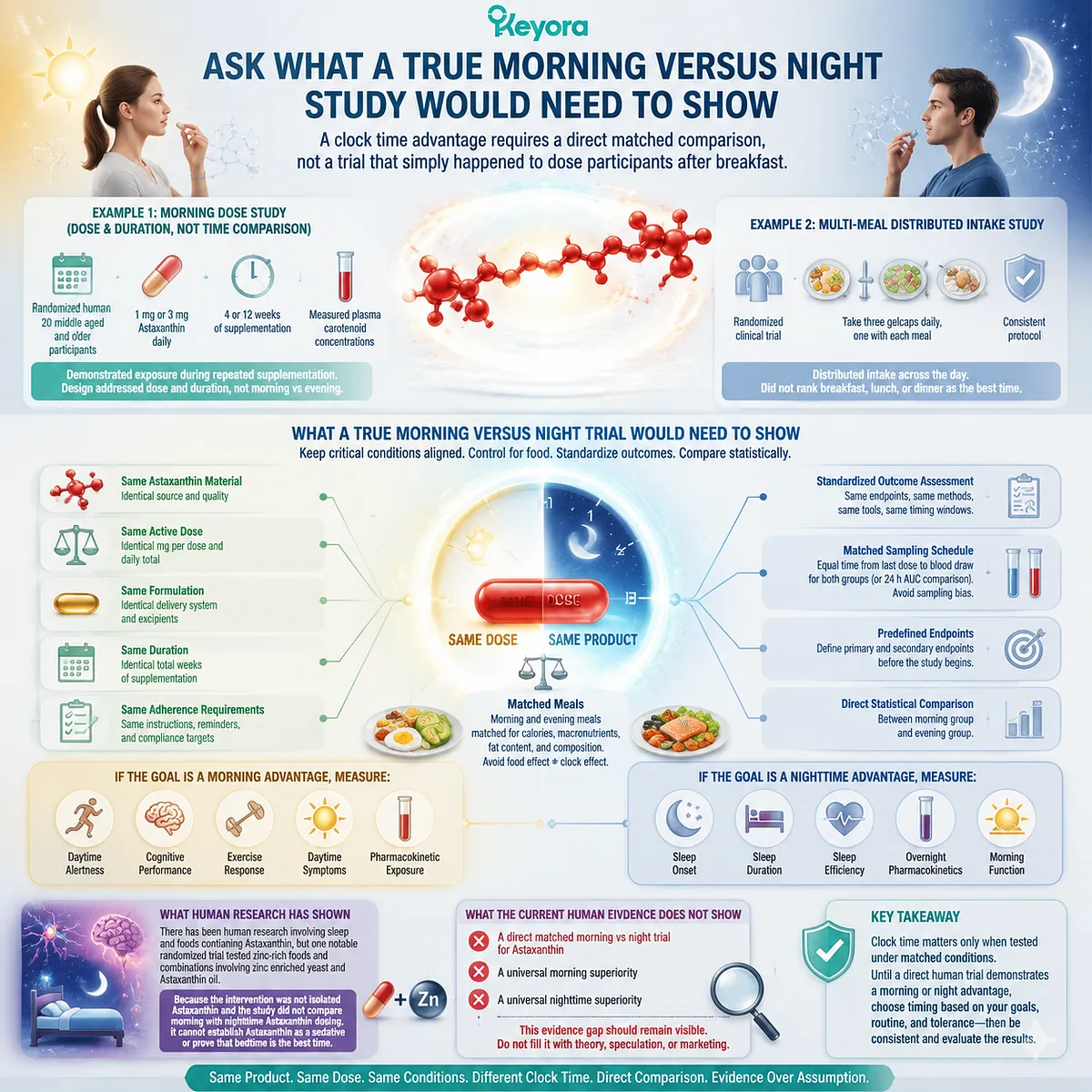
A clock time advantage requires a direct matched comparison, not a trial that simply happened to dose participants after breakfast
A study can use morning dosing without testing whether morning is better.
For example, a randomized human trial gave 20 middle aged and older participants either 1 mg or 3 mg of Astaxanthin daily for 4 or 12 weeks. The study measured plasma carotenoid concentrations and demonstrated exposure during repeated supplementation. Its design addressed dose and duration, not morning versus evening superiority.
Another randomized clinical trial instructed participants to take three gelcaps daily, one with each meal. This approach distributed intake across the day and provided a consistent protocol, but it did not rank breakfast, lunch, or dinner as the best time.
A true morning versus night trial would need to keep the important conditions aligned.
The participants would use the same Astaxanthin material, active dose, formulation, supplementation duration, and adherence requirements. Morning and evening meals would need to be matched closely enough that a food effect was not mistaken for a clock effect.
The study would also need standardized outcome assessment. If morning participants have blood collected four hours after dosing while evening participants have blood collected the next morning, the results could reflect sampling time rather than a circadian advantage.
The endpoint would need to be defined before interpreting the result.
A study seeking a morning advantage might measure:
-
daytime alertness
-
cognitive performance
-
exercise response
-
daytime symptoms
-
pharmacokinetic exposure
A study seeking a nighttime advantage might measure:
-
sleep onset
-
sleep duration
-
sleep efficiency
-
overnight pharmacokinetics
-
morning function
Direct statistical comparison between the time groups would then be required.
There has been human research involving sleep and foods containing Astaxanthin, but one notable randomized trial tested zinc rich foods and combinations involving zinc enriched yeast and Astaxanthin oil. Because the intervention was not isolated Astaxanthin and the study did not compare morning with nighttime Astaxanthin dosing, it cannot establish Astaxanthin as a sedative or prove that bedtime is the best administration time.
Among the human sources reviewed for this article, a direct matched trial establishing a universal morning or nighttime advantage was not identified. That evidence gap should remain visible rather than being filled with antioxidant theory, circadian speculation, or marketing language.
Rebuild the Schedule Around the Variables That Matter More
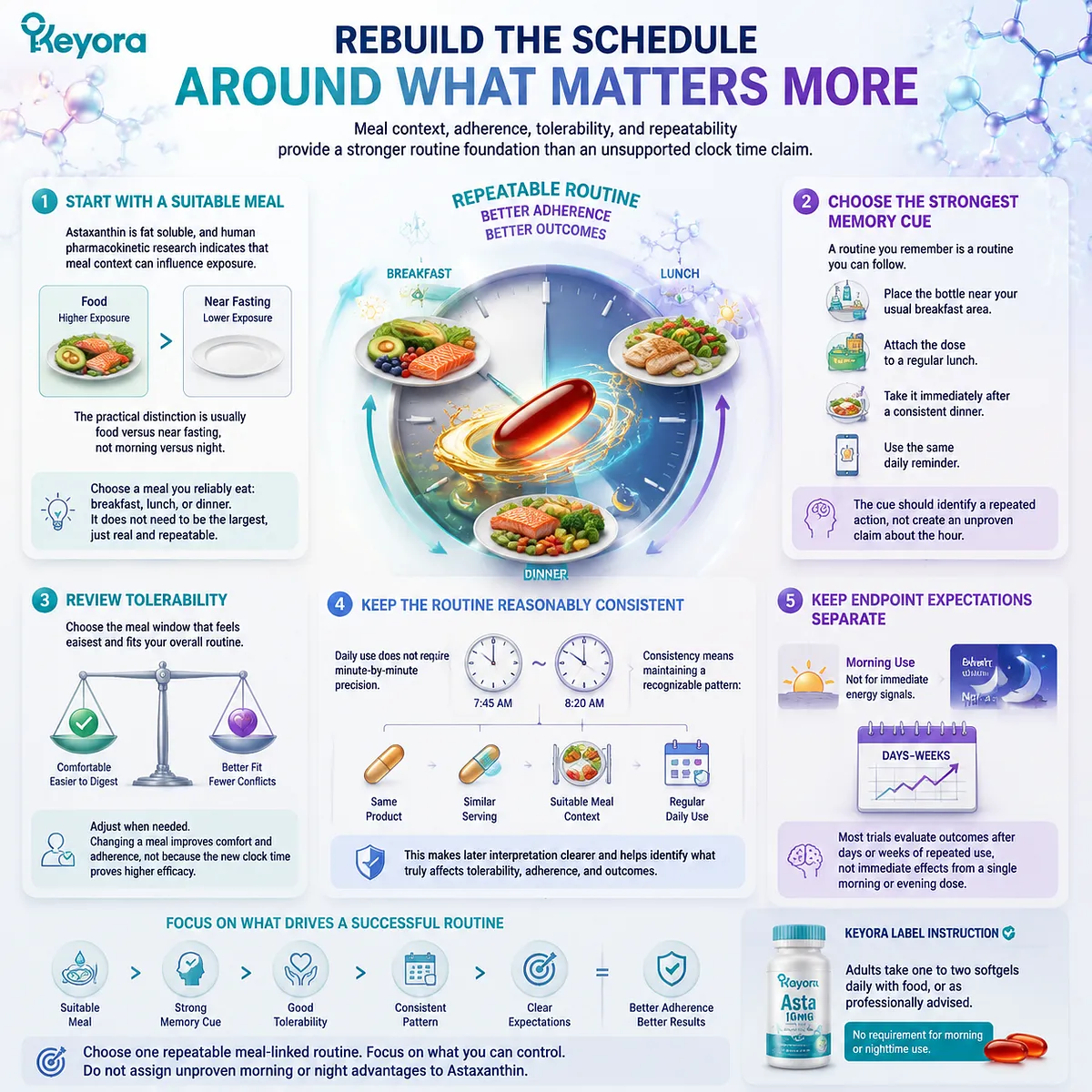
Meal context, adherence, tolerability, and repeatability provide a stronger routine foundation than an unsupported clock time claim
Once the clock has been removed as the presumed deciding factor, the routine can be rebuilt in a more practical order.
Start with a suitable meal
Astaxanthin is fat soluble, and human pharmacokinetic research indicates that meal context can influence exposure. The relevant practical distinction is usually food versus an isolated near fasting condition, not morning versus night.
A person who eats a reliable breakfast may choose morning use. Someone who skips breakfast but consistently eats lunch or dinner may choose a later meal.
The selected meal does not need to be the largest meal of the day. It needs to be a genuine, repeatable meal that fits the product instructions.
Choose the strongest memory cue
A supplement schedule that is biologically imagined but frequently forgotten is not a useful routine.
Useful cues may include:
-
placing the bottle near the normal breakfast area
-
attaching the dose to a regular lunch
-
taking it immediately after a consistent dinner
-
using the same daily reminder
The cue should identify a repeated action, not create an unproven claim about the hour.
Review tolerability
Some people may find one meal window easier to tolerate than another. Moving the dose from breakfast to dinner, or from dinner to lunch, can be a practical adjustment when it improves comfort or reduces the number of supplements taken together.
That adjustment does not demonstrate that the new clock time improves Astaxanthin efficacy. It demonstrates that the routine fits the individual more successfully.
Keep the routine reasonably consistent
Daily use does not require minute by minute precision. Taking a supplement at 7:45 one day and 8:20 the next does not create a scientifically meaningful morning timing failure.
Consistency means maintaining a recognizable pattern:
same product
-
similar serving
-
suitable meal context
-
regular daily use
This also makes later interpretation clearer. When dose, product, meal, and schedule change repeatedly, it becomes difficult to know which variable influenced tolerability, adherence, or any observed outcome.
Keep endpoint expectations separate
Morning use should not be selected because Astaxanthin is expected to produce an immediate energy signal.
Night use should not be selected because it is expected to act like a sleep aid.
Most Astaxanthin trials examine outcomes after days or weeks of repeated supplementation rather than an immediate sensation after one morning or evening dose. A repeated exposure protocol is not evidence of an acute clock time effect.
Use One Stable Anchor Without Turning It Into a Chronotherapy Rule
The Keyora One Anchor Routine creates consistency without claiming that one hour has superior biological effects
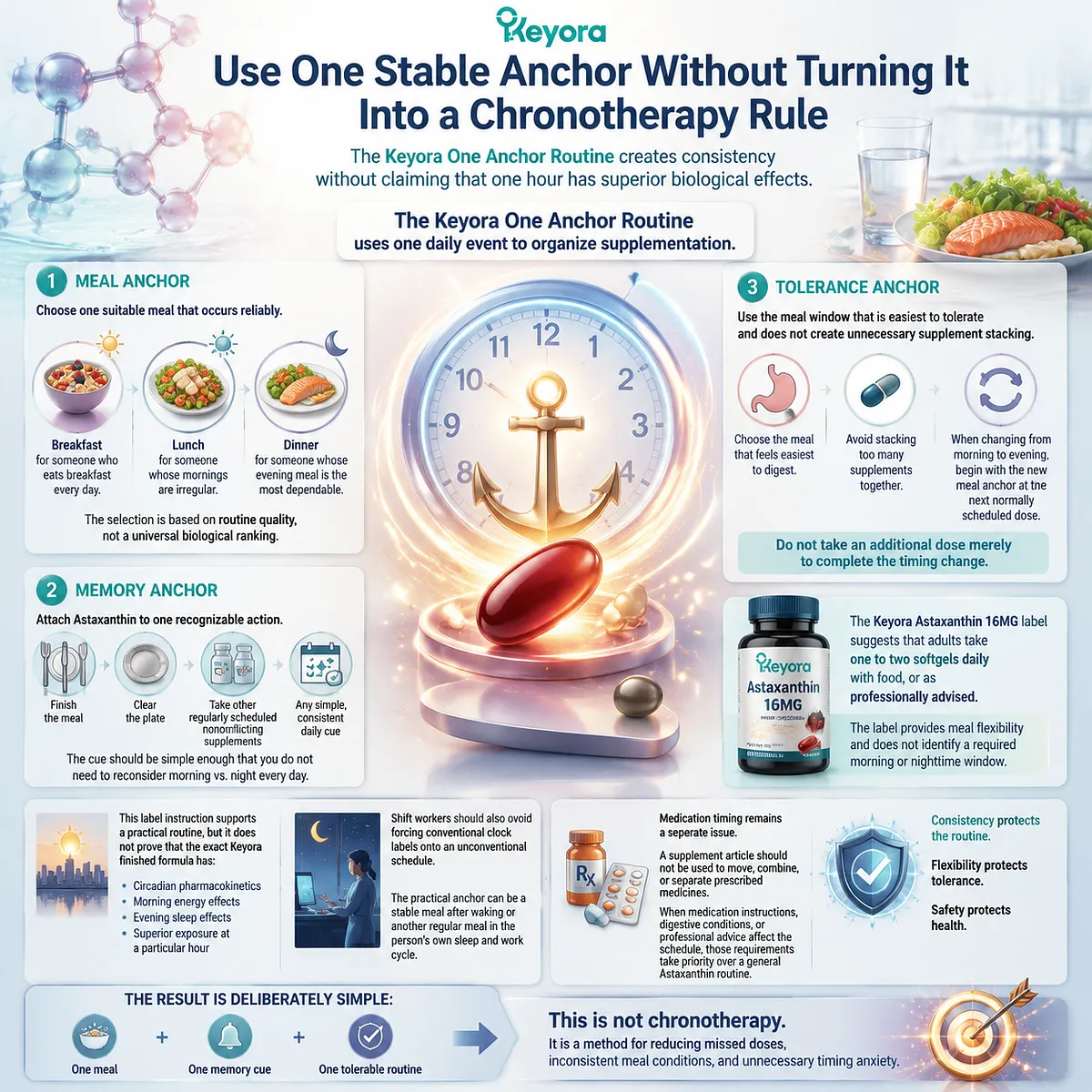
The Keyora One Anchor Routine uses one daily event to organize supplementation.
Meal Anchor
Choose one suitable meal that occurs reliably.
This might be breakfast for someone who eats breakfast every day. It might be lunch for someone whose mornings are irregular. It might be dinner for someone whose evening meal is the most dependable.
The selection is based on routine quality, not a universal biological ranking.
Memory Anchor
Attach Astaxanthin to one recognizable action.
Examples include finishing the meal, clearing the plate, or taking other regularly scheduled nonconflicting supplements. The cue should be simple enough that the person does not need to reconsider morning versus night every day.
Tolerance Anchor
Use the meal window that is easiest to tolerate and does not create unnecessary supplement stacking.
When changing from morning to evening, simply begin using the new meal anchor with the next normally scheduled dose. Do not take an additional dose merely to complete the timing change.
The Keyora Astaxanthin 16MG label suggests that adults take one to two softgels daily with food, or as professionally advised. The label provides meal flexibility and does not identify a required morning or nighttime window.
This label instruction supports a practical routine, but it does not prove that the exact Keyora finished formula has circadian pharmacokinetics, morning energy effects, evening sleep effects, or superior exposure at a particular hour.
Shift workers should also avoid forcing conventional clock labels onto an unconventional schedule. The practical anchor can be a stable meal after waking or another regular meal in the person’s own sleep and work cycle.
Medication timing remains a separate issue. A supplement article should not be used to move, combine, or separate prescribed medicines. When medication instructions, digestive conditions, or professional advice affect the schedule, those requirements take priority over a general Astaxanthin routine.
The result is deliberately simple:
One meal
-
one memory cue
-
one tolerable routine
This is not chronotherapy. It is a method for reducing missed doses, inconsistent meal conditions, and unnecessary timing anxiety.
Closing Summary
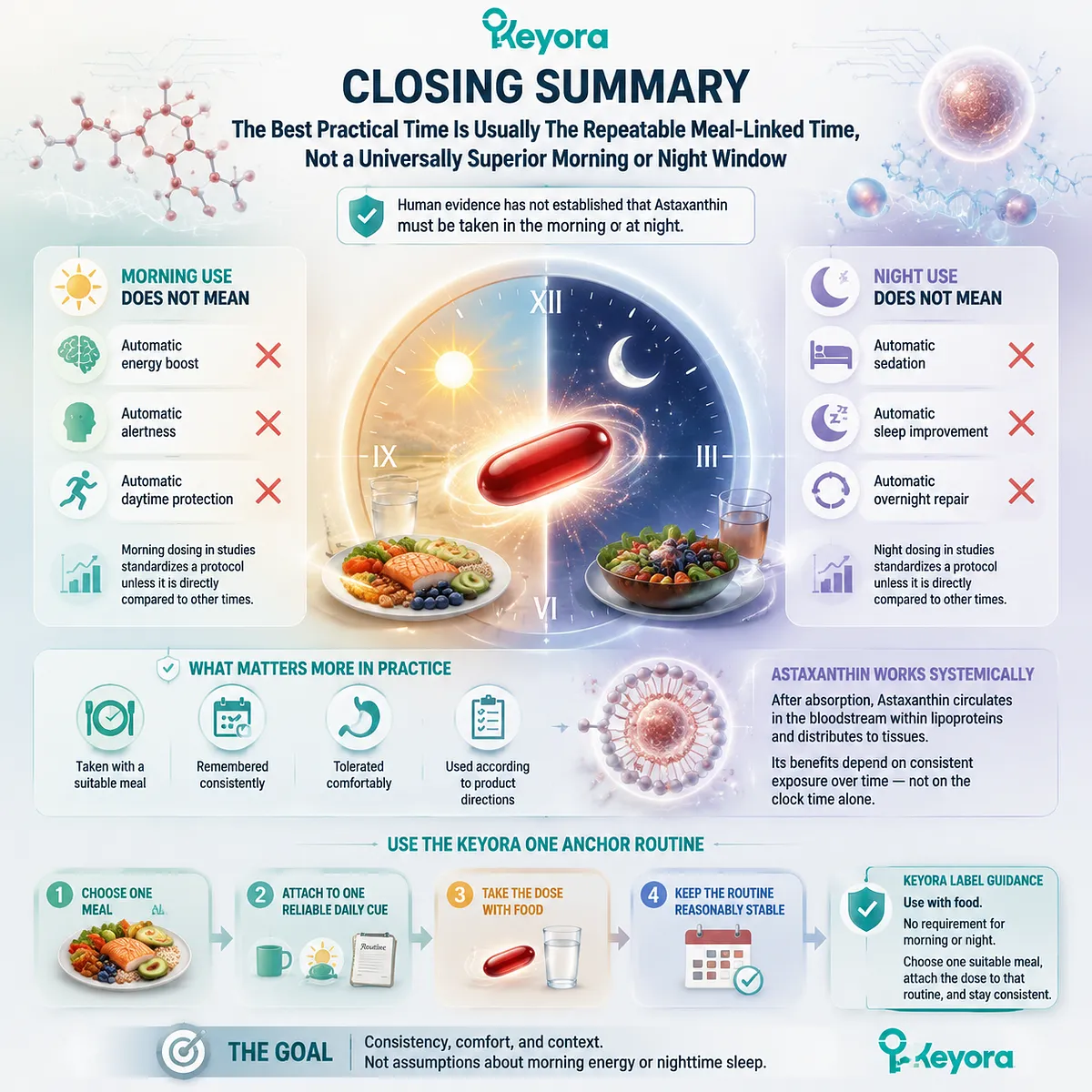
The best practical time is usually the repeatable meal linked time, not a universally superior morning or night window
Human evidence has not established that Astaxanthin must be taken in the morning or at night.
Morning use should not be assigned automatic energy, alertness, or daytime protection effects. Night use should not be assigned automatic sedation, sleep, or overnight repair effects. Studies that administer Astaxanthin after breakfast, with meals, or after food standardize a protocol unless they directly compare clock times.
What matters more in practice is whether the dose is taken with a suitable meal, remembered consistently, tolerated comfortably, and used according to the product directions.
Use the Keyora One Anchor Routine:
Choose one meal, attach the dose to one reliable daily cue, and keep that routine reasonably stable.
The Keyora label specifies use with food but does not require morning or night.
Choose one suitable meal, attach the dose to that routine, and do not assign morning energy or nighttime sleep effects that the evidence has not established.
This article is for educational and informational purposes only. It does not provide medical advice, diagnosis, treatment, cure, prevention, disease outcome claims, hormone restoration claims, fertility outcome claims, or formula-specific clinical efficacy claims.