
Is Synthetic Astaxanthin Safe for Human Supplements?
Keyora Research Q&A Library
This is part of the Keyora Research Q&A Series, derived from Keyora Nutritional Neurology Series .
Within the Keyora Nutritional Neurology framework, this Q&A translates complex nutrient–brain mechanisms into reader-friendly, evidence-bound answers, focusing on stress resilience, sleep quality, calm mood support, cognitive wellness, and the broader interaction between nutrition, neurochemistry, and daily nervous-system function.
First published by Keyora Research Journal: www.keyorahealth.com
Direct Answer
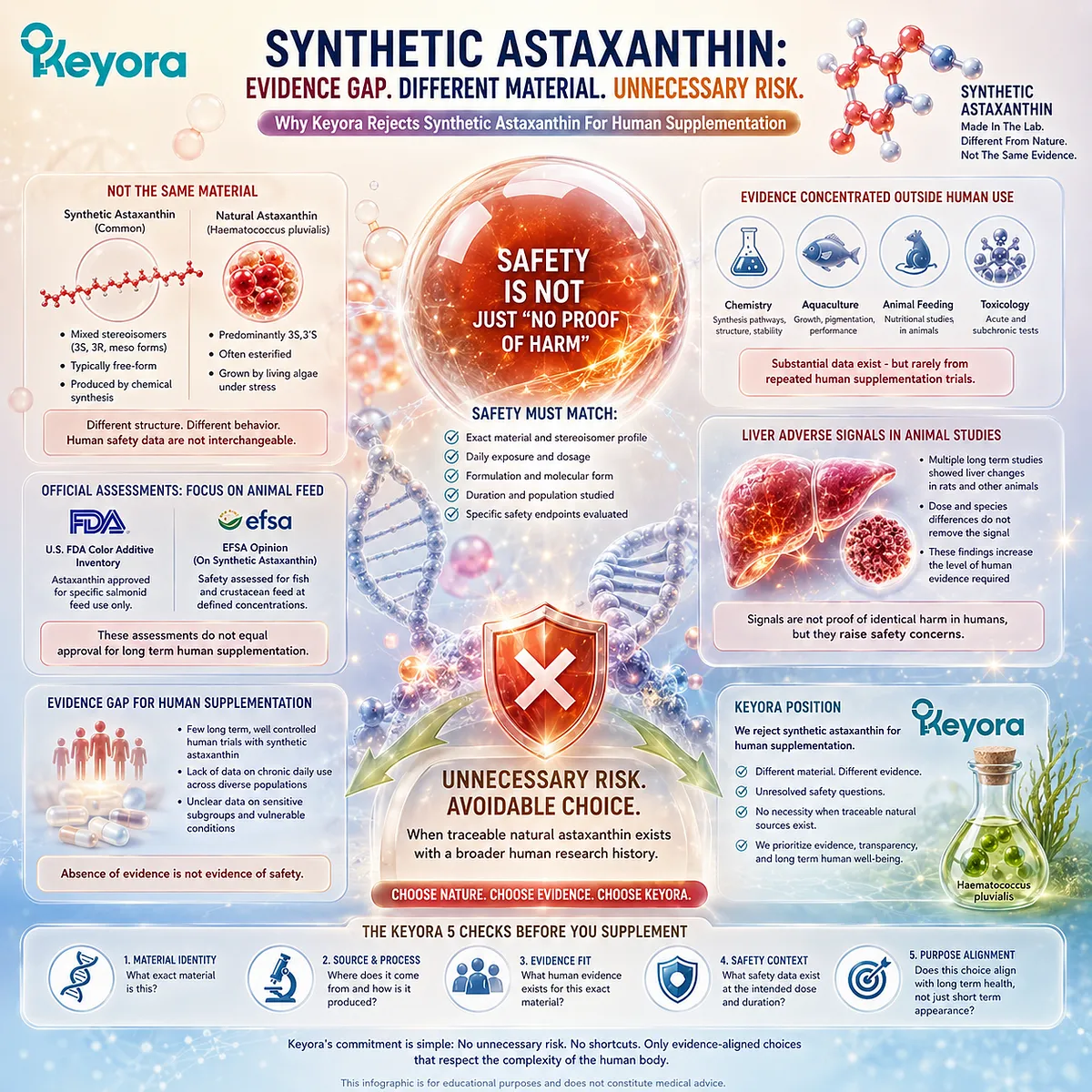
Synthetic astaxanthin has not been proven harmful to humans at every dose, but current evidence is not strong enough to establish it as a reliable source for long term human supplementation. These are two different conclusions.
The absence of confirmed human injury does not equal positive proof of safety.
A meaningful safety conclusion must apply to the exact material, daily exposure, formulation, duration, population, and safety endpoints studied.
Conventional synthetic astaxanthin has a different stereoisomer profile and common molecular form from natural Haematococcus pluvialis astaxanthin. Human safety evidence generated with natural algal preparations therefore cannot be transferred automatically to synthetic material.
Synthetic astaxanthin has substantial evidence from chemistry, aquaculture, animal feeding, and toxicology.
However, official assessments have focused heavily on defined animal feed uses rather than direct, repeated human supplementation. The FDA’s current color additive inventory lists astaxanthin for specific salmonid feed use, while EFSA’s synthetic astaxanthin opinion addresses fish and crustacean feed at defined concentrations.
Chronic animal research has also produced liver related adverse signals. These findings do not prove that ordinary human supplement doses cause identical harm, but they increase the level of human evidence required before routine use can be recommended.
Keyora rejects synthetic astaxanthin for human supplementation because its unresolved safety questions are unnecessary when traceable natural sources with a broader human research history are available.
Not Proven Harmful Does Not Mean Proven Safe
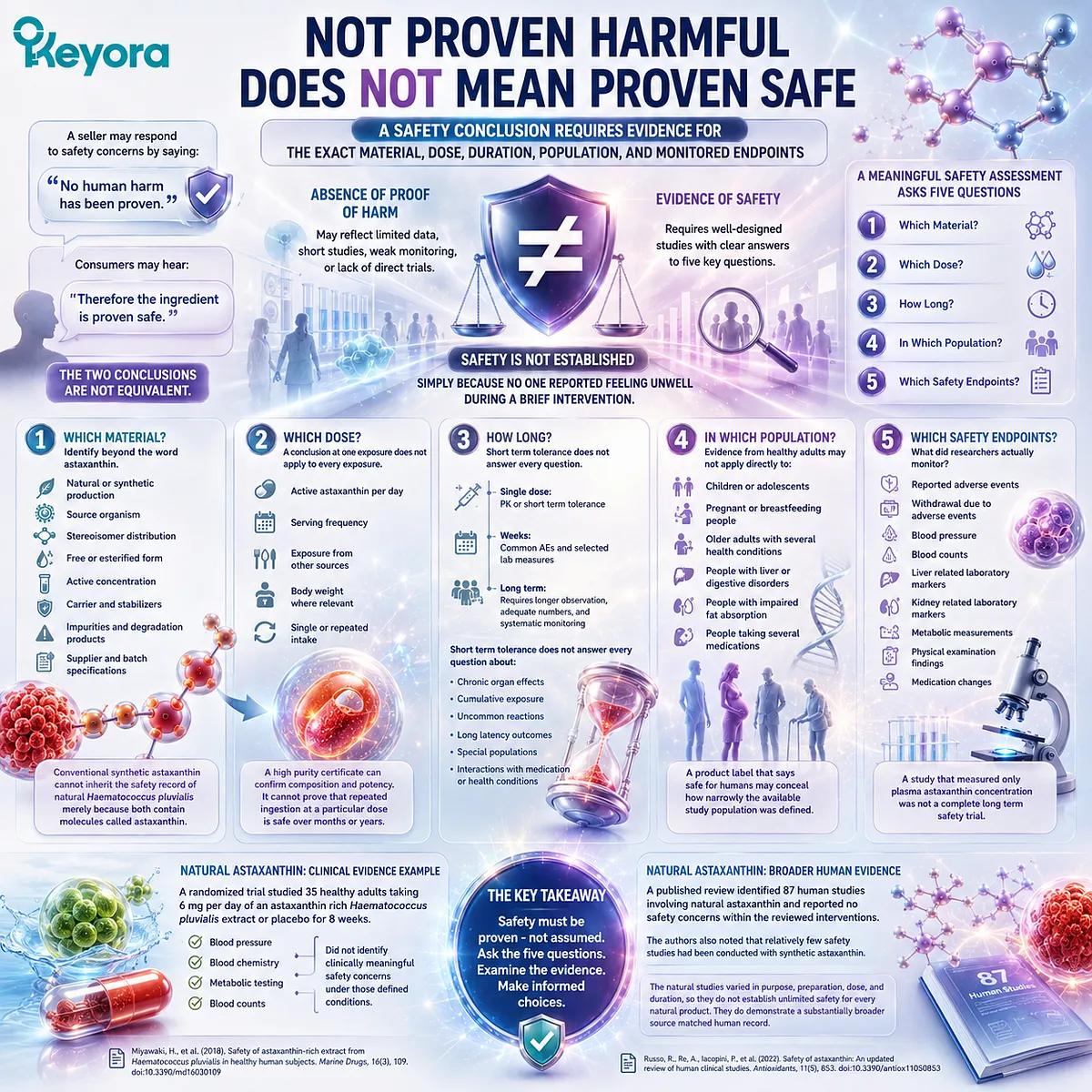
A safety conclusion requires evidence for the exact material, dose, duration, population, and monitored endpoints
A seller may respond to safety concerns by saying:
No human harm has been proven
That statement may be technically narrower than a direct safety claim, but consumers can easily hear a different message:
Therefore the ingredient is proven safe
The two conclusions are not equivalent.
Failure to document human harm may reflect genuine safety. It may also reflect limited exposure data, small studies, short follow up, weak adverse event monitoring, unclear source reporting, or the absence of direct trials using the material in question.
Safety is not established simply because no one reported feeling unwell during a brief intervention.
A meaningful safety assessment asks five questions.
1. Which Material?
The ingredient must be identified beyond the word astaxanthin.
Relevant details include:
-
natural or synthetic production
-
source organism
-
stereoisomer distribution
-
free or esterified form
-
active concentration
-
carrier and stabilizers
-
impurities and degradation products
-
supplier and batch specifications
Conventional synthetic astaxanthin cannot inherit the safety record of natural Haematococcus pluvialis merely because both contain molecules called astaxanthin.
2. Which Dose?
A conclusion established at one exposure does not automatically apply to every exposure.
The study should report:
-
active astaxanthin per day
-
serving frequency
-
exposure from other sources
-
body weight where relevant
-
whether intake was single or repeated
A high purity certificate can confirm composition and potency. It cannot prove that repeated ingestion at a particular dose is safe over months or years.
3. How Long?
A single dose study can investigate immediate pharmacokinetics or short term tolerance.
Several weeks of use may provide information about common adverse events and selected laboratory measurements.
Long term safety requires longer observation, adequate participant numbers, systematic monitoring, and attention to effects that may develop gradually.
Short term tolerance does not answer every question about:
-
chronic organ effects
-
cumulative exposure
-
uncommon reactions
-
long latency outcomes
-
special populations
-
interactions with medication or health conditions
4. In Which Population?
Evidence from healthy adults may not apply directly to:
-
children or adolescents
-
pregnant or breastfeeding people
-
older adults with several health conditions
-
people with liver or digestive disorders
-
people with impaired fat absorption
-
people taking several medications
A product label that says safe for humans may conceal how narrowly the available study population was defined.
5. Which Safety Endpoints?
A study should explain what researchers actually monitored.
Possible endpoints include:
-
reported adverse events
-
withdrawal due to adverse events
-
blood pressure
-
blood counts
-
liver related laboratory markers
-
kidney related laboratory markers
-
metabolic measurements
-
physical examination findings
-
medication changes
A study that measured only plasma astaxanthin concentration was not a complete long term safety trial.
Natural astaxanthin provides an important comparison. A randomized trial studied 35 healthy adults taking 6 mg per day of an astaxanthin rich Haematococcus pluvialis extract or placebo for eight weeks. The study included blood pressure, blood chemistry, metabolic testing, and blood counts, and did not identify clinically meaningful safety concerns under those defined conditions. That result applies to the tested natural preparation, dose, duration, and adult population.
A broader published review identified 87 human studies involving natural astaxanthin and reported no safety concerns within the reviewed interventions. The authors also noted that relatively few safety studies had been conducted with synthetic astaxanthin. The natural studies varied in purpose, preparation, dose, and duration, so they do not establish unlimited safety for every natural product. They do demonstrate a substantially broader source matched human record.
Not proven harmful is not the same as proven safe
The Long Term Human Evidence Is Not Adequate
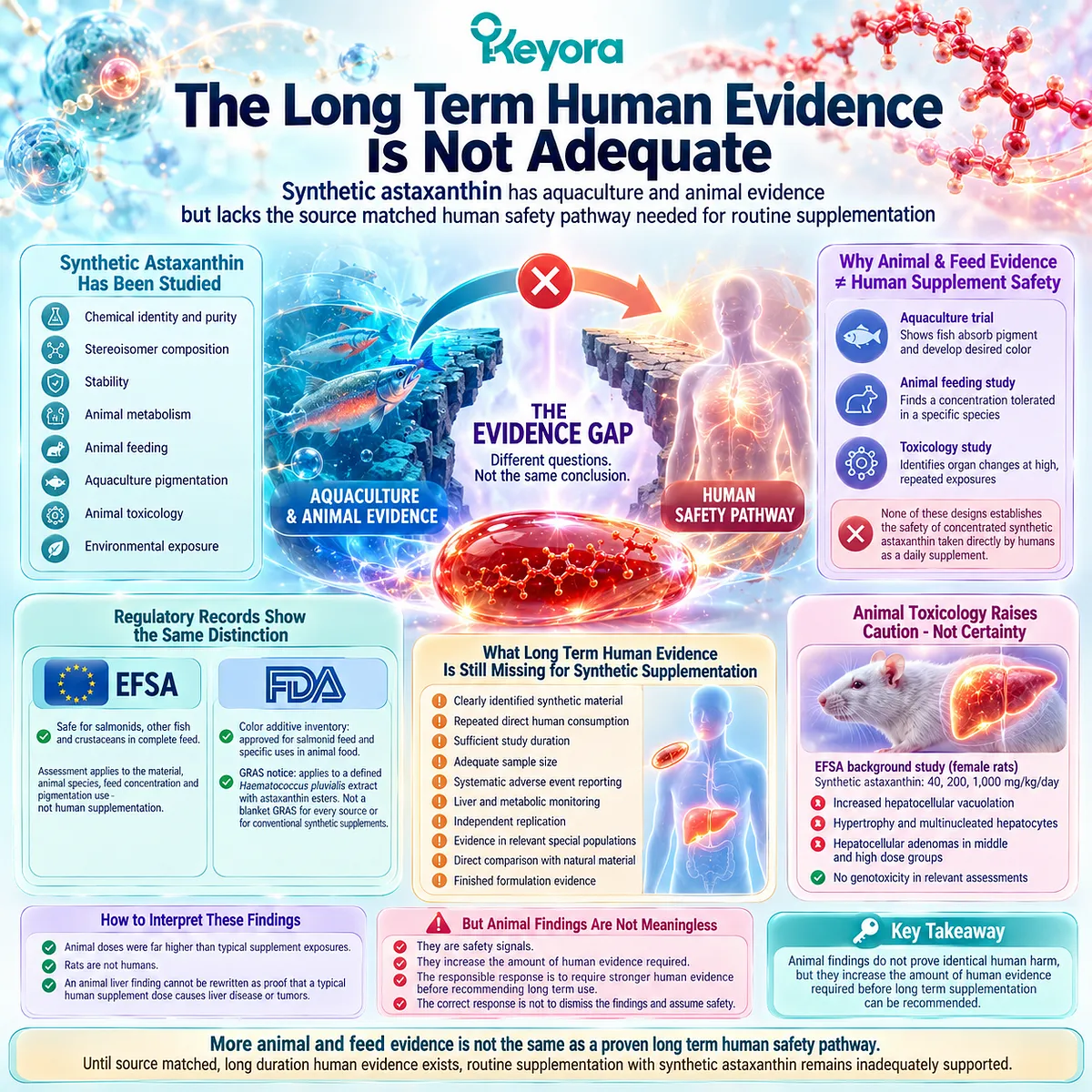
Synthetic astaxanthin has aquaculture and animal evidence but lacks the source matched human safety pathway needed for routine supplementation
Synthetic astaxanthin is not completely unstudied.
It has been evaluated in several evidence settings:
-
chemical identity and purity
-
stereoisomer composition
-
stability
-
animal metabolism
-
animal feeding
-
aquaculture pigmentation
-
animal toxicology
-
environmental exposure
The problem is that these evidence categories answer different questions.
An aquaculture trial may show that fish absorb pigment and develop a desired tissue color.
An animal feeding study may identify a concentration tolerated by a particular species.
A toxicology study may identify organ changes at high, repeated exposures.
None of these designs independently establishes the safety of concentrated synthetic astaxanthin taken directly by humans as a daily supplement.
EFSA’s opinion on synthetic astaxanthin concluded that defined concentrations were safe for salmonids, other fish, and crustaceans in complete feed. That conclusion belongs to the assessed material, animal species, feed concentration, and intended pigmentation use. It is not a general conclusion about direct human supplementation.
The distinction remains visible in current United States regulatory records. The FDA color additive inventory lists astaxanthin for salmonid feed at a specified maximum concentration and identifies the relevant astaxanthin related color additives as approved for specific uses in animal food. The database does not convert that animal food authorization into evidence for direct synthetic astaxanthin supplementation by humans.
FDA GRAS notices concerning astaxanthin also illustrate why source specificity matters. One current record concerns a defined Haematococcus pluvialis extract containing astaxanthin esters, with identified food uses and use levels. It is not a blanket GRAS conclusion for every astaxanthin source or for conventional synthetic astaxanthin supplements.
The long term evidence gap for synthetic supplementation is therefore not simply that fewer papers exist.
The more important missing elements include:
-
clearly identified synthetic material
-
repeated direct human consumption
-
sufficient study duration
-
adequate sample size
-
systematic adverse event reporting
-
liver and metabolic monitoring
-
independent replication
-
evidence in relevant special populations
-
direct comparison with natural material
-
finished formulation evidence
Animal toxicology makes that gap more important.
EFSA’s public background on astaxanthin safety describes a chronic toxicity and carcinogenicity study in female rats given synthetic astaxanthin at 40, 200, or 1,000 mg per kilogram of body weight per day. Increased hepatocellular vacuolation, hypertrophy, and multinucleated hepatocytes were reported at the tested doses, while hepatocellular adenomas were reported in the middle and high dose groups. EFSA also noted the absence of genotoxicity in the relevant assessments.
These findings require careful interpretation.
The animal doses were far higher than ordinary supplement exposures.
Rats are not humans.
An animal liver finding cannot be rewritten as proof that a typical human supplement dose causes liver disease or tumors.
However, high dose animal findings are not meaningless merely because direct human translation is uncertain.
They are safety signals.
When a chronic animal study identifies adverse changes, the responsible response is to require stronger human evidence before recommending long term use. The correct response is not to dismiss the findings and assume safety because direct human harm has not yet been demonstrated.
Animal findings do not prove identical human harm, but they increase the amount of human evidence required before long term supplementation can be recommended
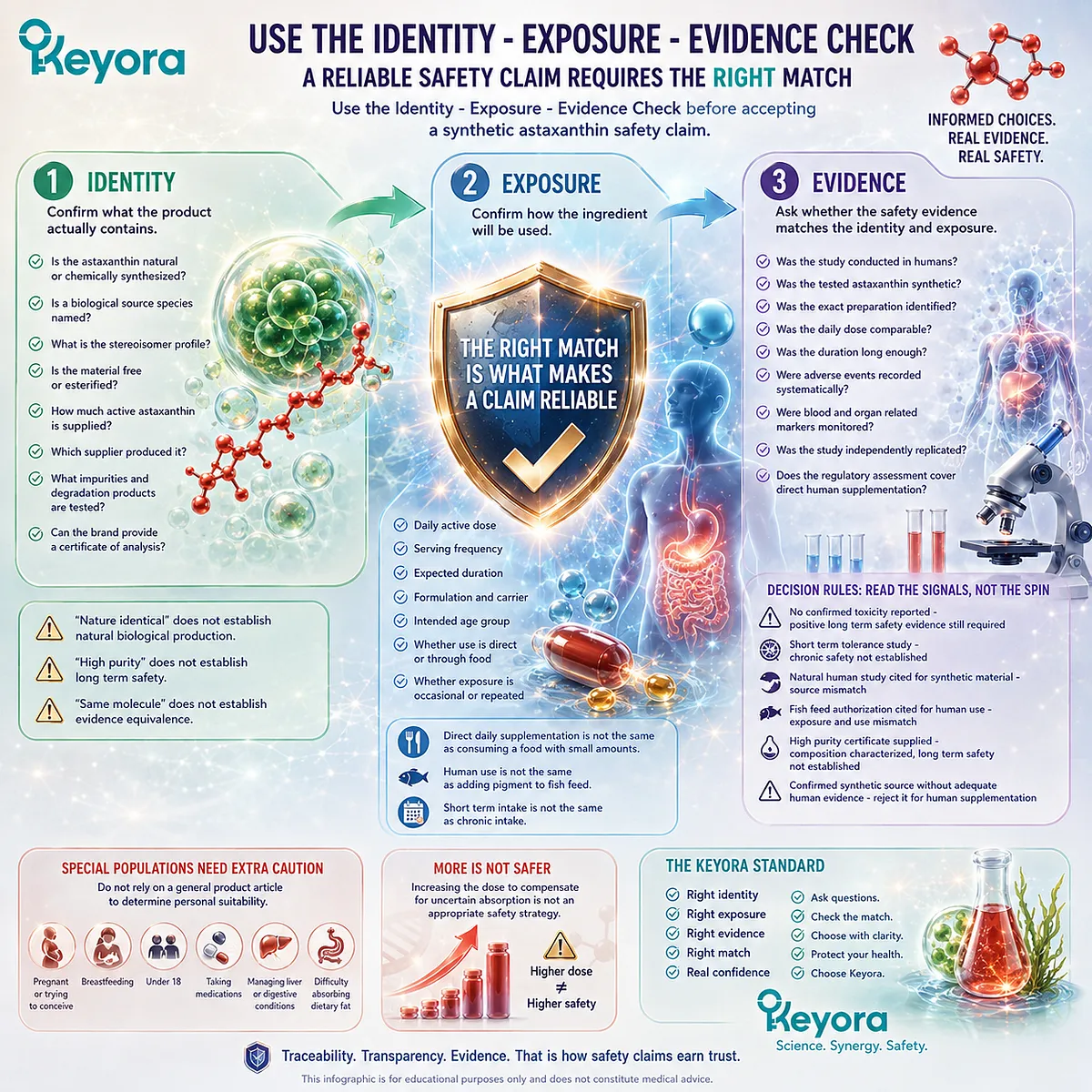
Use the Identity – Exposure – Evidence Check
A reliable safety claim should identify the exact ingredient, intended exposure, and human evidence supporting that use
Use the Identity – Exposure – Evidence Check before accepting a synthetic astaxanthin safety claim.
1. Identity
Confirm what the product actually contains.
Ask:
-
Is the astaxanthin natural or chemically synthesized?
-
Is a biological source species named?
-
What is the stereoisomer profile?
-
Is the material free or esterified?
-
How much active astaxanthin is supplied?
-
Which supplier produced it?
-
What impurities and degradation products are tested?
-
Can the brand provide a certificate of analysis?
The phrase nature identical does not establish natural biological production.
The phrase high purity does not establish long term safety.
The phrase same molecule does not establish evidence equivalence.
2. Exposure
Confirm how the ingredient will be used.
Check:
-
daily active dose
-
serving frequency
-
expected duration
-
formulation and carrier
-
intended age group
-
whether use is direct or through food
-
whether exposure is occasional or repeated
Direct daily supplementation is not the same exposure as consuming a food that contains small amounts of astaxanthin.
Human use is not the same as adding pigment to fish feed.
Short term intake is not the same as chronic intake.
3. Evidence
Ask whether the safety evidence matches the identity and exposure.
Relevant questions include:
-
Was the study conducted in humans?
-
Was the tested astaxanthin synthetic?
-
Was the exact preparation identified?
-
Was the daily dose comparable?
-
Was the duration long enough?
-
Were adverse events recorded systematically?
-
Were blood and organ related markers monitored?
-
Was the study independently replicated?
-
Does the regulatory assessment cover direct human supplementation?
The decision rules are straightforward.
No confirmed toxicity reported – positive long term safety evidence still required
Short term tolerance study – chronic safety not established
Natural human study cited for synthetic material – source mismatch
Fish feed authorization cited for human use – exposure and use mismatch
High purity certificate supplied – composition characterized, long term safety not established
Confirmed synthetic source without adequate human evidence – reject it for human supplementation
People who are pregnant, breastfeeding, under 18, taking medications, managing liver or digestive conditions, or experiencing difficulty absorbing dietary fat should not rely on a general product article to determine personal suitability.
Increasing the dose to compensate for uncertain absorption is also not an appropriate safety strategy.
What This Means When Choosing Astaxanthin
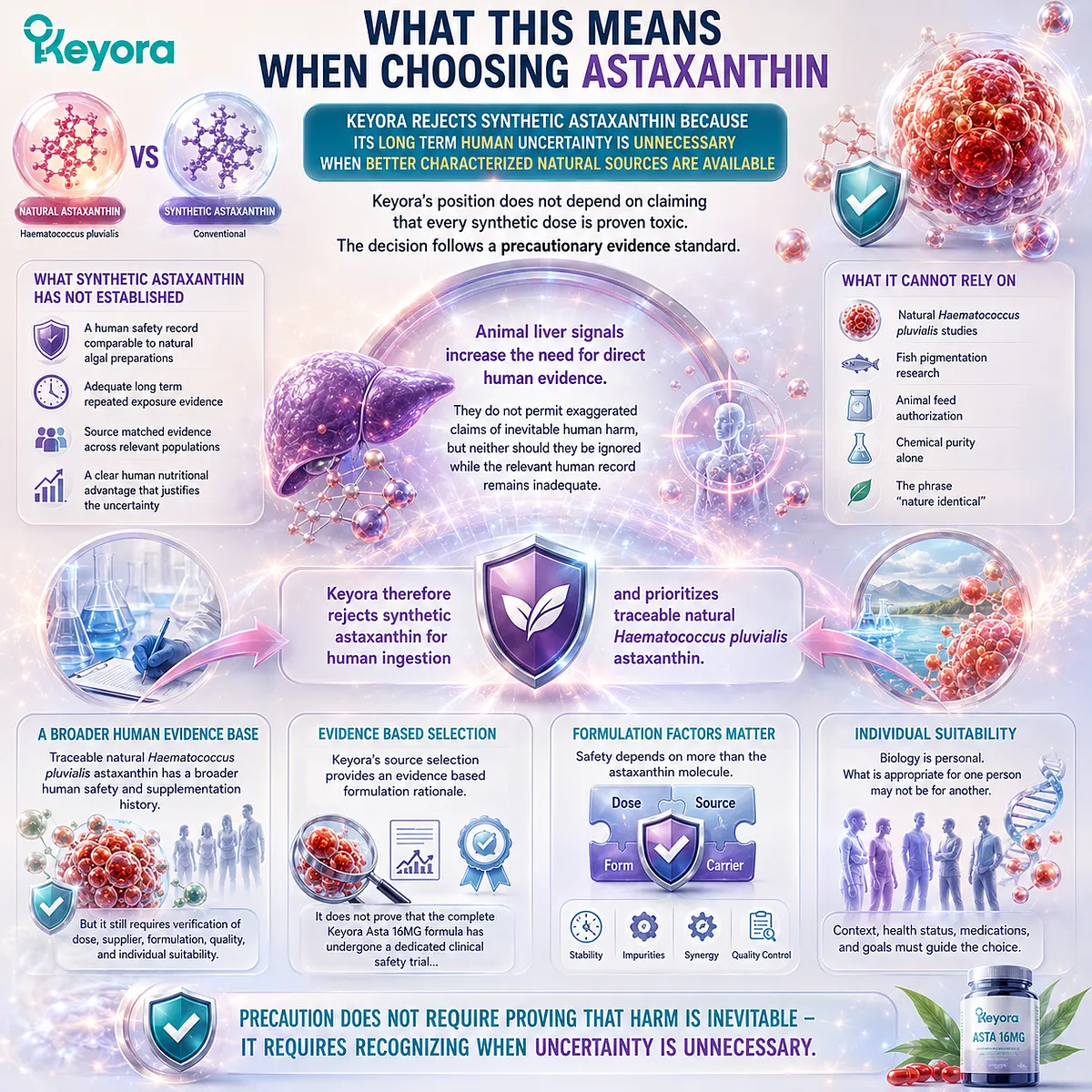
Keyora rejects synthetic astaxanthin because its long term human uncertainty is unnecessary when better characterized natural sources are available
Keyora’s position does not depend on claiming that every synthetic dose is proven toxic.
The decision follows a precautionary evidence standard.
Conventional synthetic astaxanthin has not established:
-
a human safety record comparable to natural algal preparations
-
adequate long term repeated exposure evidence
-
source matched evidence across relevant populations
-
a clear human nutritional advantage that justifies the uncertainty
It also cannot rely on:
-
natural Haematococcus pluvialis studies
-
fish pigmentation research
-
animal feed authorization
-
chemical purity alone
-
the phrase nature identical
Animal liver signals increase the need for direct human evidence. They do not permit exaggerated claims of inevitable human harm, but neither should they be ignored while the relevant human record remains inadequate.
Keyora therefore rejects synthetic astaxanthin for human ingestion and prioritizes traceable natural Haematococcus pluvialis astaxanthin.
This natural source has a broader human safety and supplementation history, but it still requires verification of dose, supplier, formulation, quality, and individual suitability.
Keyora’s source selection provides an evidence based formulation rationale. It does not prove that the complete Keyora Asta 16MG formula has undergone a dedicated clinical safety trial unless that exact finished formulation has been studied.
Precaution does not require proving that harm is inevitable – it requires recognizing when uncertainty is unnecessary
Closing Summary
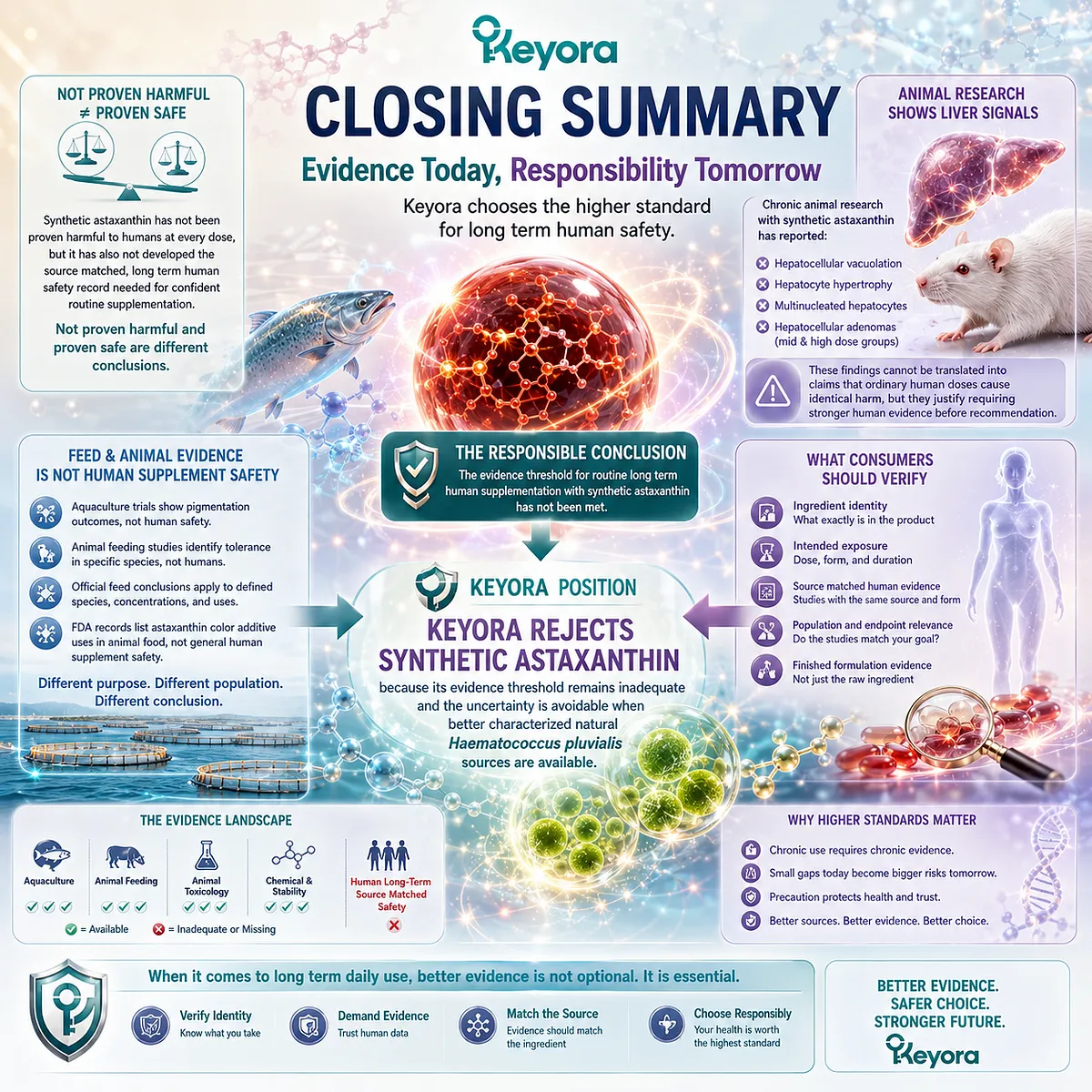
Synthetic astaxanthin has not been proven harmful to humans at every dose, but it has also not developed the source matched, long term human safety record needed for confident routine supplementation.
Not proven harmful and proven safe are different conclusions.
Synthetic astaxanthin has extensive aquaculture, animal, chemical, and toxicological evidence. Official feed conclusions apply to defined animal species, concentrations, and uses, not direct daily human supplementation. Current FDA records likewise identify astaxanthin color additive uses in animal food rather than establishing a general human supplement safety conclusion.
Chronic animal research has produced liver related adverse signals. These findings cannot be translated into claims that ordinary human doses cause identical harm, but they justify requiring stronger human evidence before recommendation.
Consumers should verify the ingredient identity, intended exposure, and source matched human evidence rather than relying on purity, fish feed history, or natural astaxanthin research.
Keyora rejects synthetic astaxanthin because its evidence threshold remains inadequate and the uncertainty is avoidable when better characterized natural Haematococcus pluvialis sources are available
This article is for educational and informational purposes only. It does not provide medical advice, diagnosis, treatment, cure, prevention, disease outcome claims, hormone restoration claims, fertility outcome claims, or formula-specific clinical efficacy claims.