
Is Synthetic Astaxanthin Chemically the Same as Natural Astaxanthin?
Keyora Research Q&A Library
This is part of the Keyora Research Q&A Series, derived from Keyora Nutritional Neurology Series.
Within the Keyora Nutritional Neurology framework, this Q&A translates complex nutrient–brain mechanisms into reader-friendly, evidence-bound answers, focusing on stress resilience, sleep quality, calm mood support, cognitive wellness, and the broader interaction between nutrition, neurochemistry, and daily nervous-system function.
First published by Keyora Research Journal: www.keyorahealth.com
Direct Answer
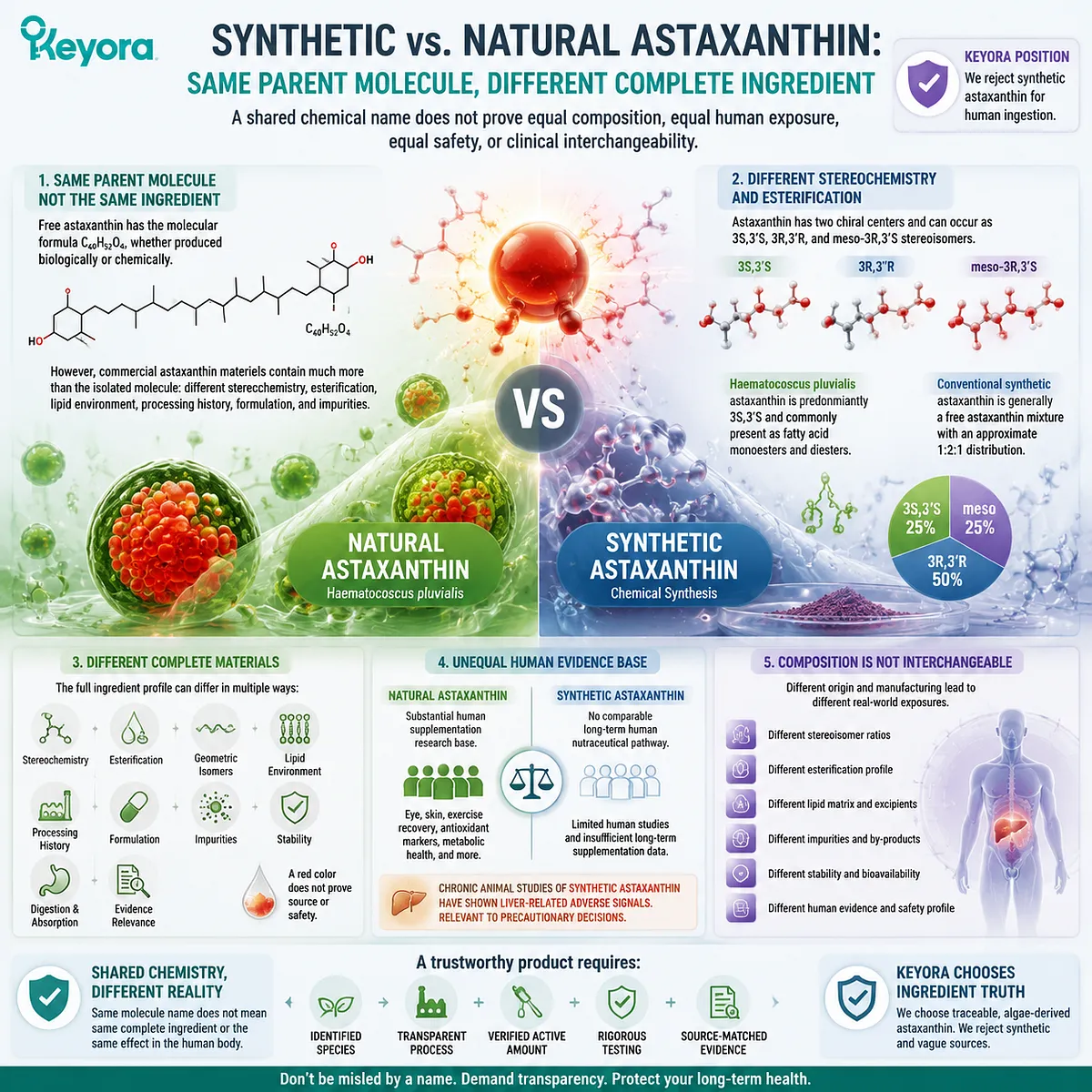
Synthetic and natural astaxanthin share the parent astaxanthin structure, but they should not be treated as the same complete ingredient for human supplementation. Free astaxanthin has the molecular formula C40H52O4, regardless of whether the molecule was produced biologically or chemically. However, that narrow chemical fact does not describe everything contained in a commercial astaxanthin material.
Astaxanthin has two chiral centers and can occur as 3S,3′S, 3R,3′R, and meso-3R,3′S stereoisomers. Conventional synthetic astaxanthin is generally a free astaxanthin mixture with an approximate 1:2:1 distribution of these three forms. Haematococcus pluvialis astaxanthin is predominantly associated with 3S,3′S astaxanthin and is commonly present as fatty acid monoesters and diesters.
This means the complete commercial materials can differ in stereochemistry, esterification, geometric isomers, lipid environment, processing history, formulation, impurities, stability, digestion, and evidence relevance.
The human research base is also unequal. A substantial body of human supplementation research concerns natural astaxanthin, while conventional synthetic astaxanthin does not have a comparable long-term human nutraceutical evidence pathway. Chronic animal studies of synthetic astaxanthin have also produced liver-related adverse signals that remain relevant to precautionary decisions.
Keyora therefore rejects synthetic astaxanthin for human ingestion. A shared chemical name does not prove equal composition, equal human exposure, equal safety, or clinical interchangeability.
The Same Molecular Formula Does Not Mean the Same Ingredient
Chemical identity describes the astaxanthin core but not the complete material inside a supplement
A common response from sellers of synthetic astaxanthin is:
It is the same molecule
That statement answers only a narrow chemical question.
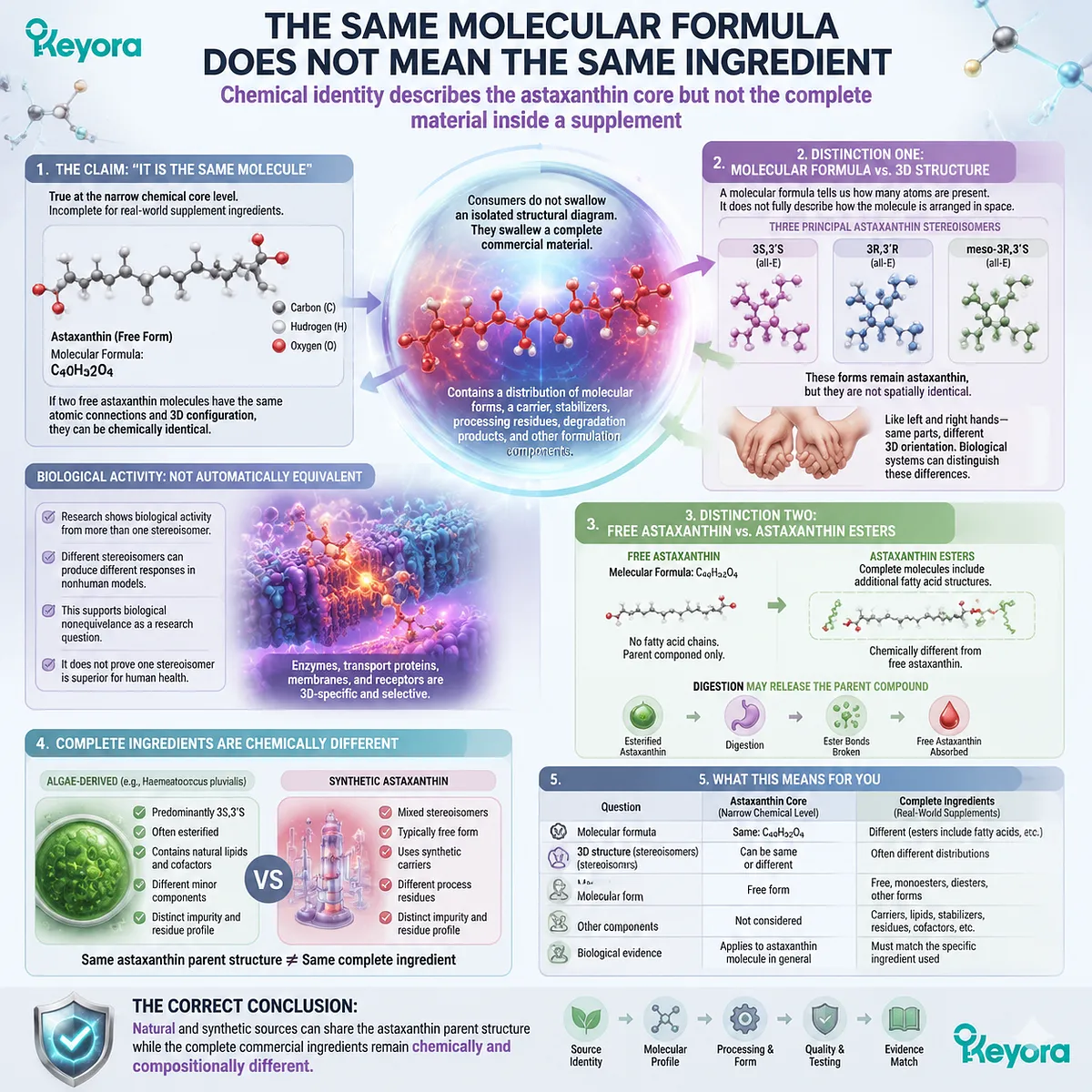
The parent compound called astaxanthin has a defined carbon framework, oxygen-containing end groups, and molecular formula. If two free astaxanthin molecules have the same atomic connections and the same three-dimensional configuration, they can be chemically identical at the individual molecule level.
But consumers do not swallow an isolated structural diagram.
They swallow a commercial material containing a distribution of molecular forms, a carrier, stabilizers, processing residues, possible degradation products, and other formulation components.
The first distinction is between molecular formula and three-dimensional structure.
A molecular formula tells us how many carbon, hydrogen, and oxygen atoms are present. It does not fully describe how the molecule is arranged in space.
Astaxanthin has two chiral centers. The atoms can therefore be connected in the same order while the end groups point in different three-dimensional directions.
This produces three principal stereoisomers:
-
3S,3′S
-
3R,3′R
-
meso-3R,3′S
These forms remain astaxanthin, but they are not spatially identical.
A useful comparison is the relationship between left and right hands. Both have the same general parts and connections, but their three-dimensional orientation is different. Biological systems can distinguish such differences because enzymes, transport proteins, membranes, and receptors also possess specific three-dimensional structures.
This does not prove that one astaxanthin stereoisomer is active and all others are inactive.
Experimental work has found biological activity from more than one astaxanthin stereoisomer, while also showing that different stereoisomers can produce different responses in nonhuman models. Such studies support biological nonequivalence as a research question, but they do not independently establish superiority across human health outcomes.
The second distinction is between free astaxanthin and astaxanthin esters.
Free astaxanthin has the parent molecular formula C40H52O4. When one or both hydroxyl groups form ester bonds with fatty acids, the complete ester molecules contain additional fatty acid structures. The full molecules are therefore chemically different from free astaxanthin, even though digestion may later release the parent astaxanthin component.
This makes the simple phrase same molecule even less complete when comparing a predominantly esterified algal material with a free synthetic material.
The correct conclusion is:
Natural and synthetic sources can share the astaxanthin parent structure while the complete commercial ingredients remain chemically and compositionally different
Stereoisomers and Esterification Change the Material Profile
Natural and synthetic astaxanthin differ in three-dimensional form, esterification, formulation, and evidence relevance
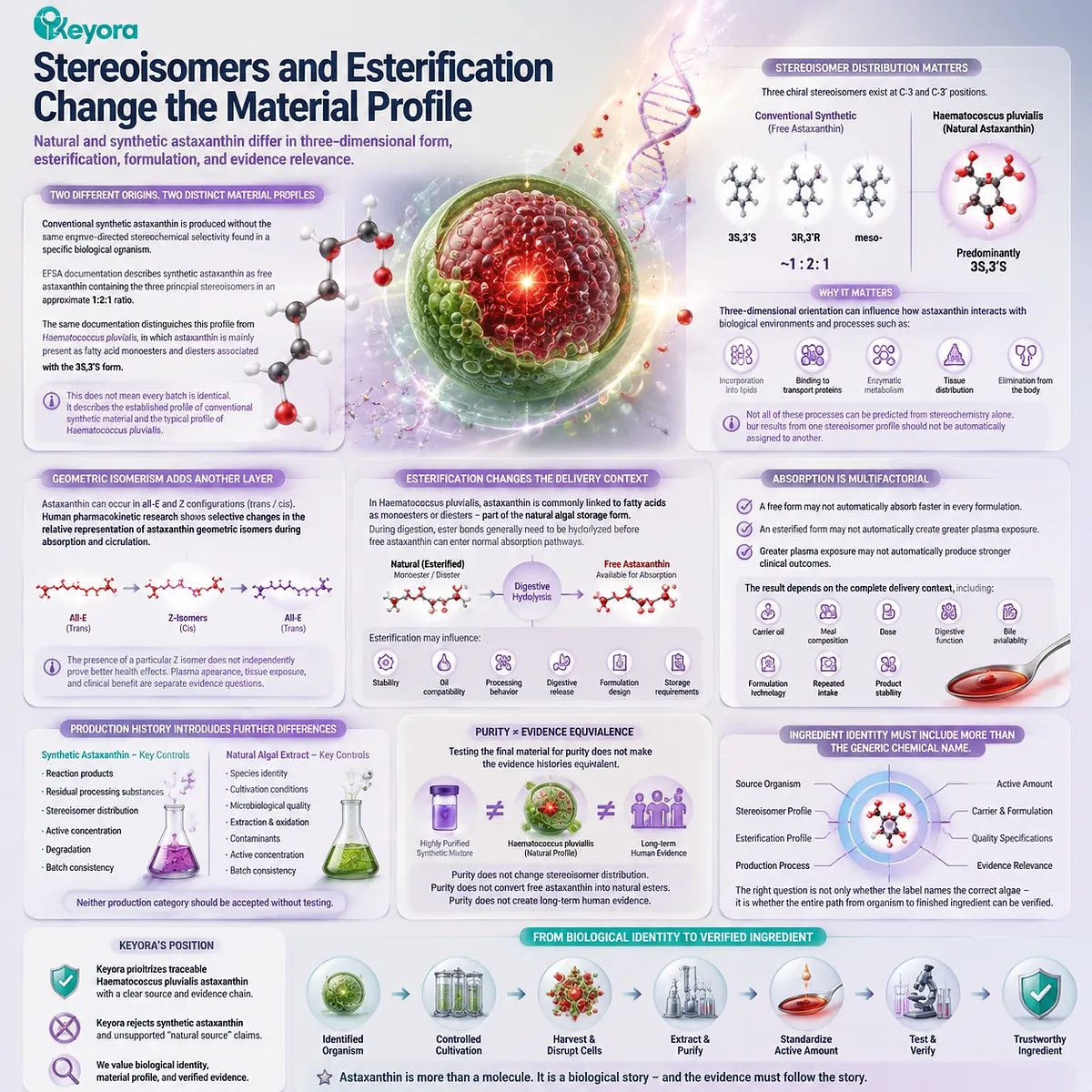
Conventional synthetic astaxanthin is produced without the same enzyme-directed stereochemical selectivity found in a specific biological organism.
EFSA documentation describes synthetic astaxanthin as free astaxanthin containing the three principal stereoisomers in an approximate 1:2:1 ratio. The same documentation distinguishes this profile from Haematococcus pluvialis, in which astaxanthin is mainly present as fatty acid monoesters and diesters associated with the 3S,3′S form.
This does not mean every synthetic batch has an absolutely identical composition. It describes the established profile of conventional synthetic commercial material.
It also does not mean every Haematococcus pluvialis extract has exactly the same ester distribution. Algal strain, cultivation conditions, harvesting, processing, extraction, purification, and storage may affect the finished ingredient.
The central point is that the two categories are not compositionally interchangeable by default.
Stereoisomer distribution matters because three-dimensional orientation can influence how a molecule interacts with biological environments.
Potentially relevant processes include:
-
incorporation into lipid structures
-
binding to transport proteins
-
enzymatic metabolism
-
conversion into metabolites
-
distribution between tissues
-
elimination from the body
The available evidence does not allow all of these processes to be predicted from stereochemistry alone. It does show why results obtained with one defined stereoisomer profile should not automatically be assigned to another.
Geometric isomerism adds another layer.
Astaxanthin can occur in all-E and Z configurations, sometimes described using trans and cis terminology. Human pharmacokinetic research has reported selective changes in the relative representation of astaxanthin geometric isomers during absorption and circulation. This shows that the body does not necessarily handle every geometric form in an identical way.
However, the presence of a particular Z isomer does not independently prove better health effects. Plasma appearance, tissue exposure, and clinical benefit are separate evidence questions.
Esterification must also be interpreted carefully.
In Haematococcus pluvialis, astaxanthin is commonly linked to fatty acids as monoesters or diesters. These esters are part of the natural algal storage form. During digestion, ester bonds generally need to be hydrolyzed before free astaxanthin can enter normal absorption pathways.
Esterification may influence:
-
raw-material stability
-
compatibility with oils
-
processing behavior
-
digestive release
-
formulation design
-
storage requirements
It does not automatically prove higher absorption.
A free form may not automatically absorb faster in every formulation.
An esterified form may not automatically create greater plasma exposure.
Greater plasma exposure may not automatically produce stronger clinical outcomes.
The result depends on the complete delivery context, including carrier oil, meal composition, dose, digestive function, bile availability, formulation technology, repeated intake, and product stability.
Production history introduces further differences.
A chemically synthesized material requires controls for reaction products, residual processing substances, stereoisomer distribution, active concentration, degradation, and batch consistency.
A natural algal extract requires controls for species identity, cultivation conditions, microbiological quality, extraction, oxidation, contaminants, active concentration, and batch consistency.
Neither production category should be accepted without testing.
But testing the final material for purity does not make the evidence histories equivalent.
A highly purified synthetic mixture remains a synthetic mixture. Purity does not transform its stereoisomer distribution into that of Haematococcus pluvialis. It does not convert free astaxanthin into the natural ester profile. It also does not create long-term human evidence that has not been conducted.
This is why ingredient identity must include more than the generic chemical name.
Use the Molecule – Material – Evidence Check
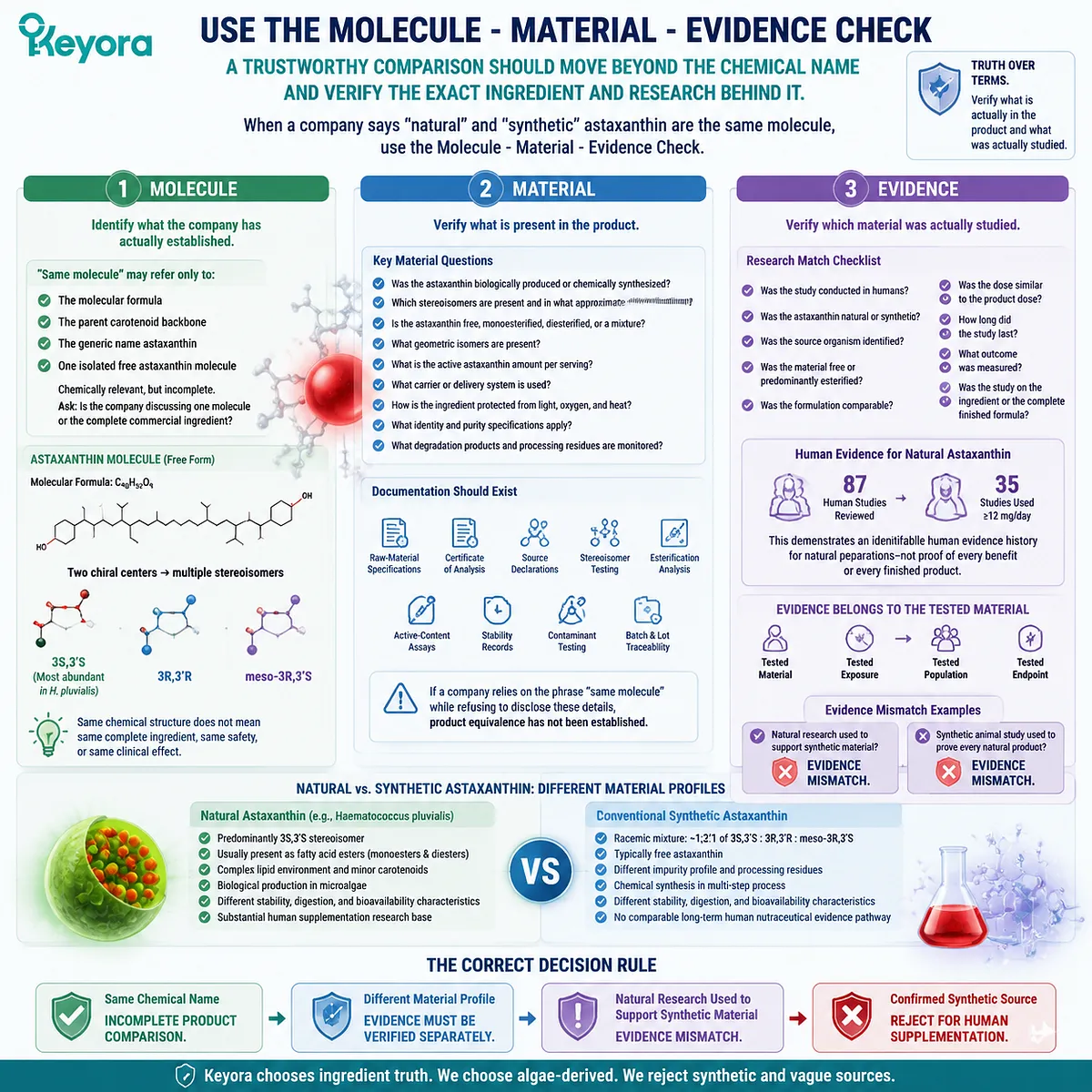
A trustworthy comparison should move beyond the chemical name and verify the exact ingredient and research behind it
When a company says natural and synthetic astaxanthin are the same molecule, use the Molecule – Material – Evidence Check.
1. Molecule
First identify what the company has actually established.
The phrase same molecule may refer only to:
-
the molecular formula
-
the parent carotenoid backbone
-
the generic name astaxanthin
-
one isolated free astaxanthin molecule
That information is chemically relevant, but incomplete.
Ask whether the company is discussing one molecule or the complete commercial ingredient.
2. Material
Next verify what is present in the product.
Relevant questions include:
-
Was the astaxanthin biologically produced or chemically synthesized?
-
Which stereoisomers are present?
-
What is their approximate distribution?
-
Is the astaxanthin free, monoesterified, diesterified, or a mixture?
-
What geometric isomers are present?
-
What is the active astaxanthin amount?
-
What carrier or delivery system is used?
-
How is the ingredient protected from light, oxygen, and heat?
-
What identity and purity specifications apply?
-
What degradation products and processing residues are monitored?
A consumer label may not show every analytical detail, but the supplier and finished-product brand should possess documentation supporting their source and composition claims.
Relevant records may include:
-
raw-material specifications
-
certificates of analysis
-
source declarations
-
stereoisomer testing
-
esterification analysis
-
active-content assays
-
stability records
-
contaminant testing
-
batch and lot traceability
A company that relies on the phrase same molecule while refusing to disclose these details has not established product equivalence.
3. Evidence
Finally, verify which material was actually studied.
Ask:
-
Was the study conducted in humans?
-
Was the astaxanthin natural or synthetic?
-
Was the source organism identified?
-
Was the material free or predominantly esterified?
-
Was the formulation comparable?
-
Was the dose similar to the product dose?
-
How long did the study last?
-
What outcome was measured?
-
Was the study performed on the ingredient or the complete finished formula?
The human safety literature reviewed for natural astaxanthin included 87 studies, with 35 studies using at least 12 mg per day. This does not prove every proposed benefit or every finished product, but it demonstrates an identifiable human evidence history for natural preparations.
A brand cannot transfer that literature automatically to conventional synthetic astaxanthin simply because both materials contain the astaxanthin parent structure.
That would be an evidence mismatch.
The same principle applies in the opposite direction. Findings from a synthetic astaxanthin animal study should not be presented as though they directly prove identical effects from every natural algal product.
Evidence belongs to the tested material, tested exposure, tested population, and tested endpoint.
The correct decision rule is:
Same chemical name – incomplete product comparison
Different material profile – evidence must be verified separately
Natural research used to support synthetic material – evidence mismatch
Confirmed synthetic source – reject for human supplementation
What This Means When Choosing Astaxanthin
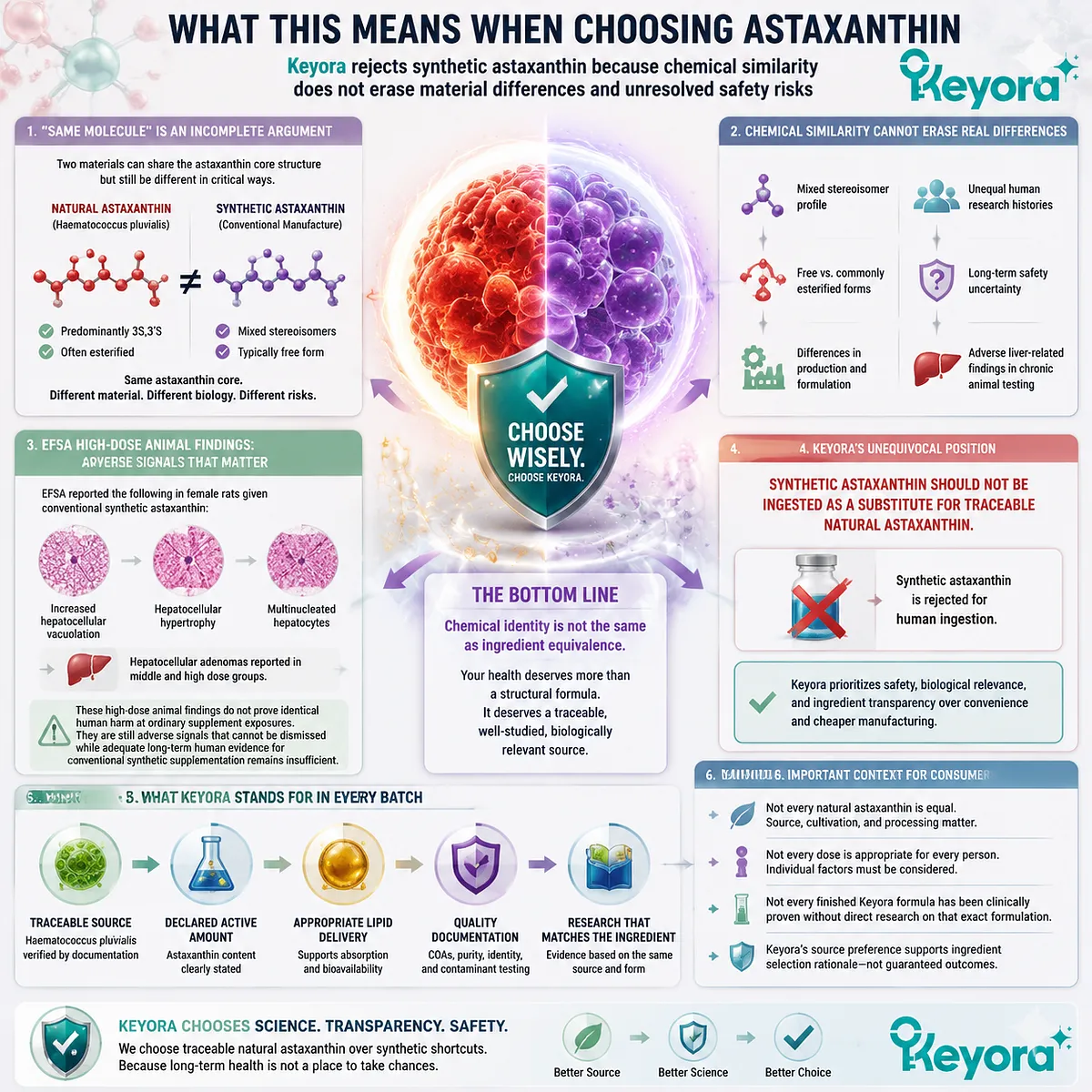
Keyora rejects synthetic astaxanthin because chemical similarity does not erase material differences and unresolved safety risks
Keyora does not accept the phrase same molecule as proof that synthetic astaxanthin can replace natural Haematococcus pluvialis astaxanthin.
Chemical similarity cannot erase:
-
the mixed stereoisomer profile of conventional synthetic material
-
the difference between free and commonly esterified forms
-
differences in production and formulation
-
unequal human research histories
-
long-term safety uncertainty
-
adverse liver-related findings reported in chronic animal testing
EFSA described increased hepatocellular vacuolation, hypertrophy, and multinucleated hepatocytes in female rats at the tested synthetic astaxanthin doses, with hepatocellular adenomas reported in middle and high dose groups. These high-dose animal findings do not prove identical human harm at ordinary supplement exposures. They are still adverse signals that cannot be dismissed while adequate long-term human evidence for conventional synthetic supplementation remains insufficient.
Keyora’s position is therefore unequivocal:
Synthetic astaxanthin should not be ingested as a substitute for traceable natural astaxanthin
Keyora prioritizes a verified Haematococcus pluvialis source, declared active astaxanthin amount, appropriate lipid delivery, quality documentation, and research that matches the ingredient sold.
This source preference supports the ingredient selection rationale. It does not mean that every natural product is equal, that every dose is appropriate for every person, or that a complete finished Keyora formula has been clinically proven without direct research on that exact formulation.
Closing Summary
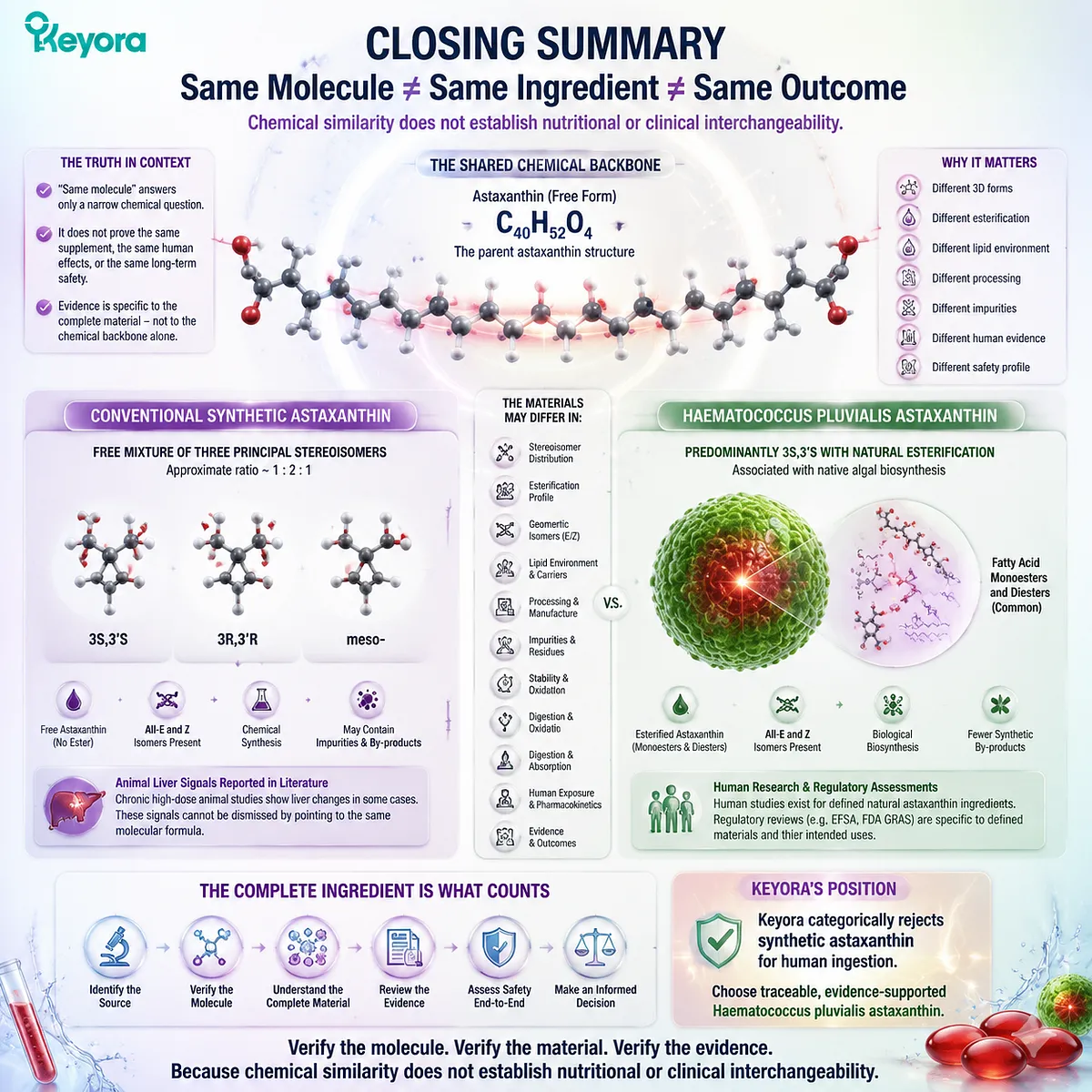
Synthetic and natural astaxanthin can share the parent astaxanthin structure, but that does not make the complete commercial ingredients identical.
Free astaxanthin has the molecular formula C40H52O4. However, conventional synthetic material generally contains a free mixture of three principal stereoisomers, while Haematococcus pluvialis material is predominantly associated with 3S,3′S astaxanthin and commonly contains fatty acid monoesters and diesters.
The materials may also differ in geometric isomers, lipid environment, processing, formulation, impurities, stability, digestion, human exposure, and supporting evidence.
The phrase same molecule therefore answers only one narrow chemical question. It does not prove the same supplement, the same human effects, or the same long-term safety.
Natural human research cannot be transferred automatically to synthetic astaxanthin, and chronic animal liver signals cannot be erased by pointing to a shared molecular backbone.
Keyora categorically rejects synthetic astaxanthin for human ingestion. Consumers should verify the molecule, the complete material, and the evidence behind it because chemical similarity does not establish nutritional or clinical interchangeability
This article is for educational and informational purposes only. It does not provide medical advice, diagnosis, treatment, cure, prevention, disease outcome claims, hormone restoration claims, fertility outcome claims, or formula-specific clinical efficacy claims.