
Is Algae-Derived Astaxanthin the Same as Marine-Derived Astaxanthin?
Keyora Research Q&A Library
This is part of the Keyora Research Q&A Series, derived from Keyora Nutritional Neurology Series.
Within the Keyora Nutritional Neurology framework, this Q&A translates complex nutrient–brain mechanisms into reader-friendly, evidence-bound answers, focusing on stress resilience, sleep quality, calm mood support, cognitive wellness, and the broader interaction between nutrition, neurochemistry, and daily nervous-system function.
First published by Keyora Research Journal: www.keyorahealth.com
Direct Answer
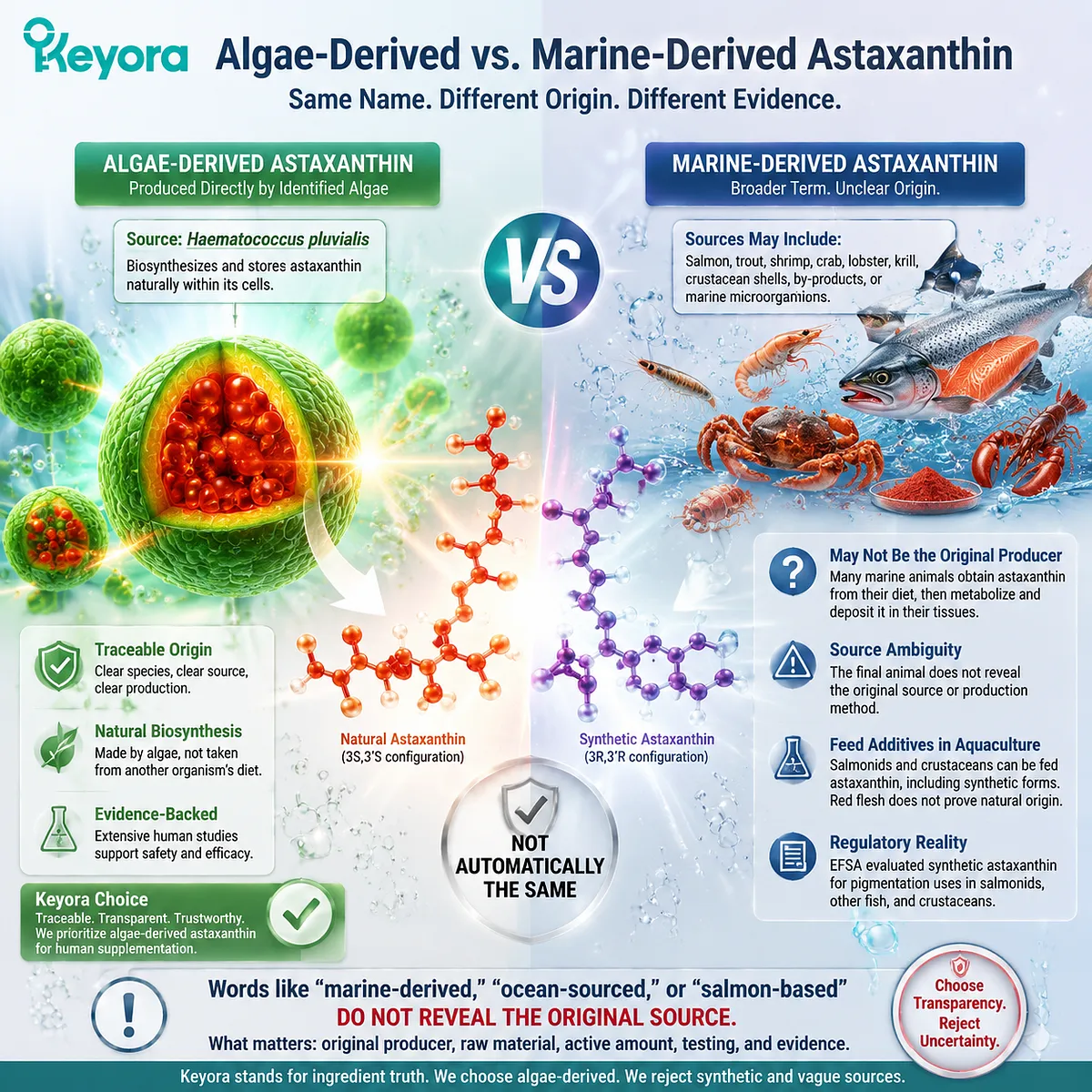
Algae-derived astaxanthin and marine-derived astaxanthin are not automatically the same material. Algae-derived astaxanthin is produced directly by an identified algal species. In human supplements, the best-known source is Haematococcus pluvialis, which biosynthesizes and stores astaxanthin within its cells.
Marine-derived astaxanthin is a broader and less precise description. It may refer to astaxanthin recovered from salmon, trout, shrimp, crab, lobster, krill, crustacean shells, seafood-processing by-products, or a marine microorganism. Many marine animals do not create the astaxanthin in their tissues from the beginning. They acquire it through food, then absorb, metabolize, and deposit it in their flesh, shells, or other tissues.
This distinction matters because the animal carrying astaxanthin may not reveal its original production source. In aquaculture, salmonids and crustaceans can receive astaxanthin from defined feed additives, including synthetic material. A red fish fillet therefore does not prove that its astaxanthin originated from natural algae. EFSA’s feed assessment specifically evaluated synthetic astaxanthin for pigmentation uses in salmonids, other fish, and crustaceans.
Keyora prioritizes traceable algae-derived astaxanthin and rejects synthetic or vaguely identified sources for human supplementation. The words marine-derived, ocean-sourced, or salmon-based cannot replace disclosure of the original producer, raw material, active amount, testing, and evidence behind the ingredient.
Algae-Derived and Marine-Derived Describe Different Source Paths
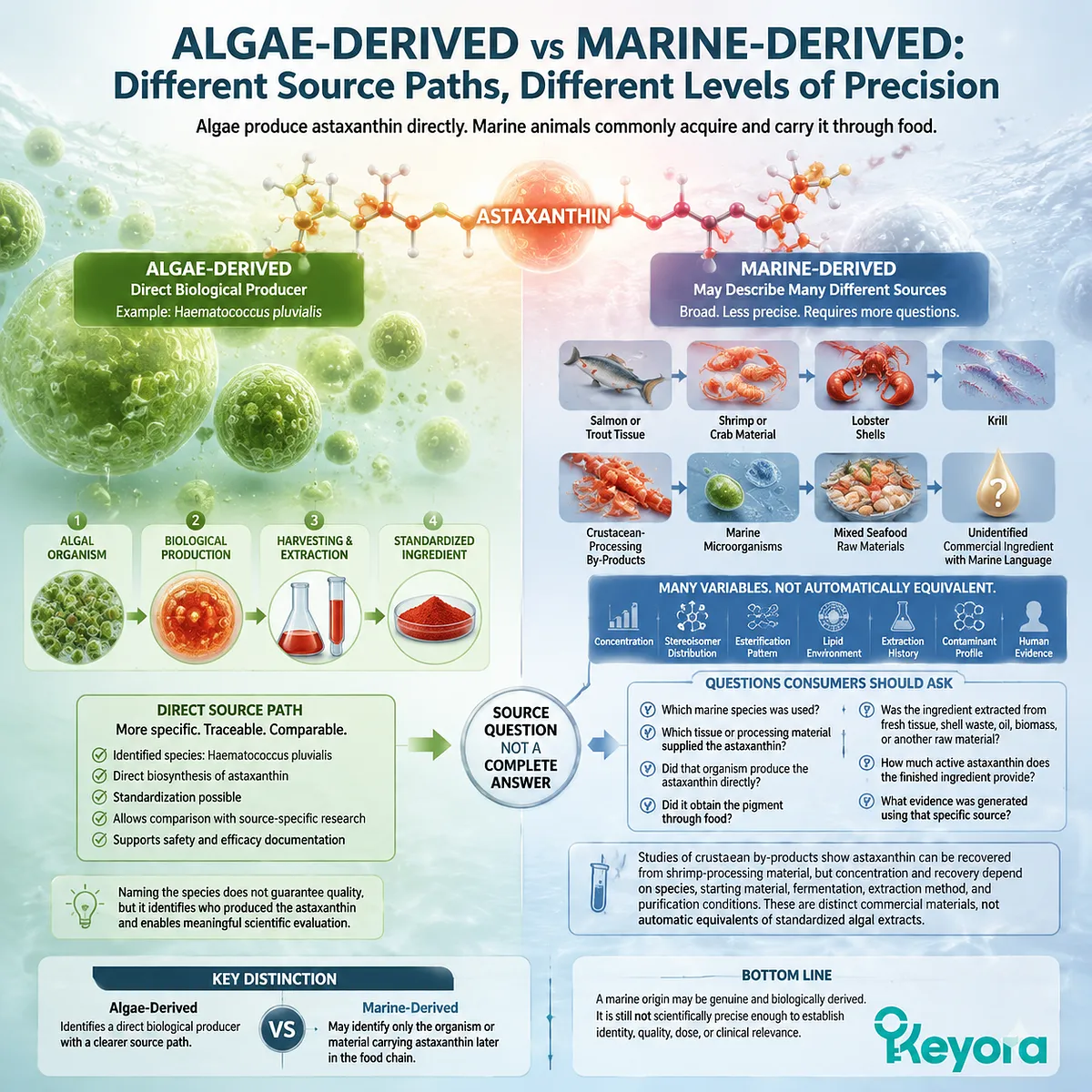
Algae produce astaxanthin directly, while marine animals commonly acquire and carry it through food
Imagine comparing two supplement labels.
The first says:
Astaxanthin from Haematococcus pluvialis
The second says:
Marine-derived astaxanthin
Both descriptions may sound natural, but they do not identify the ingredient with the same level of precision.
An algae-derived ingredient begins with an algal organism that biosynthesizes astaxanthin. The algae are cultivated, harvested, processed, and used to produce an extract containing a standardized amount of astaxanthin.
The source path is relatively direct:
Algal organism
↓
Biological production
↓
Harvesting and extraction
↓
Standardized astaxanthin ingredient
For many human supplements, the named organism is Haematococcus pluvialis. Naming the species does not prove that every finished product is high quality, but it identifies who produced the astaxanthin and allows the ingredient to be compared with source-specific research and safety documentation.
Marine-derived is much broader.
It may describe astaxanthin obtained from:
-
salmon or trout tissue
-
shrimp or crab material
-
lobster shells
-
krill
-
crustacean-processing by-products
-
marine microorganisms
-
mixed seafood raw materials
-
an unidentified commercial ingredient presented with marine language
These materials do not necessarily share the same concentration, stereoisomer distribution, esterification pattern, lipid environment, extraction history, contaminant profile, or human evidence.
This is why marine-derived should be treated as the beginning of a source question rather than a complete source answer.
The consumer still needs to ask:
Which marine species was used?
Which tissue or processing material supplied the astaxanthin?
Did that organism produce the astaxanthin directly?
Did it obtain the pigment through food?
Was the ingredient extracted from fresh tissue, shell waste, oil, biomass, or another raw material?
How much active astaxanthin does the finished ingredient provide?
What evidence was generated using that specific source?
Studies of crustacean by-products show that astaxanthin can be recovered from shrimp-processing material, but the resulting concentration and recovery depend on the species, starting material, fermentation, extraction method, and purification conditions. These are distinct commercial materials rather than automatic equivalents of standardized algal extracts.
A marine origin may be genuine and biologically derived. It is still not scientifically precise enough to establish identity, quality, dose, or clinical relevance.
The most useful distinction is:
Algae-derived identifies a direct biological producer, while marine-derived may identify only the organism or material carrying the astaxanthin later in the food chain
Marine Animal Color Does Not Reveal the Original Astaxanthin Source
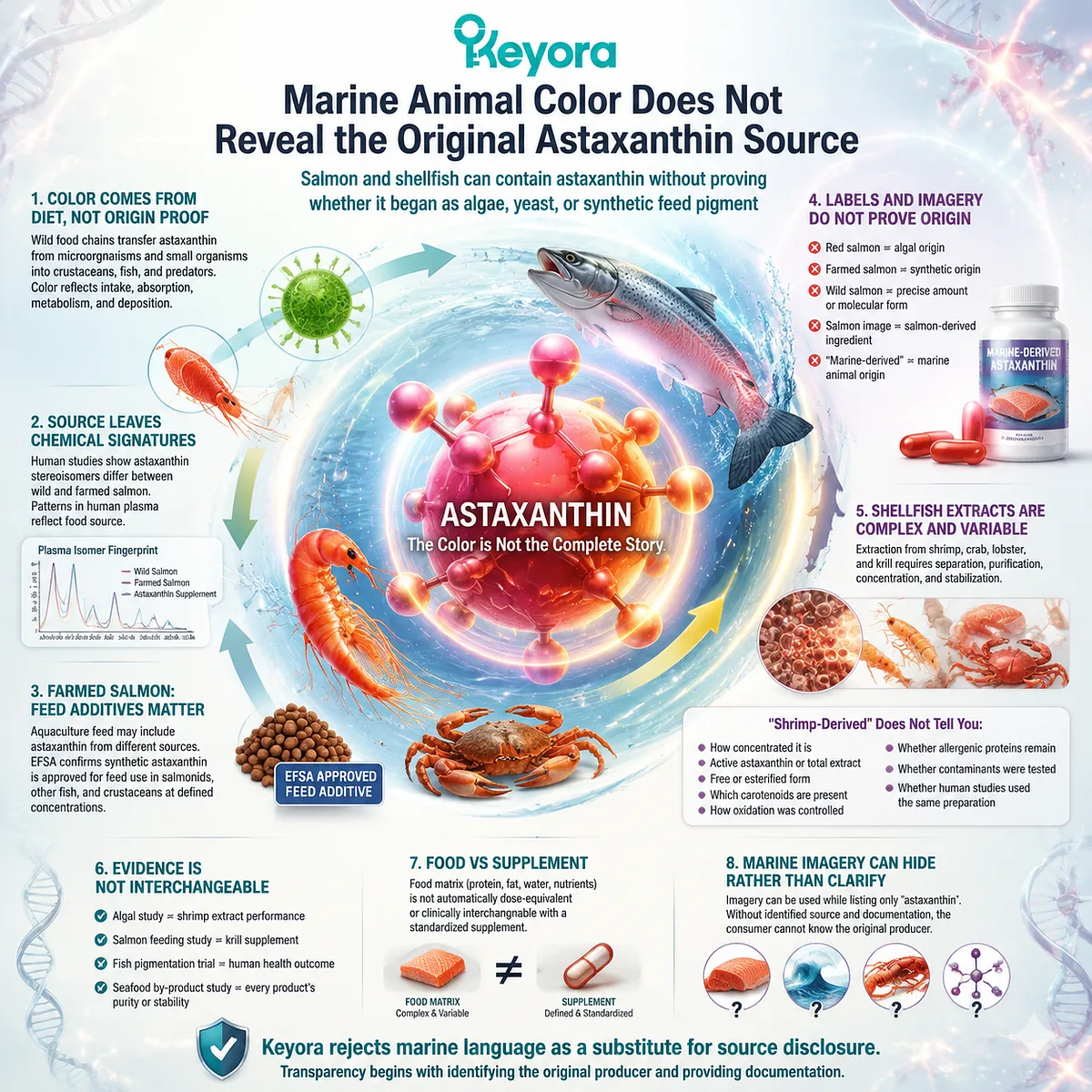
Salmon and shellfish can contain astaxanthin without proving whether it began as algae, yeast, or synthetic feed pigment
Astaxanthin contributes to the red, pink, and orange appearance associated with salmonids and many crustaceans.
However, visible color does not reveal the complete source history.
Wild aquatic food chains can transfer carotenoids from microorganisms and small organisms into crustaceans, fish, and larger predators. The astaxanthin that eventually appears in salmon tissue therefore reflects dietary intake, absorption, metabolism, and tissue deposition rather than proving that the salmon produced the pigment itself.
Human feeding research has also shown that astaxanthin from wild and farmed salmon can differ in stereoisomer distribution, and that the stereoisomers entering human plasma can reflect differences in the food source.
More recent analytical research has continued to distinguish astaxanthin isomer patterns in wild salmon, farmed salmon, processed salmon products, and human plasma after consumption. This demonstrates that source and production history can leave measurable chemical signatures.
Farmed salmon adds another layer.
Aquaculture producers may add astaxanthin to feed to achieve pigmentation and support defined production goals. The feed additive may come from different sources. EFSA’s official assessment confirms that synthetic astaxanthin has been evaluated specifically for use in feed for salmonids, other fish, and crustaceans at defined dietary concentrations.
Therefore:
A red salmon fillet does not prove algal origin.
A farmed salmon label does not prove synthetic origin.
A wild salmon label does not establish the precise amount, molecular form, or supplement equivalence.
A salmon image on a supplement package does not prove that the capsule contains salmon-derived astaxanthin.
A product described as marine-derived does not prove that its original astaxanthin producer was a marine animal.
The same caution applies to shellfish.
Shrimp, crab, lobster, and krill can contain astaxanthin in tissues and shells. The pigment may be associated with proteins, lipids, and esterified forms within a complex biological matrix. Recovering it as a commercial ingredient requires separation, extraction, purification, concentration, and stabilization.
Primary extraction studies demonstrate that different processing methods can produce materially different yields and bioaccessibility from shrimp by-products.
These differences matter because the phrase shrimp-derived astaxanthin does not tell the consumer:
-
how concentrated the ingredient is
-
whether the listed amount is active astaxanthin or total extract
-
whether the material is free or esterified
-
which carotenoids accompany it
-
how oxidation was controlled
-
whether allergenic proteins remain
-
whether environmental contaminants were tested
-
whether a human study used the same preparation
This does not mean all marine-animal extracts are unsafe or poor quality.
It means they need their own evidence.
An algal study cannot automatically prove the properties of a shrimp-shell extract.
A salmon feeding study cannot establish the performance of a krill-derived supplement.
A fish-pigmentation trial cannot prove a human health outcome.
A seafood-processing by-product study cannot establish that every commercial marine extract has the same purity or stability.
Food consumption and supplementation must also be separated.
Astaxanthin in salmon is consumed within a food matrix containing protein, fat, water, and other nutrients. A standardized supplement is designed to provide a declared active amount in a defined serving.
The two exposure systems may both provide astaxanthin, but they are not automatically dose-equivalent or clinically interchangeable.
Most importantly, marine imagery can hide rather than clarify the original source.
A product could use salmon, ocean, or shellfish imagery while listing only astaxanthin. Unless the company identifies the original producer and provides documentation, the consumer cannot determine whether the ingredient was algae-derived, yeast-derived, animal-derived, or chemically synthesized.
Keyora rejects the use of marine language as a substitute for source disclosure.
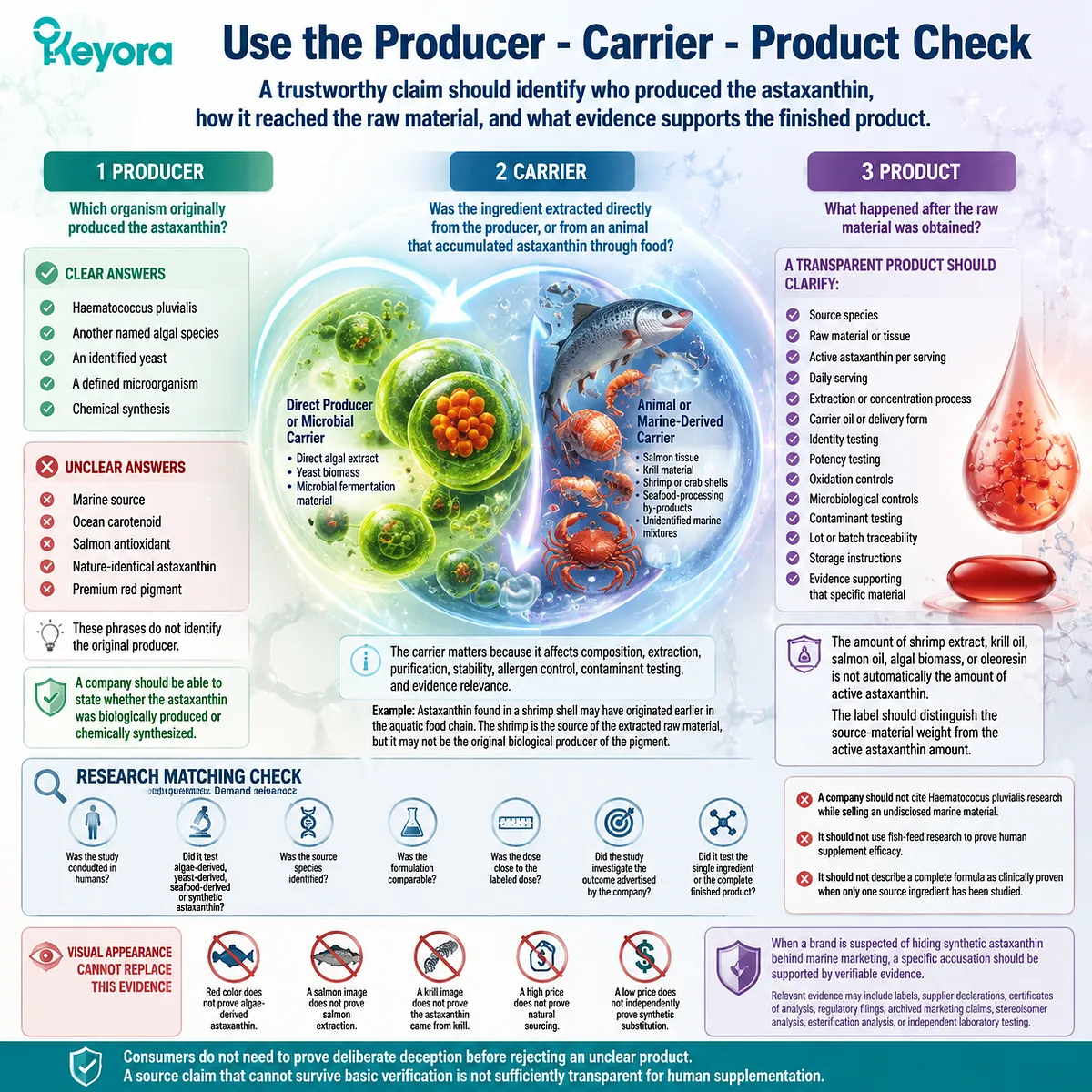
Use the Producer – Carrier – Product Check
A trustworthy claim should identify who produced the astaxanthin, how it reached the raw material, and what evidence supports the finished product
Use the Producer – Carrier – Product Check before accepting an algae-derived or marine-derived claim.
1. Producer
Ask:
Which organism originally produced the astaxanthin?
A clear answer may identify:
-
Haematococcus pluvialis
-
another named algal species
-
an identified yeast
-
a defined microorganism
-
chemical synthesis
An unclear answer may use:
-
marine source
-
ocean carotenoid
-
salmon antioxidant
-
nature-identical astaxanthin
-
premium red pigment
These phrases do not identify the original producer.
A company should be able to state whether the astaxanthin was biologically produced or chemically synthesized.
2. Carrier
Ask:
Was the ingredient extracted directly from the producer, or from an animal that accumulated astaxanthin through food?
This separates:
-
direct algal extract
-
yeast biomass
-
microbial fermentation material
-
salmon tissue
-
krill material
-
shrimp or crab shells
-
seafood-processing by-products
-
unidentified marine mixtures
The carrier matters because it affects composition, extraction, purification, stability, allergen control, contaminant testing, and evidence relevance.
For example, astaxanthin found in a shrimp shell may have originated earlier in the aquatic food chain. The shrimp is the source of the extracted raw material, but it may not be the original biological producer of the pigment.
3. Product
Ask what happened after the raw material was obtained.
A transparent product should clarify:
-
source species
-
raw material or tissue
-
active astaxanthin per serving
-
daily serving
-
extraction or concentration process
-
carrier oil or delivery form
-
identity testing
-
potency testing
-
oxidation controls
-
microbiological controls
-
contaminant testing
-
lot or batch traceability
-
storage instructions
-
evidence supporting that specific material
The amount of shrimp extract, krill oil, salmon oil, algal biomass, or oleoresin is not automatically the amount of active astaxanthin.
The label should distinguish the source-material weight from the active astaxanthin amount.
Research matching is equally important.
Ask:
Was the study conducted in humans?
Did it test algae-derived, yeast-derived, seafood-derived, or synthetic astaxanthin?
Was the source species identified?
Was the formulation comparable?
Was the dose close to the labeled dose?
Did the study investigate the outcome advertised by the company?
Did it test the single ingredient or the complete finished product?
A company should not cite Haematococcus pluvialis research while selling an undisclosed marine material.
It should not use fish-feed research to prove human supplement efficacy.
It should not describe a complete formula as clinically proven when only one source ingredient has been studied.
Visual appearance cannot replace this evidence.
Red color does not prove algae-derived astaxanthin.
A salmon image does not prove salmon extraction.
A krill image does not prove the astaxanthin came from krill.
A high price does not prove natural sourcing.
A low price does not independently prove synthetic substitution.
When a brand is suspected of hiding synthetic astaxanthin behind marine marketing, a specific accusation should be supported by verifiable evidence. Relevant evidence may include labels, supplier declarations, certificates of analysis, regulatory filings, archived marketing claims, stereoisomer analysis, esterification analysis, or independent laboratory testing.
Consumers do not need to prove deliberate deception before rejecting an unclear product.
A source claim that cannot survive basic verification is not sufficiently transparent for human supplementation.
What This Means When Choosing Astaxanthin
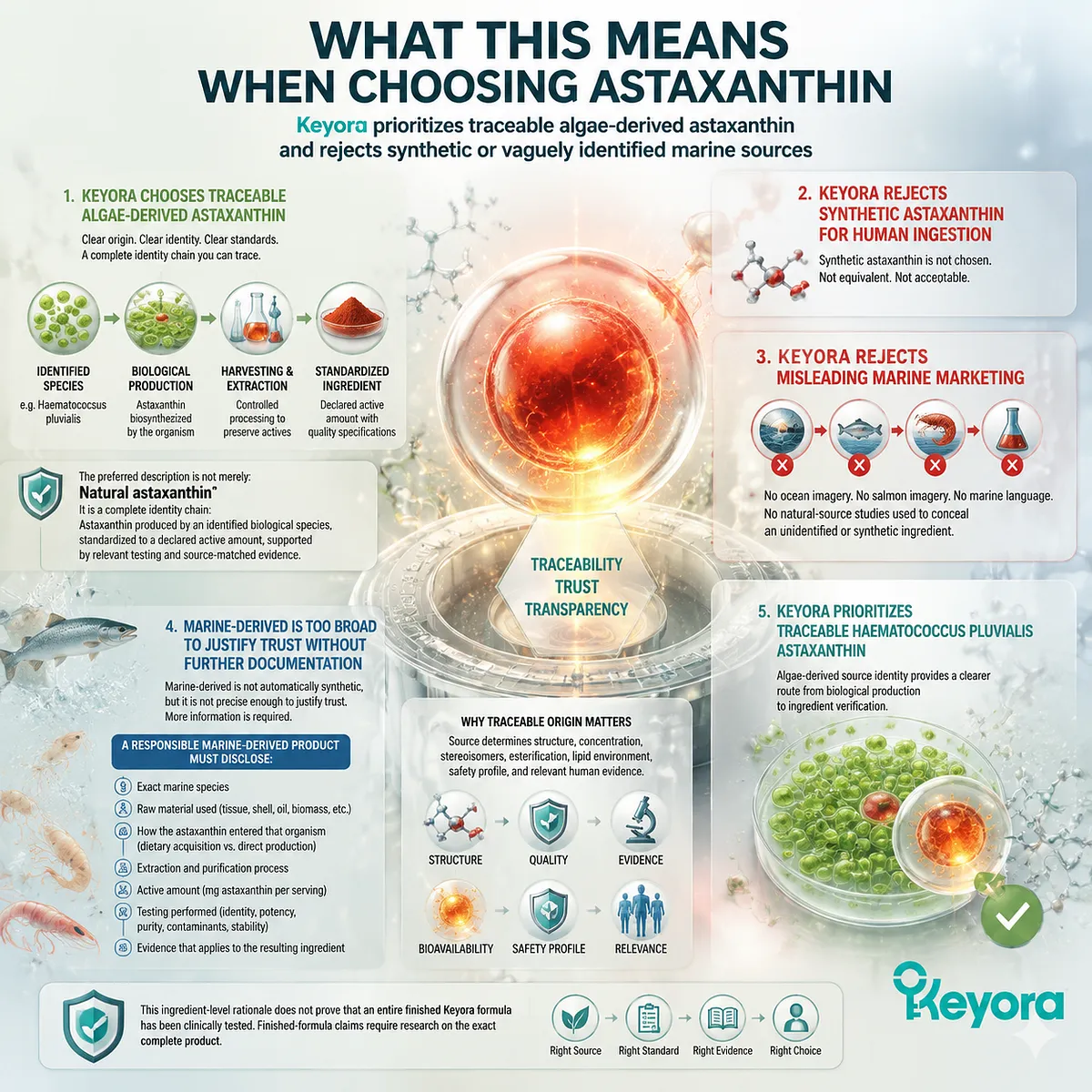
Keyora prioritizes traceable algae-derived astaxanthin and rejects synthetic or vaguely identified marine sources
Keyora chooses a clearly identified algae-derived source because the original producer, raw material, active amount, quality specifications, and relevant research can be traced more directly.
The preferred description is not merely:
Natural astaxanthin
It is a complete identity chain:
Astaxanthin produced by an identified biological species, standardized to a declared active amount, supported by relevant testing and source-matched evidence
Keyora rejects synthetic astaxanthin for human ingestion.
Keyora also rejects marketing that uses ocean imagery, salmon imagery, marine language, or natural-source studies to conceal an unidentified or synthetic ingredient.
Marine-derived astaxanthin is not automatically synthetic, but it is too broad a description to justify trust without further documentation.
A responsible marine-derived product would need to identify:
-
the exact marine species
-
the raw material used
-
how the astaxanthin entered that organism
-
the extraction and purification process
-
the active amount
-
the testing performed
-
the evidence that applies to the resulting ingredient
Keyora prioritizes traceable Haematococcus pluvialis astaxanthin because algae-derived source identity provides a clearer route from biological production to ingredient verification.
This ingredient-level rationale does not prove that an entire finished Keyora formula has been clinically tested. Finished-formula claims require research on the exact complete product.
Closing Summary
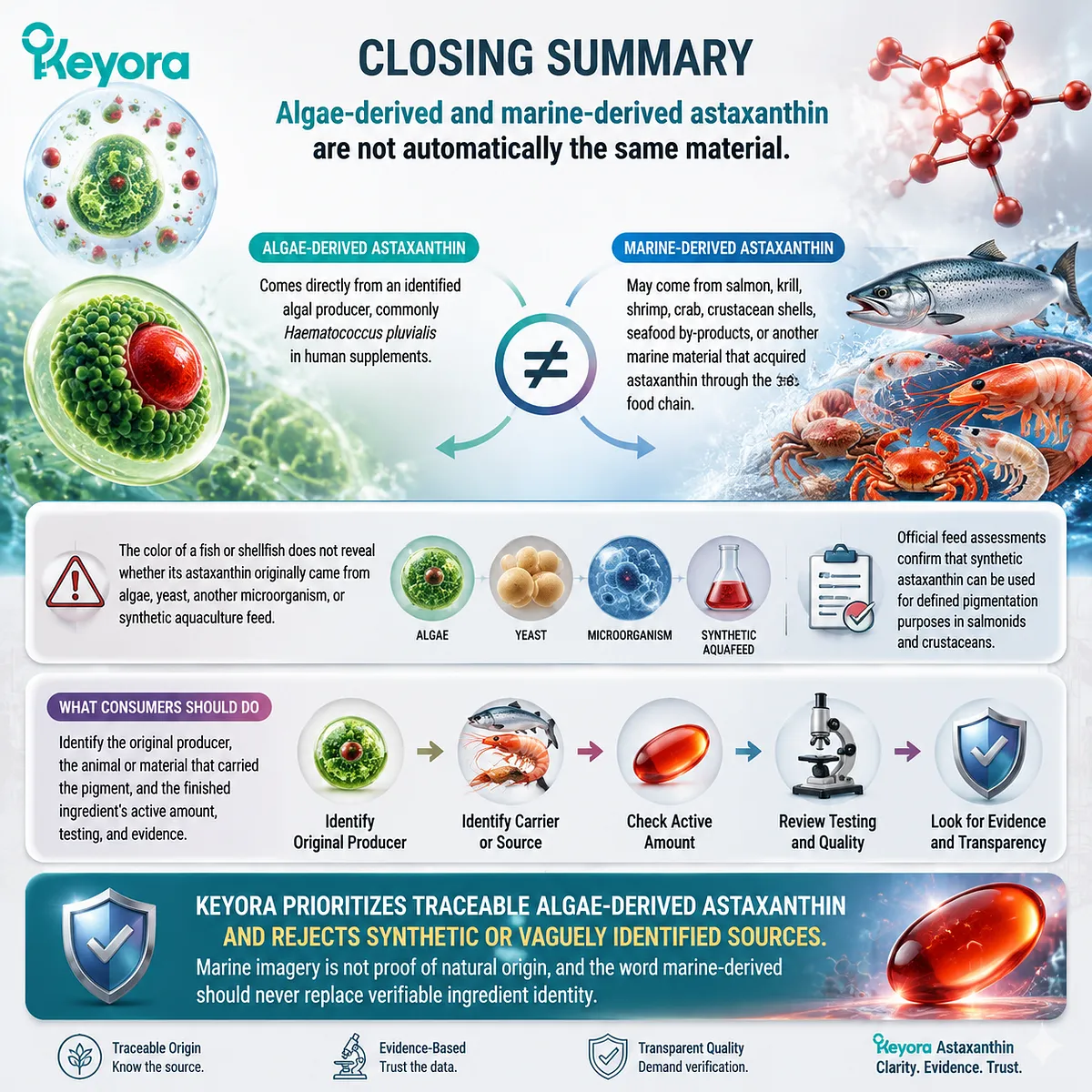
Algae-derived and marine-derived astaxanthin are not automatically the same material.
Algae-derived astaxanthin comes directly from an identified algal producer, commonly Haematococcus pluvialis in human supplements. Marine-derived astaxanthin may come from salmon, krill, shrimp, crab, crustacean shells, seafood by-products, or another marine material that acquired astaxanthin through the food chain.
The color of a fish or shellfish does not reveal whether its astaxanthin originally came from algae, yeast, another microorganism, or synthetic aquaculture feed. Official feed assessments confirm that synthetic astaxanthin can be used for defined pigmentation purposes in salmonids and crustaceans.
Consumers should therefore identify the original producer, the animal or material that carried the pigment, and the finished ingredient’s active amount, testing, and evidence.
Keyora prioritizes traceable algae-derived astaxanthin and rejects synthetic or vaguely identified sources. Marine imagery is not proof of natural origin, and the word marine-derived should never replace verifiable ingredient identity
This article is for educational and informational purposes only. It does not provide medical advice, diagnosis, treatment, cure, prevention, disease outcome claims, hormone restoration claims, fertility outcome claims, or formula-specific clinical efficacy claims.