
Is 16 mg of Astaxanthin Too Much?
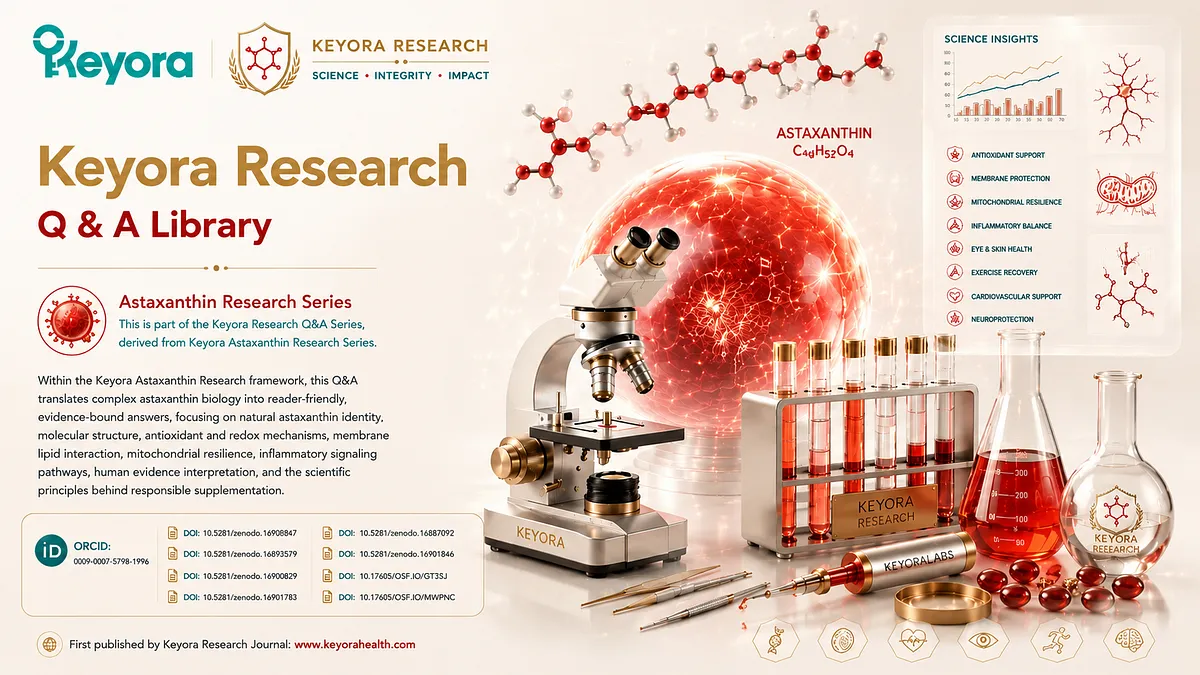
Keyora Research Q&A Library
This is part of the Keyora Research Q&A Series, derived from Keyora Astaxanthin Research Journal Series.
Within the Keyora Astaxanthin Researcn framework, this Q&A translates complex astaxanthin biology into reader-friendly, evidence-bound answers, focusing on natural astaxanthin identity, molecular structure, antioxidant and redox mechanisms, membrane lipid interaction, mitochondrial resilience, inflammatory signaling pathways, human evidence interpretation, and the scientific principles behind responsible supplementation.
First published by Keyora Research Journal: www.keyorahealth.com
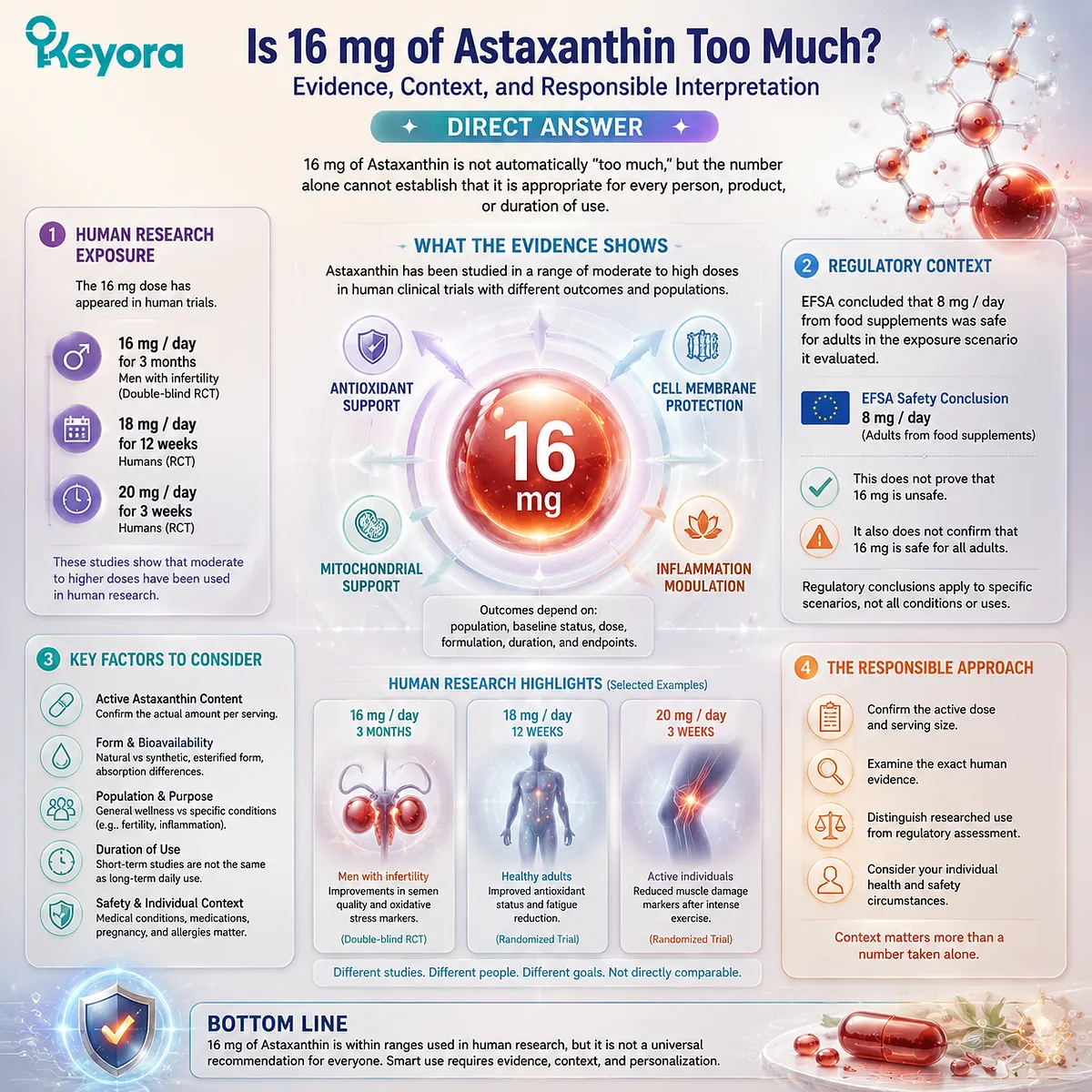
Direct Answer
Sixteen milligrams of Astaxanthin is not automatically “too much,” but the number alone cannot establish that it is appropriate for every person, product, or duration of use.
The dose has appeared in human research.
For example, a double-blind randomized trial administered 16 mg per day for three months to men with infertility. Other trials have studied nearby amounts, including 18 mg per day for 12 weeks and 20 mg per day for three weeks.
These studies show that moderate-to-higher Astaxanthin doses have human research exposure, but they do not provide universal safety clearance because the materials, populations, durations, monitoring, and endpoints were different.
Regulatory conclusions must also be read precisely.
EFSA concluded that 8 mg per day from food supplements was safe for adults in the exposure scenario it evaluated. That conclusion does not prove that 16 mg is unsafe, but it also should not be rewritten as an official confirmation of 16 mg for all adults.
The responsible answer is therefore contextual: confirm the active dose and serving size, examine the exact human evidence, distinguish researched use from regulatory assessment, and consider individual safety circumstances.
Why 16 mg Can Look Like a High Dose
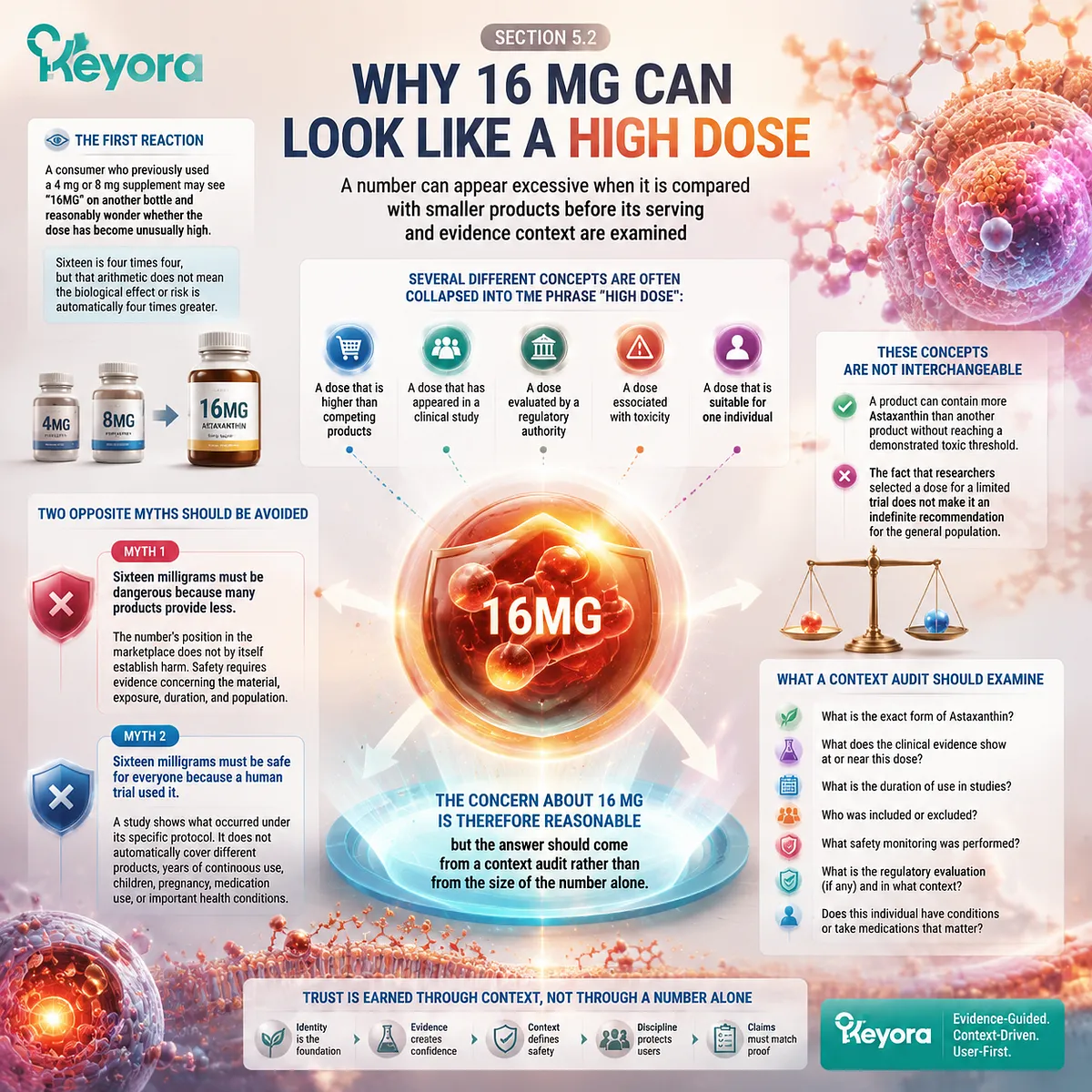
A number can appear excessive when it is compared with smaller products before its serving and evidence context are examined
A consumer who previously used a 4 mg or 8 mg supplement may see “16MG” on another bottle and reasonably wonder whether the dose has become unusually high.
Sixteen is four times four, but that arithmetic does not mean the biological effect or risk is automatically four times greater.
Several different concepts are often collapsed into the phrase “high dose”:
-
a dose that is higher than competing products
-
a dose that has appeared in a clinical study
-
a dose evaluated by a regulatory authority
-
a dose associated with toxicity
-
a dose that is suitable for one individual
These concepts are not interchangeable.
A product can contain more Astaxanthin than another product without reaching a demonstrated toxic threshold.
Conversely, the fact that researchers selected a dose for a limited trial does not make it an indefinite recommendation for the general population.
Two opposite myths should therefore be avoided.
Myth 1: Sixteen milligrams must be dangerous because many products provide less.
The number’s position in the marketplace does not by itself establish harm. Safety requires evidence concerning the material, exposure, duration, and population.
Myth 2: Sixteen milligrams must be safe for everyone because a human trial used it.
A study shows what occurred under its specific protocol. It does not automatically cover different products, years of continuous use, children, pregnancy, medication use, or important health conditions.
The concern about 16 mg is therefore reasonable, but the answer should come from a context audit rather than from the size of the number alone.
What Human Studies Using Similar Doses Can Establish
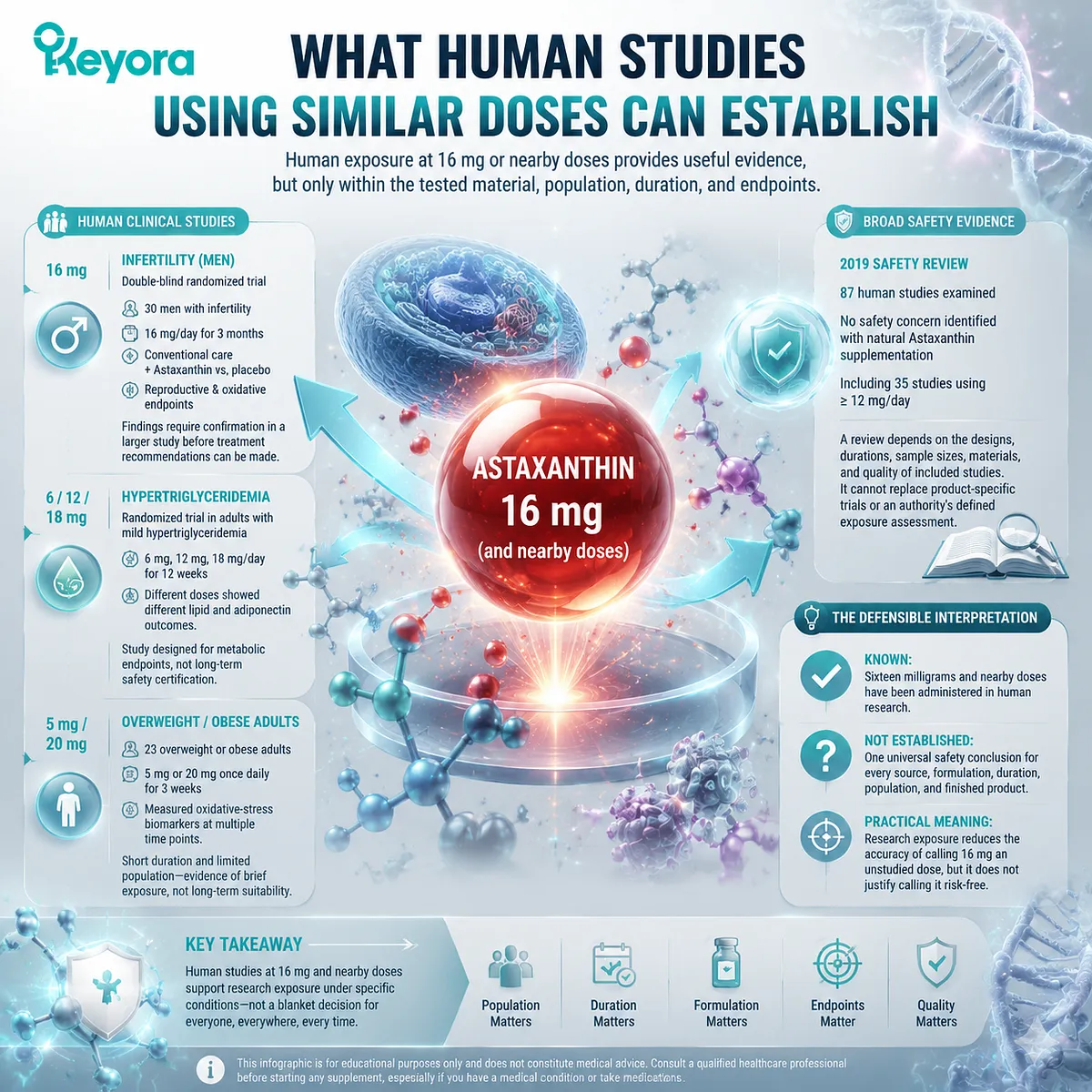
Human exposure at 16 mg or nearby doses provides useful evidence, but only within the tested material, population, duration, and endpoints
An exact 16 mg daily dose was used in a double-blind randomized trial involving 30 men with infertility.
Participants received conventional care plus either Astaxanthin or placebo for three months. The trial primarily investigated reproductive and oxidative endpoints, and its authors stated that the findings required confirmation in a larger study before treatment recommendations could be made.
This study establishes that 16 mg was administered to humans under a defined research protocol. It does not establish the safety of every 16 mg product because the participants, formulation, duration, clinical setting, and intended outcome were specific.
Nearby doses provide additional context.
In a 12-week randomized trial in adults with mild hypertriglyceridemia, researchers studied 6, 12, and 18 mg per day.
Different doses were associated with different lipid and adiponectin findings, but the study was designed around selected metabolic endpoints rather than as a universal long-term safety certification.
Another study assigned 23 overweight or obese adults to 5 mg or 20 mg once daily for three weeks and measured oxidative-stress biomarkers at several time points.
The short duration and limited population mean that this trial provides evidence of brief exposure to 20 mg, not proof that a similar dose is suitable indefinitely or for every individual.
A 2019 safety review examined 87 human studies and reported that none identified a safety concern with natural Astaxanthin supplementation, including 35 studies using at least 12 mg per day.
This broader pattern is relevant, but a review remains dependent on the designs, durations, sample sizes, materials, and quality of the included studies. It cannot replace a product-specific trial or an authority’s defined exposure assessment.
The defensible interpretation is:
Known: Sixteen milligrams and nearby doses have been administered in human research.
Not established: One universal safety conclusion for every source, formulation, duration, population, and finished product.
Practical meaning: Research exposure reduces the accuracy of calling 16 mg an unstudied dose, but it does not justify calling it risk-free.
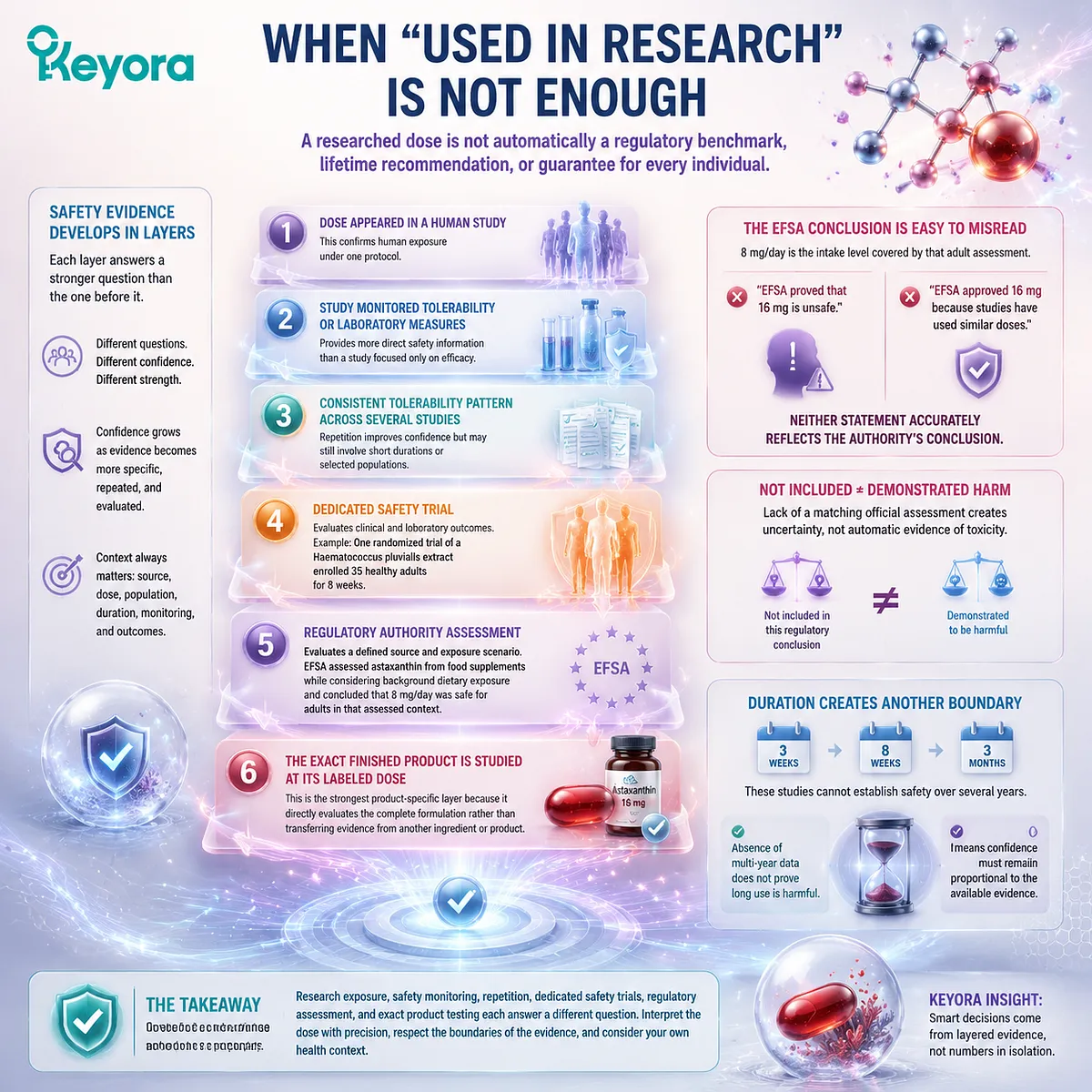
When “Used in Research” Is Not Enough
A researched dose is not automatically a regulatory benchmark, lifetime recommendation, or guarantee for every individual
Safety evidence develops in layers. Each layer answers a stronger question than the one before it:
-
The dose appeared in a human study.
This confirms human exposure under one protocol. -
The study actively monitored tolerability or laboratory measures.
This provides more direct safety information than a study focused only on efficacy. -
Several studies show a consistent tolerability pattern.
Repetition improves confidence but may still involve short durations or selected populations. -
A dedicated safety trial evaluates clinical and laboratory outcomes.
One randomized study of a Haematococcus pluvialis extract enrolled 35 healthy adults for eight weeks, illustrating the type of design used to examine safety more directly. -
A regulatory authority evaluates a defined source and exposure scenario.
EFSA assessed Astaxanthin from food supplements while considering background dietary exposure and concluded that 8 mg per day was safe for adults in that assessed context. -
The exact finished product is studied at its labeled dose.
This is the strongest product-specific layer because it directly evaluates the complete formulation rather than transferring evidence from another ingredient or product.
The EFSA conclusion is particularly easy to misread. Eight milligrams is the intake level covered by that adult assessment. It should not be converted into either of the following claims:
-
“EFSA proved that 16 mg is unsafe.”
-
“EFSA approved 16 mg because studies have used similar doses.”
Neither statement accurately reflects the authority’s conclusion.
The difference between “not included in this regulatory conclusion” and “demonstrated to be harmful” is important. Lack of a matching official assessment creates uncertainty, not automatic evidence of toxicity.
Duration creates another boundary.
A three-week, eight-week, or three-month trial cannot establish safety over several years.
At the same time, the absence of multi-year data does not prove that long use is harmful. It means that confidence must remain proportional to the available evidence.
Read the Keyora 16 mg Serving Correctly
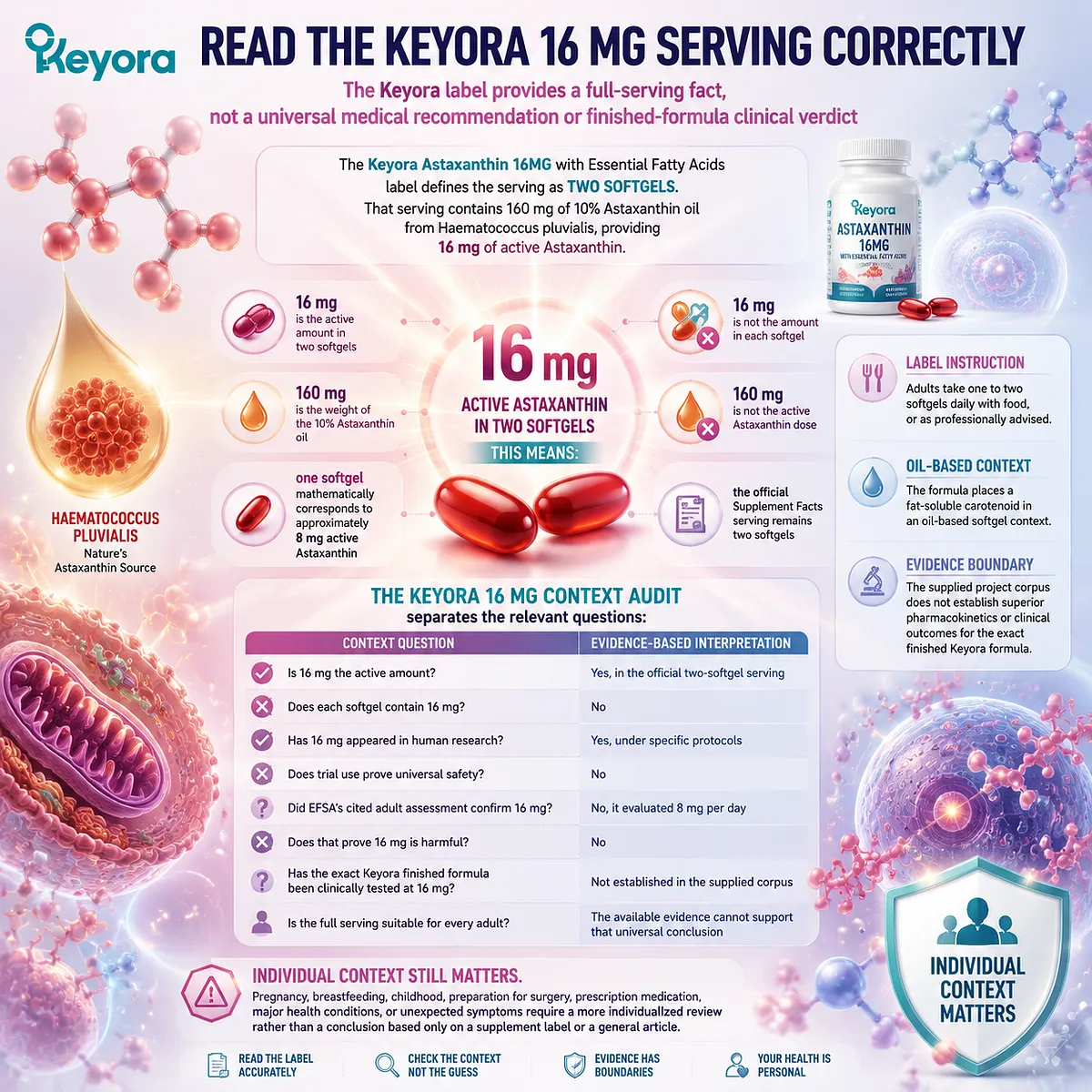
The Keyora label provides a full-serving fact, not a universal medical recommendation or finished-formula clinical verdict
The Keyora Astaxanthin 16MG with Essential Fatty Acids label defines the serving as two softgels. That serving contains 160 mg of 10% Astaxanthin oil from Haematococcus pluvialis, providing 16 mg of active Astaxanthin.
This means:
-
16 mg is the active amount in two softgels
-
16 mg is not the amount in each softgel
-
160 mg is the weight of the 10% Astaxanthin oil
-
160 mg is not the active Astaxanthin dose
-
one softgel mathematically corresponds to approximately 8 mg active Astaxanthin
-
the official Supplement Facts serving remains two softgels
The label instructs adults to take one to two softgels daily with food, or as professionally advised.
The formula places a fat-soluble carotenoid in an oil-based softgel context, but the supplied project corpus does not establish superior pharmacokinetics or clinical outcomes for the exact finished Keyora formula.
The Keyora 16 mg Context Audit separates the relevant questions:
-
Context QuestionEvidence-Based InterpretationIs 16 mg the active amount?
-
Yes, in the official two-softgel servingDoes each softgel contain 16 mg?
-
NoHas 16 mg appeared in human research?Yes, under specific protocolsDoes trial use prove universal safety?
-
NoDid EFSA’s cited adult assessment confirm 16 mg?
-
No, it evaluated 8 mg per dayDoes that prove 16 mg is harmful?
-
NoHas the exact Keyora finished formula been clinically tested at 16 mg?
Not established in the supplied corpusIs the full serving suitable for every adult?The available evidence cannot support that universal conclusion
Individual context still matters.
Pregnancy, breastfeeding, childhood, preparation for surgery, prescription medication, major health conditions, or unexpected symptoms require a more individualized review rather than a conclusion based only on a supplement label or a general article.
Closing Summary
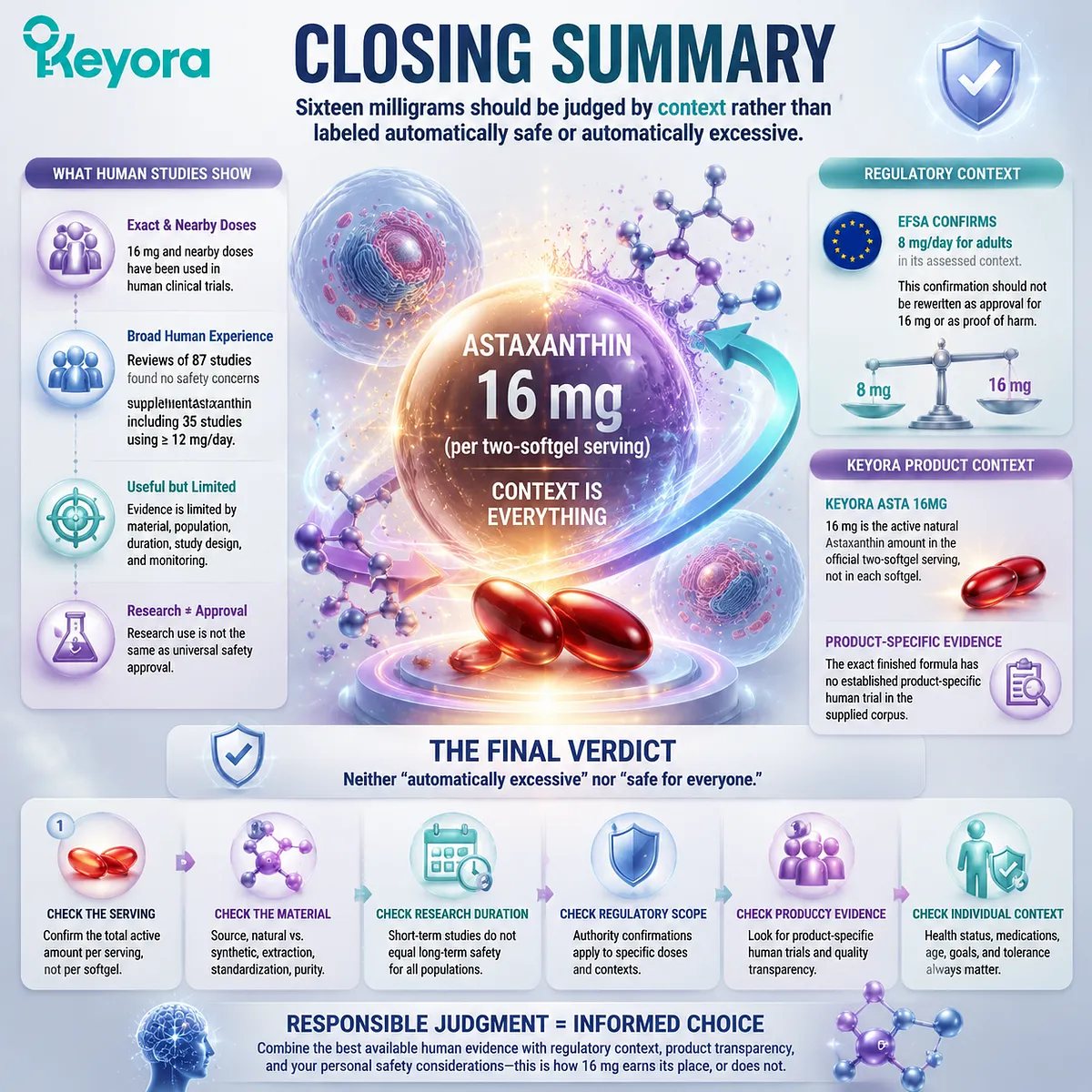
Sixteen milligrams should be judged by context rather than labeled automatically safe or automatically excessive
Sixteen milligrams of Astaxanthin is not an inherently meaningless or completely unstudied amount.
Exact and nearby doses have appeared in human trials, and broader reviews describe substantial human experience with natural Astaxanthin at doses of at least 12 mg per day.
That evidence remains limited by material, population, duration, study design, and monitoring. Research use is not the same as universal safety approval, and EFSA’s confirmation of 8 mg per day for adults in its assessed context should not be rewritten as either approval or proof of harm for 16 mg.
For Keyora, 16 mg is the active natural Astaxanthin amount in the official two-softgel serving, not in each softgel. The exact finished formula has no established product-specific human trial in the supplied corpus.
The final verdict is neither “automatically excessive” nor “safe for everyone.”
A responsible judgment checks the serving, material, research duration, regulatory scope, product-specific evidence, and individual safety context.
This article is for educational and informational purposes only. It does not provide medical advice, diagnosis, treatment, cure, prevention, disease outcome claims, hormone restoration claims, fertility outcome claims, or formula-specific clinical efficacy claims.