
If Synthetic Astaxanthin Has the Same 3S,3′S Form, Is It Equivalent to Natural Astaxanthin?
Keyora Research Q&A Library
This is part of the Keyora Research Q&A Series, derived from Keyora Astaxanthin Research Journal Series.
Within the Keyora Astaxanthin Researcn framework, this Q&A translates complex astaxanthin biology into reader-friendly, evidence-bound answers, focusing on natural astaxanthin identity, molecular structure, antioxidant and redox mechanisms, membrane lipid interaction, mitochondrial resilience, inflammatory signaling pathways, human evidence interpretation, and the scientific principles behind responsible supplementation.
First published by Keyora Research Journal: www.keyorahealth.com
Direct Answer
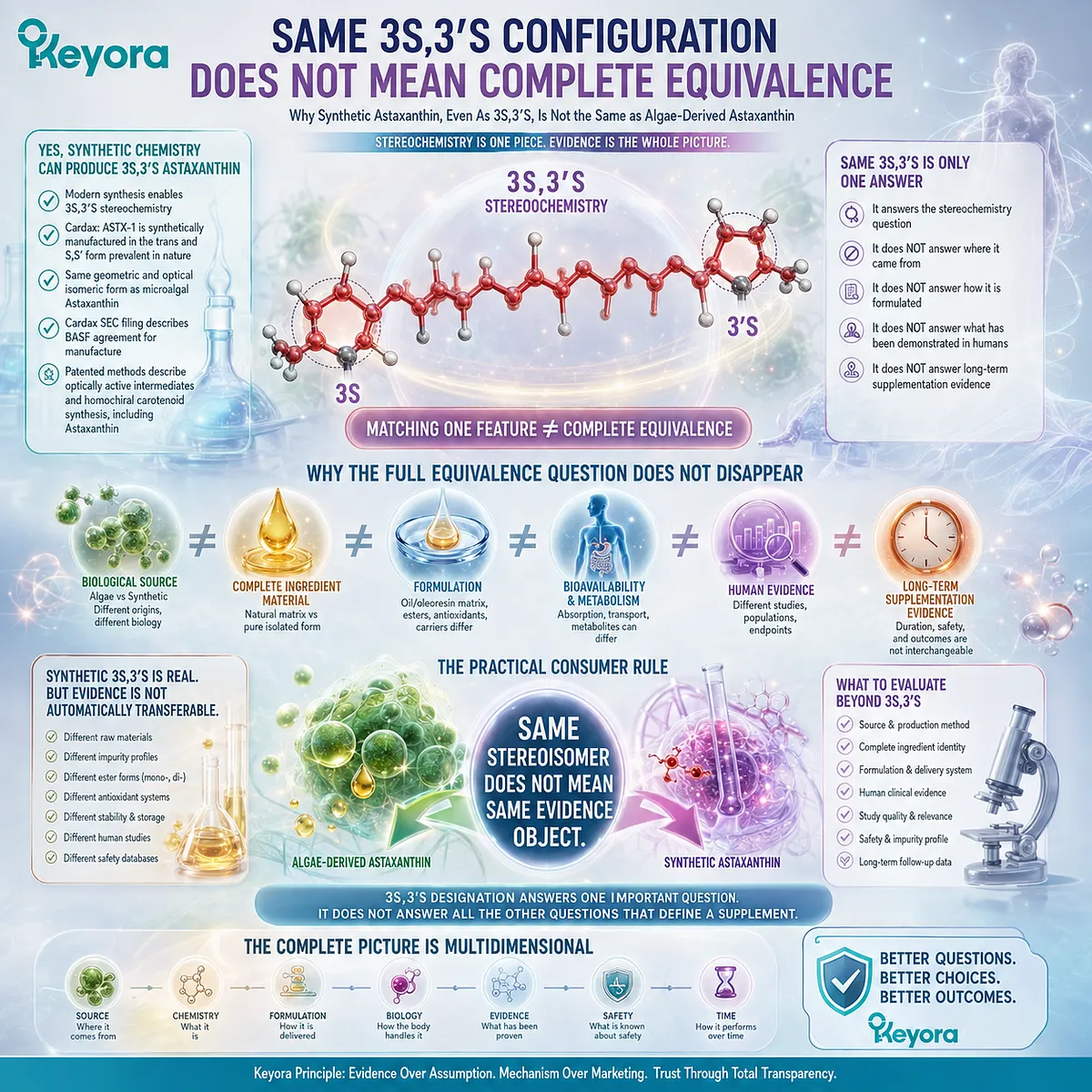
Synthetic Astaxanthin can be made in the 3S,3′S configuration, but matching one stereochemical feature does not establish complete equivalence with algae-derived Astaxanthin.
Yes, synthetic chemistry can produce Astaxanthin with the 3S,3′S configuration.
That point matters because a common older shortcut says synthetic Astaxanthin must always be the conventional mixed stereoisomer material. That is no longer a reliable rule for judging every synthetic Astaxanthin ingredient.
Cardax described ASTX-1 in an SEC filing as synthetically manufactured Astaxanthin in the trans and S,S′ isomeric form prevalent in nature, and stated that this was the same geometric and optical isomeric form found in microalgal Astaxanthin products.
The filing also describes a BASF agreement covering manufacture of that material. Patented synthesis methods likewise describe optically active intermediates and homochiral carotenoid synthesis, including Astaxanthin.
But that does not make the full equivalence question disappear.
The useful distinction is:
Same 3S,3′S configuration
≠ same biological source
≠ same complete ingredient material
≠ same formulation
≠ same human evidence
≠ same long-term supplementation evidence
The 3S,3′S designation answers an important stereochemistry question. It does not answer every other question about what a supplement is, where it came from, how it is formulated, or what has actually been demonstrated in humans.
The practical consumer rule is:
Same stereoisomer does not mean same evidence object.
Yes, Synthetic Astaxanthin Can Be Made as 3S,3′S
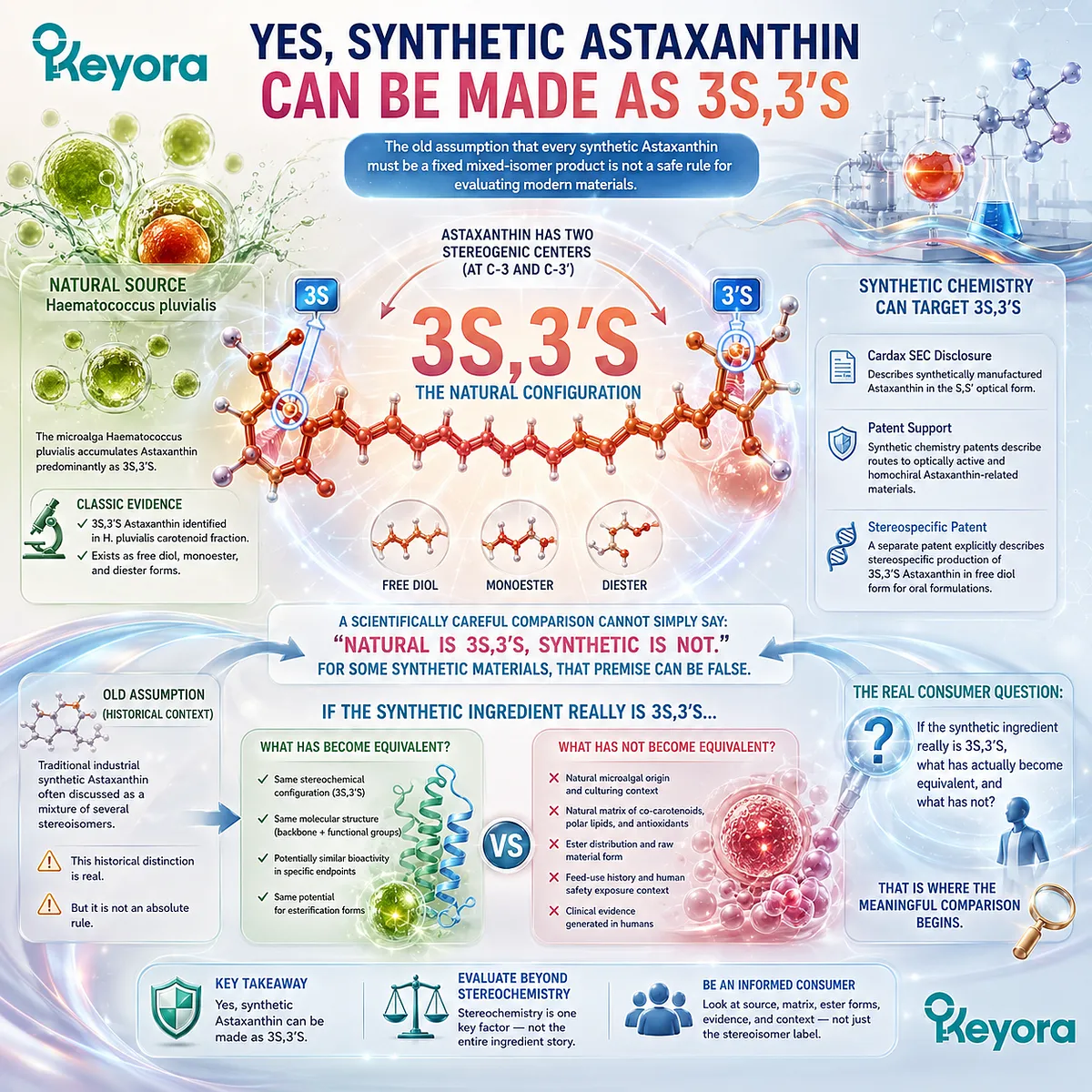
The old assumption that every synthetic Astaxanthin must be a fixed mixed-isomer product is not a safe rule for evaluating modern materials.
Astaxanthin contains two stereogenic centers, so different stereochemical configurations are possible. The 3S,3′S form is strongly associated with Haematococcus pluvialis, the microalgal source widely used for natural Astaxanthin ingredients. Classic work on H. pluvialis identified 3S,3′S Astaxanthin and its monoester and diester forms in the algal carotenoid fraction.
Traditional industrial synthetic Astaxanthin has often been discussed as a mixture containing several stereoisomers. That historical distinction is real, but it should not be turned into the absolute claim that chemical synthesis can never produce a stereochemically targeted Astaxanthin.
It can.
Cardax’s SEC disclosure specifically describes synthetically manufactured Astaxanthin in the S,S′ optical form. Synthetic chemistry patents also describe routes for producing optically active and homochiral Astaxanthin-related materials. A separate patent explicitly describes stereospecific production of 3S,3′S Astaxanthin in free diol form for use in oral formulations.
That means a scientifically careful comparison cannot simply say:
“Natural is 3S,3′S, synthetic is not.”
For some synthetic materials, that premise can be false.
A stronger consumer question is therefore:
If the synthetic ingredient really is 3S,3′S, what has actually become equivalent, and what has not?
That is where the meaningful comparison begins.
What Does Matching 3S,3′S Actually Prove?
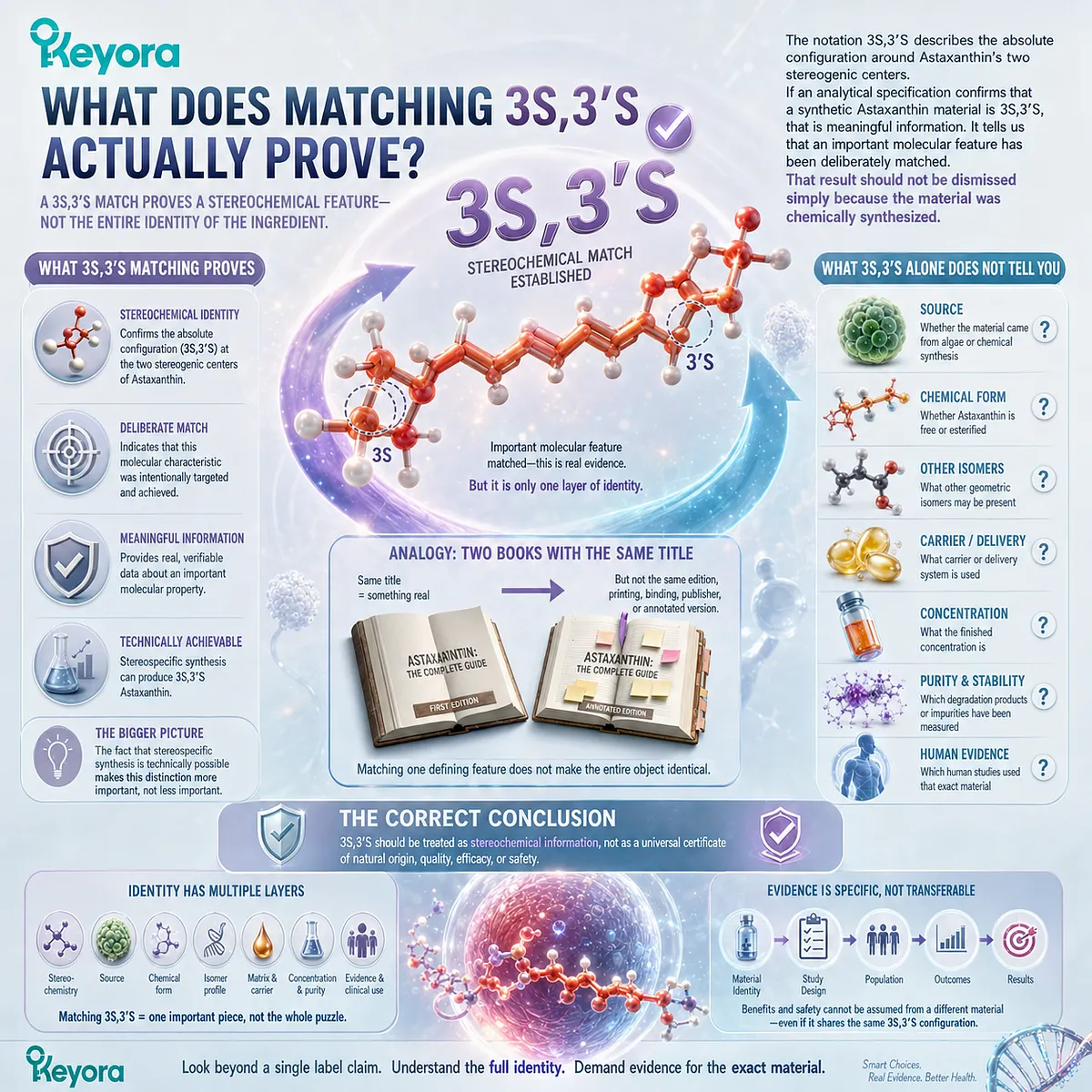
A 3S,3′S match establishes a stereochemical characteristic, not the entire identity of the commercial ingredient.
The notation 3S,3′S describes the absolute configuration around Astaxanthin’s two stereogenic centers.
If an analytical specification confirms that a synthetic Astaxanthin material is 3S,3′S, that is meaningful information. It tells us that an important molecular feature has been deliberately matched.
That result should not be dismissed simply because the material was chemically synthesized.
But stereochemical identity is only one layer of identity.
Imagine two books with exactly the same title. The title tells you something real, but it does not tell you whether they are the same edition, printing, binding, publisher, or annotated version. The analogy is imperfect, but it captures the evidence problem: matching one defining feature does not automatically make the entire object identical.
For Astaxanthin, 3S,3′S does not by itself tell you:
-
whether the material came from algae or chemical synthesis,
-
whether Astaxanthin is free or esterified,
-
what other geometric isomers may be present,
-
what carrier or delivery system is used,
-
what the finished concentration is,
-
what degradation products or impurities have been measured,
-
or which human studies used that exact material.
This is why 3S,3′S should be treated as stereochemical information, not as a universal certificate of natural origin, quality, efficacy, or safety.
The fact that stereospecific synthesis is technically possible makes this distinction more important, not less important.
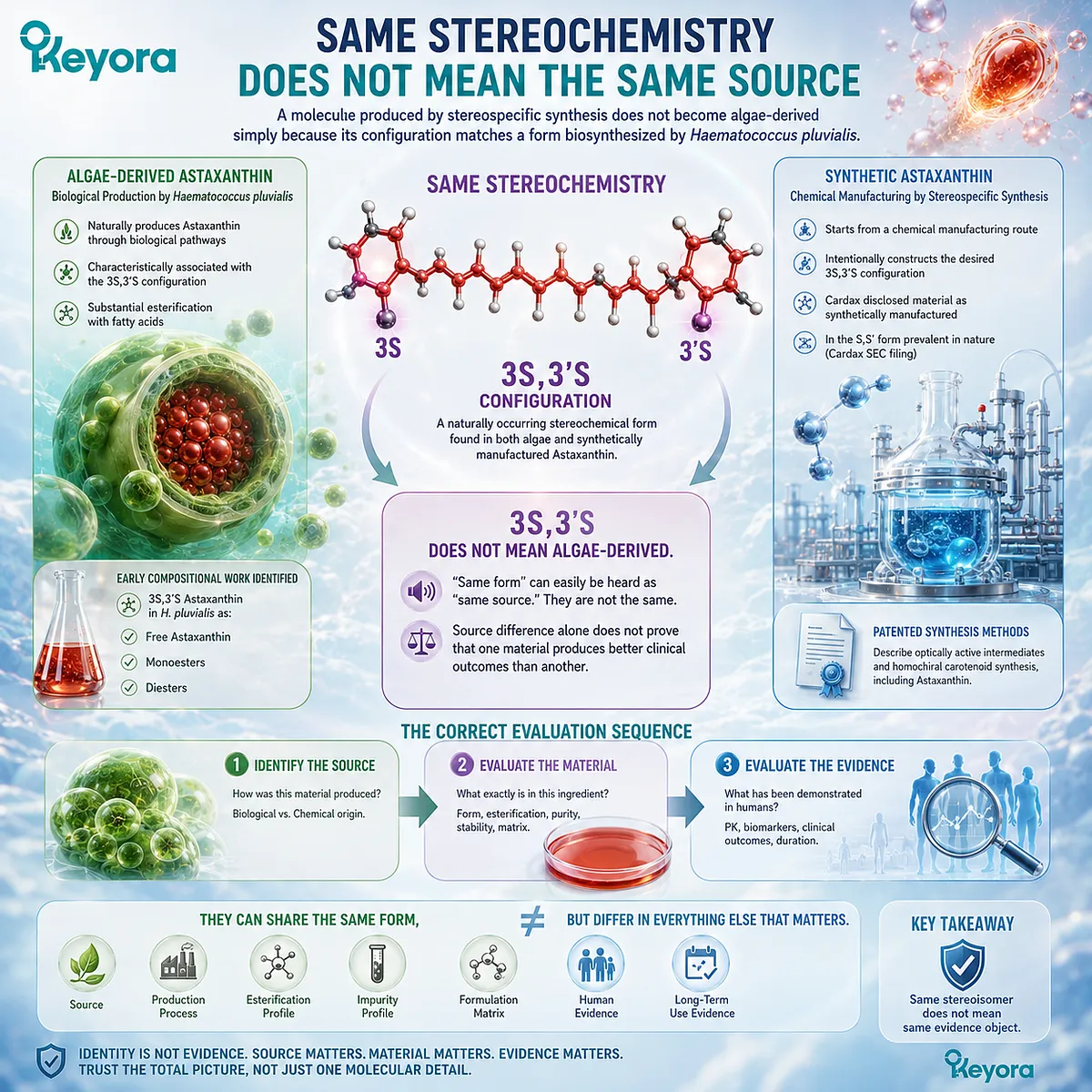
Same Stereochemistry Does Not Mean the Same Source
A molecule produced by stereospecific synthesis does not become algae-derived simply because its configuration matches a form biosynthesized by Haematococcus pluvialis.
Source identity answers a different question:
How was this material produced?
Haematococcus pluvialis produces Astaxanthin biologically. Its Astaxanthin is characteristically associated with the 3S,3′S configuration and, within the algal material, substantial esterification with fatty acids. Early compositional work identified 3S,3′S Astaxanthin as free Astaxanthin, monoesters, and diesters in H. pluvialis.
A stereospecific synthetic process starts from a chemical manufacturing route and intentionally constructs the desired configuration. Cardax’s disclosure is unusually useful here because it describes the material as both synthetically manufactured and in the S,S′ form prevalent in nature.
Those statements can both be true.
The material can be synthetic in origin while matching a naturally occurring stereochemical form.
Therefore:
3S,3′S does not mean algae-derived.
This is important for consumers because “same form” can easily be heard as “same source.” They are not the same statement.
At the same time, source difference alone does not prove that one material produces better clinical outcomes than another. Natural origin is an identity fact, not automatic efficacy proof.
The correct sequence is:
first identify the source, then evaluate the material, then evaluate the evidence.
The Complete Material Can Still Be Different
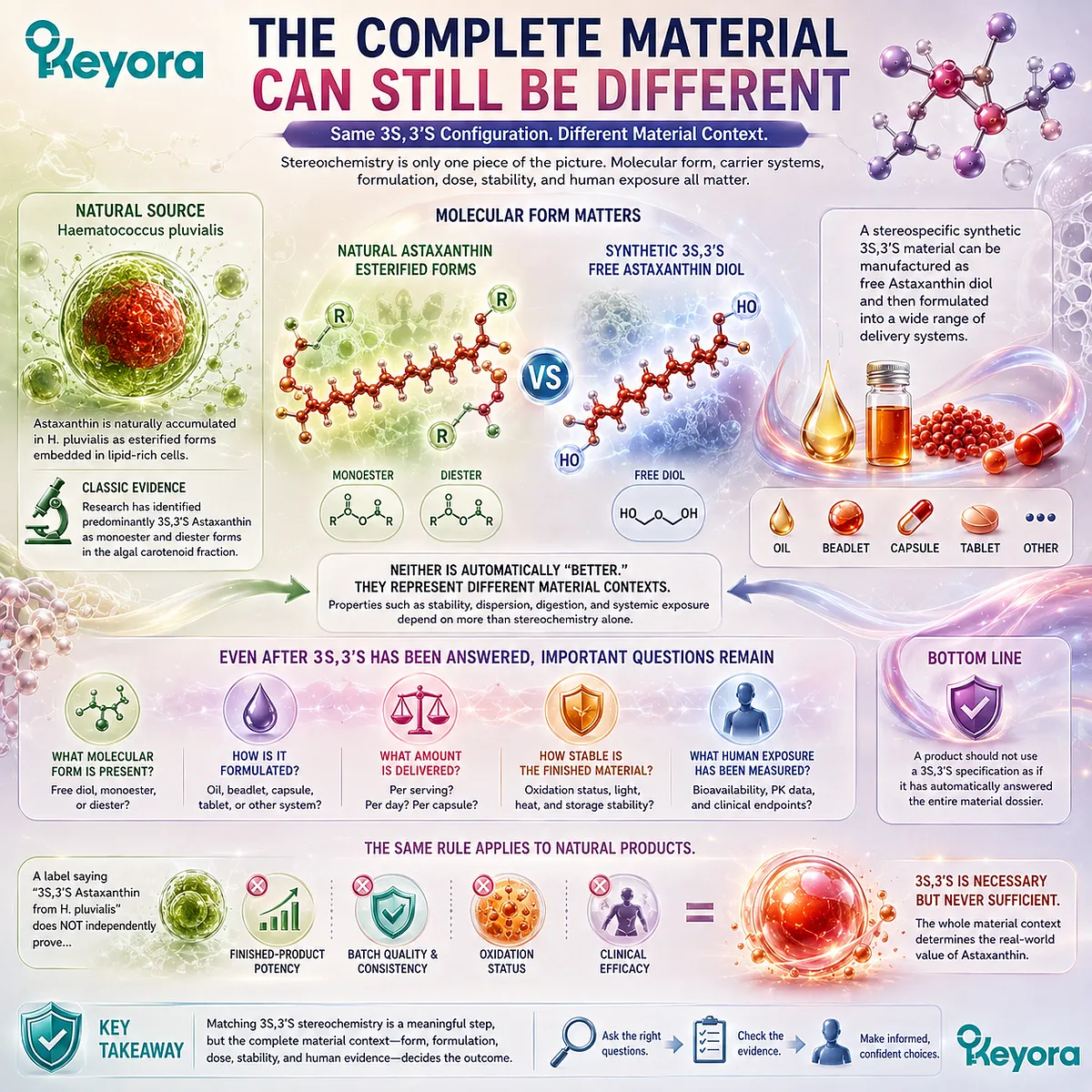
Free versus esterified forms, geometric-isomer context, carrier systems, and formulation can differ even when the 3S,3′S configuration matches.
A commercial Astaxanthin ingredient is more than a pair of stereochemical letters.
One particularly important distinction is molecular form.
Astaxanthin from H. pluvialis commonly occurs within an esterified lipid context. Classic algal analyses identified both monoesters and diesters of 3S,3′S Astaxanthin. By contrast, a stereospecific synthetic 3S,3′S material can be manufactured as free Astaxanthin diol and then formulated into an oil, beadlet, capsule, tablet, or other delivery system.
Neither description is automatically “better.” They describe different material contexts.
This distinction matters because properties such as stability, dispersion, digestion, and systemic exposure can depend on more than stereochemistry alone. The carrier, physical form, food matrix, dose, and formulation can all matter.
So even after the 3S,3′S question has been answered, several additional questions remain:
What molecular form is present?
How is it formulated?
What amount is delivered?
How stable is the finished material?
What human exposure has been measured?
A product therefore should not use a 3S,3′S specification as if it had automatically answered the entire material dossier.
The same rule applies to natural products. A label saying “3S,3′S Astaxanthin from H. pluvialis” still does not independently prove finished-product potency, batch quality, oxidation status, or clinical efficacy.
Same 3S,3′S Does Not Transfer Human Clinical Evidence
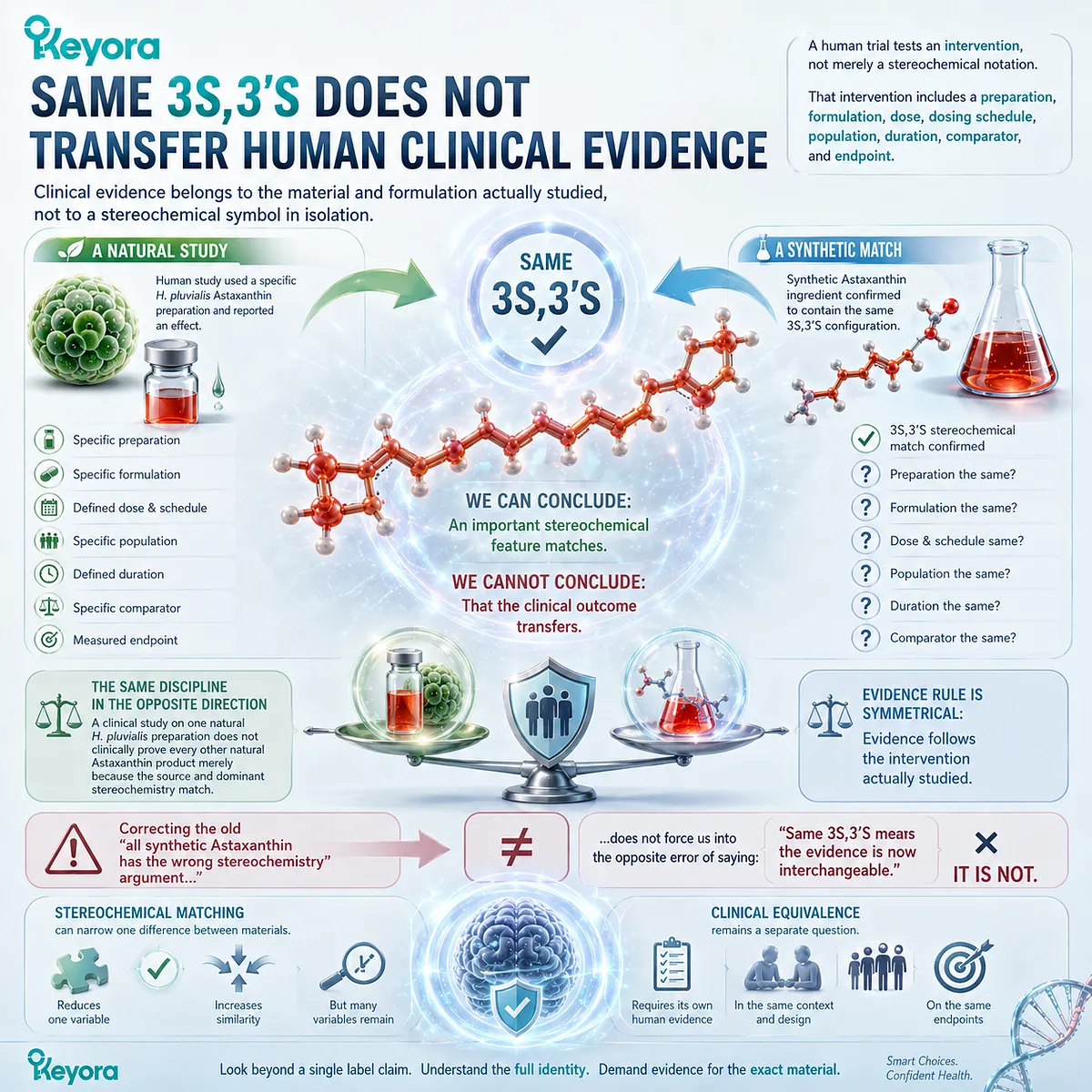
Clinical evidence belongs to the material and formulation actually studied, not to a stereochemical symbol in isolation.
Suppose a human study used a specific H. pluvialis Astaxanthin preparation and reported an effect on a skin, eye, metabolic, inflammatory, or other endpoint.
Now suppose a synthetic Astaxanthin ingredient is confirmed to contain the same 3S,3′S configuration.
What can we conclude?
We can conclude that an important stereochemical feature matches.
We cannot automatically conclude that the clinical outcome transfers.
A human trial tests an intervention, not merely a stereochemical notation.
That intervention includes a preparation, formulation, dose, dosing schedule, population, duration, comparator, and endpoint. A synthetic 3S,3′S material may deserve its own human testing precisely because its molecular configuration has been carefully controlled, but that is different from inheriting another preparation’s results.
The same discipline must be applied in the opposite direction.
A clinical study on one natural H. pluvialis preparation does not clinically prove every other natural Astaxanthin product merely because the source and dominant stereochemistry match.
The evidence rule is symmetrical:
Evidence follows the intervention actually studied.
This is why correcting the old “all synthetic Astaxanthin has the wrong stereochemistry” argument does not force us into the opposite error of saying:
“Same 3S,3′S means the evidence is now interchangeable.”
It is not.
Stereochemical matching can narrow one difference between materials. Clinical equivalence remains a separate question.
Same 3S,3′S Does Not Settle Bioavailability or Long-Term Safety
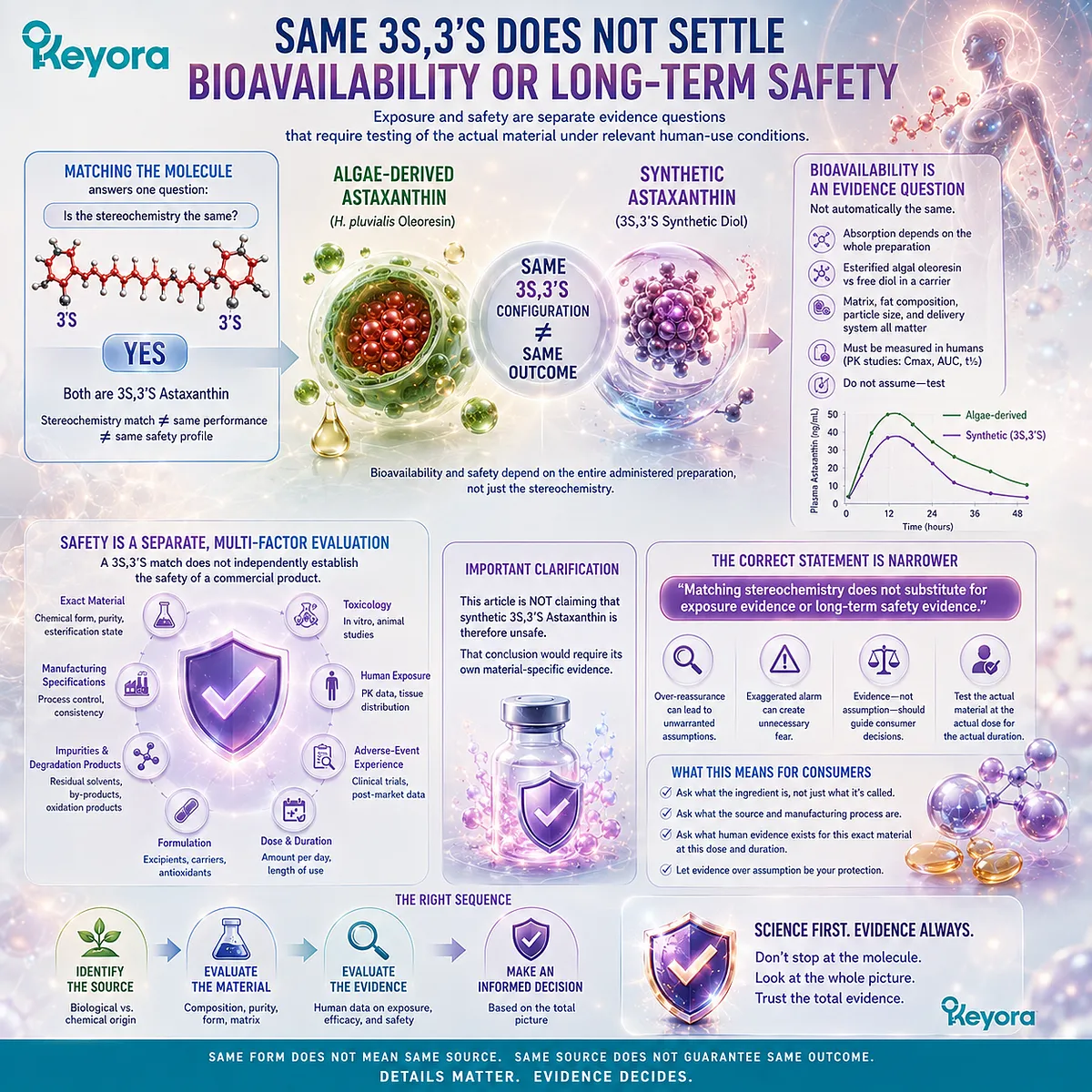
Exposure and safety are separate evidence questions that require testing of the actual material under relevant human-use conditions.
It is tempting to treat molecular matching as the end of the analysis.
If the configuration is the same, a consumer may reasonably ask:
Shouldn’t it absorb the same way?
Not necessarily.
Human exposure depends on the whole administered preparation. A free 3S,3′S synthetic diol in a designed carrier system is not automatically pharmacokinetically identical to an esterified algal oleoresin simply because both contain 3S,3′S Astaxanthin.
That does not mean one must absorb poorly. It means the exposure question has to be measured rather than assumed.
The same applies to safety.
A 3S,3′S match tells us the stereochemistry of the target Astaxanthin molecule. It does not independently establish the safety of a complete commercial material at a particular dose for repeated human use.
Safety evaluation asks additional questions about:
-
the exact material,
-
manufacturing specifications,
-
impurities and degradation products,
-
formulation,
-
dose,
-
duration,
-
toxicology,
-
human exposure,
-
and adverse-event experience.
Importantly, this article is not claiming that synthetic 3S,3′S Astaxanthin is therefore unsafe. That conclusion would require its own material-specific evidence.
The correct statement is narrower:
Matching stereochemistry does not substitute for exposure evidence or long-term safety evidence.
That distinction matters because both over-reassurance and exaggerated alarm can mislead consumers.
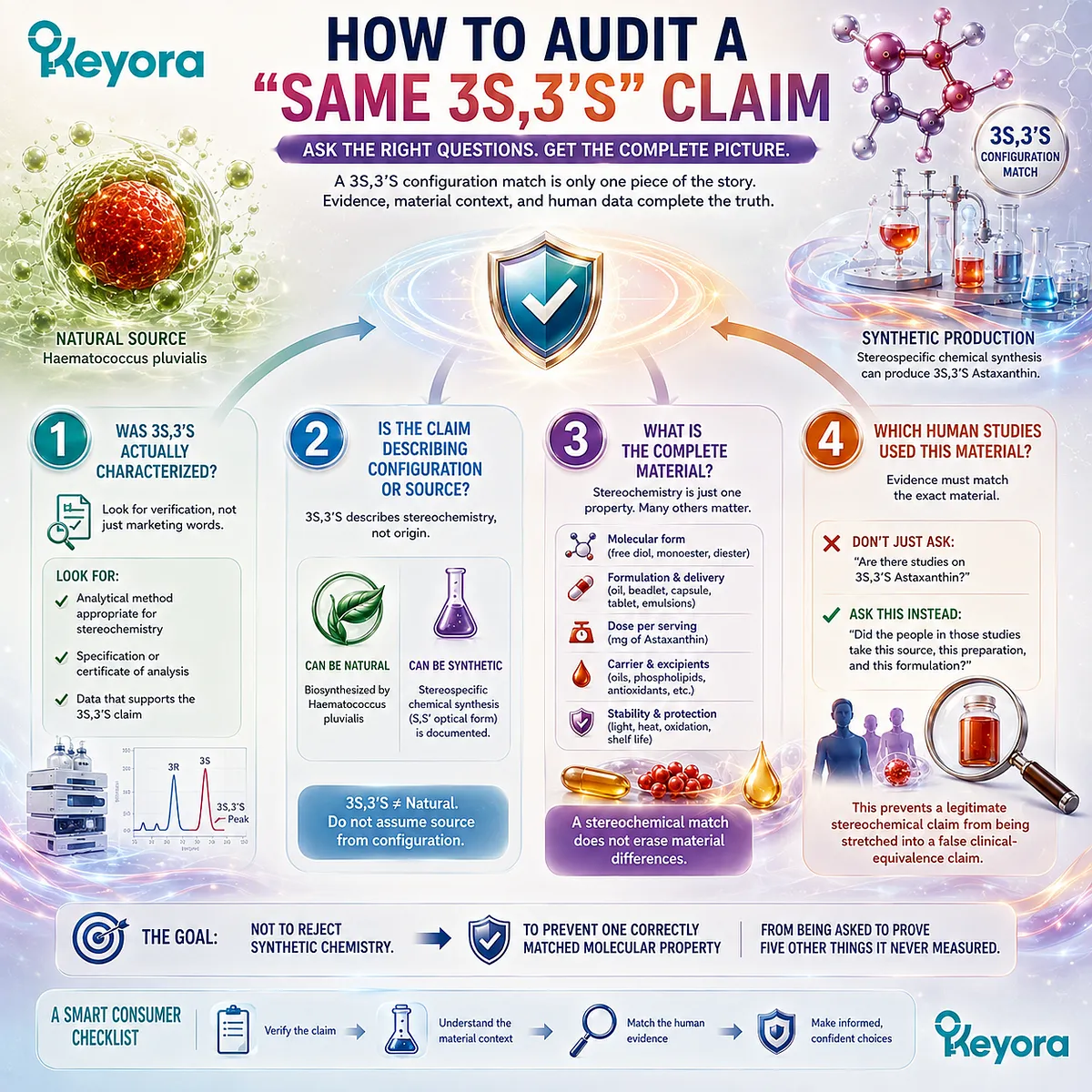
How to Audit a “Same 3S,3′S” Claim
Ask whether the configuration was verified, what complete material is being sold, and which human evidence actually belongs to it.
When a supplement or ingredient is promoted as 3S,3′S Astaxanthin, use four questions.
1. Was 3S,3′S actually characterized?
Look beyond promotional language.
A meaningful stereochemistry claim should trace back to a specification or analytical characterization appropriate to the ingredient. You do not need to become an analytical chemist, but there should be something more substantial than a front-page phrase.
2. Is the claim describing configuration or source?
3S,3′S tells you about stereochemical configuration.
It does not, by itself, tell you whether the Astaxanthin was biosynthesized by H. pluvialis or produced through stereospecific chemical synthesis. Synthetically manufactured S,S′ Astaxanthin has been explicitly documented.
3. What is the complete material?
Check whether the ingredient is free or esterified, how it is formulated, what dose is provided, and what the supplier identifies as the actual commercial preparation.
A stereochemical match does not erase these differences.
4. Which human studies used this material?
Do not ask only:
“Are there studies on 3S,3′S Astaxanthin?”
Ask:
“Did the people in those studies take this source, this preparation, and this formulation?”
That final question prevents a legitimate stereochemical claim from being stretched into a much broader clinical-equivalence claim.
The goal is not to reject synthetic chemistry.
The goal is to prevent one correctly matched molecular property from being asked to prove five other things it never measured.
Closing Summary
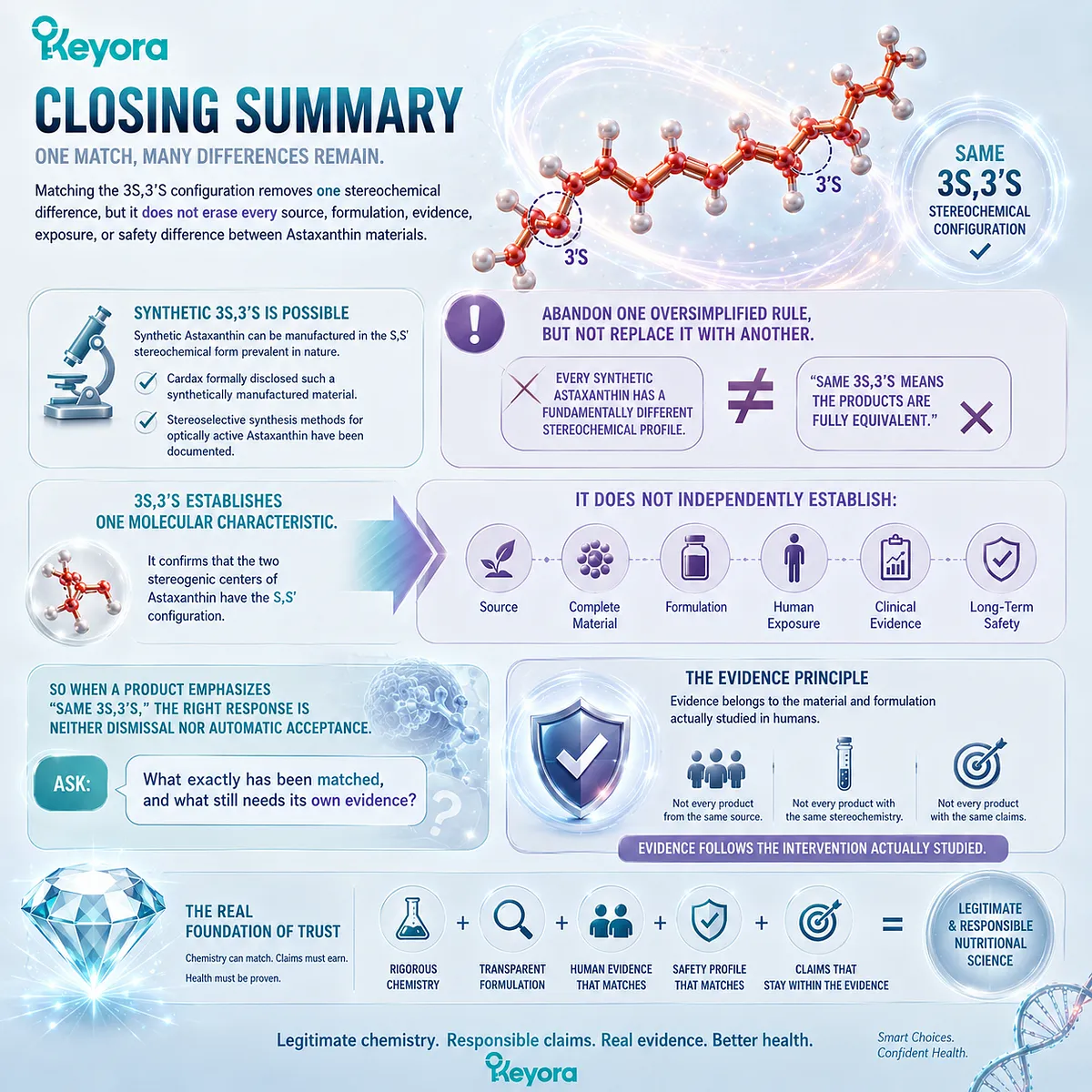
Matching the 3S,3′S configuration removes one stereochemical difference, but it does not erase every source, formulation, evidence, exposure, or safety difference between Astaxanthin materials.
Synthetic Astaxanthin can be manufactured in the S,S′ stereochemical form prevalent in nature. Cardax formally disclosed such a synthetically manufactured material, and stereoselective synthesis methods for optically active Astaxanthin have been documented.
That means consumers should abandon the oversimplified rule that every synthetic Astaxanthin must have a fundamentally different stereochemical profile.
But they should not replace it with a second oversimplification:
“Same 3S,3′S means the products are fully equivalent.”
3S,3′S establishes one molecular characteristic.
It does not independently establish:
Source → Complete Material → Formulation → Human Exposure → Clinical Evidence → Long-Term Safety
So when a product emphasizes “same 3S,3′S,” the right response is neither dismissal nor automatic acceptance.
Ask:
What exactly has been matched, and what still needs its own evidence?
That is the distinction that keeps a legitimate chemistry claim from becoming an unsupported claim of complete nutritional or clinical equivalence.
This article is for educational and informational purposes only. It does not provide medical advice, diagnosis, treatment, cure, prevention, disease outcome claims, hormone restoration claims, fertility outcome claims, or formula-specific clinical efficacy claims.