
How Much Dietary Fat Is Needed for Astaxanthin Absorption?
Keyora Research Q&A Library
This is part of the Keyora Research Q&A Series, derived from Keyora Astaxanthin Research Journal Series.
Within the Keyora Astaxanthin Researcn framework, this Q&A translates complex astaxanthin biology into reader-friendly, evidence-bound answers, focusing on natural astaxanthin identity, molecular structure, antioxidant and redox mechanisms, membrane lipid interaction, mitochondrial resilience, inflammatory signaling pathways, human evidence interpretation, and the scientific principles behind responsible supplementation.
First published by Keyora Research Journal: www.keyorahealth.com
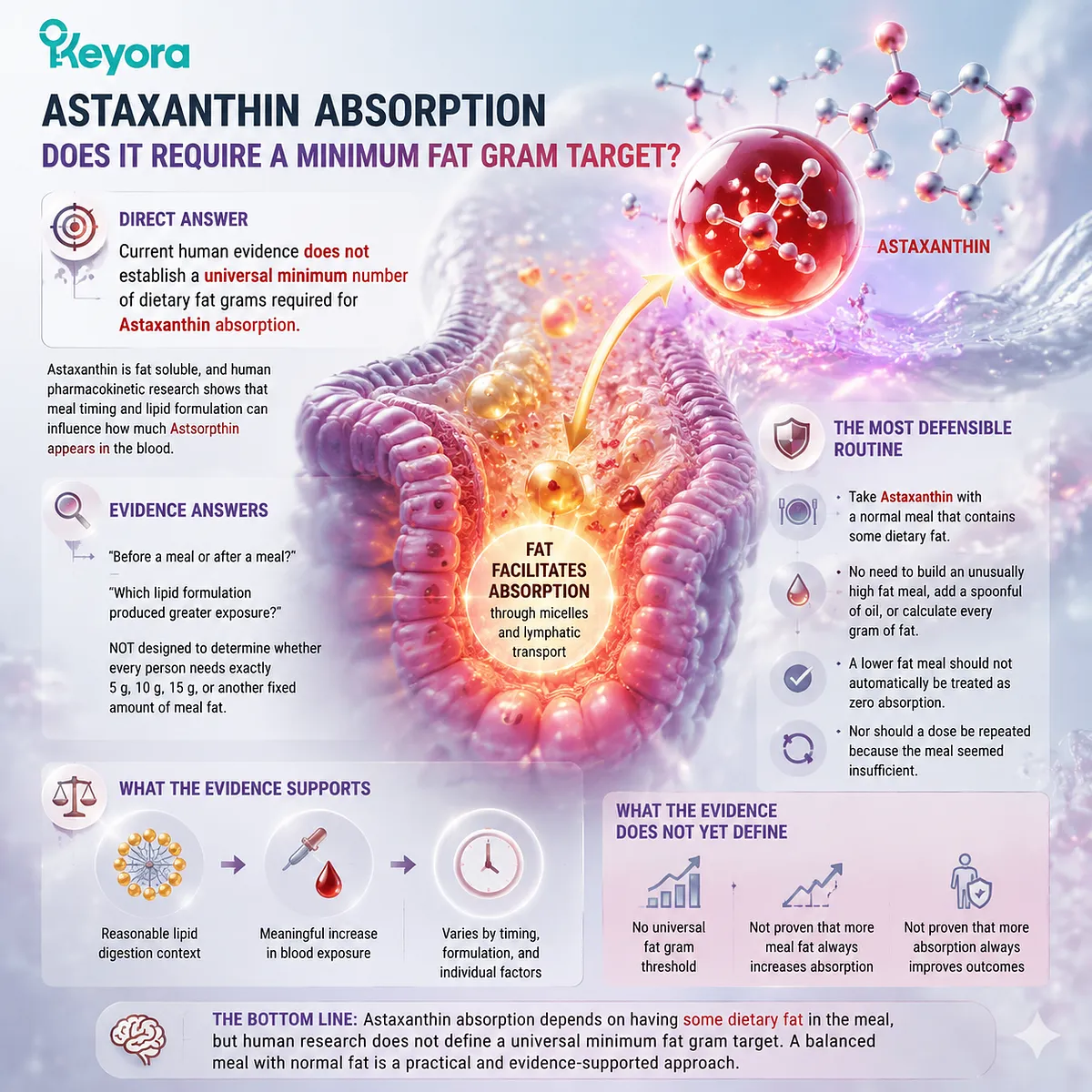
Direct Answer
Current human evidence does not establish a universal minimum number of dietary fat grams required for Astaxanthin absorption.
Astaxanthin is fat soluble, and human pharmacokinetic research shows that meal timing and lipid formulation can influence how much Astaxanthin appears in the blood.
However, the available studies answer questions such as “before a meal or after a meal?” and “which lipid formulation produced greater exposure?”
They were not designed to determine whether every person needs exactly 5 g, 10 g, 15 g, or another fixed amount of meal fat.
The most defensible routine is therefore to take Astaxanthin with a normal meal that contains some dietary fat. There is no need to build an unusually high fat meal around the supplement, add a spoonful of oil, or calculate every gram of fat.
A lower fat meal should not automatically be treated as zero absorption. Nor should a dose be repeated because the meal seemed insufficient.
The evidence supports a reasonable lipid digestion context. It does not yet define one universal threshold, and it does not prove that progressively increasing meal fat will continue to increase absorption or produce better health outcomes.
Why the Question Sounds More Precise Than the Evidence
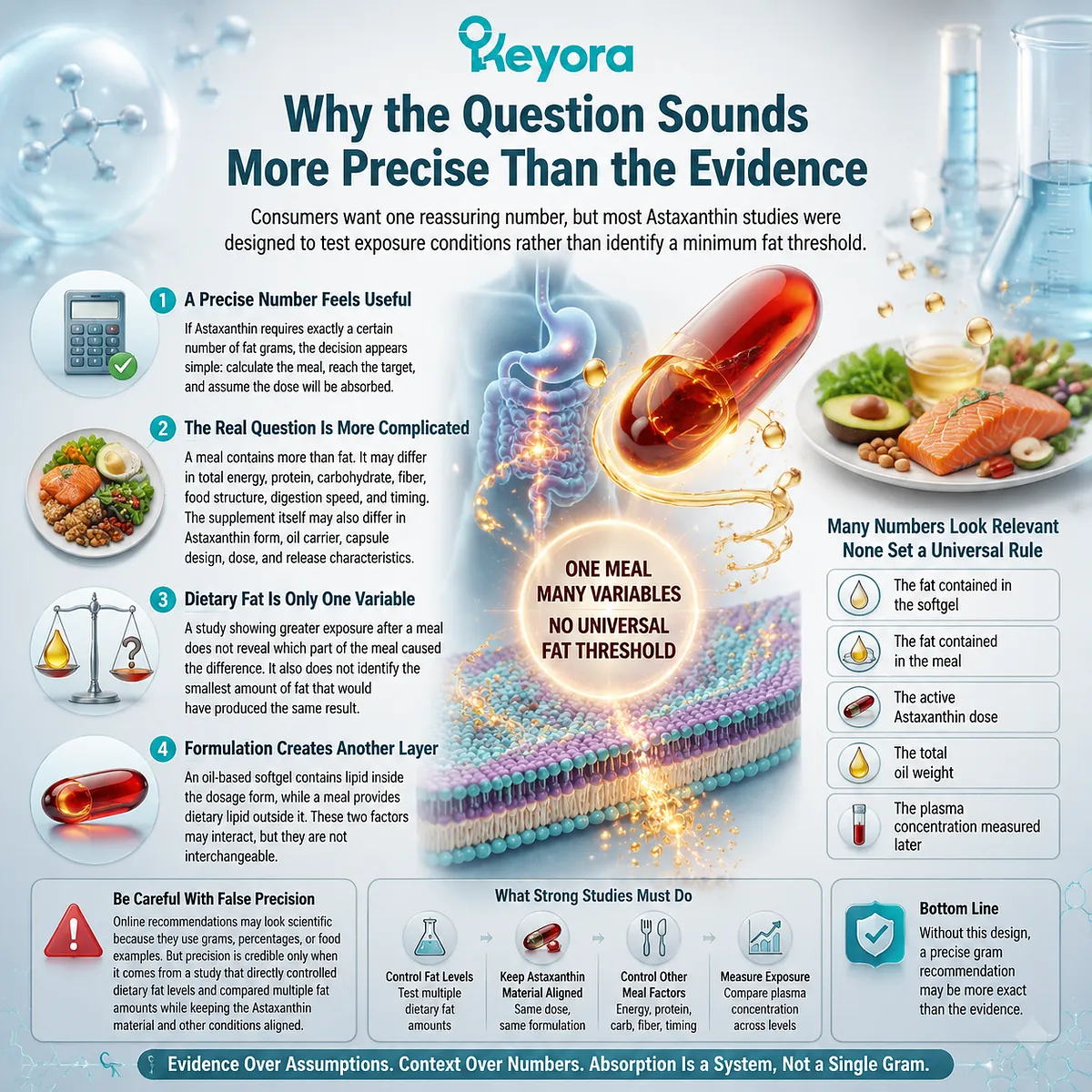
Consumers want one reassuring number, but most Astaxanthin studies were designed to test exposure conditions rather than identify a minimum fat threshold
A precise number feels useful. If someone is told that Astaxanthin requires exactly a certain number of fat grams, the decision appears simple: calculate the meal, reach the target, and assume the dose will be absorbed.
The scientific question is more complicated.
A meal contains more than fat. It may differ in total energy, protein, carbohydrate, fiber, food structure, digestion speed, and timing. The supplement itself may also differ in Astaxanthin form, oil carrier, capsule design, active dose, and release characteristics.
This means that dietary fat is only one variable within a larger exposure system.
A study showing greater exposure after a meal does not automatically reveal which part of the meal caused the difference. It also does not identify the smallest amount of fat that would have produced the same result.
The formulation creates another source of confusion. An oil based softgel contains lipid inside the dosage form, while a meal provides dietary lipid outside it. These two factors may interact, but they are not interchangeable.
A person may therefore encounter several numbers that appear relevant:
-
the fat contained in the softgel
-
the fat contained in the meal
-
the active Astaxanthin dose
-
the total oil weight
-
the plasma concentration measured later
None of these numbers alone establishes a universal meal fat requirement.
Online recommendations can look scientific because they use grams, percentages, or examples of specific foods. But numerical precision is credible only when it comes from a study that directly controlled the dietary fat amount and compared multiple fat levels while keeping the Astaxanthin material and other conditions aligned.
Without that design, a precise gram recommendation may be more exact than the evidence.
What the Studies Actually Compare
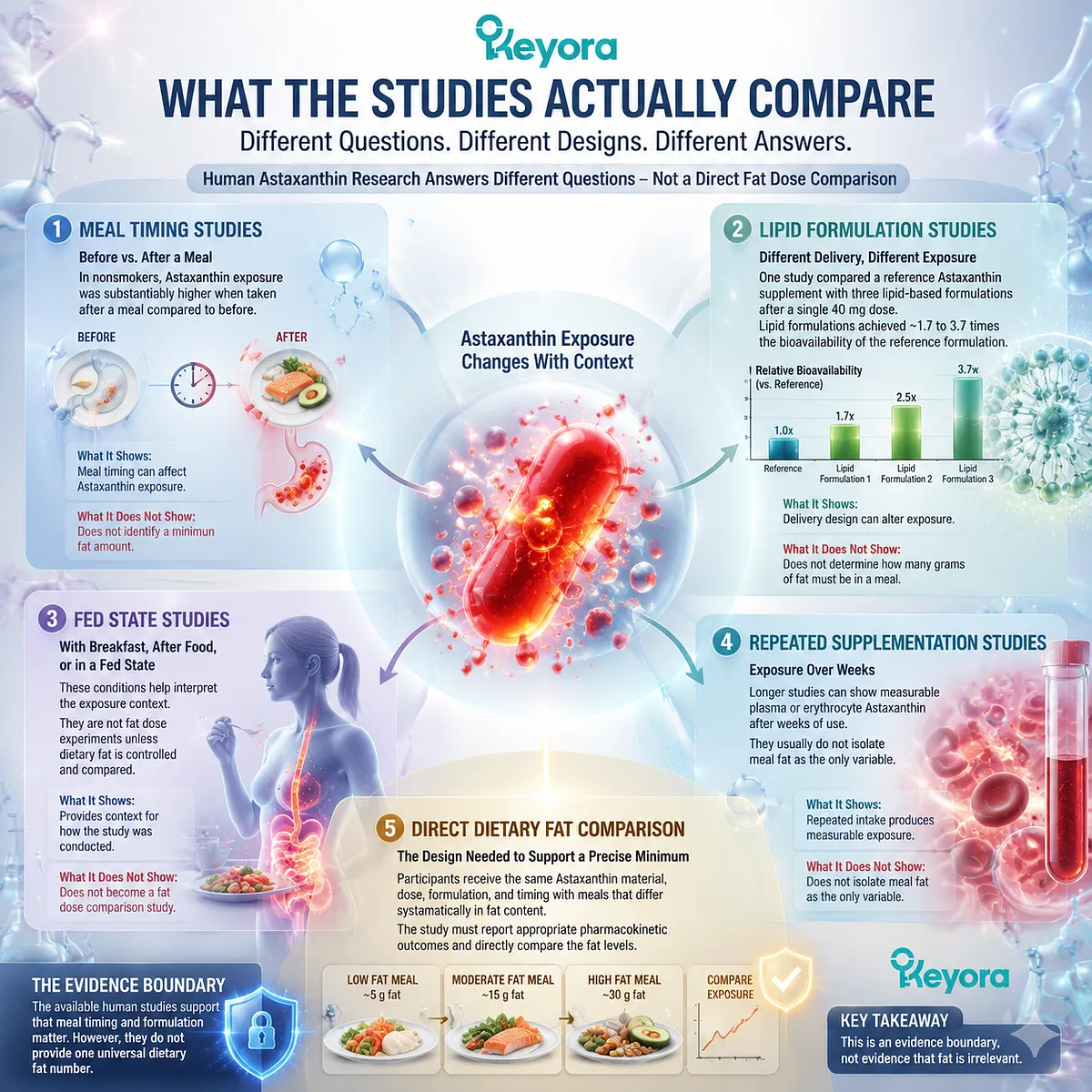
Meal timing, formulation, and blood exposure studies answer different questions from a direct dietary fat dose comparison
Human Astaxanthin research can be grouped by the question each study was designed to answer.
Meal timing studies
One human study administered Astaxanthin from a Haematococcus algal extract either before or after a meal. In nonsmokers, the reported Astaxanthin exposure over time was substantially higher in the after meal group than in the before meal group. This supports the conclusion that meal timing can affect exposure under the tested conditions.
It does not identify a minimum fat amount because the study did not randomly compare several meals containing clearly separated quantities of dietary fat.
Lipid formulation studies
Another human study compared a reference Astaxanthin supplement with three lipid based formulations after a single 40 mg dose. The lipid formulations produced approximately 1.7 to 3.7 times the bioavailability of the reference formulation, depending on the formulation used.
This demonstrates that delivery design can alter exposure. It does not tell the consumer how many grams of fat must be present in breakfast, lunch, or dinner.
Fed state studies
A study may describe supplementation as occurring with breakfast, after food, or in a fed state. That information helps interpret the exposure conditions, but it does not become a fat dose experiment unless the amount of fat was deliberately controlled and directly compared.
Repeated supplementation studies
Longer studies may measure plasma or erythrocyte Astaxanthin after weeks of use. These studies can show that repeated intake produces measurable exposure, but they usually do not isolate meal fat as the only variable.
Direct dietary fat comparison
This would be the study design needed to support a precise minimum.
Participants would receive the same Astaxanthin material, dose, formulation, and timing with meals that differ systematically in fat content. The study would need to report appropriate pharmacokinetic outcomes and directly compare the fat levels.
The available Astaxanthin human studies cited above do not provide that complete threshold design. They support the importance of meal and formulation context, but not one universal dietary fat number. This is an evidence boundary, not evidence that fat is irrelevant.
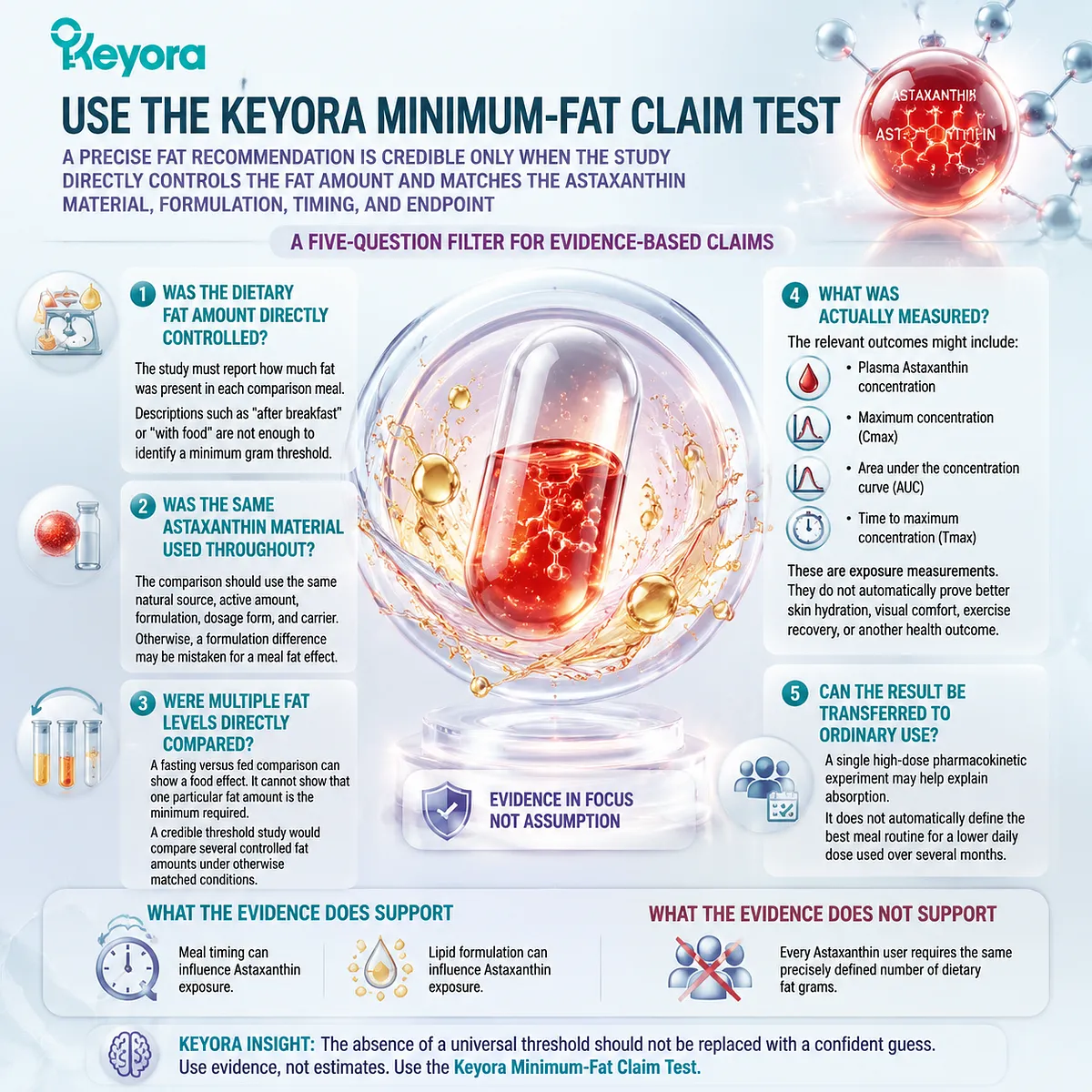
Use the Keyora Minimum-Fat Claim Test
A precise fat recommendation is credible only when the study directly controls the fat amount and matches the Astaxanthin material, formulation, timing, and endpoint
Consider a common online statement:
“Take Astaxanthin with exactly X grams of fat for proper absorption.”
The Keyora Minimum-Fat Claim Test asks five questions before treating that number as evidence based.
1. Was the dietary fat amount directly controlled?
A study must report how much fat was present in each comparison meal. Descriptions such as “after breakfast” or “with food” are not enough to identify a minimum gram threshold.
2. Was the same Astaxanthin material used throughout?
The comparison should use the same natural source, active amount, formulation, dosage form, and carrier. Otherwise, a formulation difference may be mistaken for a meal fat effect.
3. Were multiple fat levels directly compared?
A fasting versus fed comparison can show a food effect. It cannot show that one particular fat amount is the minimum required.
A credible threshold study would compare several controlled fat amounts under otherwise matched conditions.
4. What was actually measured?
The relevant outcomes might include:
-
plasma Astaxanthin concentration
-
maximum concentration
-
area under the concentration curve
-
time to maximum concentration
These are exposure measurements. They do not automatically prove better skin hydration, visual comfort, exercise recovery, or another health outcome.
5. Can the result be transferred to ordinary use?
A single high dose pharmacokinetic experiment may help explain absorption. It does not automatically define the best meal routine for a lower daily dose used over several months.
When this test is applied to the available human evidence, two conclusions remain defensible:
Meal timing can influence Astaxanthin exposure, and lipid formulation can influence Astaxanthin exposure.
A third conclusion does not follow:
Every Astaxanthin user requires the same precisely defined number of dietary fat grams.
The absence of a universal threshold should not be replaced with a confident guess.
Replace Gram Counting With a Normal Meal Principle
The practical goal is a repeatable meal context, not a high fat ritual built around one supplement
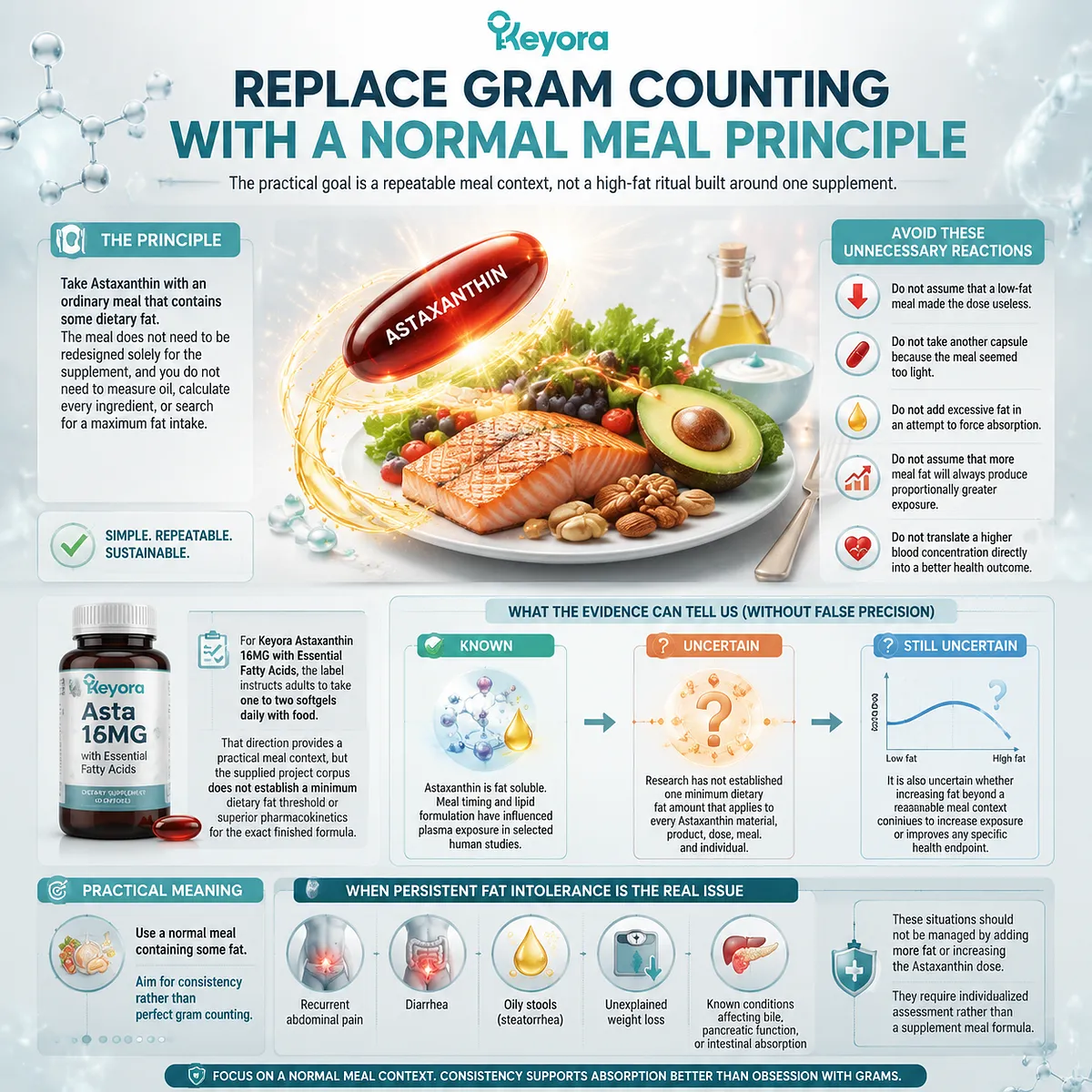
A useful routine should be simple enough to follow consistently.
Take Astaxanthin with an ordinary meal that contains some dietary fat. The meal does not need to be redesigned solely for the supplement, and the reader does not need to measure oil, calculate every ingredient, or search for a maximum fat intake.
This principle also avoids several unnecessary reactions.
Do not assume that a low fat meal made the dose useless.
Do not take another capsule because the meal seemed too light.
Do not add excessive fat in an attempt to force absorption.
Do not assume that more meal fat will always produce proportionally greater exposure.
Do not translate a higher blood concentration directly into a better health outcome.
For Keyora Astaxanthin 16MG with Essential Fatty Acids, the label instructs adults to take one to two softgels daily with food. That direction provides a practical meal context, but the supplied project corpus does not establish a minimum dietary fat threshold or superior pharmacokinetics for the exact finished formula.
The evidence can be summarized without false precision.
Known
Astaxanthin is fat soluble. Meal timing and lipid formulation have influenced plasma exposure in selected human studies.
Uncertain
Research has not established one minimum dietary fat amount that applies to every Astaxanthin material, product, dose, meal, and individual.
It is also uncertain whether increasing fat beyond a reasonable meal context continues to increase exposure or improves any specific health endpoint.
Practical meaning
Use a normal meal containing some fat. Aim for consistency rather than perfect gram counting.
Persistent difficulty tolerating dietary fat is a different question. Recurrent abdominal pain, diarrhea, oily stools, unexplained weight loss, or known conditions affecting bile, pancreatic function, or intestinal absorption should not be managed by adding more fat or increasing the Astaxanthin dose.
Those situations require individualized assessment rather than a supplement meal formula.
Closing Summary
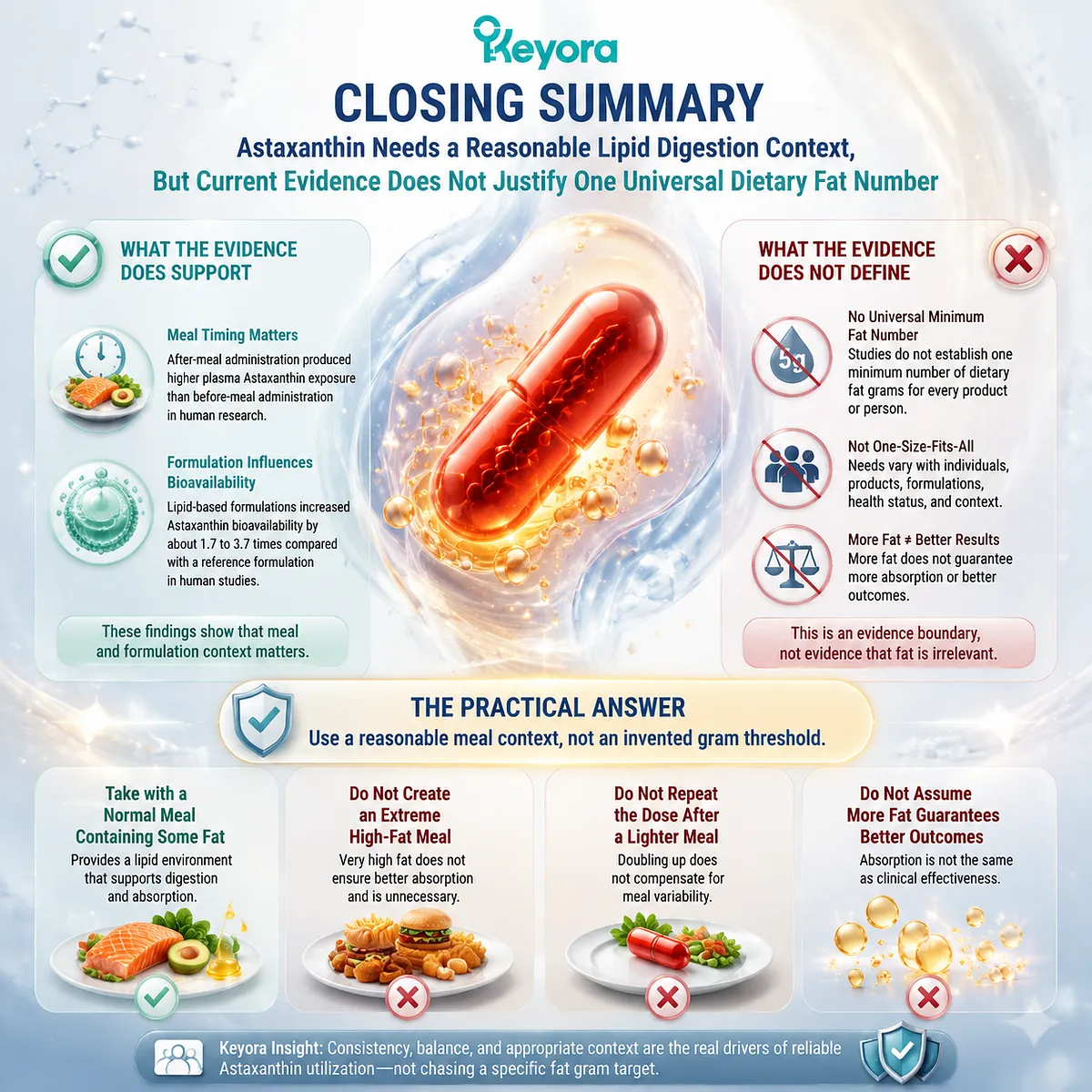
Astaxanthin needs a reasonable lipid digestion context, but current evidence does not justify one universal dietary fat number
Human research supports taking Astaxanthin in an appropriate meal and formulation context. After meal administration has produced greater plasma exposure than before meal administration in one study, while lipid based formulations have also changed bioavailability in human research.
What the evidence does not define is equally important. These studies do not establish one minimum number of dietary fat grams for every product or person.
The practical answer is therefore not a rigid calculation.
Take Astaxanthin with a normal meal containing some fat. Do not create an extreme high fat meal, repeat the dose after a lighter meal, or assume that more fat guarantees better absorption or better outcomes.
Use a reasonable meal context, not an invented gram threshold.
This article is for educational and informational purposes only. It does not provide medical advice, diagnosis, treatment, cure, prevention, disease outcome claims, hormone restoration claims, fertility outcome claims, or formula-specific clinical efficacy claims.