
How Much Astaxanthin Should You Take? What Dose Makes Sense?
Keyora Research Q&A Library
This is part of the Keyora Research Q&A Series, derived from Keyora Astaxanthin Research Journal Series.
Within the Keyora Astaxanthin Researcn framework, this Q&A translates complex astaxanthin biology into reader-friendly, evidence-bound answers, focusing on natural astaxanthin identity, molecular structure, antioxidant and redox mechanisms, membrane lipid interaction, mitochondrial resilience, inflammatory signaling pathways, human evidence interpretation, and the scientific principles behind responsible supplementation.
First published by Keyora Research Journal: www.keyorahealth.com
Short Answer
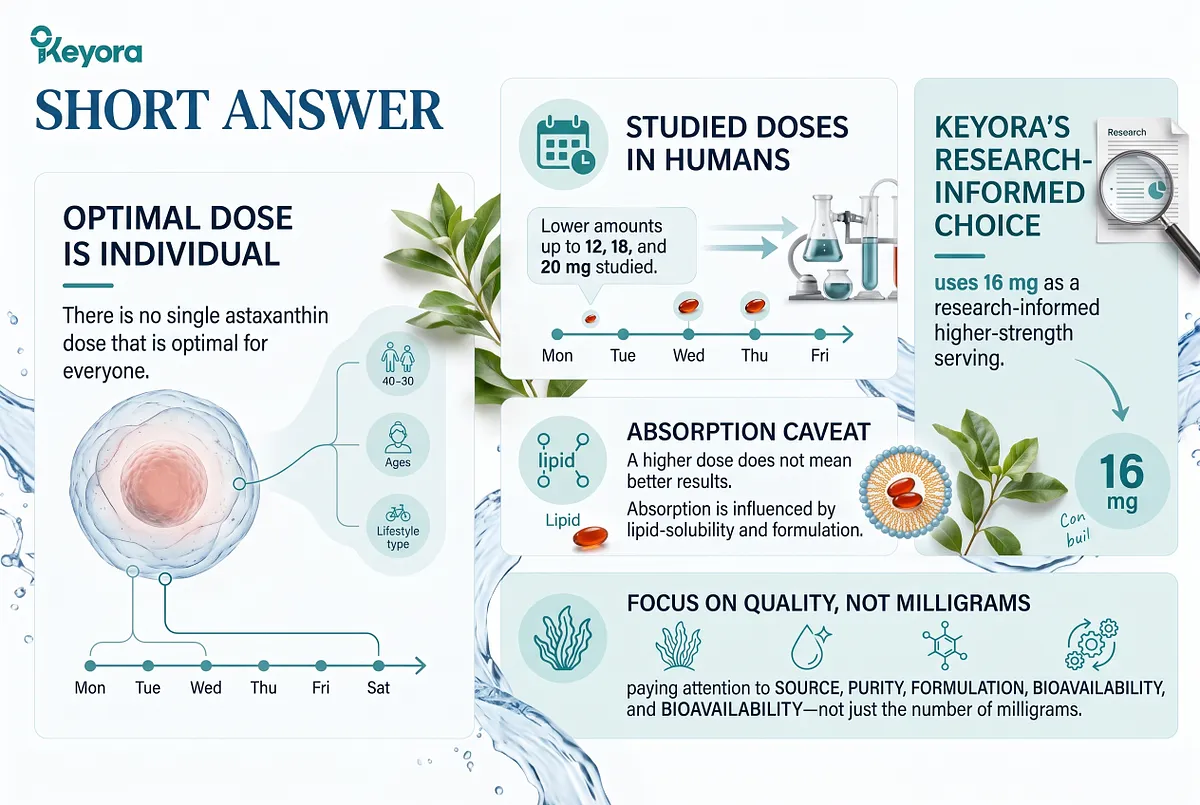
There is no single astaxanthin dose that is optimal for everyone. Human studies have evaluated daily doses ranging from lower amounts to 12, 18, and 20 mg. A higher dose does not automatically mean better results, because astaxanthin is highly lipid-soluble and its absorption can be influenced by formulation. This is why Keyora uses 16 mg as a research-informed higher-strength serving while paying attention to source, purity, formulation, and bioavailability—not just the number of milligrams.
What Astaxanthin Doses Have Been Studied in Humans?
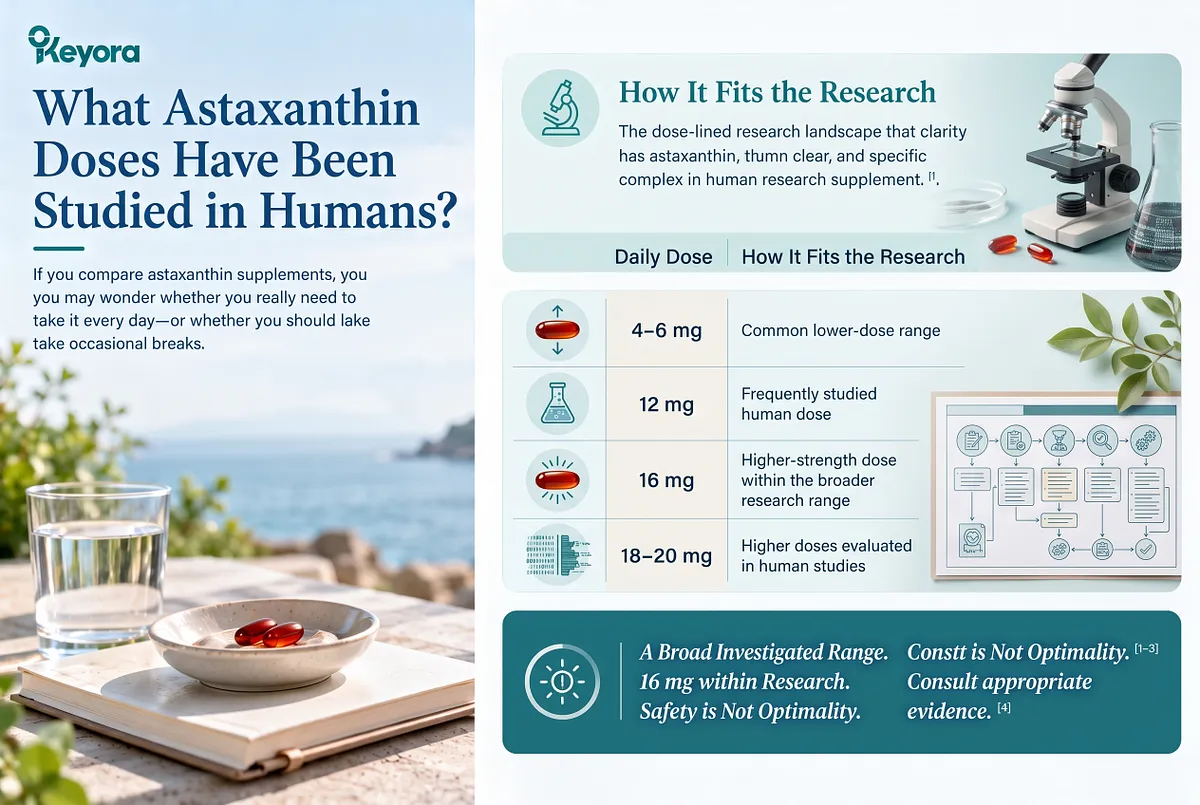
If you compare astaxanthin supplements on the market, you will often see relatively low doses such as 4 or 6 mg per serving.
But the human research landscape is broader than the numbers commonly printed on supplement labels.
Clinical studies have evaluated astaxanthin at doses including 6, 12, and 18 mg per day. One randomized, placebo-controlled study directly compared 6, 12, and 18 mg/day for 12 weeks, demonstrating that astaxanthin research is not limited to low-dose supplementation. Other human studies have evaluated 12 mg/day, while a clinical safety study also administered an extract equivalent to 20 mg/day for four weeks. [1–3]
This gives you a useful way to look at the dose range:
4–6 mg
Common lower-dose range
12 mg
Frequently studied human dose
16 mg
Higher-strength dose within the broader research range
18–20 mg
Higher doses evaluated in human studies
The important point is not that one number is universally “best.”
It is that 16 mg is not an unusually high or arbitrary dose. It sits within a broader range of doses that have already been investigated in humans.
A 2019 safety review examined 87 human studies of natural astaxanthin and reported that 35 included doses of at least 12 mg/day, with no safety concerns identified in those studies. However, safety evidence should not be interpreted as proof that a particular dose is optimal for a particular purpose. [4]
Does a Higher Astaxanthin Dose Automatically Mean Better Results?
Not necessarily.
This is where comparing astaxanthin products by milligrams alone can become misleading.
The amount listed on the label tells you how much astaxanthin the product provides. It does not, by itself, tell you how much will be absorbed or how much will become systemically available.
In other words:
Dose ≠ Absorption ≠ Bioavailability
Astaxanthin is a lipid-soluble carotenoid. Human pharmacokinetic research has shown that the formulation used to deliver astaxanthin can influence its absorption and plasma exposure. [5,6]
So when comparing two products, asking only “Which one has more milligrams?” may leave out an important part of the equation.
And that is exactly where the rationale behind Keyora’s 16 mg formula begins.
Why Does Keyora Use 16 mg of Astaxanthin?
Keyora did not choose 16 mg simply to put a larger number on the front of the bottle.
The decision starts with the research.
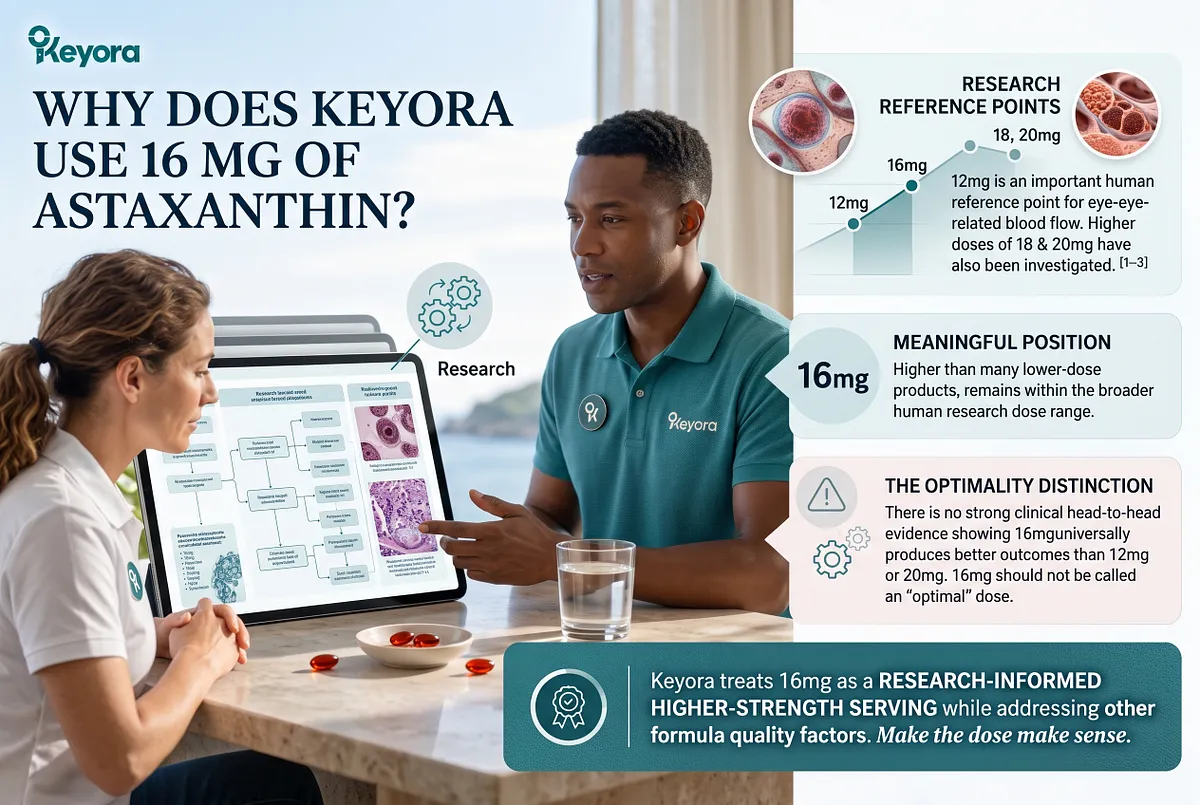
Twelve milligrams is an important reference point because it has been used repeatedly in human studies, including research investigating eye-related blood flow and other physiological outcomes. Higher doses such as 18 and 20 mg have also been investigated in humans. [1–3]
That places 16 mg in a meaningful position:
It is higher than many common lower-dose products, while remaining within the broader range of doses evaluated in human research.
But there is an important distinction:
16 mg should not be described as a clinically proven “optimal” dose.
There is currently no strong head-to-head clinical evidence showing that 16 mg universally produces better outcomes than 12 mg or 20 mg.
Instead, Keyora’s approach is to treat 16 mg as a research-informed higher-strength serving and then address the other factors that determine the quality of an astaxanthin formula.
That distinction matters.
Because the goal is not simply to take more.
The goal is to make the dose make sense.
Why Doesn’t Keyora Simply Use 20 mg?
If 18 or 20 mg has been studied, you may reasonably ask:
Why not simply use 20 mg?
Because a higher number on the label does not automatically mean a better product.
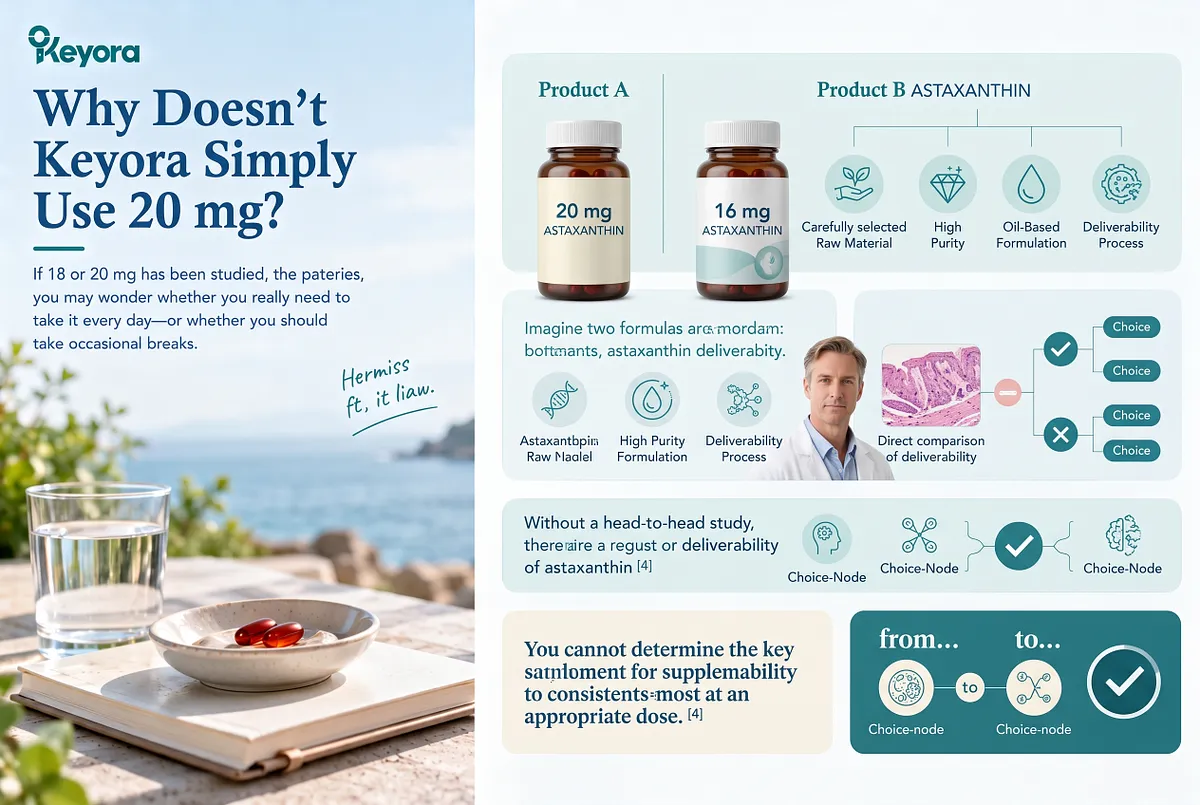
Imagine two formulas:
Product A:
20 mg astaxanthin
Product B:
16 mg astaxanthin + carefully selected raw material + high purity + an oil-based formulation
You cannot determine which product provides greater biological exposure simply by comparing “20” with “16.”
Without a head-to-head pharmacokinetic study comparing the two finished products, claiming that a 16 mg product is absorbed better than a 20 mg product would go beyond the available evidence.
What the research does tell us is that formulation can matter.
That changes the question from:
“How many milligrams does this product contain?”
to:
“How well is those milligrams designed to be delivered?”
What Makes Keyora’s 16 mg Formula Different?
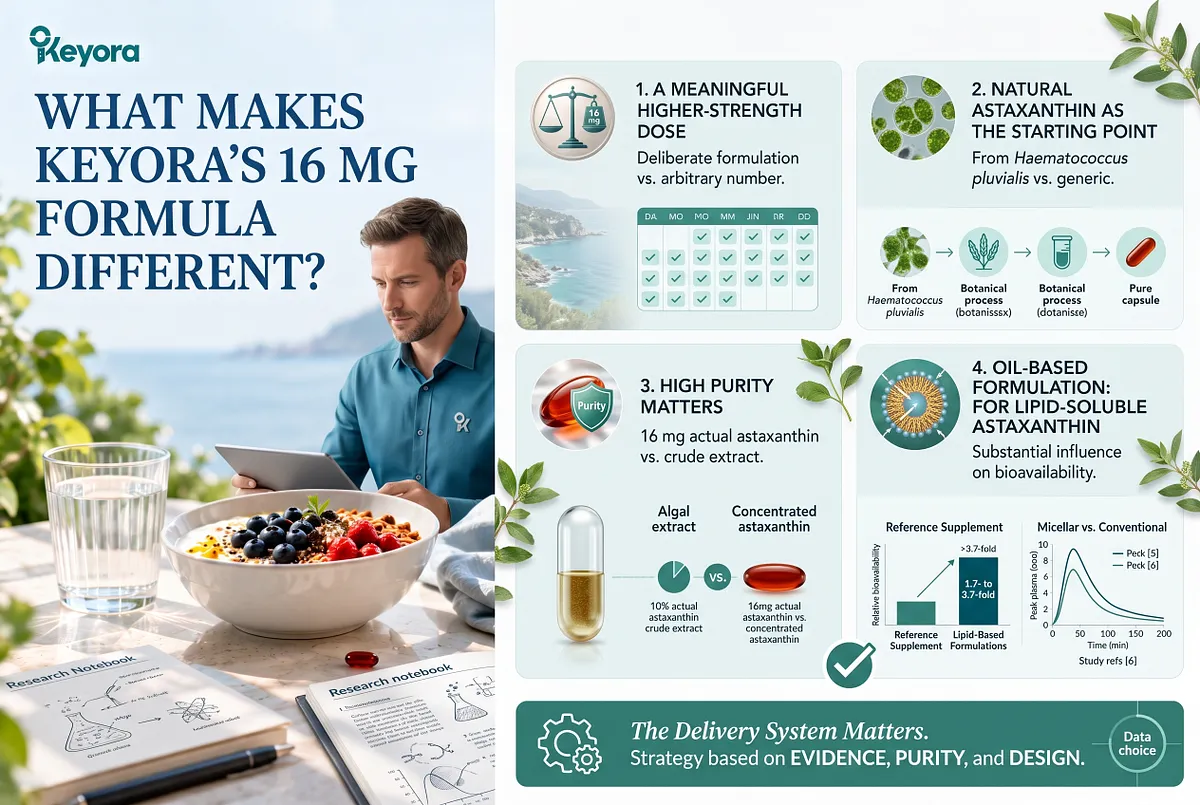
1. A Meaningful Higher-Strength Dose
Keyora provides 16 mg of astaxanthin per daily serving.
The purpose is not to chase the largest number possible. It is to provide a higher-strength serving that sits within the range of doses investigated in human research.
This makes 16 mg a deliberate formulation decision rather than an arbitrary marketing number.
2. Natural Astaxanthin as the Starting Point
Dose is only meaningful when you know what you are dosing.
Keyora uses natural astaxanthin sourced from Haematococcus pluvialis, rather than treating “astaxanthin” as a generic ingredient where source and material characteristics are ignored.
This is important because astaxanthin products can differ in source, chemical form, purity, and formulation.
For that reason, the label should not stop at the number of milligrams.
You should also ask:
What is the source of the astaxanthin?
3. High Purity Matters
A 16 mg label should mean 16 mg of astaxanthin—not simply 16 mg of a crude extract.
This distinction becomes especially important when comparing products based on price or capsule size.
A supplement can contain a certain amount of algal extract, but what matters to the dose is the amount of actual astaxanthin provided.
Keyora therefore approaches dose and purity together:
How much astaxanthin is present?
How concentrated is the raw material?
What else is present in the extract?
The higher the stated dose, the more important it becomes to know exactly what that dose represents.
4. Oil-Based Formulation: Because Astaxanthin Is Lipid-Soluble
This is one of the most important reasons that Keyora does not treat “16 mg” as the entire product story.
Astaxanthin is highly lipid-soluble, and its oral bioavailability can be limited by factors involved in dissolution and absorption.
Human research has demonstrated that formulation can substantially influence astaxanthin bioavailability. In a 2003 human pharmacokinetic study, several lipid-based formulations produced higher bioavailability than a reference commercial supplement, with reported increases ranging from 1.7- to 3.7-fold in that specific study. [5]
More recently, a 2024 randomized crossover pharmacokinetic study compared an 8 mg astaxanthin dose delivered in a micellar formulation with a conventional formulation. The micellar formulation produced a higher peak plasma concentration and reached peak concentration sooner. [6]
These studies do not mean that every oil-based or micellar product will have the same absorption advantage.
They do show something more fundamental:
The delivery system matters.
That is why Keyora’s 16 mg formula is designed around an oil-based delivery approach rather than treating the milligram number as the only important specification.
So, What Are You Really Comparing When You Compare Astaxanthin Products?
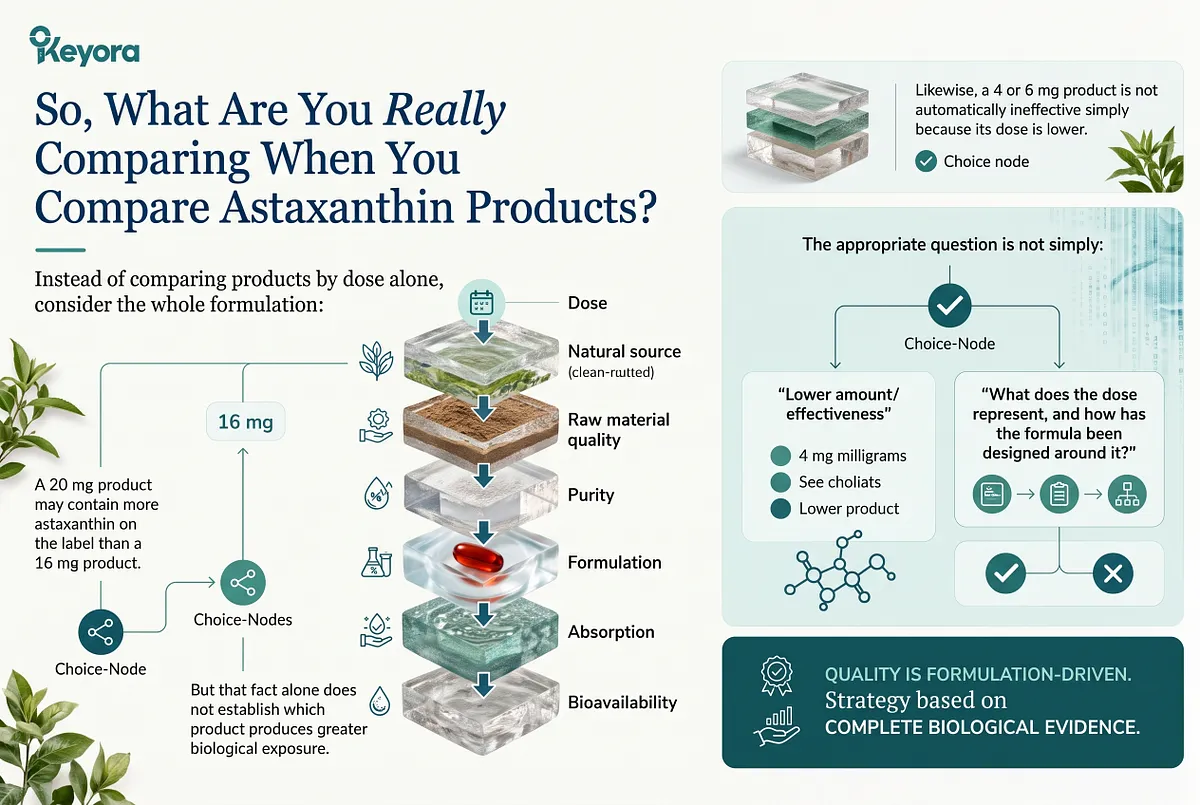
Instead of comparing products by dose alone, consider the whole formulation:
Dose
↓
Natural source
↓
Raw material quality
↓
Purity
↓
Formulation
↓
Absorption
↓
Bioavailability
This is a more complete way to understand astaxanthin quality.
A 20 mg product may contain more astaxanthin on the label than a 16 mg product.
But that fact alone does not establish which product produces greater biological exposure.
Likewise, a 4 or 6 mg product is not automatically ineffective simply because its dose is lower.
The appropriate question is not simply:
“How many milligrams?”
It is:
“What does the dose represent, and how has the formula been designed around it?”
Why 16 mg Is a Reasonable Choice for Keyora
The rationale can therefore be summarized simply:
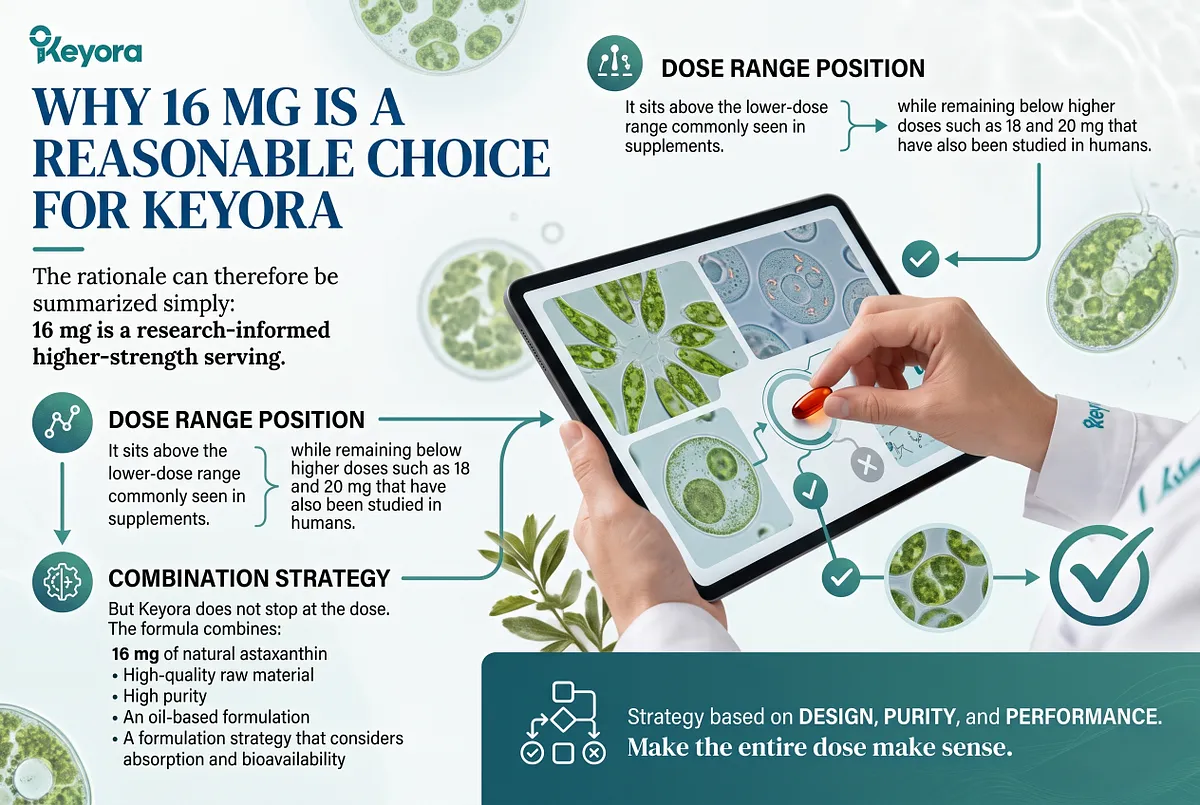
16 mg is a research-informed higher-strength serving.
It sits above the lower-dose range commonly seen in supplements while remaining below higher doses such as 18 and 20 mg that have also been studied in humans.
But Keyora does not stop at the dose.
The formula combines:
· 16 mg of natural astaxanthin
· High-quality raw material
· High purity
· An oil-based formulation
· A formulation strategy that considers absorption and bioavailability
This is why Keyora’s approach is not simply about making the dose higher.
It is about making the whole dose make sense.
Bottom Line
There is no strong evidence that 16 mg is universally the “best” astaxanthin dose—and Keyora does not need to make that claim.
The stronger argument is more straightforward:
16 mg is a rational, research-informed higher-strength serving, and its value should be considered together with source, purity, raw material quality, formulation, and bioavailability.
A higher number on the label is not automatically a better formula.
Not simply a higher dose. A more complete formula.
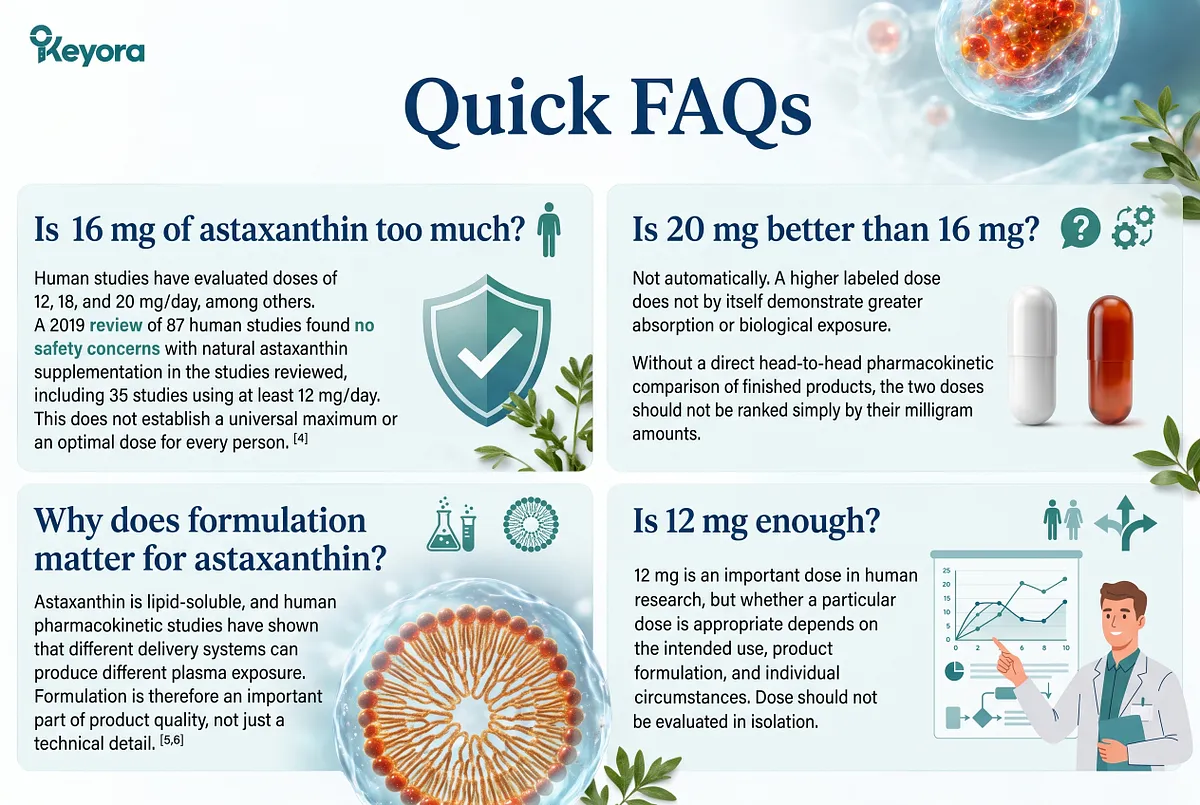
Quick FAQs
Is 16 mg of astaxanthin too much?
Human studies have evaluated doses of 12, 18, and 20 mg/day, among others. A 2019 review of 87 human studies found no safety concerns with natural astaxanthin supplementation in the studies reviewed, including 35 studies using at least 12 mg/day. This does not establish a universal maximum or an optimal dose for every person. [4]
Is 20 mg better than 16 mg?
Not automatically. A higher labeled dose does not by itself demonstrate greater absorption or biological exposure. Without a direct head-to-head pharmacokinetic comparison of finished products, the two doses should not be ranked simply by their milligram amounts.
Why does formulation matter for astaxanthin?
Astaxanthin is lipid-soluble, and human pharmacokinetic studies have shown that different delivery systems can produce different plasma exposure. Formulation is therefore an important part of product quality, not just a technical detail. [5,6]
Is 12 mg enough?
12 mg is an important dose in human research, but whether a particular dose is appropriate depends on the intended use, product formulation, and individual circumstances. Dose should not be evaluated in isolation.
References
1. Yoshida H, Yanai H, Ito K, et al. Administration of natural astaxanthin increases serum HDL-cholesterol and adiponectin in subjects with mild hyperlipidemia. Atherosclerosis. 2010;209(2):520–523. PMID: 19892350. DOI: 10.1016/j.atherosclerosis.2009.10.012.
2. Saito M, Yoshida K, Saito W, et al. Astaxanthin increases choroidal blood flow velocity. Graefe’s Archive for Clinical and Experimental Ophthalmology. 2012;250(2):239–245. PMID: 22072378. DOI: 10.1007/s00417-011-1843-1.
3. Satoh A, Tsuji S, Okada Y, et al. Preliminary clinical evaluation of toxicity and efficacy of a new astaxanthin-rich Haematococcus pluvialis extract. Journal of Clinical Biochemistry and Nutrition. 2009;44(3):280–284. PMID: 19430618. DOI: 10.3164/jcbn.08-238.
4. Brendler T, Williamson EM. Astaxanthin: How much is too much? A safety review. Phytotherapy Research. 2019;33(12):3090–3111. PMID: 31788888. DOI: 10.1002/ptr.6514.
5. Odeberg JM, Lignell Å, Pettersson A, Höglund P. Oral bioavailability of the antioxidant astaxanthin in humans is enhanced by incorporation of lipid based formulations. European Journal of Pharmaceutical Sciences. 2003;19(4):299–304. PMID: 12885395. DOI: 10.1016/S0928-0987(03)00135-0.
6. Khayyal MT, Teaima MH, Marzouk H, et al. Comparative pharmacokinetic study of standard astaxanthin and its micellar formulation in healthy male volunteers. European Journal of Drug Metabolism and Pharmacokinetics. 2024;49(4):467–475. PMID: 38748358. DOI: 10.1007/s13318-024-00898-0.