
How Much Astaxanthin Is Really in a 1%, 5%, or 10% Extract?
Keyora Research Q&A Library
This is part of the Keyora Research Q&A Series, derived from Keyora Astaxanthin Research Journal Series.
Within the Keyora Astaxanthin Researcn framework, this Q&A translates complex astaxanthin biology into reader-friendly, evidence-bound answers, focusing on natural astaxanthin identity, molecular structure, antioxidant and redox mechanisms, membrane lipid interaction, mitochondrial resilience, inflammatory signaling pathways, human evidence interpretation, and the scientific principles behind responsible supplementation.
First published by Keyora Research Journal: www.keyorahealth.com
Direct Answer
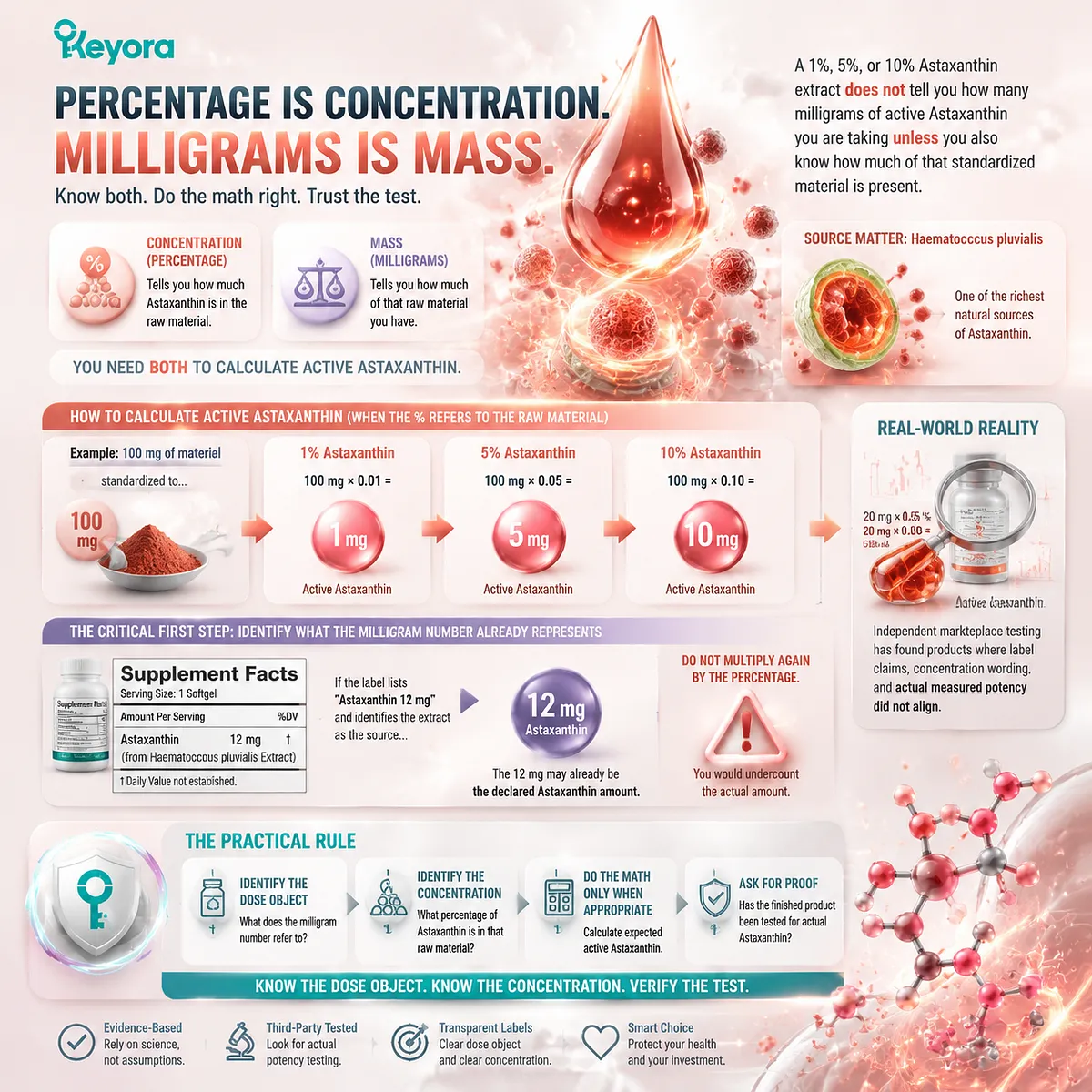
A 1%, 5%, or 10% Astaxanthin extract does not tell you how many milligrams of active Astaxanthin you are taking unless you also know how much of that standardized material is present.
The percentage describes concentration. The milligram amount describes mass. You need both numbers to calculate the expected active Astaxanthin dose.
For example, if a product contains 100 mg of a raw material standardized to 1% Astaxanthin, that material theoretically provides 1 mg of active Astaxanthin.
At 5%, the same 100 mg provides 5 mg. At 10%, it provides 10 mg. A 20 mg quantity of 5% material provides only 1 mg of active Astaxanthin.
But there is one critical step before doing any multiplication: first determine what the milligram number already represents.
If a Supplement Facts panel says “Astaxanthin 12 mg” and then identifies Haematococcus pluvialis extract as the source, the 12 mg may already be the declared Astaxanthin amount.
Multiplying it by an assumed percentage again would be wrong.
This distinction matters because real marketplace testing has documented Astaxanthin products in which prominent milligram claims, concentration wording, and actual measured potency did not align.
The practical rule is simple: identify the dose object, identify the concentration, do the math only when appropriate, and then ask whether the finished product has actually been tested.
A Percentage Is a Concentration, Not a Dose
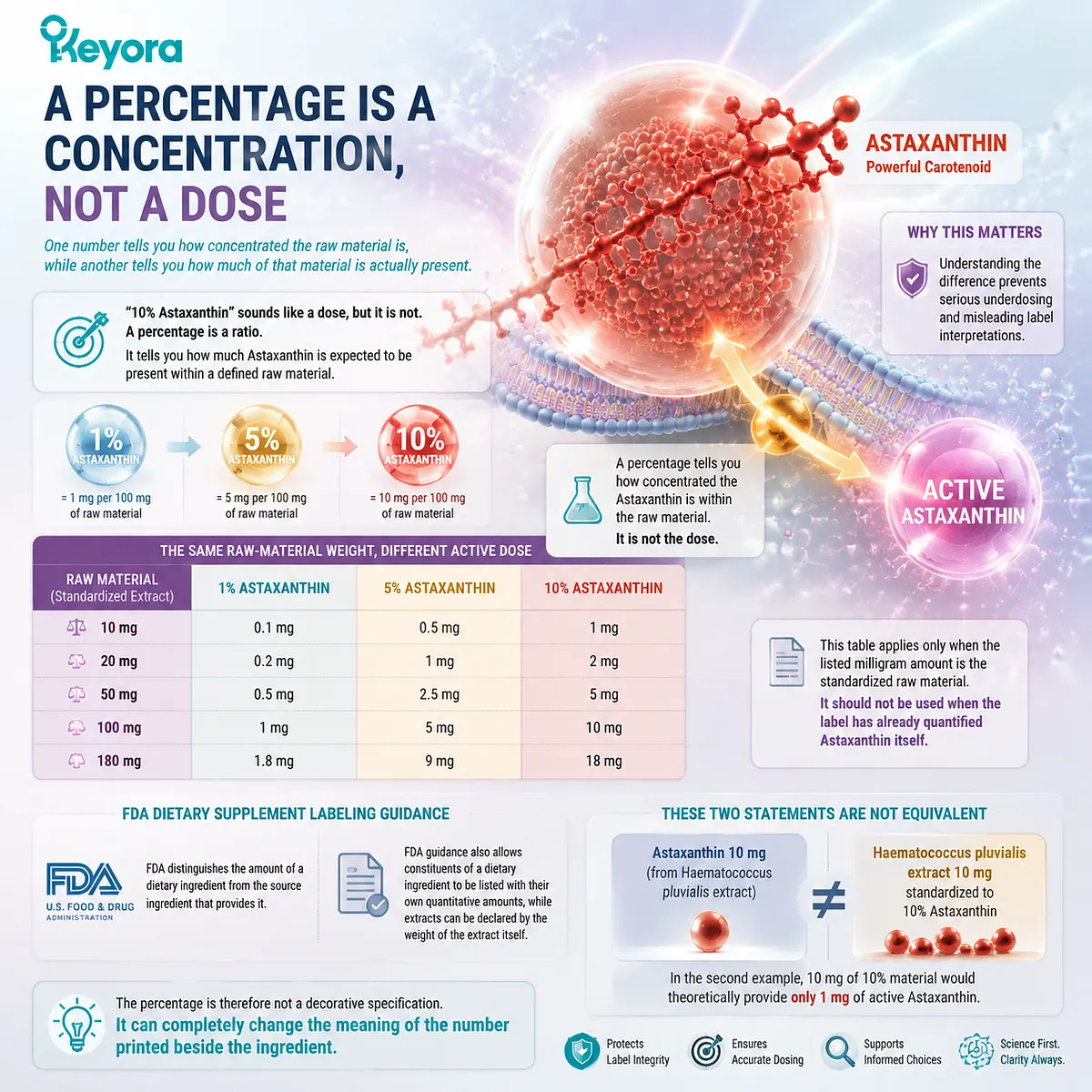
One number tells you how concentrated the raw material is, while another tells you how much of that material is actually present.
“10% Astaxanthin” sounds like a dose, but it is not. A percentage is a ratio. It tells you how much Astaxanthin is expected to be present within a defined raw material.
If a material is standardized to 10% Astaxanthin, then every 100 mg of that material would theoretically contain 10 mg of Astaxanthin.
A 5% material would provide 5 mg per 100 mg, while a 1% material would provide 1 mg per 100 mg.
That means the same raw-material weight can produce dramatically different active doses:
Raw material1% Astaxanthin5% Astaxanthin10% Astaxanthin10 mg0.1 mg0.5 mg1 mg20 mg0.2 mg1 mg2 mg50 mg0.5 mg2.5 mg5 mg100 mg1 mg5 mg10 mg180 mg1.8 mg9 mg18 mg
The table applies only when the listed milligram amount is the standardized raw material. It should not be used when the label has already quantified Astaxanthin itself.
This distinction is consistent with FDA dietary supplement labeling guidance. FDA distinguishes the amount of a dietary ingredient from the source ingredient that provides it. FDA guidance also allows constituents of a dietary ingredient to be listed with their own quantitative amounts, while extracts can be declared by the weight of the extract itself.
In other words, these two statements are not equivalent:
Astaxanthin 10 mg
(from Haematococcus pluvialis extract)
and
Haematococcus pluvialis extract 10 mg
standardized to 10% Astaxanthin
In the second example, 10 mg of 10% material would theoretically provide only 1 mg of active Astaxanthin.
The percentage is therefore not a decorative specification. It can completely change the meaning of the number printed beside the ingredient.
How to Convert 1%, 5%, and 10% Into Active Astaxanthin
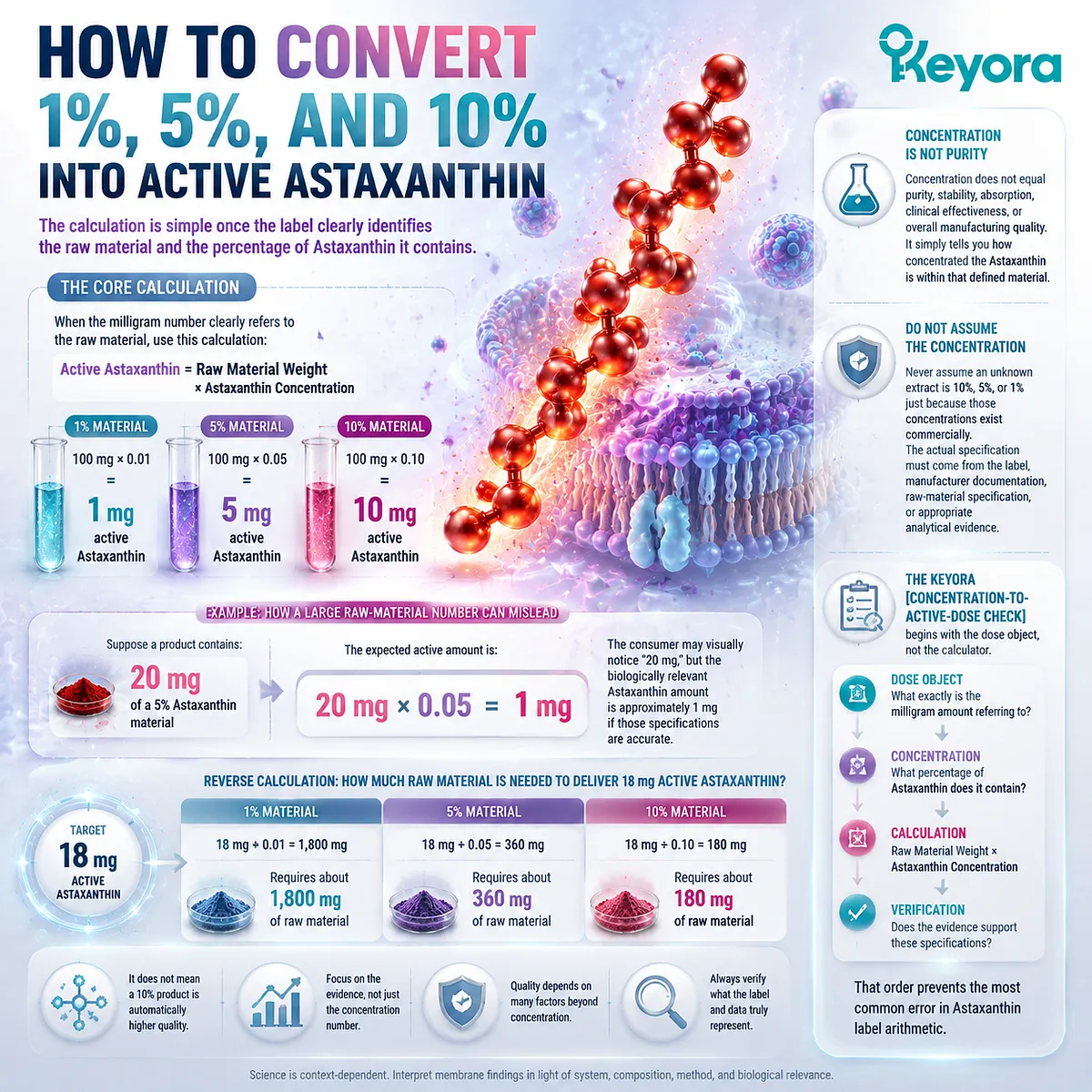
The calculation is simple once the label clearly identifies the raw material and the percentage of Astaxanthin it contains.
When the milligram number clearly refers to the raw material, use this calculation:
Active Astaxanthin = Raw Material Weight × Astaxanthin Concentration
For a 1% material:
100 mg × 0.01 = 1 mg active Astaxanthin
For a 5% material:
100 mg × 0.05 = 5 mg active Astaxanthin
For a 10% material:
100 mg × 0.10 = 10 mg active Astaxanthin
The same calculation exposes why a large raw-material number can create a misleading impression if the concentration is not given equal prominence.
Suppose a product contains:
20 mg of a 5% Astaxanthin material
The expected active amount is:
20 mg × 0.05 = 1 mg
The consumer may visually notice “20 mg,” but the biologically relevant Astaxanthin amount is approximately 1 mg if those specifications are accurate.
The reverse calculation is equally useful. If a manufacturer wants to deliver 18 mg of active Astaxanthin, the theoretical raw-material requirement varies enormously with concentration:
-
1% material requires about 1,800 mg
-
5% material requires about 360 mg
-
10% material requires about 180 mg
That does not mean a 10% product is automatically higher quality than a 5% product. Concentration is not the same as purity, stability, absorption, clinical effectiveness, or overall manufacturing quality.
It simply tells you how concentrated the Astaxanthin is within that defined material.
Another important caution is that consumers should never assume an unknown extract is 10%, 5%, or 1% merely because those concentrations exist commercially. The actual specification must come from the product label, manufacturer documentation, raw-material specification, or appropriate analytical evidence.
The Keyora [Concentration-to-Active-Dose Check] therefore begins with the dose object, not the calculator:
Dose Object → Concentration → Calculation → Verification
That order prevents the most common error in Astaxanthin label arithmetic.
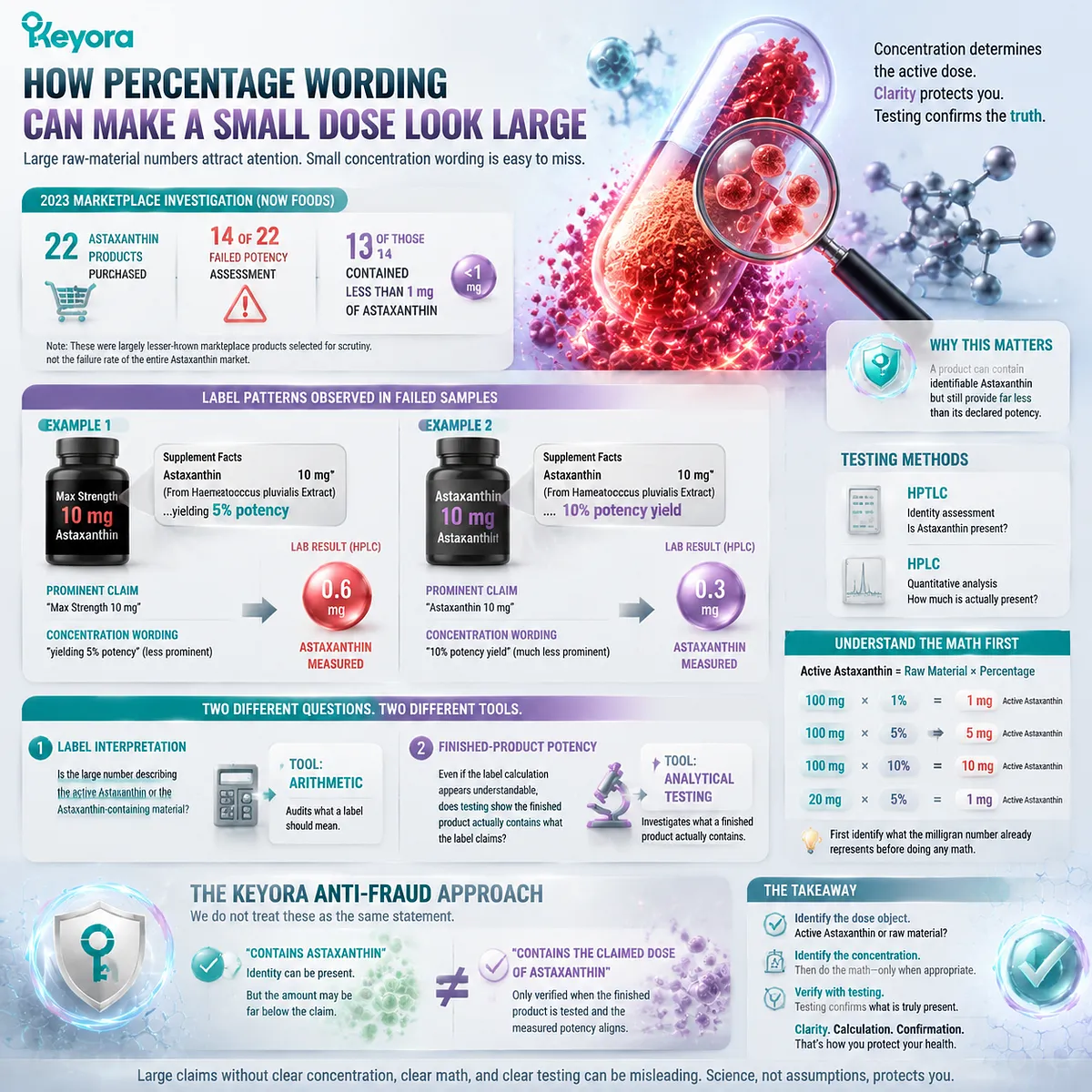
How Percentage Wording Can Make a Small Dose Look Large
The anti-fraud problem begins when a large raw-material number receives the attention while the concentration that determines the active dose becomes easy to miss.
This is not only a theoretical labeling concern.
In a 2023 marketplace investigation, NOW Foods purchased 22 Astaxanthin products and tested them for identity and potency. NOW reported that 14 of the 22 samples failed its potency assessment, and 13 of those 14 failures contained less than 1 mg of Astaxanthin. The tested products were largely lesser-known marketplace products selected for scrutiny, so these results should not be presented as the failure rate of the entire Astaxanthin market.
The label patterns were particularly relevant.
NOW described one product as listing “Astaxanthin 10 mg…yielding 5% potency” while the product name and marketplace description prominently presented “Max Strength 10 mg.” Laboratory testing measured approximately 0.6 mg Astaxanthin.
Another product reportedly used “10% potency yield” wording in much less prominent text. NOW’s published table showed a 10 mg label potency claim and an HPLC result of approximately 0.3 mg for that tested sample.
These examples illustrate two separate problems.
The first is label interpretation. Is the large number describing the active Astaxanthin or the Astaxanthin-containing material?
The second is finished-product potency. Even if the label calculation appears understandable, does laboratory analysis show that the finished product actually contains what the label claims?
Those questions require different tools.
Arithmetic can audit what a label should mean.
Analytical testing can investigate what a finished product actually contains.
NOW reported using HPTLC for identity assessment and HPLC for quantitative analysis. That distinction matters because a product can contain identifiable Astaxanthin yet still provide far less than its declared potency. Another product may fail both identity and quantity testing.
This is why the Keyora anti-fraud approach does not treat “contains Astaxanthin” and “contains the claimed dose of Astaxanthin” as the same statement.
Use the Concentration-to-Active-Dose Check
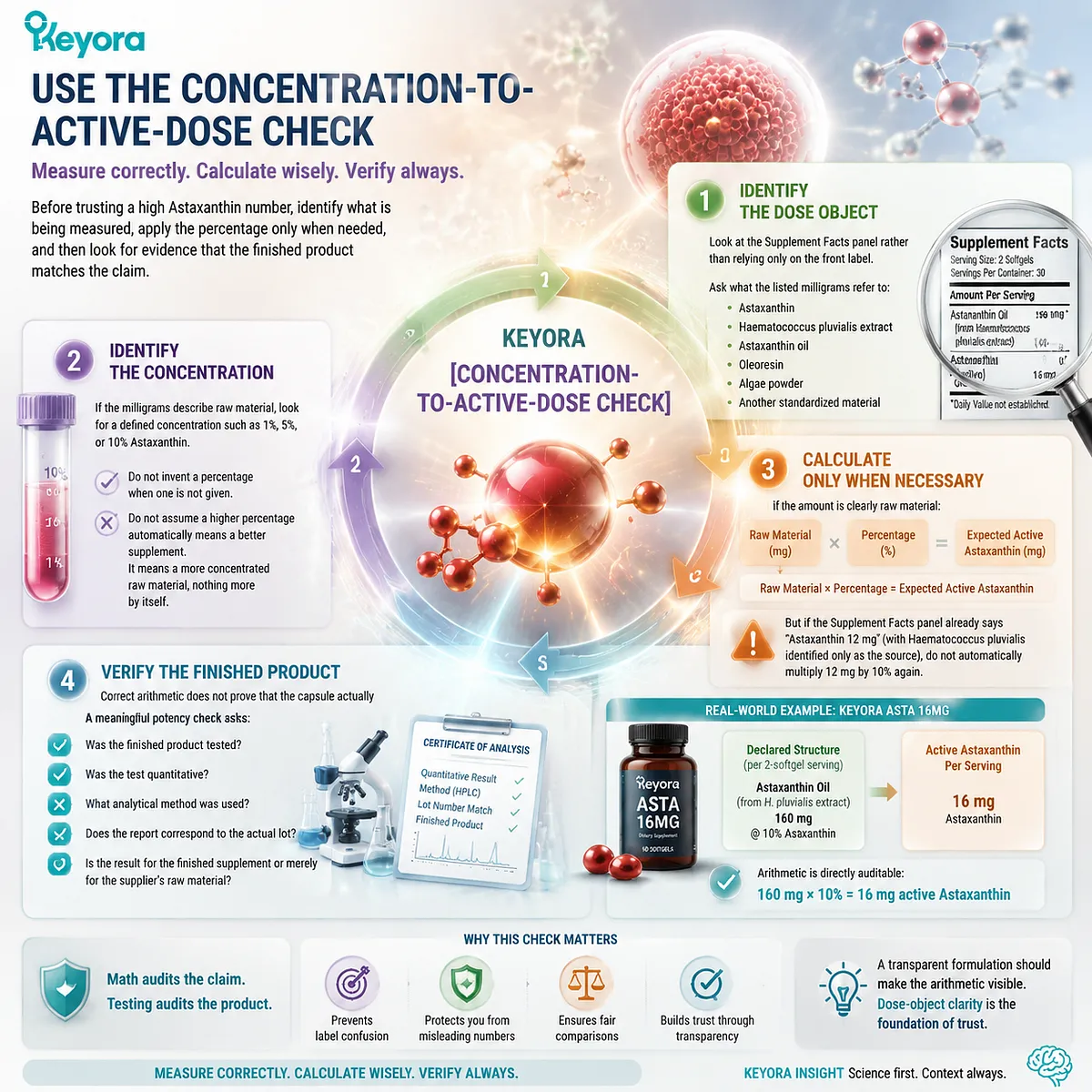
Before trusting a high Astaxanthin number, identify what is being measured, apply the percentage only when needed, and then look for evidence that the finished product matches the claim.
The Keyora [Concentration-to-Active-Dose Check] uses four steps.
1. Identify the Dose Object
Look at the Supplement Facts panel rather than relying only on the front label or product title.
Ask whether the amount refers to:
-
Astaxanthin
-
Haematococcus pluvialis extract
-
Astaxanthin oil
-
oleoresin
-
algae powder
-
another standardized material
The noun connected to the milligram number matters.
2. Identify the Concentration
If the milligrams describe raw material, look for a defined concentration such as 1%, 5%, or 10% Astaxanthin.
Do not invent a percentage when one is not given.
And do not assume a higher percentage automatically means a better supplement. It means a more concentrated raw material, nothing more by itself.
3. Calculate Only When Necessary
If the amount is clearly raw material:
Raw Material × Percentage = Expected Active Astaxanthin
But if the Supplement Facts panel already says:
Astaxanthin 12 mg
with Haematococcus pluvialis identified only as the source, do not automatically multiply 12 mg by 10% again.
FDA guidance reinforces the importance of reading these label objects separately. Supplement Facts generally provides the serving size and quantitative amount of dietary ingredients per serving, while source ingredients and extract information may be declared separately or alongside them.
4. Verify the Finished Product
Correct arithmetic does not prove that the capsule actually contains the calculated amount.
A meaningful potency check asks:
-
Was the finished product tested?
-
Was the test quantitative?
-
What analytical method was used?
-
Does the report correspond to the actual lot?
-
Is the result for the finished supplement or merely for the supplier’s raw material?
This distinction can be summarized simply:
Math audits the claim. Testing audits the product.
A transparent formulation should make the arithmetic visible. In the current Keyora Asta 16MG project record, for example, the declared structure separates 160 mg of 10% Astaxanthin oil per two-softgel serving from 16 mg active Astaxanthin. The arithmetic is therefore directly auditable:
160 mg × 10% = 16 mg active Astaxanthin
That example demonstrates dose-object transparency. It does not, by itself, establish superior absorption, clinical superiority, or prove that another product is fraudulent.
Closing Summary
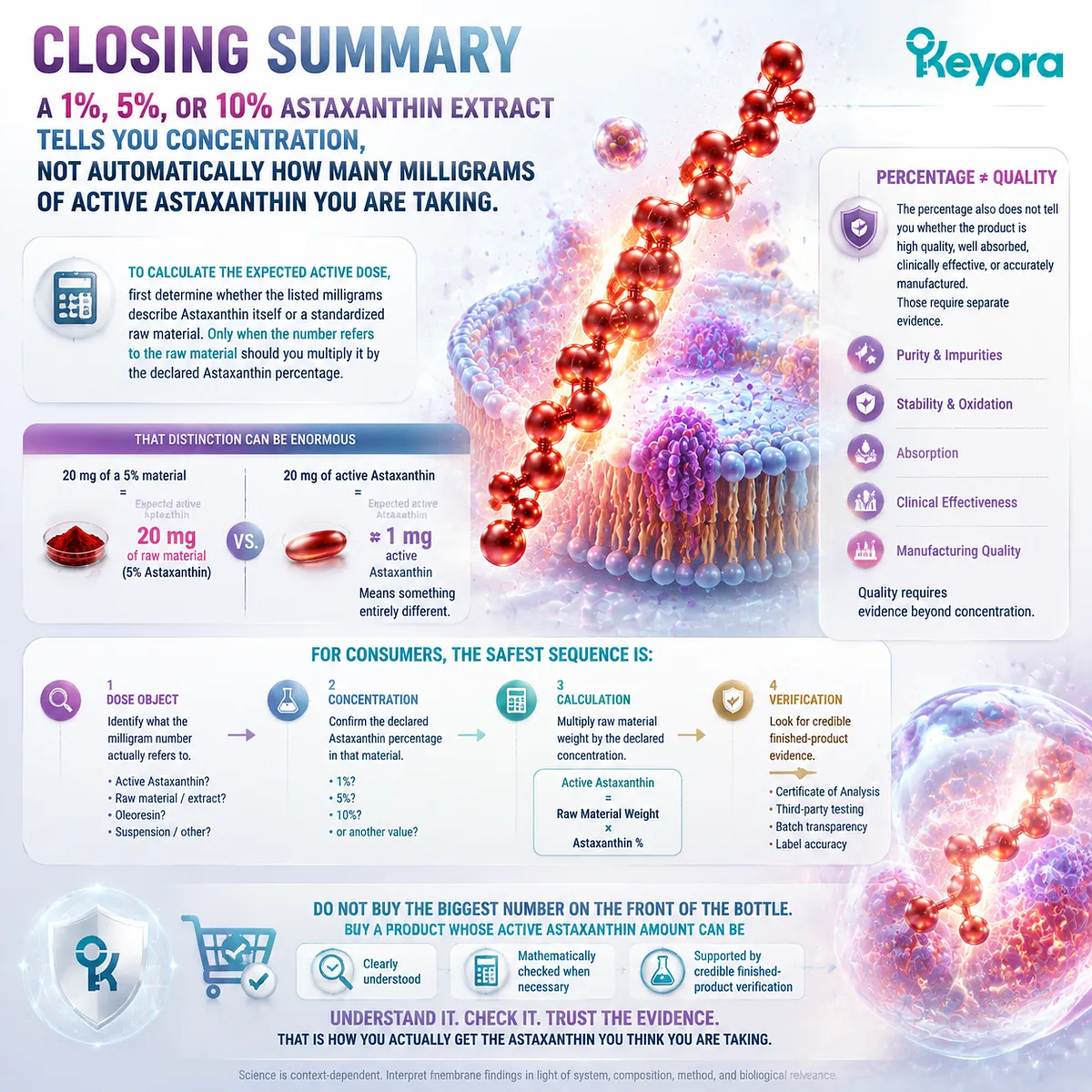
A 1%, 5%, or 10% Astaxanthin extract tells you concentration, not automatically how many milligrams of active Astaxanthin you are taking.
To calculate the expected active dose, first determine whether the listed milligrams describe Astaxanthin itself or a standardized raw material. Only when the number refers to the raw material should you multiply it by the declared Astaxanthin percentage.
That distinction can be enormous. Twenty milligrams of a 5% material corresponds to about 1 mg of active Astaxanthin, while 20 mg of active Astaxanthin means something entirely different.
The percentage also does not tell you whether the product is high quality, well absorbed, clinically effective, or accurately manufactured. Those require separate evidence.
For consumers, the safest sequence is:
Dose Object → Concentration → Calculation → Verification
Do not buy the biggest number on the front of the bottle. Buy a product whose active Astaxanthin amount can be clearly understood, mathematically checked when necessary, and supported by credible finished-product verification.
This article is for educational and informational purposes only. It does not provide medical advice, diagnosis, treatment, cure, prevention, disease outcome claims, hormone restoration claims, fertility outcome claims, or formula-specific clinical efficacy claims.