
How Long Does Astaxanthin Take to Work?
Keyora Research Q&A Library
This is part of the Keyora Research Q&A Series, derived from Keyora Astaxanthin Research Journal Series.
Within the Keyora Astaxanthin Researcn framework, this Q&A translates complex astaxanthin biology into reader-friendly, evidence-bound answers, focusing on natural astaxanthin identity, molecular structure, antioxidant and redox mechanisms, membrane lipid interaction, mitochondrial resilience, inflammatory signaling pathways, human evidence interpretation, and the scientific principles behind responsible supplementation.
First published by Keyora Research Journal: www.keyorahealth.com

Direct Answer
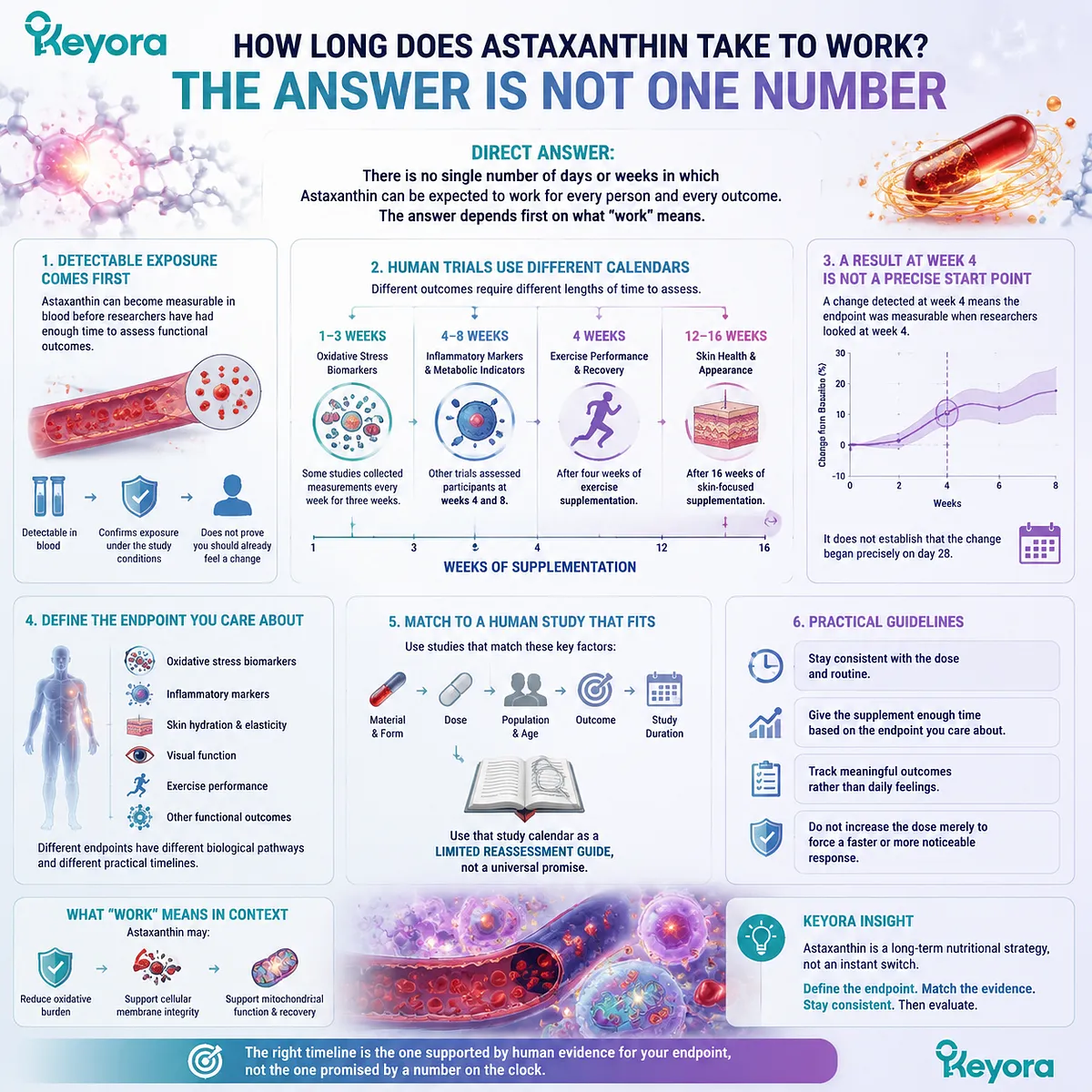
There is no single number of days or weeks in which Astaxanthin can be expected to work for every person and every outcome.
The answer depends first on what “work” means.
Astaxanthin can become measurable in blood before researchers have had enough time to assess a biomarker, symptom, skin measurement, visual function, exercise response, or another functional endpoint.
Detectable exposure confirms that Astaxanthin reached the measured blood compartment under the study conditions. It does not prove that a person should already feel a change.
Human trials also use very different calendars.
Some oxidative stress studies collected measurements every week for three weeks.
Other trials assessed participants at weeks 4 and 8, after four weeks of exercise supplementation, or after 16 weeks of skin focused supplementation. These schedules do not combine into one universal onset timeline.
A result detected at week 4 means that the endpoint was measurable when researchers looked at week 4. It does not establish that the change began precisely on day 28.
The practical approach is to define the intended endpoint, find a human study that matches the material, dose, population, and outcome, and use that study calendar as a limited reassessment guide.
Do not increase the dose merely to force a faster or more noticeable response.
Start Four Clocks With the First Dose
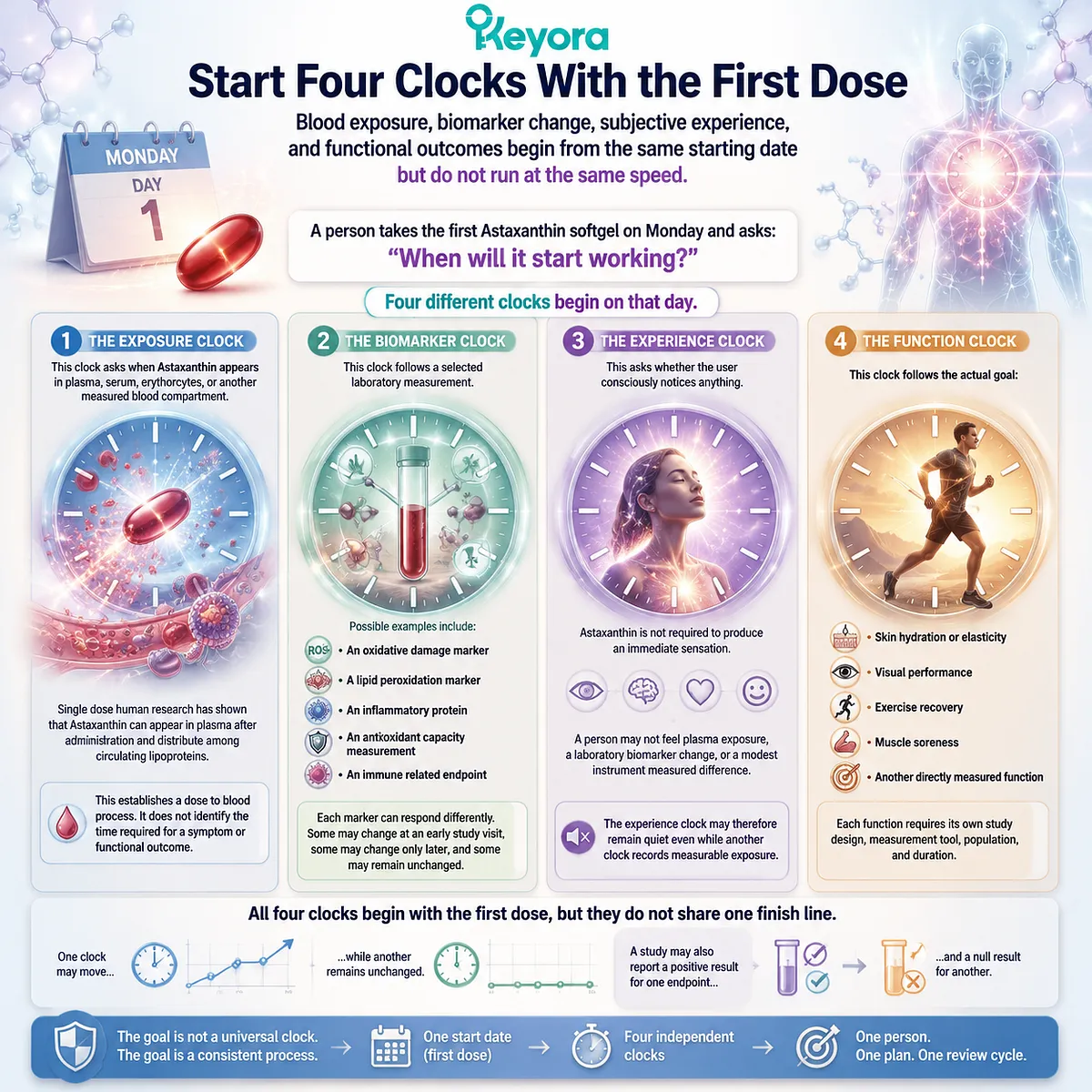
Blood exposure, biomarker change, subjective experience, and functional outcomes begin from the same starting date but do not run at the same speed
A person takes the first Astaxanthin softgel on Monday and asks:
When will it start working?
Four different clocks begin on that day.
Clock 1 – The Exposure Clock
This clock asks when Astaxanthin appears in plasma, serum, erythrocytes, or another measured blood compartment.
Single dose human research has shown that Astaxanthin can appear in plasma after administration and distribute among circulating lipoproteins. This establishes a dose to blood process. It does not identify the time required for a symptom or functional outcome.
Clock 2 – The Biomarker Clock
This clock follows a selected laboratory measurement.
Possible examples include:
-
an oxidative damage marker
-
a lipid peroxidation marker
-
an inflammatory protein
-
an antioxidant capacity measurement
-
an immune related endpoint
Each marker can respond differently. Some may change at an early study visit, some may change only later, and some may remain unchanged.
Clock 3 – The Experience Clock
This asks whether the user consciously notices anything.
Astaxanthin is not required to produce an immediate sensation. A person may not feel plasma exposure, a laboratory biomarker change, or a modest instrument measured difference.
The experience clock may therefore remain quiet even while another clock records measurable exposure.
Clock 4 – The Function Clock
This clock follows the actual goal:
-
skin hydration or elasticity
-
visual performance
-
exercise recovery
-
muscle soreness
-
another directly measured function
Each function requires its own study design, measurement tool, population, and duration.
All four clocks begin with the first dose, but they do not share one finish line. One clock may move while another remains unchanged.
A study may also report a positive result for one endpoint and a null result for another.
The Fastest Clock Is Not Necessarily the One That Matters Most
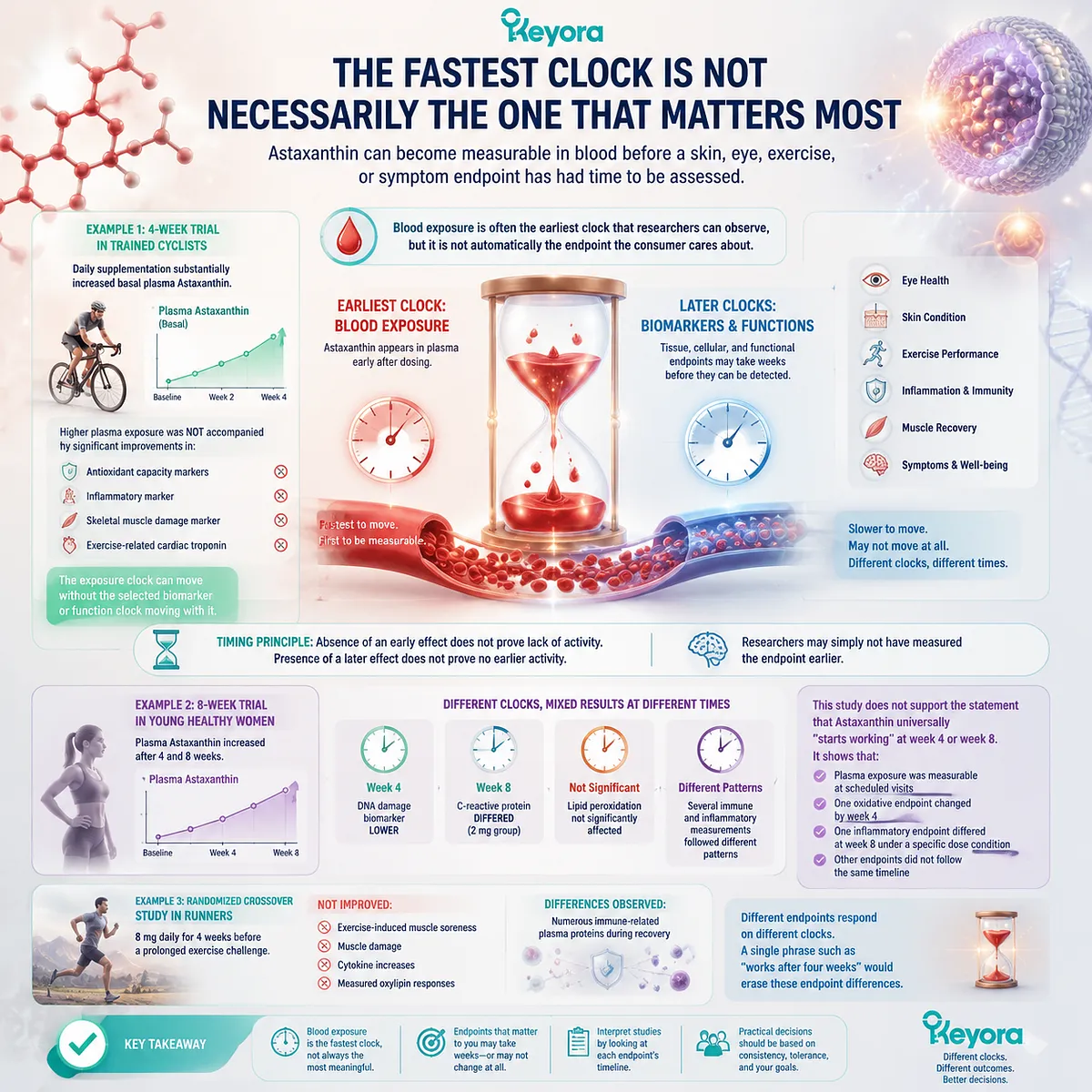
Astaxanthin can become measurable in blood before a skin, eye, exercise, or symptom endpoint has had time to be assessed
Blood exposure is often the earliest clock that researchers can observe, but it is not automatically the endpoint the consumer cares about.
A useful example comes from a four week randomized trial in trained cyclists. Daily supplementation substantially increased basal plasma Astaxanthin.
However, the higher plasma exposure was not accompanied by significant improvements in the study’s antioxidant capacity markers, inflammatory marker, skeletal muscle damage marker, or exercise related cardiac troponin endpoint.
This trial demonstrates a critical timing principle:
The exposure clock can move without the selected biomarker or function clock moving with it.
The reverse interpretation is also unsafe. When a trial detects an endpoint difference after several weeks, it does not prove that Astaxanthin was biologically inactive before that visit. Researchers may simply not have measured the endpoint earlier.
Different clocks can also produce mixed results within the same study.
In an eight week randomized trial involving young healthy women, plasma Astaxanthin increased after four and eight weeks.
A DNA damage biomarker was lower after four weeks, while a C reactive protein finding was reported at week 8 in the 2 mg group. Lipid peroxidation was not significantly affected, and several immune and inflammatory measurements followed different patterns.
The study does not support the statement that Astaxanthin universally “starts working” at week 4 or week 8.
It shows that:
-
plasma exposure was measurable at scheduled visits
-
one oxidative endpoint changed by week 4
-
one inflammatory endpoint differed at week 8 under a specific dose condition
-
other endpoints did not follow the same timeline
Exercise research provides another example. In a randomized crossover study, runners consumed 8 mg daily for four weeks before a prolonged exercise challenge. Astaxanthin did not reduce exercise induced muscle soreness, muscle damage, cytokine increases, or measured oxylipin responses, but it was associated with differences in numerous immune related plasma proteins during recovery.
A single phrase such as “works after four weeks” would erase these endpoint differences.
Read Study Visits Instead of Inventing an Onset Date
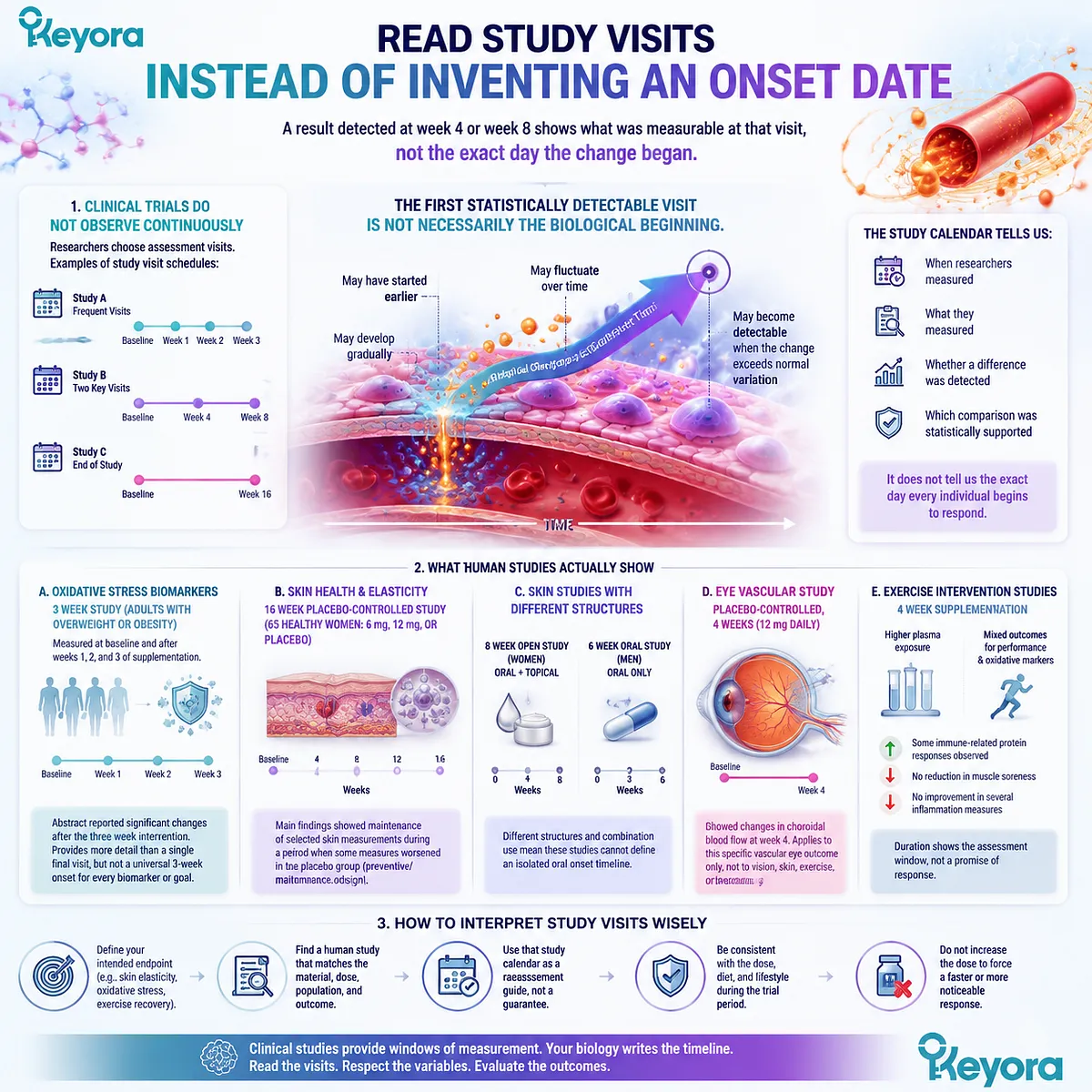
A result detected at week 4 or week 8 shows what was measurable at that visit, not the exact day the change began
Clinical trials do not continuously observe every biological variable.
Researchers choose assessment visits. A study may measure at:
-
baseline
-
week 1
-
week 2
-
week 3
Another may measure only at:
-
baseline
-
week 4
-
week 8
A third may compare baseline with the end of a 16 week intervention.
The first statistically detectable study visit is not necessarily the biological beginning of the effect. The change may have started earlier, developed gradually, fluctuated, or become detectable only when the accumulated difference exceeded normal variation.
A three week study in adults with overweight or obesity measured oxidative stress biomarkers at baseline and after weeks 1, 2, and 3 of supplementation. The published abstract reported significant changes after the three week intervention.
Because the study included repeated weekly measurements, it provides a more detailed calendar than a trial with only one final visit. Even so, it does not establish a universal three week onset for every biomarker, population, dose, or clinical goal.
Skin research uses different timelines and study structures.
One 16 week placebo controlled study assigned 65 healthy women to 6 mg, 12 mg, or placebo. The main findings concerned the maintenance of selected skin measurements during a period when some measures worsened in the placebo group. This preventive or maintenance design differs from a study asking how quickly a user notices an improvement.
Another publication reported an eight week open study combining oral and topical Astaxanthin in women, alongside a separate six week oral study in men. The combination of oral and topical use means the first study cannot establish an isolated oral Astaxanthin onset timeline.
Eye research creates another calendar.
A small placebo controlled study assessed choroidal blood flow after four weeks of 12 mg daily supplementation. That four week result belongs to the specific vascular eye measurement used in that study. It cannot be transferred automatically to visual fatigue, accommodation, retinal disease, skin, or exercise goals.
Exercise studies further demonstrate why trial duration cannot be treated as a promise. After four weeks, some studies reported higher plasma exposure without corresponding changes in several exercise and oxidative endpoints, while others found selected immune related protein responses but no reduction in muscle soreness or conventional inflammation measures.
The study calendar tells us:
-
when researchers measured
-
what they measured
-
whether a difference was detected
-
which comparison was statistically supported
It does not tell us the exact day every individual begins to respond.
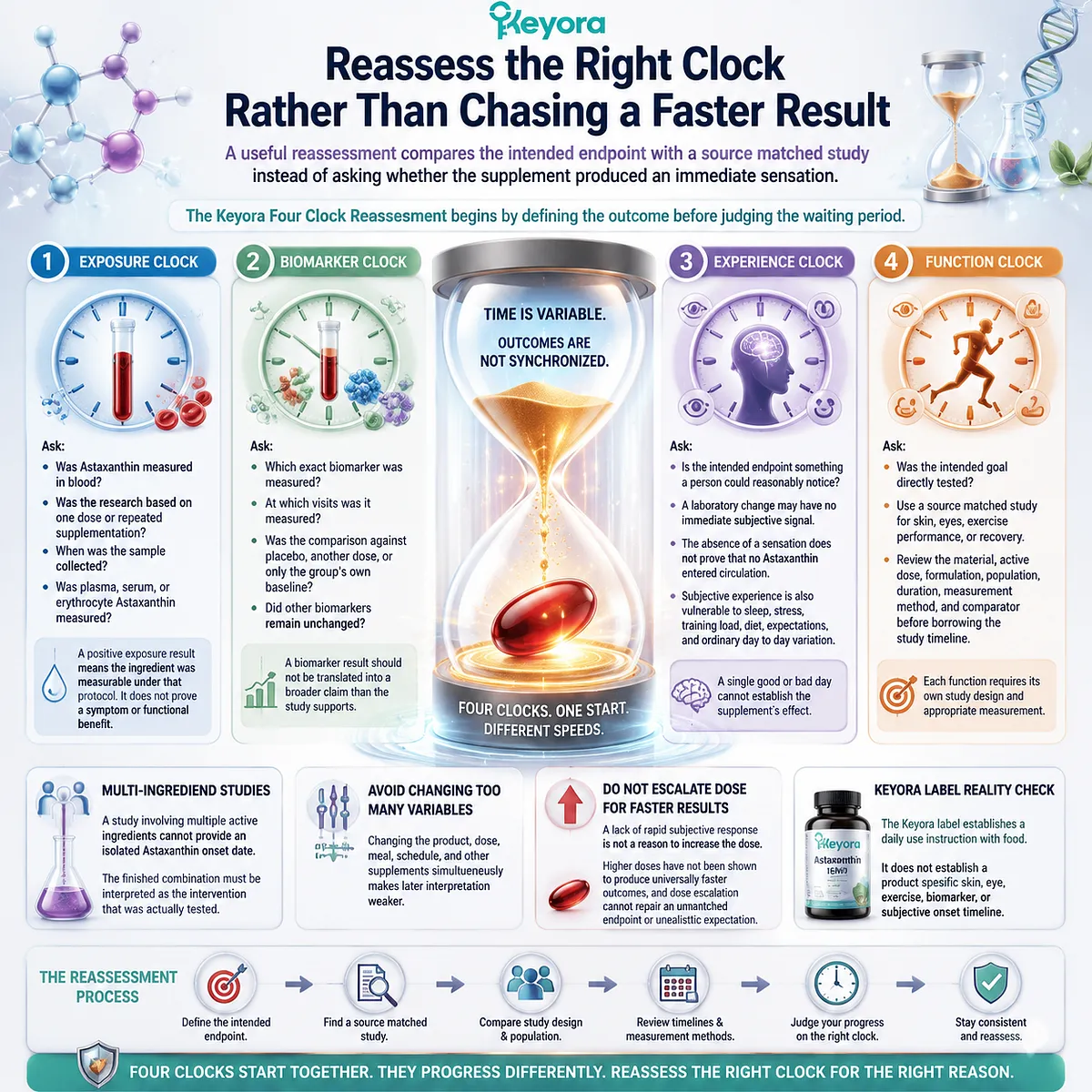
Reassess the Right Clock Rather Than Chasing a Faster Result
A useful reassessment compares the intended endpoint with a source matched study instead of asking whether the supplement produced an immediate sensation
The Keyora Four Clock Reassessment begins by defining the outcome before judging the waiting period.
Exposure Clock
Ask:
-
Was Astaxanthin measured in blood?
-
Was the research based on one dose or repeated supplementation?
-
When was the sample collected?
-
Was plasma, serum, or erythrocyte Astaxanthin measured?
A positive exposure result means the ingredient was measurable under that protocol. It does not prove a symptom or functional benefit.
Biomarker Clock
Ask:
-
Which exact biomarker was measured?
-
At which visits was it measured?
-
Was the comparison against placebo, another dose, or only the group’s own baseline?
-
Did other biomarkers remain unchanged?
A biomarker result should not be translated into a broader claim than the study supports.
Experience Clock
Ask whether the intended endpoint is something a person could reasonably notice.
A laboratory change may have no immediate subjective signal. The absence of a sensation does not prove that no Astaxanthin entered circulation.
Subjective experience is also vulnerable to sleep, stress, training load, diet, expectations, and ordinary day to day variation. A single good or bad day cannot establish the supplement’s effect.
Function Clock
Ask whether the intended goal was directly tested.
For a skin question, use a source matched skin trial.
For a visual question, use a source matched eye trial.
For an exercise question, use a source matched performance or recovery study.
The material, active dose, formulation, population, duration, measurement method, and comparator should be reviewed before borrowing the study timeline.
A study involving multiple active ingredients cannot provide an isolated Astaxanthin onset date.
A combined formula may begin with Astaxanthin, lutein, zeaxanthin, collagen, vitamins, or other ingredients, but the finished combination must be interpreted as the intervention that was actually tested.
Reassessment should also avoid moving several variables at once.
Changing the product, dose, meal, schedule, and other supplements simultaneously makes later interpretation weaker.
A lack of rapid subjective response is not a reason to increase the dose.
Higher doses have not been shown to produce universally faster outcomes, and dose escalation cannot repair an unmatched endpoint or unrealistic expectation.
The Keyora label establishes a daily use instruction with food. It does not establish a product specific skin, eye, exercise, biomarker, or subjective onset timeline.
Closing Summary
Astaxanthin does not run on one universal clock because exposure, biomarkers, symptoms, and functional outcomes represent different kinds of evidence
The four Astaxanthin clocks should not be merged.
The exposure clock may move first because Astaxanthin can become measurable in blood after administration.
The biomarker clock depends on the exact laboratory endpoint and the study visits selected by researchers.
The experience clock may remain silent because Astaxanthin is not required to produce an immediate conscious sensation.
The function clock depends on whether the intended skin, eye, exercise, or other outcome was directly measured in a matched human trial.
Human studies range from short weekly biomarker assessments to four week exercise and eye protocols, eight week multidomain trials, and 16 week skin studies. Their different calendars reflect different questions rather than one universal onset.
Define the endpoint first, then use the study calendar for that endpoint rather than expecting one universal day when Astaxanthin should feel as though it has started working.

This article is for educational and informational purposes only. It does not provide medical advice, diagnosis, treatment, cure, prevention, disease outcome claims, hormone restoration claims, fertility outcome claims, or formula-specific clinical efficacy claims.