
How Is Astaxanthin Different From Beta-Carotene as a Membrane Antioxidant?
Keyora Research Q&A Library
This is part of the Keyora Research Q&A Series, derived from Keyora Astaxanthin Research Journal Series.
Within the Keyora Astaxanthin Researcn framework, this Q&A translates complex astaxanthin biology into reader-friendly, evidence-bound answers, focusing on natural astaxanthin identity, molecular structure, antioxidant and redox mechanisms, membrane lipid interaction, mitochondrial resilience, inflammatory signaling pathways, human evidence interpretation, and the scientific principles behind responsible supplementation.
First published by Keyora Research Journal: www.keyorahealth.com
Direct Answer
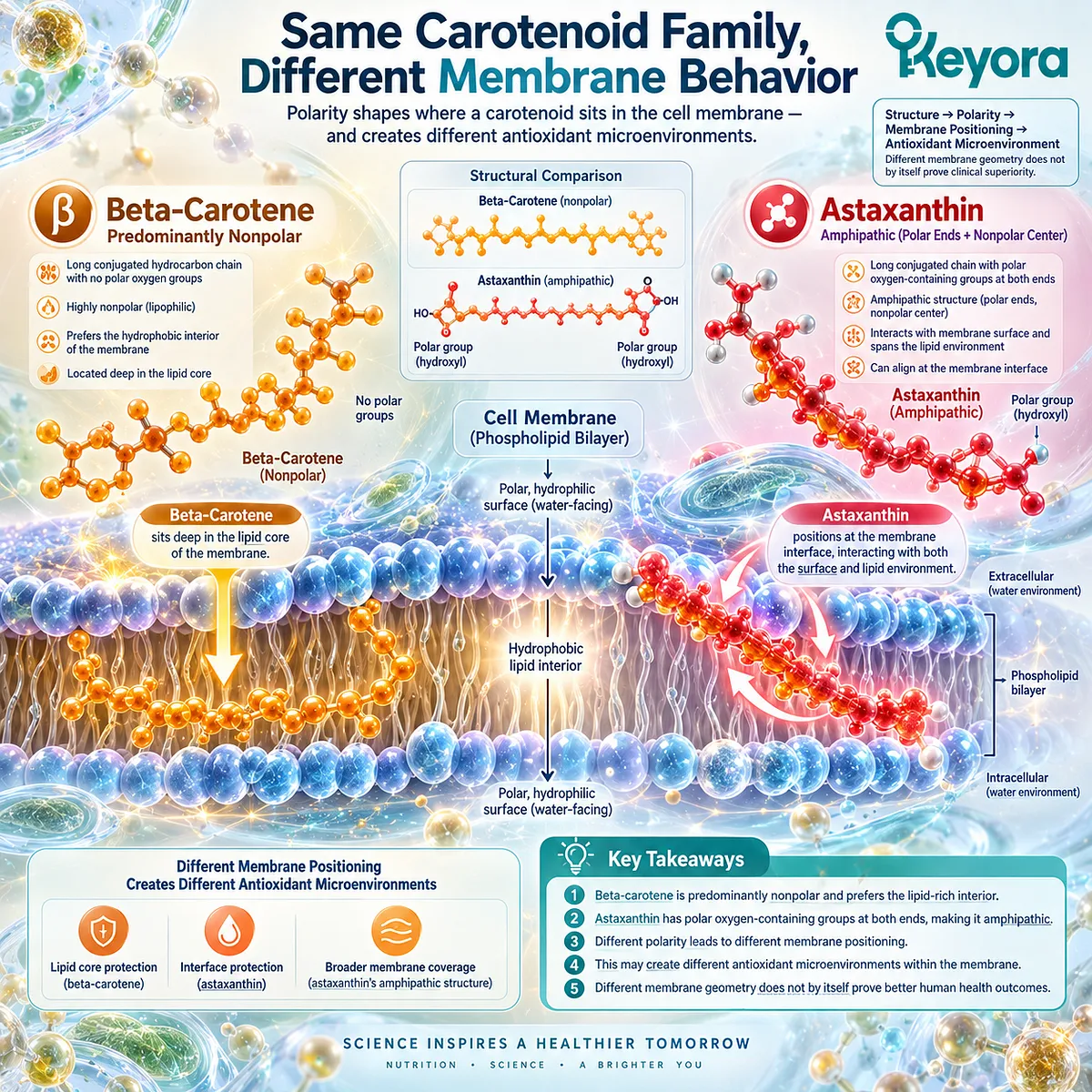
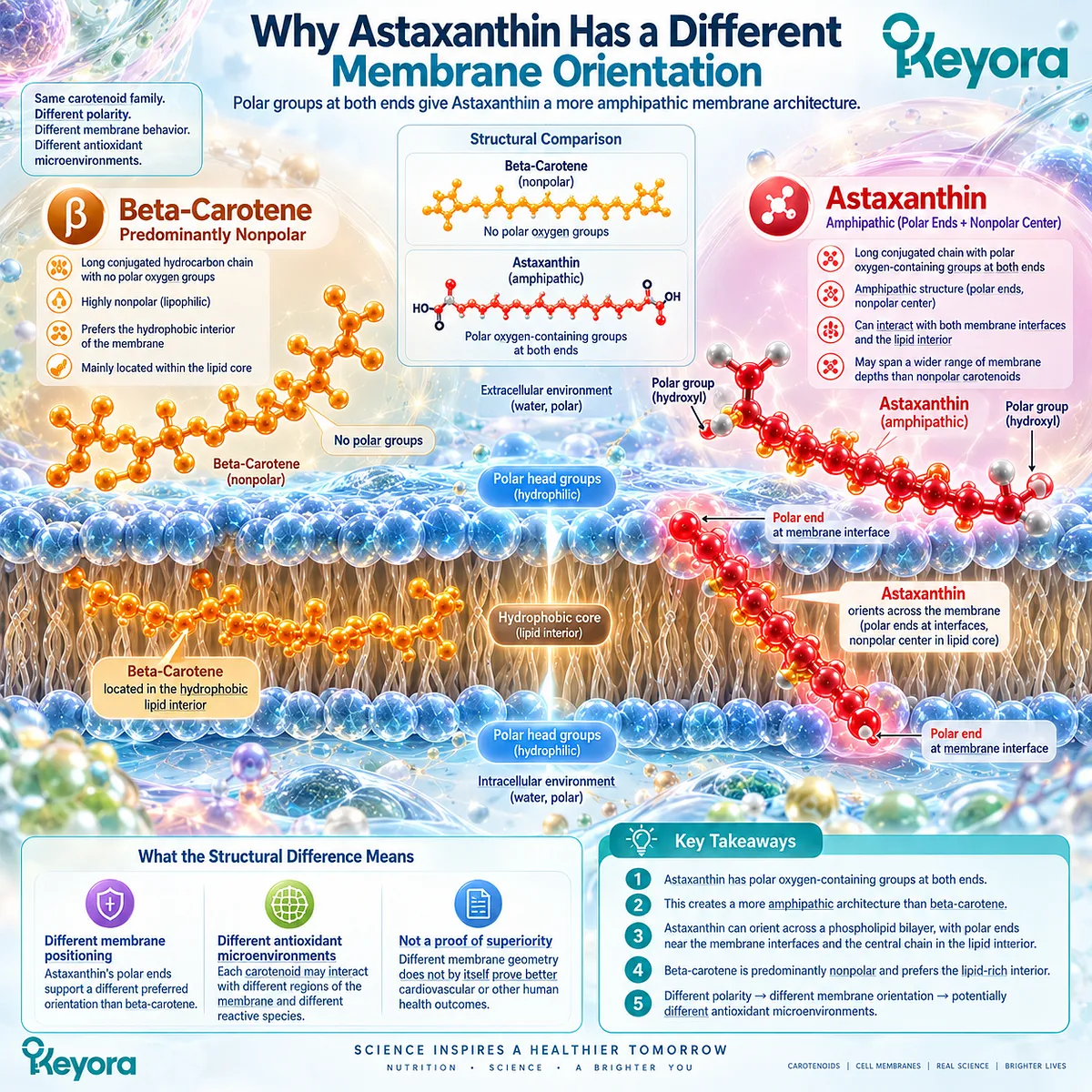
Astaxanthin and beta-carotene are both carotenoids with long conjugated molecular structures, but they differ substantially in polarity.
Beta-carotene is predominantly nonpolar, whereas Astaxanthin contains polar oxygen-containing groups at both ends of its long lipid-associated central chain.
That difference matters inside a cell membrane.
A biological membrane contains a relatively polar surface and a hydrophobic interior.
Because beta-carotene is highly nonpolar, it has a strong affinity for the lipid-rich interior of the bilayer.
Astaxanthin’s combination of polar end groups and a nonpolar central region gives it a more amphipathic architecture, allowing it to interact differently with the membrane environment.
Keyora Astaxanthin EP-4: The Cardiac Architecture: Bio-Energetic Sovereignty uses this polarity difference to explain why the two carotenoids may adopt different membrane orientations.
The scientifically appropriate conclusion is:
Different polarity → different membrane positioning → potentially different antioxidant microenvironments
But this distinction must remain separate from clinical claims.
Different membrane geometry does not by itself prove that Astaxanthin produces better cardiovascular or other human health outcomes than beta-carotene.
Why Polarity Matters Inside a Cell Membrane
A molecule’s polar and nonpolar regions influence where it prefers to interact with a lipid bilayer
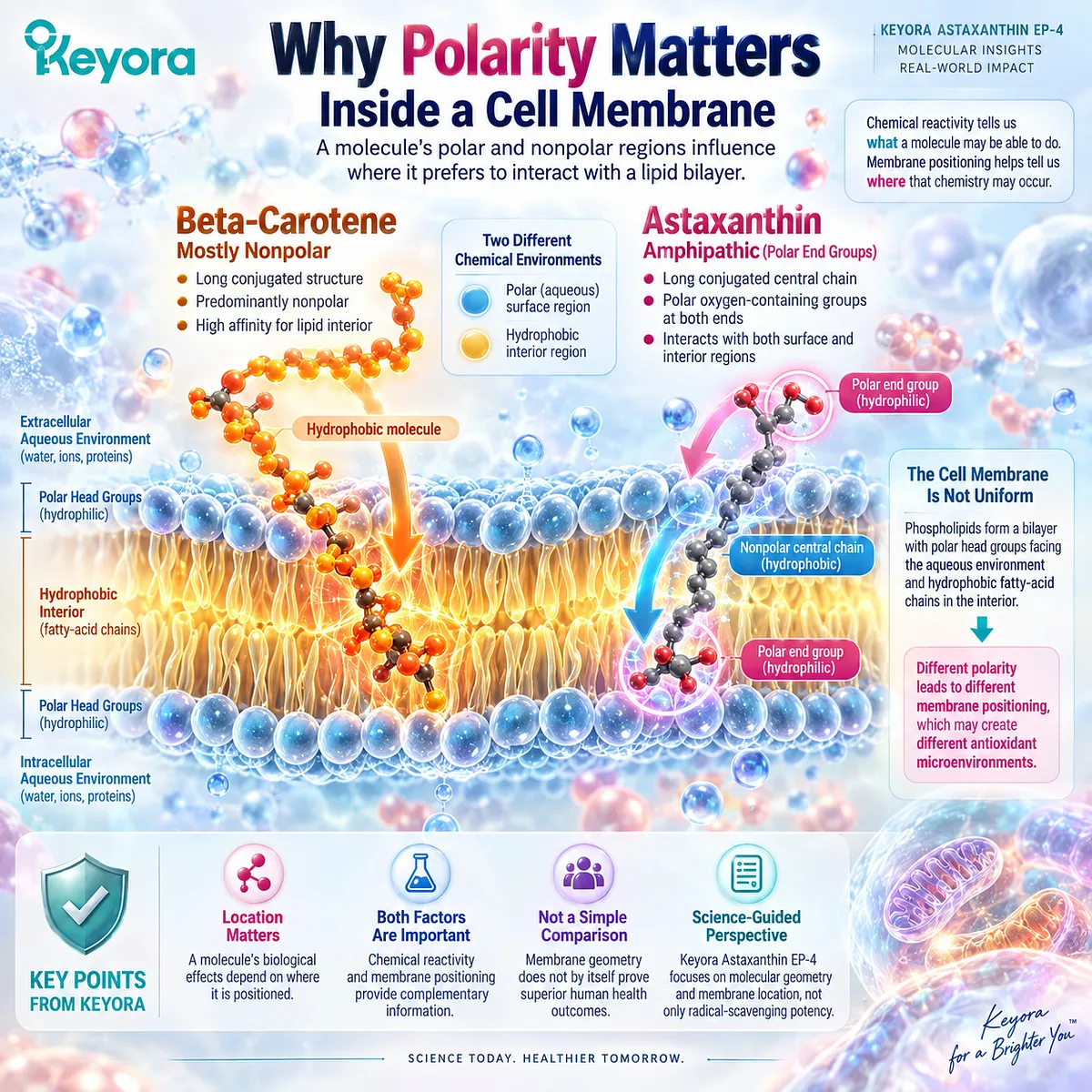
A cell membrane is not chemically uniform.
Phospholipids arrange themselves into a bilayer with polar head groups facing the surrounding aqueous environment and hydrophobic fatty-acid chains oriented toward the interior.
This creates two very different chemical regions.
Near the membrane surface, the environment is relatively polar.
Deeper inside the membrane, the environment becomes predominantly hydrophobic.
The structure of an antioxidant helps determine which part of this membrane it is most likely to interact with.
This is why membrane antioxidant biology cannot be reduced to one question such as:
“Which carotenoid has stronger antioxidant activity?”
Location matters.
A molecule may react effectively with particular reactive species in a test system, but its biological behavior also depends on where it is positioned relative to membrane lipids and oxidative reactions.
Keyora Astaxanthin EP-4 emphasizes this principle by comparing molecular geometry and membrane location rather than relying only on radical-scavenging potency.
This creates a useful framework:
Chemical reactivity tells us what a molecule may be able to do.
Membrane positioning helps tell us where that chemistry may occur.
Both are important.
Neither, by itself, establishes a human clinical outcome.
Where Beta-Carotene Fits in the Lipid Bilayer
Beta-carotene’s predominantly nonpolar structure favors the hydrophobic interior of lipid membranes
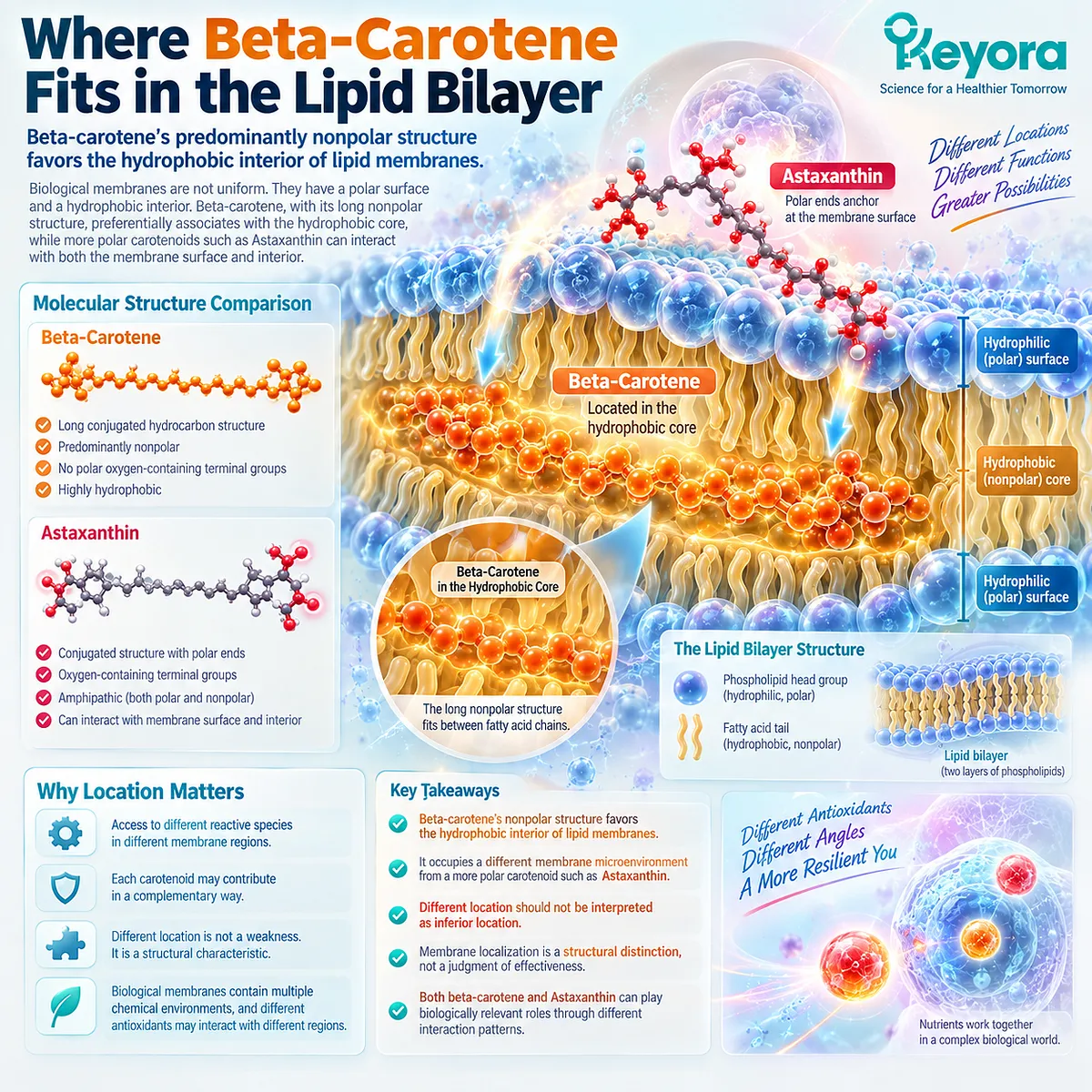
Beta-carotene is built around an extended conjugated hydrocarbon structure.
Unlike Astaxanthin, it does not contain the same polar oxygen-containing terminal groups.
That makes beta-carotene substantially more hydrophobic.
In Keyora Astaxanthin EP-4, beta-carotene is described as preferentially associating with the hydrophobic central region of the lipid bilayer. The article uses a “submarine” metaphor to illustrate this membrane-core localization.
The metaphor is useful visually, but it should not be interpreted as evidence that beta-carotene is an ineffective membrane antioxidant.
A more precise interpretation is:
Beta-carotene’s nonpolar structure favors interaction with the hydrophobic interior of lipid membranes.
That location can still be biologically relevant.
The long conjugated system characteristic of carotenoids contributes to their ability to interact with certain reactive species. Antioxidant behavior within a membrane therefore depends on both the chemical properties of the carotenoid and the membrane region in which it is located.
The important distinction is not:
Beta-carotene stays inside the membrane, therefore it fails.
It is:
Beta-carotene occupies a different membrane microenvironment from a more polar carotenoid such as Astaxanthin.
This is a structural distinction, not a nutritional judgment.
It also prevents another common mistake:
Different location should not be interpreted as inferior location.
Biological membranes contain multiple chemical environments, and different antioxidants may interact with different regions of those environments.
Why Astaxanthin Has a Different Membrane Orientation
Polar groups at both ends give Astaxanthin a more amphipathic membrane architecture
Astaxanthin also contains a long conjugated carotenoid chain, but its terminal structure differs from beta-carotene.
At both ends of the molecule are oxygen-containing polar regions.
Between them lies a long hydrophobic conjugated chain.
This combination creates what can reasonably be described as a more amphipathic architecture: the molecule contains regions compatible with both polar and lipid-rich environments.
Keyora Astaxanthin EP-4 uses this structural arrangement to propose that Astaxanthin can orient across a phospholipid bilayer, with its polar ends positioned toward the more polar membrane interfaces and its central chain interacting with the hydrophobic interior.
That model provides a plausible explanation for why Astaxanthin may interact with a broader range of membrane depths than a predominantly nonpolar carotenoid.
However, the wording matters.
It is reasonable to say:
Astaxanthin’s structure supports a different preferred orientation within lipid membranes.
It is much stronger to claim:
Every Astaxanthin molecule always spans every biological membrane vertically and mechanically locks the two membrane leaflets together.
That stronger claim requires a separate evidence audit.
Keyora Astaxanthin EP-4 goes further by describing Astaxanthin as a “Molecular Rivet” that physically reinforces the membrane.
For this comparison, the more defensible conclusion is narrower:
Astaxanthin’s two polar terminal regions distinguish its membrane orientation from beta-carotene’s predominantly hydrophobic localization.
That difference may influence the membrane microenvironments in which each carotenoid participates in antioxidant chemistry.
Does Different Geometry Mean Better Antioxidant Protection?
Different membrane positioning can change antioxidant context, but it does not establish clinical superiority
Not automatically.
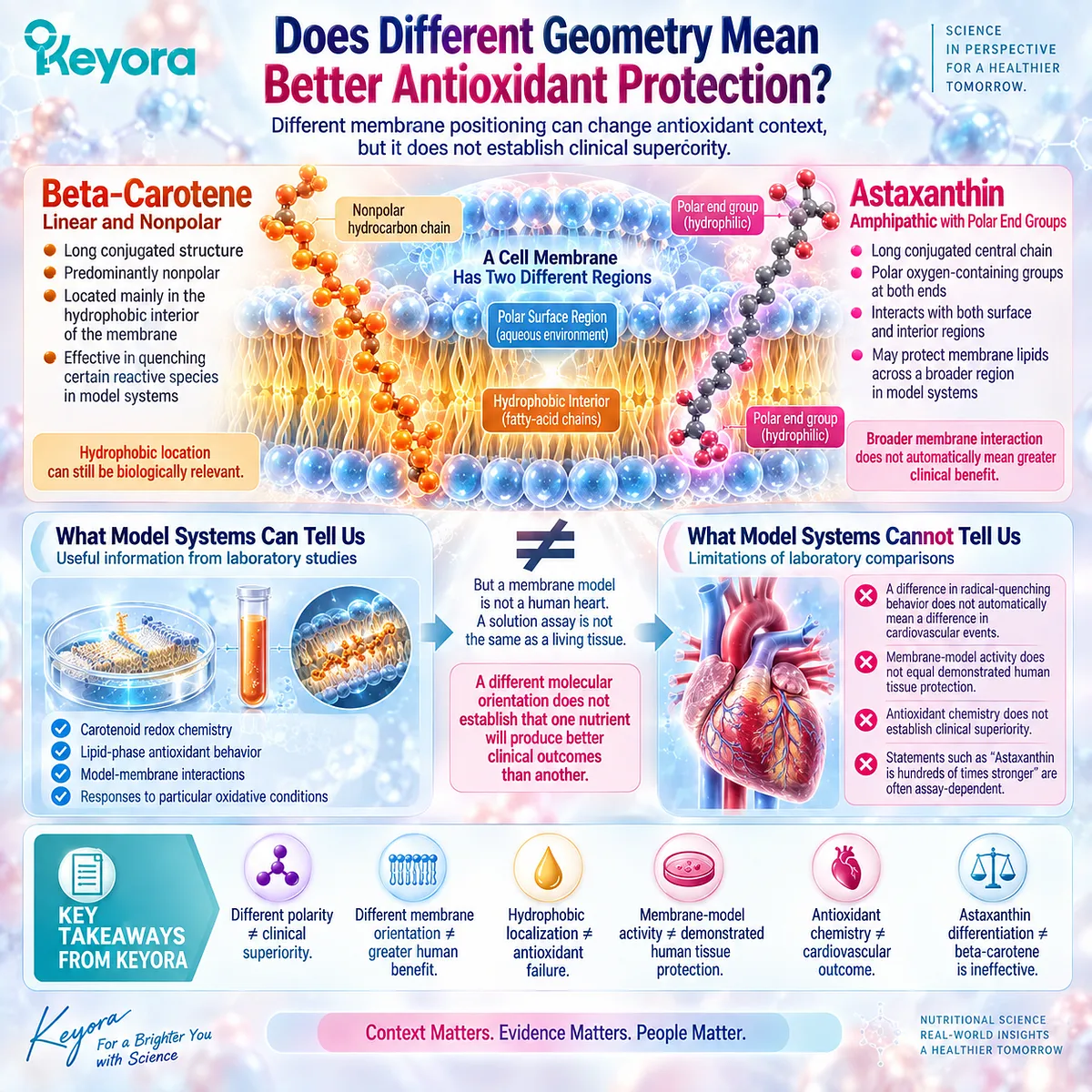
Structural differences can explain why Astaxanthin and beta-carotene may behave differently within model membranes.
They do not establish that one carotenoid is universally superior in humans.
This distinction becomes especially important when antioxidant comparisons use laboratory measurements.
The reference framework in Keyora Astaxanthin EP-4 includes studies such as Palozza and Krinsky (1992), Astaxanthin and Canthaxanthin Are Potent Antioxidants in a Membrane Model, as well as Terao (1989), Antioxidant Activity of Beta-Carotene-Related Carotenoids in Solution.
These types of experiments can tell us useful things about:
-
carotenoid redox chemistry
-
lipid-phase antioxidant behavior
-
model-membrane interactions
-
responses to particular oxidative conditions
But their conclusions remain context-specific.
A membrane model is not the same as a human heart.
A solution assay is not the same as a living tissue.
A difference in radical-quenching behavior does not automatically mean a difference in cardiovascular events.
And a different molecular orientation does not establish that one nutrient will produce better clinical outcomes than another.
The evidence boundaries therefore remain:
-
Different polarity ≠ clinical superiority
-
Different membrane orientation ≠ greater human benefit
-
Hydrophobic localization ≠ antioxidant failure
-
Membrane-model activity ≠ demonstrated human tissue protection
-
Antioxidant chemistry ≠ cardiovascular outcome
-
Astaxanthin differentiation ≠ beta-carotene is ineffective
This is why Q010 should not be converted into a potency ranking.
Statements such as “Astaxanthin is hundreds of times stronger” are usually dependent on a particular assay, reactive species, solvent system, or experimental condition.
They cannot by themselves answer the more important question:
Does that difference produce a superior human health outcome?
That requires direct human evidence.
The Keyora Cardiac Architecture: Different Carotenoids, Different Membrane Niches
Keyora uses molecular positioning to explain why carotenoids should not be treated as interchangeable antioxidants
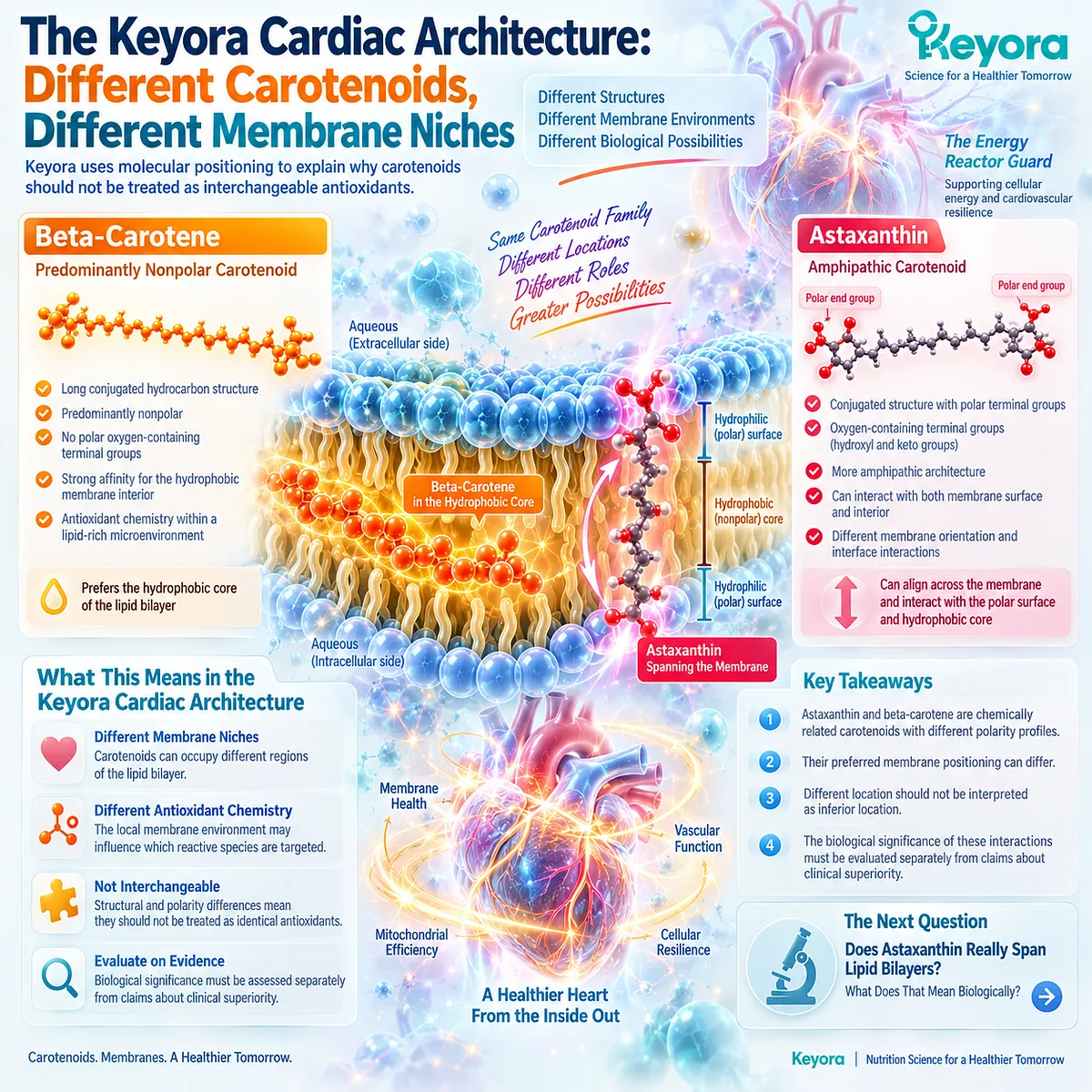
Within the Keyora Cardiac Architecture, Astaxanthin’s membrane-associated molecular structure is used as part of the rationale behind The Energy Reactor Guard.
The useful part of that framework is not the idea that every other antioxidant fails.
It is the recognition that antioxidants with different structures can occupy different membrane environments.
The comparison can be summarized as:
Beta-Carotene
→ predominantly nonpolar carotenoid
→ strong affinity for the hydrophobic membrane interior
→ antioxidant chemistry within a lipid-rich microenvironment
Astaxanthin
→ polar terminal groups + long lipid-associated conjugated chain
→ more amphipathic architecture
→ different membrane orientation and interface interactions
Both remain carotenoids.
Both possess extended conjugated molecular systems relevant to antioxidant chemistry.
But they are not structurally interchangeable.
Their polarity differs.
Their preferred membrane positioning can differ.
And that may influence where their antioxidant chemistry occurs.
What should not follow from this comparison is:
Astaxanthin’s structure proves that beta-carotene is inferior.
Nor should it become:
Membrane geometry proves better heart protection.
A more evidence-disciplined conclusion is:
Astaxanthin and beta-carotene are chemically related carotenoids with different polarity profiles, and those differences can produce distinct membrane interactions. The biological significance of those interactions must be evaluated separately from claims about clinical superiority.
That distinction leads directly to the next question.
The membrane-orientation model is now clear.
The next step is to examine how strongly the evidence supports its most distinctive claim:
Does Astaxanthin Really Span Lipid Bilayers? What Does That Mean Biologically?
This article is for educational and informational purposes only. It does not provide medical advice, diagnosis, treatment, cure, prevention, disease outcome claims, hormone restoration claims, fertility outcome claims, or formula-specific clinical efficacy claims.