
How Does MoodFlow Support Stress, Sleep, Mood, and Cognitive Resilience?
Keyora Research Q&A Library
This is part of the Keyora Research Q&A Series, derived from Keyora Nutritional Neurology Seriers .
Within the Keyora Nutritional Neurology framework, this Q&A translates complex nutrient–brain mechanisms into reader-friendly, evidence-bound answers, focusing on stress resilience, sleep quality, calm mood support, cognitive wellness, and the broader interaction between nutrition, neurochemistry, and daily nervous-system function.
First published by Keyora Research Journal: www.keyorahealth.com

Direct Answer
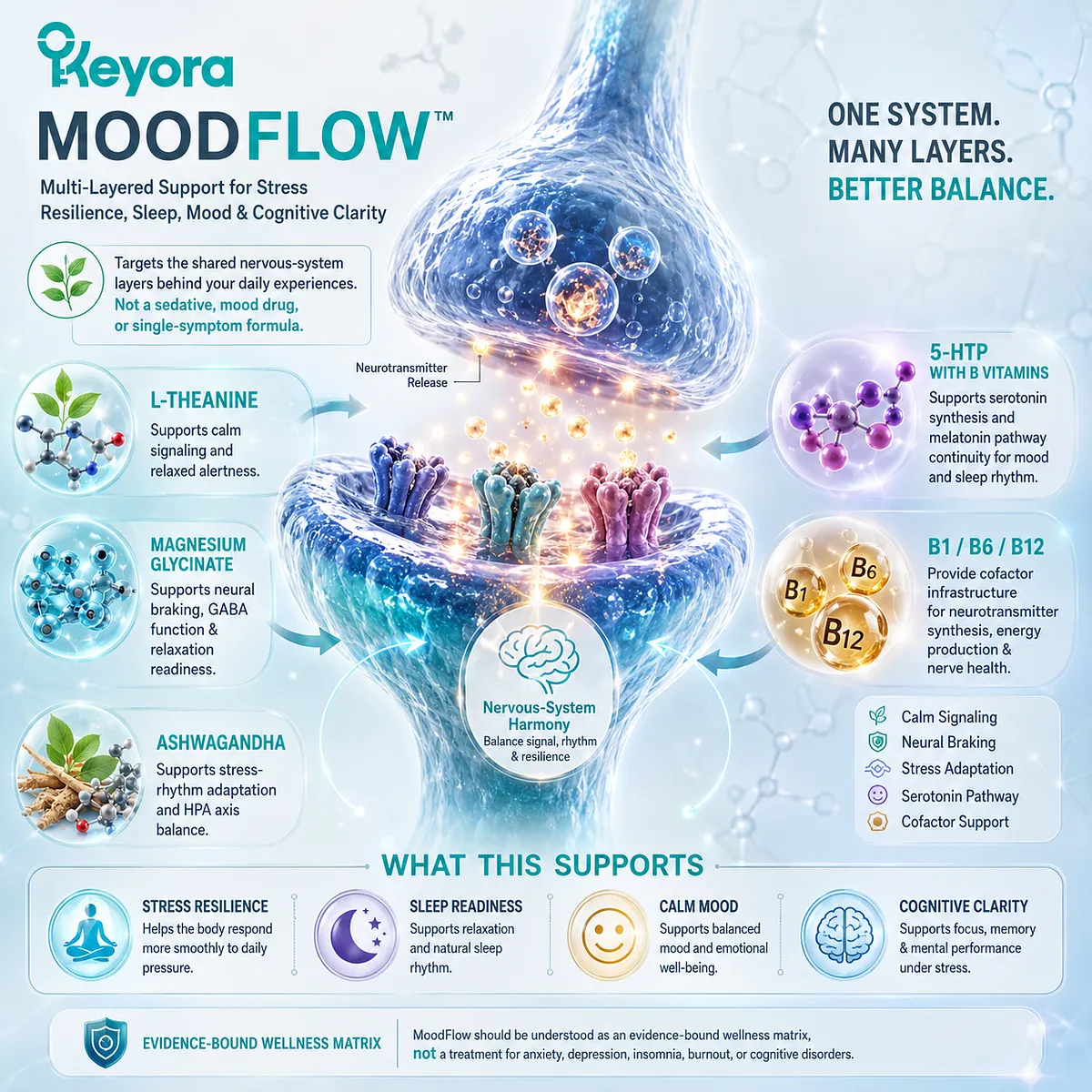
MoodFlow supports stress, sleep, mood, and cognitive resilience by targeting the shared nervous-system layers behind these daily experiences. It is not designed as a sedative, mood drug, or single-symptom formula.
In the Keyora MoodFlow framework:
-
L-Theanine supports calm signaling and relaxed alertness,
-
Magnesium glycinate supports neural braking and relaxation readiness,
-
Ashwagandha supports stress-rhythm adaptation,
-
5-HTP with B vitamins supports serotonin-melatonin pathway continuity,
-
B1/B6/B12 provide cofactor infrastructure for neurotransmitter and energy pathways.
Together, these layers help explain support for stress resilience, sleep readiness, calm mood, and cognitive clarity under everyday pressure.
MoodFlow should be understood as an evidence-bound wellness matrix, not a treatment for anxiety, depression, insomnia, burnout, or cognitive disorders.
MoodFlow Supports Shared Pathways, Not Isolated Symptoms
Why stress, sleep, mood, and cognition need a matrix rather than one single ingredient.
Many people try to place MoodFlow into one category.
They may ask: Is it a stress supplement? Is it a sleep supplement? Is it a mood support formula? Is it for focus and cognitive performance?
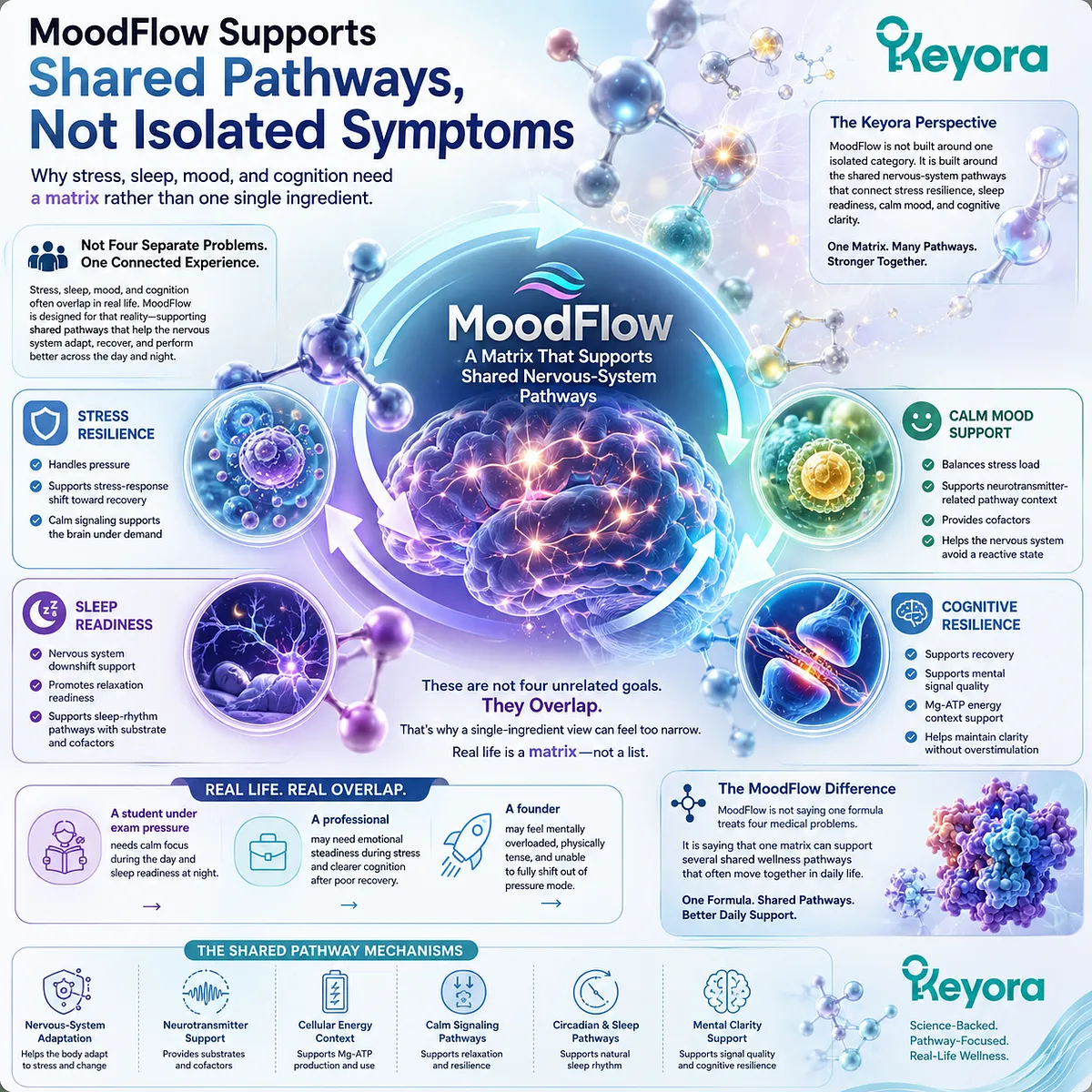
The Keyora answer is different. MoodFlow is not built around one isolated category. It is built around the shared nervous-system pathways that connect stress resilience, sleep readiness, calm mood, and cognitive clarity.
This distinction matters.
If a product says it “treats” several conditions at once, that would be a medical-style claim and should be avoided. But if a formula explains how several everyday wellness experiences share common pathways, that becomes a different kind of conversation.
MoodFlow is designed for that second conversation.
In the Keyora MoodFlow framework, stress, sleep, mood, and cognition are supported through shared nervous-system pathways, not treated as four separate symptom claims.
-
Stress resilience depends partly on how the body handles pressure, how the stress-response system shifts toward recovery, and how calm signaling supports the brain under demand.
-
Sleep readiness depends partly on whether the nervous system can downshift, whether the body can move toward relaxation readiness, and whether sleep-rhythm pathways have substrate and cofactor support.
-
Calm mood support depends partly on stress load, neurotransmitter-related pathway context, cofactor availability, and the ability of the nervous system to avoid staying in a reactive state.
-
Cognitive resilience depends partly on recovery, mental signal quality, Mg-ATP energy context, and the ability to stay clear without becoming overstimulated.
These are not four unrelated goals.
They overlap.
That is why a single-ingredient view can feel too narrow. One ingredient may support one important layer, but the real-life user often experiences several layers at the same time.
-
A student under exam pressure may need calm focus during the day and sleep readiness at night.
-
A professional may need emotional steadiness during stress and clearer cognition after poor recovery.
-
A founder may feel mentally overloaded, physically tense, and unable to fully shift out of pressure mode.
MoodFlow’s product logic is built for that kind of connected experience.
It is not saying one formula treats four medical problems. It is saying that one matrix can support several shared wellness pathways that often move together in daily life.
That is the foundation of MoodFlow’s stress, sleep, mood, and cognition support message.
The Five Support Layers Inside MoodFlow
How each ingredient group supports a different part of the stress-sleep-mood-cognition system.
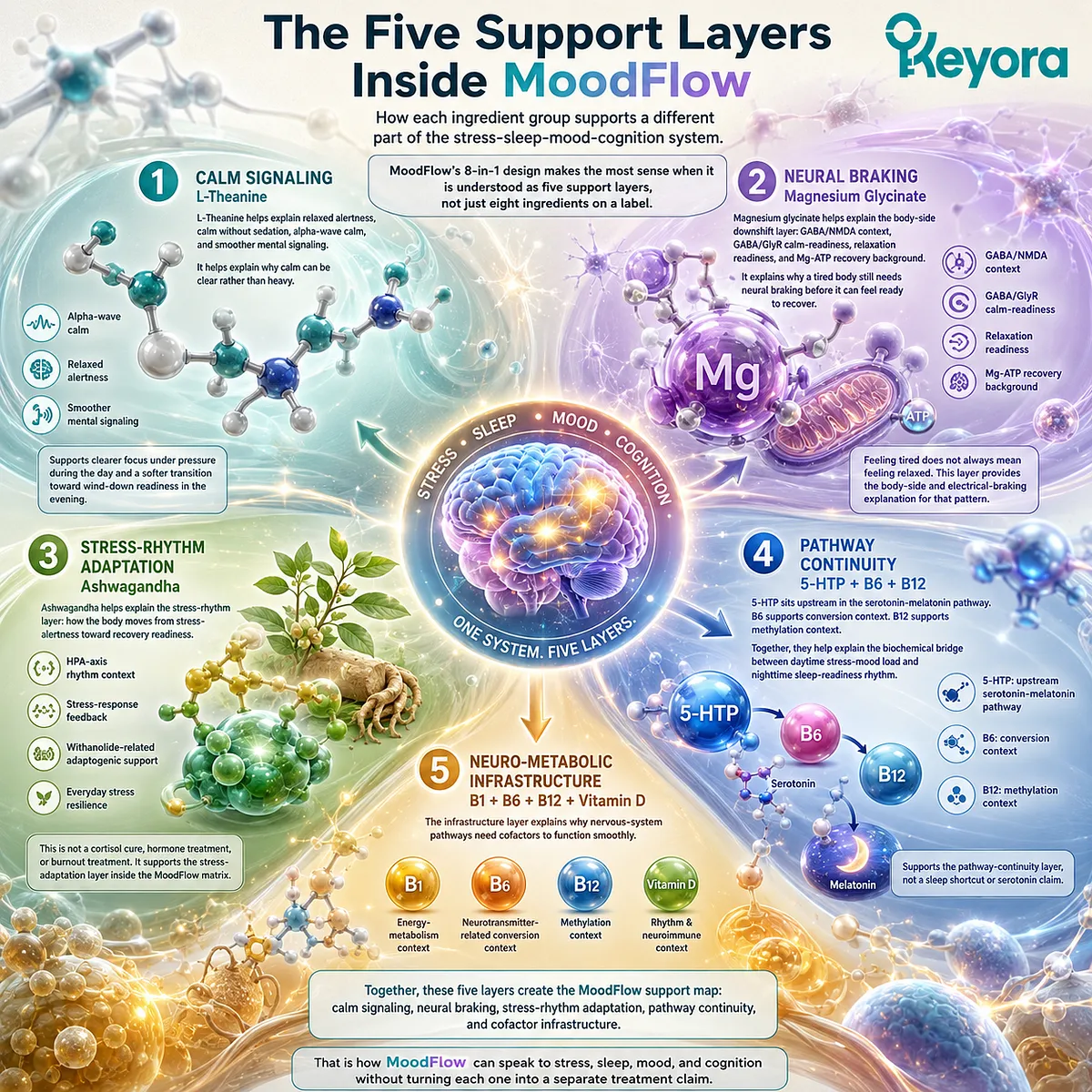
MoodFlow’s 8-in-1 design makes the most sense when it is understood as five support layers, not just eight ingredients on a label.
The first layer is calm signaling.
This is where L-Theanine plays the central role.
L-Theanine helps explain relaxed alertness, calm without sedation, alpha-wave calm, and smoother mental signaling. It is especially relevant when the brain feels fast, reactive, or overloaded.
L-Theanine helps explain why calm can be clear rather than heavy.
This matters for both stress and cognition. During the day, calm signaling can support clearer focus under pressure. In the evening, it can support a softer transition toward wind-down readiness.
The second layer is neural braking.
This is where magnesium glycinate plays the central role. Magnesium glycinate helps explain the body-side downshift layer: GABA/NMDA context, GABA/GlyR calm-readiness, relaxation readiness, and Mg-ATP recovery background.
Magnesium glycinate helps explain why a tired body still needs neural braking before it can feel ready to recover.
This layer is important because feeling tired does not always mean feeling relaxed. Many people feel exhausted while the nervous system still feels switched on. Magnesium glycinate gives MoodFlow a body-side and electrical-braking explanation for that pattern.
The third layer is stress-rhythm adaptation.
This is where Ashwagandha plays the central role. Ashwagandha helps explain the stress-rhythm layer: how the body moves from stress-alertness toward recovery readiness. It is connected with HPA-axis rhythm context, stress-response feedback, withanolide-related adaptogenic support, and everyday stress resilience.
This does not mean Ashwagandha is a cortisol cure, hormone treatment, or burnout treatment. It means Ashwagandha supports the stress-adaptation layer inside the MoodFlow matrix.
The fourth layer is pathway continuity.
This is where 5-HTP works with B6 and B12. 5-HTP sits upstream in the serotonin-melatonin pathway. B6 supports conversion context, while B12 supports methylation context. Together, they help explain the biochemical bridge between daytime stress-mood load and nighttime sleep-readiness rhythm.
5-HTP with B vitamins helps explain the pathway-continuity layer, not a sleep shortcut or serotonin claim.
This is important for safe communication. MoodFlow should not say that 5-HTP “raises serotonin” or treats mood or sleep disorders. The evidence-bound wording is pathway support: normal serotonin-melatonin continuity and sleep-readiness rhythm support.
The fifth layer is neuro-metabolic infrastructure.
This includes B1, B6, B12, Vitamin D, and the broader cofactor logic of the formula. B1 supports energy-metabolism context. B6 supports neurotransmitter-related conversion context. B12 supports methylation context. Vitamin D adds broader rhythm and neuroimmune context.
The infrastructure layer is not glamorous, but it explains why nervous-system pathways need cofactors to function smoothly.
Together, these five layers create the MoodFlow support map: calm signaling, neural braking, stress-rhythm adaptation, pathway continuity, and cofactor infrastructure.
That is how MoodFlow can speak to stress, sleep, mood, and cognition without turning each one into a separate treatment claim.
What MoodFlow Can Responsibly Claim
Why evidence-bound support language makes the formula stronger, not weaker.
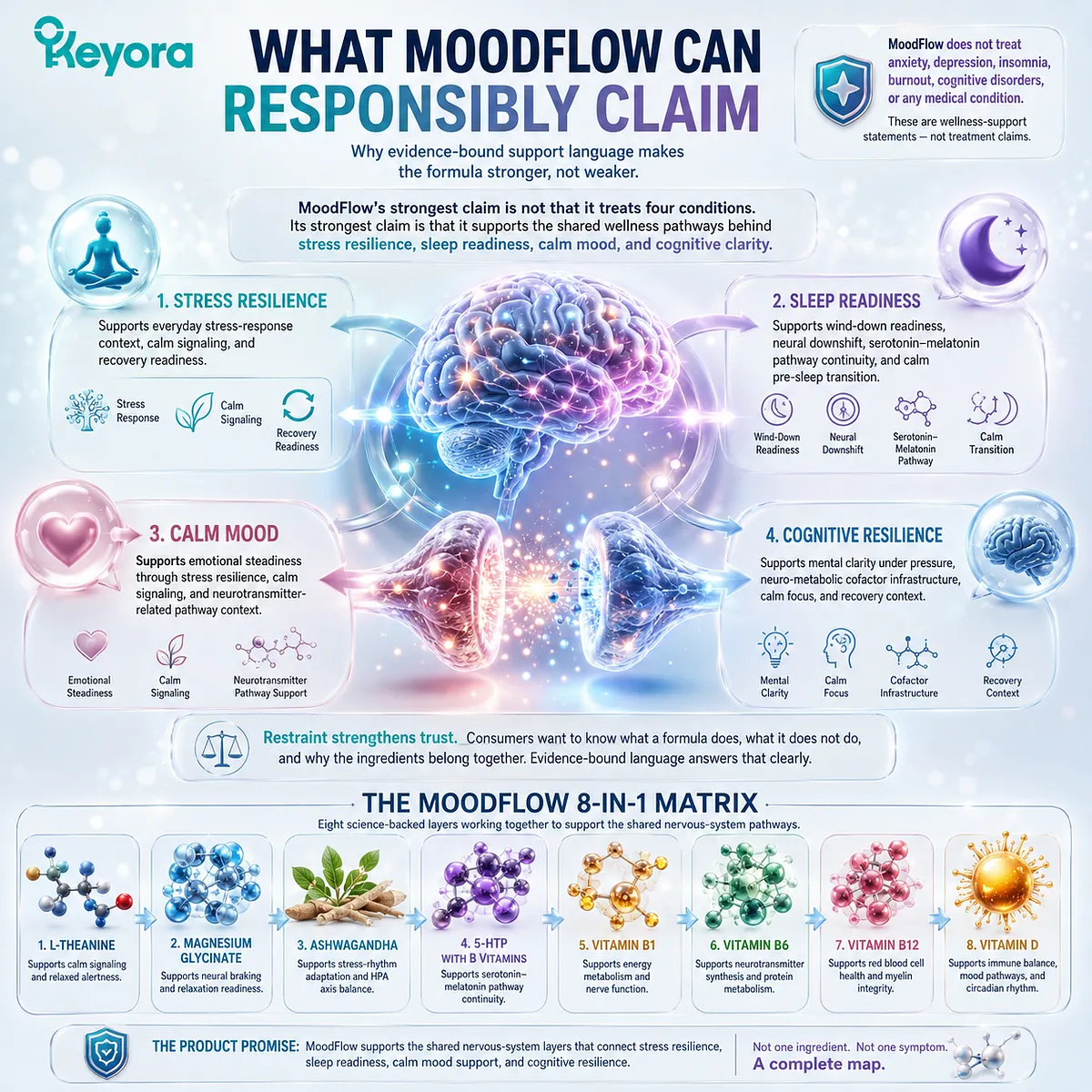
MoodFlow’s strongest claim is not that it treats four conditions. Its strongest claim is that it supports the shared wellness pathways behind stress resilience, sleep readiness, calm mood, and cognitive clarity.
This is an important difference.
-
MoodFlow can responsibly say that it supports stress resilience. That means the formula helps explain nutritional support for everyday stress-response context, calm signaling, and recovery readiness.
-
MoodFlow can responsibly say that it supports sleep readiness. That means the formula helps explain support for wind-down readiness, neural downshift, serotonin-melatonin pathway continuity, and calm pre-sleep transition.
-
MoodFlow can responsibly say that it supports calm mood. That means the formula helps explain support for emotional steadiness through stress resilience, calm signaling, and neurotransmitter-related pathway context.
-
MoodFlow can responsibly say that it supports cognitive resilience. That means the formula helps explain support for mental clarity under pressure, neuro-metabolic cofactor infrastructure, calm focus, and recovery context.
These are wellness-support statements.
They are different from saying that MoodFlow treats anxiety, depression, insomnia, burnout, cognitive disorders, or any medical condition. Those claims should not be used.
MoodFlow should also not be described as a medication replacement, sedative, sleeping pill, or finished-formula clinical cure. Unless a finished-formula clinical trial exists and is being cited specifically, the safest and most accurate language is ingredient-level evidence supporting formula rationale.
This kind of restraint does not weaken the product story. It strengthens it.
Consumers are often tired of exaggerated wellness claims. They want to understand what a formula actually does, what it does not do, and why the ingredients belong together.
Evidence-bound language helps Keyora answer those questions clearly.
The product promise is not “one formula fixes everything.” The product promise is more precise: MoodFlow supports the shared nervous-system layers that connect stress resilience, sleep readiness, calm mood support, and cognitive resilience.
That is why MoodFlow’s 8-in-1 Matrix matters.
It does not rely on one ingredient to explain the whole story.
-
L-Theanine supports calm signaling.
-
Magnesium glycinate supports neural braking.
-
Ashwagandha supports stress-rhythm adaptation.
-
5-HTP with B vitamins supports pathway continuity.
-
B1, B6, B12, and Vitamin D support cofactor and rhythm infrastructure.
Each layer has a role. The formula’s strength comes from the map.
For Keyora, responsible support language is not a limitation. It is the clearest way to build trust while explaining the real logic behind MoodFlow.
Closing Summary
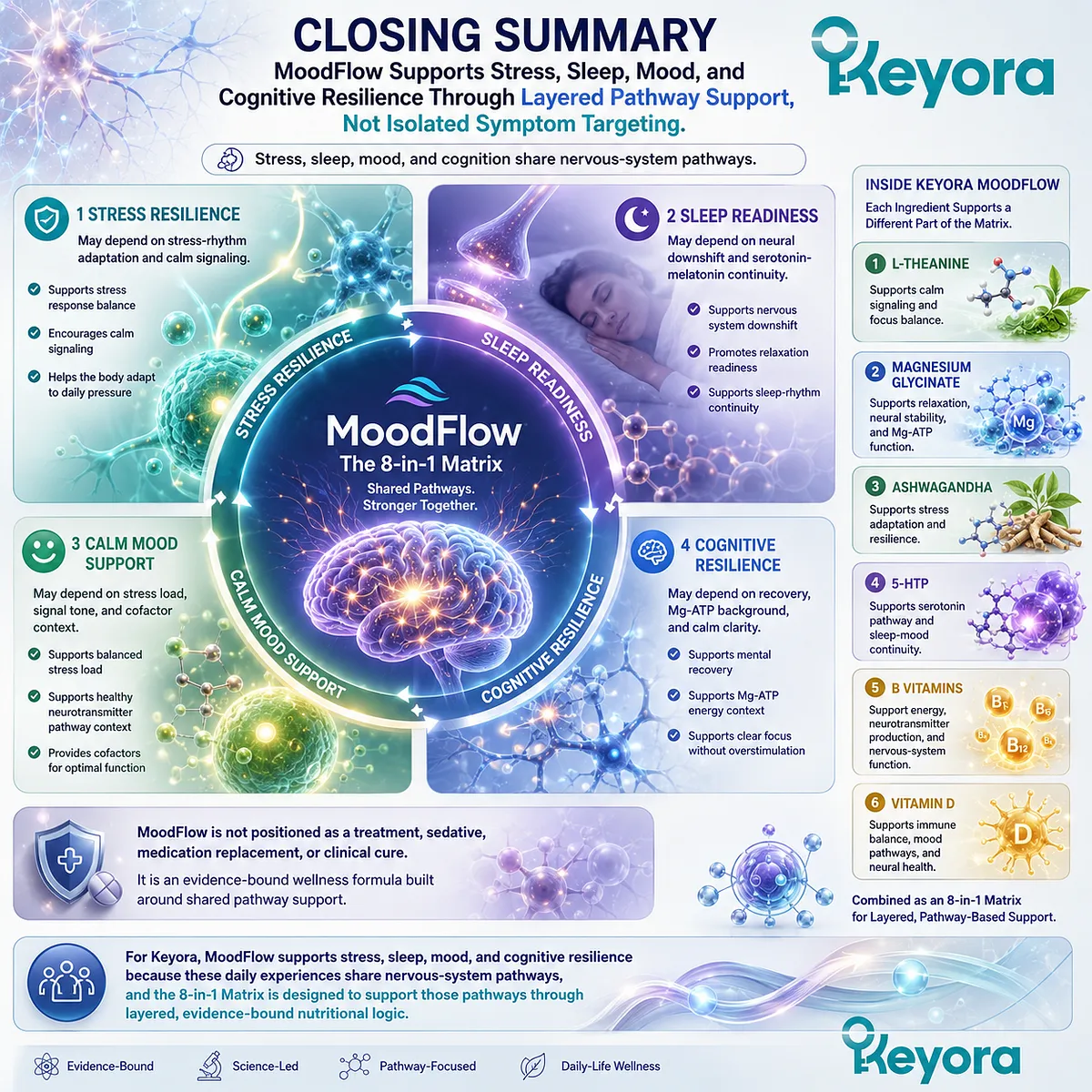
MoodFlow supports stress, sleep, mood, and cognitive resilience through layered pathway support, not isolated symptom targeting.
Stress, sleep, mood, and cognition share nervous-system pathways.
-
Stress resilience may depend on stress-rhythm adaptation and calm signaling.
-
Sleep readiness may depend on neural downshift and serotonin-melatonin continuity.
-
Calm mood support may depend on stress load, signal tone, and cofactor context.
-
Cognitive resilience may depend on recovery, Mg-ATP background, and calm clarity.
Inside Keyora MoodFlow, L-Theanine, magnesium glycinate, Ashwagandha, 5-HTP, B vitamins, and Vitamin D each support a different part of this matrix.
MoodFlow is not positioned as a treatment, sedative, medication replacement, or clinical cure. It is an evidence-bound wellness formula built around shared pathway support.
For Keyora, MoodFlow supports stress, sleep, mood, and cognitive resilience because these daily experiences share nervous-system pathways, and the 8-in-1 Matrix is designed to support those pathways through layered, evidence-bound nutritional logic.
This article is for educational and informational purposes only. It does not provide medical advice, diagnosis, treatment, cure, prevention, disease outcome claims, hormone restoration claims, fertility outcome claims, or formula-specific clinical efficacy claims.