
How Does Lipid Peroxidation Affect Human Health?
Keyora Research Q&A Library
This is part of the Keyora Research Q&A Series, derived from Keyora Astaxanthin Research Journal Series.
Within the Keyora Astaxanthin Researcn framework, this Q&A translates complex astaxanthin biology into reader-friendly, evidence-bound answers, focusing on natural astaxanthin identity, molecular structure, antioxidant and redox mechanisms, membrane lipid interaction, mitochondrial resilience, inflammatory signaling pathways, human evidence interpretation, and the scientific principles behind responsible supplementation.
First published by Keyora Research Journal: www.keyorahealth.com
Direct Answer
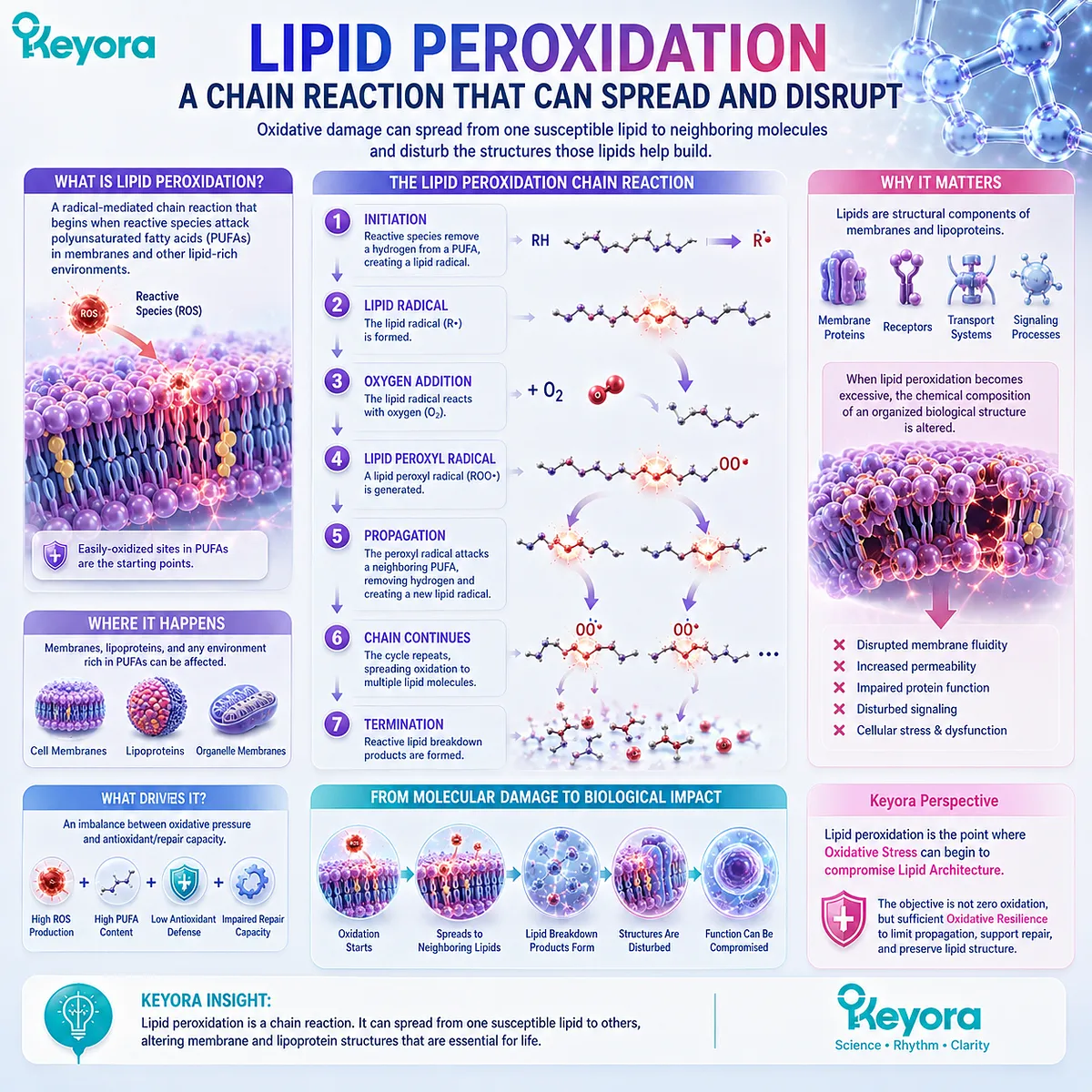
Lipid peroxidation is a chain reaction in which oxidative damage can spread from one susceptible lipid to neighboring molecules and disturb the structures those lipids help build
Lipid peroxidation is more than the oxidation of a single fat molecule.
It is a radical-mediated process that can begin when reactive species attack oxidation-sensitive lipids, particularly polyunsaturated fatty acids, or PUFAs, within membranes and other lipid-rich environments.
The first oxidative event can produce a lipid radical.
That radical can react with oxygen and generate another reactive lipid species capable of affecting neighboring fatty acids.
If the process is not interrupted, oxidation can therefore propagate through multiple lipid molecules rather than remaining confined to the original site.
The EP-3 source describes this sequence as an initiation-and-propagation process in which reactive species remove hydrogen from a PUFA, creating a lipid radical that subsequently reacts with oxygen and contributes to further lipid oxidation.
A simplified pathway is:
Reactive species
↓
Susceptible PUFA
↓
Lipid radical
↓
Lipid peroxyl radical
↓
Oxidation of neighboring lipids
↓
Reactive lipid breakdown products
↓
Potential structural and functional disruption
This is why lipid peroxidation matters for human biology.
Lipids are not simply stored energy. They are structural components of cellular membranes and lipoproteins, and their chemical properties help determine the environment in which membrane proteins, receptors, transport systems, and signaling processes operate.
When lipid peroxidation becomes excessive, the problem is therefore not merely that “fat has oxidized.” The chemical composition of an organized biological structure is being altered.
Within the Keyora framework, lipid peroxidation represents the point where Oxidative Stress can begin to compromise Lipid Architecture.
The biological objective is not zero oxidation, but sufficient Oxidative Resilience to limit propagation, maintain repairable conditions, and preserve lipid structure.
How Does Lipid Peroxidation Begin?
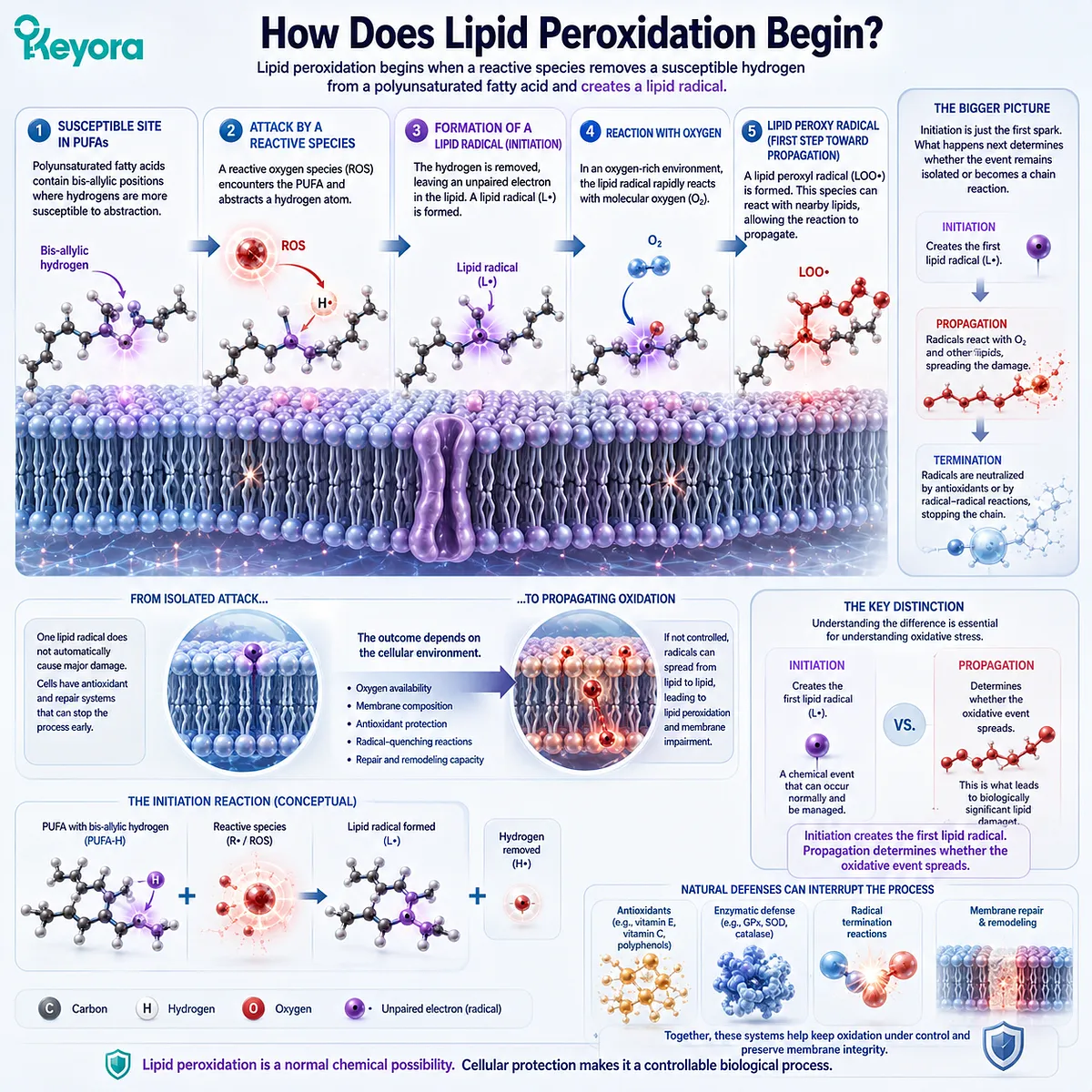
Lipid peroxidation begins when a reactive species removes a susceptible hydrogen from a polyunsaturated fatty acid and creates a lipid radical
The initiation stage begins with the chemical vulnerability discussed in the previous Q&A.
Polyunsaturated fatty acids contain multiple carbon-carbon double bonds. In many PUFAs, hydrogen atoms located at bis-allylic positions are more susceptible to abstraction during radical-mediated oxidation.
When a sufficiently reactive species encounters one of these susceptible sites, it can remove a hydrogen atom from the fatty-acid chain.
The EP-3 source describes this initial event directly: a reactive oxygen species attacks a PUFA, removes hydrogen, and leaves an unpaired electron within the lipid structure. The resulting molecule is a lipid radical, commonly represented as L•.
This first reaction is called initiation.
Conceptually:
PUFA-H
Reactive species
↓
PUFA radical, L•
The important point is that the original fatty acid has now changed chemically.
However, the formation of one lipid radical does not yet explain why lipid peroxidation can become biologically significant.
The critical issue is what happens next.
A lipid radical is reactive. In an oxygen-rich biological environment, it can rapidly interact with molecular oxygen. This creates another reactive lipid species and allows the oxidative process to move beyond the first affected molecule.
This is the transition from:
isolated oxidative attack
to
propagating lipid oxidation
Cells possess antioxidant and repair systems that can interrupt oxidative events, so initiation does not automatically mean extensive membrane damage will occur.
Whether the process continues depends on factors such as local oxygen availability, membrane composition, antioxidant protection, radical-terminating reactions, and cellular repair capacity.
The important scientific distinction is therefore:
Initiation creates the first lipid radical. Propagation determines whether the oxidative event spreads.
Why Can Lipid Peroxidation Become a Chain Reaction?
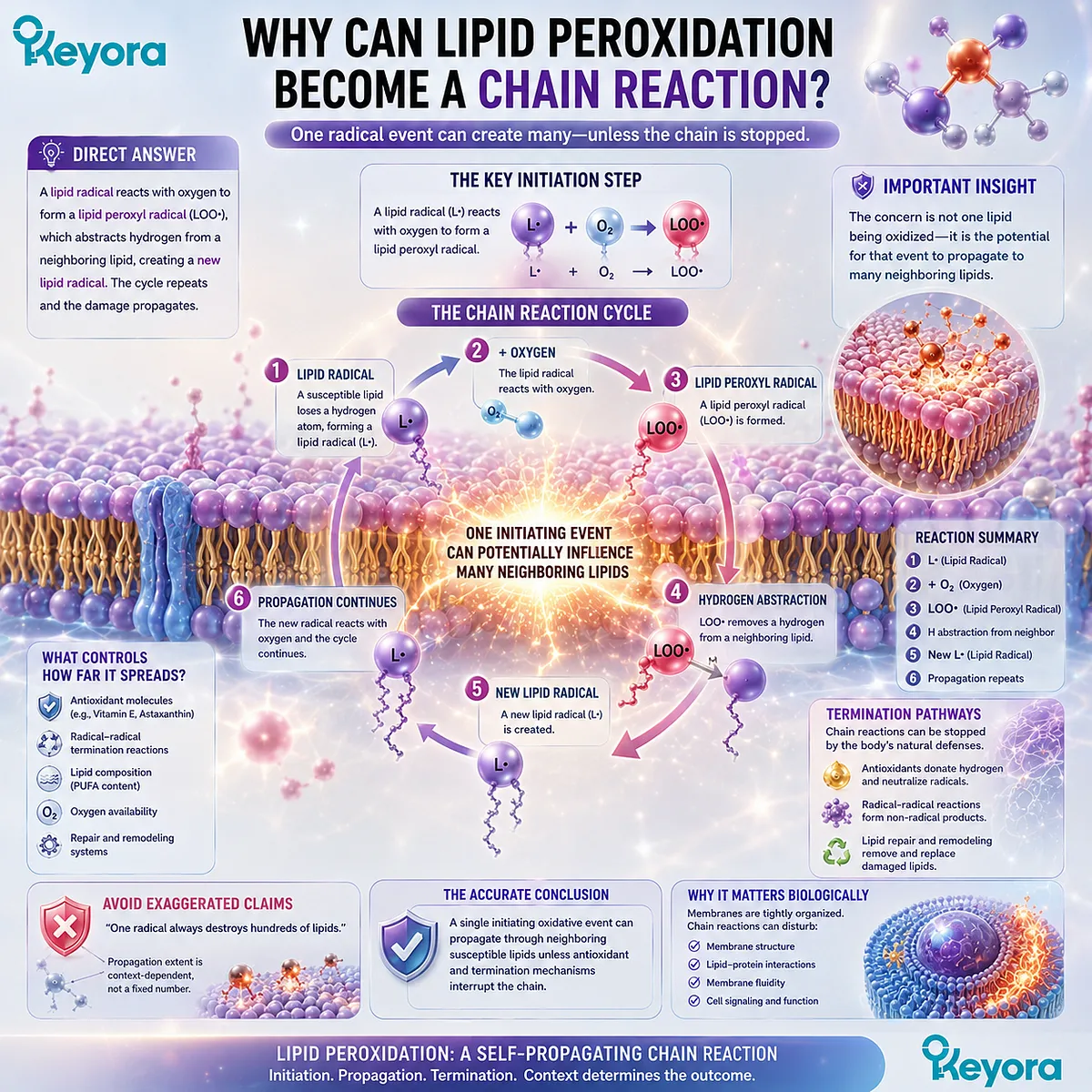
A lipid radical can react with oxygen and generate a lipid peroxyl radical that transfers oxidative damage to neighboring fatty-acid molecules
Once a lipid radical has formed, molecular oxygen becomes central to the next stage.
The lipid radical can react with oxygen to generate a lipid peroxyl radical, commonly written as LOO•.
The reaction can be represented conceptually as:
L• + O₂ → LOO•
The lipid peroxyl radical can then remove hydrogen from a neighboring fatty acid.
That reaction produces two important outcomes.
First, the original peroxyl radical can become a lipid hydroperoxide.
Second, the neighboring fatty acid becomes a new lipid radical.
That new radical can then react with oxygen and continue the same sequence.
The EP-3 source describes this mechanism as a self-propagating chain reaction: the lipid radical reacts with oxygen, forms a lipid peroxyl radical, and the reactive product then attacks another lipid molecule, creating another radical.
The cycle can therefore be simplified as:
Lipid radical
↓
+ Oxygen
↓
Lipid peroxyl radical
↓
Hydrogen abstraction from neighboring lipid
↓
New lipid radical
↓
Propagation continues
This is the defining feature of lipid peroxidation.
The biological concern is not simply that one lipid molecule becomes oxidized. It is that one initiating event can potentially influence multiple neighboring lipid molecules if the reaction is not terminated.
How far the chain reaction spreads depends on the biological environment.
Antioxidant molecules, radical-radical reactions, lipid composition, oxygen availability, and repair processes can all affect whether propagation continues or stops.
This is why exaggerated descriptions such as “one radical always destroys hundreds of lipids” should be avoided. The extent of propagation is context-dependent.
The more accurate conclusion is:
A single initiating oxidative event can propagate through neighboring susceptible lipids unless antioxidant and termination mechanisms interrupt the chain
This chain-reaction behavior helps explain why lipid peroxidation is particularly important in tightly organized lipid environments such as cellular membranes.
What Happens to Lipids as Peroxidation Progresses?
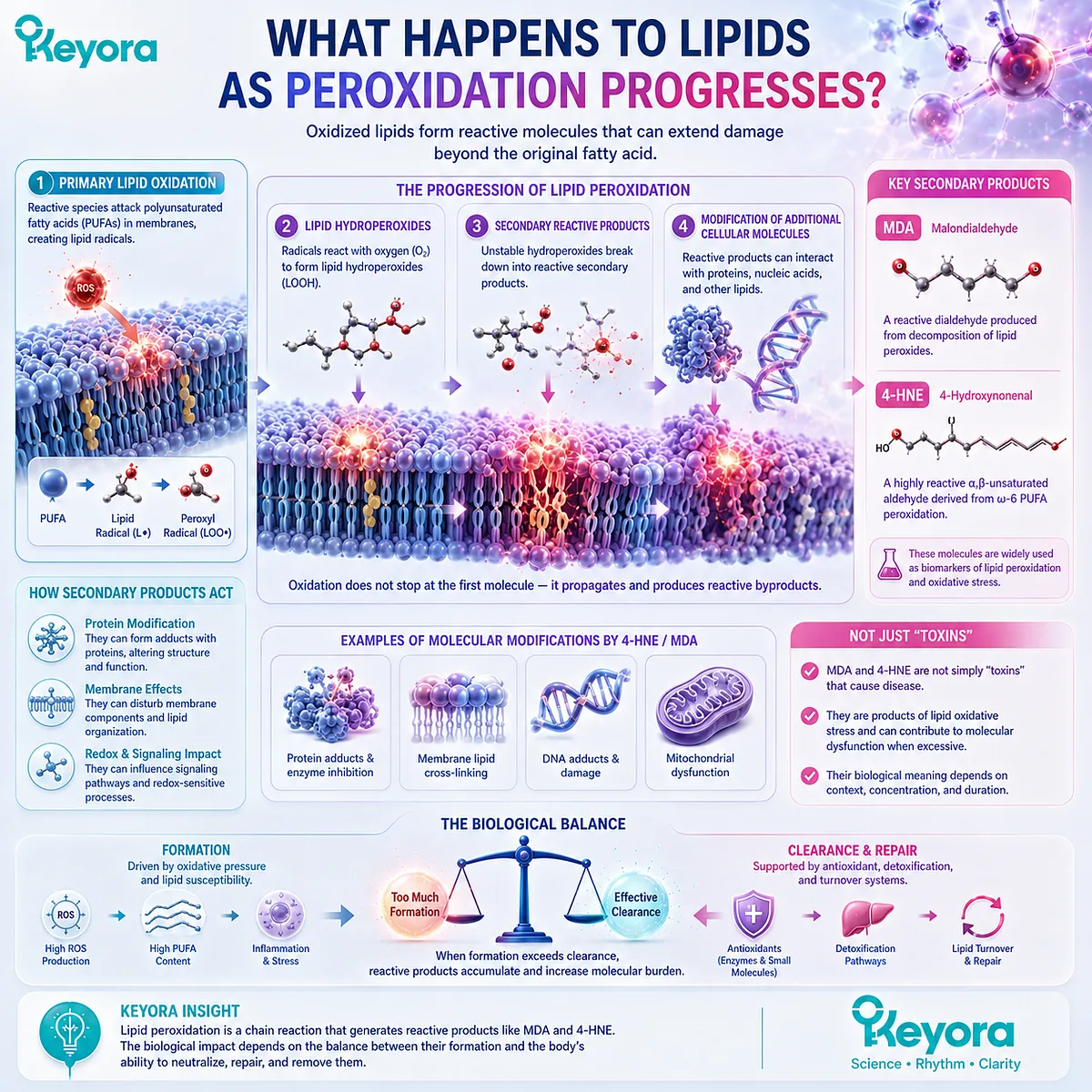
Oxidized lipids can form lipid hydroperoxides and reactive secondary products that extend molecular damage beyond the original fatty acid
Lipid peroxidation does not end with the formation of lipid radicals.
As oxidation progresses, lipid hydroperoxides and other unstable intermediates can accumulate. These molecules may subsequently decompose into smaller secondary products.
The EP-3 source identifies two important examples:
malondialdehyde, or MDA
and
4-hydroxynonenal, or 4-HNE.
These compounds are frequently discussed as markers or products of lipid oxidative damage.
Their biological significance comes partly from their reactivity.
Unlike the original fatty acid that remained embedded within a membrane, some lipid-derived aldehydes can interact with other cellular molecules.
They may modify proteins, influence membrane-associated structures, or participate in additional redox-sensitive processes.
The pathway therefore expands:
Primary lipid oxidation
↓
Lipid hydroperoxides
↓
Secondary reactive products
↓
Modification of additional cellular molecules
This explains why lipid peroxidation can have effects beyond the first lipid molecule that experienced oxidative attack.
It is important, however, not to describe MDA or 4-HNE simply as “toxins that cause disease.”
Their presence is better understood within the broader context of oxidative biology. They can reflect or participate in lipid oxidative stress, and excessive accumulation may contribute to molecular dysfunction.
Cells also possess systems capable of metabolizing, detoxifying, repairing, or removing oxidatively modified molecules.
Therefore, the biological consequence depends on balance between:
formation
and
clearance / repair
When production remains manageable, protective systems may contain the damage.
When lipid oxidation becomes persistent or widespread, reactive products can increase the molecular burden placed on those protective systems.
How Can Lipid Peroxidation Disrupt Cell Membrane Function?
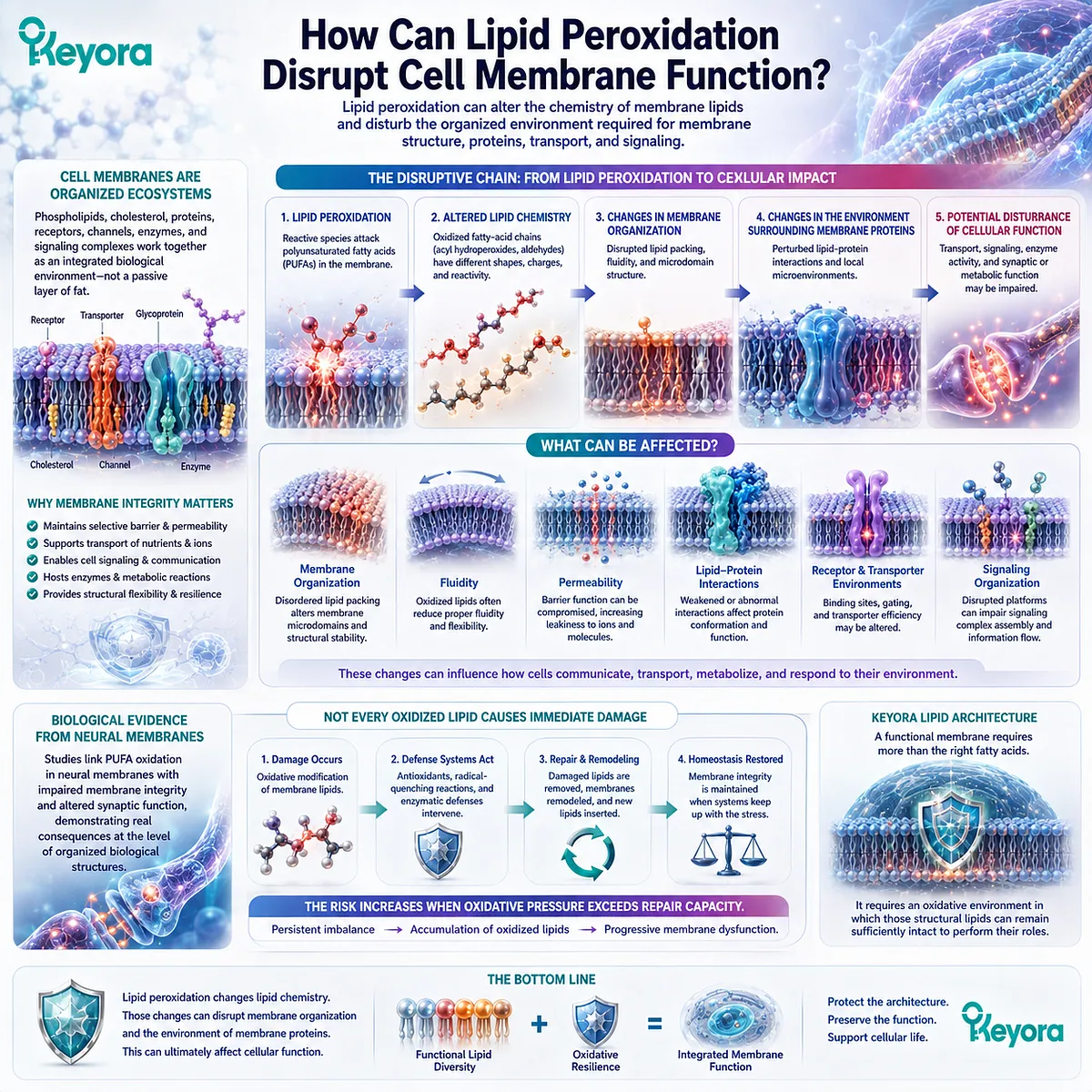
Lipid peroxidation can alter the chemistry of membrane lipids and disturb the organized environment required for membrane structure, proteins, transport, and signaling
Cell membranes depend on precise molecular organization.
Phospholipids interact with cholesterol, membrane proteins, receptors, channels, enzymes, and signaling complexes. The membrane therefore functions as an integrated biological environment rather than a passive layer of fat.
When membrane lipids undergo peroxidation, their chemical structure can change.
Oxidized fatty-acid chains may no longer pack within the membrane in the same way as their original forms.
This can potentially influence:
-
membrane organization;
-
fluidity;
-
permeability;
-
lipid-protein interactions;
-
receptor and transporter environments;
-
signaling organization.
The biological chain can therefore be understood as:
Lipid peroxidation
↓
Altered lipid chemistry
↓
Changes in membrane organization
↓
Changes in the environment surrounding membrane proteins
↓
Potential disturbance of cellular function
The project scientific source connects PUFA oxidation in neural membranes with impaired membrane integrity and altered synaptic function, illustrating how lipid oxidation can have consequences at the level of organized biological structures.
This does not mean that every oxidized lipid causes immediate cellular dysfunction.
Membranes are continuously maintained through lipid remodeling, antioxidant systems, degradation pathways, and replacement of damaged components.
The concern increases when the rate of oxidative modification exceeds the rate at which those systems can contain or repair the damage.
This brings the discussion back to Keyora Lipid Architecture.
A functional membrane requires more than the presence of appropriate fatty acids.
It also requires an oxidative environment in which those structural lipids can remain sufficiently intact to perform their roles.
Why Does Lipid Peroxidation Matter for Human Health?
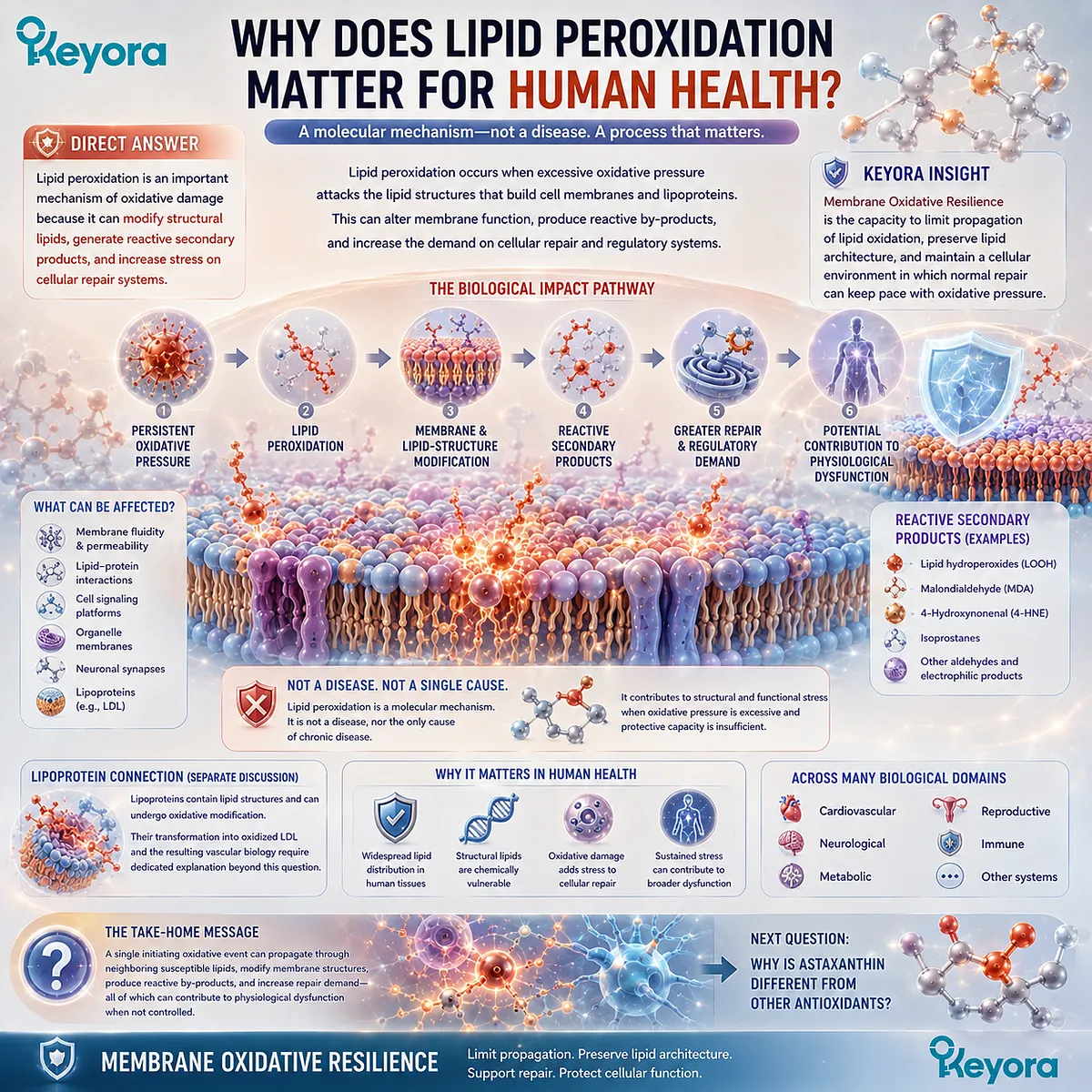
Lipid peroxidation is an important mechanism of oxidative damage because it can modify structural lipids, generate reactive secondary products, and increase stress on cellular repair systems
Lipid peroxidation is studied across cardiovascular, neurological, metabolic, reproductive, and other areas of biology because lipids are widely distributed throughout human tissues.
Its importance should nevertheless be described carefully.
Lipid peroxidation is not a disease by itself.
It is also not a single independent cause of chronic disease.
It is a molecular mechanism through which excessive oxidative pressure can contribute to structural and functional stress.
The project source connects lipid peroxidation with membrane damage, oxidative modification of lipoproteins, and oxidative stress in lipid-rich tissues.
The scientifically appropriate interpretation is:
Persistent oxidative pressure
↓
Lipid peroxidation
↓
Membrane and lipid-structure modification
↓
Reactive secondary products
↓
Greater cellular repair and regulatory demand
↓
Potential contribution to broader physiological dysfunction
Lipoproteins can also undergo oxidative modification because they contain lipid structures, but their specific transformation into oxidized LDL and the resulting vascular biology require separate discussion.
For the present question, the central conclusion is more fundamental.
Lipid peroxidation matters because Lipid Architecture is chemically vulnerable.
Building functional lipid structures is only one part of cellular biology.
Those structures also need sufficient redox protection, antioxidant support, and repair capacity to remain functional.
Within the Keyora framework, this is the role of Membrane Oxidative Resilience:
to limit propagation of lipid oxidation, preserve lipid architecture, and maintain a cellular environment in which normal repair can keep pace with oxidative pressure.
This completes the oxidative-stress foundation established across Q012–Q015.
The next step is to examine a different question.
If antioxidant protection depends not only on chemical potency but also on where an antioxidant can operate within lipid-rich biological environments, why is Astaxanthin different from other antioxidants?
This article is for educational and informational purposes only. It does not provide medical advice, diagnosis, treatment, cure, prevention, disease outcome claims, hormone restoration claims, fertility outcome claims, or formula-specific clinical efficacy claims.