
How Does L-Theanine Help a Wired Brain Wind Down?
Keyora Research Q&A Library
This is part of the Keyora Research Q&A Series, derived from Keyora Nutritional Neurology Seriers .
Within the Keyora Nutritional Neurology framework, this Q&A translates complex nutrient–brain mechanisms into reader-friendly, evidence-bound answers, focusing on stress resilience, sleep quality, calm mood support, cognitive wellness, and the broader interaction between nutrition, neurochemistry, and daily nervous-system function.
First published by Keyora Research Journal: www.keyorahealth.com

Direct Answer
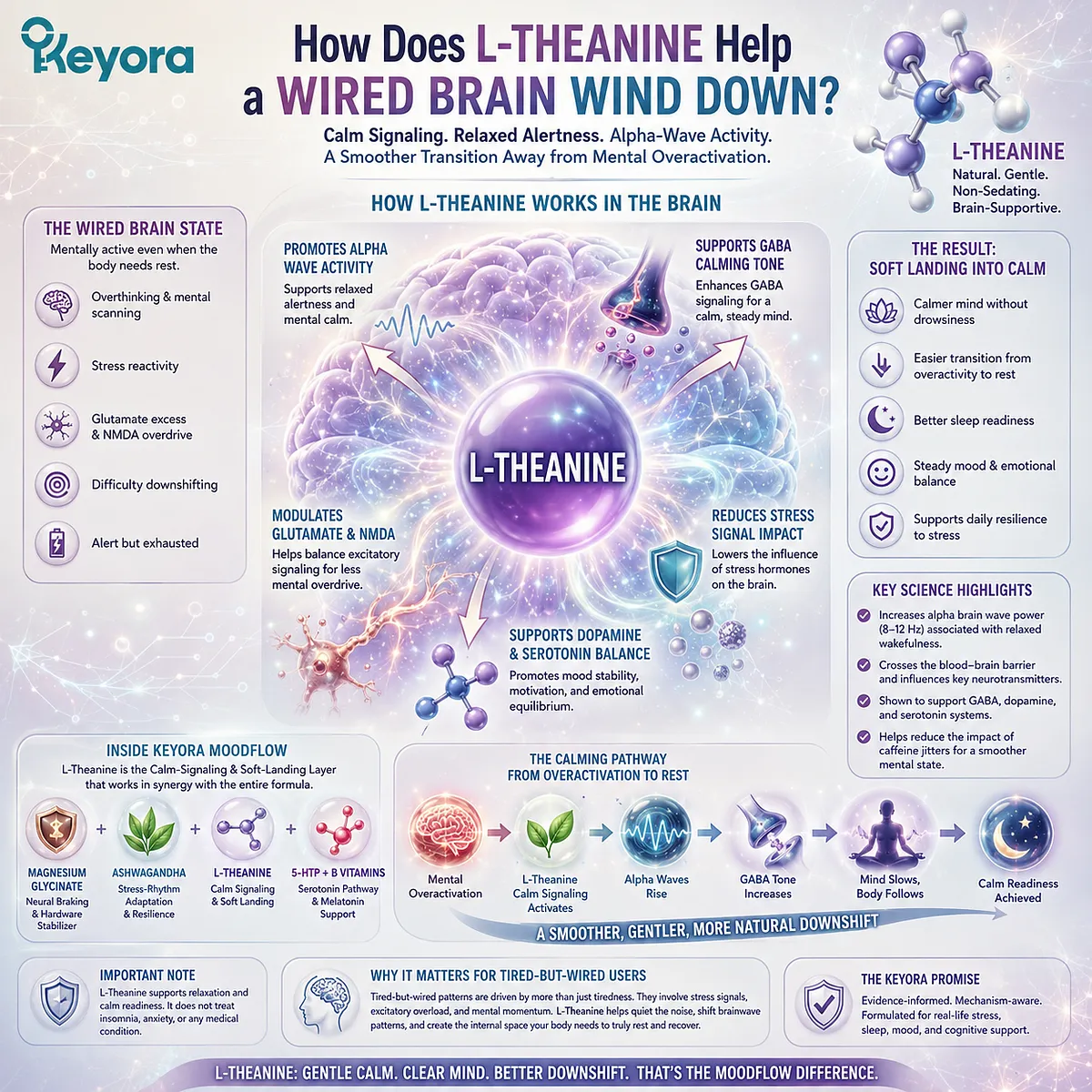
L-Theanine may help a wired brain wind down because it supports calm signaling without forcing sedation. A wired brain is often not only “awake.” It may be scanning, reacting, processing, planning, or staying mentally alert even when the body needs rest.
In the Keyora MoodFlow framework, L-Theanine is positioned as the calm-signaling and soft-landing layer. It helps explain relaxed alertness, alpha-wave calm, GABA-related calming tone, and glutamate/NMDA balance context.
This does not mean L-Theanine treats insomnia, anxiety, or racing thoughts as medical conditions. It means L-Theanine supports the transition from mental overactivation toward calm readiness.
Inside MoodFlow, L-Theanine works beside magnesium glycinate’s neural braking, Ashwagandha’s stress-rhythm adaptation, and 5-HTP with B vitamins’ serotonin-melatonin pathway support.
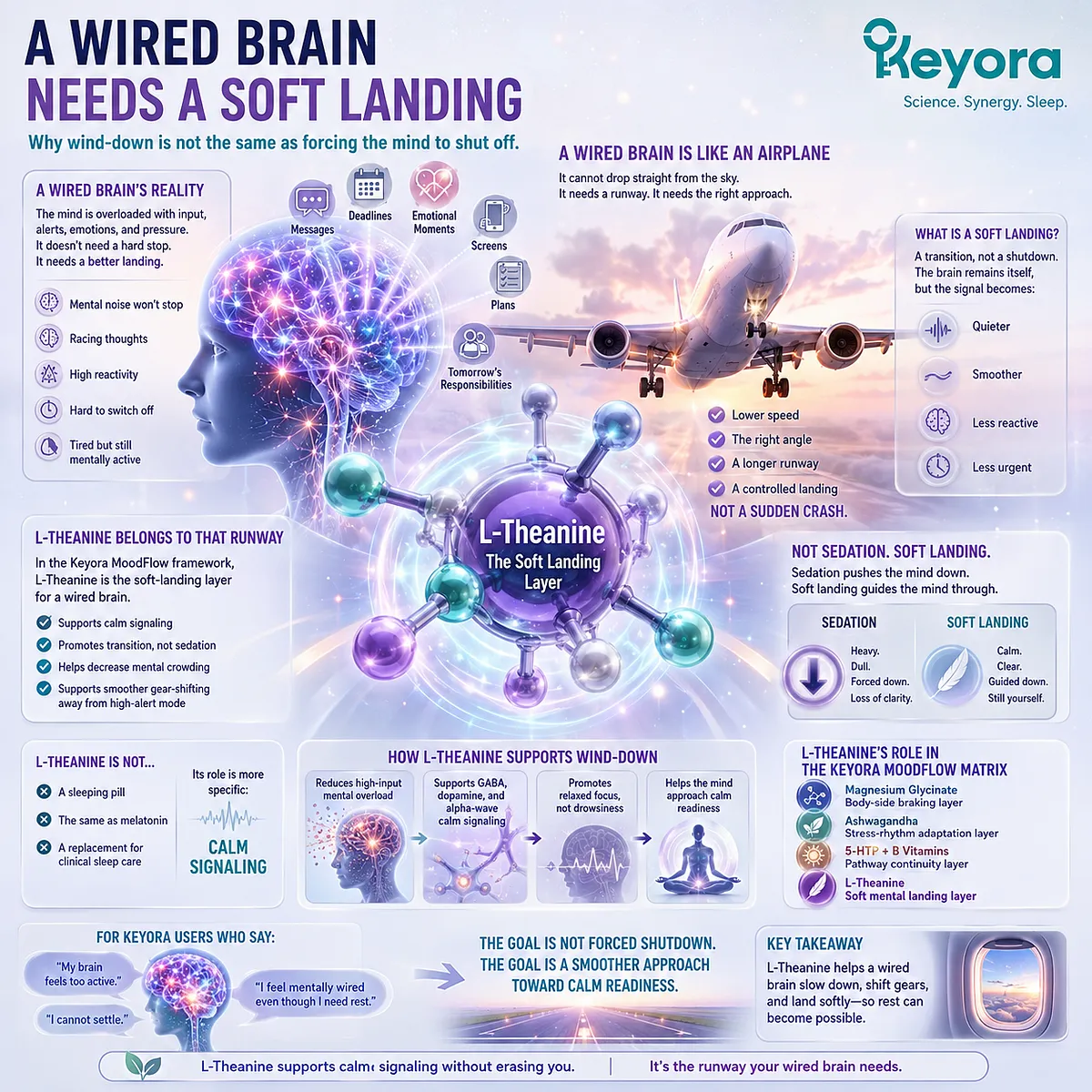
A Wired Brain Needs a Soft Landing
Why wind-down is not the same as forcing the mind to shut off.
When the brain feels wired, many people wish they could simply turn it off. They want the thoughts to stop, the mental noise to disappear, and the body to fall asleep immediately.
But the brain does not always work like a light switch.
A wired brain often needs transition, not force. It may need a slower mental speed, fewer internal alerts, less emotional reactivity, and a smoother shift away from problem-solving mode.
This is where the idea of a soft landing matters.
A wired brain is like a plane that cannot drop straight from the sky. It needs a runway. It needs to lower speed. It needs the right angle. It needs a controlled landing instead of a sudden crash.
L-Theanine belongs to that runway.
In the Keyora MoodFlow framework, L-Theanine is the soft-landing layer for a wired brain: it supports calm signaling without turning wind-down into forced shutdown.
This is different from trying to sedate the mind.
Sedation suggests heaviness, dullness, or being pushed down. Soft landing suggests transition: the brain remains itself, but the signal becomes quieter, smoother, and less reactive.
That distinction is important for tired-but-wired users.
Many people do not want to feel knocked out. They want to feel less mentally crowded. They want the mind to stop jumping from one thought to the next. They want the evening to feel less like a second workday inside the head.
A wired brain may be carrying too much input. It may still be reacting to messages, deadlines, emotional moments, screens, plans, or tomorrow’s responsibilities. It may not need a hard stop. It may need help changing gears.
That is why L-Theanine fits the wind-down conversation.
-
It is not positioned as a sleeping pill.
-
It is not the same as melatonin.
-
It is not trying to replace clinical sleep care.
-
Its role is more specific: calm signaling.
For a wired brain, calm signaling means the nervous system has support for moving away from high-input, high-reaction mode. The mind does not need to disappear. It needs to become less urgent.
This is the unique value of L-Theanine inside the tired-but-wired matrix. Magnesium glycinate helps explain the body-side braking layer. Ashwagandha helps explain stress-rhythm adaptation. 5-HTP with B vitamins helps explain pathway continuity.
L-Theanine owns the soft mental landing.
For Keyora, this makes L-Theanine especially relevant when the user says, “My brain feels too active,” “I cannot settle,” or “I feel mentally wired even though I need rest.”
The goal is not forced shutdown. The goal is a smoother approach toward calm readiness.
L-Theanine and Relaxed Alertness
How alpha-wave calm, GABA tone, and glutamate balance help explain mental downshift.
The most important phrase for understanding L-Theanine is relaxed alertness.
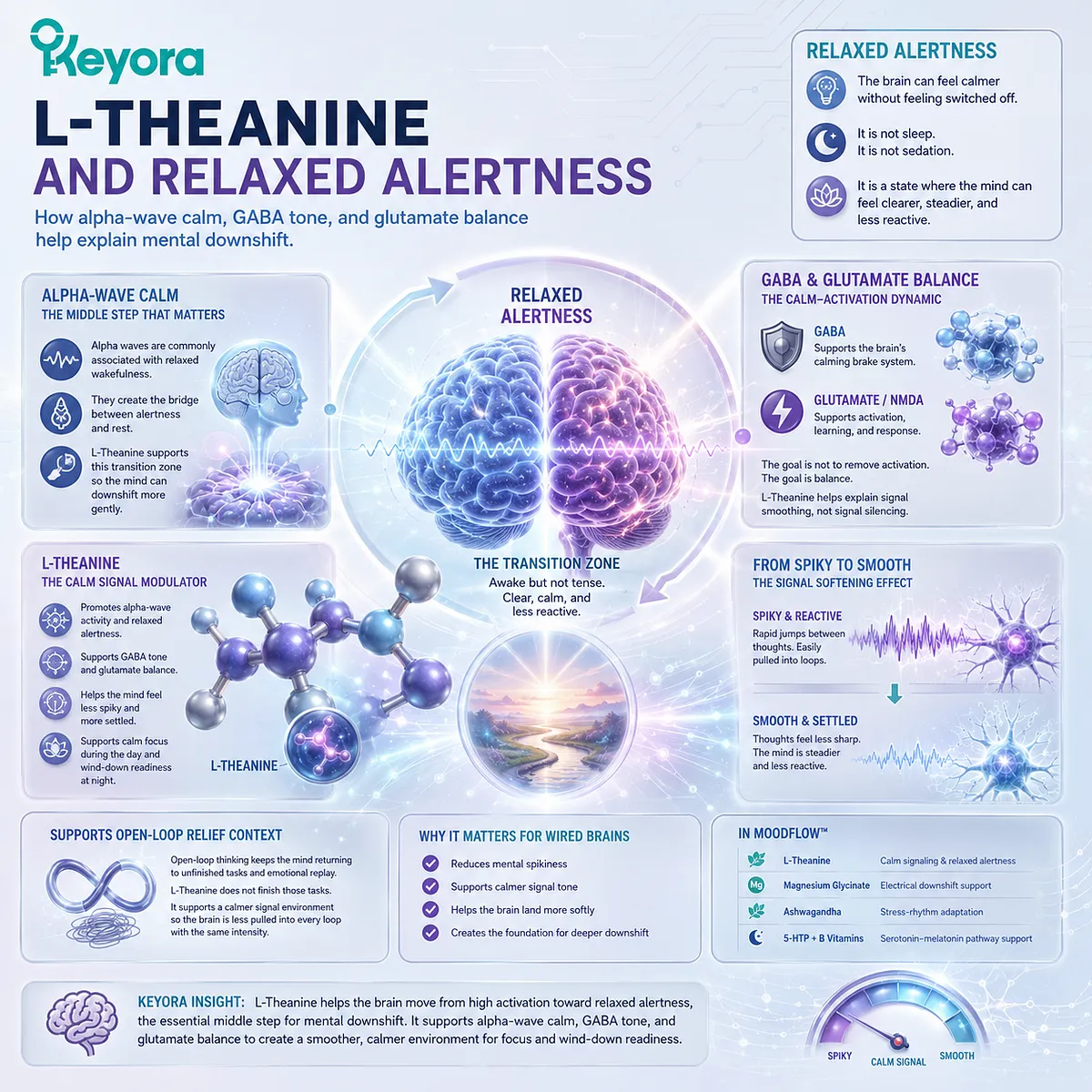
Relaxed alertness means the brain can feel calmer without feeling switched off. It is not the same as sleep. It is not the same as sedation. It is a state where the mind can feel clearer, steadier, and less reactive.
This is why L-Theanine is useful in both daytime and evening conversations. During the day, relaxed alertness can support calm focus. At night, the same idea can support wind-down readiness.
A wired brain does not always need to become instantly sleepy. Sometimes it first needs to become less sharp, less jumpy, and less pulled by every thought.
L-Theanine is often discussed in relation to alpha-wave calm, which helps explain why it fits the transition zone between alertness and rest.
Alpha-wave activity is commonly associated with relaxed wakefulness. In plain language, this is the feeling of being awake but not tense.
That transition zone matters.
Many tired-but-wired users are not ready to jump straight from mental speed into sleep. They need a middle step.
L-Theanine helps explain that middle step.
It supports the idea that calm can be clear, not foggy. The brain may remain aware, but the tone changes. The signal becomes softer. The inner environment feels less noisy.
GABA and glutamate context also help explain this.
GABA is often described as part of the brain’s calming brake system.
Glutamate and NMDA-related signaling are part of the activation side.
The brain needs both. The goal is not to remove activation completely. The goal is balance.
For a wired brain, L-Theanine helps explain signal smoothing: the goal is not to erase thought, but to make the mental environment less reactive.
This is an important difference from the open-loop thinking topic.
Open-loop thinking explains why the mind keeps returning to unfinished tasks and emotional replay.
L-Theanine’s role is not to finish those tasks for the person. Its role is to support a calmer signal environment so the brain is less likely to feel pulled into every loop with the same intensity.
In consumer language, L-Theanine may help explain why the mind can feel less “spiky.” Instead of jumping from thought to thought, the brain may feel more settled. Instead of reacting to every internal signal, the system may move closer to a calmer state.
This is why L-Theanine is one of the most important ingredients for the wired-brain side of MoodFlow.
It does not claim to treat racing thoughts. It does not claim to treat anxiety. It does not claim to guarantee sleep. Its value is in calm signaling, relaxed alertness, and wind-down readiness.
For Keyora, L-Theanine helps translate a complex nervous-system idea into a consumer-friendly message: the brain does not always need to be forced off; sometimes it needs to land more softly.
Why L-Theanine Works Best Inside a Matrix
Why calm signaling needs neural braking, stress-rhythm support, and pathway continuity around it.
L-Theanine is important, but MoodFlow does not treat it as a stand-alone shortcut.
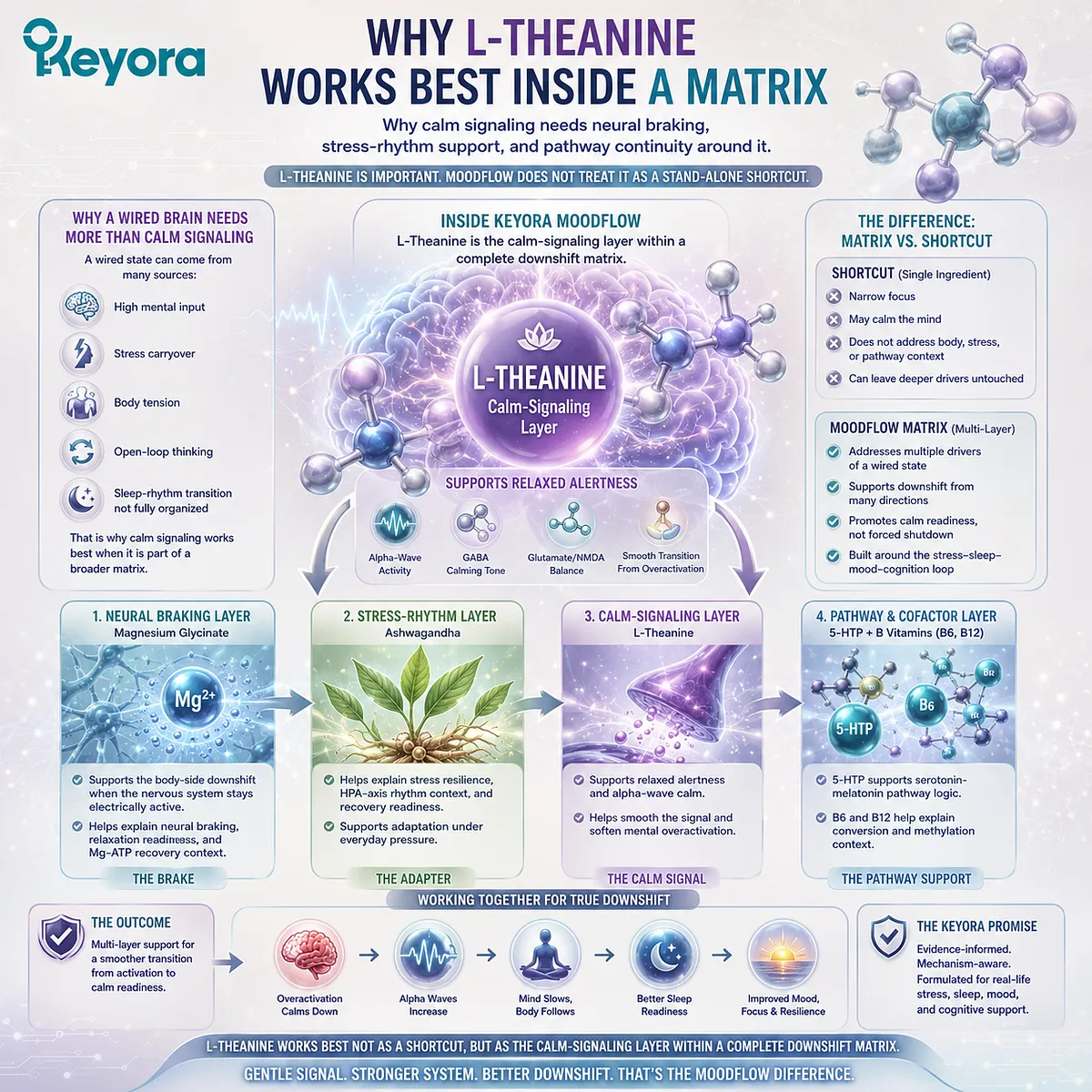
A wired brain can come from several sources. It may come from high mental input. It may come from stress carryover. It may come from body tension. It may come from open-loop thinking. It may come from a sleep-rhythm transition that has not fully organized.
That is why calm signaling works best when it is part of a broader matrix.
Inside Keyora MoodFlow, L-Theanine is not used as a stand-alone calming shortcut; it is the calm-signaling layer within a broader downshift matrix that also includes neural braking, stress-rhythm adaptation, and serotonin-melatonin continuity.
L-Theanine is the main character of this article because it fits the wired-brain experience. It supports the movement from fast, reactive, high-input mental activity toward relaxed alertness.
But if the body is tense, calm signaling may need help from the braking layer. This is where magnesium glycinate fits. If L-Theanine helps smooth the signal, magnesium glycinate supports the brake. It helps explain the body-side downshift context when the nervous system still feels electrically active.
If the wired brain is driven by stress carryover, calm signaling may need support from the stress-rhythm layer. This is where Ashwagandha fits. Ashwagandha helps explain stress resilience, HPA-axis rhythm context, and recovery readiness under everyday pressure. It is not a cortisol cure. It is the stress-adaptation layer around the wired-brain pattern.
If wind-down also depends on sleep-rhythm pathway continuity, L-Theanine may need support from the substrate and cofactor layer.
This is where 5-HTP and B vitamins fit.
-
5-HTP supports upstream serotonin-melatonin pathway logic.
-
B6 and B12 help explain conversion and methylation context.
This is pathway support, not a sleep guarantee.
This is the difference between a single-ingredient calming product and the MoodFlow architecture.
MoodFlow is not built around one idea. It is built around the stress-sleep-mood-cognition loop. In that loop, a wired brain is rarely only a thought problem. It may also involve stress rhythm, neural activation, body tension, and pathway readiness.
L-Theanine brings the calm-signaling layer, but the full matrix explains why calm often needs support from more than one direction.
This is also why MoodFlow is not positioned as a sedative. A sedative-style message would imply pushing the system down.
MoodFlow uses a different logic: support the downshift from activation into calm readiness.
For Keyora, L-Theanine is the ingredient that gives the wired brain a softer mental runway. It helps explain why calm can feel clear, not heavy. It supports a smoother transition without making the formula depend on forced shutdown.
Closing Summary
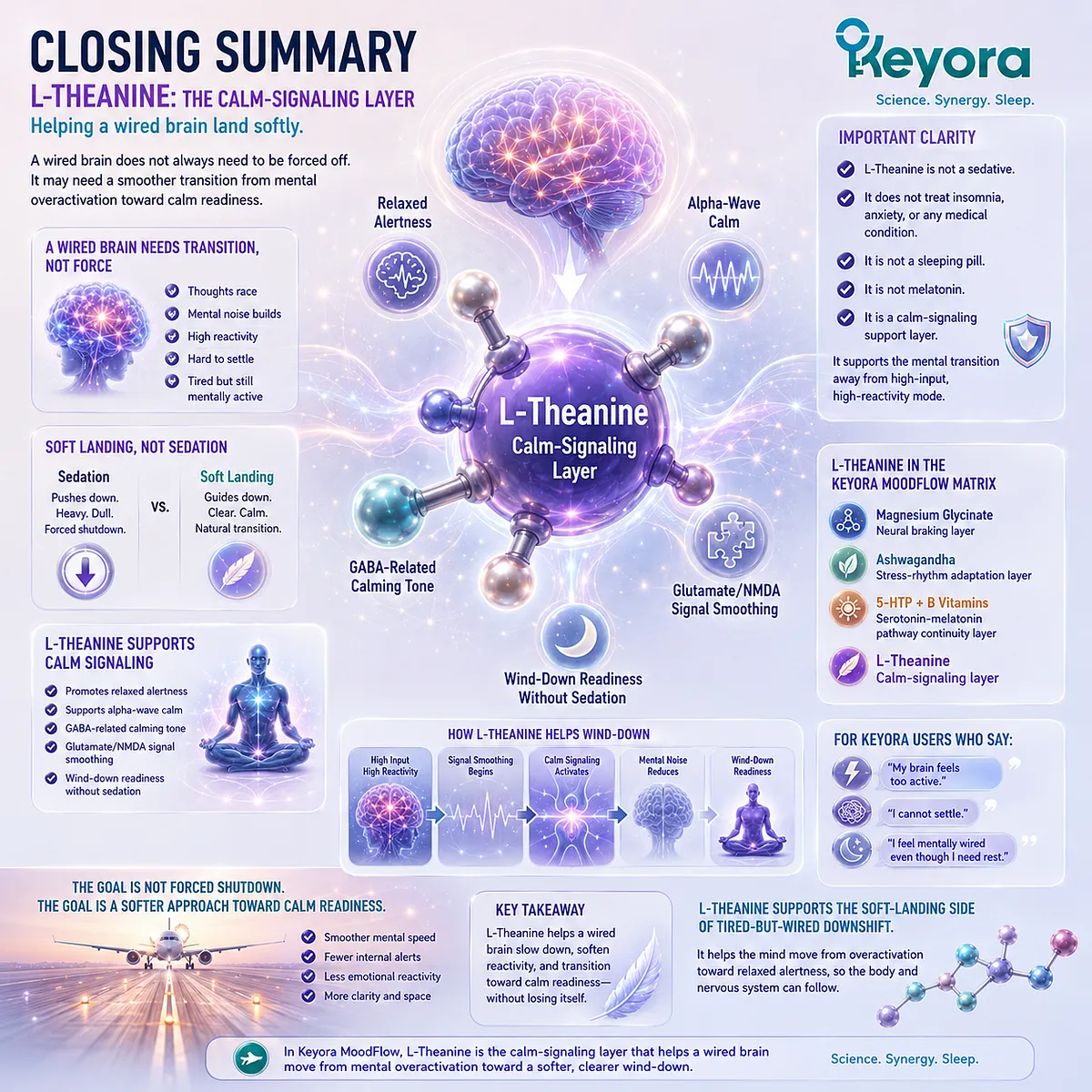
L-Theanine supports the soft-landing side of tired-but-wired downshift. A wired brain does not always need to be forced off. It may need a smoother transition from mental overactivation toward calm readiness.
In the Keyora MoodFlow framework, L-Theanine is the calm-signaling layer. It helps explain relaxed alertness, alpha-wave calm, GABA-related calming tone, glutamate/NMDA signal smoothing, and wind-down readiness without sedation.
This does not mean L-Theanine treats insomnia, anxiety, or racing thoughts as medical conditions. It means L-Theanine supports the mental transition away from high-input, high-reactivity mode.
Inside MoodFlow, L-Theanine works beside magnesium glycinate for neural braking, Ashwagandha for stress-rhythm adaptation, and 5-HTP with B vitamins for serotonin-melatonin pathway continuity.
For Keyora, L-Theanine is the calm-signaling layer that helps a wired brain move from mental overactivation toward a softer, clearer wind-down.
This article is for educational and informational purposes only. It does not provide medical advice, diagnosis, treatment, cure, prevention, disease outcome claims, hormone restoration claims, fertility outcome claims, or formula-specific clinical efficacy claims.