
How Does Ashwagandha Support the HPA Axis?
Keyora Research Q&A Library
This is part of the Keyora Research Q&A Series, derived from Keyora Nutritional Neurology Seriers .
Within the Keyora Nutritional Neurology framework, this Q&A translates complex nutrient–brain mechanisms into reader-friendly, evidence-bound answers, focusing on stress resilience, sleep quality, calm mood support, cognitive wellness, and the broader interaction between nutrition, neurochemistry, and daily nervous-system function.
First published by Keyora Research Journal: www.keyorahealth.com

Direct Answer
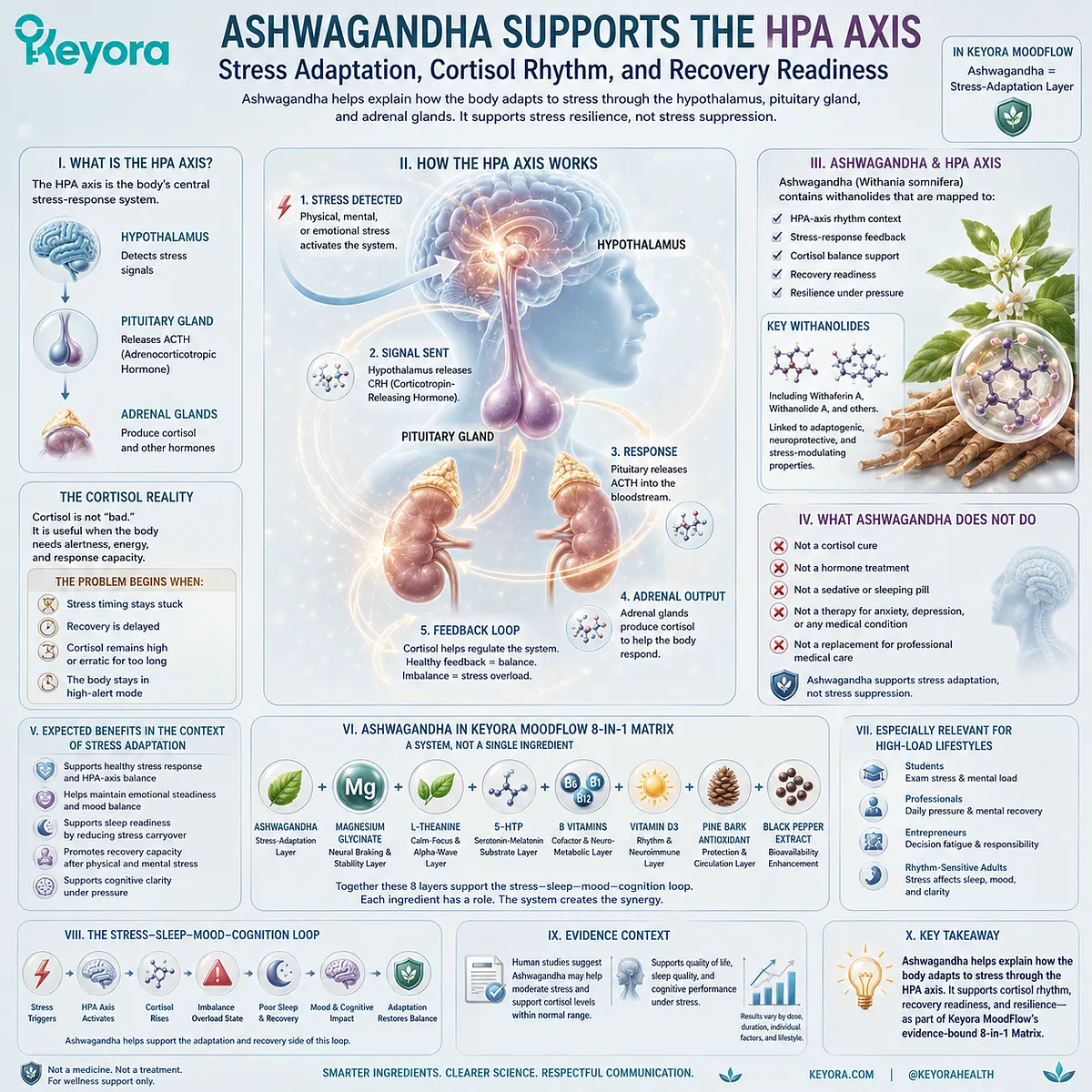
Ashwagandha supports the HPA axis by helping explain how the body adapts to stress through the hypothalamus, pituitary gland, and adrenal glands. This system helps coordinate stress signals, including cortisol rhythm.
Cortisol is not “bad.”
It is useful when the body needs alertness, energy, and response capacity. The problem begins when stress timing stays stuck, recovery is delayed, and the body remains in a high-alert pattern for too long.
In the Keyora MoodFlow framework, Ashwagandha is positioned as the stress-adaptation layer because its withanolides are mapped to HPA-axis rhythm context, stress-response feedback, and recovery readiness.
It is not a cortisol cure, hormone treatment, sedative, or medical therapy.
It supports stress resilience as part of MoodFlow’s broader stress-sleep-mood-cognition matrix.
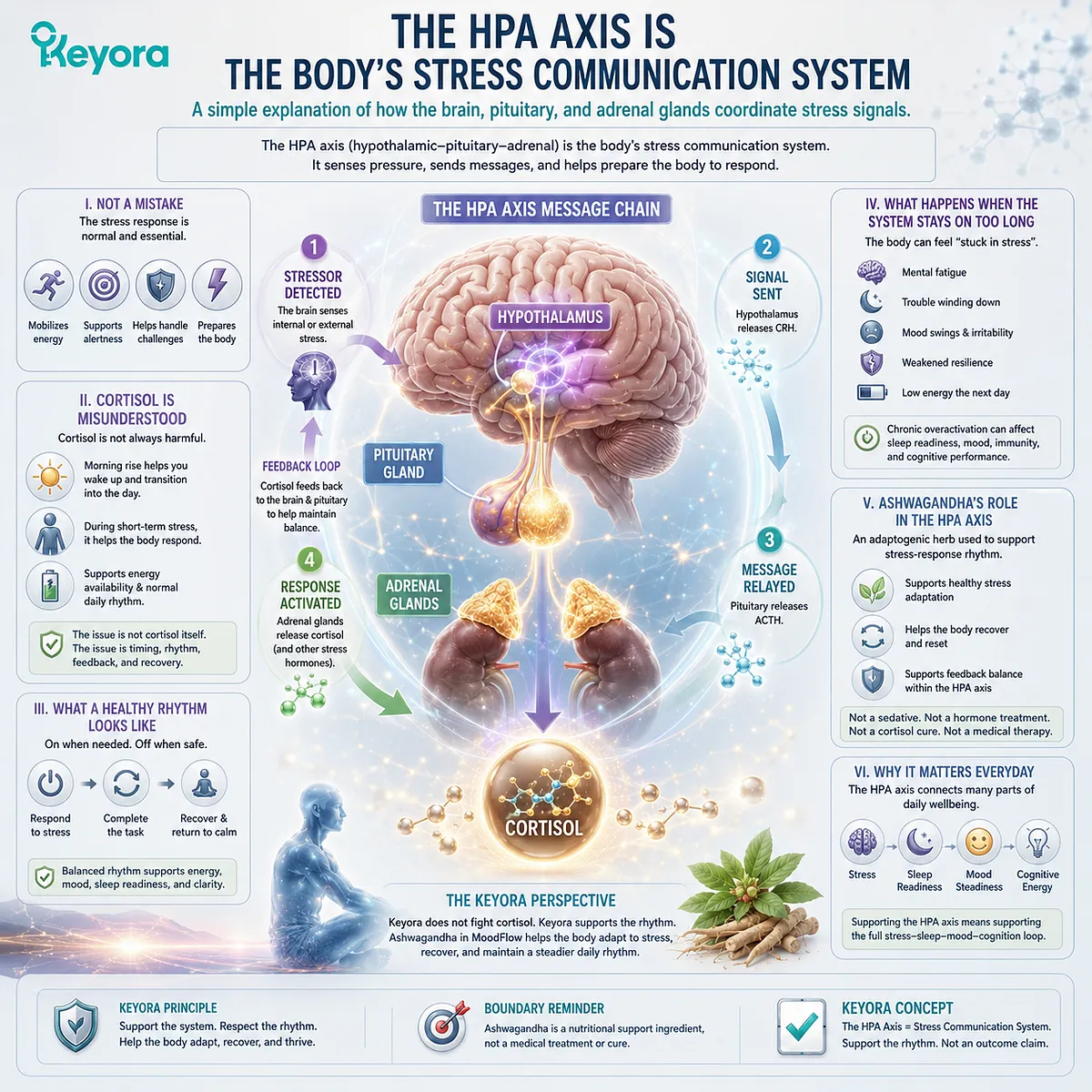
The HPA Axis Is the Body’s Stress Communication System
A simple explanation of how the brain, pituitary, and adrenal glands coordinate stress signals.
The HPA axis sounds complicated, but the basic idea is simple. It is the body’s stress communication system.
HPA stands for hypothalamic-pituitary-adrenal.
The hypothalamus is part of the brain that helps sense internal and external stress. The pituitary gland acts like a message relay. The adrenal glands help produce stress-response outputs, including cortisol.
A simple way to picture it is a message chain. The brain senses pressure, sends a signal, the pituitary passes the message along, and the adrenal glands help prepare the body to respond.
This stress response is not a mistake. It is part of normal human biology.
When you need to wake up, focus, move quickly, or handle a demanding situation, the stress-response system helps mobilize energy and alertness.
Cortisol is one of the most misunderstood parts of this story.
Many people talk about cortisol as if it is always harmful.
That is not accurate.
Cortisol helps the body stay awake, respond to challenge, regulate energy availability, and coordinate normal daily rhythm.
In the morning, a healthy cortisol rise can help the body transition into the day.
During a short-term challenge, cortisol can help the body respond.
The real issue is not that cortisol exists. The issue is timing, rhythm, feedback, and recovery.
If the stress system turns on when needed and then settles back down, the rhythm is more balanced.
If the stress system stays activated for too long, the body may feel as if it is still responding to pressure even after the pressure has passed.
That is why Keyora does not frame cortisol as an enemy. The goal is not to “kill cortisol,” but to support a healthier stress-response rhythm.
This is where Ashwagandha becomes relevant.
Ashwagandha is an adaptogenic herb, meaning it is used to support the body’s ability to adapt under stress. It is not meant to force the HPA axis in one direction.
In the Keyora MoodFlow framework, Ashwagandha helps explain stress-response feedback and recovery readiness. It supports the body’s ability to move through stress instead of staying stuck in stress.
This is different from sedation.
A sedative pushes the body toward sleepiness or heaviness.
Ashwagandha’s role in MoodFlow is not to knock the system down. Its role is to support the rhythm behind response and recovery.
For everyday users, this matters because stress is not only a feeling. Stress can affect how alert the body feels, how easily the mind winds down, how steady mood feels, and how clear thinking feels the next day.
The HPA axis sits near the center of that pattern. It helps explain why stress, sleep readiness, mood steadiness, and cognitive energy are connected.
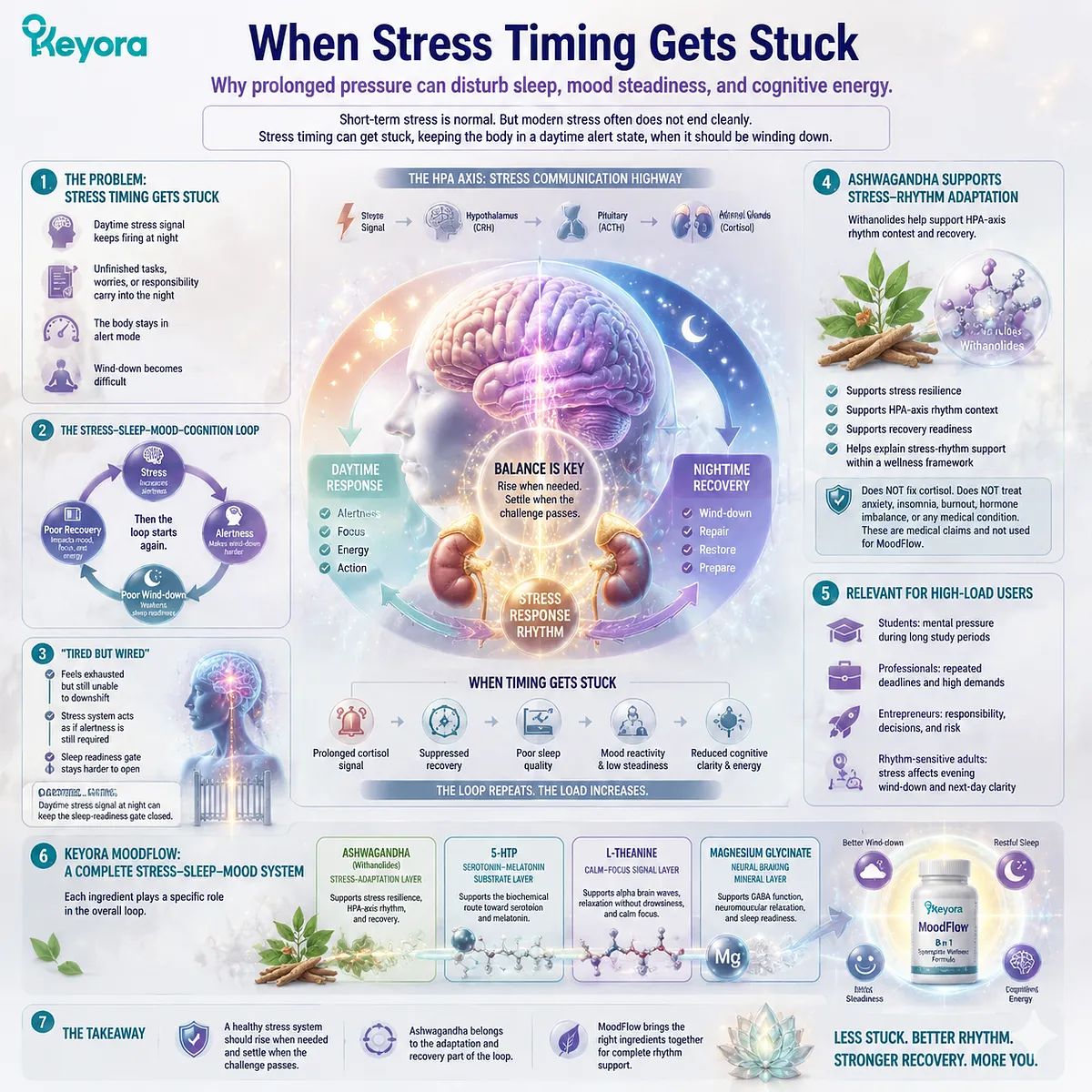
When Stress Timing Gets Stuck
Why prolonged pressure can disturb sleep, mood steadiness, and cognitive energy.
Short-term stress is normal. The body is designed to respond when something requires attention, effort, or action.
But modern stress often does not end cleanly.
-
A person may finish work but keep thinking about unfinished tasks.
-
A student may leave the exam room but continue feeling pressure.
-
An entrepreneur may stop working late at night but still carry decisions, risks, and responsibility into bed.
This is when stress timing can feel stuck. The body may still be receiving a daytime alertness signal even when the day should be winding down.
A useful way to describe this is the stress-sleep-mood-cognition loop.
-
Stress increases alertness.
-
Alertness makes wind-down harder.
-
Poor wind-down can weaken sleep readiness.
-
Poor recovery can make the next day feel more reactive, more distracted, and less steady.
Then the loop starts again.
This does not mean cortisol “causes” every sleep or mood problem. That would be too simple. But stress-response timing can help explain why some people feel tired but wired.
“Tired but wired” is the feeling of being exhausted but still unable to fully downshift. The body wants rest, but the stress system is still acting as if alertness is required.
In this state, sleep readiness may feel harder to access. The issue is not only whether the body has enough melatonin-related support. It may also be whether the internal stress-alertness signal is still too loud.
A simple phrase for this is cortisol gating. If the body is still receiving a daytime stress signal at night, the sleep-readiness gate may feel harder to open.
Ashwagandha helps support this conversation because it is connected with stress-adaptation and HPA-axis rhythm context. It helps explain how the body may support response, feedback, and recovery under everyday pressure.
This does not mean Ashwagandha “fixes cortisol.” It does not mean Ashwagandha treats anxiety, insomnia, burnout, hormone imbalance, or any medical condition. Those are medical claims and should not be used for MoodFlow.
The responsible language is more specific.
Ashwagandha supports stress resilience.
-
It supports HPA-axis rhythm context.
-
It supports recovery readiness.
-
It helps explain stress-rhythm support within a wellness framework.
This distinction protects the meaning of the ingredient.
Ashwagandha is not being used as a cortisol-blocking treatment. It is being used as an adaptogenic support layer.
For high-load users, this can be especially relevant.
-
Students may experience mental pressure during long study periods.
-
Professionals may face repeated deadlines.
-
Founders and entrepreneurs may carry responsibility across the whole day.
-
Rhythm-sensitive adults may notice that stress affects both evening wind-down and next-day clarity.
In these situations, the goal is not to erase stress. The goal is to help the body maintain a more flexible response pattern.
A healthy stress system should be able to rise when needed and settle when the challenge passes.
Ashwagandha belongs to the part of MoodFlow that supports this adaptation and recovery story.
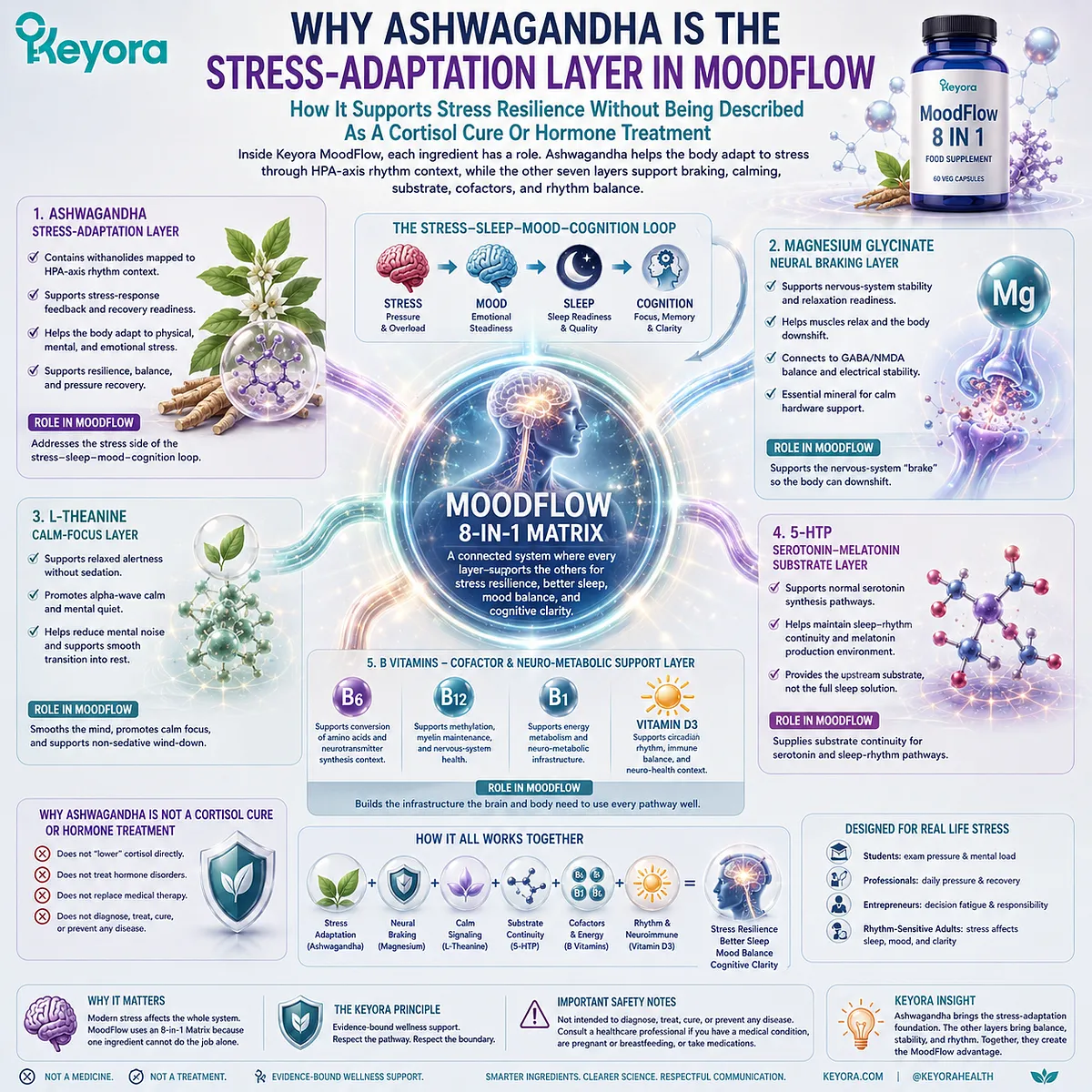
Why Ashwagandha Is the Stress-Adaptation Layer in MoodFlow
How it supports stress resilience without being described as a cortisol cure or hormone treatment.
Inside Keyora MoodFlow, Ashwagandha supports the HPA-axis stress-adaptation layer while magnesium glycinate, L-Theanine, 5-HTP, B vitamins, and Vitamin D support the surrounding braking, calming, substrate, cofactor, and rhythm layers.
This is important because the stress-sleep-mood-cognition loop is not controlled by one ingredient. It is a connected system.
-
Ashwagandha’s main role is stress adaptation.
Its active compound category, often discussed as withanolides, helps explain why Ashwagandha is mapped to HPA-axis rhythm context, stress-response feedback, and recovery readiness.
But MoodFlow does not ask Ashwagandha to do everything.
-
Magnesium glycinate supports the neural braking layer.
It helps explain nervous-system stability, relaxation readiness, and the body’s ability to downshift. If stress keeps the system electrically active, magnesium glycinate supports the “brake” side of the formula.
-
L-Theanine supports the calm-focus layer.
It helps explain relaxed alertness and non-sedative wind-down. This matters because many users do not want to feel heavy, foggy, or forced into sleepiness. They want calm clarity.
-
5-HTP supports the serotonin-melatonin substrate layer.
It helps explain normal serotonin-related pathways and sleep-rhythm continuity. But substrate support is not the same as stress adaptation. That is why Ashwagandha has a separate role.
-
B6 supports conversion context.
-
B12 supports methylation and nervous-system maintenance.
-
B1 supports neuro-metabolic energy infrastructure.
-
Vitamin D adds broader rhythm and neuroimmune context.
Together, these layers create the MoodFlow 8-in-1 Matrix.
The formula is not built around one single pathway. It is built around the reality that stress, sleep, mood, and cognition influence one another.
This is why Ashwagandha belongs in MoodFlow. It helps support the part of the system that responds to pressure and returns toward recovery.
It is especially useful as a concept for people whose main issue is not simple sleepiness, but stress-driven activation. They may feel mentally busy at night. They may feel emotionally reactive after poor recovery. They may feel that daily pressure follows them into their evening rhythm.
Ashwagandha helps explain this pattern without turning the article into a medical claim. It supports stress resilience and HPA-axis rhythm context. It does not diagnose, treat, cure, or reverse stress disorders, sleep disorders, hormone disorders, or psychiatric conditions.
That boundary is part of Keyora’s evidence-bound approach. The goal is to explain nutritional support clearly without exaggerating the role of an ingredient.
For Keyora, Ashwagandha is valuable because it gives MoodFlow a stress-adaptation foundation.
-
Magnesium glycinate helps stabilize.
-
L-Theanine helps smooth.
-
5-HTP helps supply substrate continuity.
-
B vitamins and Vitamin D support the surrounding infrastructure.
-
Ashwagandha helps the matrix speak to the stress rhythm itself.
Closing Summary
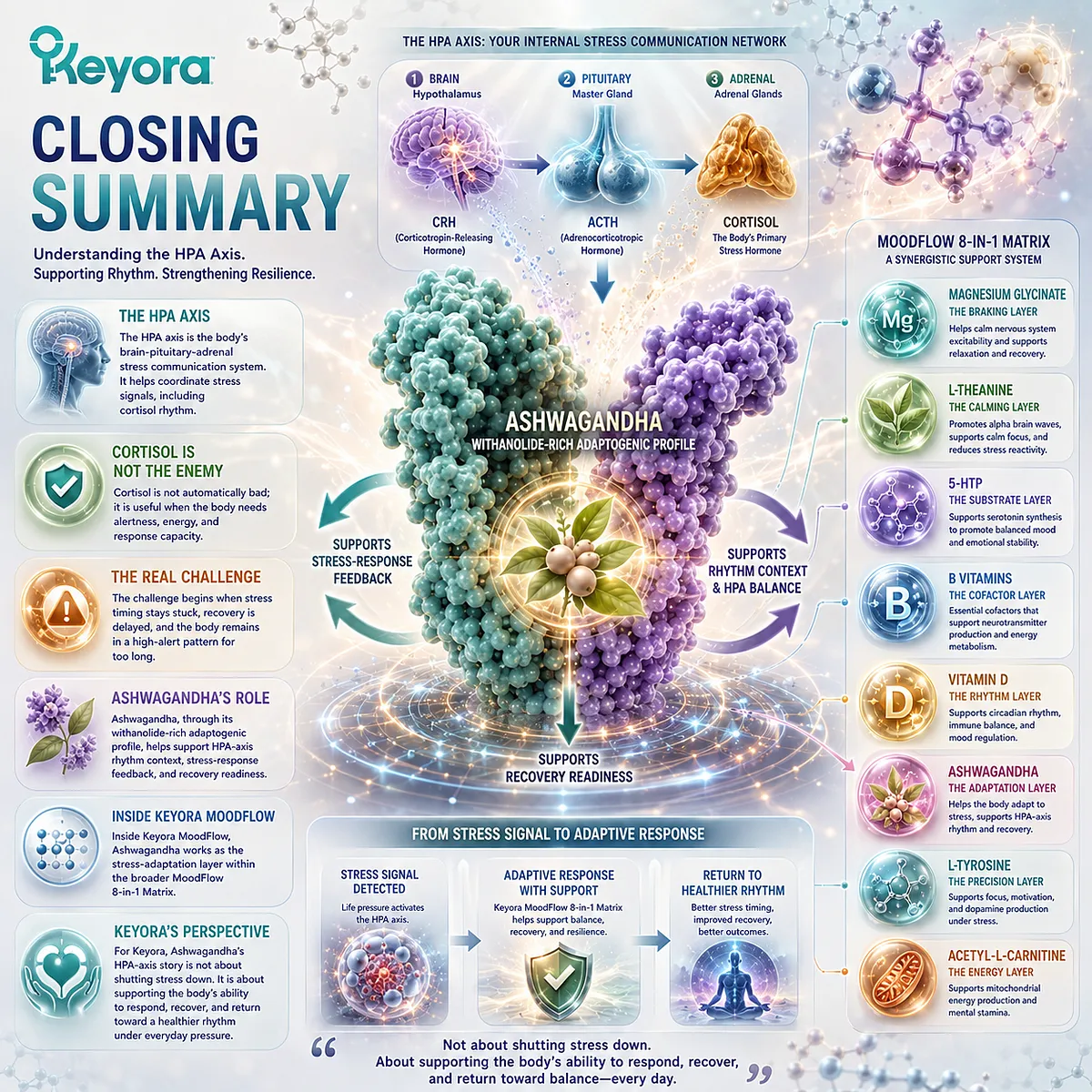
The HPA axis is the body’s brain-pituitary-adrenal stress communication system. It helps coordinate stress signals, including cortisol rhythm.
Cortisol is not automatically bad; it is useful when the body needs alertness, energy, and response capacity.
The challenge begins when stress timing stays stuck, recovery is delayed, and the body remains in a high-alert pattern for too long.
Ashwagandha, through its withanolide-rich adaptogenic profile, helps support HPA-axis rhythm context, stress-response feedback, and recovery readiness.
Inside Keyora MoodFlow, Ashwagandha works as the stress-adaptation layer within the broader MoodFlow 8-in-1 Matrix.
Magnesium glycinate, L-Theanine, 5-HTP, B vitamins, and Vitamin D provide the surrounding braking, calming, substrate, cofactor, and rhythm layers.
For Keyora, Ashwagandha’s HPA-axis story is not about shutting stress down. It is about supporting the body’s ability to respond, recover, and return toward a healthier rhythm under everyday pressure.
This article is for educational and informational purposes only. It does not provide medical advice, diagnosis, treatment, cure, prevention, disease outcome claims, hormone restoration claims, fertility outcome claims, or formula-specific clinical efficacy claims.