
How Do I Read the Astaxanthin Dose on a Supplement Label?
Keyora Research Q&A Library
This is part of the Keyora Research Q&A Series, derived from Keyora Astaxanthin Research Journal Series.
Within the Keyora Astaxanthin Researcn framework, this Q&A translates complex astaxanthin biology into reader-friendly, evidence-bound answers, focusing on natural astaxanthin identity, molecular structure, antioxidant and redox mechanisms, membrane lipid interaction, mitochondrial resilience, inflammatory signaling pathways, human evidence interpretation, and the scientific principles behind responsible supplementation.
First published by Keyora Research Journal: www.keyorahealth.com
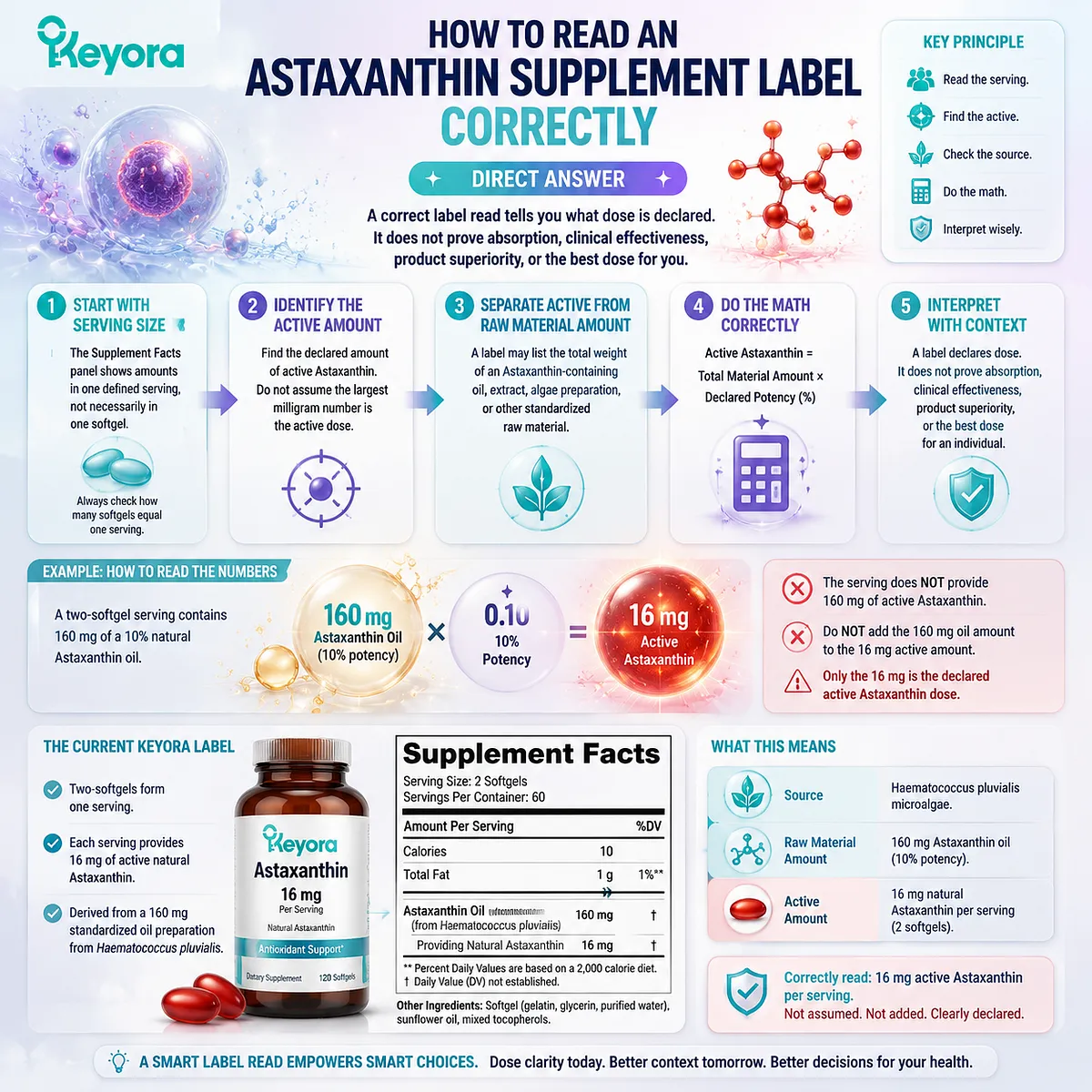
Direct Answer
To read an Astaxanthin supplement label correctly, begin with the serving size.
The quantities in the Supplement Facts panel normally describe the amount in one defined serving, not necessarily the amount in one softgel or capsule.
Next, identify the declared amount of active Astaxanthin. Do not assume that the largest milligram number is the active dose.
A label may separately list the total weight of an Astaxanthin-containing oil, extract, algae preparation, or other standardized raw material.
For example, a two-softgel serving containing 160 mg of a 10% natural Astaxanthin oil provides:
160 mg × 0.10 = 16 mg active Astaxanthin
The serving does not provide 160 mg of active Astaxanthin, and the 160 mg oil amount should not be added to the 16 mg active amount.
The current Keyora label uses this structure: two softgels form one serving, and that serving provides 16 mg of active natural Astaxanthin from a 160 mg standardized oil preparation derived from Haematococcus pluvialis.
A correctly read label tells you what dose is declared. It does not by itself prove absorption, clinical effectiveness, product superiority, or the best dose for an individual.
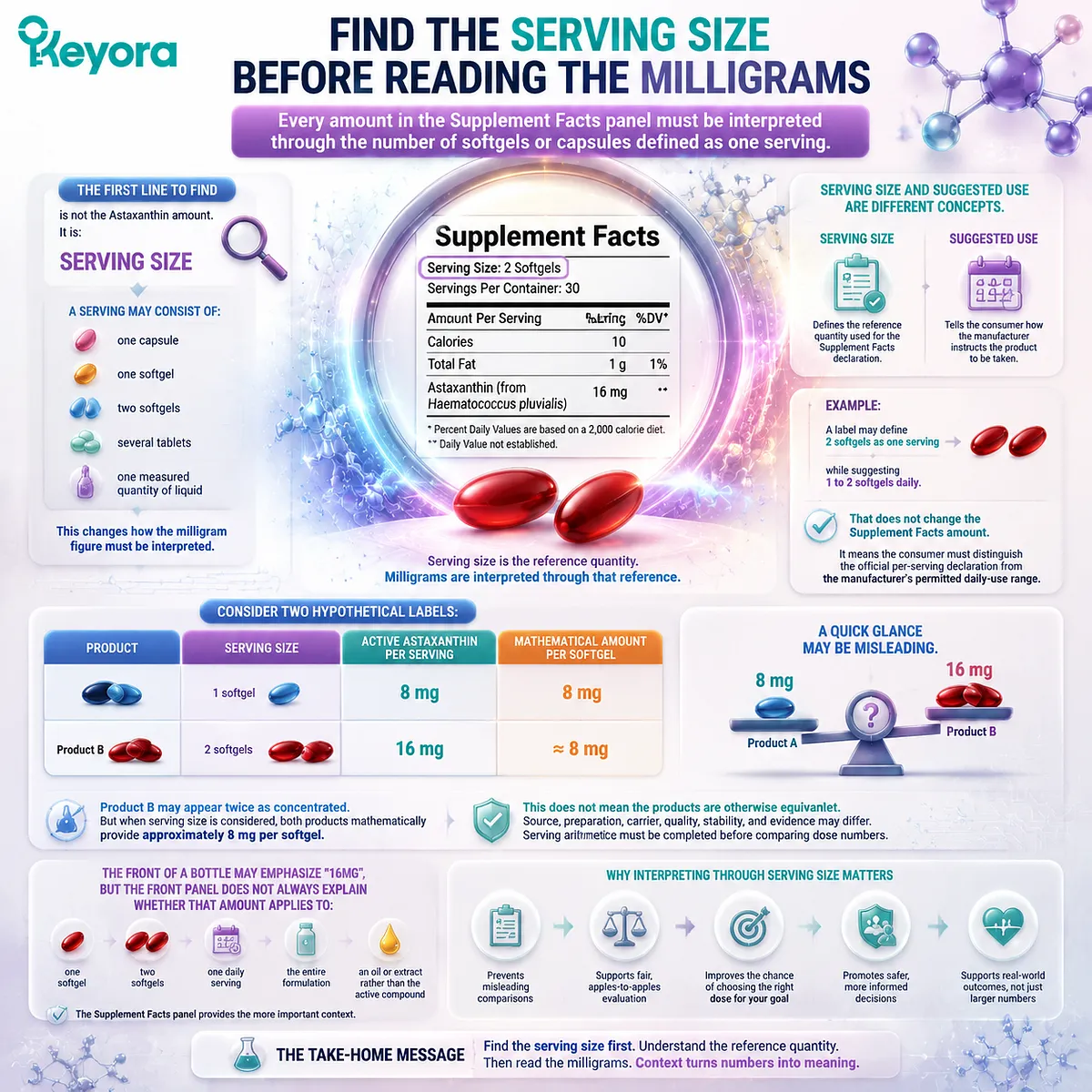
Find the Serving Size Before Reading the Milligrams
Every amount in the Supplement Facts panel must be interpreted through the number of softgels or capsules defined as one serving
The first line to find is not the Astaxanthin amount. It is:
Serving Size
A serving may consist of:
-
one capsule
-
one softgel
-
two softgels
-
several tablets
-
one measured quantity of liquid
This changes how the milligram figure must be interpreted.
Consider two hypothetical labels:
ProductServing SizeActive Astaxanthin per ServingMathematical Amount per SoftgelProduct A1 softgel8 mg8 mgProduct B2 softgels16 mgapproximately 8 mg
A quick glance may make Product B appear twice as concentrated. However, once the serving size is considered, both products mathematically provide approximately 8 mg per softgel.
This does not mean the products are otherwise equivalent. Their source, preparation, carrier, quality controls, stability, and evidence may differ. It only demonstrates why serving arithmetic must be completed before comparing dose numbers.
The front of a bottle may emphasize “16MG,” but the front panel does not always explain whether that amount applies to:
-
one softgel
-
two softgels
-
one daily serving
-
the entire formulation
-
an oil or extract rather than the active compound
The Supplement Facts panel provides the more important context.
Serving size and suggested use are also different concepts.
Serving size defines the reference quantity used for the Supplement Facts declaration. Suggested use tells the consumer how the manufacturer instructs the product to be taken. A label may define two softgels as one serving while suggesting one to two softgels daily.
That does not cause the Supplement Facts amount to change. It means the consumer must distinguish the official per-serving declaration from the manufacturer’s permitted daily-use range.
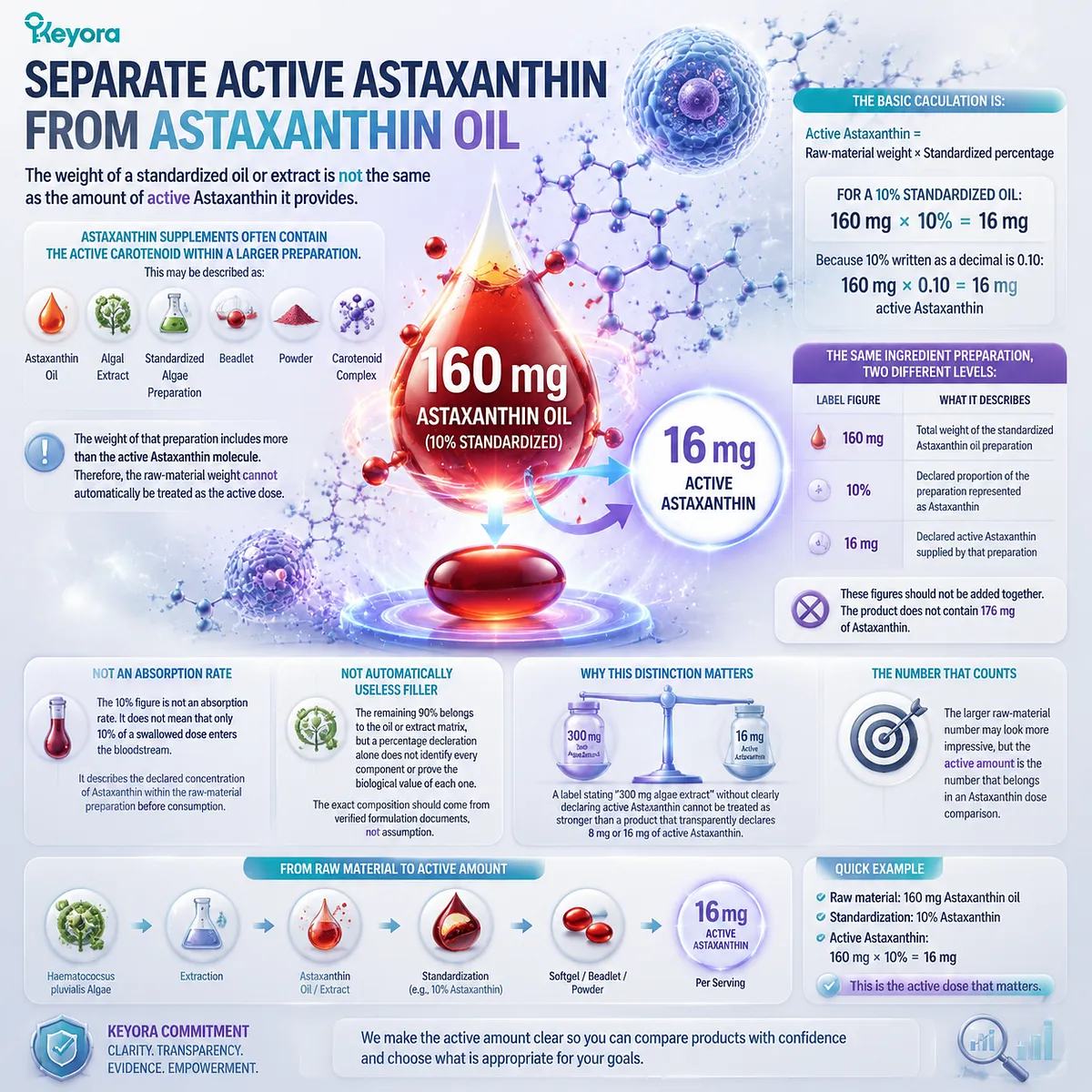
Separate Active Astaxanthin From Astaxanthin Oil
The weight of a standardized oil or extract is not the same as the amount of active Astaxanthin it provides
Astaxanthin supplements often contain the active carotenoid within a larger preparation. This may be described as:
-
Astaxanthin oil
-
algal extract
-
standardized algae preparation
-
beadlet
-
powder
-
carotenoid complex
The weight of that preparation includes more than the active Astaxanthin molecule. Therefore, the raw-material weight cannot automatically be treated as the active dose.
The basic calculation is:
Active Astaxanthin = Raw-material weight × Standardized percentage
For a 10% standardized oil:
160 mg × 10% = 16 mg
Because 10% written as a decimal is 0.10:
160 mg × 0.10 = 16 mg active Astaxanthin
The 160 mg and 16 mg figures describe the same ingredient preparation at two different levels:
Label FigureWhat It Describes160 mgTotal weight of the standardized Astaxanthin oil preparation10%Declared proportion of the preparation represented as Astaxanthin16 mgDeclared active Astaxanthin supplied by that preparation
These figures should not be added together. The product does not contain 176 mg of Astaxanthin.
The 10% figure is also not an absorption rate. It does not mean that only 10% of a swallowed dose enters the bloodstream. It describes the declared concentration of Astaxanthin within the raw-material preparation before consumption.
Nor does 10% mean that the remaining 90% is automatically useless filler. The remainder belongs to the oil or extract matrix, but a percentage declaration alone does not identify every component or prove the biological value of each one. The exact composition should come from verified formulation documents rather than assumption.
This distinction is central to comparing products. A label stating “300 mg algae extract” without clearly declaring active Astaxanthin cannot be treated as stronger than a product that transparently declares 8 mg or 16 mg of active Astaxanthin.
The larger raw-material number may look more impressive, but the active amount is the number that belongs in an Astaxanthin dose comparison.
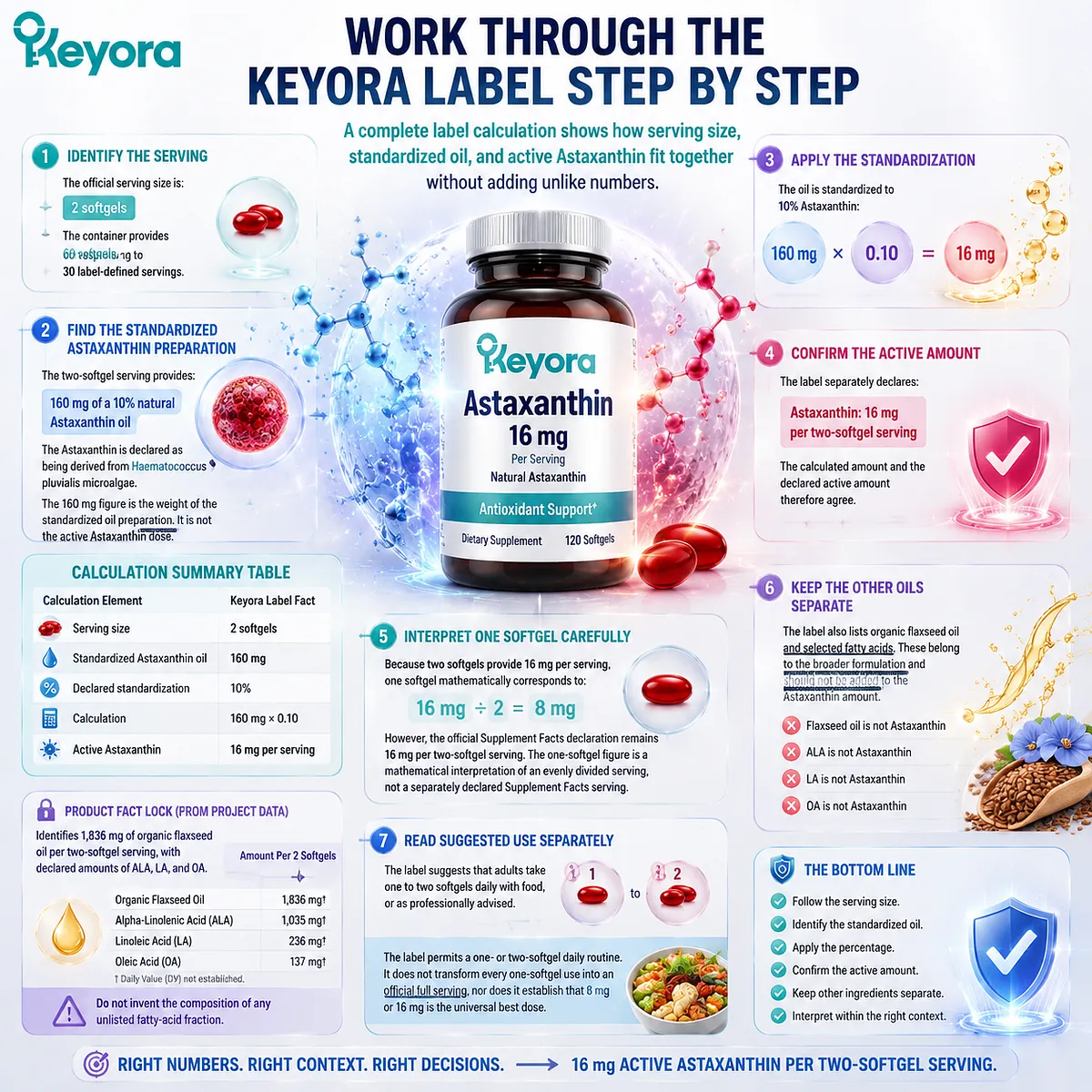
Work Through the Keyora Label Step by Step
A complete label calculation shows how serving size, standardized oil, and active Astaxanthin fit together without adding unlike numbers
The Keyora label can be read through the Keyora Label-to-Active-Dose Calculation.
Step 1: Identify the serving
The official serving size is:
2 softgels
The container provides 60 softgels, corresponding to 30 label-defined servings.
Step 2: Find the standardized Astaxanthin preparation
The two-softgel serving provides:
160 mg of a 10% natural Astaxanthin oil
The Astaxanthin is declared as being derived from Haematococcus pluvialis microalgae.
The 160 mg figure is the weight of the standardized oil preparation. It is not the active Astaxanthin dose.
Step 3: Apply the standardization
The oil is standardized to 10% Astaxanthin:
160 mg × 0.10 = 16 mg
Step 4: Confirm the active amount
The label separately declares:
Astaxanthin: 16 mg per two-softgel serving
The calculated amount and the declared active amount therefore agree.
Calculation ElementKeyora Label FactServing size2 softgelsStandardized Astaxanthin oil160 mgDeclared standardization10%Calculation160 mg × 0.10Active Astaxanthin16 mg per serving
Step 5: Interpret one softgel carefully
Because two softgels provide 16 mg per serving, one softgel mathematically corresponds to approximately:
16 mg ÷ 2 = 8 mg
However, the official Supplement Facts declaration remains 16 mg per two-softgel serving. The one-softgel figure is a mathematical interpretation of an evenly divided serving, not a separately declared Supplement Facts serving.
Step 6: Keep the other oils separate
The label also lists organic flaxseed oil and selected fatty acids, including alpha-linolenic acid, linoleic acid, and oleic acid. These belong to the broader formulation and should not be added to the Astaxanthin amount.
For example:
-
flaxseed oil is not Astaxanthin
-
ALA is not Astaxanthin
-
LA is not Astaxanthin
-
OA is not Astaxanthin
The project’s product fact lock identifies 1,836 mg of organic flaxseed oil per two-softgel serving, with declared amounts of ALA, LA, and OA. It also warns against inventing the composition of any unlisted fatty-acid fraction.
Step 7: Read suggested use separately
The label suggests that adults take one to two softgels daily with food, or as professionally advised.
This means the label permits a one- or two-softgel daily routine. It does not transform every one-softgel use into an official full serving, nor does it establish that 8 mg or 16 mg is the universal best dose.
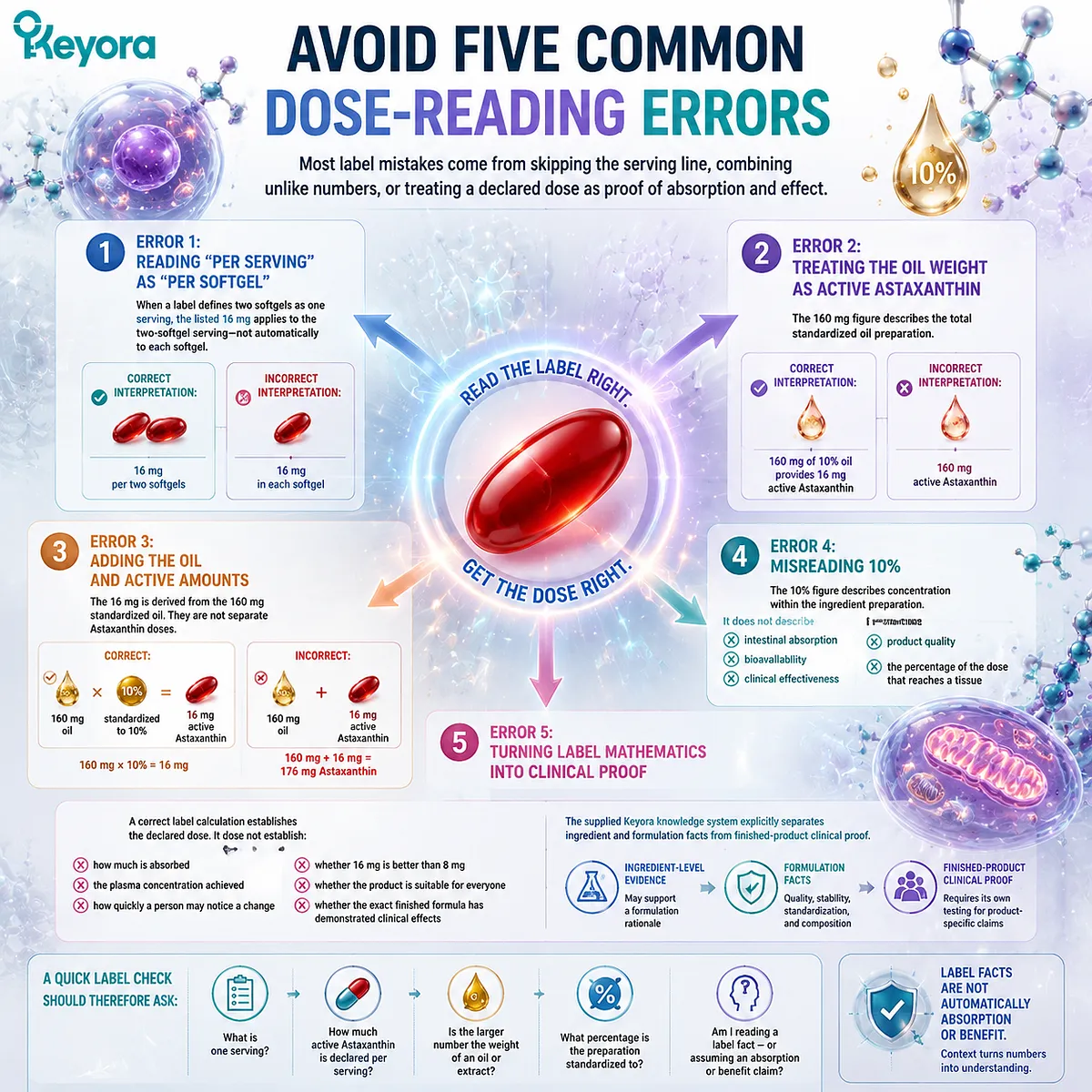
Avoid Five Common Dose-Reading Errors
Most label mistakes come from skipping the serving line, combining unlike numbers, or treating a declared dose as proof of absorption and effect
Error 1: Reading “per serving” as “per softgel”
When a label defines two softgels as one serving, the listed 16 mg applies to the two-softgel serving—not automatically to each softgel.
Correct interpretation:
16 mg per two softgels
Incorrect interpretation:
16 mg in each softgel
Error 2: Treating the oil weight as active Astaxanthin
The 160 mg figure describes the total standardized oil preparation.
Correct interpretation:
160 mg of 10% oil provides 16 mg active Astaxanthin
Incorrect interpretation:
160 mg active Astaxanthin
Error 3: Adding the oil and active amounts
The 16 mg is derived from the 160 mg standardized oil. They are not separate Astaxanthin doses.
Correct:
160 mg × 10% = 16 mg
Incorrect:
160 mg + 16 mg = 176 mg Astaxanthin
Error 4: Misreading 10%
The 10% figure describes concentration within the ingredient preparation.
It does not describe:
-
intestinal absorption
-
bioavailability
-
clinical effectiveness
-
product quality
-
the percentage of the dose that reaches a tissue
Error 5: Turning label mathematics into clinical proof
A correct label calculation establishes the declared dose. It does not establish:
-
how much is absorbed
-
the plasma concentration achieved
-
how quickly a person may notice a change
-
whether 16 mg is better than 8 mg
-
whether the product is suitable for everyone
-
whether the exact finished formula has demonstrated clinical effects
The supplied Keyora knowledge system explicitly separates ingredient and formulation facts from finished-product clinical proof. Ingredient-level evidence may support a formulation rationale, but the exact complete product requires its own testing for product-specific pharmacokinetic or clinical claims.
A quick label check should therefore ask:
-
What is one serving?
-
How much active Astaxanthin is declared per serving?
-
Is the larger number the weight of an oil or extract?
-
What percentage is the preparation standardized to?
-
Am I reading a label fact – or assuming an absorption or benefit claim?
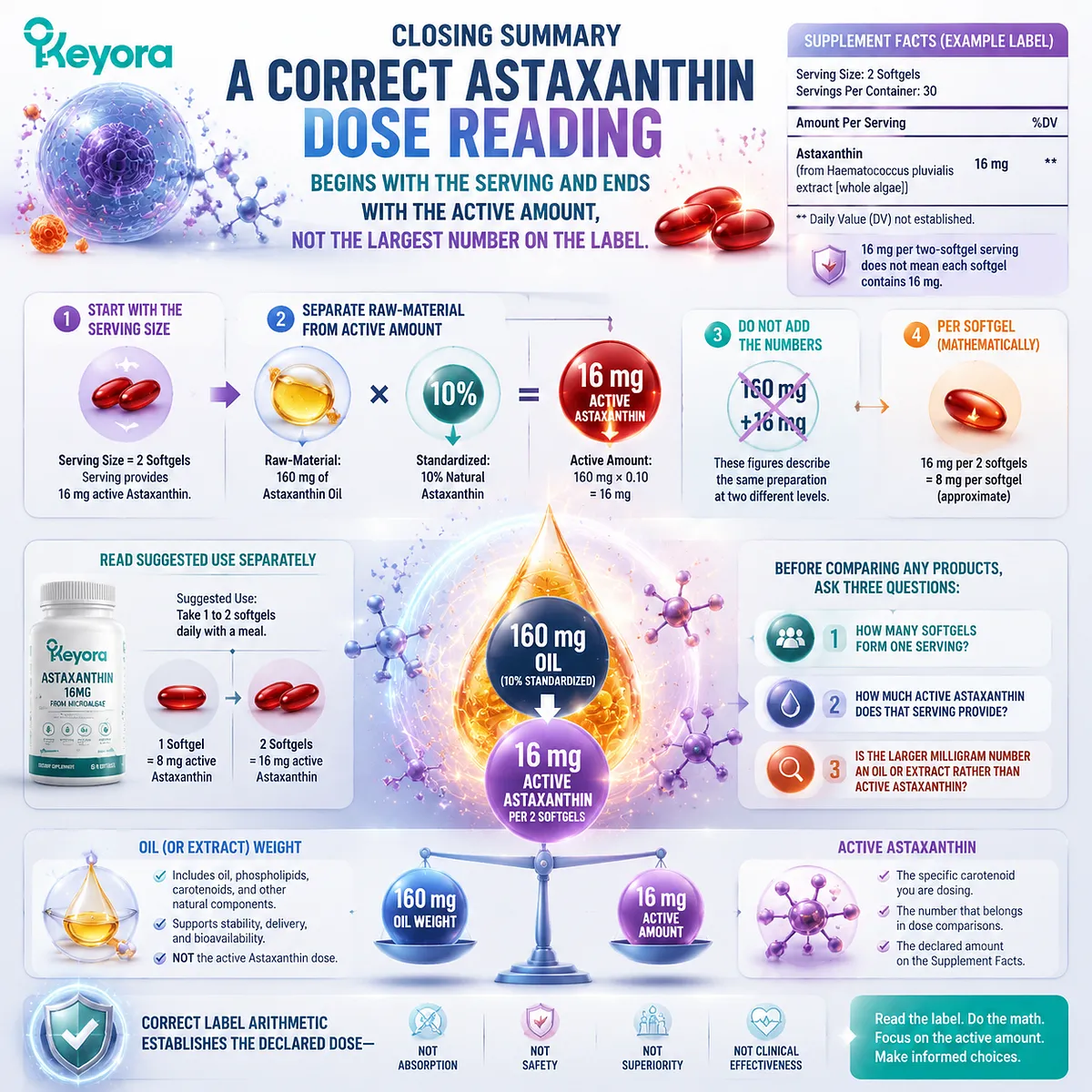
Closing Summary
A correct Astaxanthin dose reading begins with the serving and ends with the active amount, not the largest number on the label
Start with the serving size. A label stating 16 mg per two-softgel serving does not mean that each softgel contains 16 mg.
Next, separate the standardized raw-material weight from active Astaxanthin. In the Keyora label calculation:
160 mg of a 10% natural Astaxanthin oil × 0.10 = 16 mg active Astaxanthin
The 160 mg oil amount is not 160 mg of active Astaxanthin, and it should not be added to the 16 mg figure.
One softgel mathematically corresponds to approximately 8 mg, while the official Supplement Facts declaration remains 16 mg per two-softgel serving.
Suggested use and serving size must also be read separately. The label may permit one to two softgels daily without declaring both amounts as separate full servings.
Before comparing any Astaxanthin products, ask three questions:
-
How many softgels form one serving?
-
How much active Astaxanthin does that serving provide?
-
Is the larger milligram number an oil or extract rather than active Astaxanthin?
Correct label arithmetic establishes the declared dose – not absorption, safety, superiority, or clinical effectiveness.
This article is for educational and informational purposes only. It does not provide medical advice, diagnosis, treatment, cure, prevention, disease outcome claims, hormone restoration claims, fertility outcome claims, or formula-specific clinical efficacy claims.