
How Do I Choose a Natural Astaxanthin Supplement With Reliable Evidence?
Keyora Research Q&A Library
This is part of the Keyora Research Q&A Series, derived from Keyora Nutritional Neurology Series .
Within the Keyora Nutritional Neurology framework, this Q&A translates complex nutrient–brain mechanisms into reader-friendly, evidence-bound answers, focusing on stress resilience, sleep quality, calm mood support, cognitive wellness, and the broader interaction between nutrition, neurochemistry, and daily nervous-system function.
First published by Keyora Research Journal: www.keyorahealth.com

Direct Answer
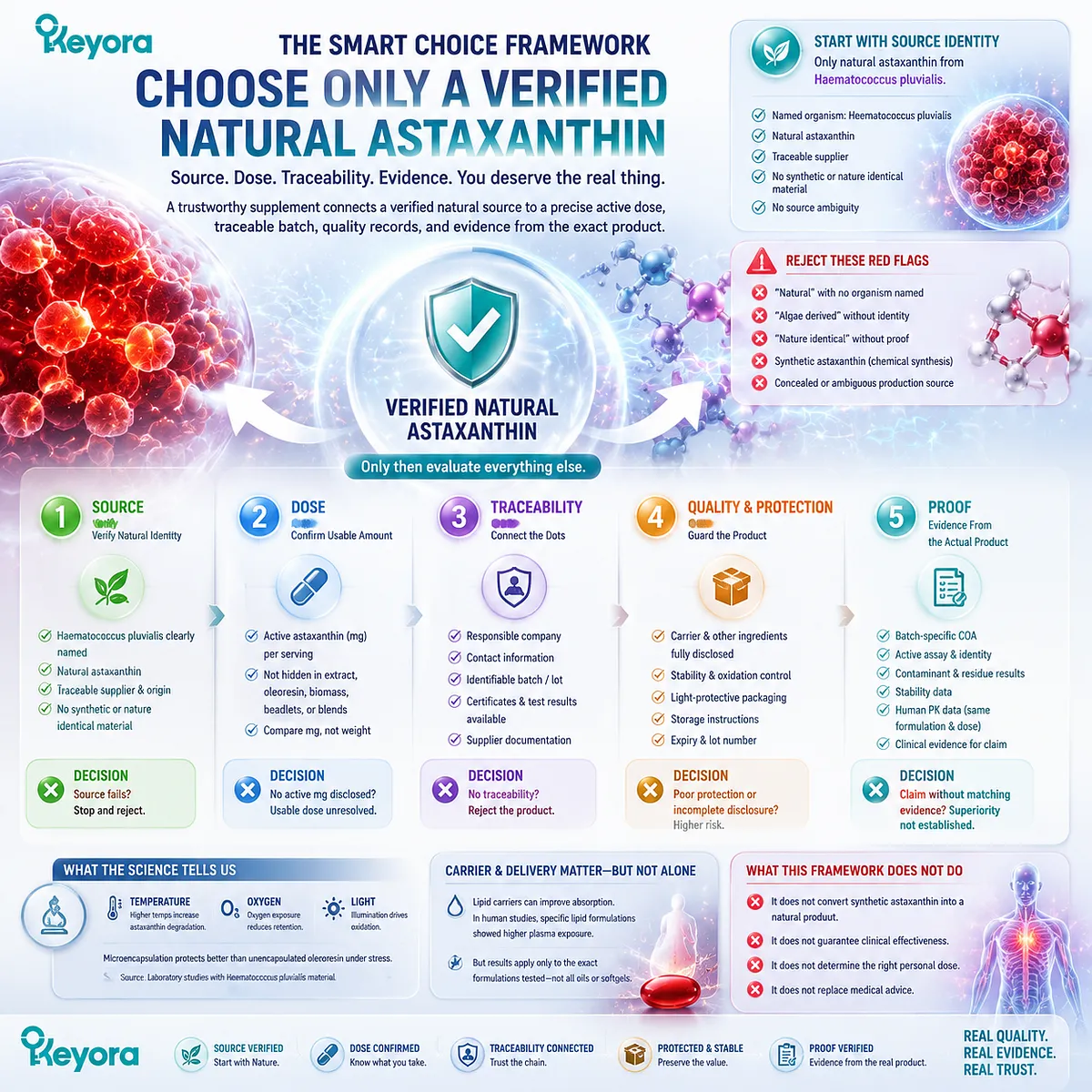
Choose only a natural astaxanthin supplement that positively identifies Haematococcus pluvialis, clearly states the active astaxanthin amount per serving, and connects the product to a traceable supplier, responsible company, identifiable batch, and accessible quality records.
Begin with source identity. The words natural, algae derived, 3S,3′S, esterified, high purity, or clinically studied cannot prove natural origin by themselves.
Conventional synthetic astaxanthin has a different commercial profile and commonly contains three principal stereoisomers in an approximate 1:2:1 distribution.
A product that confirms synthetic material, conceals its production source, or uses nature identical language without verifiable biological evidence should be rejected.
Next, confirm the usable dose. Compare active astaxanthin in milligrams per serving, not the larger weight of algae biomass, extract, oleoresin, beadlets, total carotenoids, or a proprietary blend.
FDA labeling guidance requires serving size and quantitative amounts per serving, but a compliant label does not independently prove natural identity, batch accuracy, or clinical effectiveness.
Then evaluate batch testing, carrier and other ingredients, packaging, storage, and research connected to the material actually sold.
Formulation may influence exposure, but an oil or softgel does not automatically prove superior absorption or benefit.
Finally, assess personal suitability separately from product quality.
Synthetic astaxanthin and source ambiguous astaxanthin should never enter the human supplement shortlist.
Begin With a Verified Natural Source and a Clear Active Dose
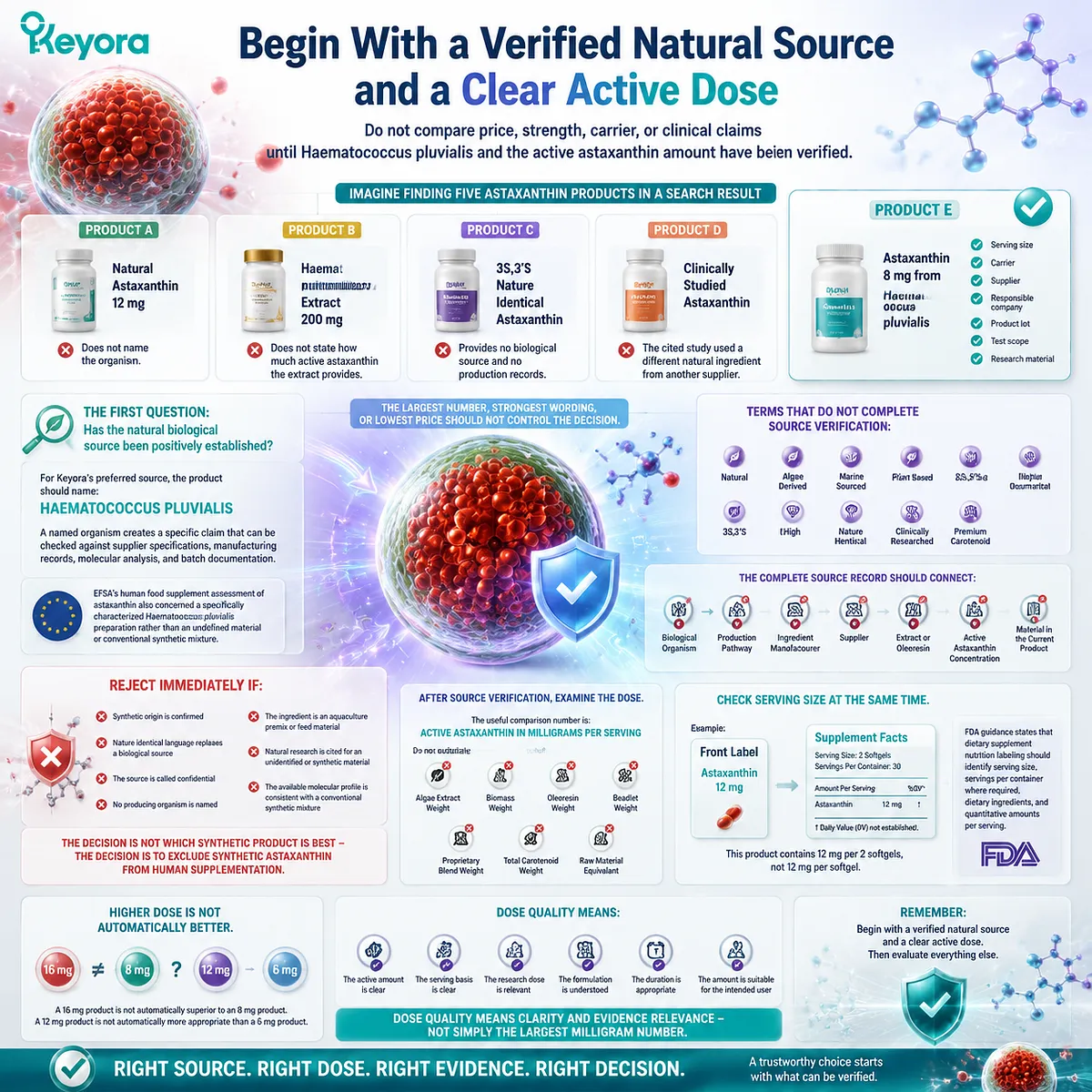
Do not compare price, strength, carrier, or clinical claims until Haematococcus pluvialis and the active astaxanthin amount have been verified
Imagine finding five astaxanthin products in a search result.
Product A says:
Natural Astaxanthin 12 mg
It does not name the organism.
Product B says:
Haematococcus pluvialis Extract 200 mg
It does not state how much active astaxanthin the extract provides.
Product C says:
3S,3′S Nature Identical Astaxanthin
It provides no biological source and no production records.
Product D says:
Clinically Studied Astaxanthin
The cited study used a different natural ingredient from another supplier.
Product E states:
Astaxanthin 8 mg from Haematococcus pluvialis
It also identifies the serving size, carrier, supplier, responsible company, product lot, test scope, and research material.
The largest number, strongest wording, or lowest price should not control the decision.
The first question is:
Has the natural biological source been positively established?
For Keyora’s preferred source, the product should name:
Haematococcus pluvialis
A named organism creates a specific claim that can be checked against supplier specifications, manufacturing records, molecular analysis, and batch documentation. EFSA’s human food supplement assessment of astaxanthin also concerned a specifically characterized Haematococcus pluvialis preparation rather than an undefined material or conventional synthetic mixture.
The following terms do not complete source verification:
-
natural
-
algae derived
-
marine sourced
-
plant based
-
3S,3′S
-
esterified
-
high purity
-
nature identical
-
clinically researched
-
premium carotenoid
A product should positively prove its biological origin rather than merely avoid the word synthetic.
The complete source record should connect:
-
the biological organism
-
the production pathway
-
the ingredient manufacturer
-
the supplier
-
the extract or oleoresin
-
the active astaxanthin concentration
-
the material placed in the current product
Synthetic astaxanthin must be excluded before any other product comparison begins.
Conventional synthetic astaxanthin is commonly characterized by an approximate 1:2:1 stereoisomer distribution involving 3S,3′S, the meso form, and 3R,3′R. This means that the presence of some 3S,3′S cannot authenticate a complete material as natural.
A product should be rejected immediately when:
-
synthetic origin is confirmed
-
nature identical language replaces a biological source
-
the source is called confidential
-
no producing organism is named
-
the ingredient is an aquaculture premix or feed material
-
natural research is cited for an unidentified or synthetic material
-
the available molecular profile is consistent with a conventional synthetic mixture
The decision is not which synthetic product is best – the decision is to exclude synthetic astaxanthin from human supplementation
After source verification, examine the dose.
The useful comparison number is:
Active astaxanthin in milligrams per serving
Do not substitute:
-
algae extract weight
-
biomass weight
-
oleoresin weight
-
beadlet weight
-
proprietary blend weight
-
total carotenoid weight
-
raw material equivalent
For example:
Haematococcus pluvialis extract 120 mg
does not tell the consumer how much astaxanthin is present.
A clearer label would state:
Astaxanthin 8 mg from Haematococcus pluvialis extract
Serving size must be checked at the same time.
A front label may display 12 mg, while the Supplement Facts panel defines one serving as two softgels. In that case, the product contains 12 mg per two softgels, not 12 mg per softgel.
FDA guidance states that dietary supplement nutrition labeling should identify serving size, servings per container where required, dietary ingredients, and quantitative amounts per serving. FDA also identifies the ingredient list and responsible manufacturer, packer, or distributor among the core label statements.
A dose cannot be compared until it is expressed on the same basis:
-
per capsule
-
per softgel
-
per serving
-
per labeled day
Higher dose is not automatically better.
A 16 mg product is not automatically superior to an 8 mg product. A 12 mg product is not automatically more appropriate than a 6 mg product.
Dose quality means:
-
the active amount is clear
-
the serving basis is clear
-
the research dose is relevant
-
the formulation is understood
-
the duration is appropriate
-
the amount is suitable for the intended user
Dose quality means clarity and evidence relevance – not simply the largest milligram number
Batch Quality and Evidence Must Match the Product Being Sold
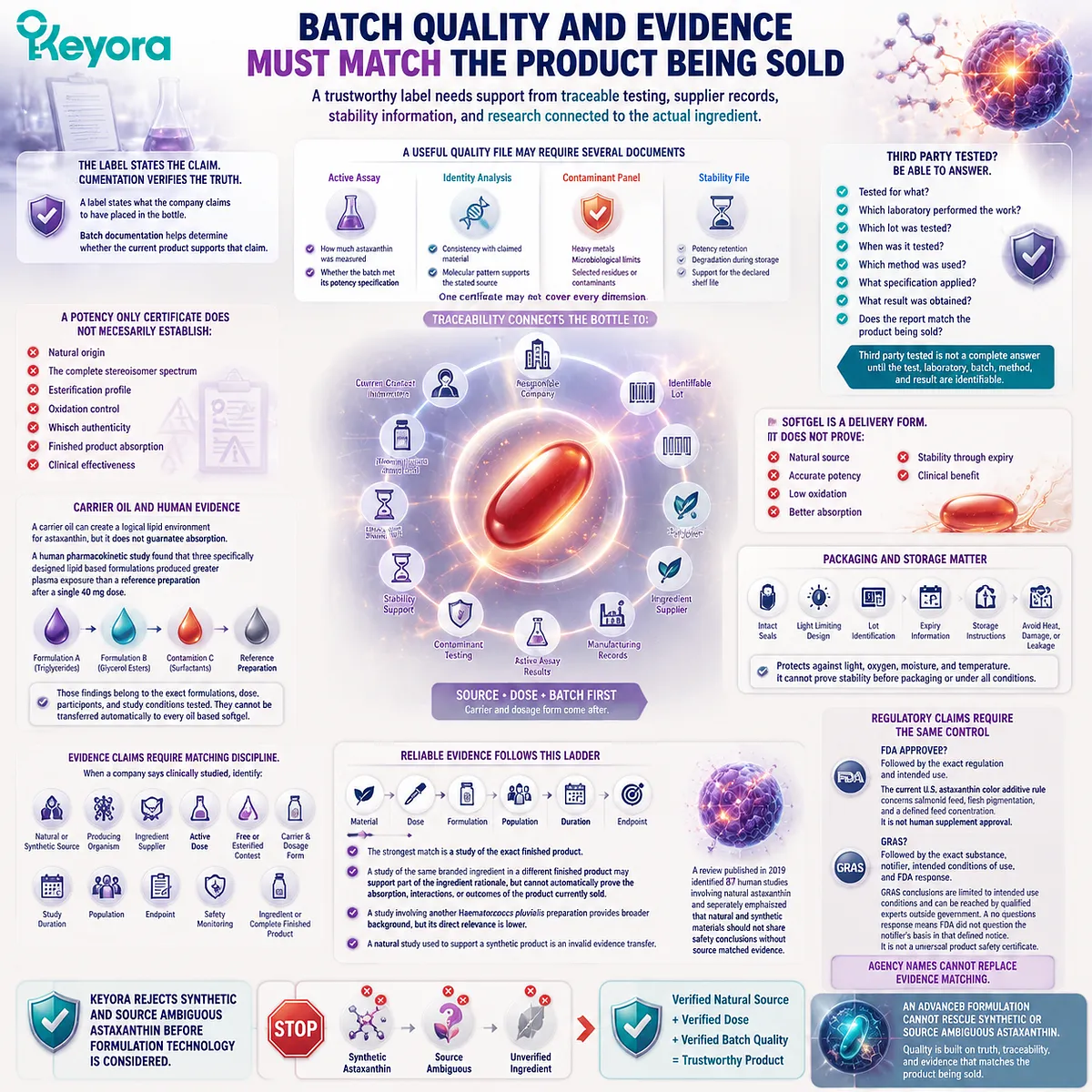
A trustworthy label needs support from traceable testing, supplier records, stability information, and research connected to the actual ingredient
A label states what the company claims to have placed in the bottle.
Batch documentation helps determine whether the current product supports that claim.
A useful quality file may require several documents rather than one universal certificate.
An active assay can address:
-
how much astaxanthin was measured
-
whether the batch met its potency specification
An identity analysis can address:
-
whether the ingredient profile is consistent with the claimed material
-
whether the molecular pattern supports the stated source
A contaminant panel can address:
-
heavy metals
-
microbiological limits
-
selected residues or contaminants
A stability file can address:
-
potency retention
-
degradation during storage
-
support for the declared shelf life
One certificate may not cover every dimension.
A brand that says third party tested should be able to answer:
-
Tested for what?
-
Which laboratory performed the work?
-
Which lot was tested?
-
When was it tested?
-
Which method was used?
-
What specification applied?
-
What result was obtained?
-
Does the report match the product being sold?
Third party tested is not a complete answer until the test, laboratory, batch, method, and result are identifiable
A potency only certificate does not necessarily establish:
-
natural origin
-
the complete stereoisomer spectrum
-
esterification profile
-
oxidation control
-
supplier authenticity
-
finished product absorption
-
clinical effectiveness
Traceability should connect the bottle to:
-
a responsible company
-
current contact information
-
an identifiable lot
-
the ingredient supplier
-
manufacturing records
-
active assay results
-
contaminant testing
-
stability support
-
the formulation on the label
The carrier and dosage form should be evaluated only after the source, dose, and batch have passed.
A carrier oil may provide a logical lipid environment for astaxanthin, but it does not guarantee absorption. A human pharmacokinetic study found that three specifically designed lipid based formulations produced greater plasma exposure than a reference preparation after a single 40 mg dose. Those findings belong to the exact formulations, dose, participants, and study conditions tested. They cannot be transferred automatically to every oil based softgel.
Softgel is a delivery form.
It does not prove:
-
natural source
-
accurate potency
-
low oxidation
-
better absorption
-
stability through expiry
-
clinical benefit
Packaging should also be reviewed for:
-
intact seals
-
light limiting design
-
lot identification
-
expiry information
-
storage instructions
-
damage, leakage, or heat exposure
Formulation can support a verified natural ingredient.
It cannot transform the wrong ingredient into the right one.
An advanced formulation cannot rescue synthetic or source ambiguous astaxanthin
Evidence claims require the same matching discipline.
When a company says clinically studied, identify:
-
natural or synthetic source
-
producing organism
-
ingredient supplier
-
active dose
-
free or esterified context
-
carrier and dosage form
-
study duration
-
population
-
endpoint
-
safety monitoring
-
ingredient or complete finished product
Reliable evidence follows:
Material – dose – formulation – population – duration – endpoint
The strongest match is a study of the exact finished product.
A study of the same branded ingredient in a different finished product may support part of the ingredient rationale, but it cannot automatically prove the absorption, interactions, or outcomes of the product currently sold.
A study involving another Haematococcus pluvialis preparation provides broader background, but its direct relevance is lower.
A natural study used to support a synthetic product is an invalid evidence transfer.
A review published in 2019 identified 87 human studies involving natural astaxanthin and separately emphasized that natural and synthetic materials should not share safety conclusions without source matched evidence.
Regulatory claims require similar control.
FDA approved should be followed by the exact regulation and intended use. The current United States astaxanthin color additive rule concerns salmonid feed, flesh pigmentation, and a defined feed concentration. It is not human supplement approval.
GRAS should be followed by the exact substance, notifier, intended conditions of use, and FDA response. FDA explains that GRAS conclusions remain limited to intended use conditions and can be reached by qualified experts outside government. A no questions response means FDA did not question the notifier’s basis in that defined notice. It is not a universal product safety certificate.
Agency names cannot replace evidence matching.
Use the Source – Dose – Batch – Evidence – Fit Check
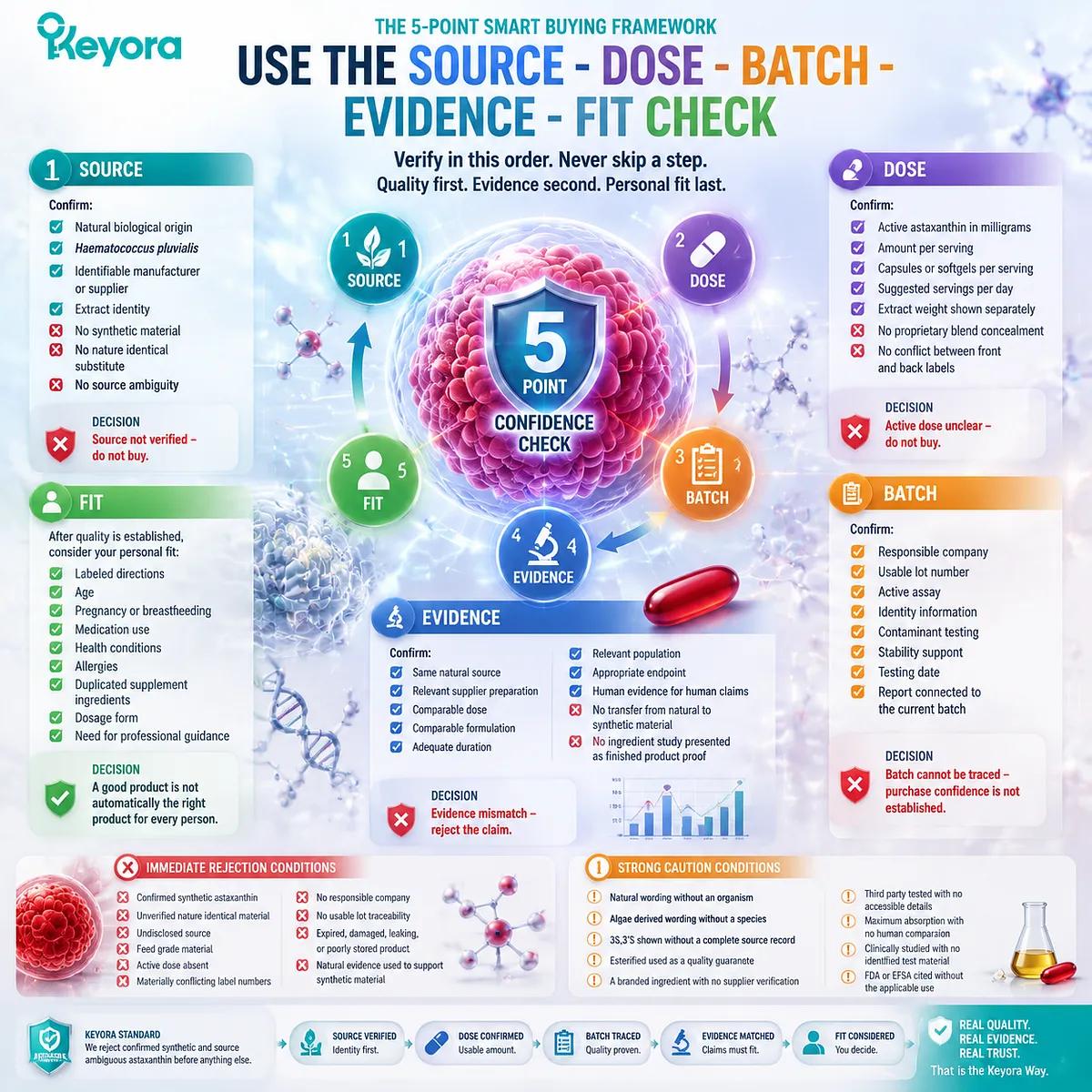
A reliable buying decision should verify ingredient identity, usable dose, batch quality, evidence relevance, and personal suitability in that order
Use the Source – Dose – Batch – Evidence – Fit Check before purchasing.
1. Source
Confirm:
-
natural biological origin
-
Haematococcus pluvialis
-
identifiable manufacturer or supplier
-
extract identity
-
no synthetic material
-
no nature identical substitute
-
no source ambiguity
Decision:
Source not verified – do not buy
2. Dose
Confirm:
-
active astaxanthin in milligrams
-
amount per serving
-
capsules or softgels per serving
-
suggested servings per day
-
extract weight shown separately
-
no proprietary blend concealment
-
no conflict between front and back labels
Decision:
Active dose unclear – do not buy
3. Batch
Confirm:
-
responsible company
-
usable lot number
-
active assay
-
identity information
-
contaminant testing
-
stability support
-
testing date
-
report connected to the current batch
Decision:
Batch cannot be traced – purchase confidence is not established
4. Evidence
Confirm:
-
same natural source
-
relevant supplier preparation
-
comparable dose
-
comparable formulation
-
adequate duration
-
relevant population
-
appropriate endpoint
-
human evidence for human claims
-
no transfer from natural to synthetic material
-
no ingredient study presented as finished product proof
Decision:
Evidence mismatch – reject the claim
5. Fit
After product quality is established, consider:
-
labeled directions
-
age
-
pregnancy or breastfeeding
-
medication use
-
health conditions
-
allergies
-
duplicated supplement ingredients
-
dosage form
-
need for professional guidance
A good product is not automatically the right product for every person.
This personal fit boundary does not weaken the synthetic exclusion rule.
Natural source verification is required before personal consideration begins. Confirmed synthetic material never reaches this stage.
Immediate rejection conditions include:
-
confirmed synthetic astaxanthin
-
unverified nature identical material
-
undisclosed source
-
feed grade material
-
active dose absent
-
materially conflicting label numbers
-
no responsible company
-
no usable lot traceability
-
expired, damaged, leaking, or poorly stored product
-
natural evidence used to support synthetic material
Strong caution conditions include:
-
natural wording without an organism
-
algae derived wording without a species
-
3S,3′S shown without a complete source record
-
esterified used as a quality guarantee
-
a branded ingredient with no supplier verification
-
third party tested with no accessible details
-
maximum absorption with no human comparison
-
clinically studied with no identified test material
-
FDA or EFSA cited without the applicable use
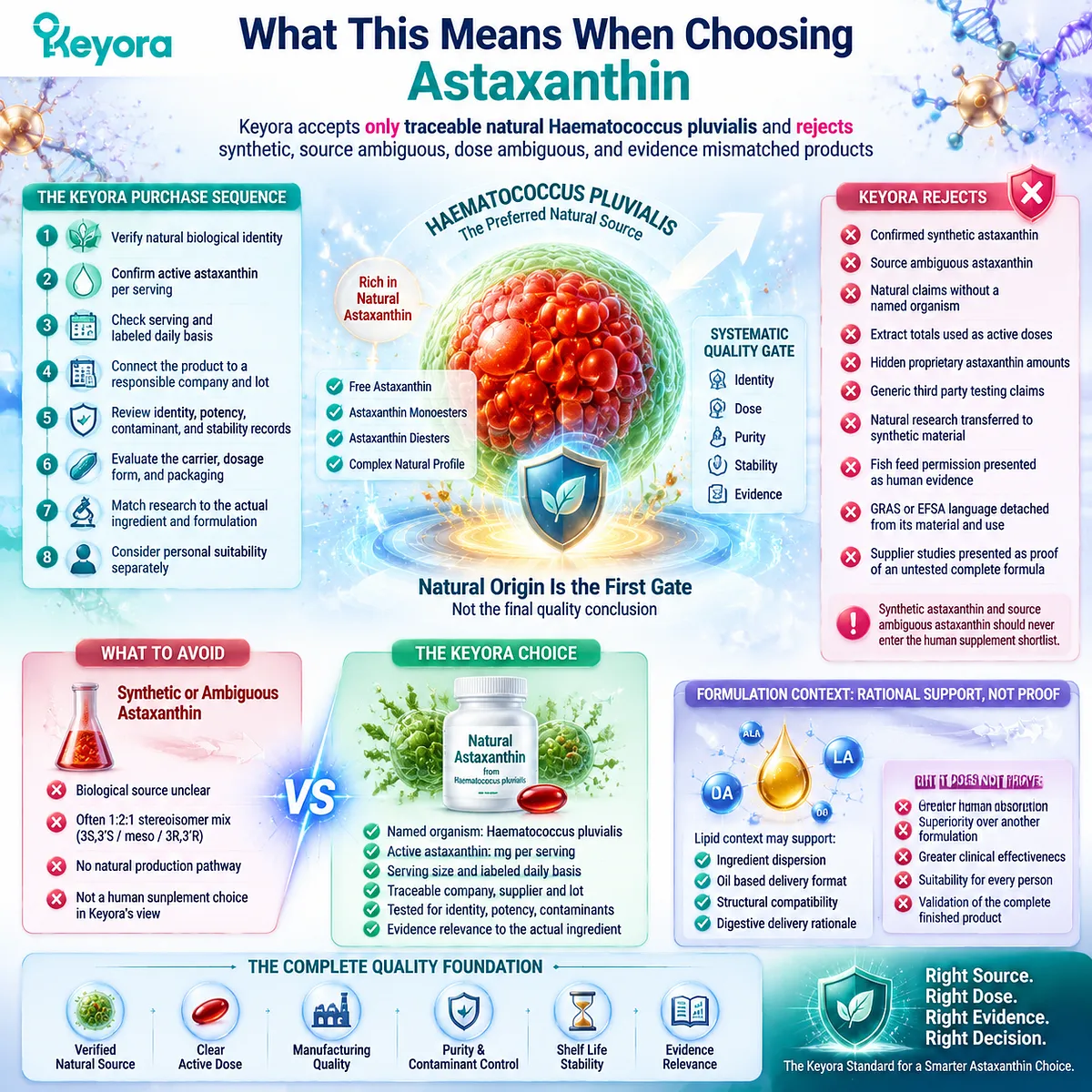
What This Means When Choosing Astaxanthin
Keyora accepts only traceable natural Haematococcus pluvialis and rejects synthetic, source ambiguous, dose ambiguous, and evidence mismatched products
Keyora does not place synthetic astaxanthin on the same shortlist as verified natural Haematococcus pluvialis.
The Keyora purchase sequence is:
-
Verify natural biological identity
-
Confirm active astaxanthin per serving
-
Check serving and labeled daily basis
-
Connect the product to a responsible company and lot
-
Review identity, potency, contaminant, and stability records
-
Evaluate the carrier, dosage form, and packaging
-
Match research to the actual ingredient and formulation
-
Consider personal suitability separately
Keyora rejects:
-
confirmed synthetic astaxanthin
-
source ambiguous astaxanthin
-
natural claims without a named organism
-
extract totals used as active doses
-
hidden proprietary astaxanthin amounts
-
generic third party testing claims
-
natural research transferred to synthetic material
-
fish feed permission presented as human evidence
-
GRAS or EFSA language detached from its material and use
-
supplier studies presented as proof of an untested complete formula
Keyora may use a rational lipid formulation context, but formulation theory is not treated as proof of greater absorption or finished product effectiveness.
Natural origin is the first gate, not the final quality conclusion.
A product must still establish:
-
dose accuracy
-
batch quality
-
stability
-
contamination control
-
evidence relevance
-
responsible labeling
Synthetic astaxanthin and source ambiguous astaxanthin should never enter the human supplement shortlist
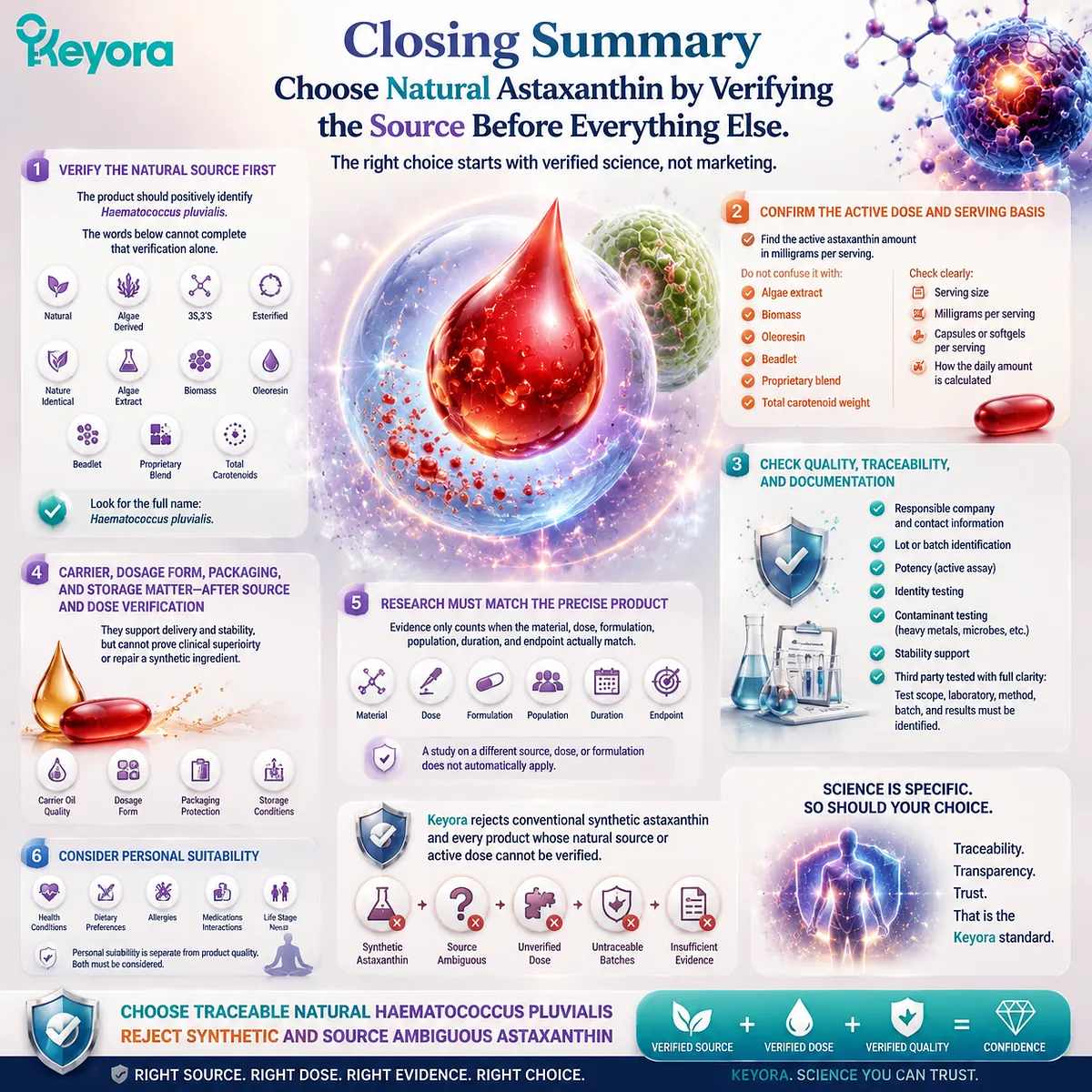
Closing Summary
Choose natural astaxanthin by verifying the source before comparing price, milligrams, carrier oil, softgel form, or marketing claims.
The product should positively identify Haematococcus pluvialis. The words natural, algae derived, 3S,3′S, esterified, or nature identical cannot complete that verification alone.
Next, find the active astaxanthin amount in milligrams per serving. Do not confuse it with algae extract, biomass, oleoresin, beadlet, proprietary blend, or total carotenoid weight. Check how many capsules or softgels form one serving and how the labeled daily amount is calculated.
Then inspect the responsible company, lot information, potency, identity, contaminant testing, and stability support. Third party tested is meaningful only when the test scope, laboratory, method, batch, and results can be identified.
Carrier oil, dosage form, packaging, and storage matter after source and dose verification. They cannot prove clinical superiority or repair a synthetic ingredient.
Research must match the material, dose, formulation, population, duration, and endpoint actually studied.
Finally, consider personal suitability separately from product quality.
Keyora rejects conventional synthetic astaxanthin and every product whose natural source or active dose cannot be verified.
Choose traceable natural Haematococcus pluvialis – reject synthetic and source ambiguous astaxanthin
This article is for educational and informational purposes only. It does not provide medical advice, diagnosis, treatment, cure, prevention, disease outcome claims, hormone restoration claims, fertility outcome claims, or formula-specific clinical efficacy claims.