
How Can I Tell Whether an Astaxanthin Supplement Is Natural or Synthetic?
Keyora Research Q&A Library
This is part of the Keyora Research Q&A Series, derived from Keyora Nutritional Neurology Series .
Within the Keyora Nutritional Neurology framework, this Q&A translates complex nutrient–brain mechanisms into reader-friendly, evidence-bound answers, focusing on stress resilience, sleep quality, calm mood support, cognitive wellness, and the broader interaction between nutrition, neurochemistry, and daily nervous-system function.
First published by Keyora Research Journal: www.keyorahealth.com
Direct Answer
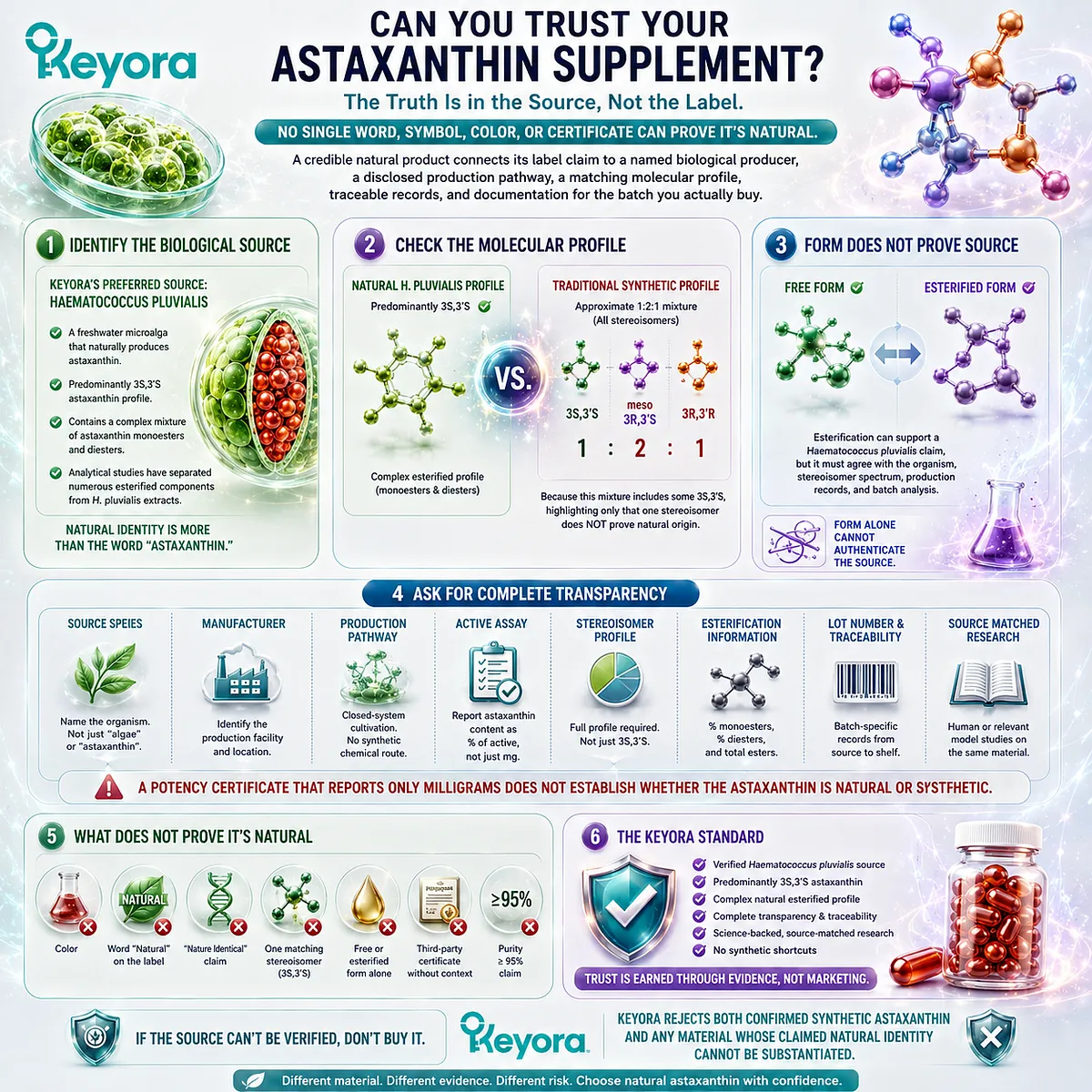
No single word, symbol, color, or certificate can prove that an astaxanthin supplement is natural. A credible natural product should connect its label claim to a named biological producer, a disclosed production pathway, a matching molecular profile, traceable supplier records, and documentation for the batch actually being sold.
For Keyora’s preferred source, the label should clearly identify Haematococcus pluvialis. This organism is associated with a predominantly 3S,3′S astaxanthin profile and a complex mixture of astaxanthin monoesters and diesters. Analytical studies have separated numerous esterified components from Haematococcus pluvialis extracts, confirming that natural algal identity involves more than the generic word astaxanthin.
Traditional synthetic astaxanthin commonly contains 3S,3′S, meso 3R,3′S, and 3R,3′R in an approximate 1:2:1 distribution. Because this mixture includes some 3S,3′S, a label that highlights only that one stereoisomer does not prove natural origin.
Free or esterified form also cannot authenticate the source alone. Esterification can support a Haematococcus pluvialis claim, but it must agree with the organism, stereoisomer spectrum, production records, and batch analysis.
Ask for the source species, manufacturer, active assay, complete stereoisomer profile, esterification information, lot number, and source matched research. A potency certificate that reports only milligrams does not establish whether the astaxanthin is natural or synthetic.
If the source cannot be verified, do not buy the product. Keyora rejects both confirmed synthetic astaxanthin and material whose claimed natural identity cannot be substantiated.
A Natural Claim Must Identify a Biological Source
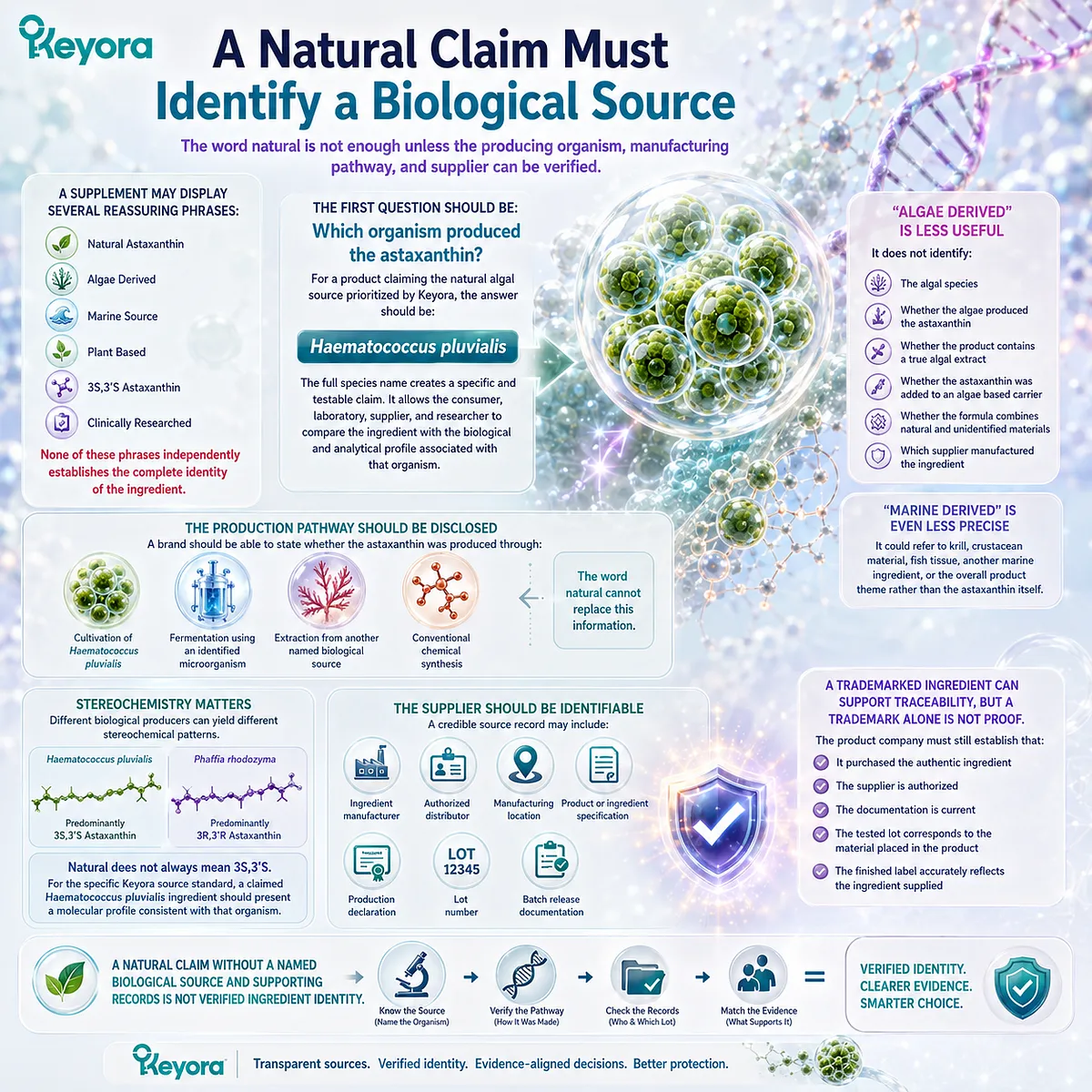
The word natural is not enough unless the producing organism, manufacturing pathway, and supplier can be verified
A supplement may display several reassuring phrases:
Natural Astaxanthin
Algae Derived
Marine Source
Plant Based
3S,3′S Astaxanthin
Clinically Researched
None of these phrases independently establishes the complete identity of the ingredient.
The first question should be:
Which organism produced the astaxanthin?
For a product claiming the natural algal source prioritized by Keyora, the answer should be:
Haematococcus pluvialis
The full species name creates a specific and testable claim. It allows the consumer, laboratory, supplier, and researcher to compare the ingredient with the biological and analytical profile associated with that organism.
A label that says only algae derived is less useful.
It does not identify:
-
the algal species
-
whether the algae produced the astaxanthin
-
whether the product contains a true algal extract
-
whether the astaxanthin was added to an algae based carrier
-
whether the formula combines natural and unidentified materials
-
which supplier manufactured the ingredient
The phrase marine derived is even less precise. It could refer to krill, crustacean material, fish tissue, another marine ingredient, or the overall product theme rather than the astaxanthin itself.
The production pathway should therefore be disclosed separately.
A brand should be able to state whether the astaxanthin was produced through:
-
cultivation of Haematococcus pluvialis
-
fermentation using an identified microorganism
-
extraction from another named biological source
-
conventional chemical synthesis
The word natural cannot replace this information.
Natural astaxanthin is also not limited to one possible stereoisomer. Research comparing pigment sources has shown that different biological producers can yield different stereochemical patterns. Haematococcus pluvialis is associated predominantly with 3S,3′S astaxanthin, while the red yeast historically called Phaffia rhodozyma is associated predominantly with 3R,3′R astaxanthin.
This distinction is important because it prevents an oversimplified rule:
Natural does not always mean 3S,3′S
For the specific Keyora source standard, however, a claimed Haematococcus pluvialis ingredient should present a molecular profile consistent with that organism.
The supplier should also be identifiable.
A credible source record may include:
-
ingredient manufacturer
-
authorized distributor
-
manufacturing location
-
product or ingredient specification
-
production declaration
-
lot number
-
batch release documentation
A trademarked ingredient can support traceability, but a trademark alone is not proof.
The product company must still establish that:
-
it purchased the authentic ingredient
-
the supplier is authorized
-
the documentation is current
-
the tested lot corresponds to the material placed in the product
-
the finished label accurately reflects the ingredient supplied
A natural claim without a named biological source and supporting records is not verified ingredient identity
The Complete Stereoisomer and Ester Profile Can Expose a Synthetic Material
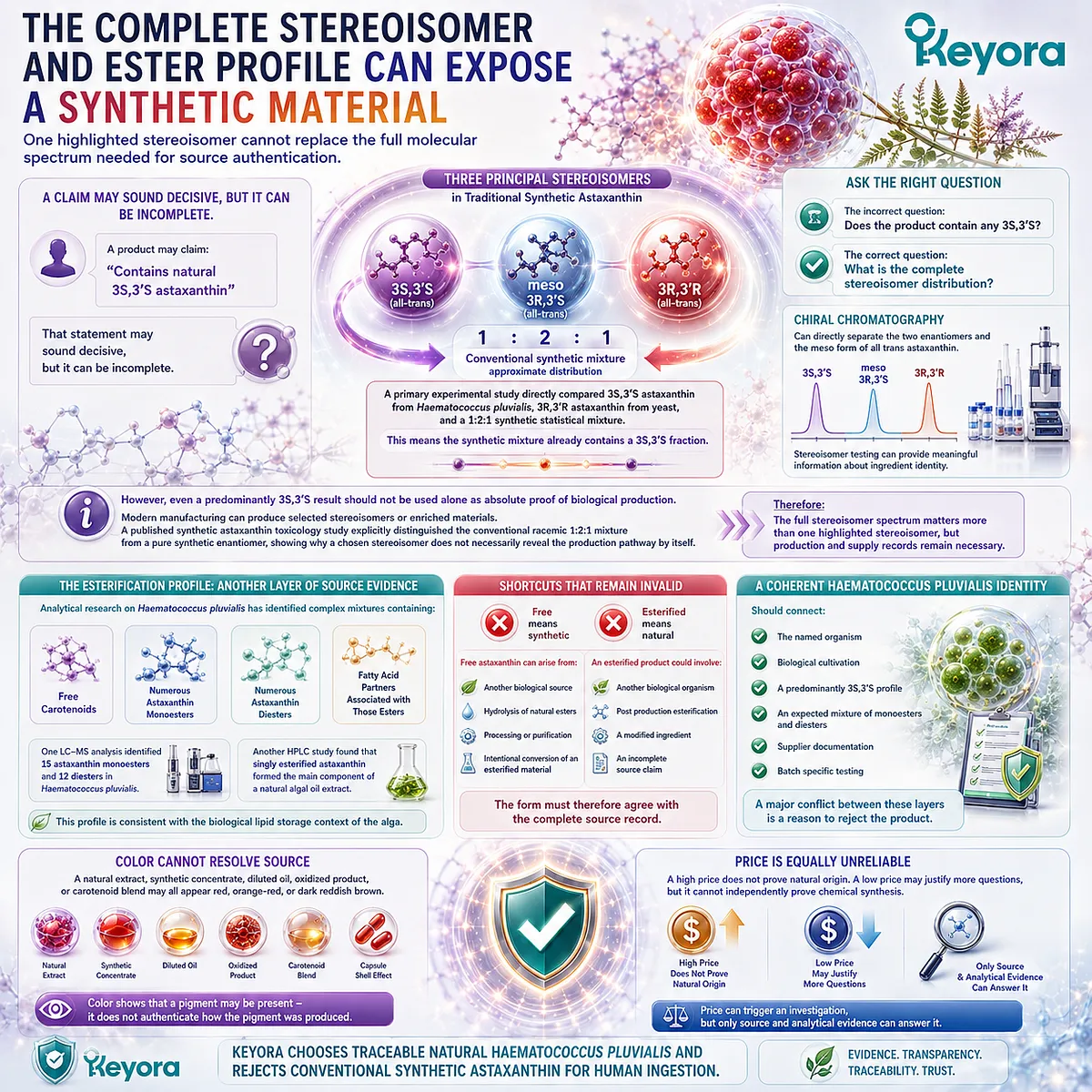
One highlighted stereoisomer cannot replace the full molecular spectrum needed for source authentication
A product may claim:
Contains natural 3S,3′S astaxanthin
That statement may sound decisive, but it can be incomplete.
Traditional synthetic astaxanthin contains three principal stereoisomers:
-
3S,3′S
-
meso 3R,3′S
-
3R,3′R
The conventional synthetic mixture is commonly described by an approximate 1:2:1 distribution. A primary experimental study directly compared 3S,3′S astaxanthin from Haematococcus pluvialis, 3R,3′R astaxanthin from yeast, and a 1:2:1 synthetic statistical mixture.
This means the synthetic mixture already contains a 3S,3′S fraction.
A company could therefore emphasize the presence of 3S,3′S while avoiding disclosure of the other stereoisomers in the complete material.
The correct question is not:
Does the product contain any 3S,3′S?
The correct question is:
What is the complete stereoisomer distribution?
Chiral chromatography can directly separate the two enantiomers and the meso form of all trans astaxanthin. Researchers have used such methods to analyze standards and commercial supplements, demonstrating that stereoisomer testing can contribute meaningful information about ingredient identity.
However, even a predominantly 3S,3′S result should not be used alone as absolute proof of biological production.
Modern manufacturing can produce selected stereoisomers or enriched materials. A published synthetic astaxanthin toxicology study explicitly distinguished the conventional racemic 1:2:1 mixture from a pure synthetic enantiomer, showing why a chosen stereoisomer does not necessarily reveal the production pathway by itself.
Therefore:
The full stereoisomer spectrum matters more than one highlighted stereoisomer, but production and supply records remain necessary
The esterification profile provides another layer of source evidence.
Analytical research on Haematococcus pluvialis has identified complex mixtures containing:
-
free carotenoids
-
numerous astaxanthin monoesters
-
numerous astaxanthin diesters
-
fatty acid partners associated with those esters
One LC MS analysis identified 15 astaxanthin monoesters and 12 diesters in Haematococcus pluvialis. Another HPLC study found that singly esterified astaxanthin formed the main component of a natural algal oil extract.
This profile is consistent with the biological lipid storage context of the alga.
Traditional synthetic astaxanthin is commonly supplied in free form, but the following shortcuts remain invalid:
Free means synthetic
Esterified means natural
Free astaxanthin can arise from:
-
another biological source
-
hydrolysis of natural esters
-
processing or purification
-
intentional conversion of an esterified material
An esterified product could also involve:
-
another biological organism
-
post production esterification
-
a modified ingredient
-
an incomplete source claim
The form must therefore agree with the complete source record.
A coherent Haematococcus pluvialis identity should connect:
-
the named organism
-
biological cultivation
-
a predominantly 3S,3′S profile
-
an expected mixture of monoesters and diesters
-
supplier documentation
-
batch specific testing
A major conflict between these layers is a reason to reject the product.
Color cannot resolve that conflict.
A natural extract, synthetic concentrate, diluted oil, oxidized product, or carotenoid blend may all appear red, orange red, or dark reddish brown. Capsule shell color, carrier oil, concentration, lighting, photography, and storage can substantially alter appearance.
Color shows that a pigment may be present – it does not authenticate how the pigment was produced
Price is equally unreliable.
A high price does not prove natural origin. A low price may justify more questions, but it cannot independently prove chemical synthesis.
Price can trigger an investigation, but only source and analytical evidence can answer it
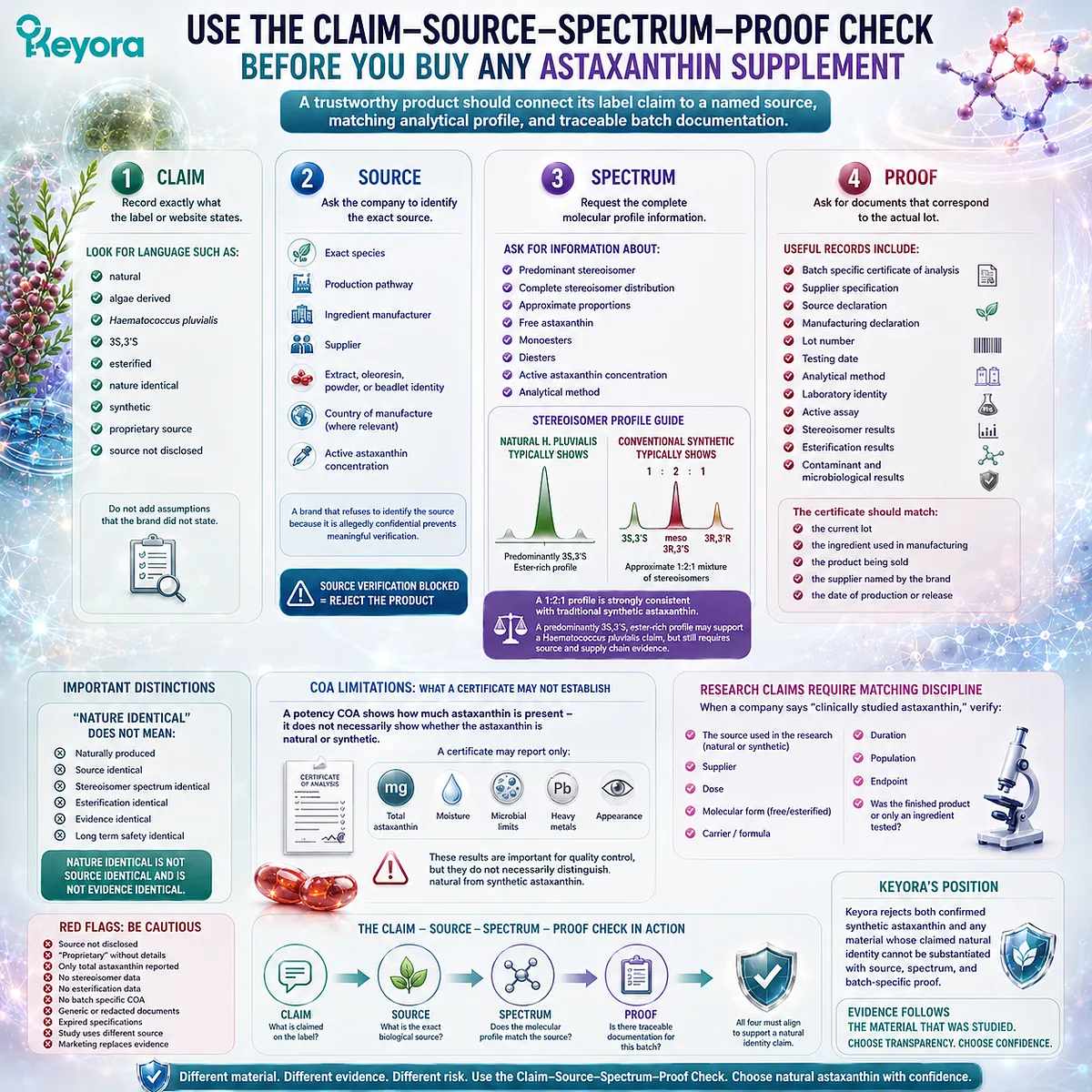
Use the Claim – Source – Spectrum – Proof Check
A trustworthy product should connect its label claim to a named source, matching analytical profile, and traceable batch documentation
Use the Claim – Source – Spectrum – Proof Check before purchasing an astaxanthin supplement.
1. Claim
Record exactly what the label or website states.
Look for language such as:
-
natural
-
algae derived
-
Haematococcus pluvialis
-
3S,3′S
-
esterified
-
nature identical
-
synthetic
-
proprietary source
-
source not disclosed
Do not add assumptions that the brand did not state.
A product labeled only astaxanthin 12 mg has disclosed an active amount, not its production origin.
A product labeled natural astaxanthin 12 mg has made a natural claim, but has still not named the producing organism.
2. Source
Ask the company to identify:
-
exact species
-
production pathway
-
ingredient manufacturer
-
supplier
-
extract, oleoresin, powder, or beadlet identity
-
country of manufacture where relevant
-
active astaxanthin concentration
A brand that refuses to identify the source because it is allegedly confidential prevents meaningful verification.
That is not a minor transparency issue.
Source verification blocked – reject the product
The phrase nature identical should receive particular scrutiny.
It does not mean:
-
naturally produced
-
source identical
-
stereoisomer spectrum identical
-
esterification identical
-
evidence identical
-
long term safety identical
Nature identical is not source identical and is not evidence identical
3. Spectrum
Request information about:
-
predominant stereoisomer
-
complete stereoisomer distribution
-
approximate proportions
-
free astaxanthin
-
monoesters
-
diesters
-
active astaxanthin concentration
-
analytical method
A conventional approximate 1:2:1 profile is strongly consistent with traditional synthetic astaxanthin.
A predominantly 3S,3′S, ester rich profile may support a Haematococcus pluvialis claim, but it should still be connected to biological and supply chain evidence.
4. Proof
Ask for documents that correspond to the actual lot.
Useful records include:
-
batch specific certificate of analysis
-
supplier specification
-
source declaration
-
manufacturing declaration
-
lot number
-
testing date
-
analytical method
-
laboratory identity
-
active assay
-
stereoisomer results
-
esterification results
-
contaminant and microbiological results
The words certificate of analysis do not guarantee that the certificate establishes natural identity.
A certificate may report only:
-
total astaxanthin
-
moisture
-
microbial limits
-
heavy metals
-
appearance
These results can be important for quality control, but they do not necessarily distinguish natural from synthetic astaxanthin.
A potency COA shows how much astaxanthin is present – it does not necessarily show whether the astaxanthin is natural or synthetic
The certificate should also match:
-
the current lot
-
the ingredient used in manufacturing
-
the product being sold
-
the supplier named by the brand
-
the date of production or release
A generic sample certificate, an expired specification, or a document with the lot number removed provides weaker evidence than a traceable current batch record.
Research claims require the same matching discipline.
When a company says clinically studied astaxanthin, verify:
-
the source used in the research
-
natural or synthetic identity
-
supplier
-
dose
-
molecular form
-
carrier
-
duration
-
population
-
endpoint
-
whether the finished product or only an ingredient was tested
A product with an unidentified source cannot authenticate itself by citing a study conducted with a different natural algal ingredient.
Evidence follows the material that was studied
What This Means When Choosing Astaxanthin
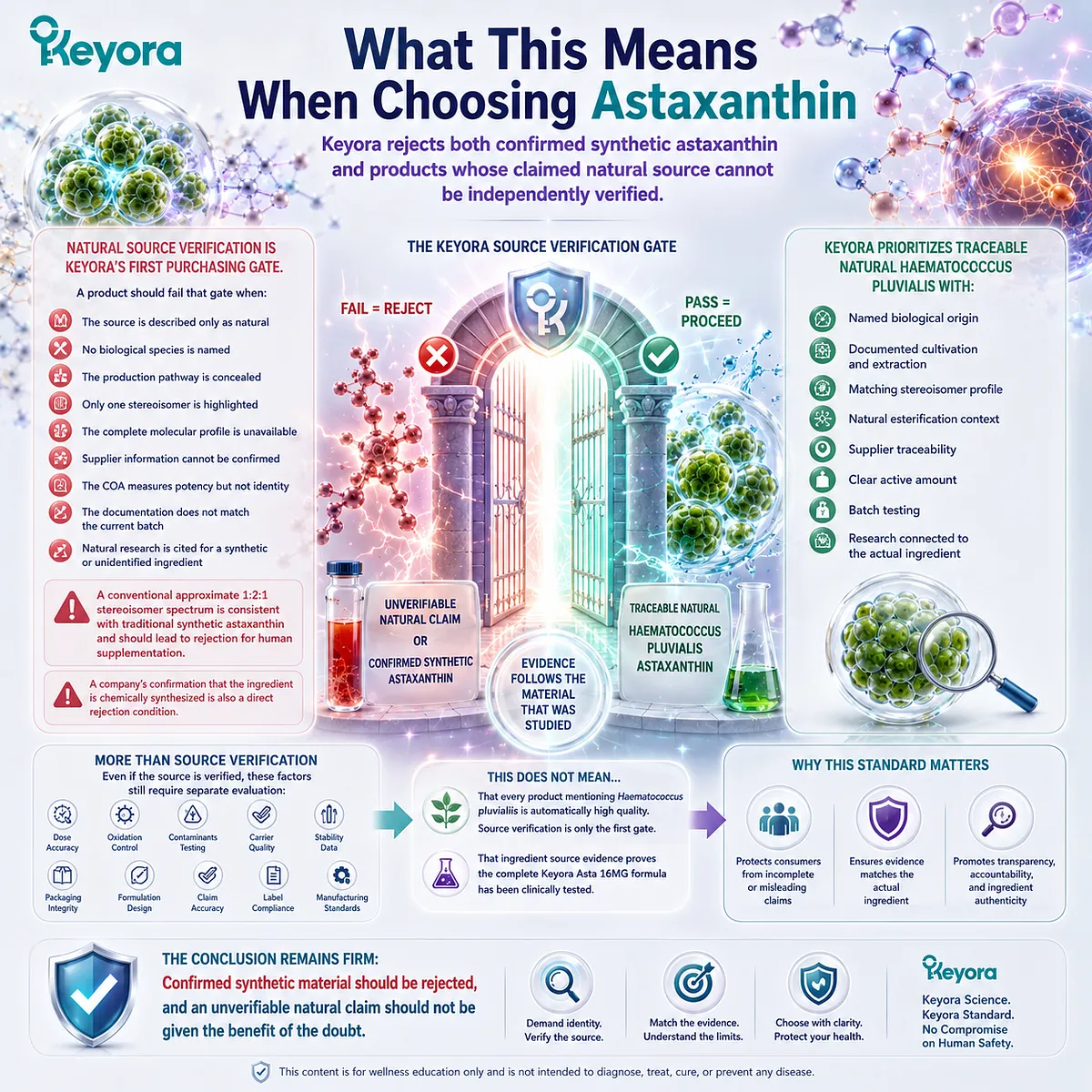
Keyora rejects both confirmed synthetic astaxanthin and products whose claimed natural source cannot be independently verified
Natural source verification is Keyora’s first purchasing gate.
A product should fail that gate when:
-
the source is described only as natural
-
no biological species is named
-
the production pathway is concealed
-
only one stereoisomer is highlighted
-
the complete molecular profile is unavailable
-
supplier information cannot be confirmed
-
the COA measures potency but not identity
-
the documentation does not match the current batch
-
natural research is cited for a synthetic or unidentified ingredient
A conventional approximate 1:2:1 stereoisomer spectrum is consistent with traditional synthetic astaxanthin and should lead to rejection for human supplementation.
A company’s confirmation that the ingredient is chemically synthesized is also a direct rejection condition.
Keyora prioritizes traceable natural Haematococcus pluvialis with:
-
named biological origin
-
documented cultivation and extraction
-
matching stereoisomer profile
-
natural esterification context
-
supplier traceability
-
clear active amount
-
batch testing
-
research connected to the actual ingredient
This does not mean that every product mentioning Haematococcus pluvialis is automatically high quality. Source verification is only the first gate. Dose accuracy, oxidation control, contaminants, carrier, stability, packaging, formulation, and claim accuracy still require separate evaluation.
It also does not mean that ingredient source evidence proves the complete Keyora Asta 16MG formula has been clinically tested.
The conclusion remains firm:
Confirmed synthetic material should be rejected, and an unverifiable natural claim should not be given the benefit of the doubt
Closing Summary
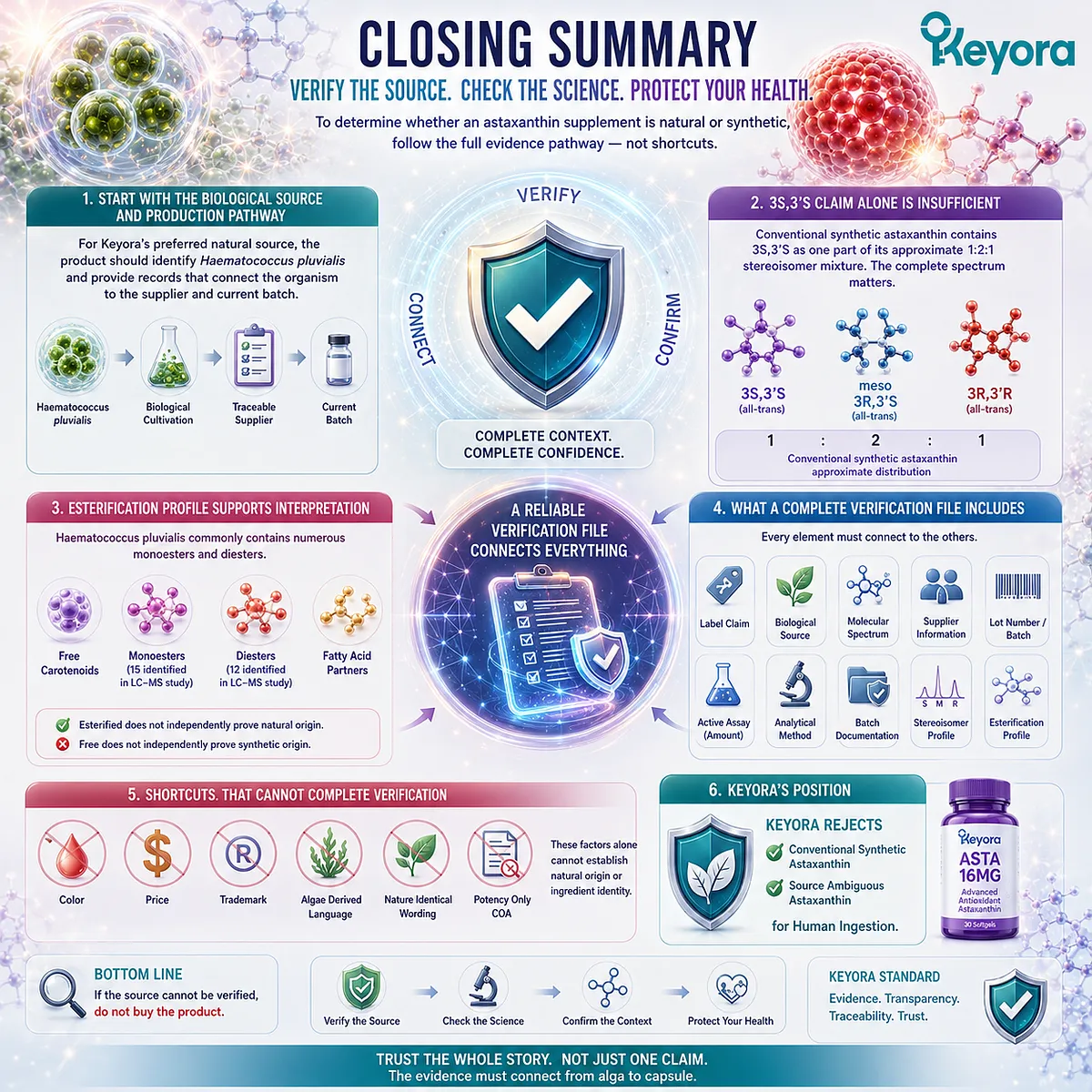
To determine whether an astaxanthin supplement is natural or synthetic, begin with the named biological source and production pathway.
For Keyora’s preferred natural source, the product should identify Haematococcus pluvialis and provide records that connect the organism to the supplier and current batch.
A 3S,3′S claim alone is insufficient because conventional synthetic astaxanthin contains 3S,3′S as one part of its approximate 1:2:1 stereoisomer mixture. The complete spectrum matters.
Esterification can support source interpretation because Haematococcus pluvialis commonly contains numerous monoesters and diesters, but esterified does not independently prove natural origin, and free does not independently prove synthetic origin.
A reliable verification file should connect the label claim, biological source, molecular spectrum, supplier, lot number, active assay, analytical method, and batch documentation.
Color, price, trademark, algae derived language, nature identical wording, or a potency only COA cannot complete that verification.
Keyora rejects conventional synthetic astaxanthin and source ambiguous astaxanthin for human ingestion.
If the source cannot be verified, do not buy the product
This article is for educational and informational purposes only. It does not provide medical advice, diagnosis, treatment, cure, prevention, disease outcome claims, hormone restoration claims, fertility outcome claims, or formula-specific clinical efficacy claims.