
Does Crossing a Biological Barrier Prove Astaxanthin Works?
Keyora Research Q&A Library
This is part of the Keyora Research Q&A Series, derived from Keyora Astaxanthin Research Journal Series.
Within the Keyora Astaxanthin Researcn framework, this Q&A translates complex astaxanthin biology into reader-friendly, evidence-bound answers, focusing on natural astaxanthin identity, molecular structure, antioxidant and redox mechanisms, membrane lipid interaction, mitochondrial resilience, inflammatory signaling pathways, human evidence interpretation, and the scientific principles behind responsible supplementation.
First published by Keyora Research Journal: www.keyorahealth.com
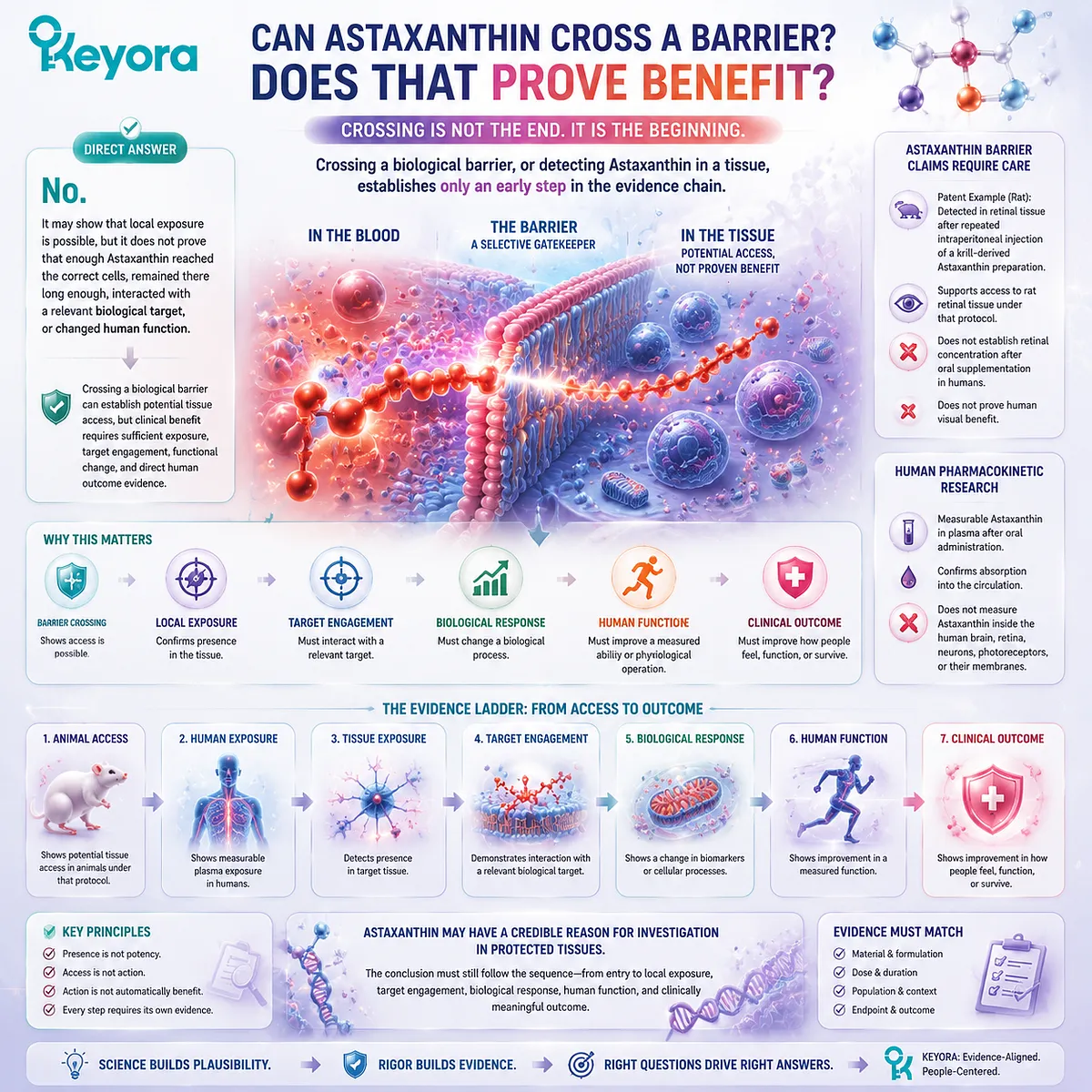
Direct Answer
No.
Crossing a biological barrier, or detecting Astaxanthin in a tissue, establishes only an early step in the evidence chain.
It may show that local exposure is possible, but it does not prove that enough Astaxanthin reached the correct cells, remained there long enough, interacted with a relevant biological target, or changed human function.
Crossing a biological barrier can establish potential tissue access, but clinical benefit requires sufficient exposure, target engagement, functional change, and direct human outcome evidence.
Astaxanthin barrier claims require particular care.
A frequently cited patent reported retinal detection after repeated intraperitoneal administration of a krill-derived Astaxanthin preparation to rats.
That experiment supports access to rat retinal tissue under that protocol. It does not directly establish retinal concentration after ordinary oral supplementation in humans, and it does not prove human visual benefit.
Human pharmacokinetic research has shown measurable Astaxanthin in plasma after oral administration.
Plasma exposure confirms absorption into the circulation, but it does not measure Astaxanthin inside the human brain, retina, neurons, photoreceptors, or their membranes.
Astaxanthin may therefore have a credible reason for investigation in protected tissues. The conclusion must still follow the sequence from entry to local exposure, target engagement, biological response, human function, and clinically meaningful outcome.
Presence is not potency, access is not action, and action is not automatically benefit.
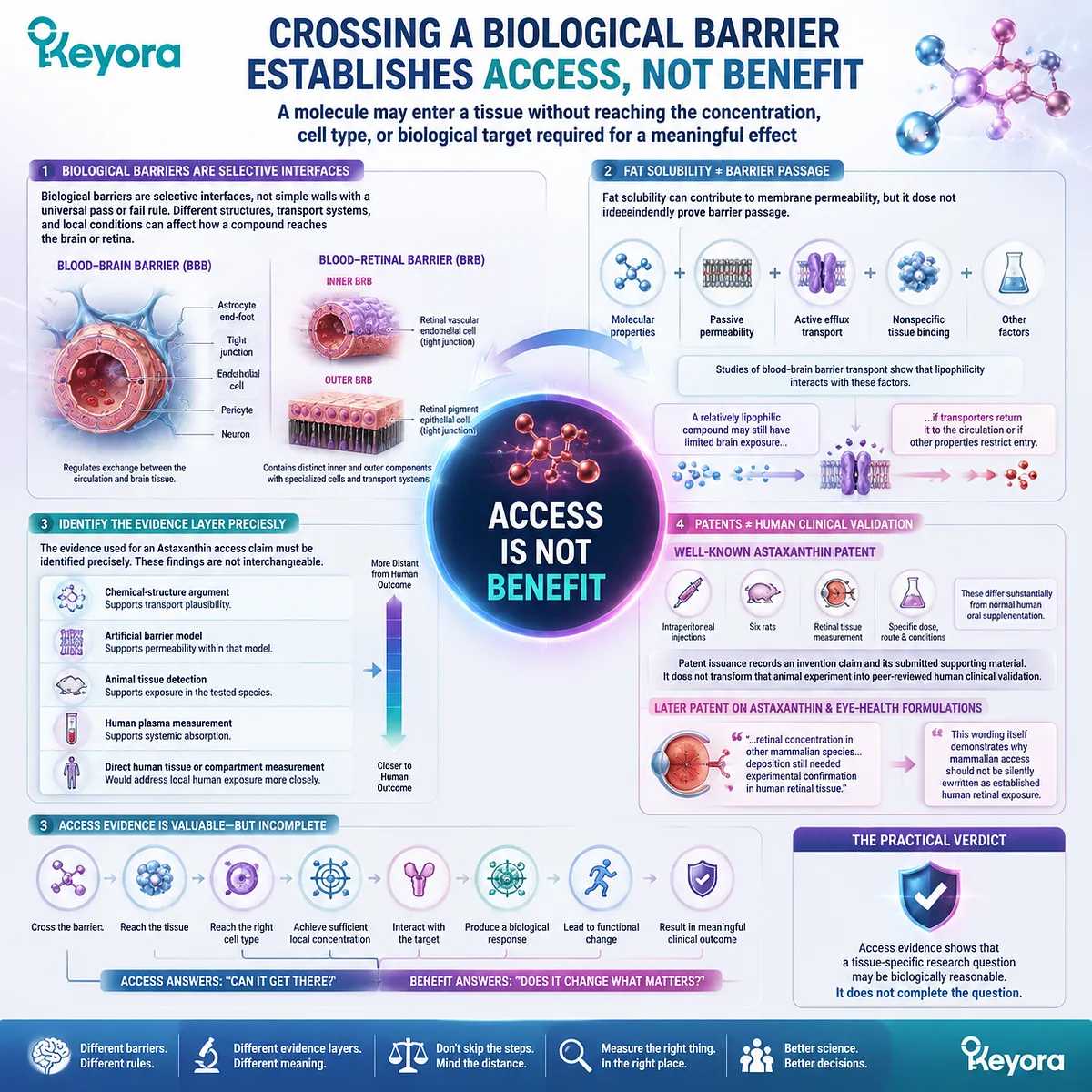
Crossing a Biological Barrier Establishes Access, Not Benefit
A molecule may enter a tissue without reaching the concentration, cell type, or biological target required for a meaningful effect
Biological barriers are selective interfaces, not simple walls with a universal pass or fail rule. The blood-brain barrier regulates exchange between the circulation and brain tissue, while the blood-retinal barrier contains distinct inner and outer components associated with retinal vascular endothelial cells and retinal pigment epithelial cells. Different structures, transport systems, and local conditions can therefore affect how a compound reaches the brain or retina.
Fat solubility can contribute to membrane permeability, but it does not independently prove barrier passage. Studies of blood-brain barrier transport show that lipophilicity interacts with factors such as molecular properties, nonspecific tissue binding, passive permeability, and active efflux transport. A relatively lipophilic compound may still have limited brain exposure if transporters return it to the circulation or if other properties restrict entry.
The evidence used for an Astaxanthin access claim must therefore be identified precisely.
A chemical-structure argument supports transport plausibility.
An artificial barrier model supports permeability within that model.
Animal tissue detection supports exposure in the tested species.
Human plasma measurement supports systemic absorption.
Direct human tissue or compartment measurement would address local human exposure more closely.
These findings are not interchangeable.
The well-known Astaxanthin patent illustrates the distinction. Its retinal-access experiment used repeated intraperitoneal injections in six rats, followed by measurement in retinal tissue. The material, route, dose, species, and sampling conditions differ substantially from normal human oral supplementation. Patent issuance records an invention claim and its submitted supporting material. It does not transform that animal experiment into peer-reviewed human clinical validation.
A later patent discussing Astaxanthin and eye-health formulations explicitly referred to retinal concentration in other mammalian species and stated that deposition still needed experimental confirmation in human retinal tissue. That wording itself demonstrates why mammalian access should not be silently rewritten as established human retinal exposure.
Access evidence is valuable. It shows that a tissue-specific research question may be biologically reasonable. It does not complete the question.
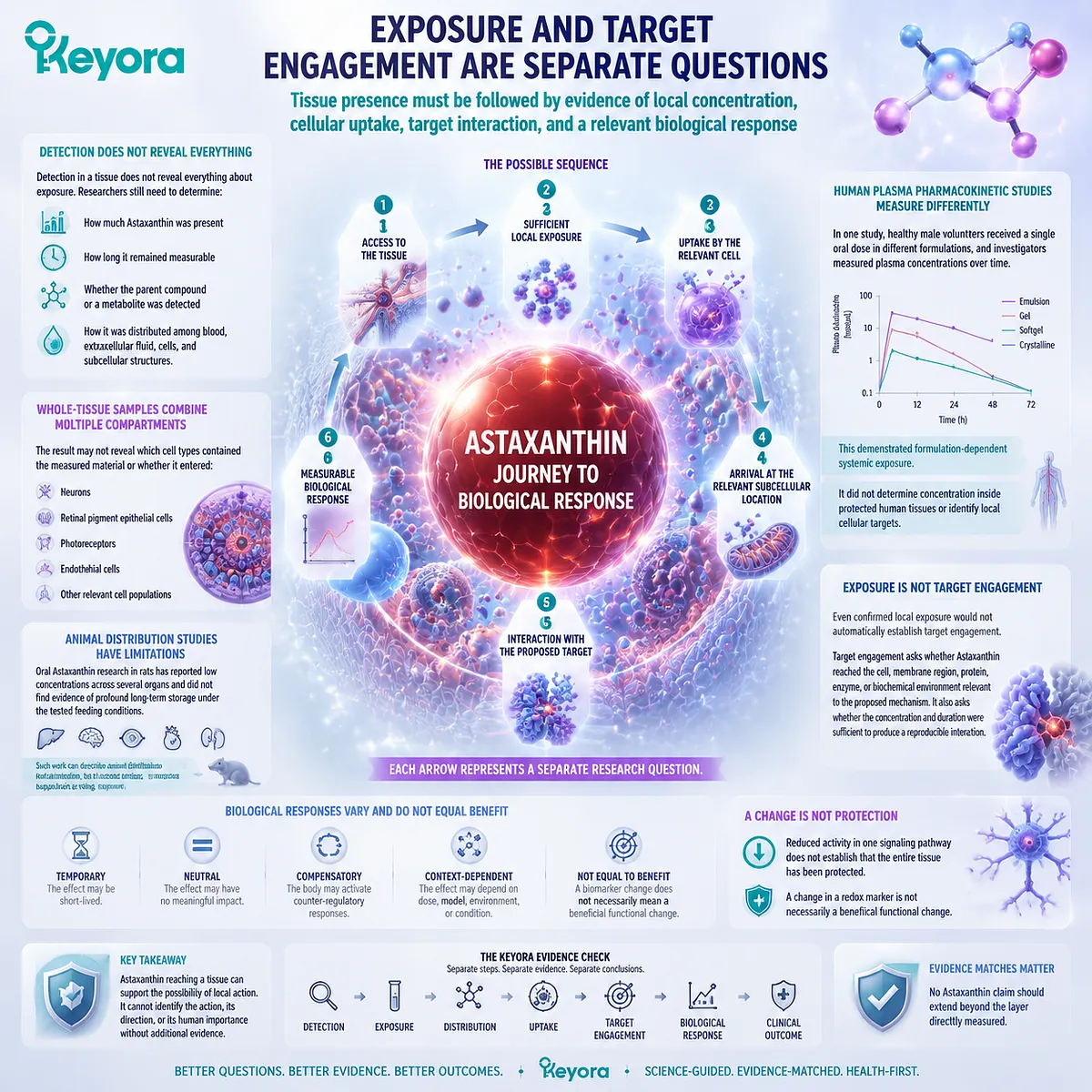
Exposure and Target Engagement Are Separate Questions
Tissue presence must be followed by evidence of local concentration, cellular uptake, target interaction, and a relevant biological response
Detection in a tissue does not reveal everything about exposure. Researchers still need to determine how much Astaxanthin was present, how long it remained measurable, whether the parent compound or a metabolite was detected, and how it was distributed among blood, extracellular fluid, cells, and subcellular structures.
A whole-tissue sample can combine several biological compartments. The result may not reveal which cell types contained the measured material or whether it entered neurons, retinal pigment epithelial cells, photoreceptors, endothelial cells, or another relevant population.
Animal distribution studies reinforce this limitation. Oral Astaxanthin research in rats has reported low concentrations across several organs and did not find evidence of profound long-term storage under the tested feeding conditions. Such work can describe animal distribution and elimination, but it cannot calculate human brain or retinal exposure from a supplement serving.
Human plasma pharmacokinetic studies provide a different measurement. In one study, healthy male volunteers received a single oral dose in different formulations, and investigators measured plasma concentrations over time. This demonstrated formulation-dependent systemic exposure. It did not determine concentration inside protected human tissues or identify local cellular targets.
Even confirmed local exposure would not automatically establish target engagement.
Target engagement asks whether Astaxanthin reached the cell, membrane region, protein, enzyme, or biochemical environment relevant to the proposed mechanism. It also asks whether the concentration and duration were sufficient to produce a reproducible interaction.
The possible sequence is:
Access to the tissue
→ sufficient local exposure
→ uptake by the relevant cell
→ arrival at the relevant subcellular location
→ interaction with the proposed target
→ measurable biological response
Each arrow represents a separate research question.
A biological response may also be temporary, neutral, compensatory, or dependent on the experimental context. A change in a redox marker is not necessarily a beneficial functional change. Reduced activity in one signaling pathway does not establish that the entire tissue has been protected.
Astaxanthin reaching a tissue can therefore support the possibility of local action. It cannot identify the action, its direction, or its human importance without additional evidence.
Brain and Retinal Claims Need Direct Human Endpoints
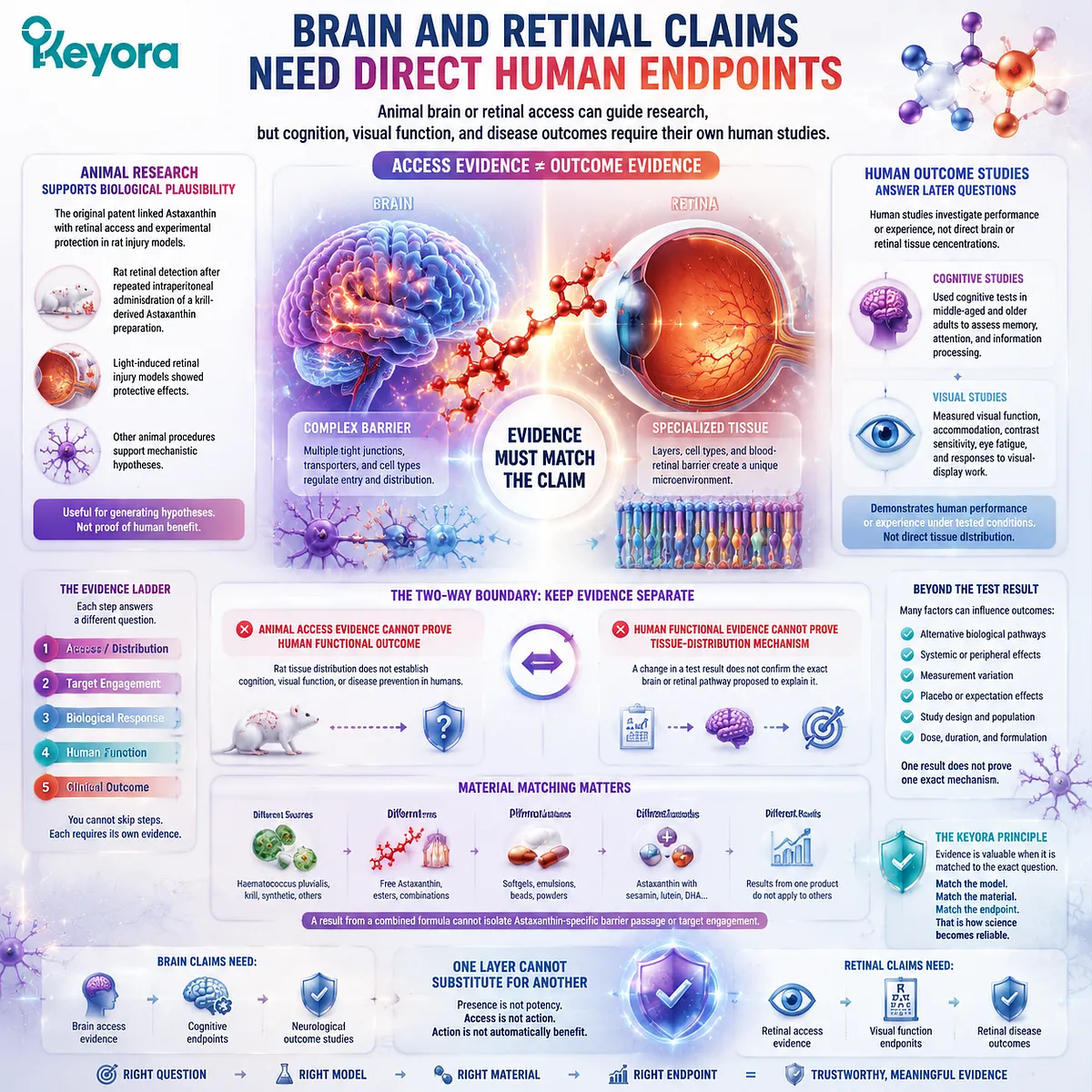
Animal brain or retinal access can guide research, but cognition, visual function, and disease outcomes require their own human studies
The brain and retina illustrate why access evidence and outcome evidence must remain separate.
The original patent linked Astaxanthin with retinal access and experimental protection in rat injury models. Its evidence included rat retinal detection, light-related retinal injury experiments, and other animal procedures. These studies can support animal-level biological plausibility. They cannot directly establish cognitive improvement, visual-function improvement, or prevention of neurological and retinal diseases in humans.
Human studies answer later questions in the evidence chain. Astaxanthin research has used cognitive tests in middle-aged and older participants, while visual studies have measured outcomes such as visual function, eye fatigue, or responses to visual-display work. These trials investigate human performance or experience, not direct Astaxanthin concentrations in human brain or retinal tissue.
This creates an important two-way boundary.
An animal tissue-distribution result cannot prove a human functional outcome.
A human functional result cannot, by itself, prove the exact tissue-distribution mechanism proposed to explain it.
For example, a change in a cognitive test does not directly demonstrate that Astaxanthin crossed the blood-brain barrier, entered neurons, associated with neuronal membranes, and produced the test result through that sequence. Alternative biological pathways, systemic effects, measurement variation, and study design must still be considered.
The same applies to visual outcomes. A study of eye fatigue or accommodation does not directly establish retinal Astaxanthin deposition. It also does not establish prevention of macular degeneration, retinal injury, or another eye disease unless the study directly measured that clinical outcome.
Material matching is equally important. Human cognitive studies have used different preparations, including Astaxanthin-rich bacterial extracts, Haematococcus pluvialis extracts, and combined formulas containing other ingredients. A result from a combined Astaxanthin and sesamin supplement cannot isolate Astaxanthin-specific barrier passage or target engagement.
The defensible interpretation is not that brain or retinal research is invalid. It is that each conclusion requires matched evidence:
-
tissue access requires tissue-access evidence
-
cognitive claims require cognitive endpoints
-
visual claims require visual endpoints
-
disease claims require disease-relevant clinical outcomes
One layer cannot substitute for another.
Use the Keyora Entry – Engagement – Outcome Check
Three questions can reveal whether an access claim has been extended beyond the evidence actually measured
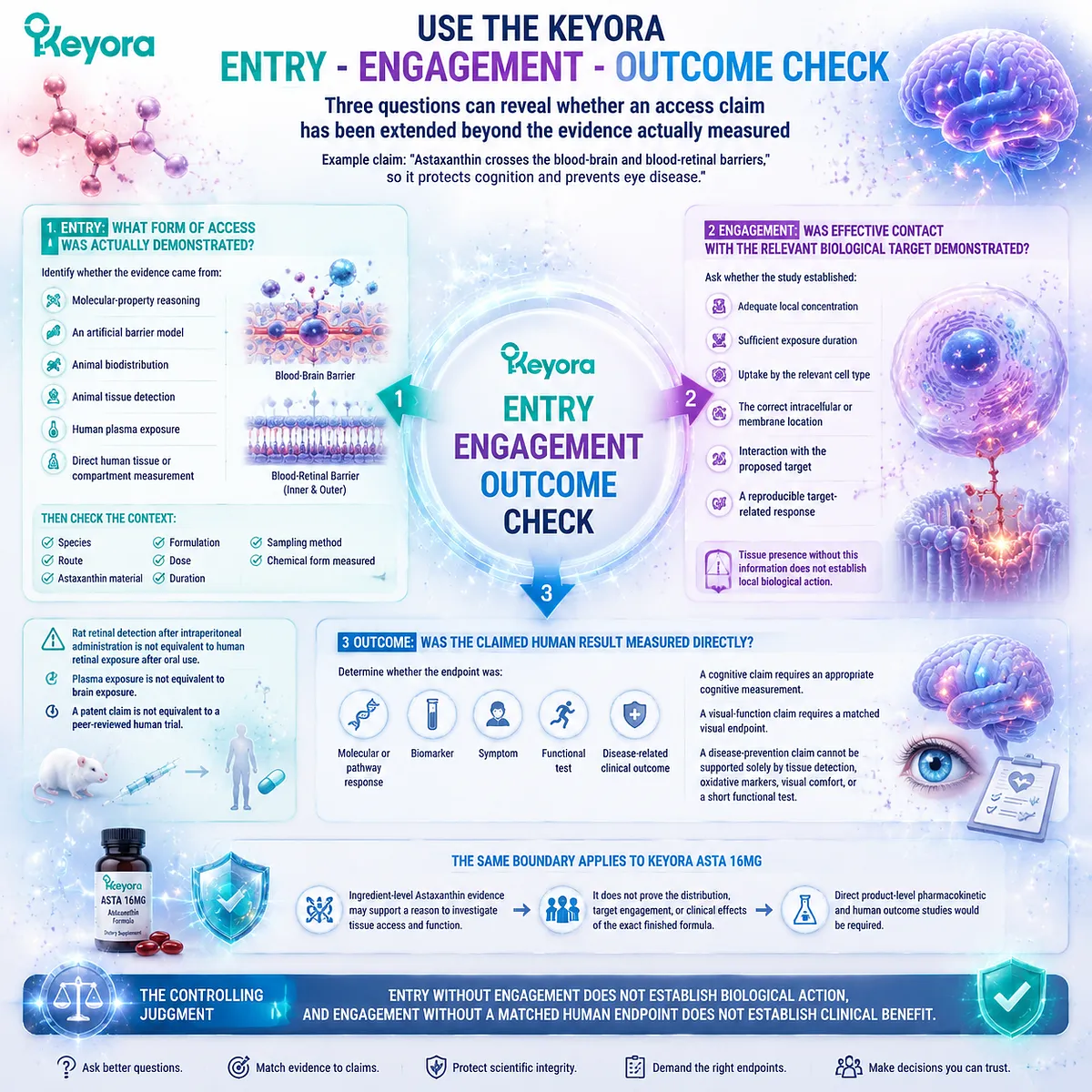
The Keyora Entry – Engagement – Outcome Check provides a practical method for evaluating statements such as, “Astaxanthin crosses the blood-brain and blood-retinal barriers, so it protects cognition and prevents eye disease.”
Entry: What form of access was actually demonstrated?
Identify whether the evidence came from:
-
molecular-property reasoning
-
an artificial barrier model
-
animal biodistribution
-
animal tissue detection
-
human plasma exposure
-
direct human tissue or compartment measurement
Then check the species, route, Astaxanthin material, formulation, dose, duration, sampling method, and chemical form measured.
Rat retinal detection after intraperitoneal administration is not equivalent to human retinal exposure after oral use. Plasma exposure is not equivalent to brain exposure. A patent claim is not equivalent to a peer-reviewed human trial.
Engagement: Was effective contact with the relevant biological target demonstrated?
Ask whether the study established:
-
adequate local concentration
-
sufficient exposure duration
-
uptake by the relevant cell type
-
the correct intracellular or membrane location
-
interaction with the proposed target
-
a reproducible target-related response
Tissue presence without this information does not establish local biological action.
Outcome: Was the claimed human result measured directly?
Determine whether the endpoint was:
-
a molecular or pathway response
-
a biomarker
-
a symptom
-
a functional test
-
a disease-related clinical outcome
A cognitive claim requires an appropriate cognitive measurement. A visual-function claim requires a matched visual endpoint. A disease-prevention claim cannot be supported solely by tissue detection, oxidative markers, visual comfort, or a short functional test.
The same boundary applies to Keyora Asta 16MG. Ingredient-level Astaxanthin evidence may support a reason to investigate tissue access and function. It does not prove the distribution, target engagement, or clinical effects of the exact finished formula. Direct product-level pharmacokinetic and human outcome studies would be required.
The controlling judgment is:
Entry without engagement does not establish biological action, and engagement without a matched human endpoint does not establish clinical benefit.
Closing Summary
Astaxanthin tissue access can justify research, but it cannot replace evidence of local action and human benefit
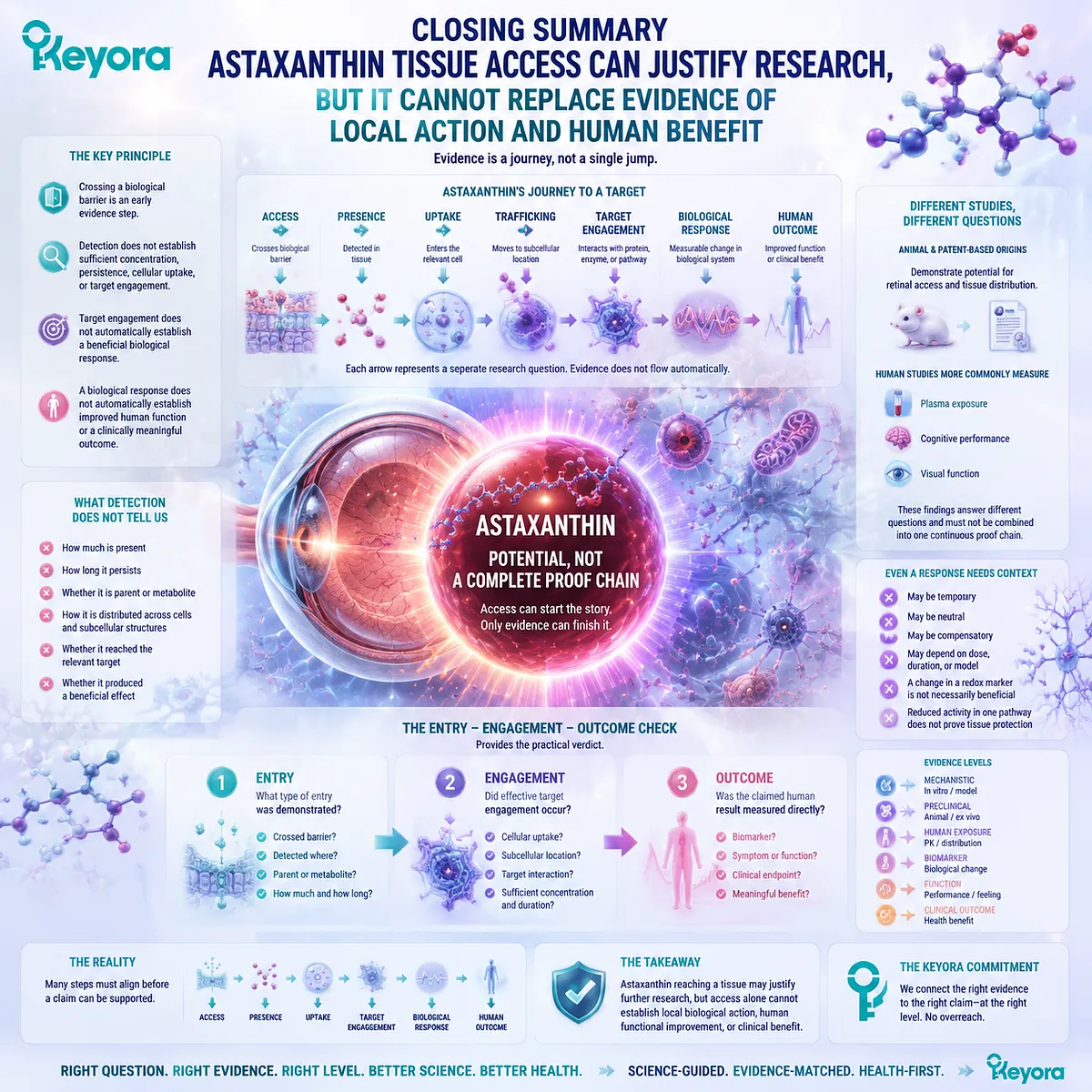
Crossing a biological barrier is an early evidence step.
Detection does not establish sufficient concentration, persistence, cellular uptake, or target engagement.
Target engagement does not automatically establish a beneficial biological response, and a biological response does not automatically establish improved human function or a clinically meaningful outcome.
Astaxanthin retinal-access claims have important animal and patent-based origins, while human studies more commonly measure plasma exposure, cognitive performance, or visual function. These findings answer different questions and must not be combined into one continuous proof chain.
The Entry – Engagement – Outcome Check provides the practical verdict. Identify what type of entry was demonstrated, determine whether effective target engagement occurred, and ask whether the claimed human result was measured directly.
Astaxanthin reaching a tissue may justify further research, but access alone cannot establish local biological action, human functional improvement, or clinical benefit.
This article is for educational and informational purposes only. It does not provide medical advice, diagnosis, treatment, cure, prevention, disease outcome claims, hormone restoration claims, fertility outcome claims, or formula-specific clinical efficacy claims.