
Does Astaxanthin Purity Matter? What 5%, 10% & 20% Really Mean
Keyora Research Q&A Library
This is part of the Keyora Research Q&A Series, derived from Keyora Astaxanthin Research Journal Series.
Within the Keyora Astaxanthin Researcn framework, this Q&A translates complex astaxanthin biology into reader-friendly, evidence-bound answers, focusing on natural astaxanthin identity, molecular structure, antioxidant and redox mechanisms, membrane lipid interaction, mitochondrial resilience, inflammatory signaling pathways, human evidence interpretation, and the scientific principles behind responsible supplementation.
First published by Keyora Research Journal: www.keyorahealth.com
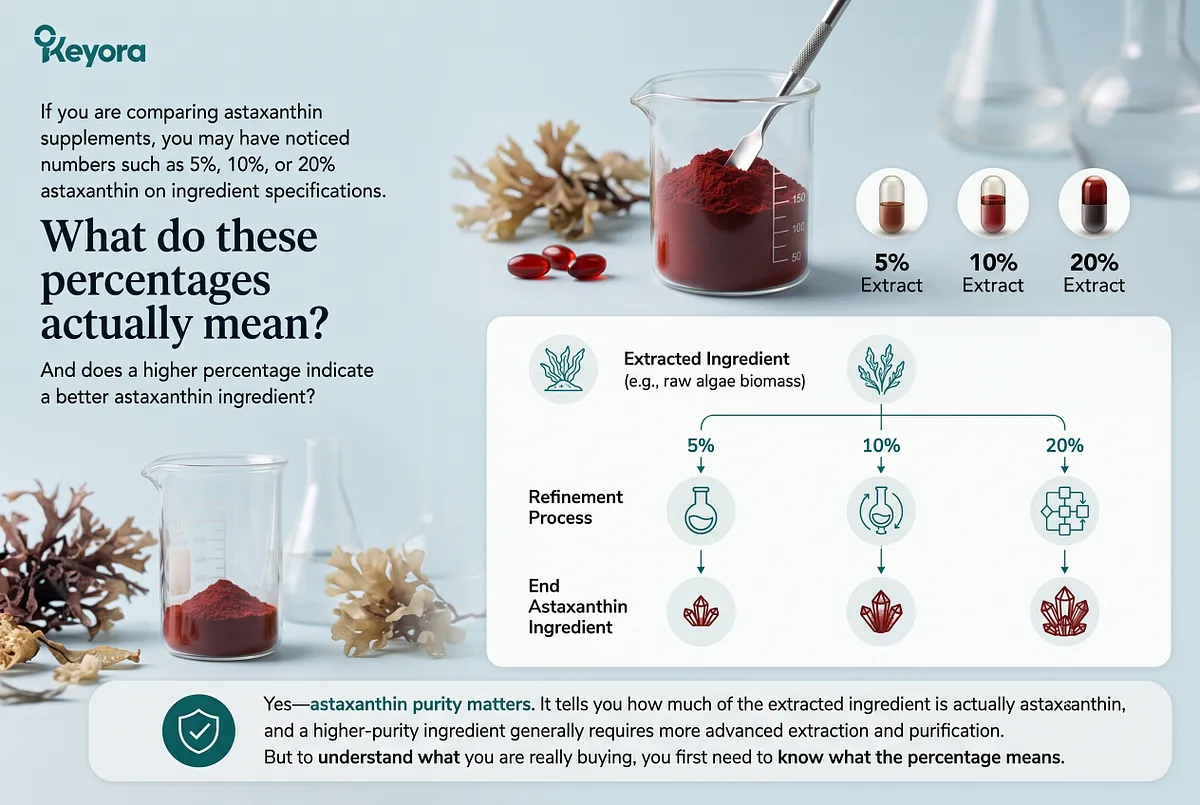
If you are comparing astaxanthin supplements, you may have noticed numbers such as 5%, 10%, or 20% astaxanthin on ingredient specifications.
So, what do these percentages actually mean? And does a higher percentage indicate a better astaxanthin ingredient?
Yes—astaxanthin purity matters. It tells you how much of the extracted ingredient is actually astaxanthin, and a higher-purity ingredient generally requires more advanced extraction and purification. But to understand what you are really buying, you first need to know what the percentage means.
What Does Astaxanthin Purity Mean?
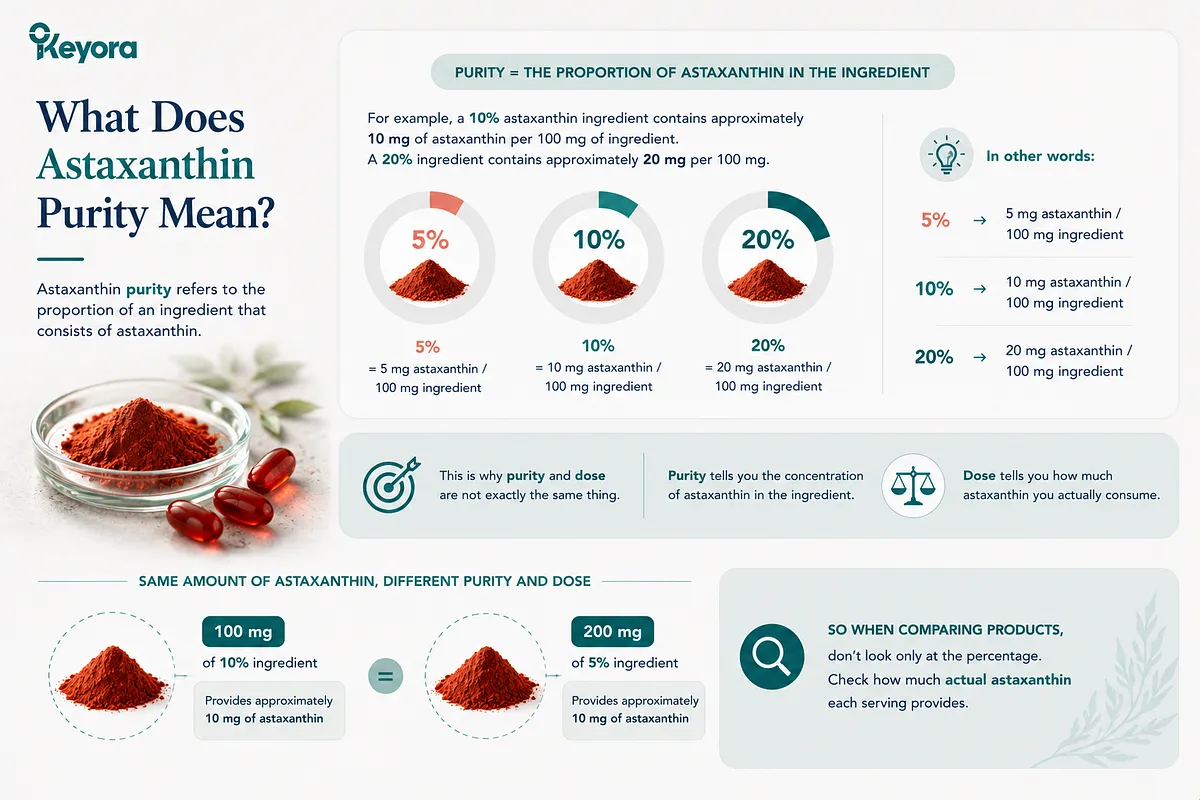
Astaxanthin purity refers to the proportion of an ingredient that consists of astaxanthin.
For example, a 10% astaxanthin ingredient contains approximately 10 mg of astaxanthin per 100 mg of ingredient. A 20% ingredient contains approximately 20 mg per 100 mg.
In other words:
5% → 5 mg astaxanthin / 100 mg ingredient
10% → 10 mg astaxanthin / 100 mg ingredient
20% → 20 mg astaxanthin / 100 mg ingredient
This is why purity and dose are not exactly the same thing.
Purity tells you the concentration of astaxanthin in the ingredient. Dose tells you how much astaxanthin you actually consume.
For example, 100 mg of a 10% ingredient provides approximately the same amount of astaxanthin as 200 mg of a 5% ingredient.
So when comparing products, don’t look only at the percentage. Check how much actual astaxanthin each serving provides.
Why Does Higher Astaxanthin Purity Matter?
1. More of the ingredient is astaxanthin
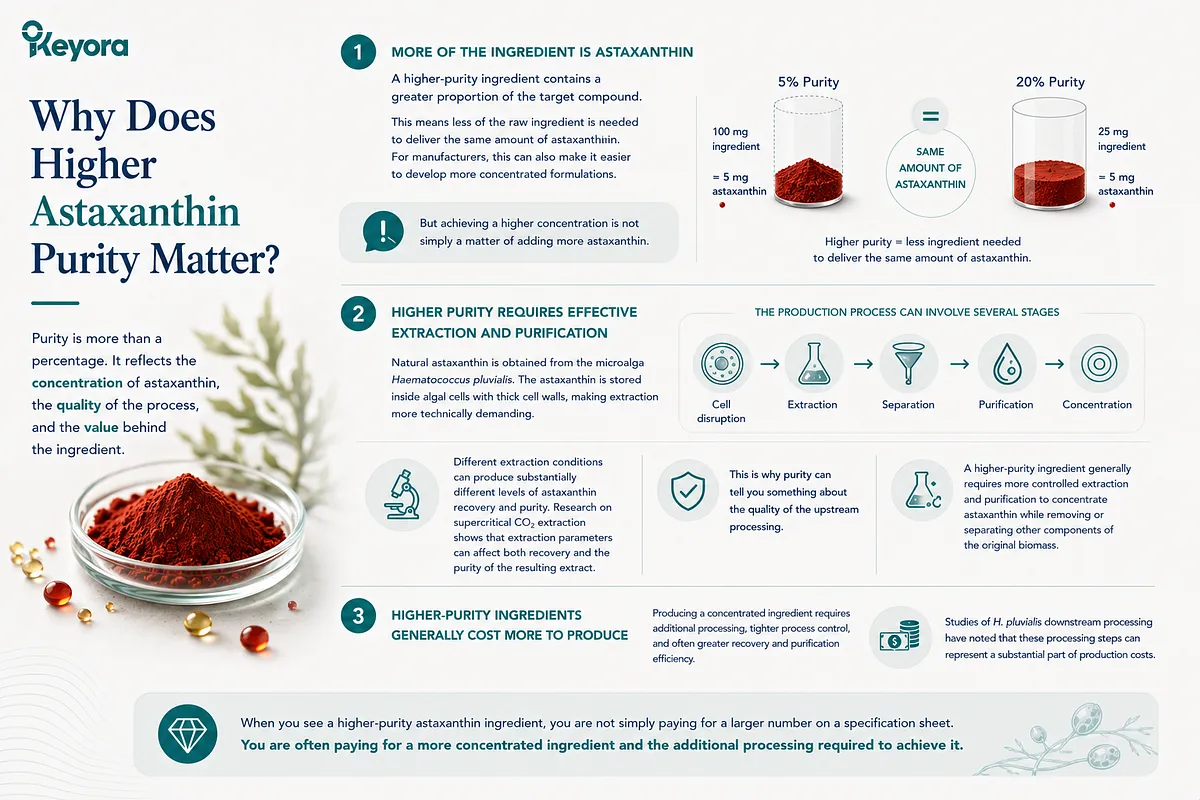
A higher-purity ingredient contains a greater proportion of the target compound.
This means less of the raw ingredient is needed to deliver the same amount of astaxanthin. For supplement manufacturers, this can also make it easier to develop more concentrated formulations.
But achieving a higher concentration is not simply a matter of adding more astaxanthin.
2. Higher purity requires effective extraction and purification
Natural astaxanthin is commonly obtained from the microalga Haematococcus pluvialis. The astaxanthin is stored inside the algal cells, which develop thick cell walls during astaxanthin accumulation. This makes extraction more technically demanding.
The production process can involve several stages, including:
Cell disruption → Extraction → Separation → Purification → Concentration
Different extraction conditions can produce substantially different levels of astaxanthin recovery and purity. Research on supercritical CO₂ extraction, for example, has shown that extraction parameters can affect both recovery and the purity of the resulting extract.
This is why purity can tell you something about the quality of the upstream processing.
A higher-purity ingredient generally requires more controlled extraction and purification to concentrate astaxanthin while removing or separating other components of the original biomass.
3. Higher-purity ingredients generally cost more to produce
There is also an economic reason high-purity astaxanthin ingredients tend to cost more.
Producing a concentrated ingredient requires additional processing, tighter process control, and often greater recovery and purification efficiency. Studies of H. pluvialis downstream processing have noted that these processing steps can represent a substantial part of production costs.
So, when you see a higher-purity astaxanthin ingredient, you are not simply paying for a larger number on a specification sheet.
You are often paying for a more concentrated ingredient and the additional processing required to achieve it.
Does Higher Purity Mean Better Astaxanthin?
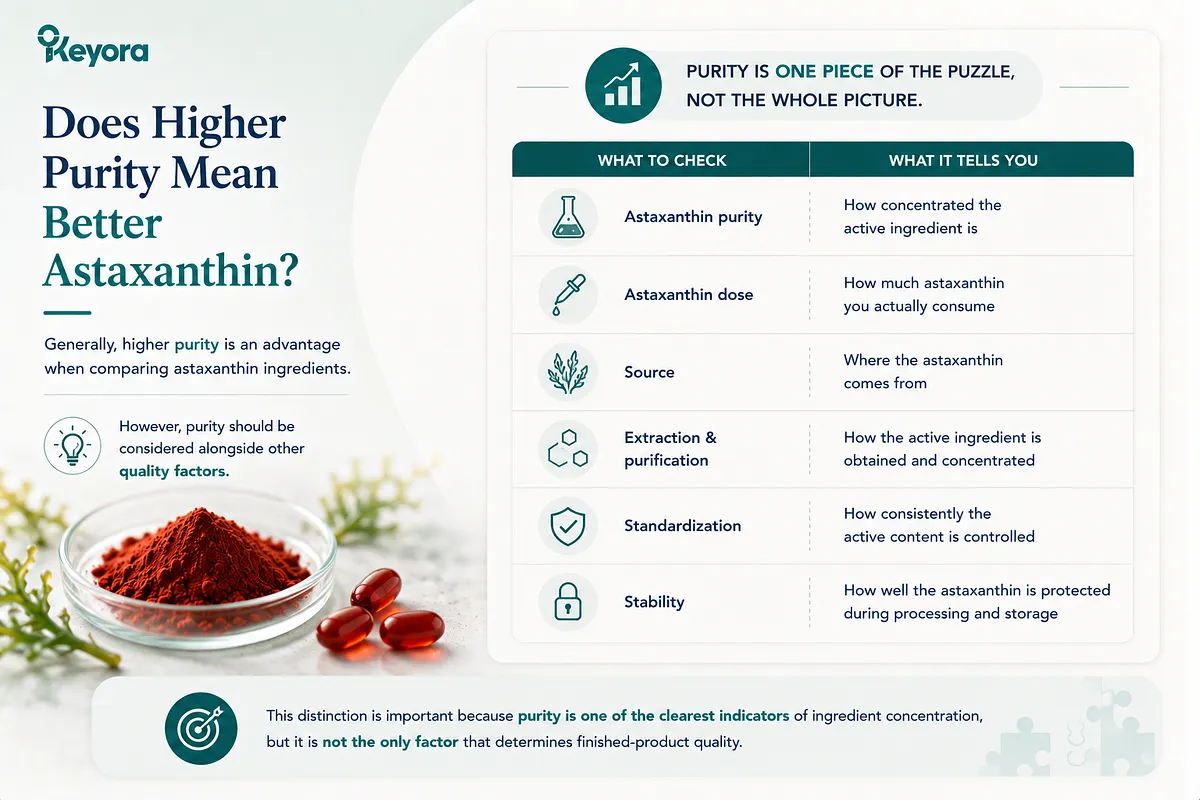
Generally, higher purity is an advantage when comparing astaxanthin ingredients.
However, purity should be considered alongside other quality factors.
For example:
What to check
What it tells you
Astaxanthin purity
How concentrated the active ingredient is
Astaxanthin dose
How much astaxanthin you actually consume
Source
Where the astaxanthin comes from
Extraction & purification
How the active ingredient is obtained and concentrated
Standardization
How consistently the active content is controlled
Stability
How well the astaxanthin is protected during processing and storage
This distinction is important because purity is one of the clearest indicators of ingredient concentration, but it is not the only factor that determines finished-product quality.
How Should You Compare Astaxanthin Products?
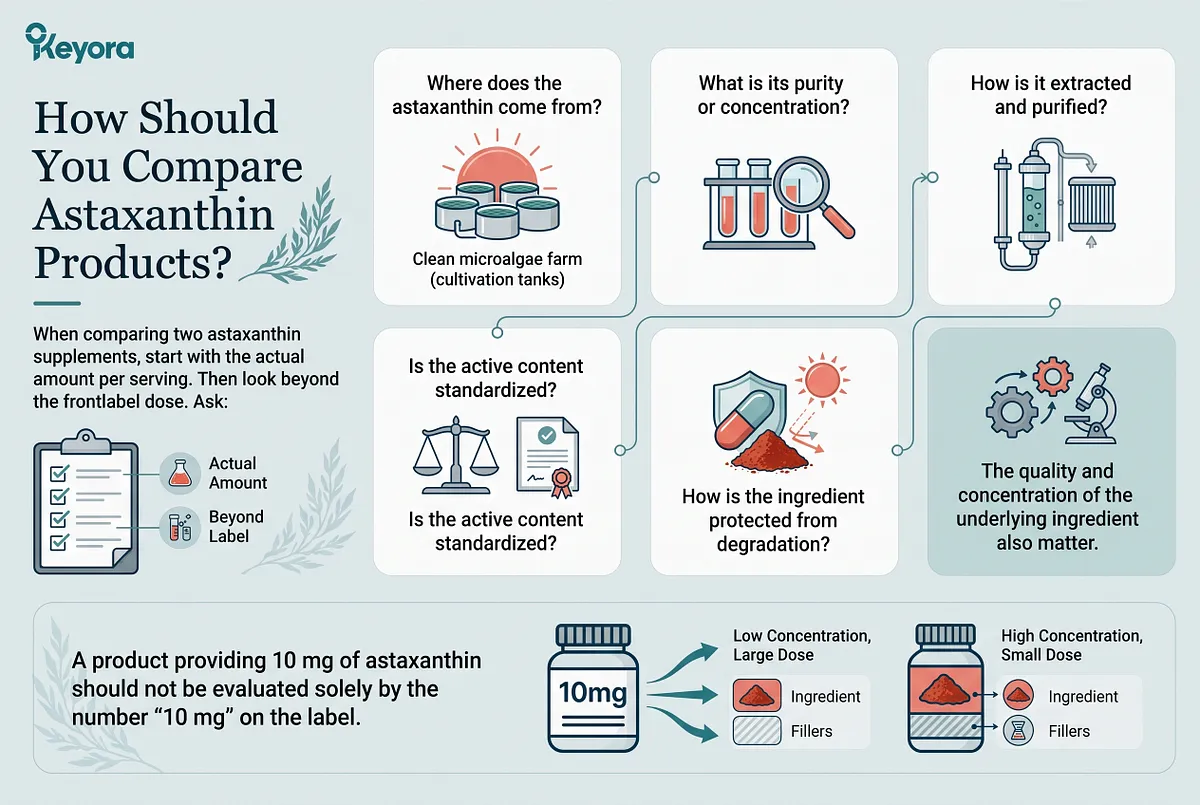
When comparing two astaxanthin supplements, start with the actual astaxanthin amount per serving.
Then look beyond the front-label dose.
Ask:
Where does the astaxanthin come from?
What is its purity or concentration?
How is it extracted and purified?
Is the active content standardized?
How is the ingredient protected from degradation?
A product providing 10 mg of astaxanthin should not be evaluated solely by the number “10 mg” on the label. The quality and concentration of the underlying ingredient also matter.
The Bottom Line
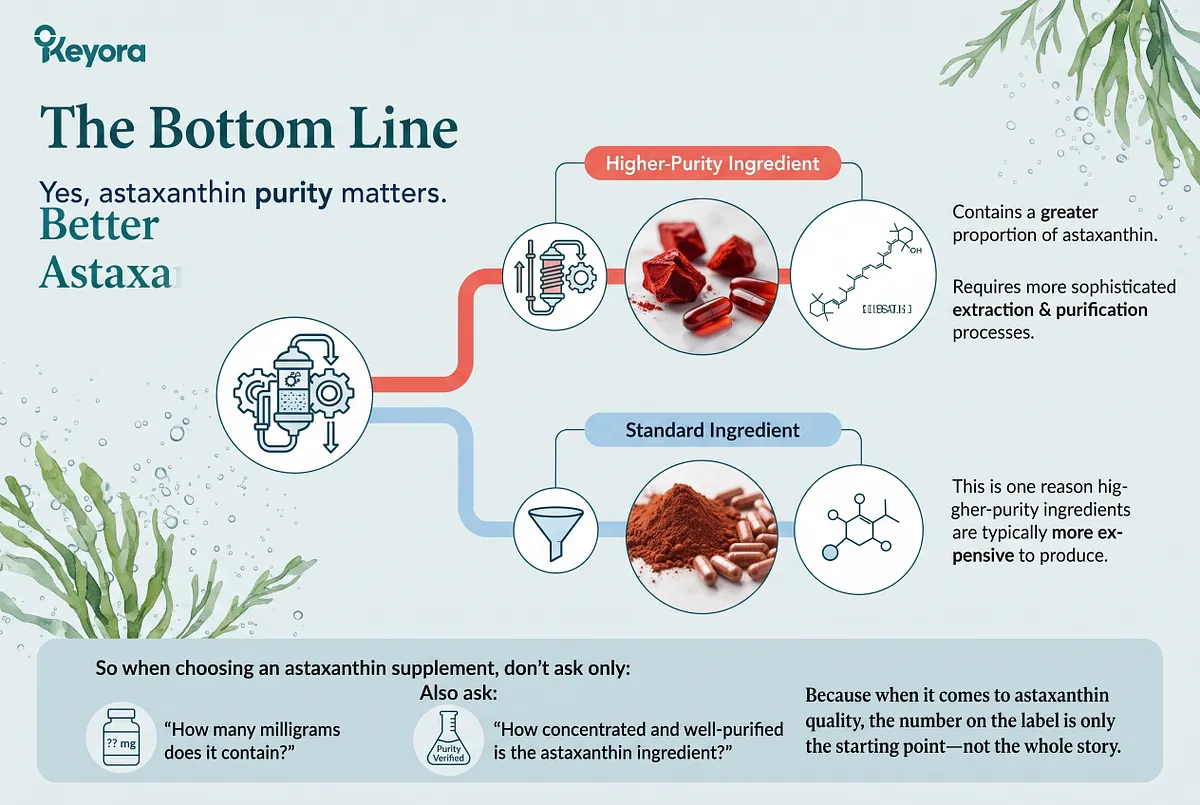
Yes, astaxanthin purity matters.
A higher-purity ingredient contains a greater proportion of astaxanthin and generally requires more sophisticated extraction and purification processes. This is one reason higher-purity ingredients are typically more expensive to produce.
So when choosing an astaxanthin supplement, don’t ask only:
“How many milligrams does it contain?”
Also ask:
“How concentrated and well-purified is the astaxanthin ingredient?”
Because when it comes to astaxanthin quality, the number on the label is only the starting point—not the whole story.
References
1. Kim, B., Lee, S. Y., Narasimhan, A. L., Kim, S., & Oh, Y. K. (2022). Cell disruption and astaxanthin extraction from Haematococcus pluvialis: Recent advances. Bioresource Technology, 343, 126124.
2. Khoo, K. S., Lee, S. Y., Ooi, C. W., Fu, X., Miao, X., Ling, T. C., & Show, P. L. (2019). Recent advances in biorefinery of astaxanthin from Haematococcus pluvialis. Bioresource Technology, 288, 121606.
3. Ambati, R. R., Phang, S. M., Ravi, S., & Aswathanarayana, R. G. (2020). Importance of Downstream Processing of Natural Astaxanthin for Pharmaceutical Application. Frontiers in Chemical Engineering, 2, 601483.
4. Duan, M., Zhou, X., Fang, T., et al. (2024). Efficient supercritical carbon dioxide extraction of astaxanthin from Haematococcus pluvialis at high pressure. The Journal of Supercritical Fluids, 205, 106145.
5. Cui, H., Zhu, X., Yu, X., et al. (2025). Advancements of astaxanthin production in Haematococcus pluvialis: Update insight and way forward. Biotechnology Advances.