
Does Astaxanthin Make You Tan?
Keyora Research Q&A Library
This is part of the Keyora Research Q&A Series, derived from Keyora Astaxanthin Research Journal Series.
Within the Keyora Astaxanthin Researcn framework, this Q&A translates complex astaxanthin biology into reader-friendly, evidence-bound answers, focusing on natural astaxanthin identity, molecular structure, antioxidant and redox mechanisms, membrane lipid interaction, mitochondrial resilience, inflammatory signaling pathways, human evidence interpretation, and the scientific principles behind responsible supplementation.
First published by Keyora Research Journal: www.keyorahealth.com
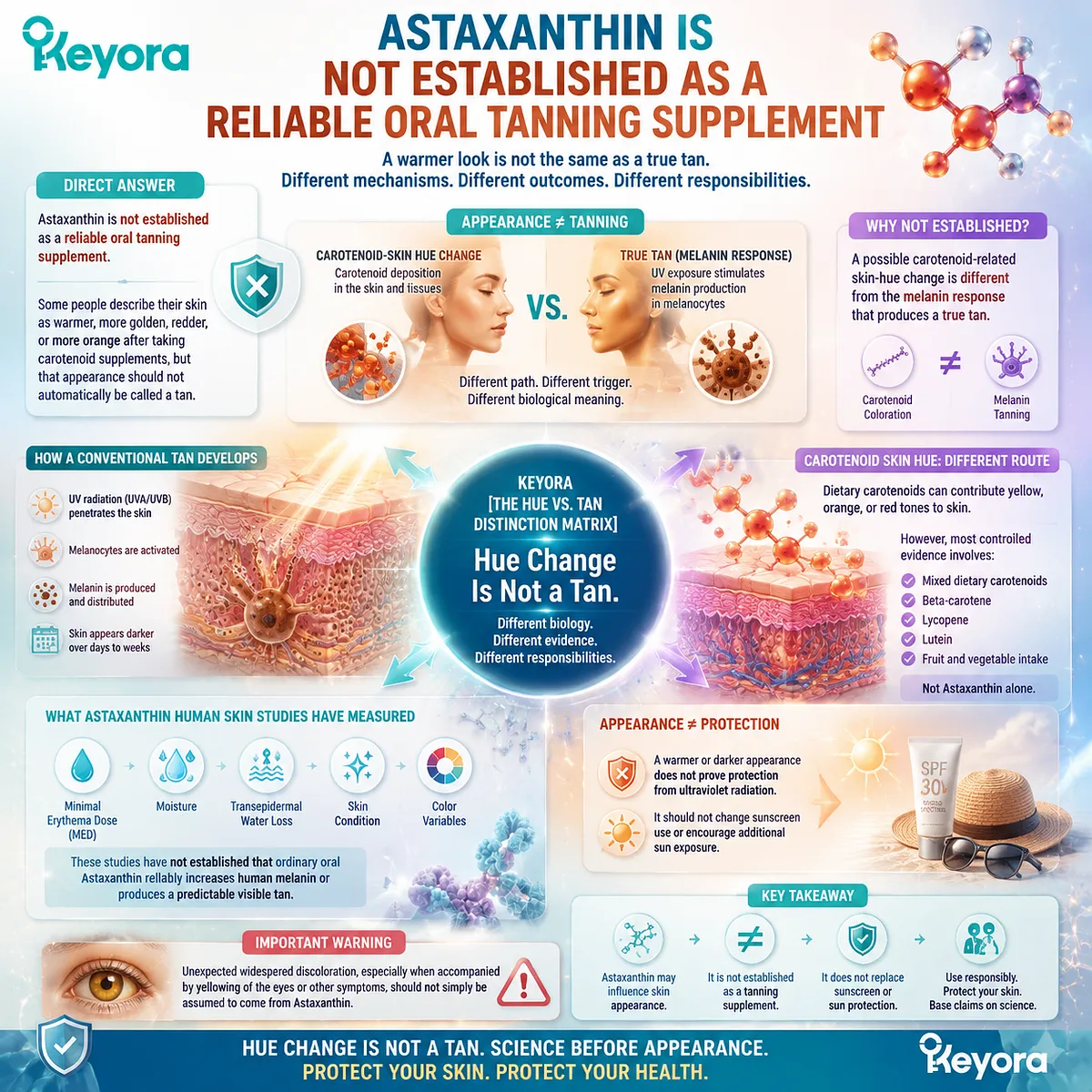
Direct Answer
Astaxanthin is not established as a reliable oral tanning supplement.
Some people describe their skin as warmer, more golden, redder, or more orange after taking carotenoid supplements, but that appearance should not automatically be called a tan.
Astaxanthin is not established as a reliable tanning supplement because a possible carotenoid-related skin-hue change is different from the melanin response that produces a true tan.
A conventional tan develops through ultraviolet-related changes in melanin.
Carotenoid coloration follows a different route.
Dietary carotenoids can contribute yellow, orange, or red tones to human skin, but most controlled evidence concerns mixed dietary carotenoids, beta-carotene, lycopene, lutein, or fruit and vegetable intake rather than Astaxanthin alone.
Astaxanthin-specific human skin studies have measured endpoints such as minimal erythema dose, moisture, water loss, skin condition, and color variables. They have not established that ordinary oral Astaxanthin reliably increases human melanin or produces a predictable visible tan.
A warmer or darker appearance also does not prove protection from ultraviolet radiation. It should not change sunscreen use or encourage additional sun exposure.
Unexpected widespread discoloration, especially when accompanied by yellowing of the eyes or other symptoms, should not simply be assumed to come from Astaxanthin.
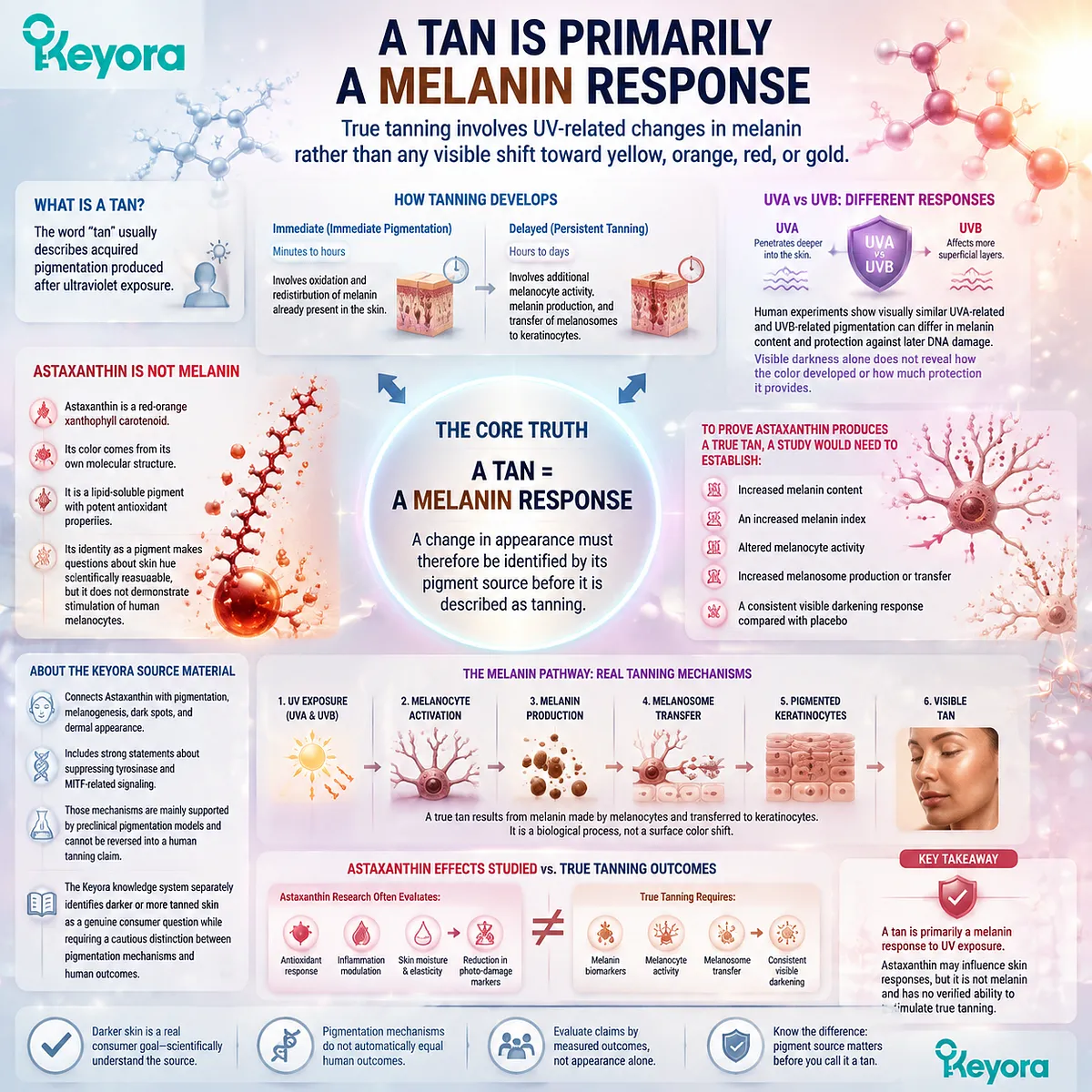
A Tan Is Primarily a Melanin Response
True tanning involves UV-related changes in melanin rather than any visible shift toward yellow, orange, red, or gold
The word “tan” usually describes acquired pigmentation produced after ultraviolet exposure.
An immediate darkening response can involve oxidation and redistribution of melanin already present in the skin. Delayed tanning develops later and involves additional melanocyte activity, melanin production, and transfer of pigment-containing melanosomes to surrounding keratinocytes.
UVA and UVB do not produce identical responses. Human experiments have shown that visually similar UVA-related and UVB-related pigmentation can differ in melanin content and protection against later DNA damage. Visible darkness alone therefore does not reveal how the color developed or how much protection it provides.
Astaxanthin is not melanin. It is a red-orange xanthophyll carotenoid whose color comes from its own molecular structure. Its identity as a pigment makes questions about skin hue scientifically reasonable, but it does not demonstrate stimulation of human melanocytes.
To prove that Astaxanthin produces a true tan, a study would need to establish outcomes such as:
-
increased melanin content
-
an increased melanin index
-
altered melanocyte activity
-
increased melanosome production or transfer
-
a consistent visible darkening response compared with placebo
The supplied Keyora source material connects Astaxanthin with pigmentation, melanogenesis, dark spots, and dermal appearance. It also includes strong statements about suppressing tyrosinase and MITF-related signaling. Those mechanisms are mainly supported by preclinical pigmentation models and cannot be reversed into a human tanning claim.
The Keyora knowledge system separately identifies darker or more tanned skin as a genuine consumer question while requiring a cautious distinction between pigmentation mechanisms and human outcomes.
A change in appearance must therefore be identified by its pigment source before it is described as tanning.
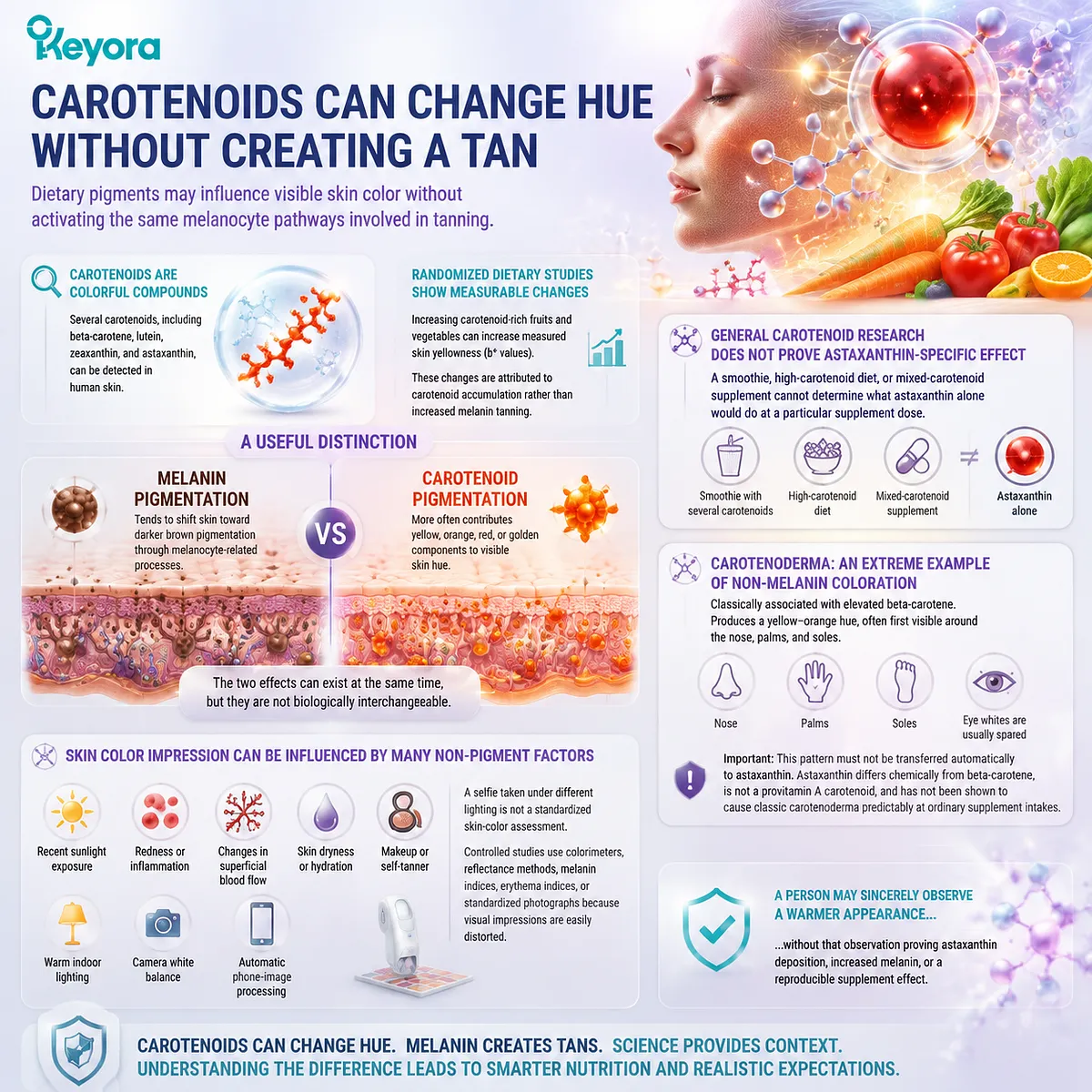
Carotenoids Can Change Hue Without Creating a Tan
Dietary pigments may influence visible skin color without activating the same melanocyte pathways involved in tanning
Carotenoids are colored compounds, and several can be detected in human skin.
Randomized dietary studies have shown that increasing carotenoid-rich fruits and vegetables can increase measured skin yellowness. These changes are attributed to carotenoid accumulation rather than increased melanin tanning.
This creates a useful distinction:
Melanin pigmentation tends to shift skin toward darker brown pigmentation through melanocyte-related processes.
Carotenoid pigmentation more often contributes yellow, orange, red, or golden components to visible skin hue.
The two effects can exist at the same time, but they are not biologically interchangeable.
General carotenoid research does not prove an Astaxanthin-specific effect. A smoothie containing several carotenoids, a high-carotenoid diet, or a mixed-carotenoid supplement cannot determine what Astaxanthin alone would do at a particular supplement dose.
Carotenoderma provides an extreme example of non-melanin coloration. It is classically associated with elevated beta-carotene and produces a yellow-orange hue, often first visible around the nose, palms, and soles. The eye whites are generally spared because they do not contain the same outer keratinized layer where the pigment becomes visible.
That clinical pattern must not be transferred automatically to Astaxanthin. Astaxanthin differs chemically from beta-carotene, is not a provitamin A carotenoid, and has not been shown to cause classic carotenoderma predictably at ordinary supplement intakes.
A skin color impression may also reflect factors unrelated to pigment accumulation, including:
-
recent sunlight exposure
-
redness or inflammation
-
changes in superficial blood flow
-
skin dryness or hydration
-
makeup or self-tanner
-
warm indoor lighting
-
camera white balance
-
automatic phone-image processing
A selfie taken under different lighting is therefore not a standardized skin-color assessment. Controlled studies commonly use colorimeters, reflectance methods, melanin indices, erythema indices, or carefully standardized photographs because visual impressions are easily distorted.
A person may sincerely observe a warmer appearance without that observation proving Astaxanthin deposition, increased melanin, or a reproducible supplement effect.
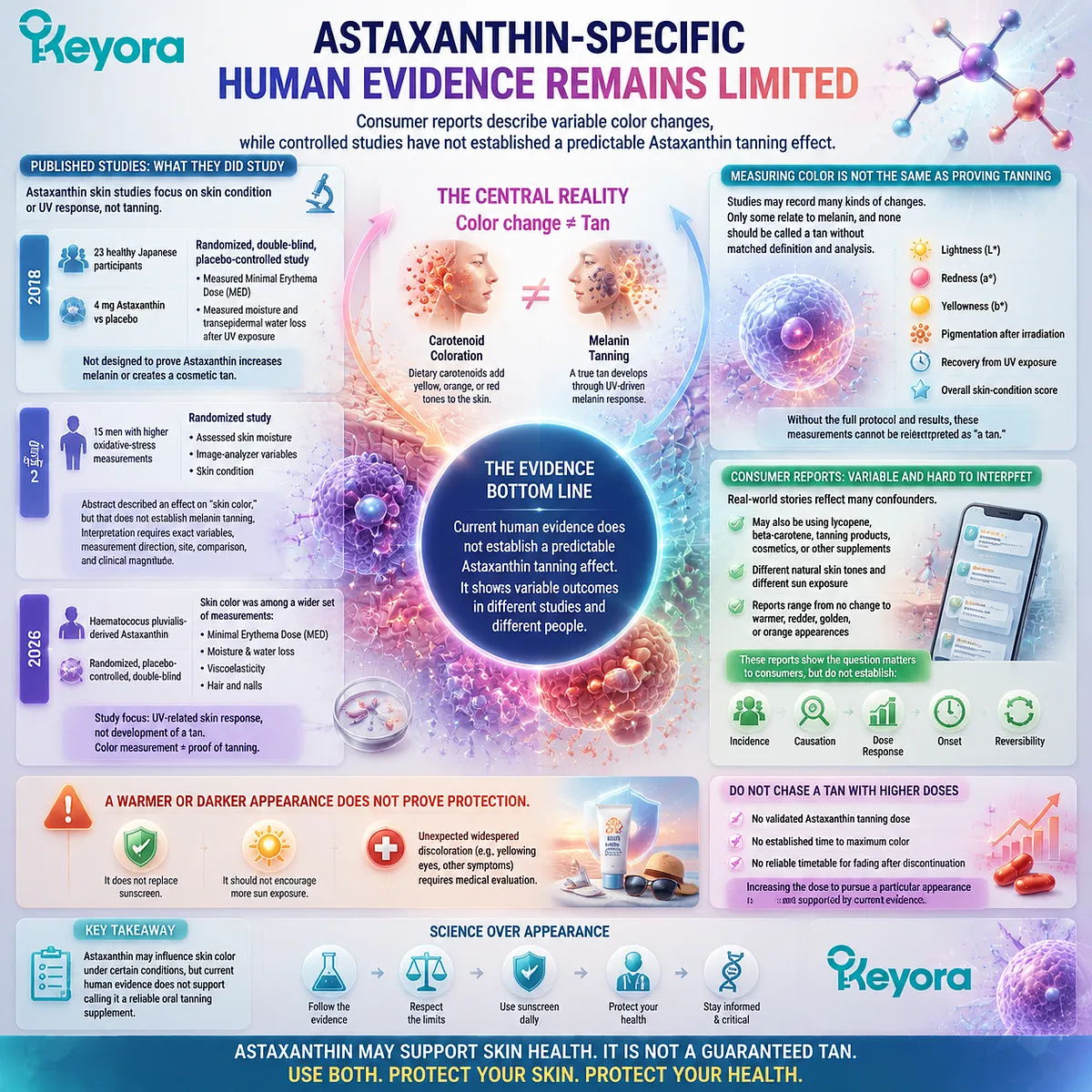
Astaxanthin-Specific Human Evidence Remains Limited
Consumer reports describe variable color changes, while controlled studies have not established a predictable Astaxanthin tanning effect
Published Astaxanthin skin studies have generally been designed around skin condition or ultraviolet response rather than tanning.
A 2018 randomized, double-blind, placebo-controlled study involved 23 healthy Japanese participants taking 4 mg of Astaxanthin or placebo. The investigators measured minimal erythema dose and ultraviolet-related changes in moisture and transepidermal water loss. The study was not designed to prove that Astaxanthin increased melanin or created a cosmetic tan.
Another randomized study in 15 men with higher oxidative-stress measurements assessed skin moisture, image-analyzer variables, and skin condition. Its abstract described an effect on “skin color,” but that broad term does not establish melanin tanning. Interpretation requires the exact color variable, measurement direction, measurement site, between-group comparison, and clinical magnitude.
A 2026 randomized, placebo-controlled, double-blind study of Haematococcus pluvialis-derived Astaxanthin included skin color among a wider set of measurements involving minimal erythema dose, moisture, water loss, viscoelasticity, hair, and nails. The reported study focus was ultraviolet-related skin response, not development of a tan. Its inclusion of a color measurement should not be rewritten as proof that Astaxanthin creates predictable tanning.
The distinction between measuring color and proving tanning is important. A study might record:
-
lightness
-
redness
-
yellowness
-
pigmentation after irradiation
-
recovery from ultraviolet exposure
-
an overall skin-condition score
Only some of these measurements relate directly to melanin, and none should be called a tan without a matched definition and analysis.
Consumer stories are even more difficult to interpret. People reporting color changes may also be using lycopene, beta-carotene, tanning products, dietary changes, cosmetics, or other supplements. They may have different natural skin tones and different levels of sun exposure. Reports range from no visible change to warmer, redder, golden, or orange appearances.
These reports establish that the question matters to consumers. They do not establish incidence, causation, dose response, onset, or reversibility.
Current evidence also does not justify increasing the dose to pursue a particular appearance. There is no validated Astaxanthin tanning dose, no established time to maximum color, and no reliable timetable for fading after discontinuation.
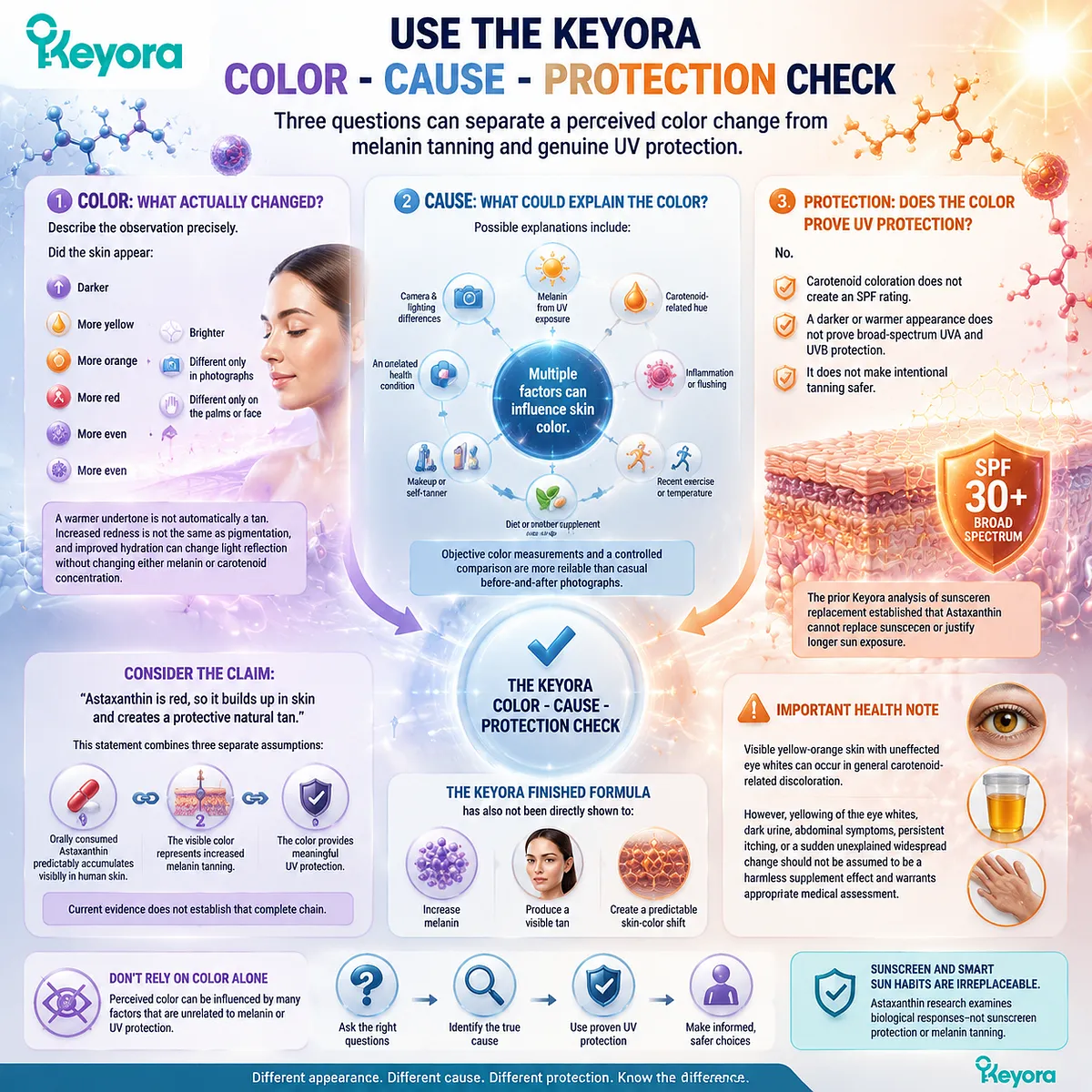
Use the Keyora Color – Cause – Protection Check
Three questions can separate a perceived color change from melanin tanning and genuine UV protection
The Keyora Color – Cause – Protection Check provides a practical way to assess claims such as, “Astaxanthin deposits pigment in the skin, gives you a natural tan, and protects you from sunlight.”
Color: What actually changed?
Describe the observation precisely.
Did the skin appear:
-
darker
-
more yellow
-
more orange
-
more red
-
more even
-
brighter
-
different only in photographs
-
different only on the palms or face
A warmer undertone is not automatically a tan. Increased redness is not the same as pigmentation, and improved hydration can change light reflection without changing either melanin or carotenoid concentration.
Cause: What could explain the color?
Possible explanations include:
-
melanin from UV exposure
-
carotenoid-related hue
-
inflammation or flushing
-
recent exercise or temperature
-
diet or another supplement
-
makeup or self-tanner
-
medication
-
camera and lighting differences
-
an unrelated health condition
Objective color measurements and a controlled comparison are more reliable than casual before-and-after photographs.
Protection: Does the color prove UV protection?
No.
Carotenoid coloration does not create an SPF rating. A darker or warmer appearance does not prove broad-spectrum UVA and UVB protection, and it does not make intentional tanning safer. The prior Keyora analysis of sunscreen replacement established that Astaxanthin cannot replace sunscreen or justify longer sun exposure.
Consider the claim:
“Astaxanthin is red, so it builds up in skin and creates a protective natural tan.”
This statement combines three separate assumptions:
-
orally consumed Astaxanthin predictably accumulates visibly in human skin
-
the visible color represents increased melanin tanning
-
the color provides meaningful UV protection
Current evidence does not establish that complete chain.
The exact Keyora finished formula has also not been directly shown to increase melanin, produce a visible tan, or create a predictable skin-color shift.
Visible yellow-orange skin with unaffected eye whites can occur in general carotenoid-related discoloration. However, yellowing of the eye whites, dark urine, abdominal symptoms, persistent itching, or a sudden unexplained widespread change should not be assumed to be a harmless supplement effect and warrants appropriate medical assessment.
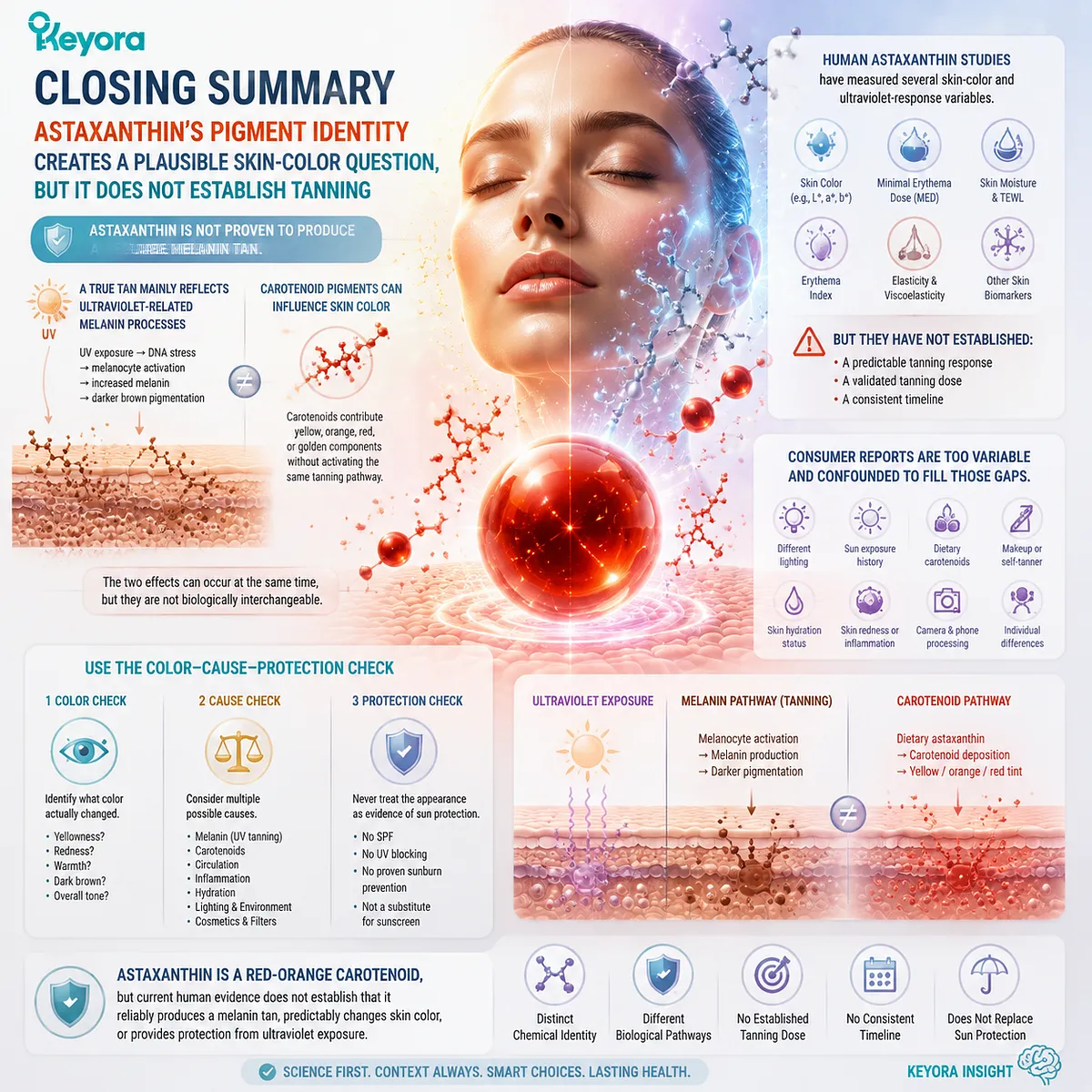
Closing Summary
Astaxanthin’s pigment identity creates a plausible skin-color question, but it does not establish tanning
Astaxanthin is not proven to produce a reliable melanin tan.
A true tan mainly reflects ultraviolet-related melanin processes. Carotenoid pigments can influence yellow, orange, red, or golden components of skin color without activating the same tanning pathway.
Human Astaxanthin studies have measured several skin-color and ultraviolet-response variables, but they have not established a predictable tanning response, a validated tanning dose, or a consistent timeline. Consumer reports are too variable and confounded to fill those gaps.
Use the Color – Cause – Protection Check. Identify what color actually changed, consider melanin, carotenoids, circulation, lighting, and other explanations, and never treat the appearance as evidence of sun protection.
Astaxanthin is a red-orange carotenoid, but current human evidence does not establish that it reliably produces a melanin tan, predictably changes skin color, or provides protection from ultraviolet exposure.
This article is for educational and informational purposes only. It does not provide medical advice, diagnosis, treatment, cure, prevention, disease outcome claims, hormone restoration claims, fertility outcome claims, or formula-specific clinical efficacy claims.