
Does Astaxanthin Improve Endurance in Humans?
Keyora Research Q&A Library
This is part of the Keyora Research Q&A Series, derived from Keyora Astaxanthin Research Journal Series.
Within the Keyora Astaxanthin Researcn framework, this Q&A translates complex astaxanthin biology into reader-friendly, evidence-bound answers, focusing on natural astaxanthin identity, molecular structure, antioxidant and redox mechanisms, membrane lipid interaction, mitochondrial resilience, inflammatory signaling pathways, human evidence interpretation, and the scientific principles behind responsible supplementation.
First published by Keyora Research Journal: www.keyorahealth.com
Direct Answer
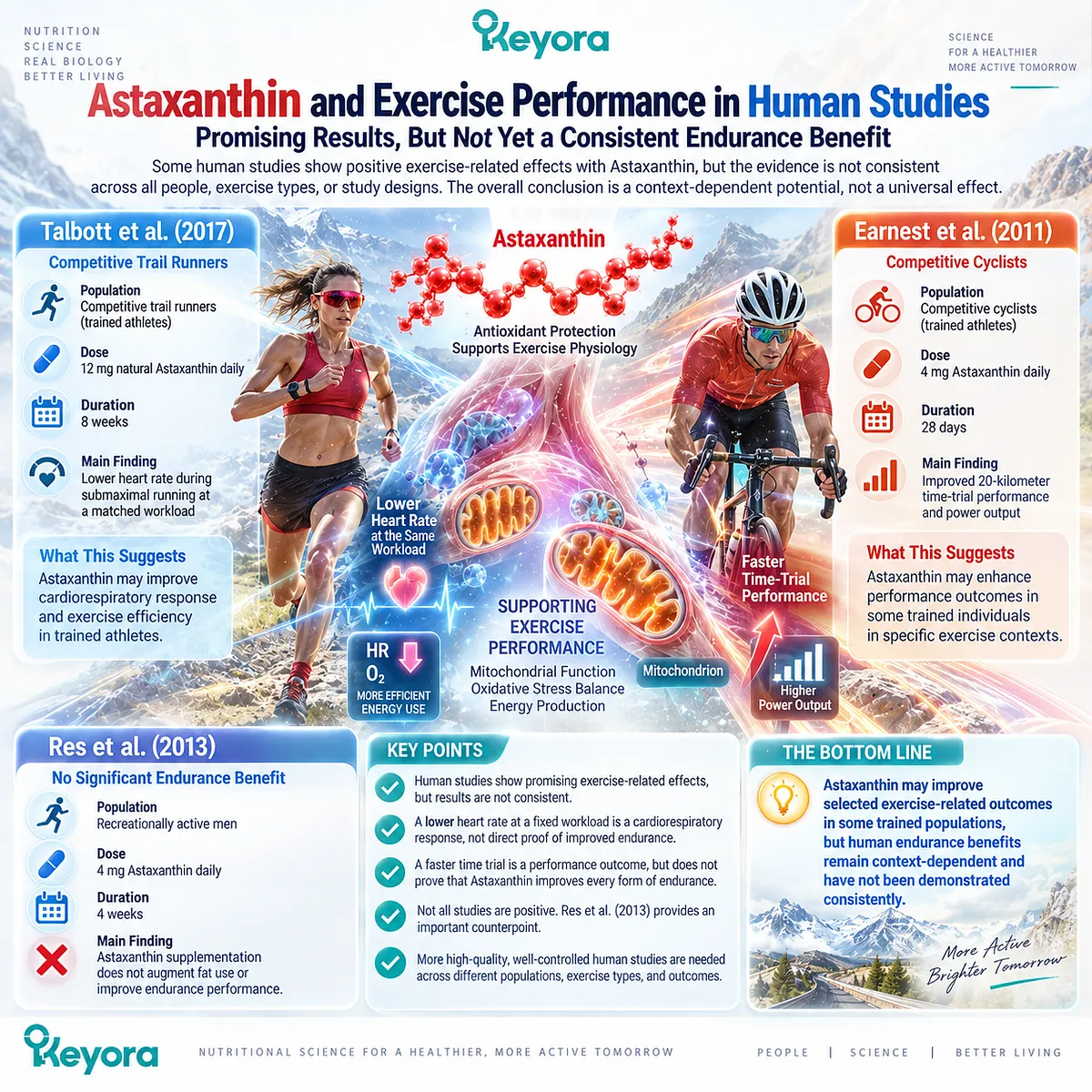
Astaxanthin has shown promising exercise-related effects in some human studies, but the current evidence does not establish a consistent endurance benefit across all people, exercise types, or study designs.
Two human studies highlighted in Keyora Astaxanthin EP-4: The Cardiac Architecture: Bio-Energetic Sovereignty provide positive signals in trained athletes.
Talbott et al. (2017) studied competitive trail runners receiving 12 mg of natural Astaxanthin daily for eight weeks and reported a lower heart rate during submaximal running at a matched workload.
Earnest et al. (2011) studied competitive cyclists receiving 4 mg daily for 28 days and reported improved 20-kilometer time-trial performance and power output.
These findings are relevant to exercise performance.
But they do not answer exactly the same question.
A lower heart rate at a fixed submaximal workload is a cardiorespiratory response.
A faster cycling time trial is a performance outcome.
Neither result, by itself, proves that Astaxanthin improves every form of endurance.
The evidence is also not uniformly positive. The EP-4 reference set includes Res et al. (2013), Astaxanthin Supplementation Does Not Augment Fat Use or Improve Endurance Performance, providing an important counterpoint to the positive studies.
The most defensible conclusion is therefore:
Astaxanthin may improve selected exercise-related outcomes in some trained populations, but human endurance benefits remain context-dependent and have not been demonstrated consistently.
What Does “Improved Endurance” Actually Mean in a Human Study?
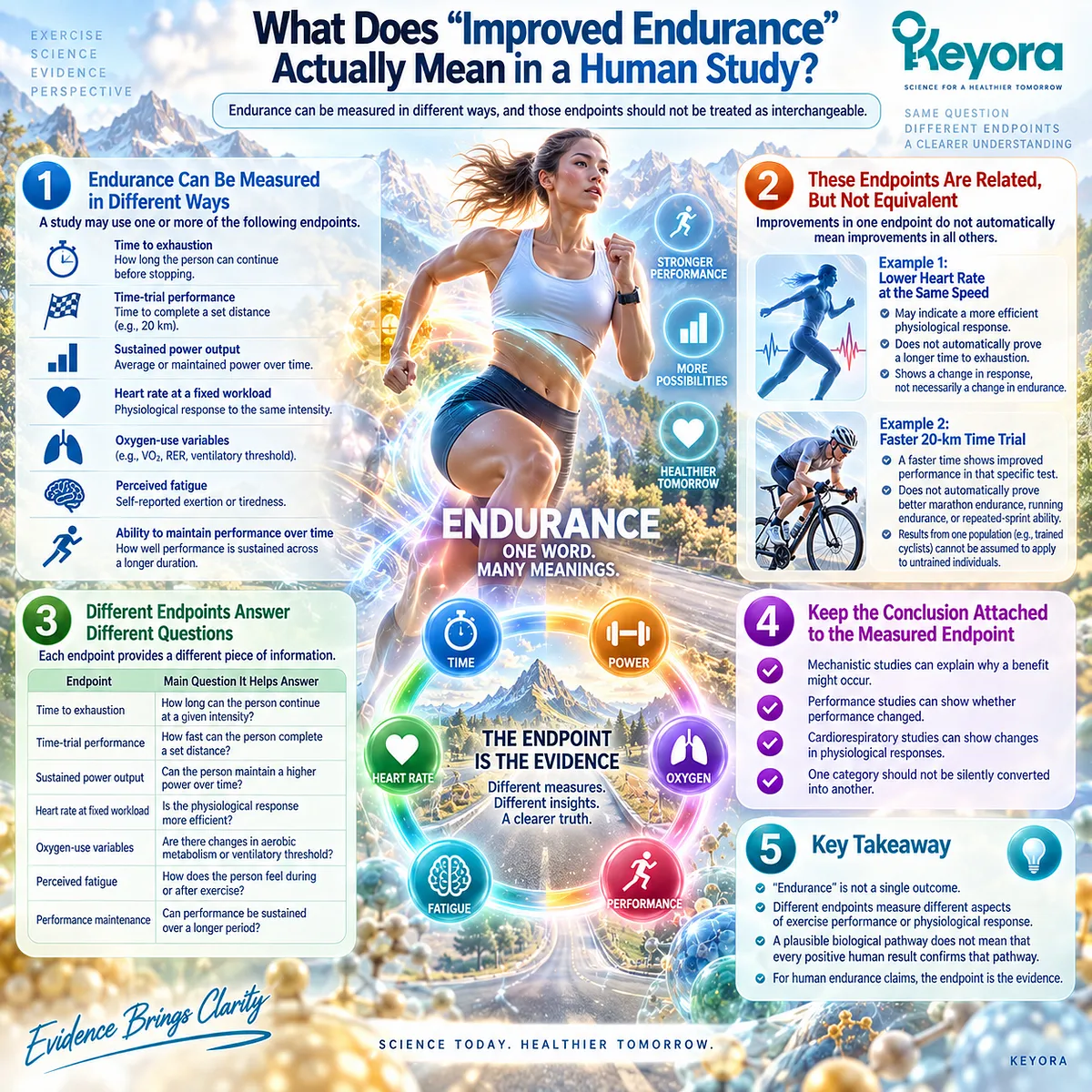
Endurance can be measured in different ways, and those endpoints should not be treated as interchangeable
“Endurance” sounds like a single outcome.
In research, it can mean several different things.
A study might measure:
-
time to exhaustion
-
time-trial performance
-
sustained power output
-
heart rate at a fixed workload
-
oxygen-use variables
-
perceived fatigue
-
ability to maintain performance over time
These outcomes can be related, but they are not equivalent.
For example, imagine that a runner can maintain the same speed with a lower heart rate.
That may indicate a different physiological response to the workload.
But it does not automatically prove that the runner can continue for a longer time.
Similarly, if a cyclist completes a 20-kilometer time trial faster, that is meaningful evidence of improved performance in that test.
It does not automatically prove improved marathon endurance, running endurance, repeated-sprint ability, or endurance in an untrained person.
This leads to one of the most important rules for interpreting Astaxanthin exercise research:
Keep the conclusion attached to the endpoint that was actually measured.
Mechanistic studies can explain why a benefit might occur.
Performance studies can show whether performance changed.
Cardiorespiratory studies can show changes in physiological responses.
But one category should not silently be converted into another.
This distinction is particularly important because previous questions in this series discussed CPT1, fat oxidation, oxidative stress, and metabolic flexibility.
Those pathways may provide biological explanations for an exercise effect.
But a plausible pathway does not mean that every positive human exercise result confirms that pathway.
For human endurance claims, the endpoint is the evidence.
What Did the Runner Study Show?
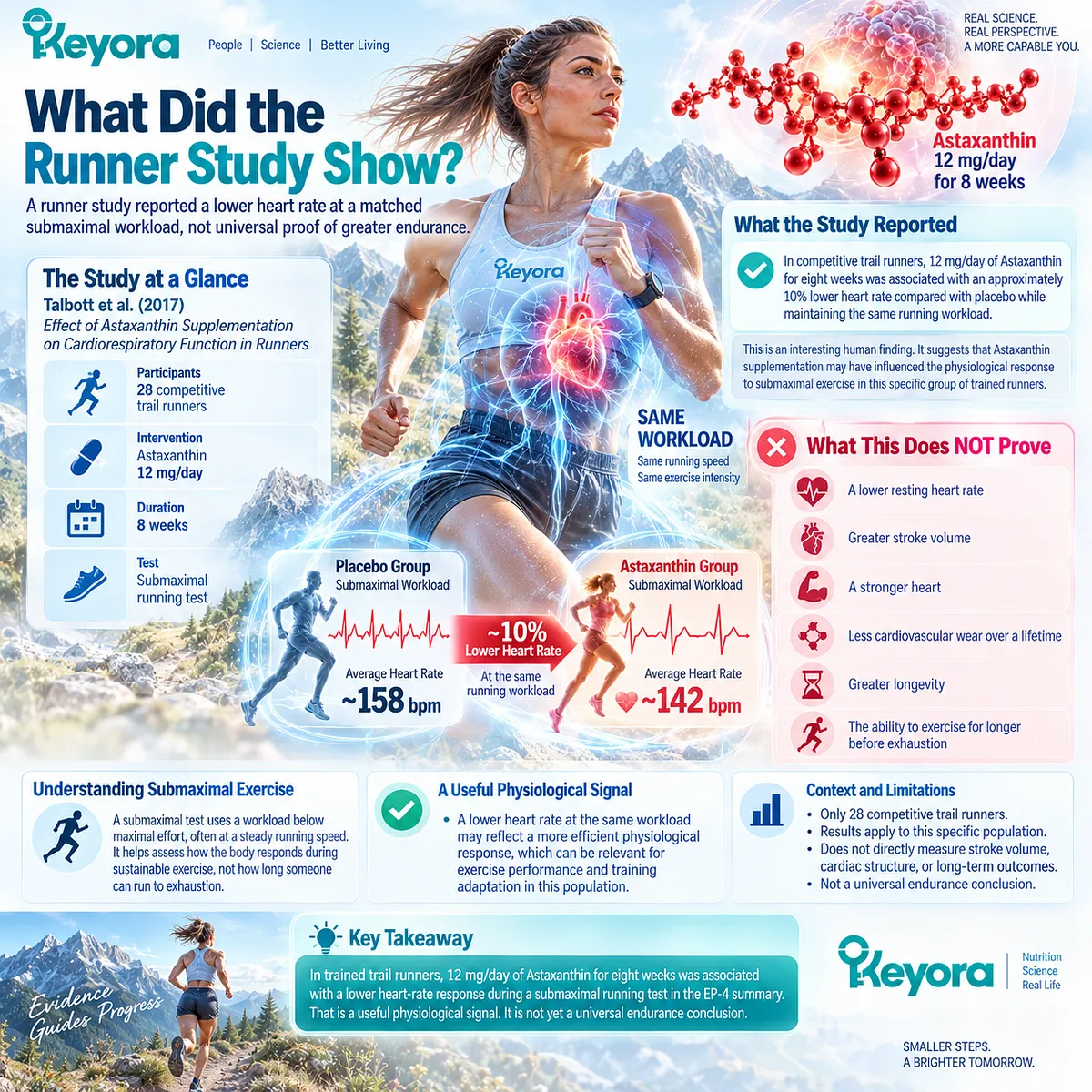
A runner study reported a lower heart rate at a matched submaximal workload, not universal proof of greater endurance
Talbott et al. (2017), Effect of Astaxanthin Supplementation on Cardiorespiratory Function in Runners, is one of the main human studies discussed in the Keyora EP-4 evidence framework.
According to the EP-4 summary, the study involved 28 competitive trail runners.
The Astaxanthin group received:
12 mg/day
for:
8 weeks
The runners then completed a submaximal running test.
The source reports that the Astaxanthin group showed an approximately 10% lower heart rate compared with placebo while maintaining the same running workload.
This is an interesting human finding.
It suggests that Astaxanthin supplementation may have influenced the physiological response to submaximal exercise in this specific group of trained runners.
However, several stronger interpretations should be avoided.
The lower exercise heart rate does not, by itself, prove:
-
a lower resting heart rate
-
greater stroke volume
-
a stronger heart
-
less cardiovascular wear over a lifetime
-
greater longevity
or:
-
the ability to exercise for longer before exhaustion
Keyora Astaxanthin EP-4 goes beyond the measured endpoint by mathematically inferring increased stroke volume and then extending the finding into long-term cardiac-efficiency and longevity concepts.
Those extrapolations should not be treated as direct findings of the runner trial.
The most evidence-matched interpretation is simpler:
In trained trail runners, 12 mg/day of Astaxanthin for eight weeks was associated with a lower heart-rate response during a submaximal running test in the EP-4 summary.
That is a useful physiological signal.
It is not yet a universal endurance conclusion.
What Did the Cyclist Study Show?
A controlled cyclist trial reported better time-trial performance, but one performance test cannot establish a universal endurance effect
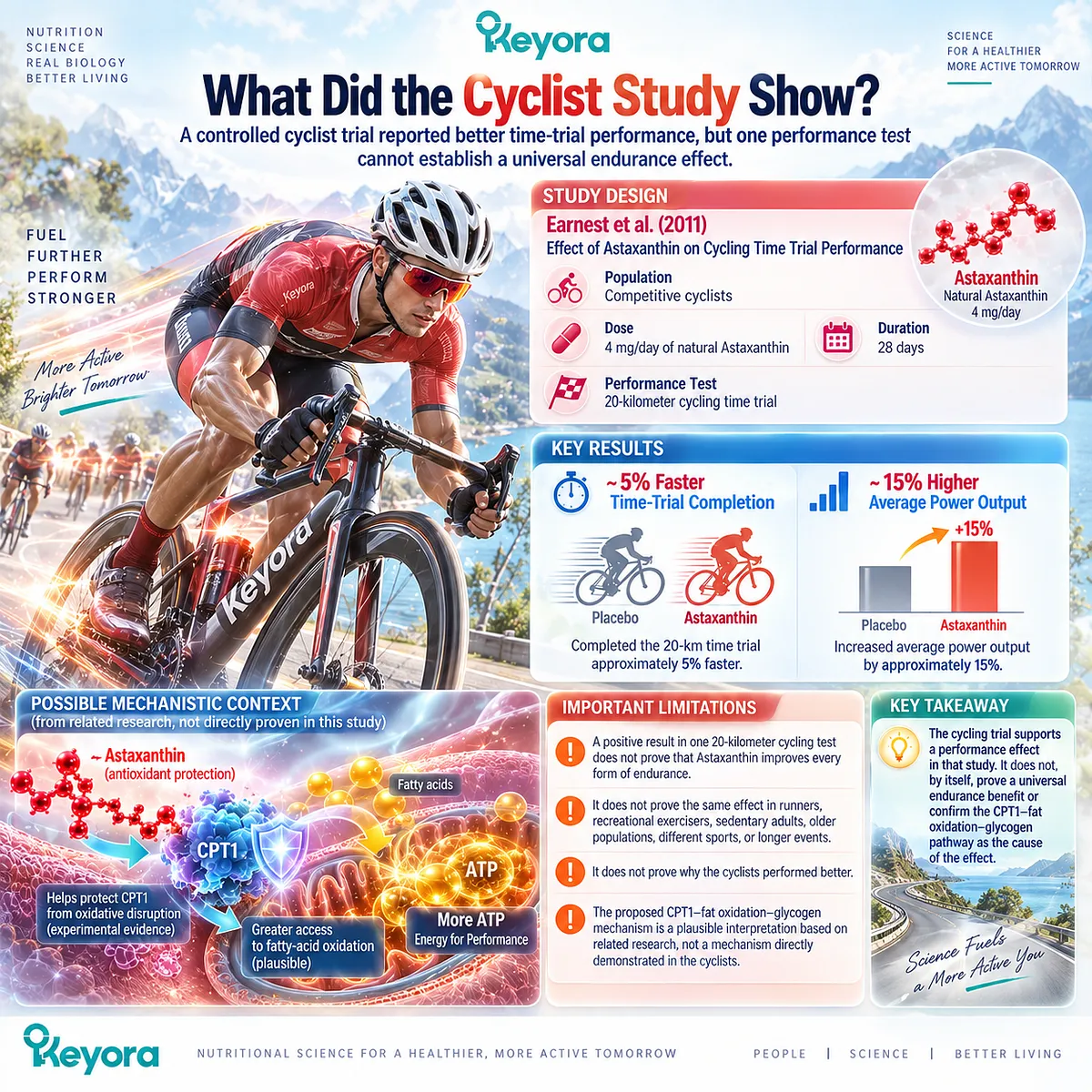
Earnest et al. (2011), Effect of Astaxanthin on Cycling Time Trial Performance, provides a different type of human evidence.
The participants were competitive cyclists.
According to the EP-4 source, the intervention was:
4 mg/day of natural Astaxanthin
for:
28 days
The performance test was a:
20-kilometer cycling time trial
The source reports that the Astaxanthin group completed the time trial approximately 5% faster and increased average power output by approximately 15%.
Unlike the runner study, this is directly relevant to a performance outcome.
The cyclists were not simply showing a different heart-rate response.
They performed differently in the specific cycling test.
That makes the study important when asking whether Astaxanthin can influence human exercise performance.
But the conclusion still needs boundaries.
A positive 20-kilometer cycling result does not prove that Astaxanthin improves every form of endurance.
It does not prove the same effect in:
-
runners
-
recreational exercisers
-
sedentary adults
-
older populations
-
different sports
-
longer endurance events
It also does not prove why the cyclists performed better.
The EP-4 narrative explains the result through CPT1 protection, maintained fat oxidation, and glycogen sparing.
That is a plausible mechanistic interpretation based on related experimental research.
It is not the same as directly demonstrating those mechanisms in the cyclists.
The correct distinction is:
The cycling trial supports a performance effect in that study.
It does not, by itself, prove the CPT1-fat oxidation-glycogen pathway as the cause of the effect.
Why the Human Evidence Is Still Mixed
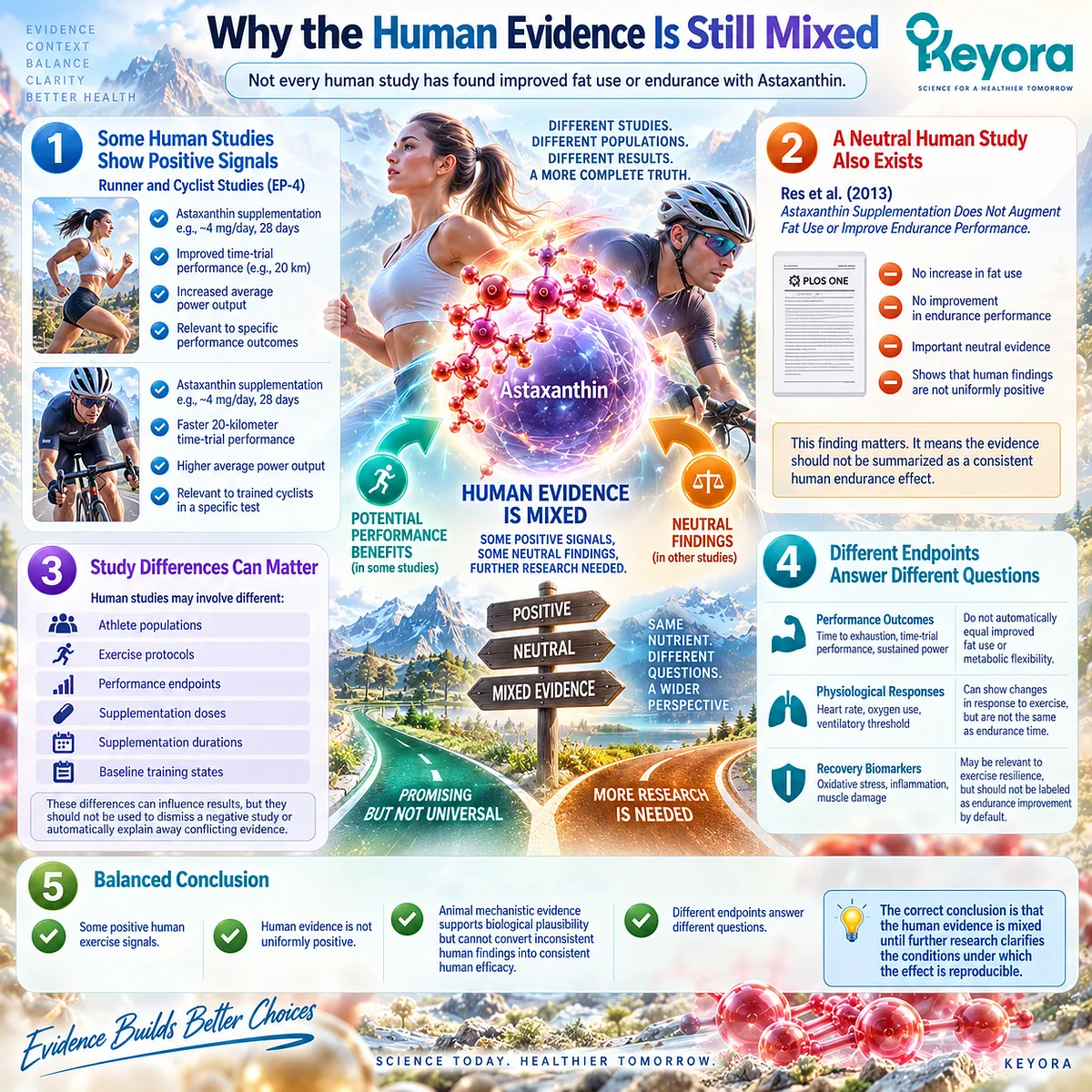
Not every human study has found improved fat use or endurance with Astaxanthin
If the only human evidence consisted of positive runner and cyclist studies, it would be easy to conclude that Astaxanthin consistently improves endurance.
But the literature summarized in EP-4 does not support such a simple conclusion.
The reference set also includes Res et al. (2013), whose article title directly states:
Astaxanthin Supplementation Does Not Augment Fat Use or Improve Endurance Performance.
That finding matters.
It means the human evidence is not uniformly positive.
This does not erase the positive findings from the runner or cyclist studies.
It changes how confidently those findings can be generalized.
The evidence should therefore be read as:
some positive human exercise signals
rather than:
a universally reproduced human endurance effect
Different studies may involve different:
-
athlete populations
-
exercise protocols
-
performance endpoints
-
supplementation doses
-
supplementation durations
-
baseline training states
These differences can matter when interpreting results.
However, they should not be used as an excuse to dismiss a negative study or automatically explain away conflicting evidence.
If one study is positive and another is neutral, the correct conclusion is that the evidence is mixed until further research clarifies the conditions under which the effect is reproducible.
The same principle applies to mechanistic evidence.
Animal studies involving CPT1 and fat oxidation can strengthen biological plausibility.
They cannot convert inconsistent human findings into consistent human efficacy.
Recovery studies also belong in a separate evidence category.
Changes in oxidative-stress, inflammation, or muscle-damage biomarkers may be relevant to exercise resilience, but they should not automatically be labeled endurance improvement.
Different endpoints answer different questions.
The Keyora Human Endurance Evidence Rule: Positive Signals Are Not Universal Proof
Astaxanthin has promising human exercise signals, but each benefit should remain attached to the population and endpoint actually studied
The Keyora Human Endurance Evidence Rule keeps every Astaxanthin result attached to five things:
population
→ dose
→ duration
→ exercise protocol
→ measured endpoint
Using that framework, the current human evidence can be interpreted more accurately.
The runner study provides evidence related to:
submaximal exercise heart-rate response
The cyclist study provides evidence related to:
20-kilometer time-trial performance and power output
The Res study provides evidence that:
a human endurance or fat-use benefit is not reproduced consistently across all research
These findings can coexist.
They do not need to be forced into a single positive or negative verdict.
The practical evidence boundaries are:
-
Lower exercise heart rate ≠ universal endurance improvement
-
Cycling performance improvement ≠ all-sport endurance improvement
-
Performance improvement ≠ mechanism proven
-
Athlete evidence ≠ identical effect in untrained adults
-
One positive study ≠ consistent human evidence
-
A higher Astaxanthin dose ≠ a larger endurance benefit
This last point is particularly important.
The runner study used 12 mg/day, while the cyclist study used 4 mg/day. These different doses cannot be arranged into a simple dose-response hierarchy.
A 16 mg product therefore cannot be assumed to produce a larger endurance effect simply because its dose is higher.
The most useful conclusion remains evidence-specific:
Astaxanthin has produced promising cardiorespiratory and exercise-performance signals in some trained human populations, but the total human literature does not yet establish a consistent, universal endurance benefit.
The next question narrows the evidence further and examines one particularly interesting human endpoint:
Can Astaxanthin Lower Heart Rate During Exercise?
This article is for educational and informational purposes only. It does not provide medical advice, diagnosis, treatment, cure, prevention, disease outcome claims, hormone restoration claims, fertility outcome claims, or formula-specific clinical efficacy claims.