
Does Astaxanthin Extraction Affect Quality? Why the Extraction Method Matters
Keyora Research Q&A Library
This is part of the Keyora Research Q&A Series, derived from Keyora Astaxanthin Research Journal Series.
Within the Keyora Astaxanthin Researcn framework, this Q&A translates complex astaxanthin biology into reader-friendly, evidence-bound answers, focusing on natural astaxanthin identity, molecular structure, antioxidant and redox mechanisms, membrane lipid interaction, mitochondrial resilience, inflammatory signaling pathways, human evidence interpretation, and the scientific principles behind responsible supplementation.
First published by Keyora Research Journal: www.keyorahealth.com
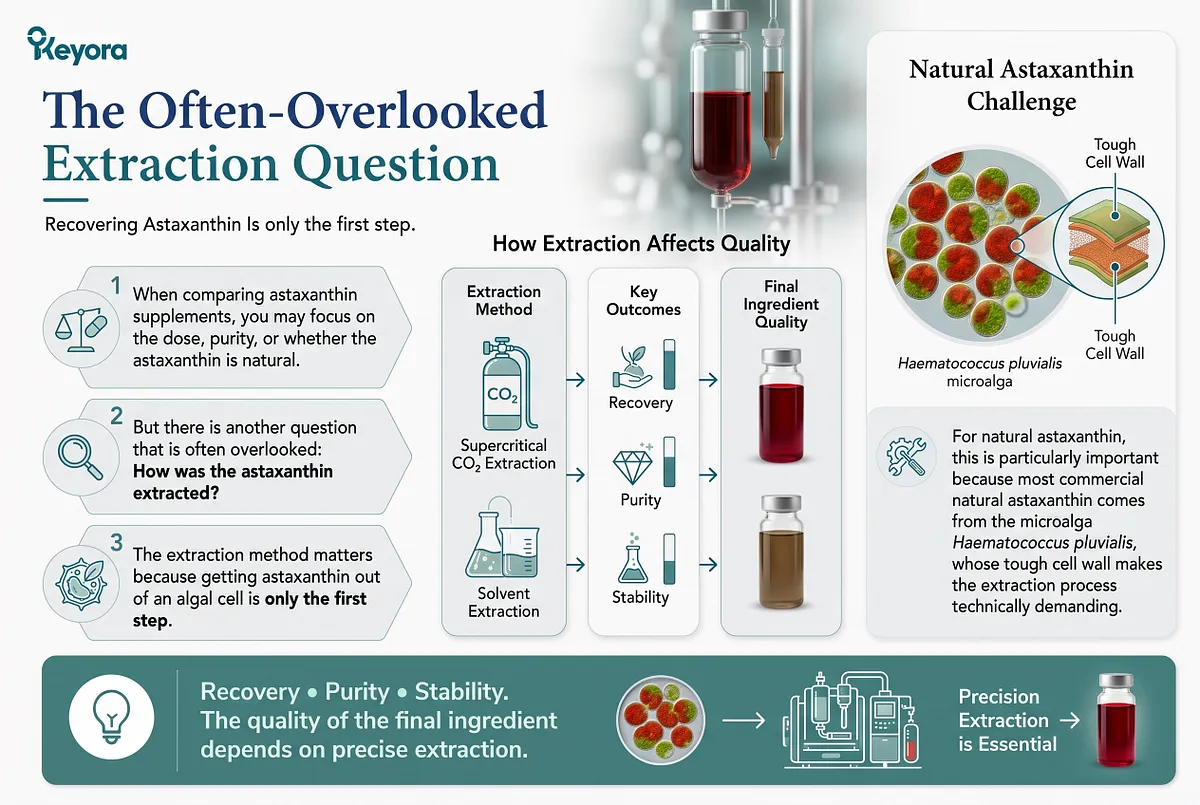
When you compare astaxanthin supplements, you may focus on the dose, purity, or whether the astaxanthin is natural.
But there is another question that is often overlooked:
How was the astaxanthin extracted?
The extraction method matters because getting astaxanthin out of an algal cell is only the first step. The way it is extracted can affect recovery, purity, stability, and the quality of the final ingredient.
For natural astaxanthin, this is particularly important because most commercial natural astaxanthin comes from the microalga Haematococcus pluvialis, whose tough cell wall makes the extraction process technically demanding.
Where Does Natural Astaxanthin Come From?
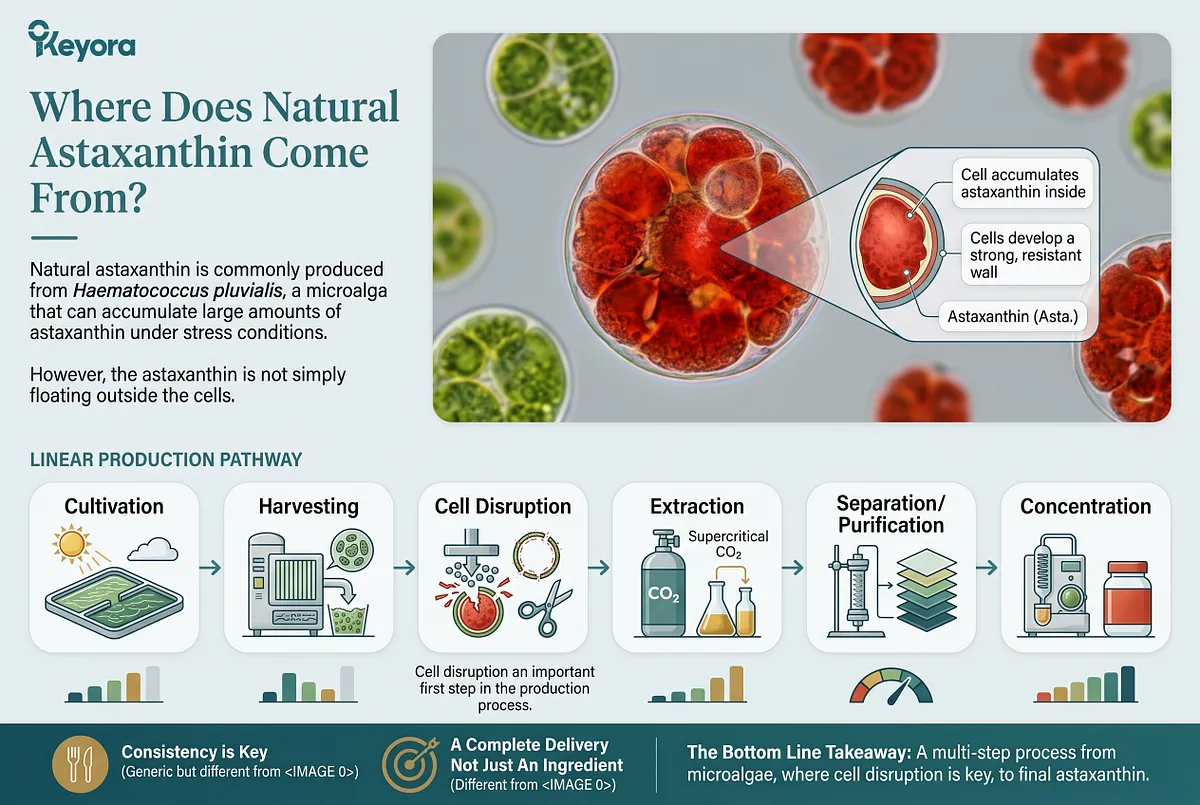
Natural astaxanthin is commonly produced from Haematococcus pluvialis, a microalga that can accumulate large amounts of astaxanthin under stress conditions.
However, the astaxanthin is not simply floating outside the cells.
It accumulates inside the algal cells, while the cells develop a strong, resistant wall during the astaxanthin-accumulation stage. This makes cell disruption an important first step in the production process.
A simplified production pathway looks like this:
Cultivation → Harvesting → Cell Disruption → Extraction → Separation/Purification → Concentration
Each step can influence the quality of the final astaxanthin ingredient.
How Is Astaxanthin Traditionally Extracted?
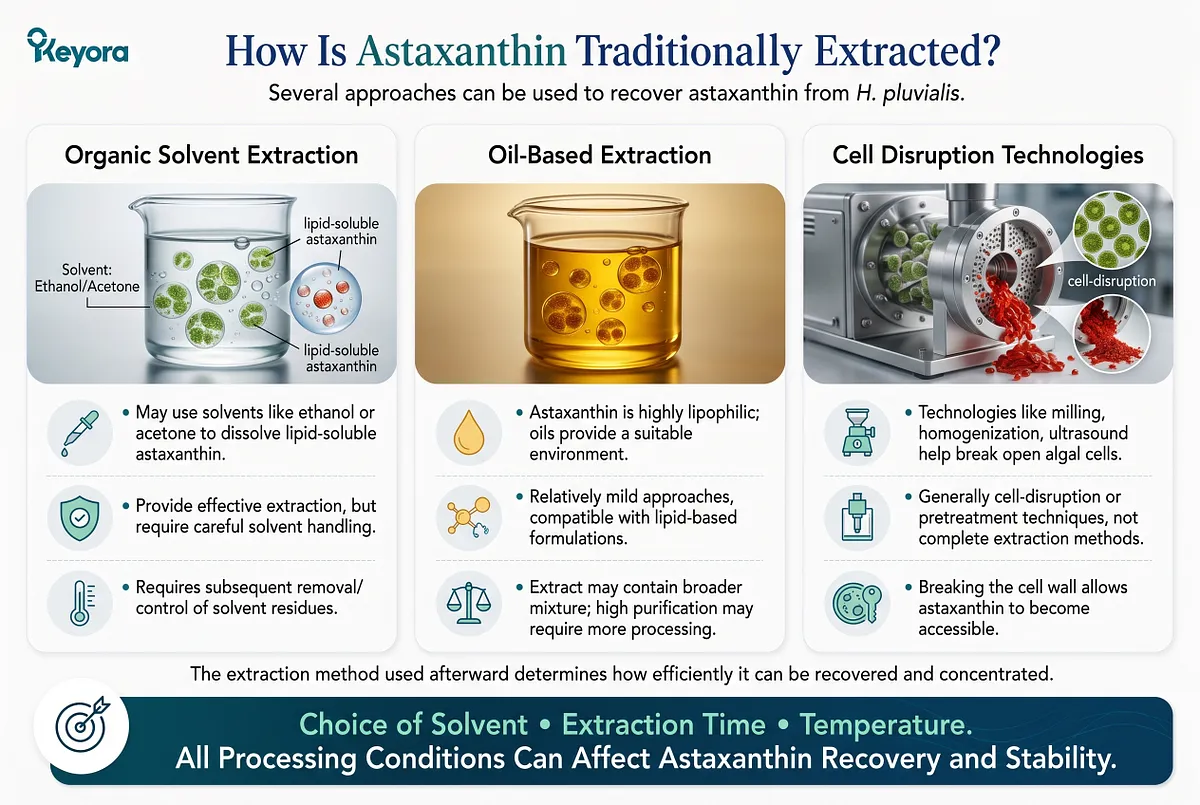
Several approaches can be used to recover astaxanthin from H. pluvialis.
Organic Solvent Extraction
Traditional extraction methods may use solvents such as ethanol, acetone, or other organic solvents to dissolve lipid-soluble astaxanthin.
These methods can provide effective extraction, but they also require careful solvent handling and subsequent removal or control of solvent residues.
The choice of solvent, extraction time, temperature, and other processing conditions can also influence astaxanthin recovery and stability.
Oil-Based Extraction
Because astaxanthin is highly lipophilic, oils can also provide a suitable environment for extracting and carrying astaxanthin.
Oil-based approaches can be relatively mild and are compatible with lipid-based formulations. However, the resulting extract may contain a broader mixture of lipids and other compounds, meaning that achieving a highly concentrated or purified ingredient may require additional processing.
Cell Disruption Technologies
Mechanical milling, homogenization, ultrasound, and other pretreatment technologies can help break open algal cells and release intracellular astaxanthin.
Importantly, these are generally cell-disruption or pretreatment techniques rather than complete extraction methods.
Breaking the cell wall allows the astaxanthin to become accessible. The extraction method used afterward determines how efficiently it can be recovered and concentrated.
Why Does the Extraction Method Matter?
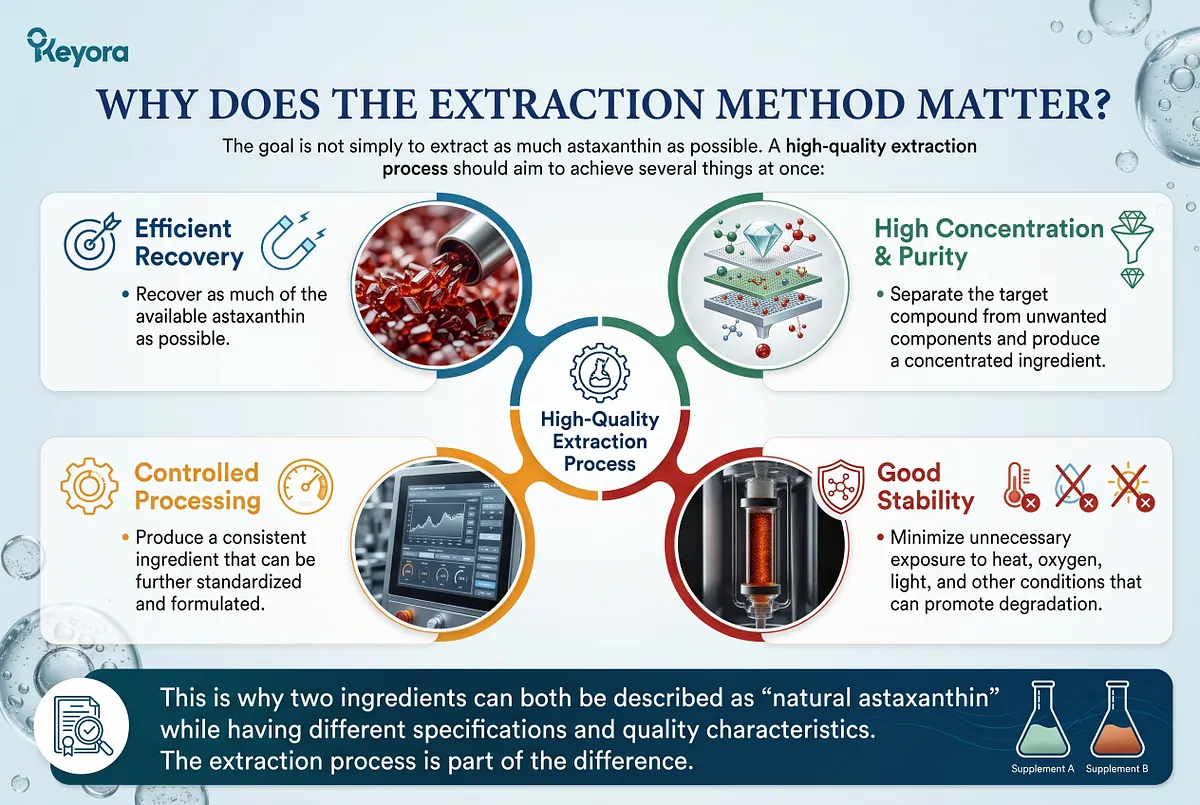
The goal is not simply to extract as much astaxanthin as possible.
A high-quality extraction process should aim to achieve several things at once:
Efficient recovery
Recover as much of the available astaxanthin as possible.
High concentration and purity
Separate the target compound from unwanted components and produce a concentrated ingredient.
Good stability
Minimize unnecessary exposure to heat, oxygen, light, and other conditions that can promote degradation.
Controlled processing
Produce a consistent ingredient that can be further standardized and formulated.
This is why two ingredients can both be described as “natural astaxanthin” while having different specifications and quality characteristics.
The extraction process is part of the difference.
Why Is Supercritical CO₂ Extraction Different?
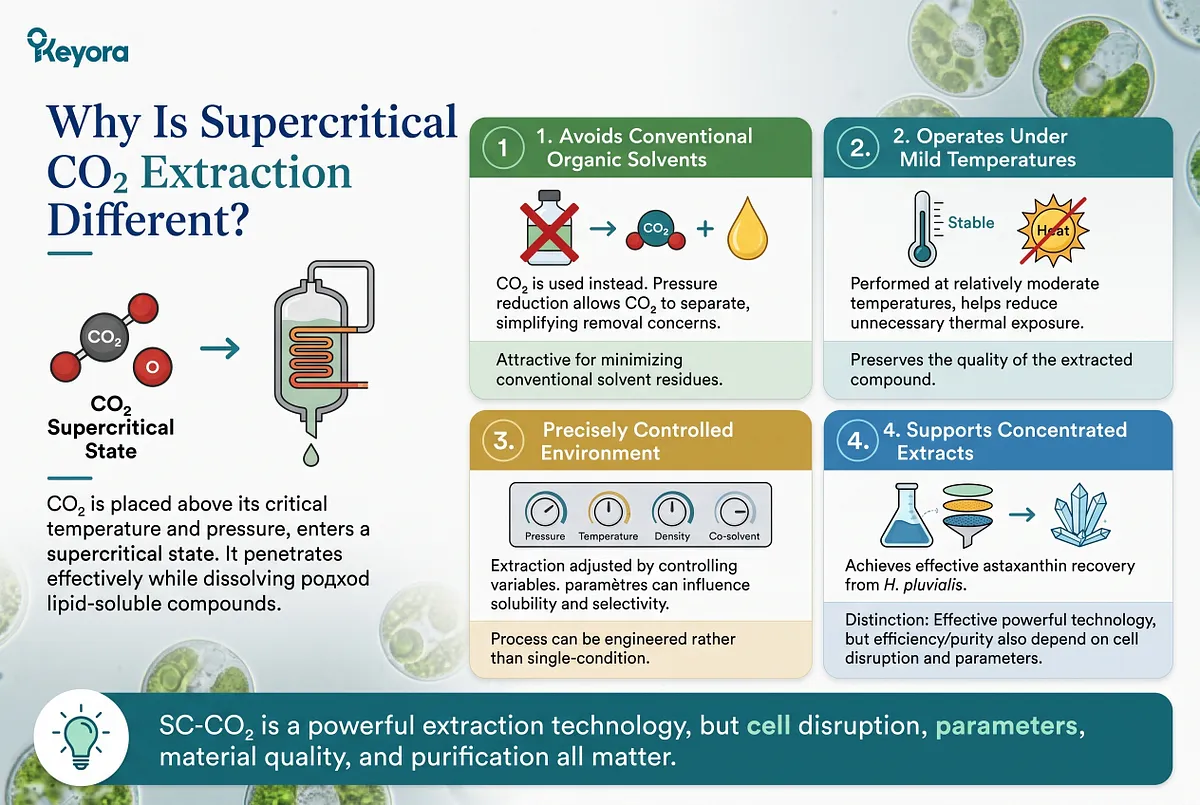
Among modern extraction technologies, supercritical carbon dioxide (SC-CO₂) extraction has attracted particular interest for natural astaxanthin.
When CO₂ is placed above its critical temperature and pressure, it enters a supercritical state. In this state, it has properties that allow it to penetrate a matrix effectively while dissolving suitable lipid-soluble compounds.
For astaxanthin, this creates several potential advantages.
1. It avoids conventional organic solvents as the main extraction medium
CO₂ is used as the extraction medium instead of conventional organic solvents.
After extraction, reducing the pressure allows the CO₂ to separate readily from the extract.
This can simplify solvent-removal concerns and makes SC-CO₂ attractive for applications where minimizing conventional solvent residues is important.
2. It can operate under relatively mild temperatures
Astaxanthin is sensitive to environmental factors including heat, oxygen, and light.
SC-CO₂ extraction can be performed at relatively moderate temperatures, which can help reduce unnecessary thermal exposure compared with some conventional processing conditions.
This is particularly relevant when the objective is not just to recover astaxanthin, but to preserve the quality of the extracted compound.
3. The extraction environment can be precisely controlled
One of the major advantages of SC-CO₂ is that its extraction performance can be adjusted by controlling variables such as:
Pressure + Temperature + CO₂ density + Co-solvent
These parameters can influence the solubility and selectivity of the extraction process.
In other words, the process can be engineered rather than relying simply on a single extraction condition.
4. It can support the production of concentrated extracts
Research has demonstrated that optimized SC-CO₂ conditions can achieve effective astaxanthin recovery from H. pluvialis.
However, extraction efficiency and final purity are not determined by CO₂ alone.
Cell disruption, extraction parameters, raw material quality, and downstream purification all matter.
This distinction is important: SC-CO₂ is a powerful extraction technology, but it is not a magic shortcut to purity.
Does Better Extraction Mean Better Astaxanthin?
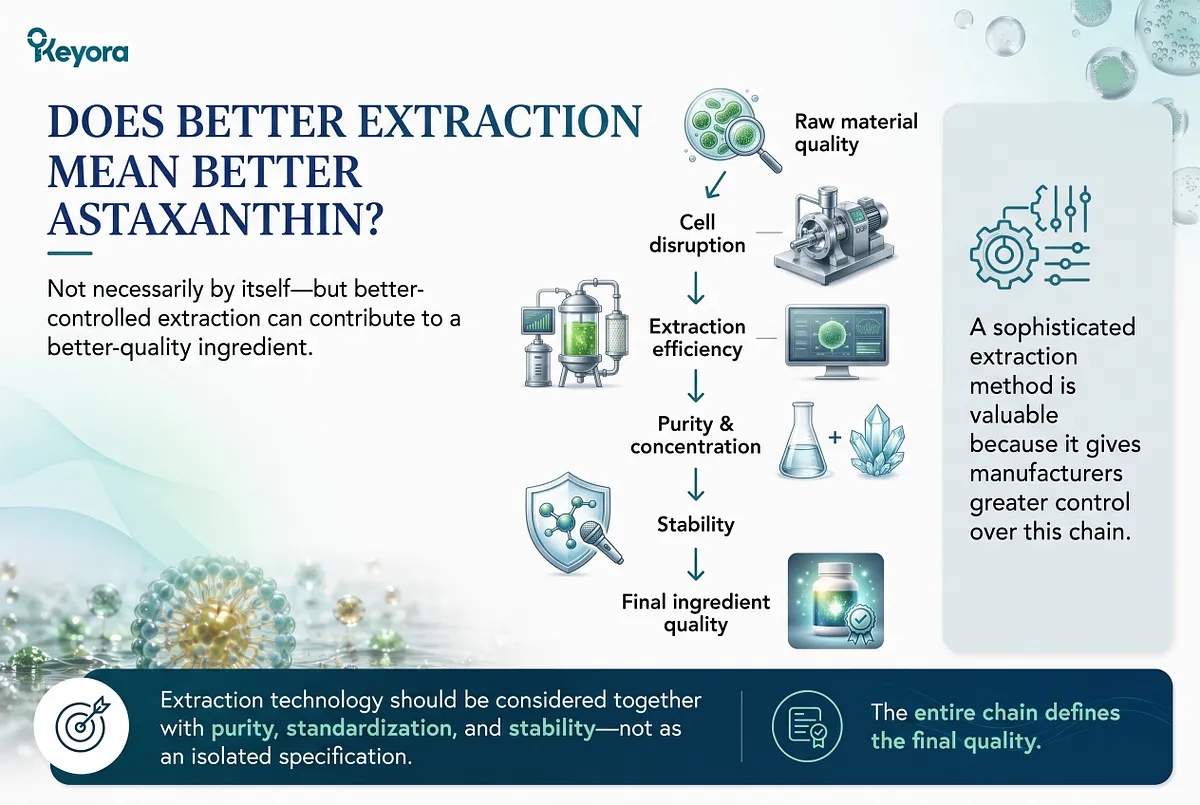
Not necessarily by itself—but better-controlled extraction can contribute to a better-quality ingredient.
Think of the process as a chain:
Raw material quality
↓
Cell disruption
↓
Extraction efficiency
↓
Purity & concentration
↓
Stability
↓
Final ingredient quality
A sophisticated extraction method is valuable because it gives manufacturers greater control over this chain.
That is also why extraction technology should be considered together with purity, standardization, and stability—not as an isolated specification.
What Should You Look for in an Astaxanthin Supplement?
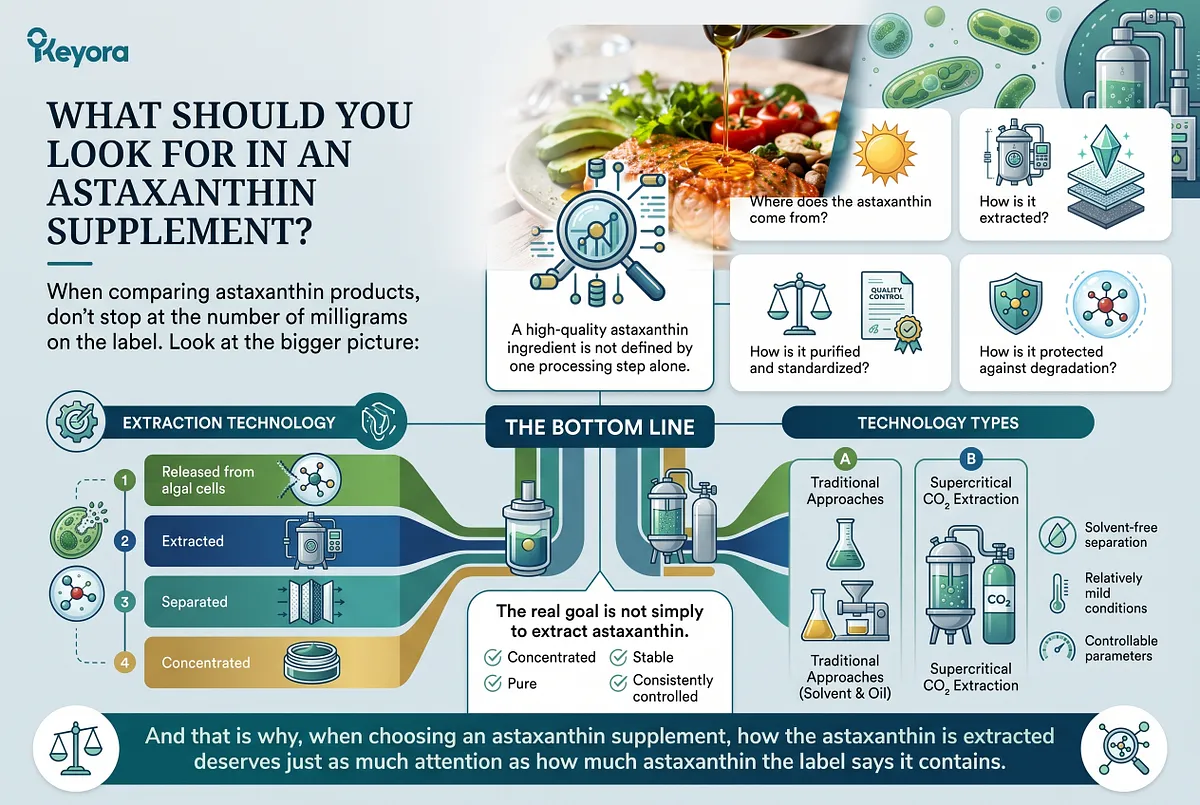
When comparing astaxanthin products, don’t stop at the number of milligrams on the label.
Look at the bigger picture:
Where does the astaxanthin come from?
What is its purity or concentration?
How is it extracted?
How is it purified and standardized?
How is it protected against degradation?
A high-quality astaxanthin ingredient is not defined by one processing step alone.
The Bottom Line
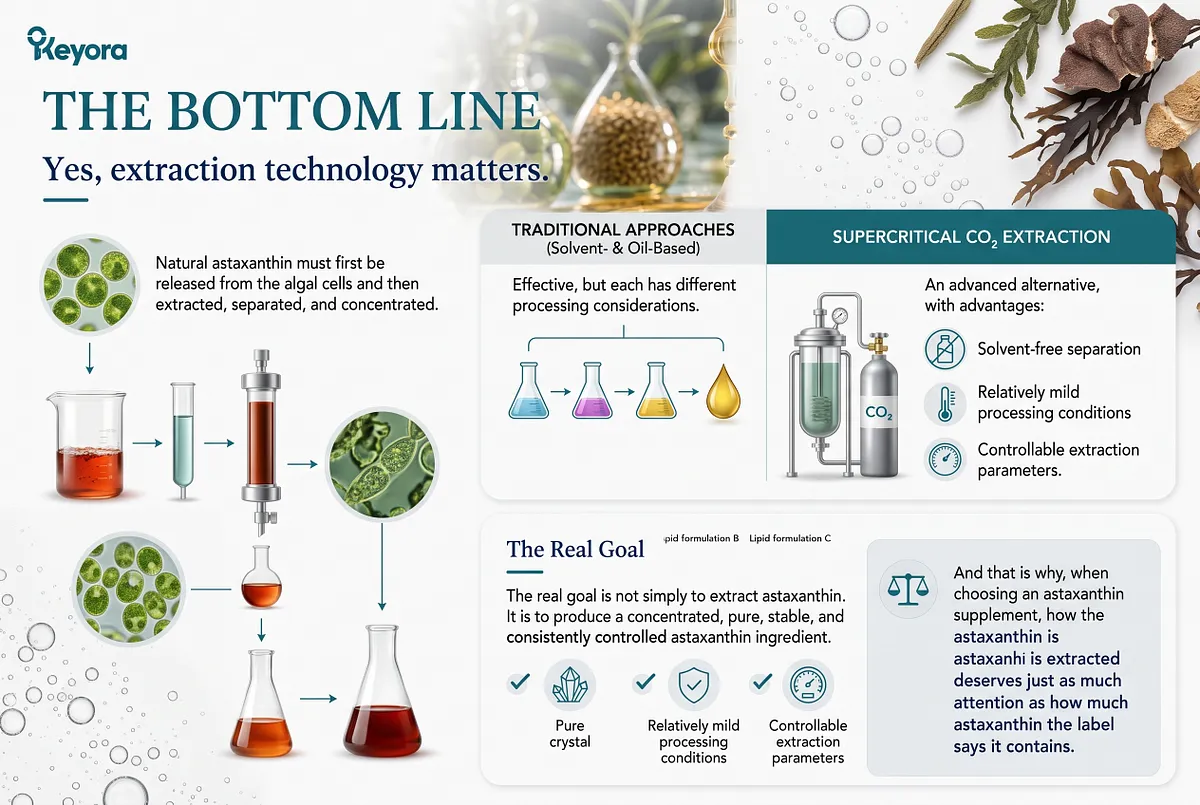
Yes, extraction technology matters.
Natural astaxanthin must first be released from the algal cells and then extracted, separated, and concentrated. Traditional solvent- and oil-based approaches can be effective, but each has different processing considerations.
Supercritical CO₂ extraction offers an advanced alternative, with advantages including solvent-free separation, relatively mild processing conditions, and controllable extraction parameters.
The real goal is not simply to extract astaxanthin.
It is to produce a concentrated, pure, stable, and consistently controlled astaxanthin ingredient.
And that is why, when choosing an astaxanthin supplement, how the astaxanthin is extracted deserves just as much attention as how much astaxanthin the label says it contains.
References
Ambati, R. R., Phang, S. M., Ravi, S., & Aswathanarayana, R. G. (2020). Importance of Downstream Processing of Natural Astaxanthin for Pharmaceutical Application. Frontiers in Chemical Engineering, 2, 601483.
Kim, B., Lee, S. Y., Narasimhan, A. L., Kim, S., & Oh, Y. K. (2022). Cell disruption and astaxanthin extraction from Haematococcus pluvialis: Recent advances. Bioresource Technology, 343, 126124.
Khoo, K. S., Lee, S. Y., Ooi, C. W., Fu, X., Miao, X., Ling, T. C., & Show, P. L. (2019). Recent advances in biorefinery of astaxanthin from Haematococcus pluvialis. Bioresource Technology, 288, 121606.
Duan, M., Zhou, X., Fang, T., et al. (2024). Efficient supercritical carbon dioxide extraction of astaxanthin from Haematococcus pluvialis at high pressure. The Journal of Supercritical Fluids, 205, 106145.
Recent Advances in Astaxanthin Extraction and Purification from Haematococcus pluvialis. Recent review literature on extraction technologies, purification, process efficiency, and scale-up considerations.