
Does Astaxanthin Become Part of Cell Membranes?
Keyora Research Q&A Library
This is part of the Keyora Research Q&A Series, derived from Keyora Astaxanthin Research Journal Series.
Within the Keyora Astaxanthin Researcn framework, this Q&A translates complex astaxanthin biology into reader-friendly, evidence-bound answers, focusing on natural astaxanthin identity, molecular structure, antioxidant and redox mechanisms, membrane lipid interaction, mitochondrial resilience, inflammatory signaling pathways, human evidence interpretation, and the scientific principles behind responsible supplementation.
First published by Keyora Research Journal: www.keyorahealth.com
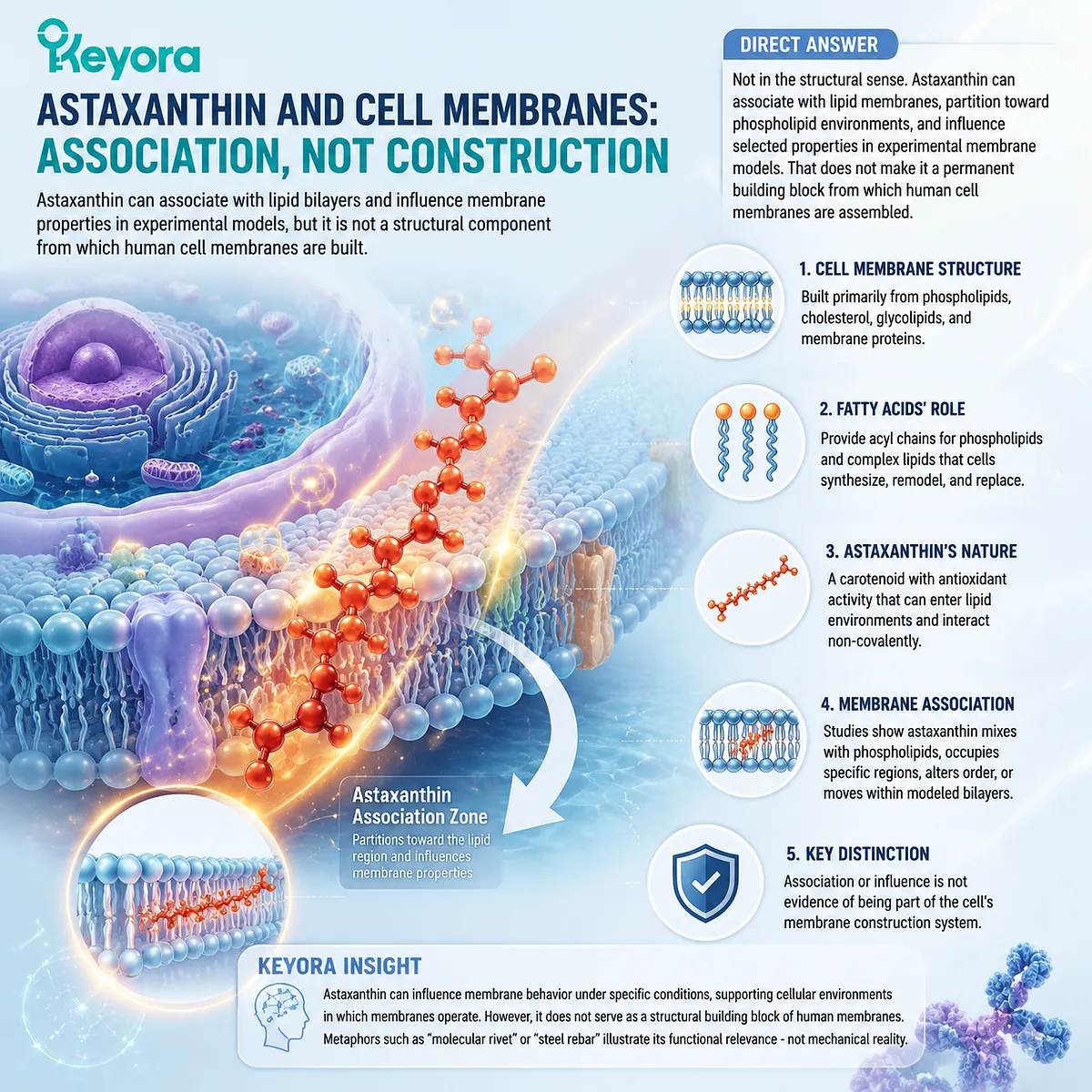
Direct Answer
Not in the structural sense. Astaxanthin can associate with lipid membranes, partition toward phospholipid environments, and influence selected properties in experimental membrane models.
That does not make it a permanent building block from which human cell membranes are assembled.
Astaxanthin can associate with lipid bilayers without becoming a permanent structural membrane component like phospholipids or cholesterol.
A cell membrane is built primarily from a phospholipid bilayer containing cholesterol, glycolipids, and many types of membrane proteins.
Fatty acids contribute mainly as acyl chains within phospholipids and other complex membrane lipids that cells synthesize, transport, remodel, and replace.
Astaxanthin belongs to a different chemical and biological category.
Membrane studies may show Astaxanthin mixing with phospholipids, occupying a particular region, changing membrane order, or moving within a modeled bilayer.
These findings demonstrate membrane association or influence under specific experimental conditions. They do not demonstrate that Astaxanthin becomes part of the cell’s membrane construction system.
This distinction is important because Keyora source materials have used terms such as “molecular rivet,” “steel rebar,” membrane anchoring, and structural reinforcement to visualize Astaxanthin’s membrane relevance.
Those expressions should be understood as educational metaphors, not literal claims that Astaxanthin mechanically fastens membrane leaflets together or rebuilds human membranes.
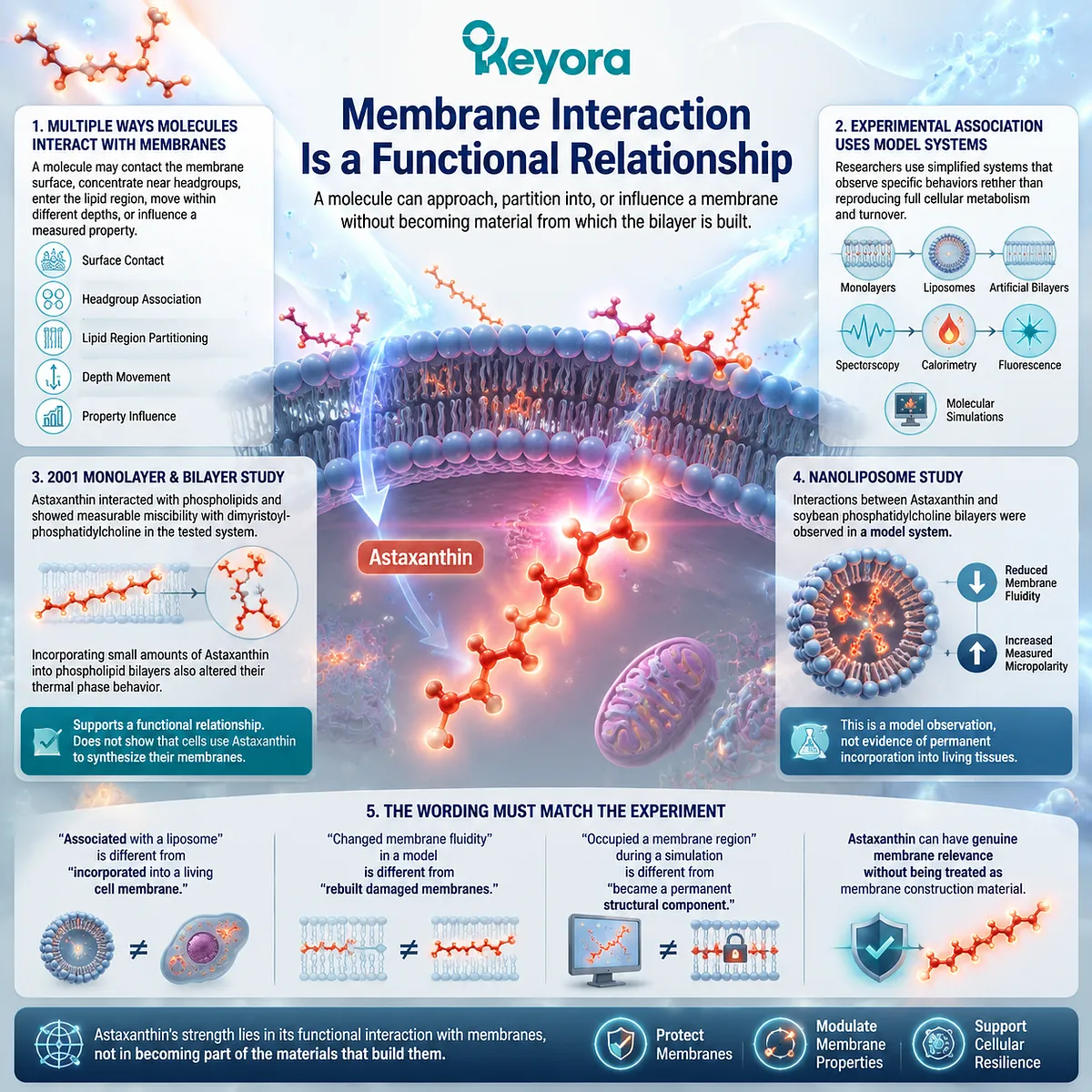
Membrane Interaction Is a Functional Relationship
A molecule can approach, partition into, or influence a membrane without becoming material from which the bilayer is built
The phrase “part of the membrane” can describe several very different situations.
A molecule may contact the membrane surface, concentrate near phospholipid headgroups, enter part of the lipid region, move between different depths, or influence a measured membrane property. None of these possibilities automatically establishes permanent structural incorporation.
Experimental association is often studied using simplified systems.
Researchers may use phospholipid monolayers, liposomes, artificial bilayers, spectroscopy, calorimetry, fluorescence methods, or molecular simulations.
Each method observes a selected aspect of membrane behavior rather than reproducing the full metabolism and turnover of a living human cell.
A 2001 monolayer and bilayer study found that Astaxanthin interacted with phospholipids and showed measurable miscibility with dimyristoylphosphatidylcholine in the tested system.
Incorporating small amounts of Astaxanthin into phospholipid bilayers also altered their thermal phase behavior. These findings support a functional relationship between Astaxanthin and selected phospholipid environments. They do not show that cells use Astaxanthin to synthesize their membranes.
A separate nanoliposome study reported interactions between Astaxanthin and soybean phosphatidylcholine bilayers.
Within a defined concentration range, Astaxanthin incorporation reduced the fluidity of the liposomal membrane and increased its measured micropolarity. This was a formulation and model membrane observation, not evidence of permanent incorporation into living human tissues.
The wording must therefore match the experiment.
“Associated with a liposome” is different from “incorporated into a living cell membrane.”
“Changed membrane fluidity in a model” is different from “rebuilt damaged membranes.”
“Occupied a membrane region during a simulation” is different from “became a permanent structural component.”
Astaxanthin can have genuine membrane relevance without being treated as membrane construction material.
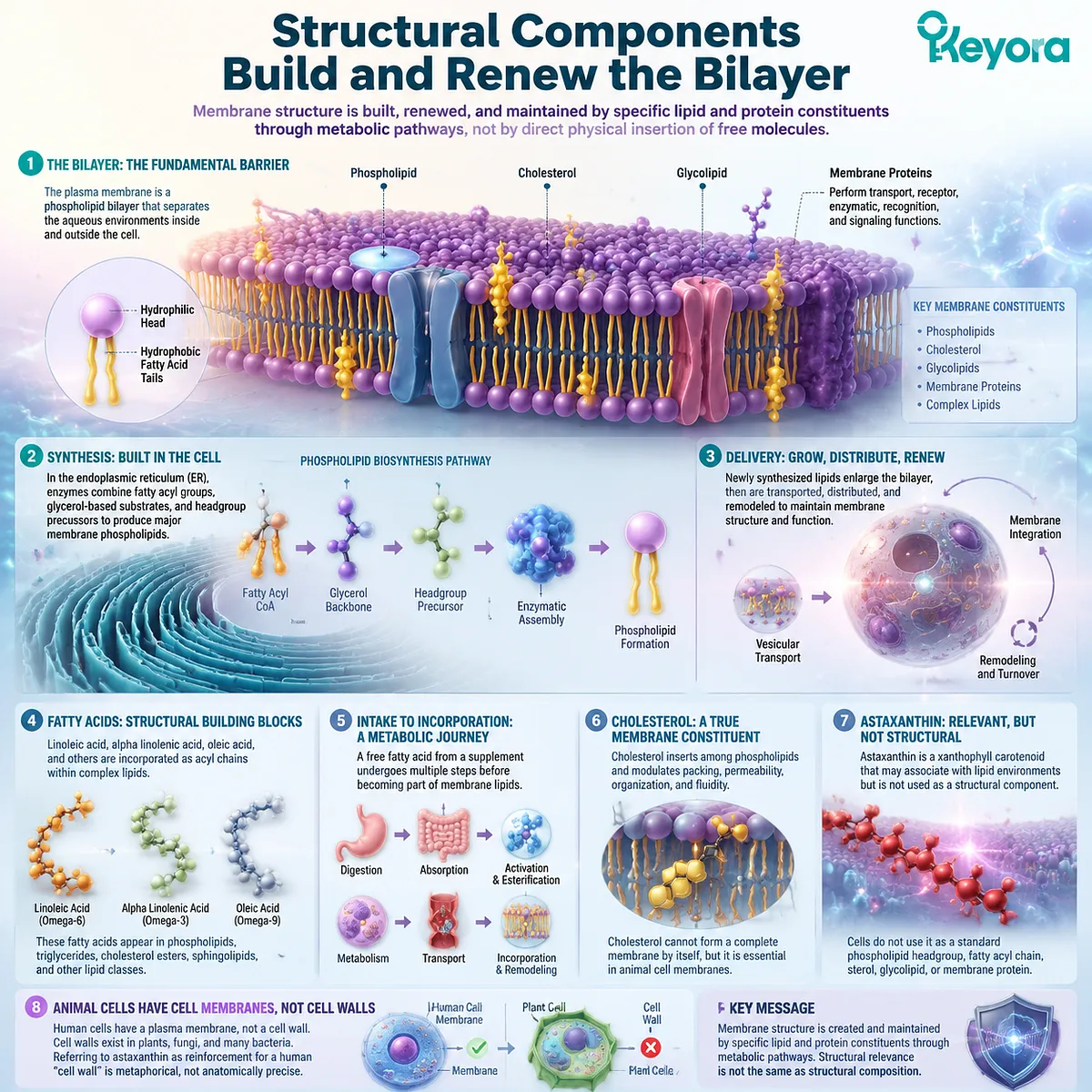
Structural Components Build and Renew the Bilayer
Phospholipids, cholesterol, membrane proteins, and complex lipids participate directly in membrane composition, assembly, and turnover
The fundamental structure of the plasma membrane is a phospholipid bilayer. Phospholipids form the barrier between the aqueous environment inside the cell and the aqueous environment outside it.
Animal cell membranes also contain cholesterol and glycolipids, while embedded and associated proteins perform transport, receptor, enzymatic, recognition, and signaling functions.
Phospholipids are not simply substances that happen to touch a membrane. They are synthesized through cellular metabolic pathways and assembled into the bilayer.
In the endoplasmic reticulum, enzymes combine fatty acyl groups, glycerol based substrates, and headgroup precursors to produce major membrane phospholipids.
Newly synthesized lipids enlarge the bilayer and are subsequently distributed, transported, and remodeled.
This is the structural sense in which fatty acids contribute to cell membranes. Fatty acids such as linoleic acid, alpha linolenic acid, or oleic acid may appear as acyl chains within phospholipids, triglycerides, cholesterol esters, sphingolipids, and other lipid classes. Their structural meaning depends on the complex lipid into which they have been metabolically incorporated.
A free fatty acid taken in a supplement should not be pictured as an unchanged piece of material being directly pressed into a membrane. Digestion, absorption, activation, esterification, metabolism, transport, incorporation, and remodeling occur between intake and membrane composition.
Cholesterol is also a true membrane constituent. It inserts among phospholipids and affects packing, permeability, organization, and fluidity. Although cholesterol cannot form a complete membrane by itself, it is routinely present in animal cell membranes and participates in their continuing structure.
Astaxanthin differs from these structural constituents. It is a xanthophyll carotenoid that may enter or associate with selected lipid environments. Cells do not use it as a standard phospholipid headgroup, fatty acyl chain, sterol, glycolipid, or membrane protein.
This is why structural relevance and structural composition must remain separate.
Astaxanthin may be relevant to the chemical or physical environment of a membrane. It does not follow that the membrane is made from Astaxanthin.
Human cells should also be described as having a cell membrane or plasma membrane, not a cell wall. Cell walls are distinct external structures found in organisms such as plants, fungi, and many bacteria. Referring to Astaxanthin as reinforcement for a human “cell wall” is therefore metaphorical rather than anatomically precise.
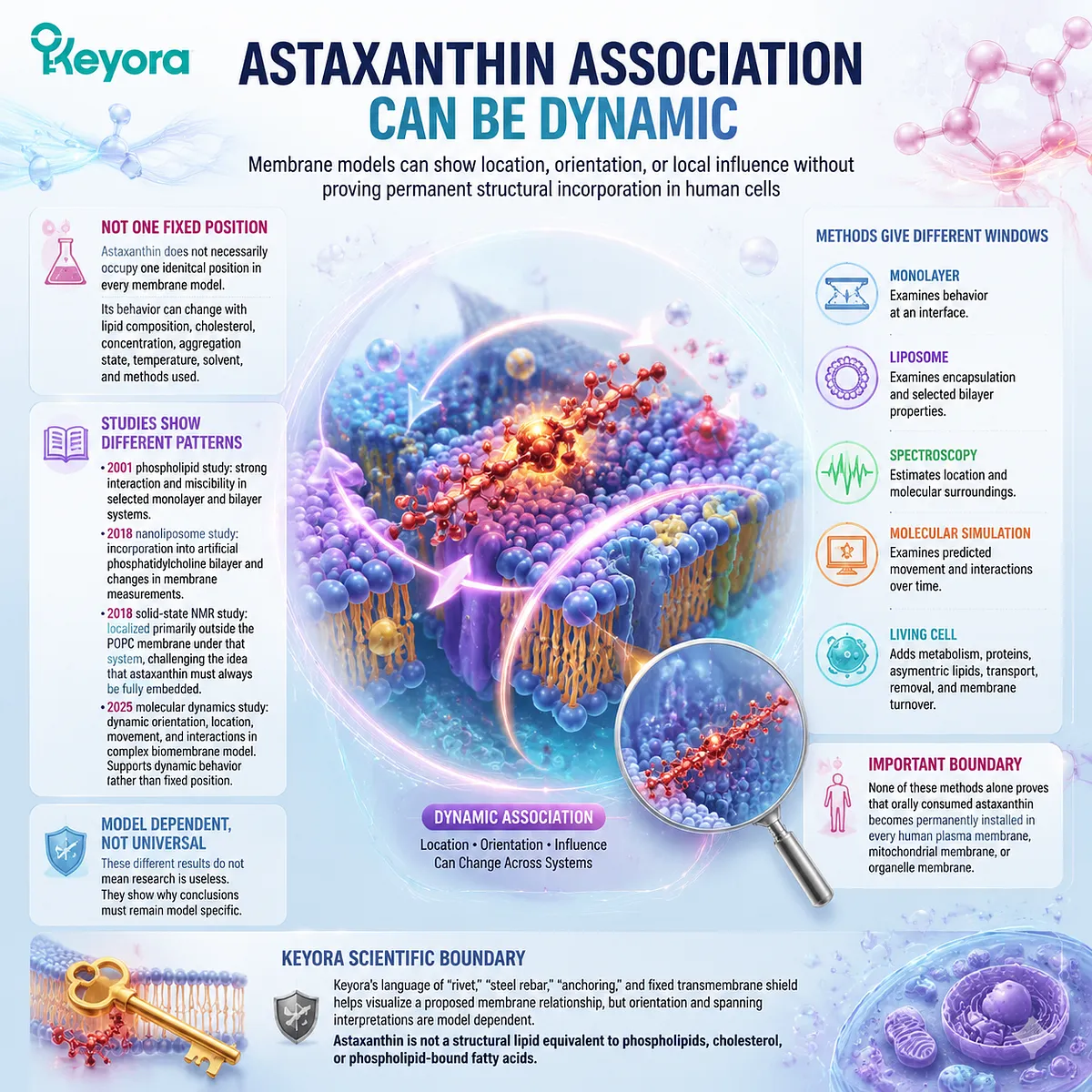
Astaxanthin Association Can Be Dynamic
Membrane models can show location, orientation, or local influence without proving permanent structural incorporation in human cells
Astaxanthin does not necessarily occupy one identical position in every membrane model. Its observed or predicted behavior can change with phospholipid composition, cholesterol content, Astaxanthin concentration, aggregation state, temperature, solvent conditions, and the research method used.
The 2001 phospholipid study supported considerable Astaxanthin interaction and miscibility in selected monolayer and bilayer systems. A 2018 nanoliposome study also reported incorporation into an artificial phosphatidylcholine bilayer and changes in selected membrane measurements.
However, a 2018 solid state nuclear magnetic resonance investigation conducted as part of a comparative carotenoid study reported that Astaxanthin localized primarily outside the POPC membrane under that experimental system. This finding is important because it challenges the idea that Astaxanthin must always be fully embedded or permanently span every phospholipid bilayer.
A 2025 molecular dynamics study examined Astaxanthin’s orientation, location, movement, and interactions in a more complex modeled biomembrane. It supported dynamic membrane related behavior rather than a simple image of every molecule being fixed in one universal position. Because this was a computational membrane model, its findings describe behavior under the assumptions and composition of that model rather than permanent incorporation into human cell membranes.
These apparently different results do not mean membrane research is useless. They show why conclusions must remain model specific.
A monolayer can examine behavior at an interface.
A liposome can examine encapsulation and selected bilayer properties.
Spectroscopy can help estimate location and molecular surroundings.
Molecular simulation can examine predicted movement and interactions over time.
A living cell adds metabolism, proteins, asymmetric lipid composition, transport, removal, and membrane turnover.
None of these methods alone proves that orally consumed Astaxanthin becomes permanently installed in every human plasma membrane, mitochondrial membrane, or organelle membrane.
The Keyora source language of “rivet,” “steel rebar,” “anchoring,” and a fixed transmembrane shield may help visualize a proposed membrane relationship, but the project’s current scientific boundary recognizes that orientation and spanning interpretations are model dependent. Astaxanthin should not be presented as a structural lipid equivalent to phospholipids, cholesterol, or phospholipid bound fatty acids.
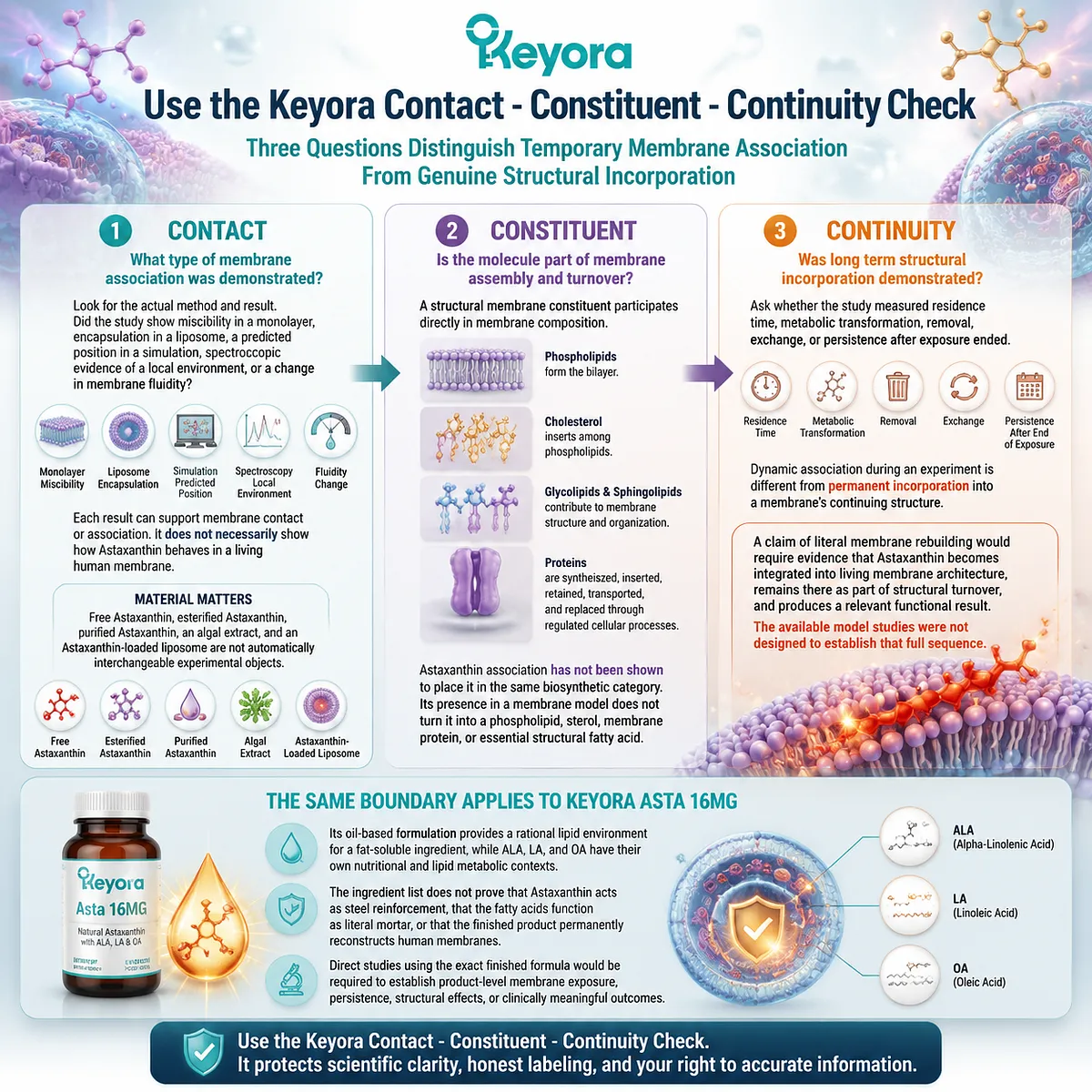
Use the Keyora Contact – Constituent – Continuity Check
Three questions can distinguish temporary membrane association from genuine structural incorporation
The Keyora Contact – Constituent – Continuity Check helps readers evaluate claims such as “Astaxanthin becomes part of the cell membrane” or “Astaxanthin rebuilds cell membranes.”
Contact: What type of membrane association was demonstrated?
Look for the actual method and result. Did the study show miscibility in a monolayer, encapsulation in a liposome, a predicted position in a simulation, spectroscopic evidence of a local environment, or a change in membrane fluidity?
Each result can support membrane contact or association. It does not necessarily show how Astaxanthin behaves in a living human membrane.
The material also matters. Free Astaxanthin, esterified Astaxanthin, purified Astaxanthin, an algal extract, and an Astaxanthin loaded liposome are not automatically interchangeable experimental objects.
Constituent: Is the molecule part of membrane assembly and turnover?
A structural membrane constituent participates directly in membrane composition. Phospholipids form the bilayer. Cholesterol inserts among them. Glycolipids and sphingolipids contribute to membrane structure and organization. Proteins are synthesized, inserted, retained, transported, and replaced through regulated cellular processes.
Astaxanthin association has not been shown to place it in the same biosynthetic category. Its presence in a membrane model does not turn it into a phospholipid, sterol, membrane protein, or essential structural fatty acid.
Continuity: Was long term structural incorporation demonstrated?
Ask whether the study measured residence time, metabolic transformation, removal, exchange, or persistence after exposure ended. Dynamic association during an experiment is different from permanent incorporation into a membrane’s continuing structure.
A claim of literal membrane rebuilding would require evidence that Astaxanthin becomes integrated into living membrane architecture, remains there as part of structural turnover, and produces a relevant functional result. The available model studies were not designed to establish that full sequence.
The same boundary applies to Keyora Asta 16MG. Its oil based formulation provides a rational lipid environment for a fat soluble ingredient, while ALA, LA, and OA have their own nutritional and lipid metabolic contexts.
The ingredient list does not prove that Astaxanthin acts as steel reinforcement, that the fatty acids function as literal mortar, or that the finished product permanently reconstructs human membranes.
Direct studies using the exact finished formula would be required to establish product level membrane exposure, persistence, structural effects, or clinically meaningful outcomes.
Closing Summary
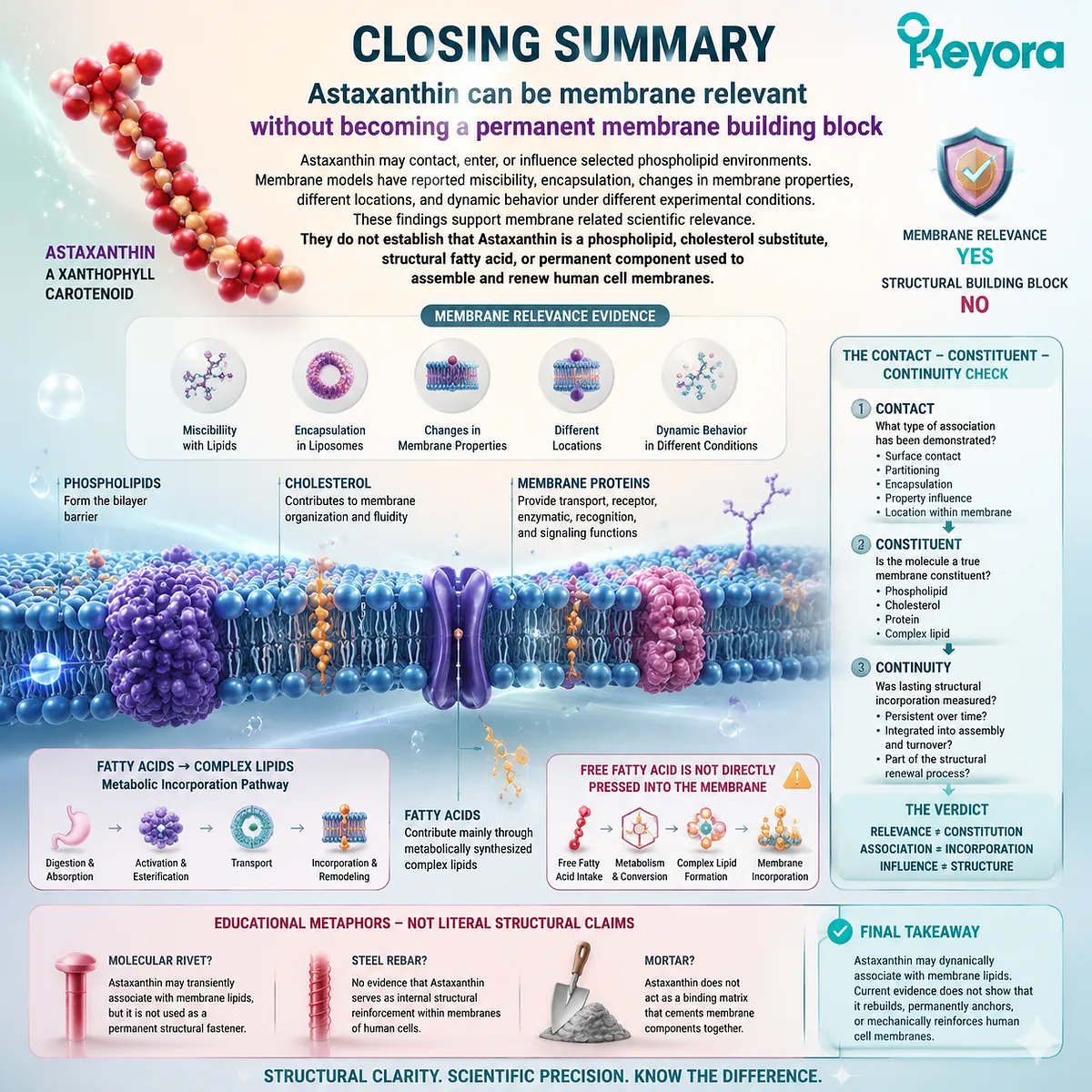
Astaxanthin can be membrane relevant without becoming a permanent membrane building block
Astaxanthin may contact, enter, or influence selected phospholipid environments. Membrane models have reported miscibility, encapsulation, changes in membrane properties, different locations, and dynamic behavior under different experimental conditions.
These findings support membrane related scientific relevance. They do not establish that Astaxanthin is a phospholipid, cholesterol substitute, structural fatty acid, or permanent component used to assemble and renew human cell membranes.
Phospholipids form the bilayer, cholesterol contributes to membrane organization, proteins provide specialized functions, and fatty acids contribute mainly through metabolically synthesized complex lipids.
The Contact – Constituent – Continuity Check provides the practical verdict. Identify the demonstrated association, determine whether the molecule is a true membrane constituent, and ask whether lasting structural incorporation was measured.
Terms such as “molecular rivet,” “steel rebar,” and “mortar” are educational metaphors. Astaxanthin may dynamically associate with membrane lipids, but current evidence does not show that it literally rebuilds, permanently anchors, or mechanically reinforces human cell membranes.
This article is for educational and informational purposes only. It does not provide medical advice, diagnosis, treatment, cure, prevention, disease outcome claims, hormone restoration claims, fertility outcome claims, or formula-specific clinical efficacy claims.