
Can Synthetic Astaxanthin Use Natural Astaxanthin Studies as Proof?
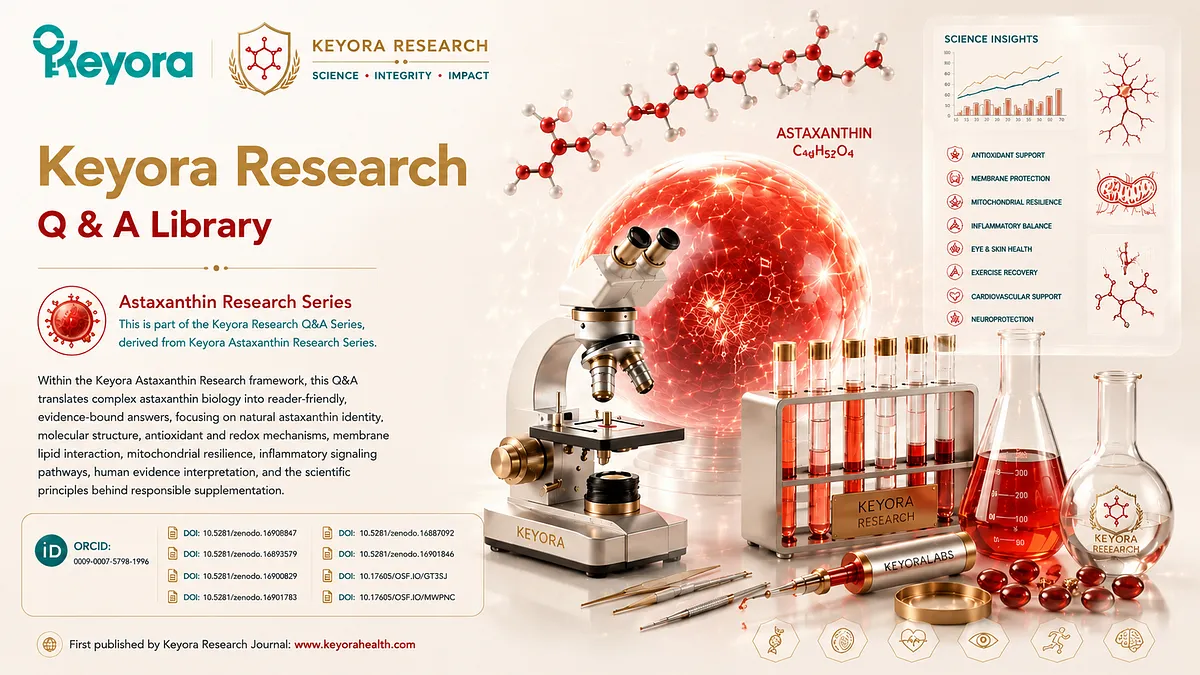
Keyora Research Q&A Library
This is part of the Keyora Research Q&A Series, derived from Keyora Astaxanthin Research Journal Series.
Within the Keyora Astaxanthin Researcn framework, this Q&A translates complex astaxanthin biology into reader-friendly, evidence-bound answers, focusing on natural astaxanthin identity, molecular structure, antioxidant and redox mechanisms, membrane lipid interaction, mitochondrial resilience, inflammatory signaling pathways, human evidence interpretation, and the scientific principles behind responsible supplementation.
First published by Keyora Research Journal: www.keyorahealth.com
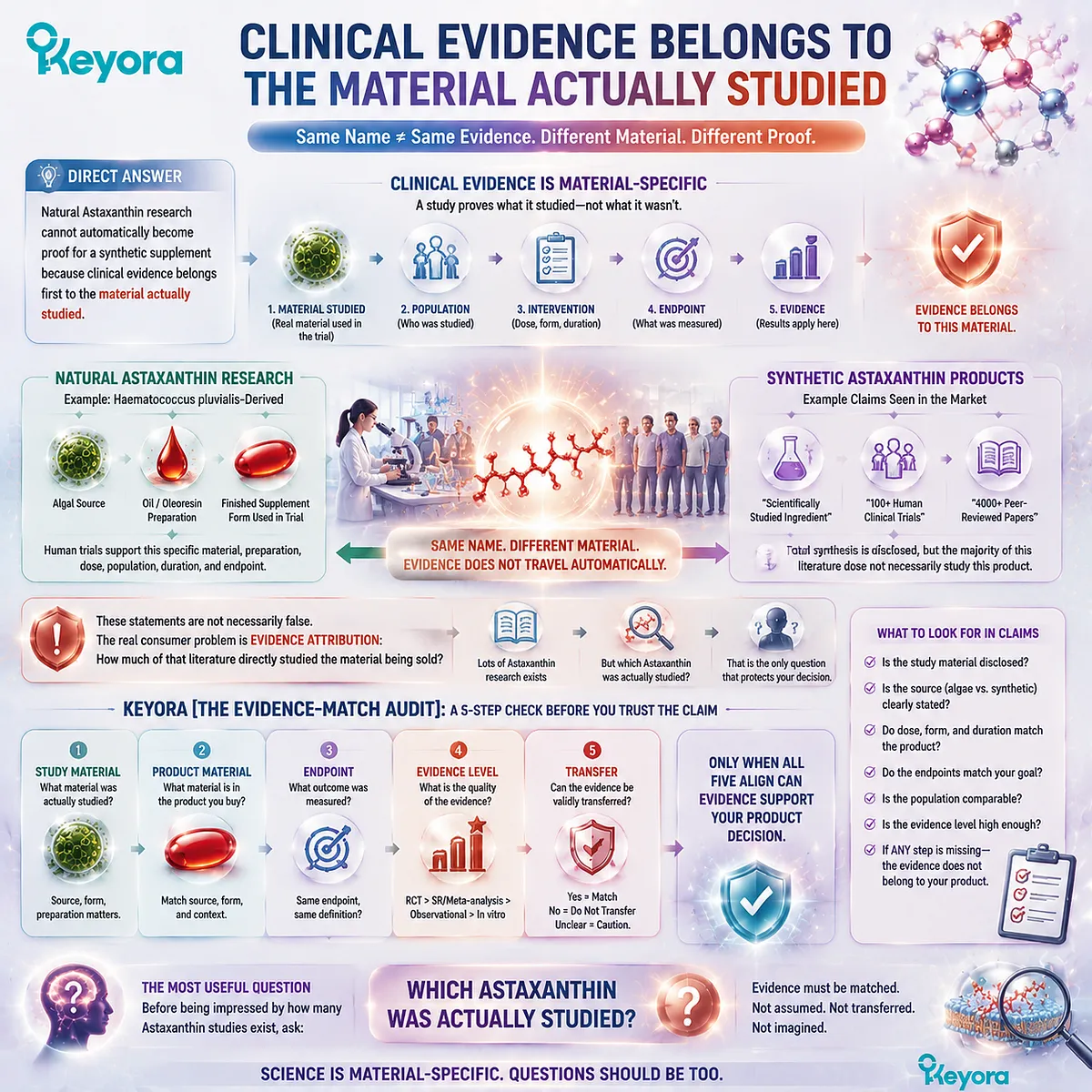
Direct Answer
Natural Astaxanthin research cannot automatically become proof for a synthetic supplement because clinical evidence belongs first to the material actually studied.
A scientific paper can be completely real, peer reviewed, and clinically meaningful while still being the wrong evidence for the product in front of you.
If a human trial used Astaxanthin derived from Haematococcus pluvialis, the study directly supports that investigated material, preparation, dose, population, duration, and endpoint.
It does not automatically become a clinical trial of a synthetic Astaxanthin product simply because both materials carry the name “Astaxanthin.”
This distinction matters because current synthetic Astaxanthin products are sold within a much larger Astaxanthin research environment.
One current synthetic product describes Astaxanthin as a scientifically studied ingredient and discusses human research across cardiovascular, metabolic, liver, and inflammatory endpoints.
Another current synthetic product website displays “100+ Human Clinical Trials” and “4000+ Peer-Reviewed Papers” while separately identifying its own ingredient as Astaxanthin made through total synthesis.
Those statements do not by themselves establish fraud. The consumer problem is evidence attribution: how much of that literature directly studied the material being sold?
Keyora therefore uses [The Evidence-Match Audit]:
Study Material → Product Material → Endpoint → Evidence Level → Transfer
Before being impressed by how many Astaxanthin studies exist, ask the question that matters more:
Which Astaxanthin was actually studied?
Why “Clinically Studied Astaxanthin” Can Mislead Consumers
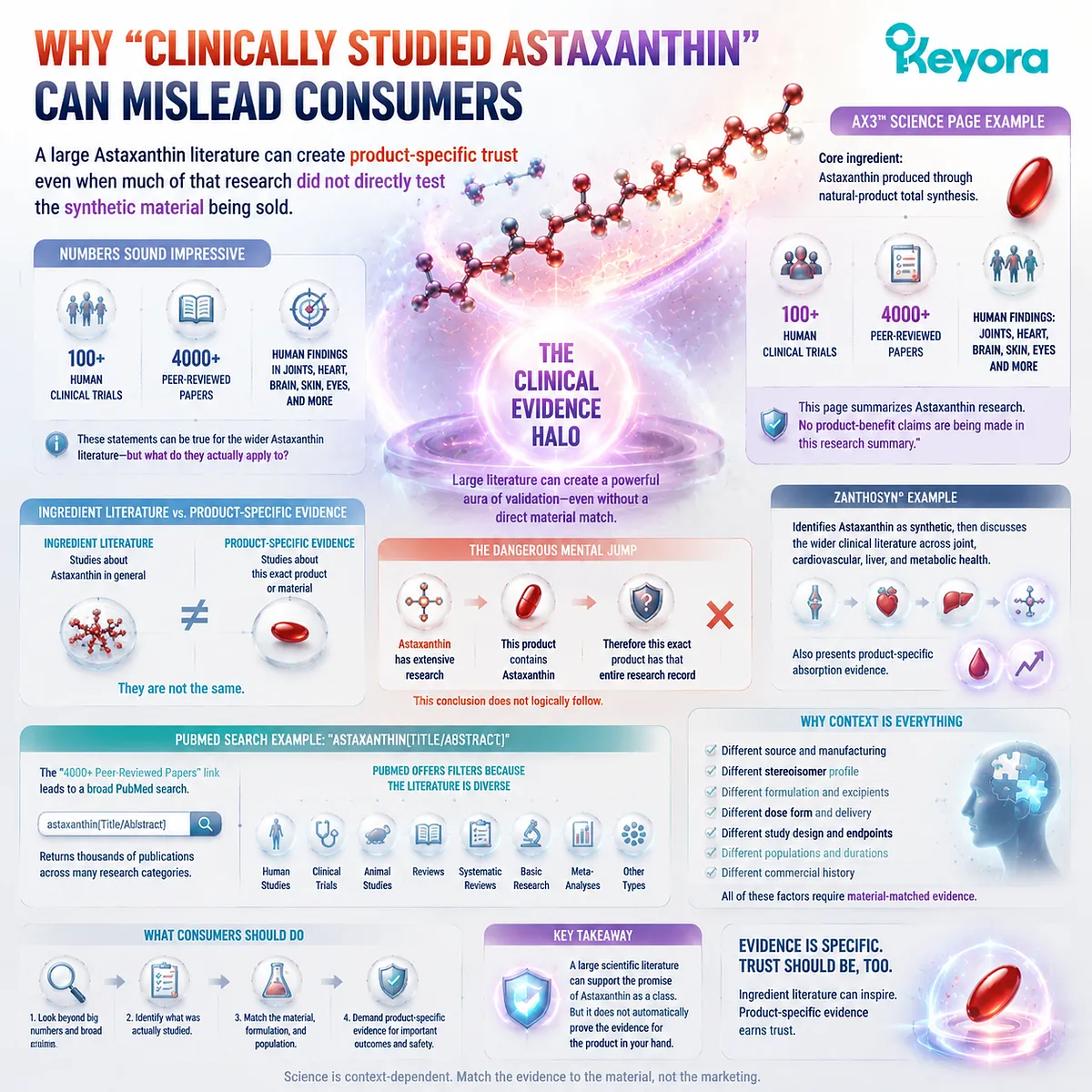
A large Astaxanthin literature can create product-specific trust even when much of that research did not directly test the synthetic material being sold.
Scientific numbers are persuasive. “100+ human trials,” “thousands of peer-reviewed papers,” and “clinically studied Astaxanthin” sound like strong evidence because, in one sense, they can be true descriptions of the wider Astaxanthin literature.
The problem begins when the reader mentally changes the subject of the sentence.
AX3 currently identifies its core ingredient as Astaxanthin produced through natural-product total synthesis, while its Science page displays “100+ Human Clinical Trials,” “4000+ Peer-Reviewed Papers,” and human findings involving joints, heart, brain, skin, and eyes. Importantly, that Science page also states that it is summarizing Astaxanthin research and that no product-benefit claims are being made in that research summary.
That qualification matters. It also illustrates exactly why consumers need to distinguish ingredient literature from product-specific evidence.
The “4000+ Peer-Reviewed Papers” link currently leads to a broad PubMed search for astaxanthin[Title/Abstract]. That search returns thousands of publications across many research categories. PubMed itself offers filters for human studies, animal studies, clinical trials, reviews, and other publication types, which shows why a generic literature count cannot be treated as a count of clinical trials on one finished synthetic supplement.
The same interpretive challenge appears elsewhere. ZanthoSyn openly identifies its Astaxanthin as synthetic, then discusses the wider clinical literature on Astaxanthin across joint, cardiovascular, liver, and metabolic health while also presenting product-specific absorption evidence.
Again, the issue is not that Astaxanthin research is fake.
The issue is that consumers may unknowingly make this jump:
Astaxanthin has extensive research
→ this product contains Astaxanthin
→ therefore this exact product has that entire research record
Keyora calls this the [Clinical Evidence Halo].
A large scientific literature can create a powerful aura of validation around a product even when the direct material match has not yet been established.
A Real Study Can Still Be the Wrong Study for Your Product
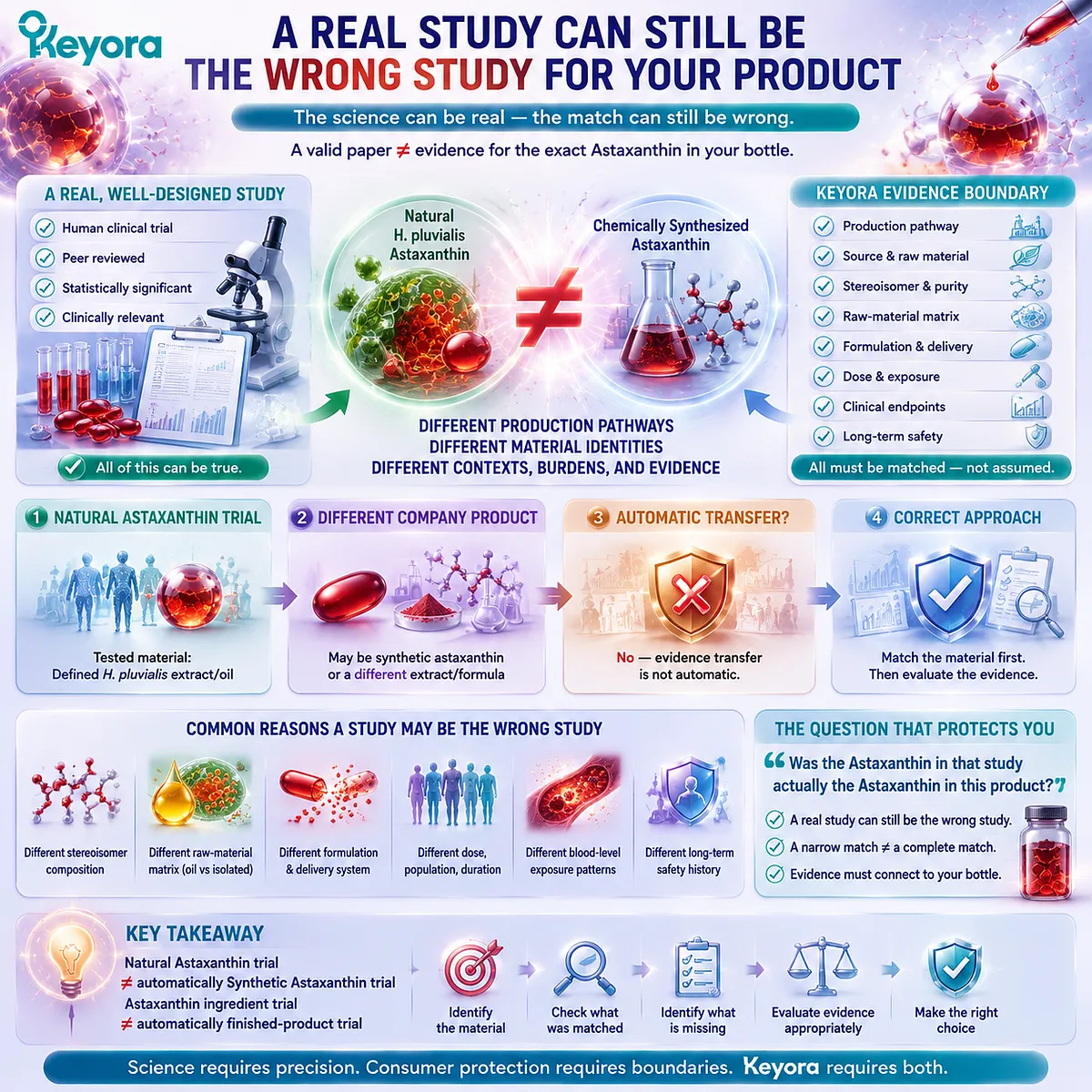
The paper can be genuine and the result can be valid while the Astaxanthin material tested still does not match the supplement you are buying.
This is one of the most important anti-fraud lessons in nutritional science because misleading evidence does not require a fabricated paper.
Imagine a well-designed human trial showing a measurable effect after participants consume a defined H. pluvialis Astaxanthin preparation.
The researchers may have done everything correctly.
The paper may have been peer reviewed.
The result may be statistically and clinically relevant.
But if a different company sells a chemically synthesized Astaxanthin preparation, that natural-material trial is not suddenly a direct clinical trial of the synthetic product.
The Keyora EP-2 evidence boundary explicitly rejects automatic interchangeability between natural and synthetic Astaxanthin evidence. Its stronger scientific logic is that different production pathways, material identities, stereoisomer and formulation contexts, commercial histories, and safety records create a burden to demonstrate that evidence can legitimately transfer.
This does not mean evidence can never inform another material.
Scientific extrapolation and bridging are normal. Chemical identity, stereochemical characterization, pharmacokinetics, formulation comparisons, mechanistic evidence, and direct head-to-head studies can all contribute to an equivalence argument.
But transfer must be demonstrated rather than assumed.
A useful way to think about it is:
Natural Astaxanthin trial
≠ automatically Synthetic Astaxanthin trial
and:
Astaxanthin ingredient trial
≠ automatically finished-product trial
The first 20 Keyora Q&A articles already established the broader human-evidence asymmetry and the principle that natural study outcomes should not simply be transferred to synthetic materials or to an exact finished formula that was not studied.
EP-2 now turns that scientific rule into a consumer-protection question.
Whenever a product invokes a study, ask:
Was the Astaxanthin in that study actually the Astaxanthin in this product?
A real study can still be the wrong study for your bottle.
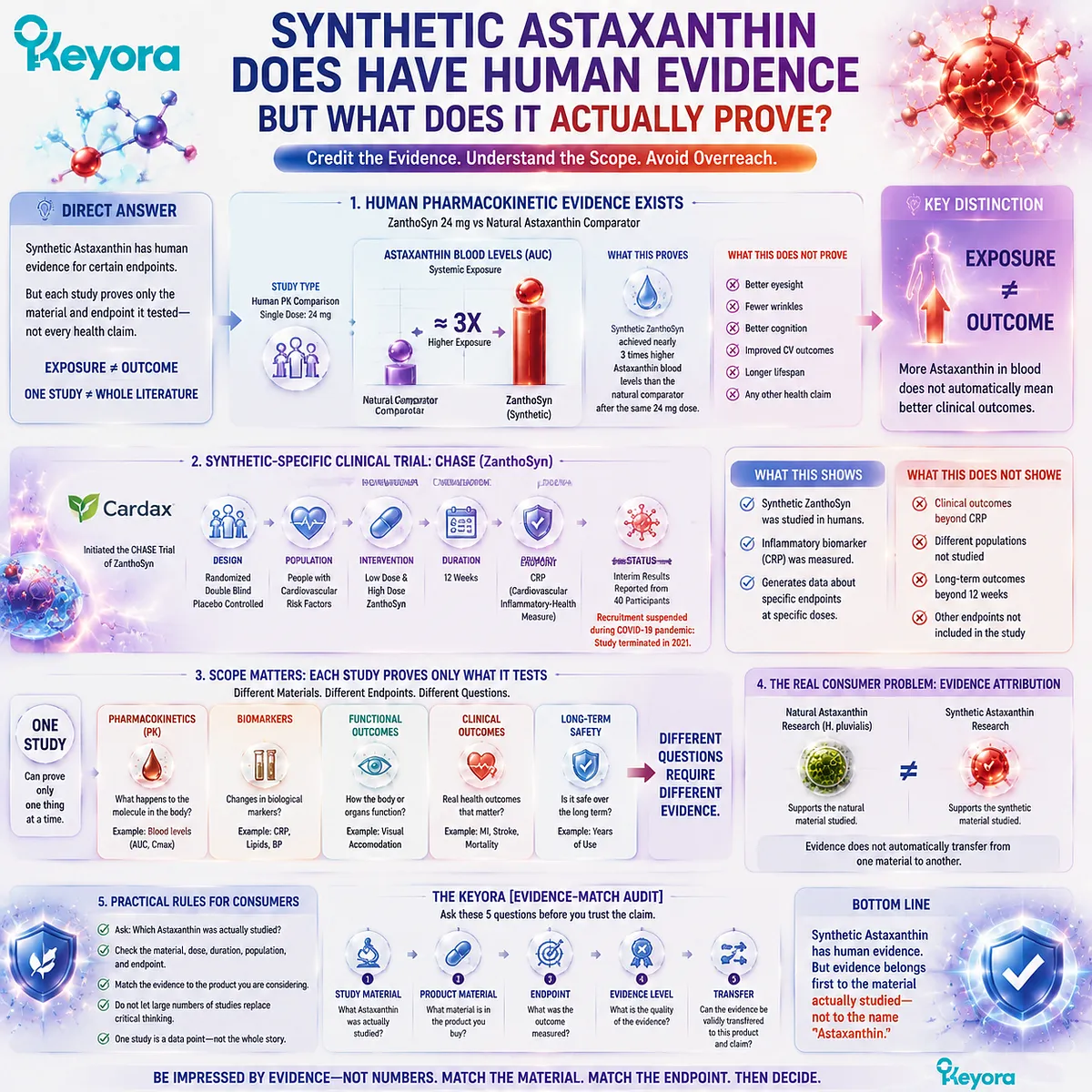
Synthetic Astaxanthin Does Have Human Evidence, but What Does It Actually Prove?
Synthetic-specific human evidence should be credited where it exists, but each study proves only the material and endpoint it actually tested.
An evidence audit must work in both directions. It would be inaccurate to protect natural Astaxanthin by pretending that synthetic Astaxanthin has never been studied in humans.
ZanthoSyn currently reports a human comparison in which its synthetic formulation produced nearly three times the Astaxanthin blood levels of a natural Astaxanthin comparator after the same stated 24 mg dose.
That is direct human evidence concerning systemic exposure to that synthetic formulation.
Cardax also initiated the CHASE trial of ZanthoSyn.
According to the company’s clinical-trial page, CHASE was randomized, double blind, and placebo controlled, and evaluated low-dose and high-dose ZanthoSyn over 12 weeks in people with cardiovascular risk factors, with CRP as the primary cardiovascular inflammatory-health measure.
Interim results were reported from 40 participants.
The company also states that recruitment was later suspended during the COVID-19 pandemic and the study was terminated in 2021.
These data matter.
They mean the correct statement is not:
“Synthetic Astaxanthin has no human evidence.”
The correct question is:
What kind of human evidence exists, and what conclusion does that evidence actually support?
A pharmacokinetic study can show how much Astaxanthin reaches the bloodstream.
That does not automatically prove better eyesight, fewer wrinkles, better cognition, improved cardiovascular outcomes, or longer human lifespan.
This is the critical distinction:
Exposure ≠ Outcome
Likewise, a study evaluating CRP, lipids, or blood pressure cannot automatically become evidence for every unrelated Astaxanthin claim.
This gives consumers another essential rule:
One Study ≠ Whole Literature
Synthetic-specific human evidence should be recognized when it exists. But direct evidence for one material and one outcome does not make every natural Astaxanthin trial transferable to that material.
Evidence Must Match Both the Material and the Claim
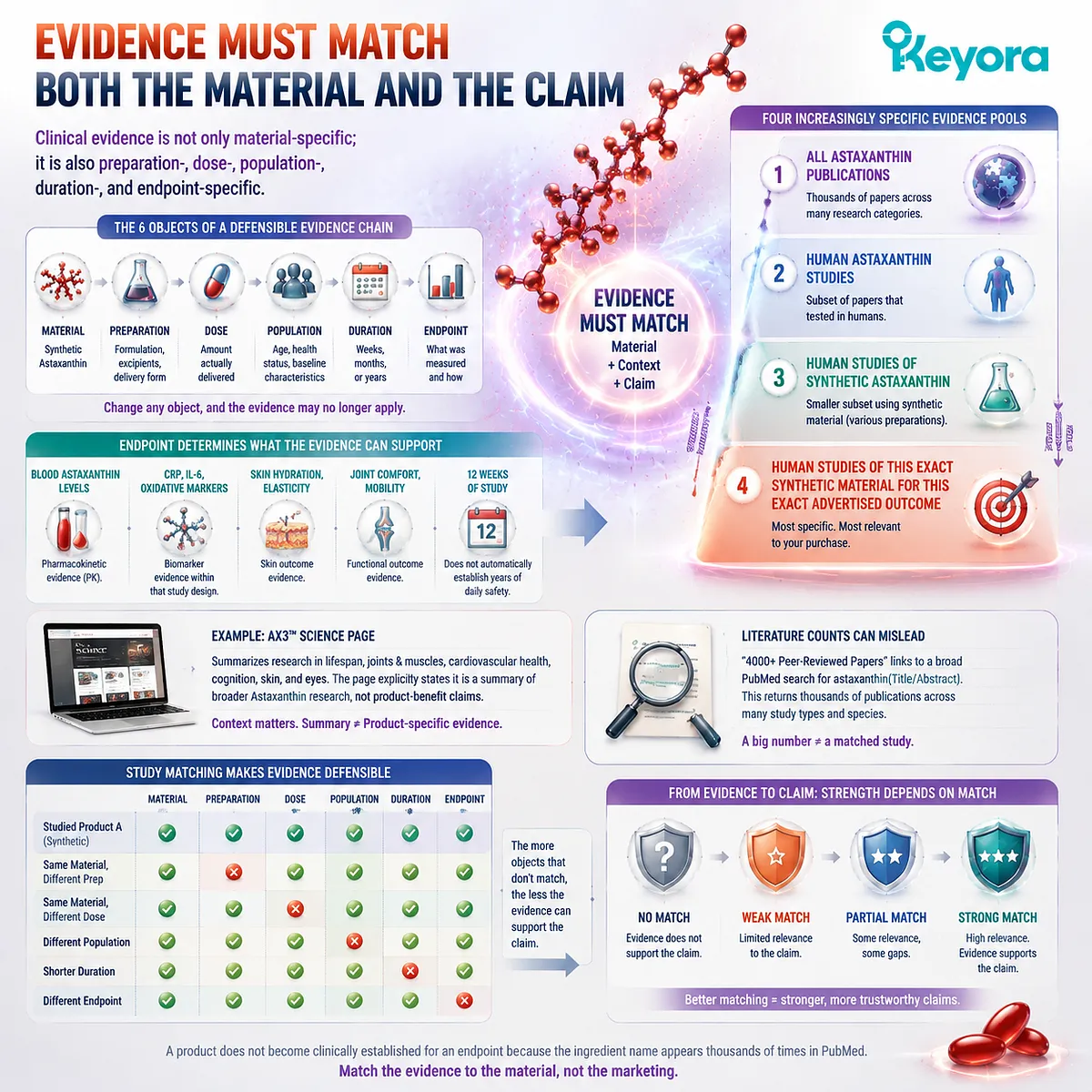
Clinical evidence is not only material-specific; it is also preparation-, dose-, population-, duration-, and endpoint-specific.
Material matching is only the first layer.
Suppose a synthetic Astaxanthin product really has a human study. That is important. The next question is what the investigators actually tested.
A defensible evidence chain should identify at least six objects:
Material
→ Preparation
→ Dose
→ Population
→ Duration
→ Endpoint
If the endpoint was Astaxanthin concentration in blood, the evidence is pharmacokinetic.
If the endpoint was CRP, the evidence concerns that biomarker within the study design.
If the endpoint was skin hydration, the evidence concerns skin hydration.
If the study lasted 12 weeks, it does not automatically establish years of daily safety.
This matters because current consumer-facing Astaxanthin pages can discuss many health domains side by side. AX3’s Science page, for example, summarizes research involving lifespan, joints and muscles, cardiovascular health, cognition, skin, and eyes, while explicitly identifying the page as a summary of broader Astaxanthin research rather than product-benefit claims.
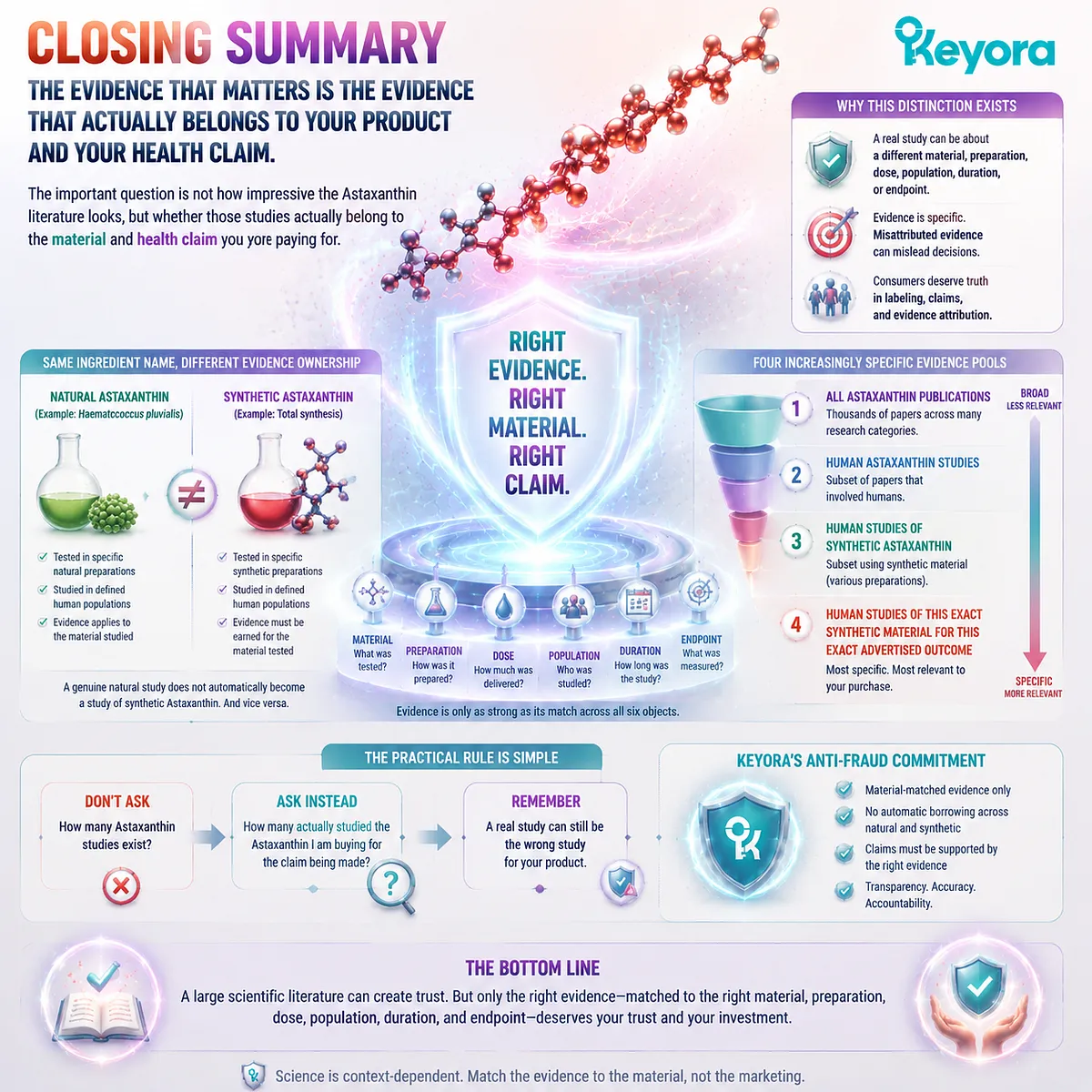
Consumers therefore need to distinguish four increasingly specific evidence pools:
All Astaxanthin publications
is not the same as:
Human Astaxanthin studies
which is not the same as:
Human studies of synthetic Astaxanthin
which is not the same as:
Human studies of this exact synthetic material for this exact advertised outcome
The closer a marketing claim moves toward the bottom of that chain, the more relevant the evidence becomes to the consumer’s actual purchase.
This is why a large paper count should never replace study matching.
A product does not become clinically established for an endpoint because the ingredient name appears thousands of times in PubMed.
Safety Evidence Cannot Be Borrowed Wholesale Either
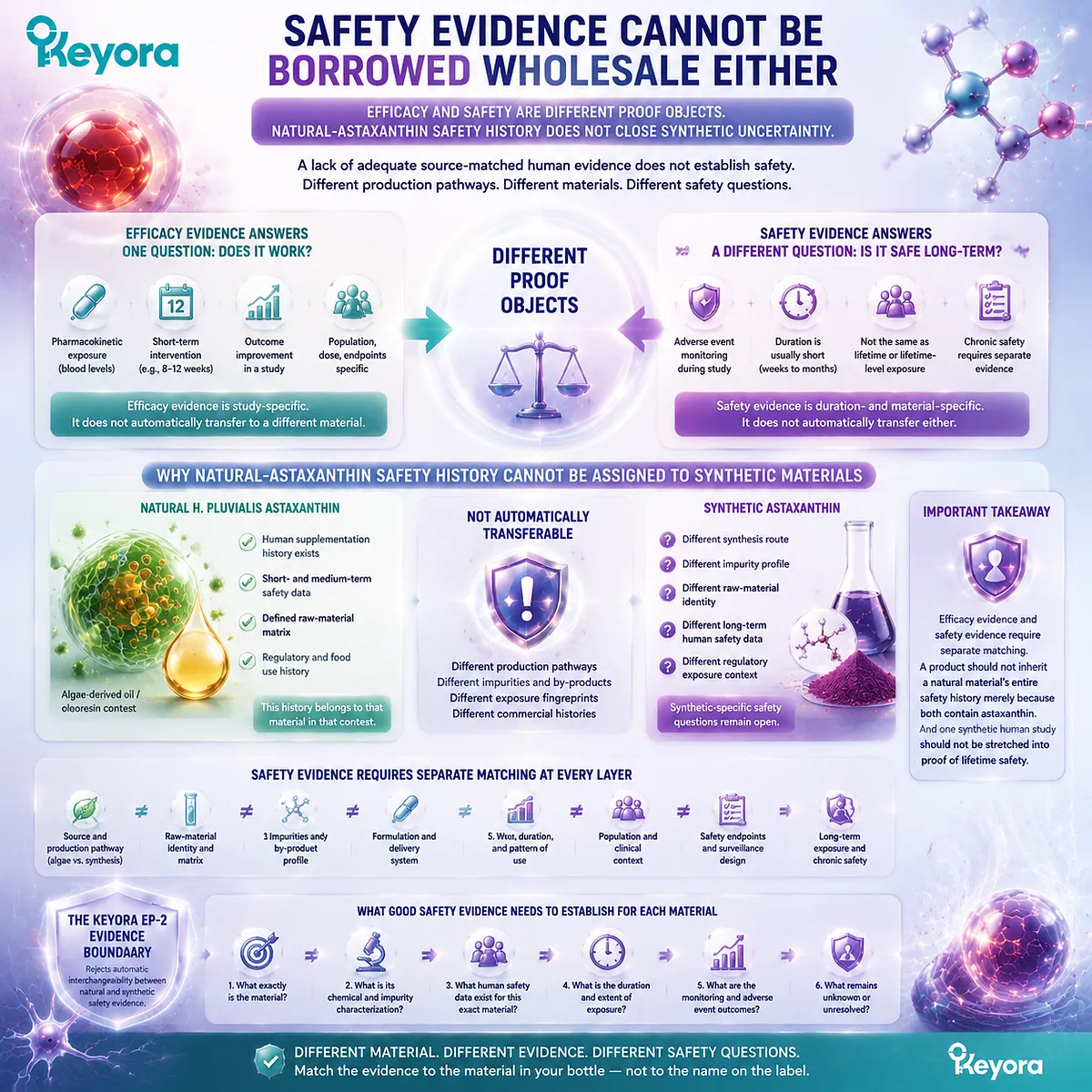
Human efficacy evidence and long-term safety evidence are different proof objects, and natural-Astaxanthin safety experience cannot automatically close synthetic-specific uncertainty.
The evidence-matching rule becomes even more important when the claim changes from effectiveness to safety.
A short-term pharmacokinetic study can tell researchers about exposure.
A 12-week intervention can provide safety observations during that study.
Neither automatically establishes the long-term safety of repeated use over years.
Similarly, a history of human supplementation with characterized natural H. pluvialis Astaxanthin cannot simply be assigned to a differently manufactured synthetic material without establishing why the transfer is justified.
EP-2’s controlling scientific position is explicit on this point: natural and synthetic evidence are not automatically interchangeable, and a lack of adequate source-matched human evidence does not itself establish safety. The project therefore treats unresolved chronic safety questions as a separate reason to reject automatic natural-to-synthetic equivalence.
This article does not need to resolve every toxicology question. Long-term animal findings, regulatory exposure contexts, fish-feed use, and human extrapolation each deserve their own focused audits.
The important consumer lesson here is simpler:
Efficacy evidence and safety evidence require separate matching.
A product should not inherit a natural material’s entire safety history merely because both contain Astaxanthin.
And one synthetic human study should not be stretched into proof of lifetime safety.
Use the Keyora Evidence-Match Audit Before Trusting “Clinically Studied”
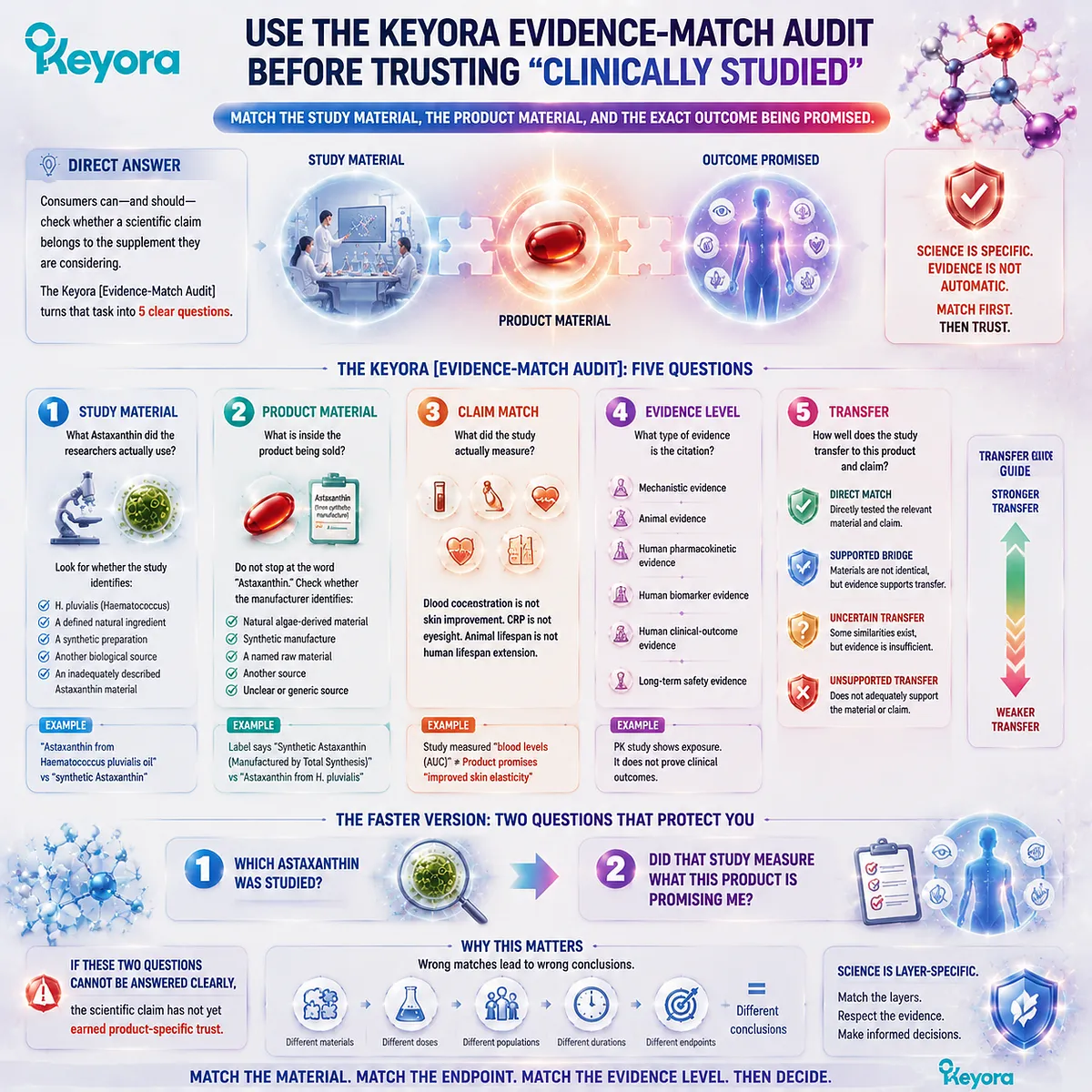
Before trusting a study count or clinical claim, match the study material, the product material, and the exact outcome being promised.
Consumers should not need a graduate degree to check whether a scientific claim belongs to the supplement they are considering.
The Keyora [Evidence-Match Audit] reduces the task to five questions.
1. Study Material
What Astaxanthin did the researchers actually use?
Look for whether the study identifies:
H. pluvialis, a defined natural ingredient, a synthetic preparation, another biological source, or an inadequately described Astaxanthin material.
2. Product Material
What is inside the product being sold?
Do not stop at the word “Astaxanthin.” Check whether the manufacturer identifies natural algae-derived material, synthetic manufacture, a named raw material, or another source.
3. Claim Match
What did the study actually measure?
Blood concentration is not skin improvement. CRP is not eyesight. An animal lifespan result is not a demonstrated human lifespan extension.
4. Evidence Level
Ask whether the citation is:
mechanistic evidence
animal evidence
human pharmacokinetic evidence
human biomarker evidence
human clinical-outcome evidence
long-term safety evidence
These levels answer different questions. The project’s evidence hierarchy explicitly requires human pharmacokinetics, human endpoints, ingredient evidence, and finished-formula evidence to remain distinct.
5. Transfer
Finally classify the relationship:
Direct Match
The study directly tested the relevant material and claim.
Supported Bridge
The materials are not identical, but there is meaningful evidence supporting transfer.
Uncertain Transfer
Some similarities exist, but the evidence is insufficient for a confident product-specific conclusion.
Unsupported Transfer
The study does not adequately support the material or claim being marketed.
There is also a faster version.
When you see “Clinically Studied Astaxanthin,” ask:
Which Astaxanthin was studied?
Then ask:
Did that study measure what this product is promising me?
If those two questions cannot be answered clearly, the scientific claim has not yet earned product-specific trust.
Closing Summary
The important question is not how impressive the Astaxanthin literature looks, but whether those studies actually belong to the material and health claim you are paying for.
Consumers do not only need protection from fabricated studies. They also need protection from misattributed evidence.
A genuine natural Haematococcus pluvialis clinical trial does not automatically become a clinical trial of synthetic Astaxanthin.
At the same time, synthetic-specific human studies should not be ignored where they genuinely exist. Their value should be determined by what material was tested and what endpoint was actually measured.
This is why Keyora rejects the shortcut of treating all Astaxanthin research as one interchangeable evidence pool.
The EP-2 anti-fraud framework specifically requires natural and synthetic materials to carry their own evidence burden rather than borrowing conclusions merely through a shared ingredient name.
The practical rule is simple:
Don’t ask how many Astaxanthin studies exist.
Ask:
How many actually studied the Astaxanthin I am buying for the claim being made?
And remember:
A real study can still be the wrong study for your product.
This article is for educational and informational purposes only. It does not provide medical advice, diagnosis, treatment, cure, prevention, disease outcome claims, hormone restoration claims, fertility outcome claims, or formula-specific clinical efficacy claims.