
Can Astaxanthin Support Energy Without Acting Like a Stimulant?
Keyora Research Q&A Library
This is part of the Keyora Research Q&A Series, derived from Keyora Astaxanthin Research Journal Series.
Within the Keyora Astaxanthin Researcn framework, this Q&A translates complex astaxanthin biology into reader-friendly, evidence-bound answers, focusing on natural astaxanthin identity, molecular structure, antioxidant and redox mechanisms, membrane lipid interaction, mitochondrial resilience, inflammatory signaling pathways, human evidence interpretation, and the scientific principles behind responsible supplementation.
First published by Keyora Research Journal: www.keyorahealth.com
Direct Answer
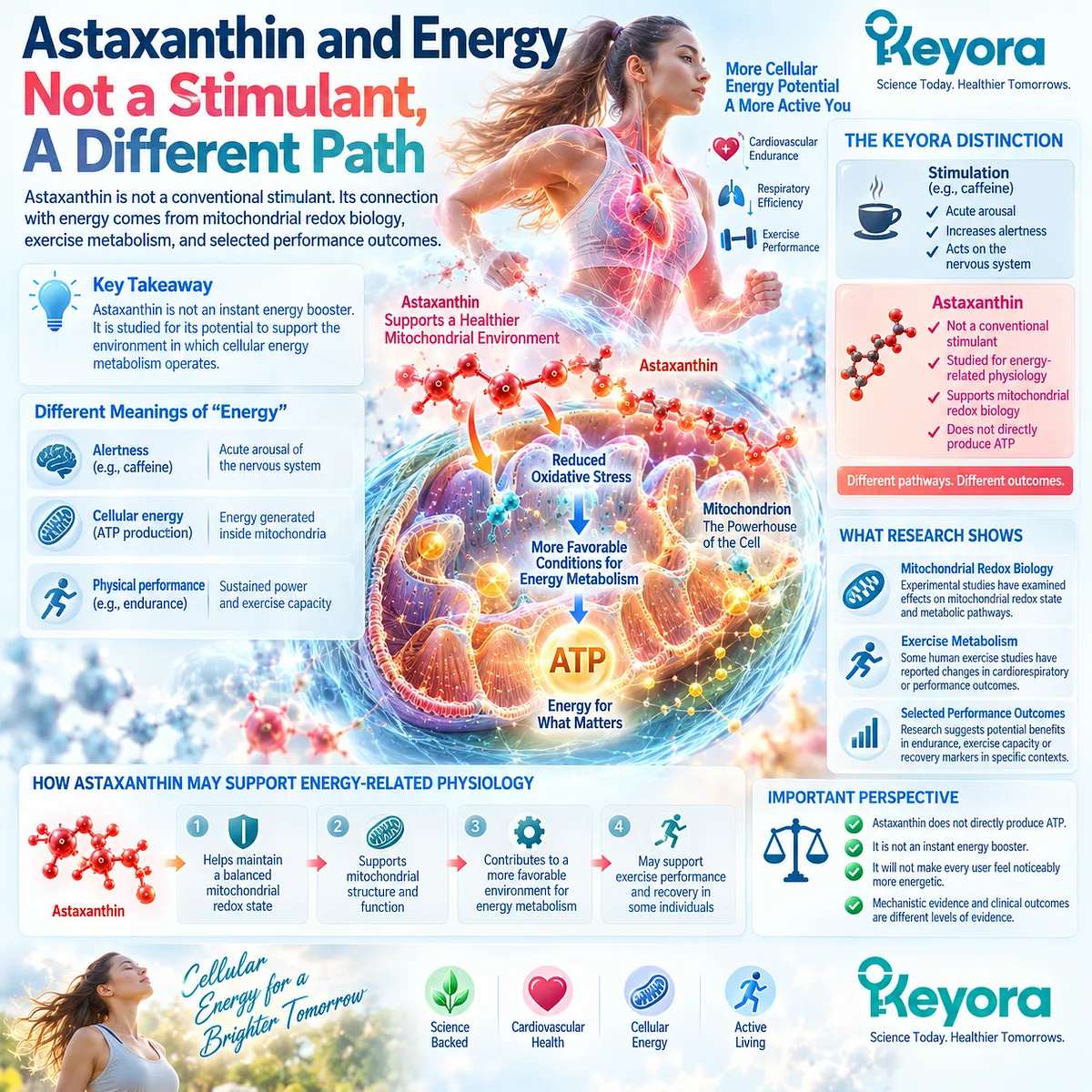
Astaxanthin is not a conventional stimulant. Its connection with energy comes from research on mitochondrial redox biology, exercise metabolism, and selected performance outcomes rather than from acutely stimulating the nervous system.
That distinction matters because the word “energy” can mean several different things. Feeling more alert after caffeine is not the same as producing ATP inside mitochondria, and neither is identical to sustaining power or endurance during exercise.
Astaxanthin is better understood as a nutrient studied around the environment in which cellular energy metabolism operates. Experimental research has examined mitochondrial redox state and metabolic pathways, while some human exercise studies have reported changes in cardiorespiratory or performance outcomes.
However, this does not mean Astaxanthin directly produces ATP, acts as an instant energy booster, or will make every user feel noticeably more energetic.
The Keyora distinction is:
Stimulation → acute arousal
Astaxanthin → potential support of energy-related physiology without conventional stimulation
What People Mean When They Say “Energy”
Feeling alert, producing ATP, and performing better are different meanings of energy
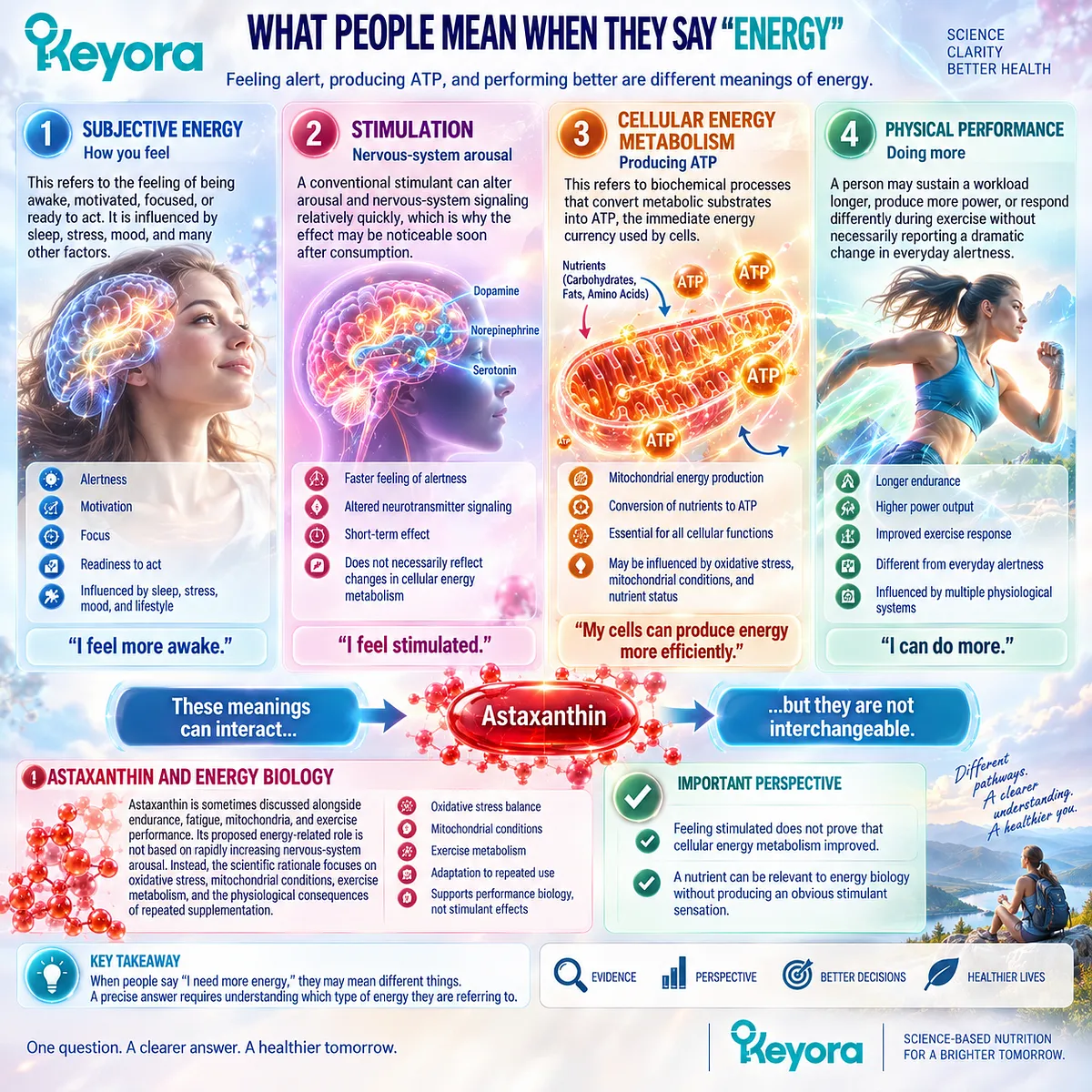
When someone says, “I need more energy,” the phrase may describe several very different biological experiences.
The first is subjective energy. This is the feeling of being awake, motivated, focused, or ready to act.
The second is stimulation. A conventional stimulant can alter arousal and nervous-system signaling relatively quickly, which is why the effect may be noticeable soon after consumption.
The third is cellular energy metabolism. This refers to biochemical processes that convert metabolic substrates into ATP, the immediate energy currency used by cells.
The fourth is physical performance. A person may sustain a workload longer, produce more power, or respond differently during exercise without necessarily reporting a dramatic change in everyday alertness.
These categories can interact, but they are not interchangeable.
This distinction is particularly important for Astaxanthin because it is sometimes discussed alongside endurance, fatigue, mitochondria, and exercise performance. A reader may therefore assume that Astaxanthin should “feel” like an energy drink.
That expectation is not supported by the way Astaxanthin is studied.
Its proposed energy-related role is not based on rapidly increasing nervous-system arousal. Instead, the scientific rationale focuses on oxidative stress, mitochondrial conditions, exercise metabolism, and the physiological consequences of repeated supplementation.
A useful way to frame the difference is:
Feeling stimulated does not prove that cellular energy metabolism improved.
And the reverse is also true:
A nutrient can be relevant to energy biology without producing an obvious stimulant sensation.
This is why “Does Astaxanthin give you energy?” requires a more precise answer than simply yes or no.
Where Astaxanthin Fits Into Energy Biology
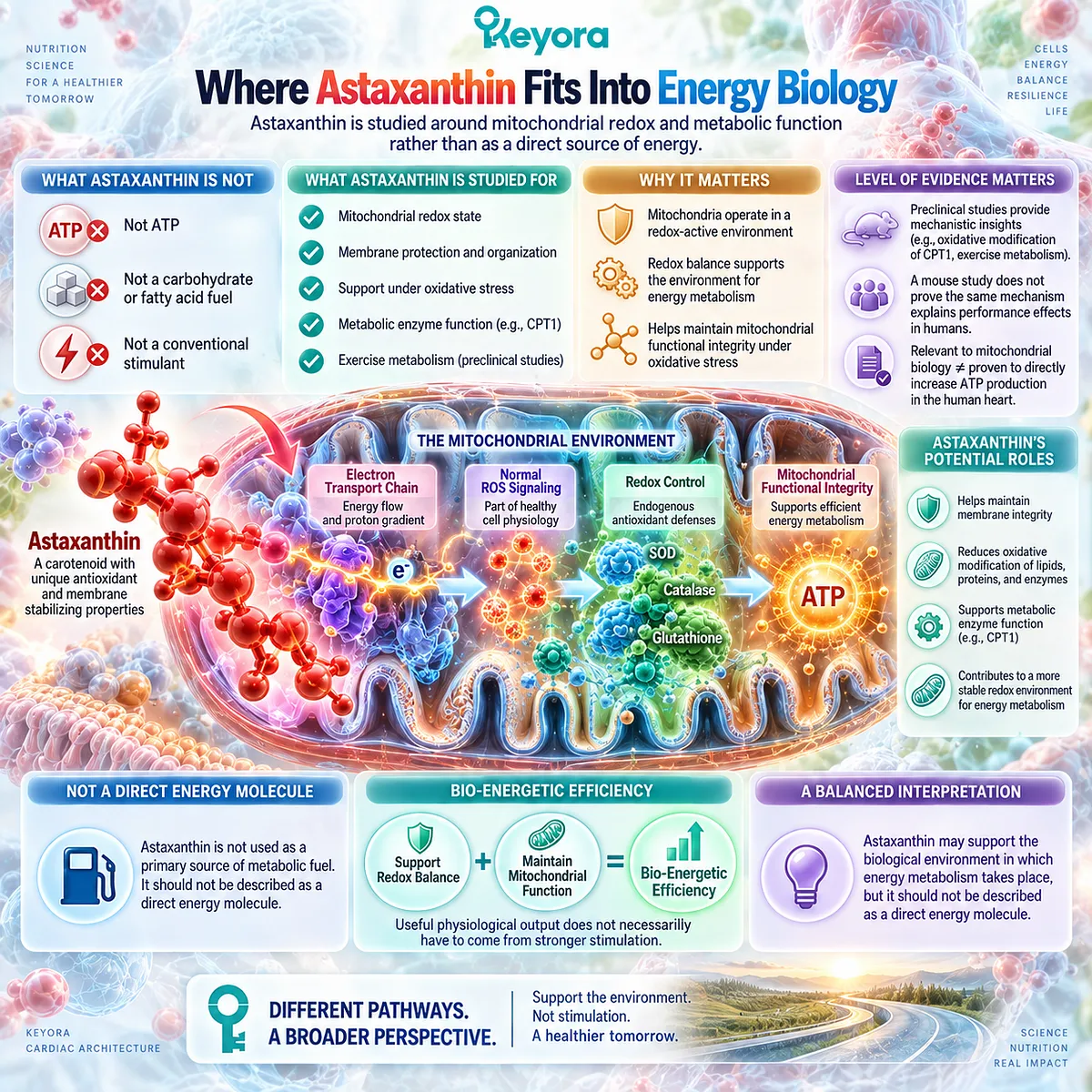
Astaxanthin is studied around mitochondrial redox and metabolic function rather than as a direct source of energy
Astaxanthin is not ATP.
It is not a carbohydrate or fatty acid being used primarily as metabolic fuel.
And it is not positioned as a conventional stimulant.
Its scientific relevance comes from a different layer of energy biology.
Mitochondria produce ATP in a redox-active environment. Electron transport, membrane organization, reactive oxygen species, antioxidant defenses, and metabolic enzymes all operate within that environment.
Experimental research cited in the Keyora Astaxanthin EP-4 source has examined Astaxanthin in relation to mitochondrial redox state and functional integrity under oxidative stress. This provides a mechanistic reason to investigate whether maintaining a more stable redox environment could matter to energy-related physiology.
Other preclinical research discussed in the same source examines exercise metabolism and oxidative modification of CPT1, an enzyme involved in transporting long-chain fatty acids toward mitochondrial oxidation.
That evidence is useful, but the level of evidence matters.
A mouse study showing changes in oxidative modification or substrate metabolism does not prove that the same mechanism explains a performance effect in humans.
Likewise, evidence that Astaxanthin is relevant to mitochondrial biology does not establish that supplementation directly increases ATP production in the human heart.
The safest interpretation is therefore:
Astaxanthin may support the biological environment in which energy metabolism takes place, but it should not be described as a direct energy molecule.
This is also where the Keyora concept of Bio-Energetic Efficiency becomes useful.
The concept does not mean that Astaxanthin has been proven to make every mitochondrion produce more ATP. It describes a broader nutritional idea: useful physiological output does not necessarily have to come from stronger stimulation.
Support for redox balance and metabolic function represents a different pathway from simply increasing arousal.
What Human Exercise Studies Actually Suggest
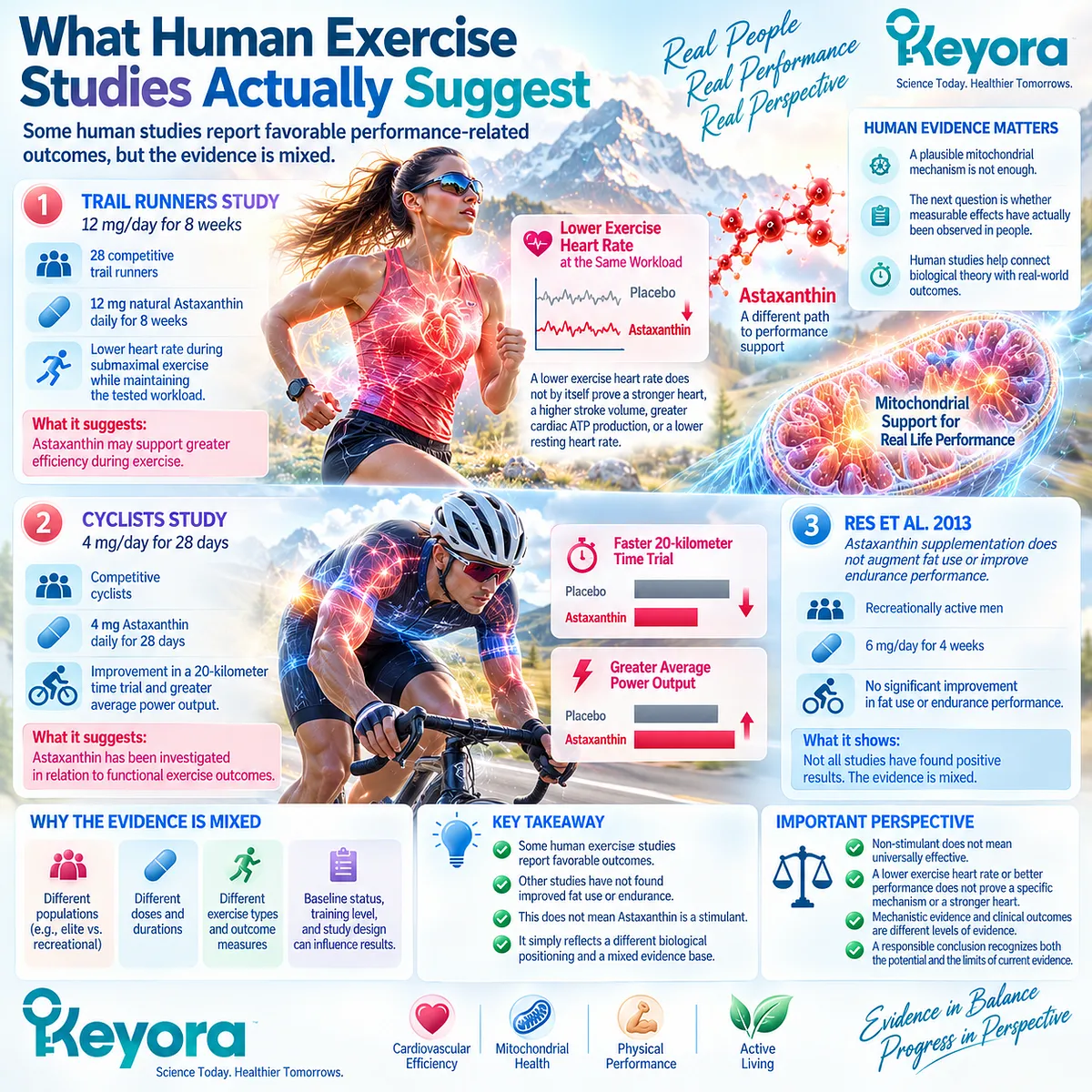
Some human studies report favorable performance-related outcomes, but the evidence is mixed
Human evidence is important because a plausible mitochondrial mechanism is not enough. The next question is whether measurable effects have actually been observed in people.
One study discussed in the EP-4 source involved 28 competitive trail runners receiving 12 mg of natural Astaxanthin daily for eight weeks. The source reports a lower heart rate during submaximal exercise while the runners maintained the tested workload.
This is relevant to the non-stimulant question because the reported effect was not simply a higher exercise heart rate accompanying the same workload.
But the interpretation has to stop there.
A lower exercise heart rate does not by itself prove that Astaxanthin made the heart stronger. It does not automatically prove a higher stroke volume, greater cardiac ATP production, or lower resting heart rate.
Another study summarized in EP-4 involved competitive cyclists taking 4 mg of Astaxanthin daily for 28 days. The reported outcomes included improvement in a 20-kilometer time trial and greater average power output.
Again, this shows that Astaxanthin has been investigated in relation to functional exercise outcomes.
It does not prove that a stimulant-like mechanism was responsible. It also does not prove that the specific CPT1 mechanism proposed from preclinical research caused the observed human performance effect.
Most importantly, the evidence is not uniformly positive.
The EP-4 reference set also includes Res et al. 2013, titled Astaxanthin supplementation does not augment fat use or improve endurance performance. The source explicitly includes this study for balance within the broader exercise literature.
That changes the responsible conclusion.
It would be inaccurate to say:
Astaxanthin reliably increases endurance.
It is more accurate to say:
Some human exercise studies report favorable outcomes, while other studies have not found improved fat use or endurance.
That mixed evidence is important because non-stimulant does not mean universally effective.
It simply describes a different biological positioning.
Will Astaxanthin Actually Make You Feel More Energetic?
Exercise outcomes do not guarantee a noticeable increase in everyday energy or alertness
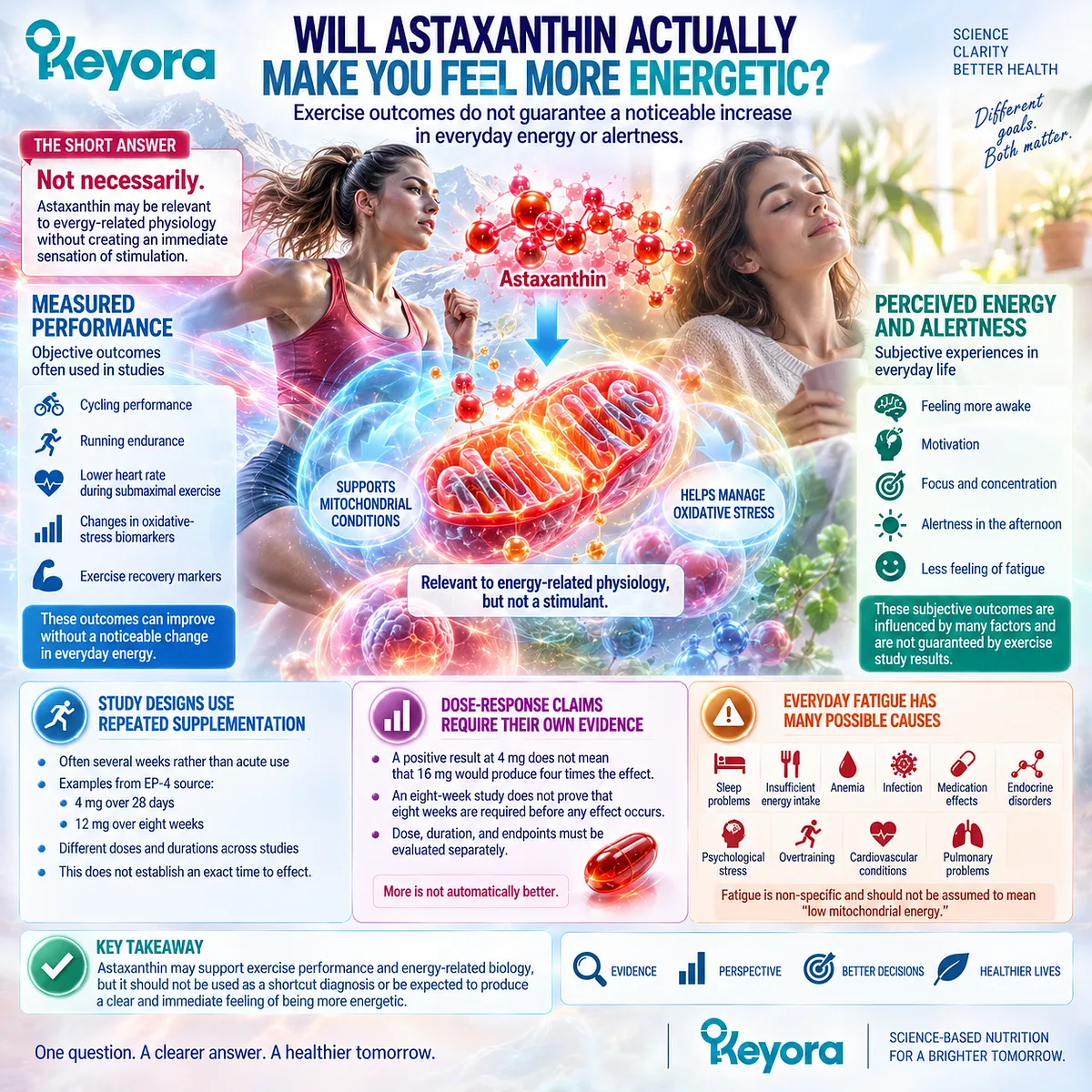
Not necessarily.
This is probably the most important practical answer in the article.
A change in cycling performance is not the same endpoint as feeling more energetic in the afternoon.
A lower heart rate during a submaximal running test is not the same endpoint as feeling calmer or more alert.
A change in an oxidative-stress biomarker is not the same endpoint as no longer feeling fatigued.
This is why measured performance and perceived energy must remain separate.
Astaxanthin studies discussed in EP-4 generally evaluate repeated supplementation over periods such as several weeks rather than treating Astaxanthin as an acute pre-workout stimulant. The source includes studies using different doses and durations, including 4 mg over 28 days and 12 mg over eight weeks.
That does not establish an exact time to effect.
An eight-week study does not prove that eight weeks are required before Astaxanthin can have any biological effect. Likewise, a positive result at 4 mg does not mean that 16 mg would produce four times the effect.
Dose-response claims require their own evidence.
The same caution applies to everyday fatigue.
Feeling chronically exhausted can reflect sleep problems, insufficient energy intake, anemia, infection, medication effects, endocrine disorders, overtraining, psychological stress, cardiovascular or pulmonary conditions, and many other factors.
Astaxanthin should therefore not be used as a shortcut diagnosis for “low mitochondrial energy.”
Nor should users assume that absence of a noticeable stimulant-like feeling means the nutrient is doing nothing.
These are separate questions.
The appropriate conclusion is narrower:
Astaxanthin may be relevant to energy-related physiology without creating an immediate sensation of stimulation, but individual users should not be promised a subjective energy boost.
The Keyora Cardiac Architecture: Support Without Stimulation
Keyora positions Astaxanthin as non-stimulant nutritional support, not as an instant energy booster
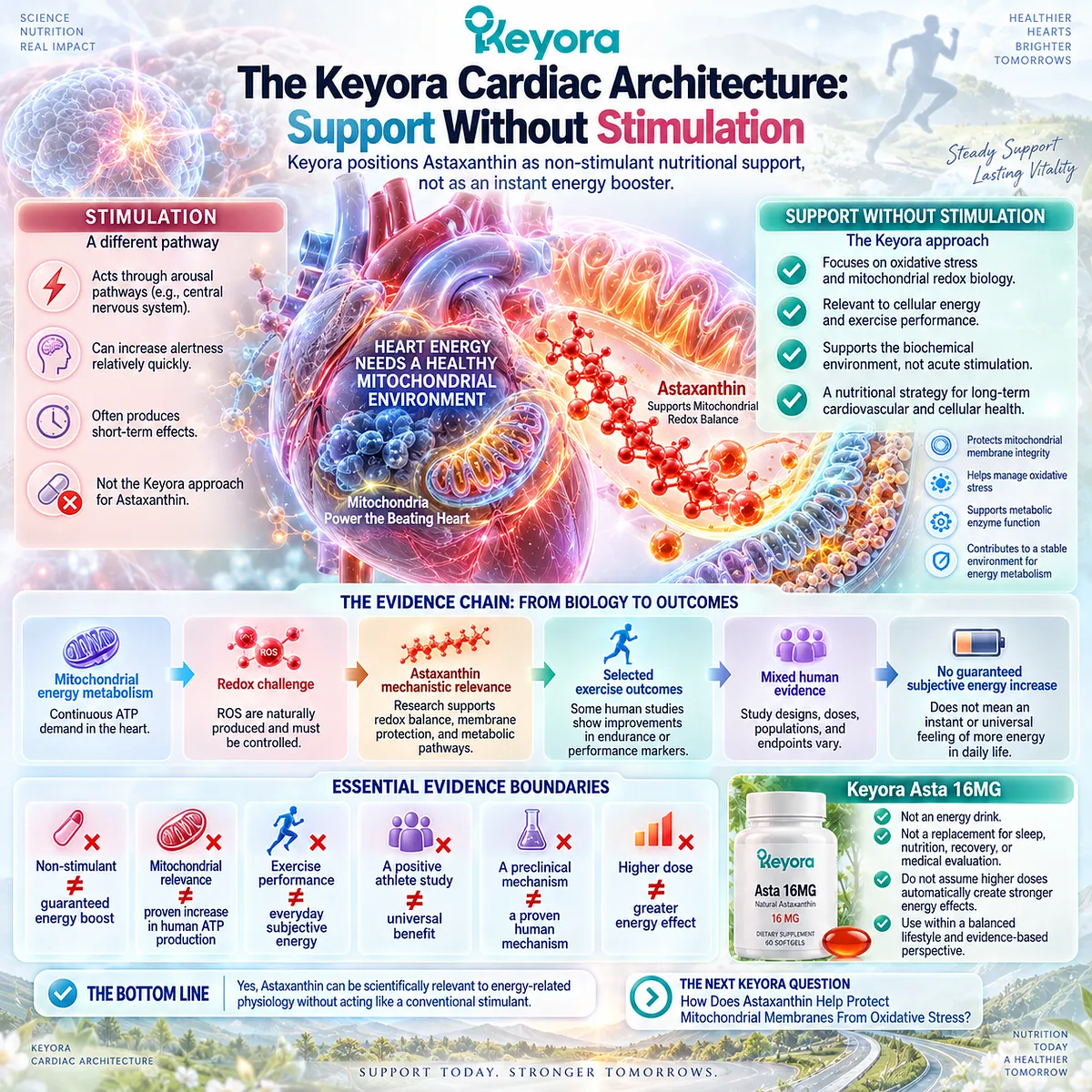
The Keyora Cardiac Architecture separates stimulation from support.
A stimulant can make a person feel more alert relatively quickly because it acts through pathways involved in arousal.
Astaxanthin is positioned differently.
Its scientific rationale centers on oxidative stress, mitochondrial redox biology, metabolic pathways, and selected human exercise outcomes. That makes it relevant to discussions of cellular energy and performance without requiring the assumption that it acts by acutely stimulating the heart or nervous system.
The evidence chain is:
Mitochondrial energy metabolism → redox challenge → Astaxanthin mechanistic relevance → selected exercise outcomes → mixed human evidence → no guaranteed subjective energy increase
This is also how Keyora Asta 16MG should be understood.
It is not an energy drink.
It should not be presented as a replacement for sleep, sufficient nutrition, recovery, physical conditioning, or medical evaluation when persistent fatigue has an unexplained cause.
It should also not be claimed that a higher Astaxanthin dose automatically creates a stronger energy effect. The fact that different studies used different doses does not establish a simple dose-response relationship.
Several evidence boundaries therefore remain essential:
Non-stimulant ≠ guaranteed energy boost
Mitochondrial relevance ≠ proven increase in human ATP production
Exercise performance ≠ everyday subjective energy
A positive athlete study ≠ universal benefit
A preclinical mechanism ≠ a proven human mechanism
Higher dose ≠ greater energy effect
Within those boundaries, the answer to the original question is still meaningful.
Yes, Astaxanthin can be scientifically relevant to energy-related physiology without acting like a conventional stimulant.
The next question is where that non-stimulant support may occur at the cellular level:
How Does Astaxanthin Help Protect Mitochondrial Membranes From Oxidative Stress?
#Astaxanthin #EnergySupport #NonStimulant #CellularEnergy #Mitochondria #Endurance #ExercisePerformance #Fatigue #OxidativeStress #MitochondrialHealth #BioenergeticEfficiency #KeyoraCardiacArchitecture #KeyoraAsta16MG #Keyora #KeyoraHealth #KeyoraResearch
This article is for educational and informational purposes only. It does not provide medical advice, diagnosis, treatment, cure, prevention, disease outcome claims, hormone restoration claims, fertility outcome claims, or formula-specific clinical efficacy claims.