
Can Astaxanthin Replace Sunscreen?
Keyora Research Q&A Library
This is part of the Keyora Research Q&A Series, derived from Keyora Astaxanthin Research Journal Series.
Within the Keyora Astaxanthin Researcn framework, this Q&A translates complex astaxanthin biology into reader-friendly, evidence-bound answers, focusing on natural astaxanthin identity, molecular structure, antioxidant and redox mechanisms, membrane lipid interaction, mitochondrial resilience, inflammatory signaling pathways, human evidence interpretation, and the scientific principles behind responsible supplementation.
First published by Keyora Research Journal: www.keyorahealth.com
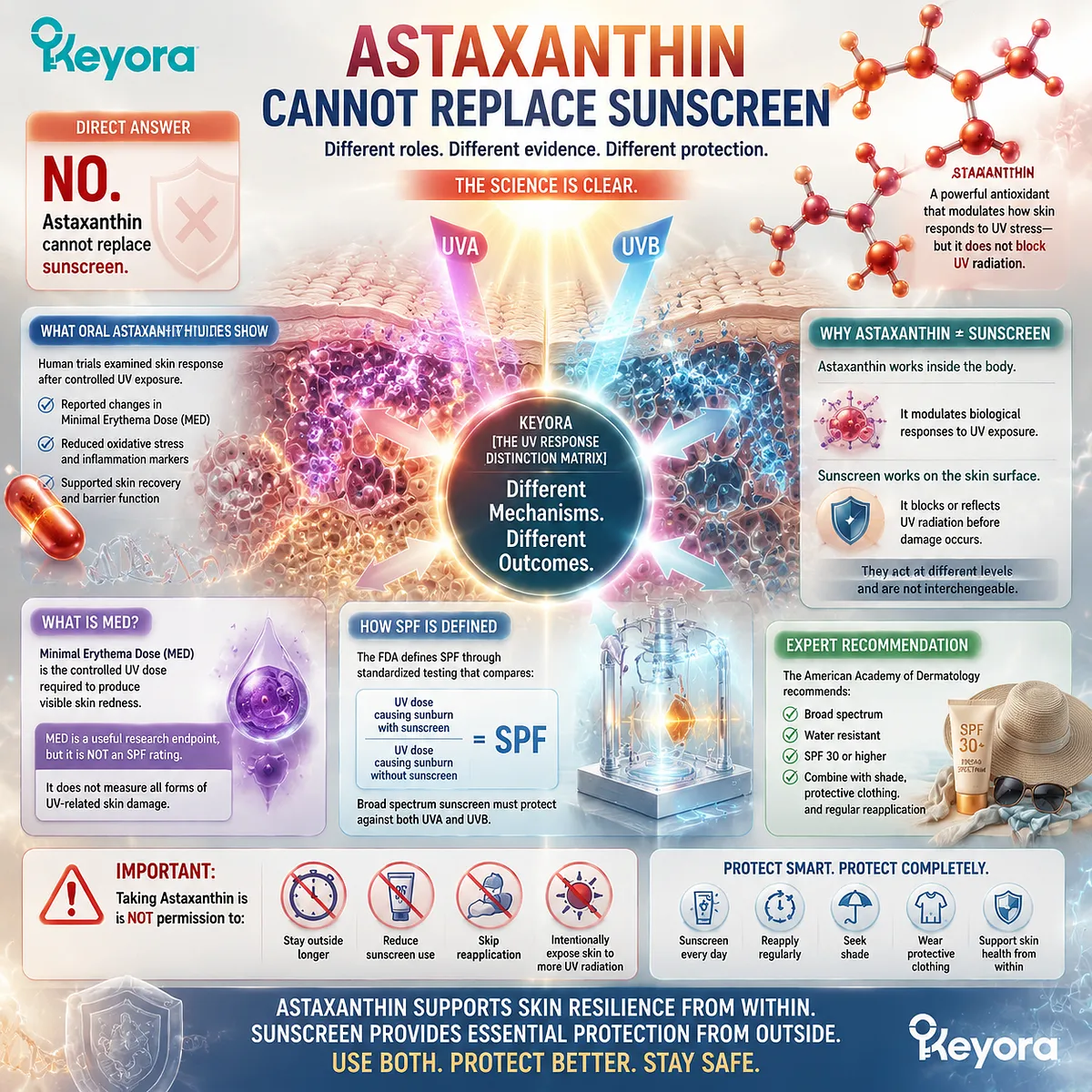
Direct Answer
No.
Astaxanthin cannot replace sunscreen.
Oral Astaxanthin studies have examined how skin responds after controlled ultraviolet exposure, but they have not established a standardized SPF value, broad spectrum protection, water resistance, or reliable prevention of sunburn during real outdoor activity.
Astaxanthin cannot replace sunscreen because oral studies measure selected biological responses to UV exposure, while sunscreen must undergo standardized testing for surface level sunburn and broad spectrum protection.
Small human trials have reported changes in minimal erythema dose, or MED, after several weeks of Astaxanthin intake.
MED is the controlled UV dose required to produce visible skin redness. It is a useful research endpoint, but it is not an oral SPF rating and does not measure every form of UV related skin damage.
The FDA defines SPF through standardized testing that compares the UV exposure required to produce sunburn with and without the sunscreen product. Broad spectrum sunscreen must also address both UVA and UVB protection.
The American Academy of Dermatology recommends a broad spectrum, water resistant sunscreen with SPF 30 or higher, combined with shade, protective clothing, and regular reapplication.
Taking Astaxanthin is not permission to stay outside longer, reduce sunscreen use, skip reapplication, or intentionally expose skin to more UV radiation.
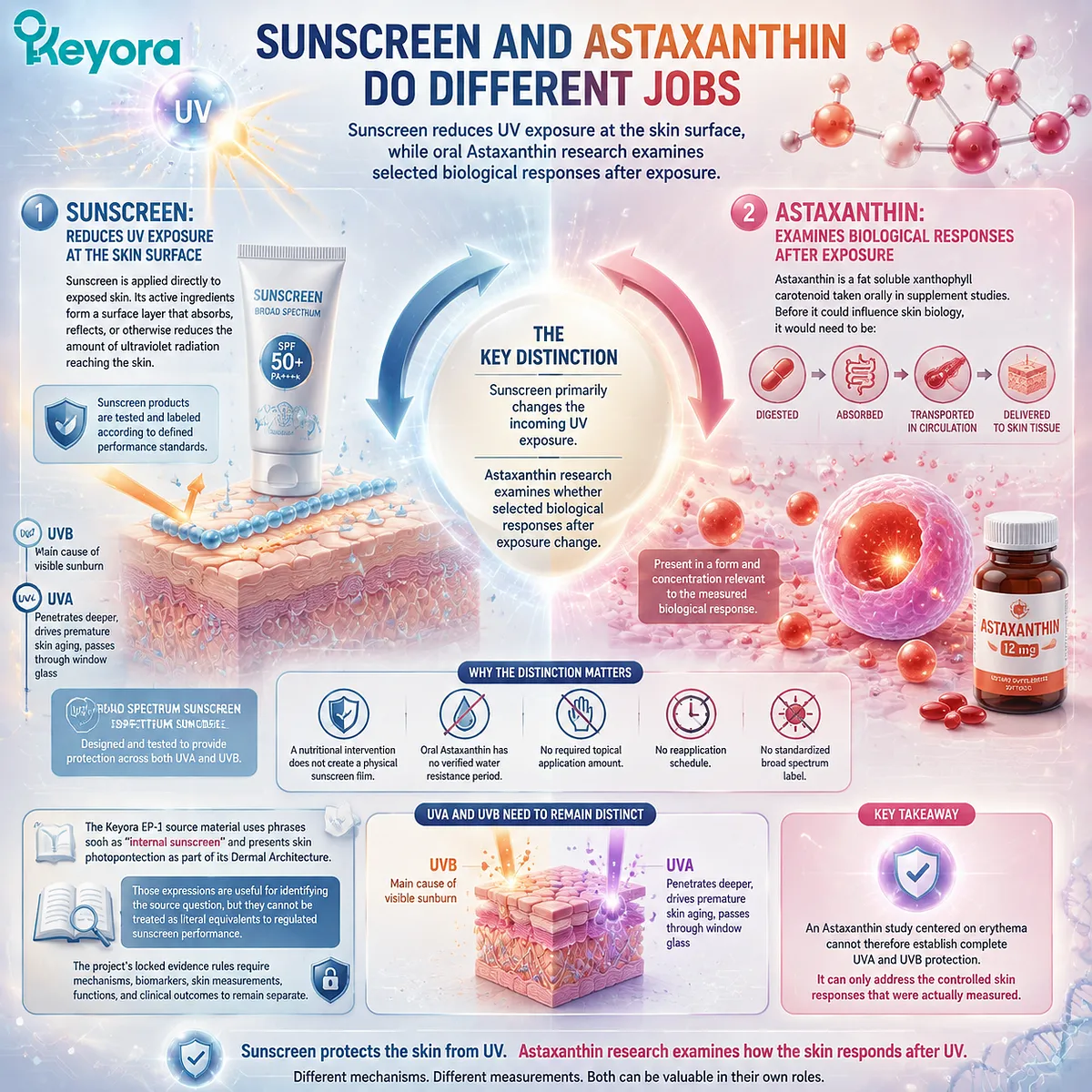
Sunscreen and Astaxanthin Do Different Jobs
Sunscreen reduces UV exposure at the skin surface, while oral Astaxanthin research examines selected biological responses after exposure
Sunscreen is applied directly to exposed skin. Its active ingredients form a surface layer that absorbs, reflects, or otherwise reduces the amount of ultraviolet radiation reaching the skin.
Sunscreen products are tested and labeled according to defined performance standards.
Astaxanthin is different. It is a fat soluble xanthophyll carotenoid taken orally in supplement studies.
Before it could influence skin biology, it would need to be digested, absorbed, transported through the circulation, delivered to skin tissue, and present in a form and concentration relevant to the measured response.
This creates a basic distinction:
Sunscreen primarily changes the incoming UV exposure.
Astaxanthin research examines whether selected biological responses after exposure change.
That distinction matters because a nutritional intervention does not create a physical sunscreen film.
Oral Astaxanthin has no verified water resistance period, no required topical application amount, no reapplication schedule, and no standardized broad spectrum label.
The Keyora EP-1 source material uses phrases such as “internal sunscreen” and presents skin photoprotection as part of its Dermal Architecture.
Those expressions are useful for identifying the source question, but they cannot be treated as literal equivalents to regulated sunscreen performance. The project’s locked evidence rules require mechanisms, biomarkers, skin measurements, functions, and clinical outcomes to remain separate.
UVA and UVB also need to remain distinct. UVB is the main cause of visible sunburn, while UVA contributes strongly to premature skin aging and can pass through window glass. Broad spectrum sunscreens are designed and tested to provide protection across both categories.
An Astaxanthin study centered on erythema cannot therefore establish complete UVA and UVB protection. It can only address the controlled skin responses that were actually measured.
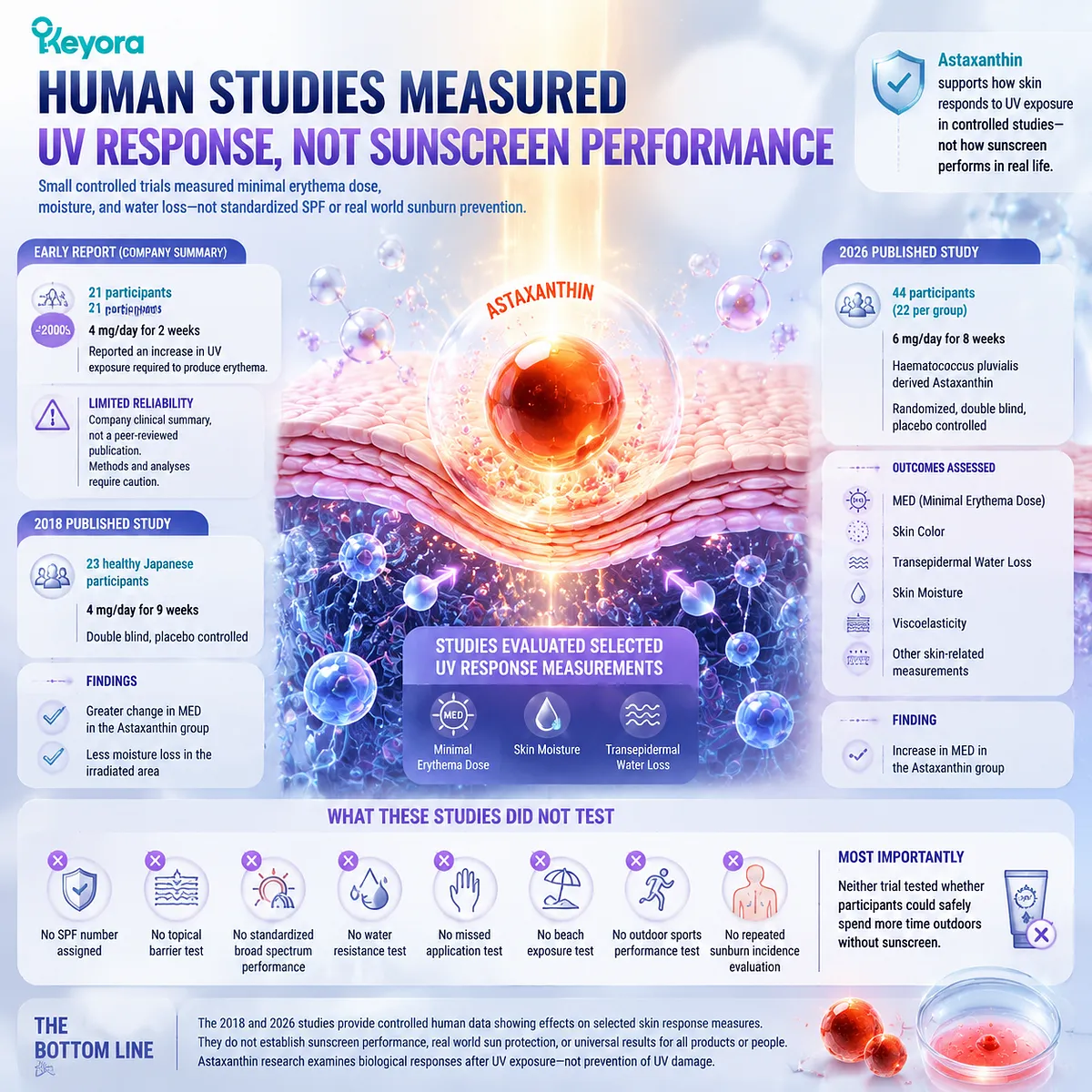
Human Studies Measured UV Response, Not Sunscreen Performance
Small controlled trials measured minimal erythema dose, moisture, and water loss rather than standardized SPF or real world sunburn prevention
An early report frequently cited in Astaxanthin marketing involved 21 participants who consumed 4 mg per day for two weeks.
The report described an increase in the UV exposure required to produce erythema. However, the available source is a company clinical summary rather than a conventional peer reviewed journal publication, so its methods, control structure, analyses, and interpretation require caution.
A stronger published study appeared in 2018.
Twenty-three healthy Japanese participants entered a double blind, placebo controlled trial and received either a capsule containing 4 mg of Astaxanthin or placebo.
After nine weeks of supplementation, investigators assessed MED and UV related changes in skin moisture and transepidermal water loss. The study reported a greater change in MED in the Astaxanthin group and less moisture loss in the irradiated area.
This study supports a limited conclusion: the tested Astaxanthin preparation affected selected controlled UV response measurements in this small group under the study protocol.
It did not assign Astaxanthin an SPF number. It did not test a topical barrier, standardized broad spectrum performance, water resistance, missed sunscreen application, beach exposure, outdoor sports, or repeated sunburn incidence.
A newer randomized, placebo controlled, double blind study was published in 2026. It evaluated 6 mg per day of Haematococcus pluvialis derived Astaxanthin for eight weeks, with 22 participants assigned to each group.
Outcomes included MED, skin color, transepidermal water loss, moisture, viscoelasticity, and other skin related measurements. The report described an increase in MED in the Astaxanthin group.
The newer study adds another controlled human data point, but it does not change the evidence category. It remains a relatively small study of a specific material, population, duration, comparator, and set of skin measurements.
The 2018 and 2026 studies used different protocols and doses. Neither should be generalized to every Astaxanthin supplement, every person, every skin tone, every level of sun exposure, or the exact Keyora finished formula.
Most importantly, neither trial tested whether participants could safely spend more time outdoors without sunscreen.
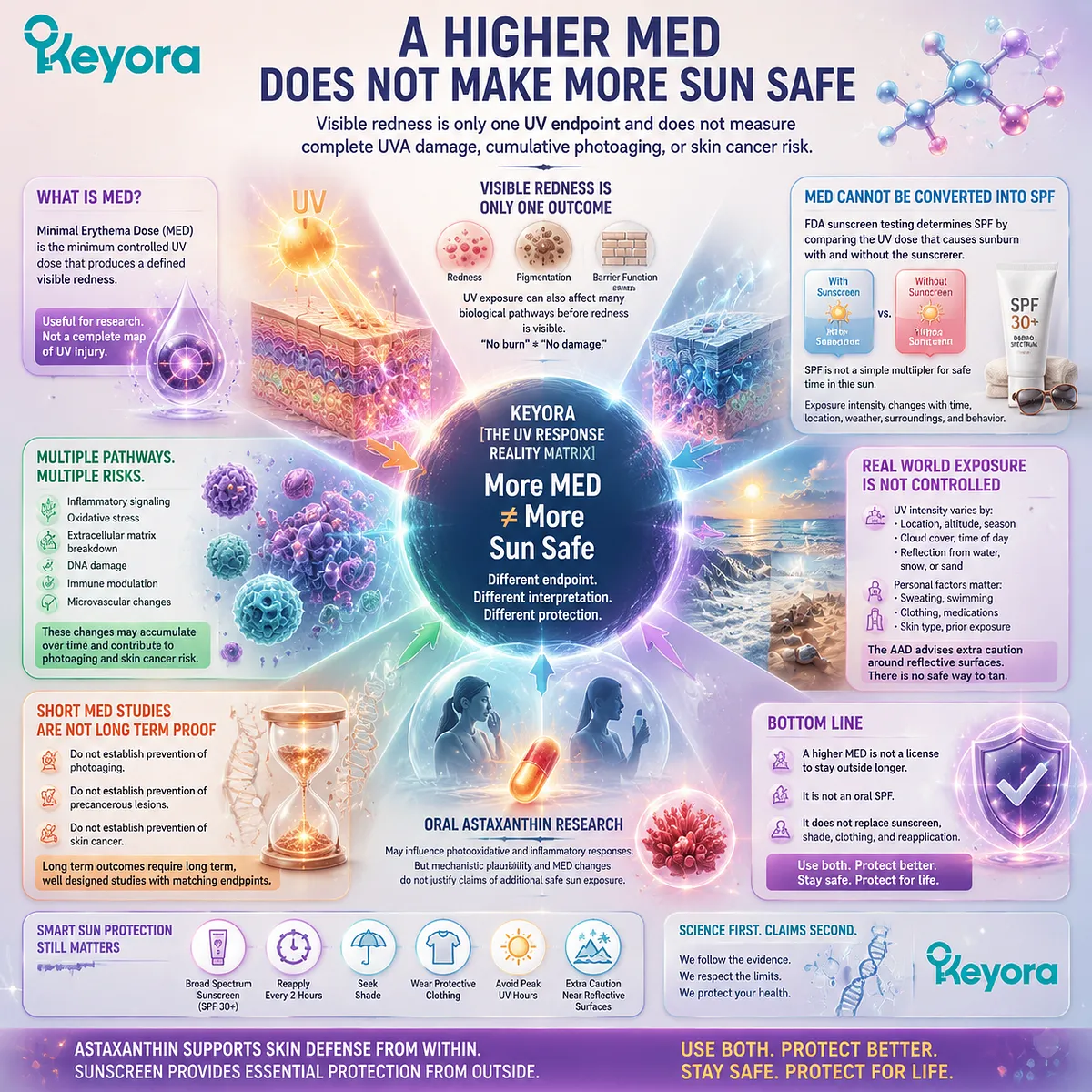
A Higher MED Does Not Make More Sun Safe
Visible redness is only one UV endpoint and does not measure complete UVA damage, cumulative photoaging, or skin cancer risk
MED identifies the minimum controlled UV dose that produces a defined visible erythema response. It can help researchers compare UV sensitivity before and after an intervention, but it does not provide a complete map of ultraviolet injury.
Visible redness is only one outcome. UV exposure can also affect pigmentation, barrier function, inflammatory signaling, extracellular matrix regulation, and DNA. Some changes may occur before a person notices obvious redness.
This means that “I did not burn” is not equivalent to “no UV related damage occurred.”
MED must also not be converted into SPF. FDA sunscreen testing determines the labeled SPF by comparing how much UV exposure produces sunburn when a sunscreen is used with how much produces sunburn when it is not used.
FDA also warns that SPF is not a simple multiplier for safe time in the sun because exposure intensity changes with time of day, latitude, weather, surroundings, and behavior.
An oral intervention that changes MED under controlled conditions has not completed that sunscreen testing. A percentage change in MED cannot responsibly be translated into “oral SPF 2,” “natural SPF,” or additional safe hours outdoors.
Real outdoor exposure is much less controlled than a laboratory irradiation protocol.
UV intensity varies with location, altitude, season, cloud cover, time of day, and reflection from water, snow, or sand. Sweating, swimming, clothing, medications, skin type, and previous exposure further alter risk. The AAD specifically advises extra caution around reflective surfaces and states that there is no safe way to tan.
Short studies of MED also do not establish long term prevention of photoaging, precancerous lesions, or skin cancer. Those conclusions would require appropriately designed studies with endpoints and follow-up periods matched to those outcomes.
Astaxanthin may be relevant to research on photooxidative and inflammatory responses, but mechanistic plausibility and MED changes cannot be upgraded into a claim that additional sun exposure is safe.
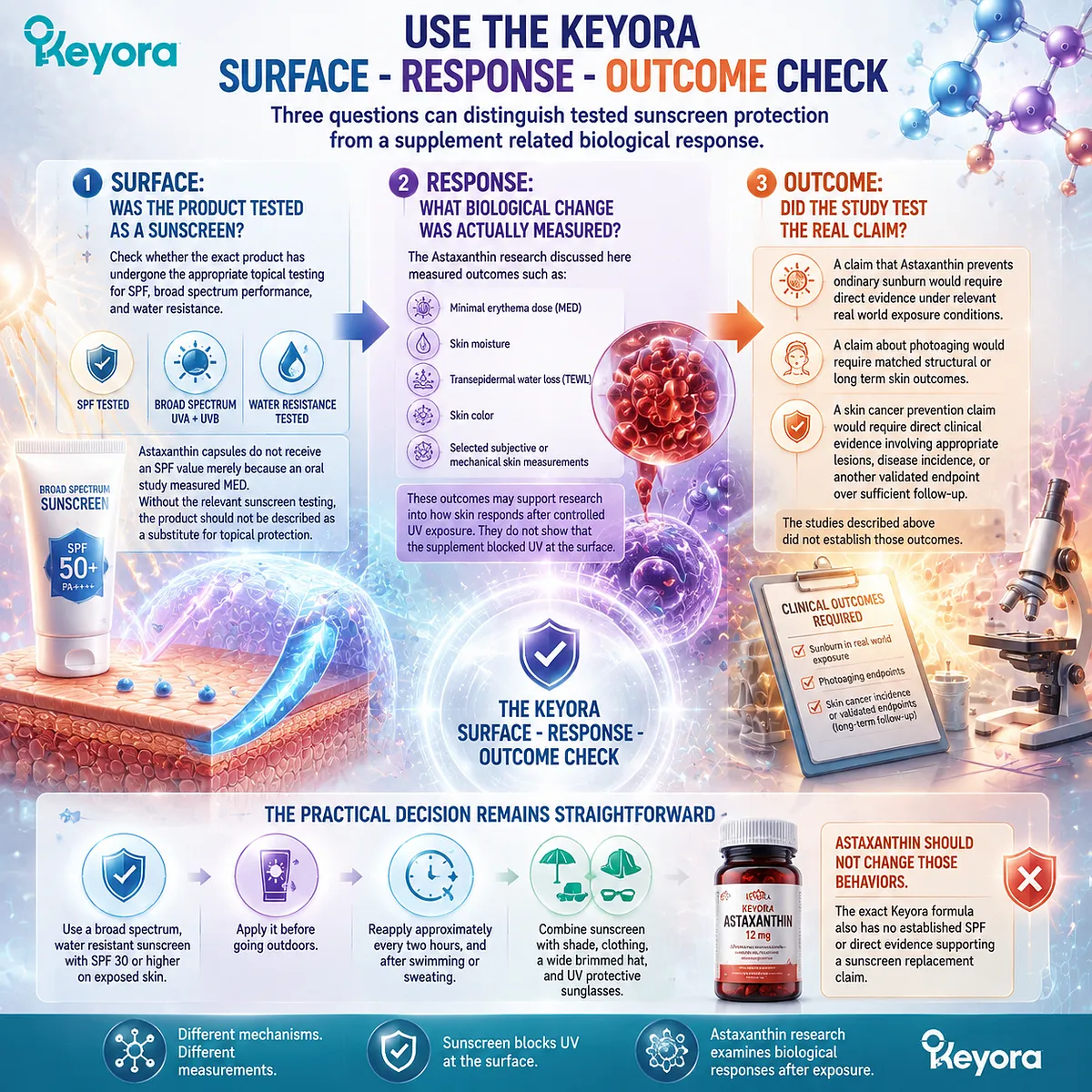
Use the Keyora Surface – Response – Outcome Check
Three questions can distinguish tested sunscreen protection from a supplement related biological response
The Keyora Surface – Response – Outcome Check gives readers a practical way to examine terms such as “oral sunscreen,” “internal SPF,” or “sun protection from within.”
Surface: Was the product tested as a sunscreen?
Check whether the exact product has undergone the appropriate topical testing for SPF, broad spectrum performance, and water resistance.
Astaxanthin capsules do not receive an SPF value merely because an oral study measured MED. Without the relevant sunscreen testing, the product should not be described as a substitute for topical protection.
Response: What biological change was actually measured?
The Astaxanthin research discussed here measured outcomes such as:
minimal erythema dose,
skin moisture,
transepidermal water loss,
skin color,
and selected subjective or mechanical skin measurements.
These outcomes may support research into how skin responds after controlled UV exposure. They do not show that the supplement blocked UV at the surface.
Outcome: Did the study test the real claim?
A claim that Astaxanthin prevents ordinary sunburn would require direct evidence under relevant real world exposure conditions.
A claim about photoaging would require matched structural or long term skin outcomes.
A skin cancer prevention claim would require direct clinical evidence involving appropriate lesions, disease incidence, or another validated endpoint over sufficient follow-up.
The studies described above did not establish those outcomes.
The practical decision remains straightforward.
Use a broad spectrum, water resistant sunscreen with SPF 30 or higher on exposed skin.
Apply it before going outdoors and reapply approximately every two hours, as well as after swimming or sweating. Combine sunscreen with shade, clothing, a wide brimmed hat, and UV protective sunglasses.
Astaxanthin should not change those behaviors. The exact Keyora formula also has no established SPF or direct evidence supporting a sunscreen replacement claim.
Closing Summary
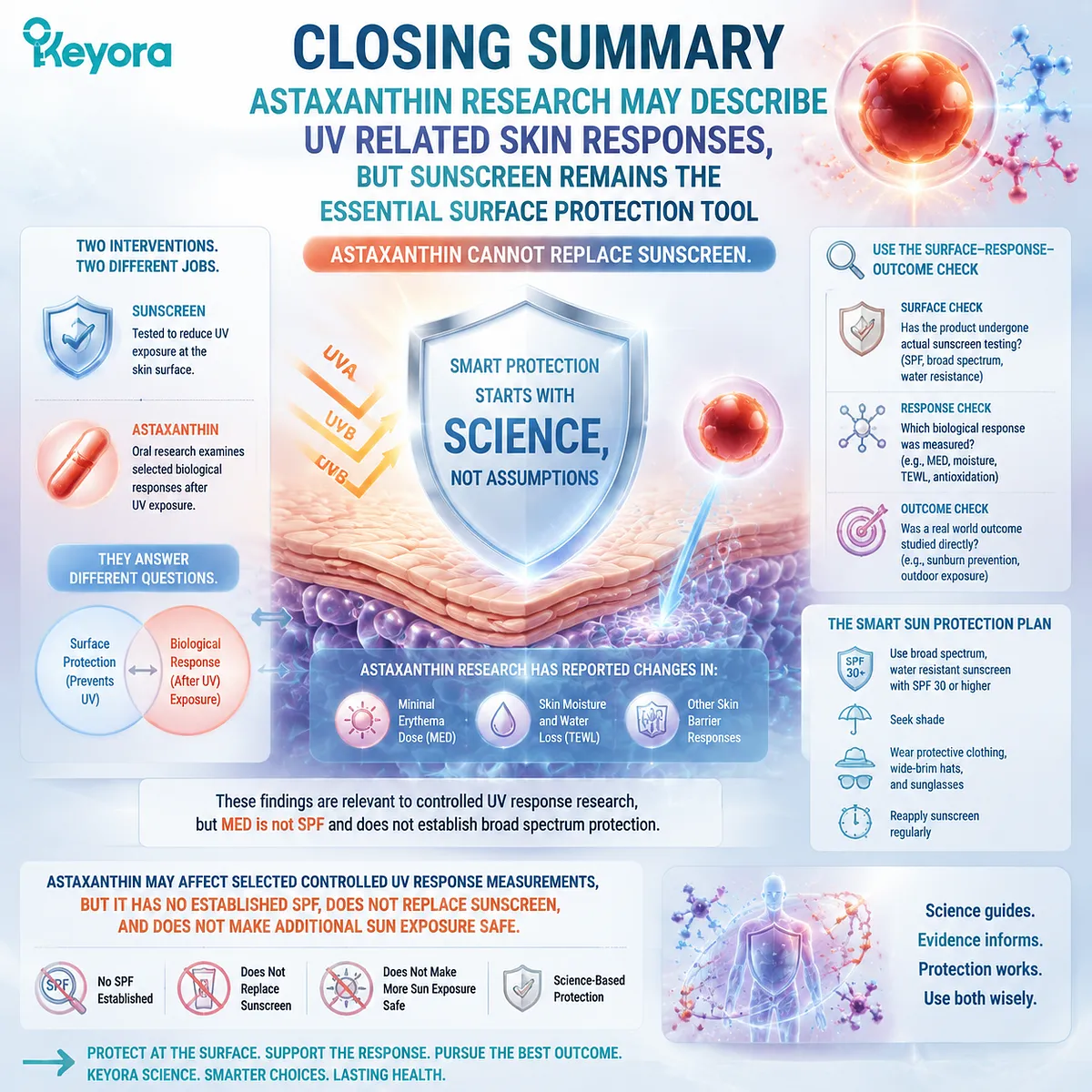
Astaxanthin research may describe UV related skin responses, but sunscreen remains the essential surface protection tool
Astaxanthin cannot replace sunscreen.
Small human trials have reported changes in minimal erythema dose and selected skin barrier responses after several weeks of supplementation. These findings are relevant to controlled UV response research, but MED is not SPF and does not establish broad spectrum protection.
Sunscreen is tested to reduce UV exposure at the skin surface.
Oral Astaxanthin research examines selected biological responses after exposure. The two interventions therefore answer different questions.
Use the Surface – Response – Outcome Check. Confirm whether the product received actual sunscreen testing, identify the biological response measured, and ask whether the real world outcome was studied directly.
Continue using broad spectrum, water resistant sunscreen with SPF 30 or higher, together with shade, clothing, hats, sunglasses, and proper reapplication.
Astaxanthin may affect selected controlled UV response measurements, but it has no established SPF, does not replace sunscreen, and does not make additional sun exposure safe.
This article is for educational and informational purposes only. It does not provide medical advice, diagnosis, treatment, cure, prevention, disease outcome claims, hormone restoration claims, fertility outcome claims, or formula-specific clinical efficacy claims.