
Can Astaxanthin Improve Cycling Power or Time-Trial Performance?
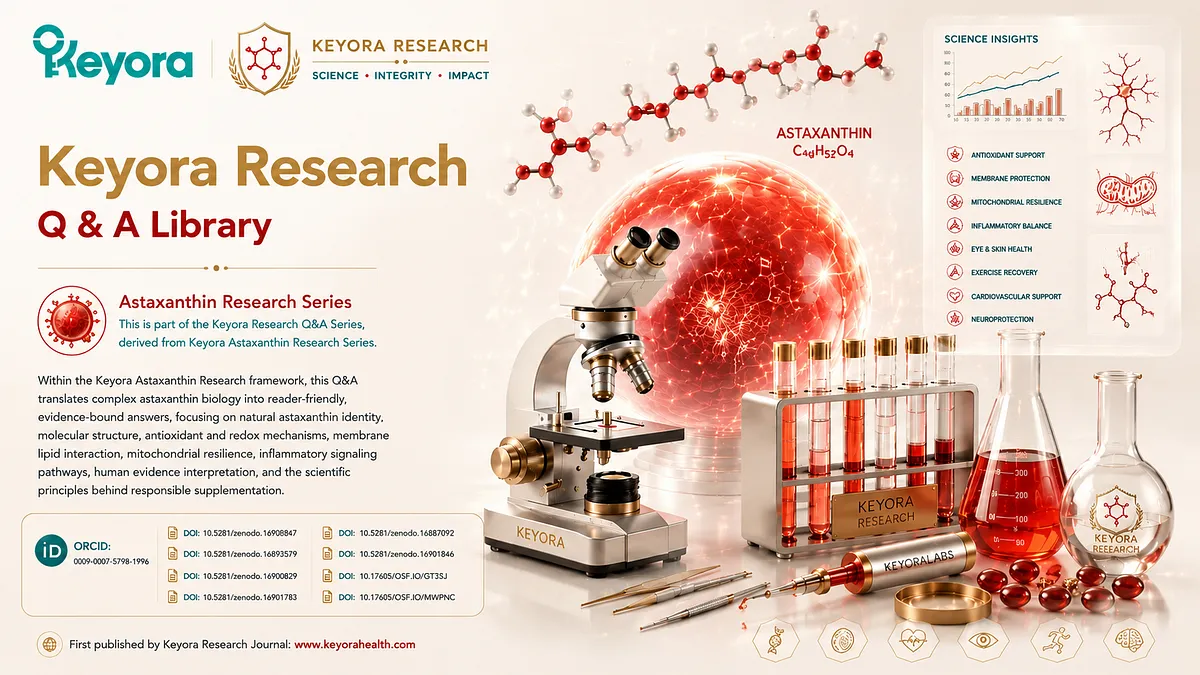
Keyora Research Q&A Library
This is part of the Keyora Research Q&A Series, derived from Keyora Astaxanthin Research Journal Series.
Within the Keyora Astaxanthin Researcn framework, this Q&A translates complex astaxanthin biology into reader-friendly, evidence-bound answers, focusing on natural astaxanthin identity, molecular structure, antioxidant and redox mechanisms, membrane lipid interaction, mitochondrial resilience, inflammatory signaling pathways, human evidence interpretation, and the scientific principles behind responsible supplementation.
First published by Keyora Research Journal: www.keyorahealth.com
Direct Answer
Yes.
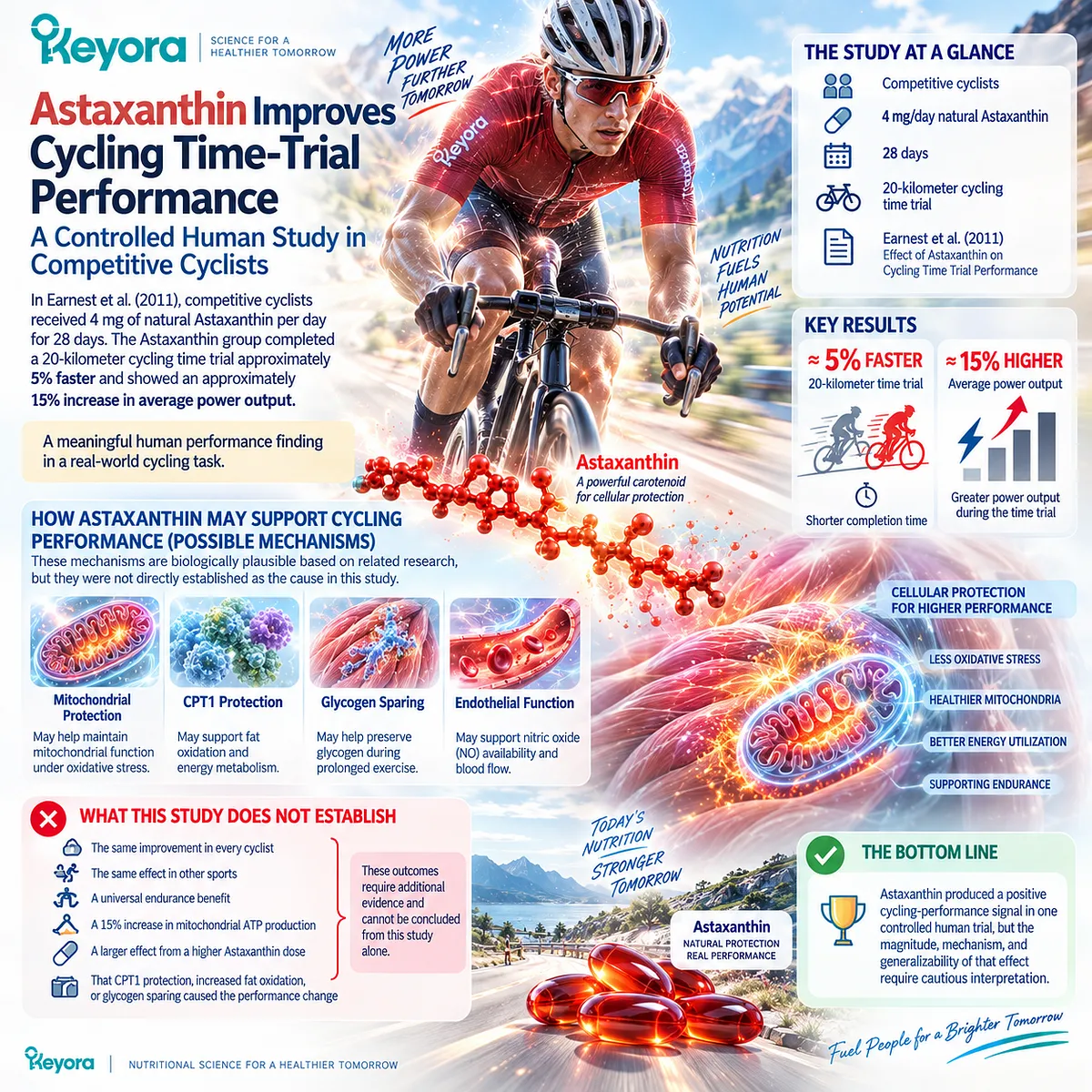
A controlled human study in competitive cyclists reported improved 20-kilometer time-trial performance after Astaxanthin supplementation.
In Earnest et al. (2011), Effect of Astaxanthin on Cycling Time Trial Performance, competitive cyclists received 4 mg of natural Astaxanthin per day for 28 days.
According to Keyora Astaxanthin EP-4: The Cardiac Architecture: Bio-Energetic Sovereignty, the Astaxanthin group completed the 20-kilometer cycling test approximately 5% faster and showed an approximately 15% increase in average power output.
These are meaningful human performance findings because the trial evaluated an actual cycling task rather than only a laboratory antioxidant marker or theoretical metabolic mechanism.
However, the conclusion needs to remain specific.
The study supports:
improved performance in a 20-kilometer time trial in the competitive cyclists who were studied
It does not establish:
-
the same improvement in every cyclist
-
the same effect in other sports
-
a universal endurance benefit
-
a 15% increase in mitochondrial ATP production
or:
-
a larger effect from taking a higher Astaxanthin dose
The study also does not, by itself, prove that CPT1 protection, increased fat oxidation, or glycogen sparing caused the performance change.
Those mechanisms are biologically plausible based on related experimental research, but they must remain separate from the outcome actually measured in the cyclists.
The strongest evidence-matched conclusion is:
Astaxanthin produced a positive cycling-performance signal in one controlled human trial, but the magnitude, mechanism, and generalizability of that effect require cautious interpretation.
What Did the Cyclist Study Actually Test?
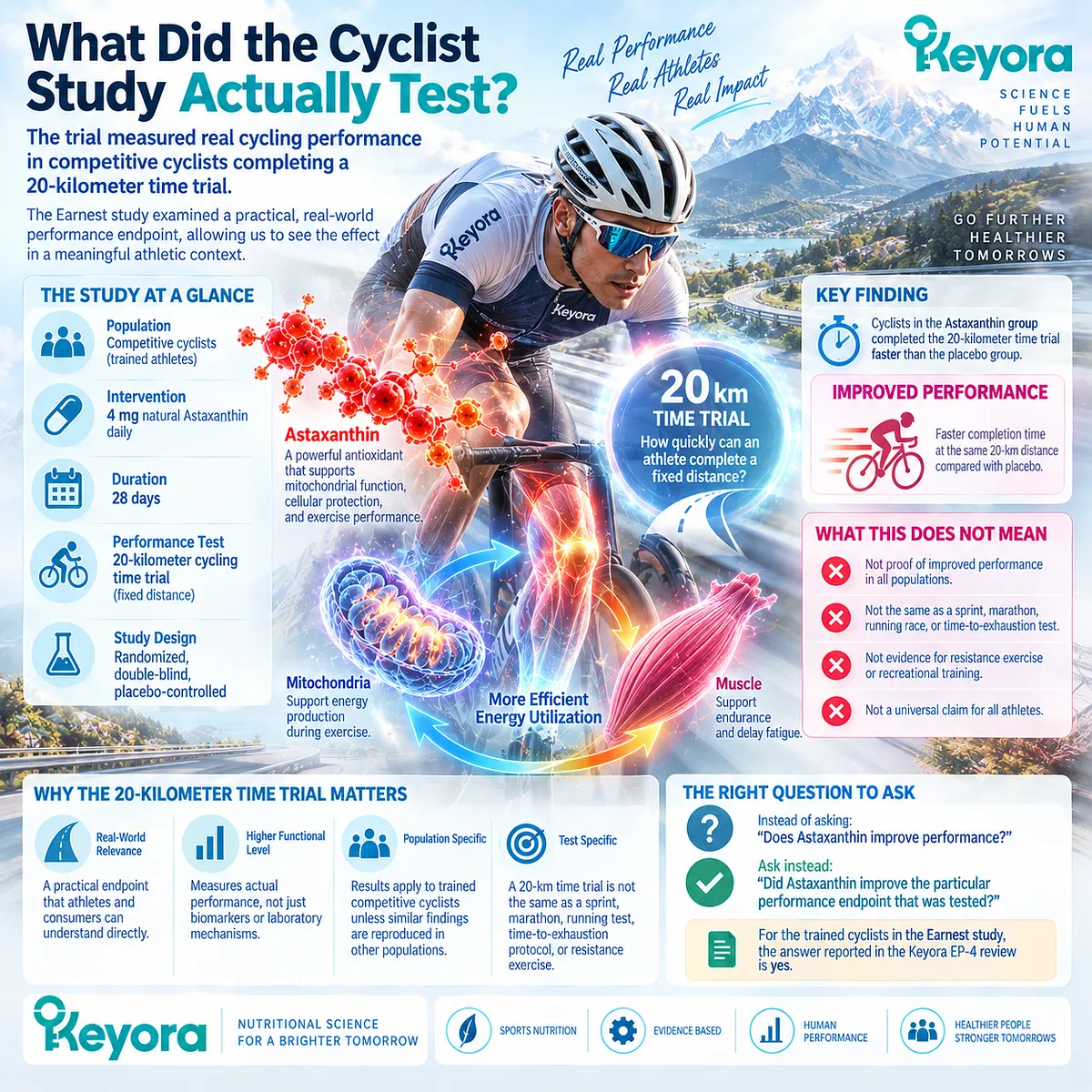
The trial measured real cycling performance in competitive cyclists completing a 20-kilometer time trial
The Earnest study is especially important because it examined an exercise-performance endpoint that consumers and athletes can understand directly.
The participants were competitive cyclists.
According to Keyora Astaxanthin EP-4, the study design was randomized, double-blind, and placebo-controlled.
The supplementation protocol was:
4 mg/day of natural Astaxanthin
for:
28 days
The performance test was:
a 20-kilometer cycling time trial.
A time trial asks a practical question:
How quickly can an athlete complete a fixed distance?
That makes the endpoint different from laboratory measures such as antioxidant capacity, oxidative-stress biomarkers, or isolated mitochondrial mechanisms.
The study therefore provides evidence at a higher functional level:
supplementation
→ human athlete
→ defined performance test
→ measured performance outcome
This does not make the trial universal proof.
Competitive cyclists represent a specific athletic population with substantial training adaptation.
A result in trained cyclists should remain attached to that population unless similar findings are reproduced elsewhere.
The 20-kilometer format also matters.
A fixed-distance cycling time trial is not identical to:
-
a sprint test
-
a marathon
-
a running race
-
a time-to-exhaustion protocol
-
resistance exercise
-
recreational training
Each test creates different physiological demands.
Therefore, the relevant question is not simply:
Does Astaxanthin improve performance?
It is:
Did Astaxanthin improve the particular performance endpoint that was tested?
For this study, the answer reported in the Keyora EP-4 review is yes.
What Happened to Time-Trial Performance and Power?
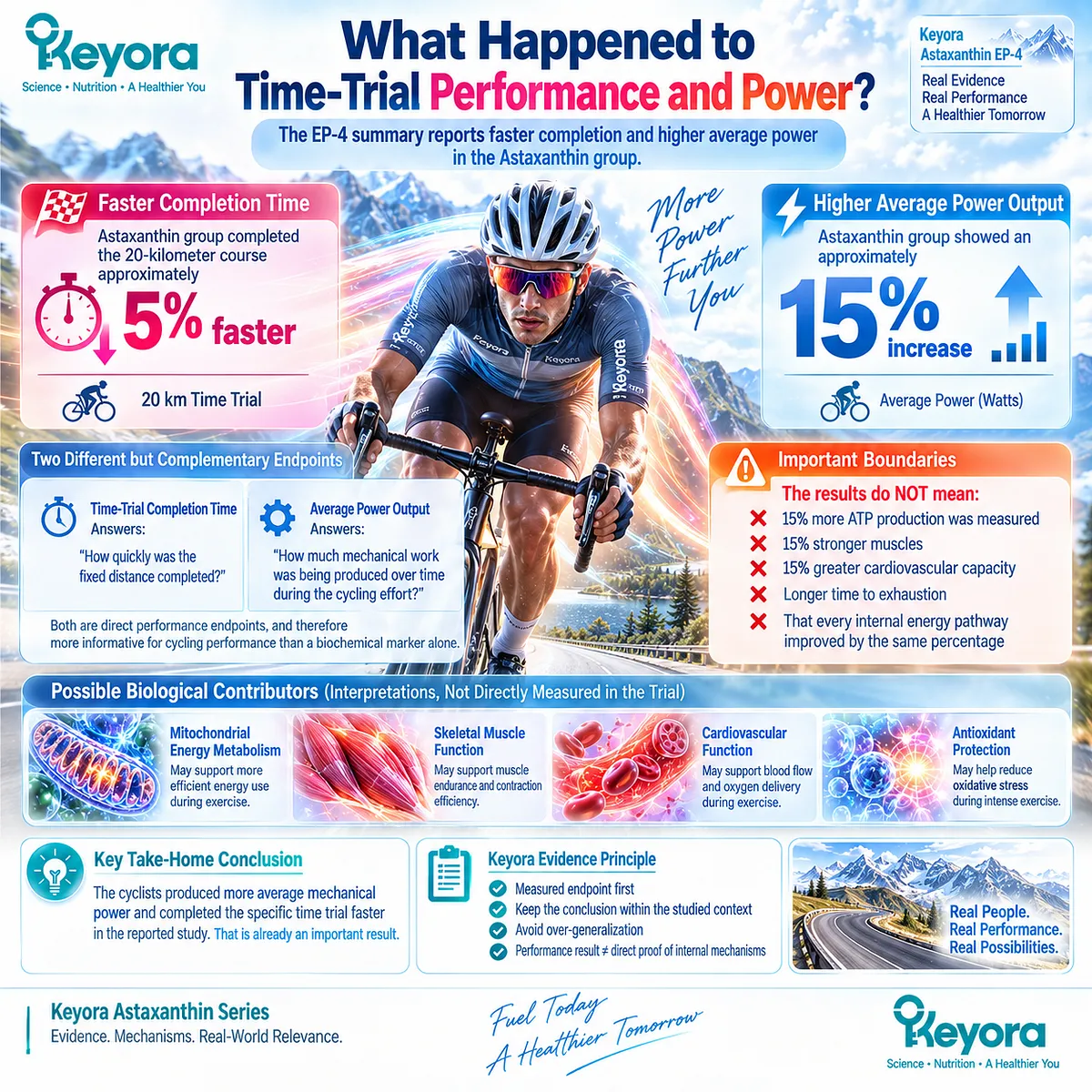
The EP-4 summary reports faster completion and higher average power in the Astaxanthin group
Two outcomes make the cyclist trial especially interesting.
The first was time.
Keyora Astaxanthin EP-4 reports that the Astaxanthin group completed the 20-kilometer course approximately 5% faster.
The second was average power output.
The EP-4 summary reports an approximately 15% increase in average power, measured in watts.
These two endpoints describe different aspects of performance.
Time-trial completion time answers:
How quickly was the fixed distance completed?
Average power answers:
How much mechanical work was being produced over time during the cycling effort?
Because both are direct performance endpoints, they are more informative for cycling performance than a biochemical marker alone.
But they should not be translated into unrelated physiological claims.
For example:
15% higher average cycling power does not mean 15% more ATP production was measured
It does not mean:
15% stronger muscles
and it does not mean:
15% greater cardiovascular capacity
Power output is a performance variable.
Its biological causes may involve multiple interacting systems.
The correct interpretation is therefore:
The cyclists produced more average mechanical power and completed the specific time trial faster in the reported study.
That is already an important result.
There is no scientific need to enlarge it into a claim that every internal energy pathway improved by the same percentage.
Similarly, a faster 20-kilometer time trial is related to endurance performance, but it should not automatically be converted into:
longer time to exhaustion
Those are different tests.
The measured outcome should remain the conclusion.
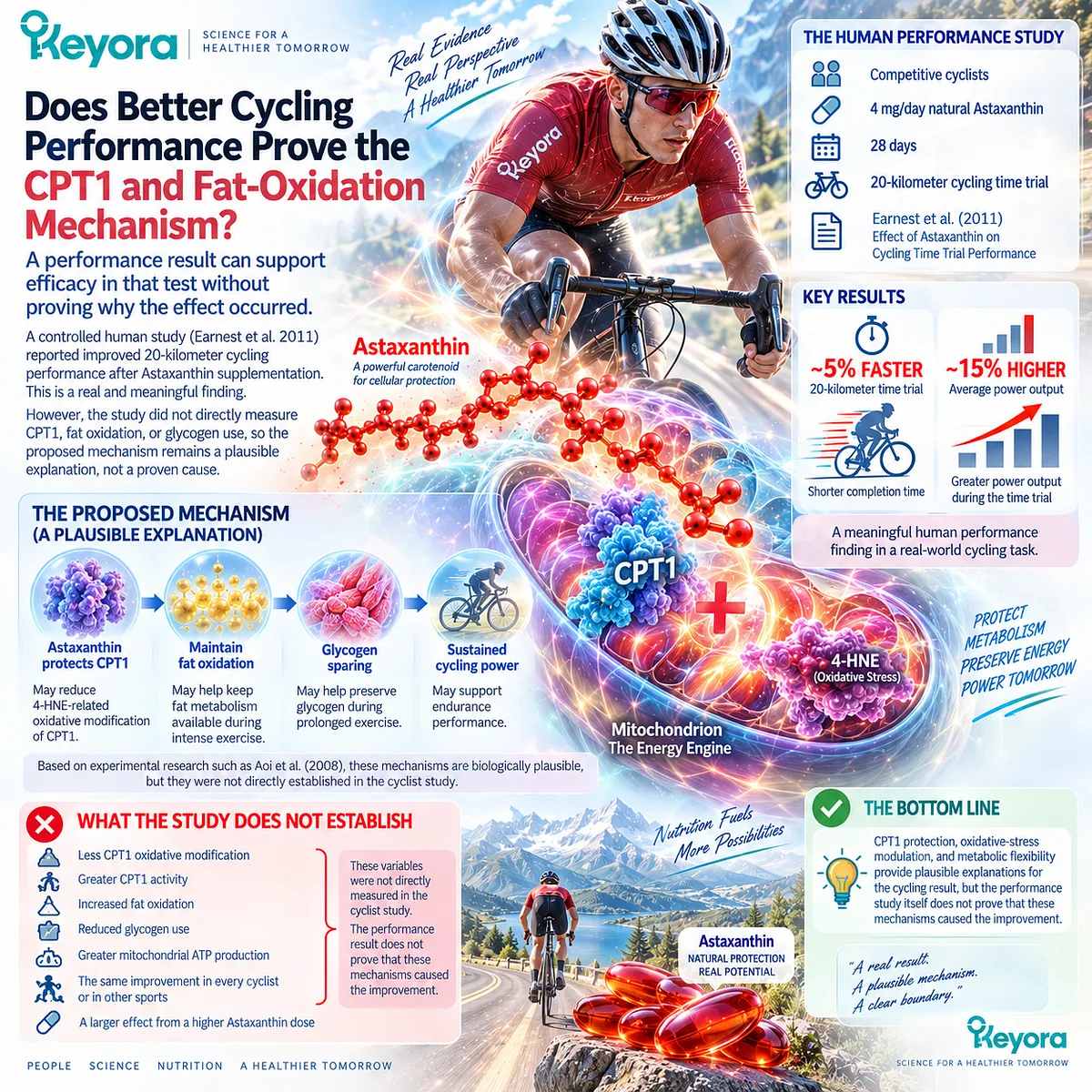
Does Better Cycling Performance Prove the CPT1 and Fat-Oxidation Mechanism?
A performance result can support efficacy in that test without proving why the effect occurred
Keyora Astaxanthin EP-4 proposes a specific metabolic explanation for the cyclist findings.
The article connects the result with:
CPT1 protection
→ reduced oxidative disruption
→ maintained fat oxidation
→ glycogen sparing
→ sustained cycling power
The article further describes Astaxanthin as protecting CPT1 from 4-HNE-related oxidative modification and allowing fat metabolism to remain available during intense exercise.
This mechanism is scientifically interesting because earlier experimental research, particularly Aoi et al. (2008), provides a biological basis for linking Astaxanthin with oxidative modification of CPT1 and exercise lipid metabolism.
But the two types of evidence should not be merged.
The Earnest cyclist study directly measured performance.
It does not automatically establish that the cyclists experienced:
-
less CPT1 oxidative modification
-
greater CPT1 activity
-
increased fat oxidation
-
reduced glycogen use
-
greater mitochondrial ATP production
unless those variables were directly measured in that trial.
This leads to an important Keyora evidence rule:
Measured performance should be separated from the proposed mechanism explaining that performance.
The performance result can be real even if the precise mechanism remains uncertain.
Likewise, a plausible mechanism can exist without being proven as the cause of the human effect.
This distinction matters because mechanistic explanations often sound more certain than the trial itself allows.
The scientifically stronger wording is:
CPT1 protection, oxidative-stress modulation, and metabolic flexibility provide plausible explanations for the cycling result, but the performance study itself does not prove that these mechanisms caused the improvement.
That preserves both sides of the evidence:
the human outcome remains meaningful,
while the biological explanation remains appropriately qualified.
Does a 4 mg Result Mean a Higher Dose Should Work Better?
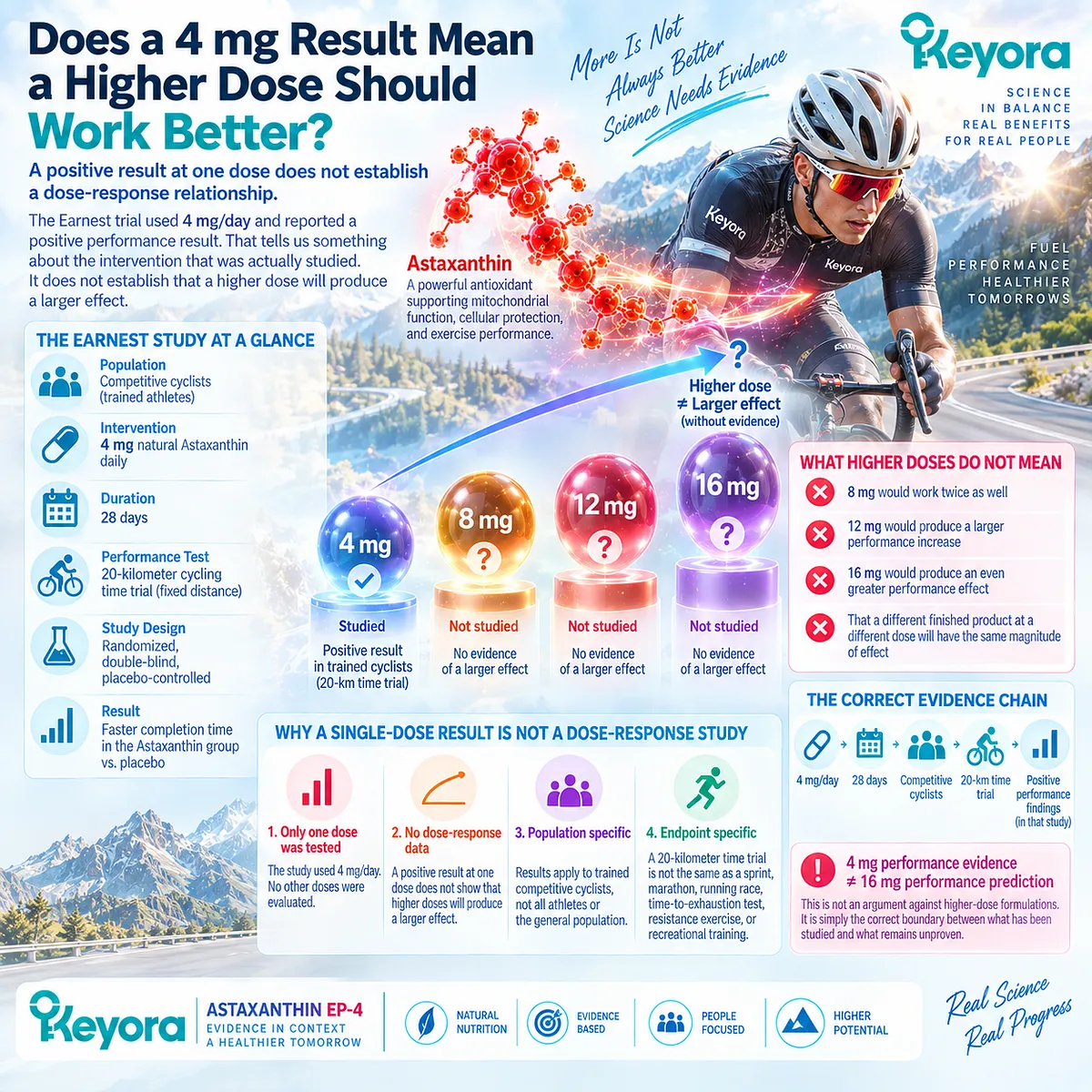
A positive result at one dose does not establish a dose-response relationship
No.
This is one of the most important interpretation boundaries in the entire cyclist evidence discussion.
The Earnest trial used:
4 mg/day
and reported a positive performance result.
That tells us something about the intervention that was actually studied.
It does not establish that:
8 mg would work twice as well
12 mg would produce a larger power increase
or:
16 mg would produce an even greater performance effect
A positive response at one dose is not the same as a dose-response study.
Keyora Astaxanthin EP-4 moves beyond this boundary when it asks readers to imagine the implications of a 16 mg protocol after discussing the 4 mg cyclist result.
That extrapolation should not be treated as clinical evidence.
The correct evidence chain is:
4 mg/day
→ 28 days
→ competitive cyclists
→ 20-kilometer time trial
→ positive performance findings in that study
The chain does not continue automatically to:
higher dose
→ larger performance gain
The same principle applies to finished products.
An ingredient study using 4 mg/day of Astaxanthin cannot, by itself, establish the magnitude of exercise-performance effects from a different finished formula at a different dose.
Dose, formulation, population, and endpoint all matter.
Therefore:
4 mg performance evidence ≠ 16 mg performance prediction
This is not an argument against higher-dose formulations.
It is simply the correct boundary between what has been studied and what remains unproven.
The Keyora Cycling Performance Evidence Rule: Keep the Result Attached to the Test
The strongest conclusion is improved performance in the specific cyclist trial, not a universal athletic-performance claim
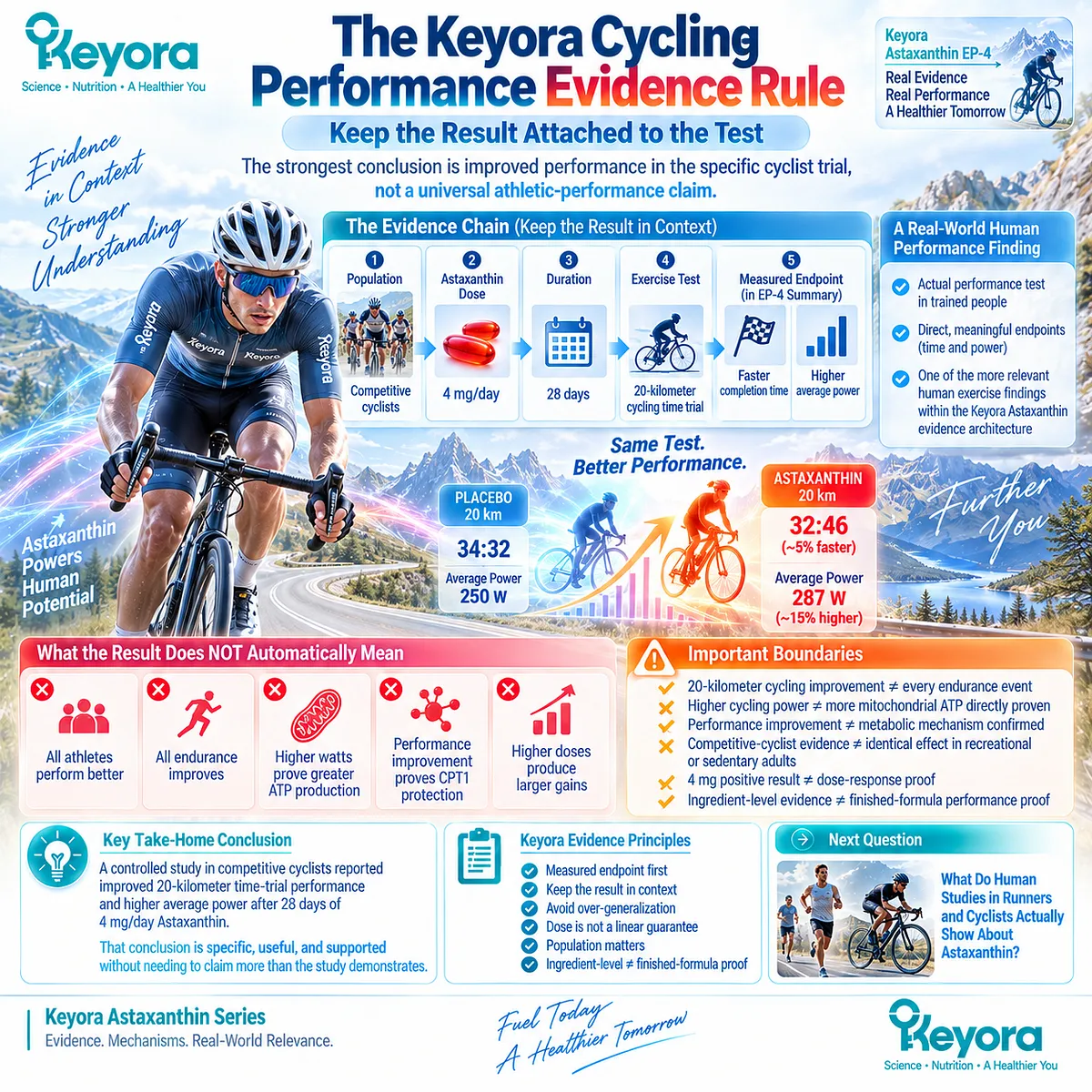
The Keyora Cycling Performance Evidence Rule keeps a human performance finding attached to the conditions under which it was observed:
population
→ dose
→ duration
→ exercise test
→ measured endpoint
For Earnest et al. (2011), the evidence chain is:
competitive cyclists
→ 4 mg/day Astaxanthin
→ 28 days
→ 20-kilometer cycling time trial
→ faster completion and higher average power in the EP-4 summary
That is the result that should be communicated.
The evidence should not automatically become:
all athletes perform better
all endurance improves
higher watts prove greater ATP production
performance improvement proves CPT1 protection
or:
higher Astaxanthin doses produce larger gains
The practical boundaries are:
-
20-kilometer cycling improvement ≠ every endurance event
-
Higher cycling power ≠ more mitochondrial ATP directly proven
-
Performance improvement ≠ metabolic mechanism confirmed
-
Competitive-cyclist evidence ≠ identical effect in recreational or sedentary adults
-
4 mg positive result ≠ dose-response proof
-
Ingredient-level evidence ≠ finished-formula performance proof
The human cycling evidence is still important.
Unlike an antioxidant assay or an animal mechanism, the Earnest trial examined actual performance in trained people.
That makes it one of the more directly relevant human exercise findings within the Keyora Astaxanthin evidence architecture.
But the scientific value of the result is strongest when it remains precise:
A controlled study in competitive cyclists reported improved 20-kilometer time-trial performance and higher average power after 28 days of 4 mg/day Astaxanthin.
That conclusion is specific, useful, and supported without needing to claim more than the study demonstrates.
The next question brings the major runner and cyclist trials together:
What Do Human Studies in Runners and Cyclists Actually Show About Astaxanthin?
This article is for educational and informational purposes only. It does not provide medical advice, diagnosis, treatment, cure, prevention, disease outcome claims, hormone restoration claims, fertility outcome claims, or formula-specific clinical efficacy claims.